REVIEW 2 major objections 2 minor 18 references
Exact solution of the Gaunt-modified Landau-Lifshitz equation in a plane wave
T0 review · 2 major / 2 minor · reviewed 2026-06-30 · grok-4.3
Pith's one-line read The Gaunt-modified Landau-Lifshitz equation admits an exact solution for electron motion in a plane electromagnetic wave.
desk verdict Exact integrable solution for the Gaunt-modified LL equation in plane waves, thanks to χ depending only on lightfront momentum. read the letter →
The pith
A machine-rendered reading of the paper's core claim, the machinery that carries it, and where it could break.
The reading
What carries the argument
The lightfront-momentum dependence of the quantum parameter χ, which preserves the integrable structure of the Gaunt-modified Landau-Lifshitz equation.
What would settle it
A calculation or measurement showing that χ acquires additional dependence on the particle trajectory or field structure beyond lightfront momentum would remove the integrability and invalidate the exact solution.
Extended reading notes
Core claim
In plane electromagnetic waves the quantum parameter χ depends solely on the lightfront momentum. This property allows the Landau-Lifshitz equation modified by a Gaunt factor to retain its integrable structure. Consequently exact solutions exist for the energy evolution and the four-velocity of the electron, reducing to the classical result when quantum effects are negligible. The results provide an analytical and deterministic description of semiclassical radiation reaction in plane-wave fields.
Load-bearing premise
The quantum parameter χ depends solely on the lightfront momentum in this geometry, allowing the modified equation of motion to retain the integrable structure of the classical problem.
Editorial extensions
If this is right
- Exact analytical expressions are obtained for the electron energy evolution and four-velocity.
- The solution recovers the known classical Landau-Lifshitz result in the appropriate limit.
- An analytical and deterministic description of semiclassical radiation reaction becomes available for plane-wave fields.
Reading between the lines
- The closed-form solution could be used to benchmark numerical codes that simulate quantum radiation reaction in strong laser fields.
- The same lightfront dependence may allow exact solutions in other modified equations of motion that share the plane-wave symmetry.
- The approach highlights how specific field geometries can keep quantum corrections tractable even when the classical problem is already integrable.
Signed reviews
Editorial analysis
A structured set of objections, weighed in public.
Referee Report
Summary. The paper analyzes electron dynamics in a plane electromagnetic wave using the Landau-Lifshitz equation modified by a Gaunt factor for quantum radiation reaction. It claims that in this geometry the quantum parameter χ depends only on the lightfront momentum, preserving the integrable structure of the classical problem, and derives an exact solution for the energy evolution and four-velocity that recovers the known classical result in the appropriate limit.
Significance. If the derivation is correct, the result supplies a rare exact analytical benchmark for semiclassical radiation reaction in plane-wave fields. This is valuable for validating numerical codes, testing the transition between classical and quantum regimes, and providing deterministic predictions without stochastic sampling. The explicit reduction to the classical limit is a clear strength.
major comments (2)
- [Section introducing the plane-wave field and χ (near the start of the derivation)] The central claim that χ depends solely on the lightfront momentum (k · p) and thereby preserves integrability rests on the algebraic structure of F_μν for a plane wave. The manuscript should explicitly display the step showing (F_μν p^ν)^2 ∝ (k · p)^2 |F(φ)|^2 independent of transverse momentum components, preferably in the section introducing the field tensor and the definition of χ.
- [Derivation of the exact solution (main results section)] The exact solution for the lightfront momentum evolution is stated to exist because the modified equation retains the same first-integral structure. The manuscript must show the explicit integration step (or the conserved quantity) that yields the closed-form expression for the energy evolution before substituting back to obtain the four-velocity.
minor comments (2)
- The abstract and introduction should include a brief reference to the specific form of the Gaunt factor G(χ) employed, with a citation to the original literature.
- Ensure consistent equation numbering and that the classical-limit verification (G(χ) → 1) is tied to a specific equation or limiting case rather than stated only qualitatively.
Simulated Author's Rebuttal
We thank the referee for the positive assessment and the recommendation of minor revision. The comments request additional explicit algebraic and integration steps, which we address by expanding the relevant sections in the revised manuscript.
read point-by-point responses
-
Referee: [Section introducing the plane-wave field and χ (near the start of the derivation)] The central claim that χ depends solely on the lightfront momentum (k · p) and thereby preserves integrability rests on the algebraic structure of F_μν for a plane wave. The manuscript should explicitly display the step showing (F_μν p^ν)^2 ∝ (k · p)^2 |F(φ)|^2 independent of transverse momentum components, preferably in the section introducing the field tensor and the definition of χ.
Authors: We agree that an explicit display of this step improves clarity. In the revised manuscript we insert, immediately after the definition of the plane-wave field tensor F_μν(φ) = k_μ a_ν(φ) − k_ν a_μ(φ), the contraction F_μν p^ν = (k·p) a_ν − (a·p) k_ν. Squaring then yields (F_μν p^ν)^2 = −(k·p)^2 |a(φ)|^2 (in the metric signature used), which is manifestly independent of the transverse components of p because k is null and the only non-vanishing contractions involve k·p. This step is placed before the definition of χ and confirms that χ is a function of k·p alone, preserving the integrability. revision: yes
-
Referee: [Derivation of the exact solution (main results section)] The exact solution for the lightfront momentum evolution is stated to exist because the modified equation retains the same first-integral structure. The manuscript must show the explicit integration step (or the conserved quantity) that yields the closed-form expression for the energy evolution before substituting back to obtain the four-velocity.
Authors: We accept the request for an explicit integration step. In the revised main-results section we now display the projection of the Gaunt-modified Landau-Lifshitz equation onto the light-front direction, identify the resulting first integral (the modified radiation-reaction term remains proportional to the same combination of k·p that appears classically), and perform the quadrature to obtain the closed-form expression for the light-front momentum p^−(φ). Only after this explicit integration do we substitute back to recover the transverse and longitudinal components of the four-velocity. The added paragraph makes the conserved structure and the integration transparent. revision: yes
Circularity Check
No significant circularity; derivation is self-contained from field geometry
full rationale
The paper's central step is showing that for a plane wave the quantum parameter χ is a function solely of the lightfront momentum (k·p) because (F_μν p^ν)^2 ∝ (k·p)^2 |F(φ)|^2 from the null rank-2 structure of F_μν. This is a direct algebraic consequence of the external field, not a fitted or self-defined quantity. The modified LL equation then inherits the same first integral as the classical case, permitting an exact solution for the lightfront momentum evolution that is substituted back to obtain the four-velocity. The classical limit is recovered by the explicit substitution G(χ)→1, which is a verification step rather than a prediction. No self-citation is load-bearing, no parameter is fitted to data and relabeled as a prediction, and no ansatz is smuggled via prior work. The derivation is therefore independent of its own outputs.
Assumptions & free parameters
assumptions (1)
- domain assumption The quantum parameter χ depends solely on the lightfront momentum in plane-wave geometry.
Cite this review
Pith. "Pith review of Exact solution of the Gaunt-modified Landau-Lifshitz equation in a plane wave." pith.science (2026). https://pith.science/paper/3WE74NPB
@misc{pith2026260605205,
  author       = {Pith},
  title        = {Pith review of: Exact solution of the Gaunt-modified Landau-Lifshitz equation in a plane wave},
  year         = {2026},
  howpublished = {\url{https://pith.science/paper/3WE74NPB}},
  note         = {Machine review of arXiv:2606.05205}
}
abstract
We analyze electron dynamics in a plane electromagnetic wave using the Landau-Lifshitz equation with a quantum radiation reaction correction modeled by a Gaunt factor. In this geometry, the quantum parameter $\chi$ depends solely on the lightfront momentum, allowing the modified equation of motion to retain the integrable structure of the classical problem. We derive an exact solution for the energy evolution and the four-velocity, which reduces to the known classical result in the appropriate limit. The results provide an analytical and deterministic description of semiclassical radiation reaction in plane-wave fields.
Figures

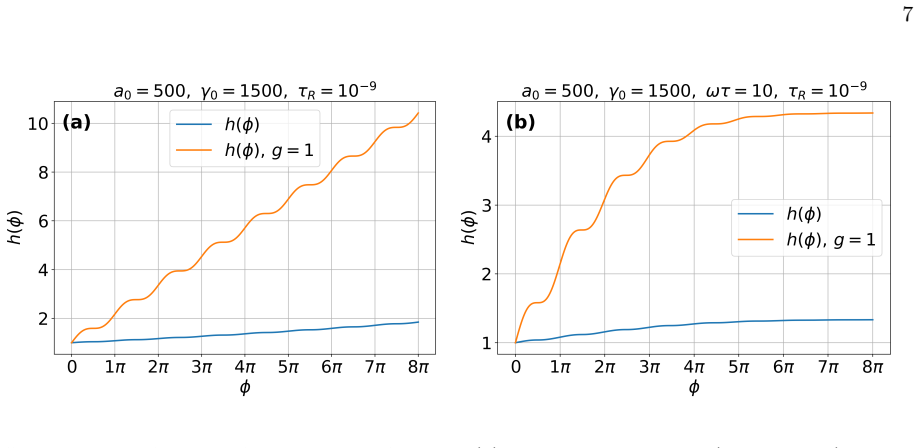

Figures from the paper (2 more)


Reference graph
Works this paper leans on
-
[1]
A. Di Piazza, C. M¨ uller, K. Z. Hatsagortsyan, and C. H. Keitel, Reviews of Modern Physics84, 1177 (2012)
work page 2012
- [2]
-
[3]
A. Gonoskov, T. G. Blackburn, M. Marklund, and S. S. Bulanov, Reviews of Modern Physics94, 045001 (2022). 15
work page 2022
-
[4]
A. A. Sokolov and I. M. Ternov,Radiation from Relativistic Electrons(American Institute of Physics, New York, 1986)
work page 1986
-
[5]
V. N. Baier, V. M. Katkov, and V. M. Strakhovenko,Electromagnetic Processes at High Energies in Oriented Single Crystals(World Scientific, Singapore, 1998)
work page 1998
-
[6]
Di Piazza, Letters in Mathematical Physics83, 305 (2008)
A. Di Piazza, Letters in Mathematical Physics83, 305 (2008)
work page 2008
-
[7]
V. I. Ritus, Journal of Soviet Laser Research6, 497 (1985)
work page 1985
-
[8]
A. R. Bell and J. G. Kirk, Physical Review Letters101, 200403 (2008)
work page 2008
Show all 18 references
-
[9]
N. V. Elkinaet al., Physical Review Special Topics - Accelerators and Beams14, 054401 (2011)
2011
-
[10]
C. P. Ridgers, J. G. Kirk, C. S. Brady, T. D. Arber, and A. R. Bell, Journal of Computational Physics 260, 273 (2014)
2014
-
[11]
S. V. Bulanovet al., Physics Letters A374, 1110 (2010)
2010
-
[12]
N. B. Narozhny and A. M. Fedotov, Contemporary Physics56, 249 (2015)
2015
-
[13]
A. M. Fedotov, Journal of Physics: Conference Series826, 012027 (2017)
2017
-
[14]
Nielet al., Physical Review E97, 043209 (2018)
F. Nielet al., Physical Review E97, 043209 (2018)
2018
-
[15]
T. G. Blackburn, Reviews of Modern Plasma Physics (2024)
2024
-
[16]
L. D. Landau and E. M. Lifshitz,The Classical Theory of Fields, 4th ed. (Pergamon Press, 1975)
1975
-
[17]
R. Z. Sagdeev and G. M. Zaslavsky,Nonlinear Physics: From Pendulum to Turbulence and Chaos (Harwood Academic Publishers, 1988)
1988
-
[18]
E. S. Sarachik and G. T. Schappert, Physical Review D1, 2738 (1970)
1970
Reviewed June 30, 2026 · model on record in the stance chip above.
Discussion (0). Continue with ORCID to comment.