REVIEW 6 major objections 6 minor 82 references
Constraining Axion-Like Particles from observations of AGN B2 2234+28A and 3C 454.3
T0 review · 6 major / 6 minor · reviewed 2026-08-12 · deepseek-v4-flash
Pith's one-line read The paper reports that axion-photon oscillation improves the fit to very-high-energy gamma-ray spectra of two distant blazars, giving couplings near 1e-11 GeV^-1 and masses near 5e-8 eV.
desk verdict The abstract's B2A best-fit is statistically unsupported — the paper's own upper-limit caveat undercuts it — but the CLs exclusion and source-selection heuristic are worth a look. read the letter →
The pith
A machine-rendered reading of the paper's core claim, the machinery that carries it, and where it could break.
The reading
What carries the argument
The central object is the photon–axion conversion probability computed under the cellular model of galactic magnetic fields, in which each galaxy is divided into cells of scale $r$ with equal field strength but random directions. The mixing is governed by the matrix entries $\Delta_{a\gamma}$, $\Delta_a$, and $\Delta_{pl}$, giving the per-cell probability $P_0=(\Delta_{a\gamma}r)^2\,\sin^2(\Delta_{\mathrm{osc}}r/2)/(\Delta_{\mathrm{osc}}r/2)^2$ and the total conversion probability $P_{\gamma\to a}=\frac{1}{3}(1-e^{-3P_0L/2r})$. The detected fraction of a source's flux is $P_{\gamma\to\gamma}=P^S_{\gamma\to a}P^G_{a\to\gamma}+(1-P^S_{\gamma\to\gamma})e^{-\tau_{\gamma\gamma}}$, where the first term is the axion-regeneration channel and $e^{-\tau_{\gamma\gamma}}$ is the EBL absorption. A source-selection criterion uses the critical energy for conversion and demands photon energies near 0.5 TeV from sources at redshift 0.6–0.8, where the ALP transmission gain exceeds a factor of ten.
What would settle it
Re-fit the B2A SED treating its last seven MAGIC points as upper limits in a censored likelihood instead of the ordinary chi-square, or re-fit either source with an independently measured kpc-scale magnetic field; if the best-fit $g_{a\gamma}$ leaves the quoted $1\sigma$ intervals, the reported values are artifacts of those assumptions.
Extended reading notes
Core claim
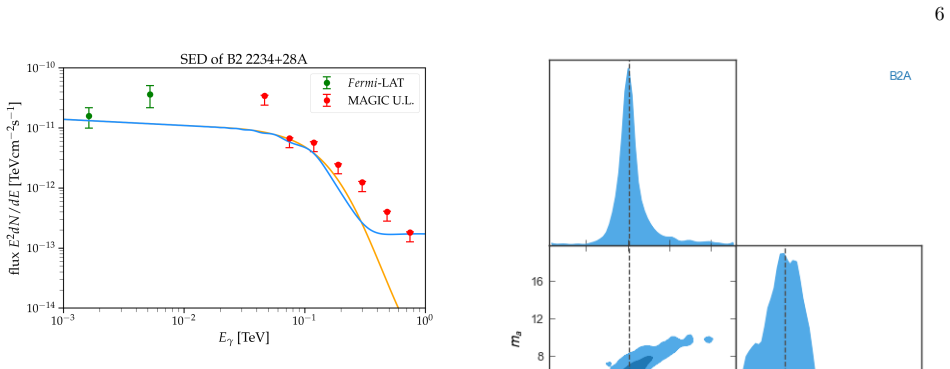
The paper's central claim is that the high-energy excess seen in the SEDs of B2 2234+28A and 3C 454.3 is naturally accounted for by axion-photon conversion, with both sources yielding ALP masses near $5\times10^{-8}$ eV and couplings of a few $10^{-11}$ GeV$^{-1}$. It further claims that the 95% confidence-level exclusion regions derived from these sources improve existing bounds in the small-mass part of the ALP parameter space. The paper presents the results as model-dependent constraints rather than a detection, and explicitly notes that the B2A result should be read as an upper threshold because its high-energy points are MAGIC upper limits.
Load-bearing premise
The load-bearing premise is that the last seven B2A spectral points can be fitted as ordinary measured fluxes even though they are only upper limits, and that the magnetic field in each source is 5 microgauss with 3-kiloparsec cells; if either is wrong, the fitted coupling shifts.
Editorial extensions
If this is right
- If the fits are right, ALP masses near $5\times10^{-8}$ eV and couplings of a few $10^{-11}$ GeV$^{-1}$ can explain why very-high-energy photons from $z\simeq0.8$ blazars reach Earth despite EBL absorption.
- The 95% CL exclusion regions from B2A and 3C4 extend existing bounds in the low-mass part of the ALP parameter space, where laboratory and other gamma-ray limits are weaker.
- The selection rule (redshift 0.6–0.8, photon energy near 0.5 TeV) gives a concrete recipe for choosing additional AGN targets for ALP searches.
- For 3C4, the ALP enhancement dominates the high-energy SED so strongly that the intrinsic cutoff energy $E_c$ is poorly constrained; more VHE detections would separate the two effects.
- For B2A, the quoted coupling should be read as an upper threshold because the high-energy data are upper limits; actual detections would turn it into a two-sided measurement.
Reading between the lines
- Going beyond the paper: because the conversion probability scales roughly as $(g_{a\gamma}B_T)^2$, a direct measurement of the kpc-scale magnetic field in either source would rescale the fitted couplings; for a $1\,\mu\mathrm{G}$ field instead of $5\,\mu\mathrm{G}$, the implied coupling would be roughly five times larger.
- Going beyond the paper: treating the seven B2A upper limits with a censored likelihood rather than ordinary flux points would test whether the quoted best-fit $g_{a\gamma}$ survives; the paper itself says the result can only serve as an upper threshold.
- Going beyond the paper: the same redshift–energy selection rule could be applied to a population of Fermi-LAT flat-spectrum radio quasars to build a stacked ALP constraint that averages over unknown source magnetic fields.
- Going beyond the paper: if the ALP interpretation is correct, the predicted axion regeneration in the Milky Way should imprint a characteristic energy-dependent hardening that could be searched for in the spectra of all $z>0.6$ blazars under a single magnetic-field model.
Signed reviews
Editorial analysis
A structured set of objections, weighed in public.
Referee Report
Summary. The manuscript proposes a model-dependent source-selection criterion based on the ALP-photon conversion critical energy and a redshift-energy window, and applies it to two flat-spectrum radio quasars, B2 2234+28A and 3C 454.3, using Fermi-LAT and MAGIC data. The authors perform Markov Chain Monte Carlo fits with a power-law-with-exponential-cutoff intrinsic spectrum and a cellular magnetic-field model, reporting best-fit ALP parameters gaγ = 3.05+0.51-0.31 × 10^-11 GeV^-1 and ma = 5.25+2.35-2.65 × 10^-8 eV for B2A, and gaγ = 7.40+2.65-2.74 × 10^-11 GeV^-1 and ma = 5.50+1.69-2.17 × 10^-8 eV for 3C 454.3, together with a CLs exclusion region. The central claim is that the ALP scenario provides a better description of the observed high-energy spectral energy distributions than the no-ALP null hypothesis.
Significance. The paper introduces a useful idea: selecting high-redshift AGNs in a specific redshift-energy window to maximize sensitivity to ALP-photon oscillations. The authors use publicly available Fermi-LAT and MAGIC data, provide a clear description of the propagation model, and explicitly compare their CLs exclusion region with CAST, HESS, and Fermi limits. The MCMC machinery and the CLs scan are standard and reproducible in principle. If the statistical treatment of upper limits and the magnetic-field systematics were corrected, the method could contribute meaningful constraints in the small-mass ALP parameter space. The authors' explicit admission in Section V.A that the B2A result is only an upper threshold is a candid limitation, but it is not reflected in the abstract.
major comments (6)
- [V.A and Eq. (16)] The last seven B2A SED points are upper limits, as stated in Section V.A, but Eq. (16) enters all points as symmetric Gaussian measurements. A model prediction below an upper limit is statistically consistent, yet the chi-square term penalizes it; entering the nominal upper-limit value as a central value biases the fit and the quoted gaγ. The paper itself concedes that the B2A result can only serve as an upper threshold, so the abstract's report of gaγ = 3.05+0.51-0.31 × 10^-11 GeV^-1 as a fit result is not supported. The fit should be redone with a censored likelihood or one-sided terms, and the B2A results should be presented only as upper limits.
- [V.B and Table I] The best-fit couplings for the two sources, gaγ = 3.05 × 10^-11 GeV^-1 and 7.40 × 10^-11 GeV^-1, do not agree within their quoted 68% intervals. Since ALP parameters are universal, two independent measurements should be consistent; the paper's statement that the difference 'may arise from our assumptions regarding the magnetic field' is not quantified. A joint fit or an explicit treatment of source-by-source systematics is needed before the results can be interpreted as constraints on a single ALP.
- [V.B and V.C] The 3C 454.3 best-fit gaγ = 7.40 × 10^-11 GeV^-1 lies above the CAST limit gaγ < 6.6 × 10^-11 GeV^-1 quoted later in the paper, yet the paper does not discuss this tension. A best-fit value in a region excluded by a laboratory experiment requires explanation; at minimum, the 3C 454.3 result should be reported as an upper limit with the CAST constraint overlaid.
- [III.A-B] The conversion probability depends sensitively on the assumed magnetic field, with Pγ→a ~ (gaγ BT)^2 in the small-mixing regime, but BT = 5 μG, r = 3 kpc, and L = 10r are set by hand without source-specific data. The MCMC uncertainties therefore include only statistical errors and not the dominant systematic uncertainty from the magnetic-field model. The authors should provide a systematic error budget or scan over plausible BT, r, and L values.
- [IV.B] The CLs procedure uses a threshold of χ²/d.o.f > 2.7 for 95% CL, but the justification is not given. For two fitted parameters, the 95% confidence region is usually defined by Δχ² = 5.99 relative to the minimum; the 'half-χ² distribution' in Eq. (18) is nonstandard and needs a derivation or a proper citation. Without this, the exclusion region in Fig. 10 may be incorrect.
- [V.A and Table I] The reduced chi-square for B2A is 3.38, which indicates a poor fit even with the ALP contribution. The paper does not report the null-hypothesis chi-square or a likelihood-ratio statistic, so the claim that the ALP scenario fits the high-energy data 'better' is not quantitatively supported.
minor comments (6)
- [III.B] The selection interval is z ∈ [0.6, 0.8], but 3C 454.3 has z = 0.859; the paper should explain why this source is included outside the stated interval.
- [Table I] Uncertainties are given in the text but not in the table; include the 68% intervals for all fitted parameters.
- [V.C and Fig. 10] Figure 10 caption and text disagree on which line corresponds to which source (B2A vs 3C 454.3); please check and make consistent.
- [Throughout] There are numerous typos, including 'sectioin' (Section III.A), 'threotical' (Section III.A), 'F ermi-LAT' (multiple), 'souce's' (Section II.C), '3C 354.3' (Section V.C), and 'confidential level' (Section IV.A).
- [IV.A] The notation L = lp - χ²/2 in Eq. (17) should be defined; if lp is the log-prior, this is the log-posterior, but the text calls it the likelihood.
- [II.C] The sentence about not incorporating the term for unabsorbed photons converting to ALP before reception is unclear; 'reception area' should be 'Milky Way', and the statement that B_G = 0.5 μG is 'much less significant' should be quantified.
Circularity Check
No significant circularity: the fitted gaγ and ma values are outputs of an MCMC fit to external Fermi-LAT/MAGIC data, and no fitted quantity is recycled as an input.
full rationale
The derivation chain is a forward model: the propagation probability in Eqs. (11)-(14) is evaluated at trial values of (gaγ, ma), and the MCMC likelihood in Eq. (16) compares the resulting SED with external Fermi-LAT and MAGIC fluxes. The best-fit values reported in Section V are outputs of that fit, not inputs. Eq. (15) and the reference point (gaγ = 2e-11 GeV^-1, ma = 1e-8 eV) are used only to select a redshift and energy window; they do not fix the fitted ALP parameters. The paper's self-citation [41] supplies a critical-energy estimate and a remark about M87, but the same formula is also attributed to the external reference [62], and it is not a uniqueness argument or an output-forcing input. The statement in Section V.A that the last seven B2A points are upper limits and that the B2A result can only serve as an upper threshold raises a legitimate statistical concern about how Eq. (16) treats those points, but treating an upper limit as a measurement is a data-treatment issue, not a circular reduction of the kind required by the hard rules. No equation in the paper reduces to its own input, and no load-bearing prediction is equivalent by construction to fitted data.
Assumptions & free parameters
free parameters (7)
- gaγ (ALP-photon coupling) =
3.05+0.51-0.31 x 10^-11 GeV^-1 (B2A); 7.40+2.65-2.74 x 10^-11 GeV^-1 (3C4)
- ma (ALP mass) =
5.25+2.35-2.65 x 10^-8 eV (B2A); 5.50+1.69-2.17 x 10^-8 eV (3C4)
- phi0 (PLC normalization) =
6.08 x 10^-12 TeV cm^-2 s^-1 (B2A); 1.49 x 10^-9 TeV cm^-2 s^-1 (3C4)
- alpha (PLC photon index) =
2.13 (B2A); 2.34 (3C4)
- Ec (PLC cutoff energy) =
47 TeV (B2A); 46 TeV (3C4)
- BT (source transverse magnetic field) =
5 μG (assumed)
- r, L (cellular model scales) =
r = 3 kpc, L = 10r
assumptions (8)
- standard math Standard ALP-photon mixing dynamics in a magnetic field (Raffelt-Stodolsky equations, Eqs. 2-11)
- domain assumption Cellular model for galactic magnetic fields: equal field strength, random direction per cell
- ad hoc to paper Source and Milky Way magnetic field parameters BT = 5 μG, r = 3 kpc, L = 10r
- domain assumption Extragalactic background light attenuation model of Finke et al. 2022
- domain assumption Intrinsic source spectrum is a power law with exponential cutoff (PLC)
- domain assumption Neglect of intergalactic magnetic field conversion; only source and Milky Way conversion are included
- standard math Neglect of Faraday rotation and Cotton-Mouton effect for VHE photons
- domain assumption MCMC likelihood with flat priors and symmetric chi-square for all data points including upper limits
Cite this review
Pith. "Pith review of Constraining Axion-Like Particles from observations of AGN B2 2234+28A and 3C 454.3." pith.science (2026). https://pith.science/paper/3YBEOZJX
@misc{pith2026241108577,
  author       = {Pith},
  title        = {Pith review of: Constraining Axion-Like Particles from observations of AGN B2 2234+28A and 3C 454.3},
  year         = {2026},
  howpublished = {\url{https://pith.science/paper/3YBEOZJX}},
  note         = {Machine review of arXiv:2411.08577}
}
abstract
Axion-photon oscillation effect provides a possible explanation for the presence of very-high-energy (VHE) $\gamma$-ray signals from distant sources. In this work, we propose a model-dependent method to select possible sources that may give sufficient constraints on the axion parameters. We investigate such effect in the spectra of active galactic nuclei (AGN) B2 2234+28A and 3C 454.3 based on data obtained from Fermi Large Area Telescope (Fermi-LAT) and MAGIC U.L. We utilize the Markov Chain Monte Carlo method to fit the axion parameters, yielding a result of $g_{a\gamma}=3.05^{+0.51}_{-0.31} \times 10^{-11}$ GeV$^{-1}$ for the axion-photon coupling strength and $m_{a}=5.25^{+2.35}_{-2.65} \times 10^{-8} $ eV for the axion mass. We also perform 95\% confidence level (CL) constraints to set an upper limit for $g_{a\gamma}$.
Figures


Figures from the paper (4 more)


Reference graph
Works this paper leans on
-
[1]
Cp conser- vation in the presence of pseudoparticles
Roberto D Peccei and Helen R Quinn. Cp conser- vation in the presence of pseudoparticles. Physical Review Letters, 38(25):1440, 1977
1977
-
[2]
A new light boson? Physical Re- view Letters, 40(4):223, 1978
Steven Weinberg. A new light boson? Physical Re- view Letters, 40(4):223, 1978
1978
-
[3]
F. Wilczek. Problem of strong p and t invariance in the presence of instantons. Phys. Rev. Lett., 40:279– 282, Jan 1978
work page 1978
-
[4]
The µ-problem and the strong cp-problem
Jihn E Kim and Hans Peter Nilles. The µ-problem and the strong cp-problem. Physics Letters B, 138(1- 3):150–154, 1984
work page 1984
-
[5]
The strong cp problem revisited
Hai-Yang Cheng. The strong cp problem revisited. Physics Reports, 158(1):1–89, 1988
work page 1988
-
[6]
Axions and the strong cp problem
Jihn E Kim and Gianpaolo Carosi. Axions and the strong cp problem. Reviews of Modern Physics , 82(1):557–601, 2010
work page 2010
-
[7]
Peter Svrcek and Edward Witten. Axions in string theory. Journal of High Energy Physics , 2006(06):051, 2006
work page 2006
-
[8]
The Low- Energy Frontier of Particle Physics
Joerg Jaeckel and Andreas Ringwald. The Low- Energy Frontier of Particle Physics. Ann. Rev. Nucl. Part. Sci. , 60:405–437, 2010
work page 2010
Show all 82 references
-
[9]
Cos- mology of the invisible axion
John Preskill, Mark B Wise, and Frank Wilczek. Cos- mology of the invisible axion. Physics Letters B , 120(1-3):127–132, 1983
1983
-
[10]
The not-so- harmless axion
Michael Dine and Willy Fischler. The not-so- harmless axion. Physics Letters B, 120(1-3):137–141, 1983
1983
-
[11]
A cosmologi- cal bound on the invisible axion
Laurence F Abbott and Pierre Sikivie. A cosmologi- cal bound on the invisible axion. Physics Letters B , 120(1-3):133–136, 1983
1983
-
[12]
Axions as dark matter particles
Leanne D Duffy and Karl Van Bibber. Axions as dark matter particles. New Journal of Physics , 11(10):105008, 2009
2009
-
[13]
Mixing of the photon with low-mass particles
Georg Raffelt and Leo Stodolsky. Mixing of the photon with low-mass particles. Physical Review D , 37(5):1237, 1988
1988
-
[14]
Opening the axion window
David B Kaplan. Opening the axion window. Nuclear Physics B , 260(1):215–226, 1985
1985
-
[15]
P. Sikivie. Experimental tests of the ”invisible” ax- ion. Phys. Rev. Lett. , 51:1415–1417, Oct 1983
1983
-
[16]
Exper- imental searches for the axion and axion-like parti- cles
Peter W Graham, Igor G Irastorza, Steven K Lam- oreaux, Axel Lindner, and Karl A van Bibber. Exper- imental searches for the axion and axion-like parti- cles. Annual Review of Nuclear and Particle Science , 65(1):485–514, 2015
2015
-
[17]
Windows on the axion
Michael S Turner. Windows on the axion. Physics Reports, 197(2):67–97, 1990
1990
-
[18]
A decommissioned lhc model magnet as an axion telescope
Konstantinos Zioutas, CE Aalseth, D Abriola, FT Avignone Iii, RL Brodzinski, JI Collar, R Creswick, DE Di Gregorio, H Farach, AO Gat- tone, et al. A decommissioned lhc model magnet as an axion telescope. Nuclear Instruments and Methods in Physics Research Section A: Accelerato...
1999
-
[19]
Results from the osqar photon- 9 regeneration experiment: No light shining through a wall
Pierre Pugnat, Lionel Duvillaret, Remy Jost, Guy Vitrant, Daniele Romanini, Andrzej Siemko, Rafik Ballou, Bernard Barbara, Michael Finger, Miroslav Finger, et al. Results from the osqar photon- 9 regeneration experiment: No light shining through a wall. Physical Review D—Parti...
2008
-
[20]
New exclusion limits on scalar and pseudoscalar axionlike particles from light shining through a wall
R Ballou, G Deferne, M Finger Jr, M Fin- ger, L Flekova, J Hosek, S Kunc, K Macuchova, KA Meissner, P Pugnat, et al. New exclusion limits on scalar and pseudoscalar axionlike particles from light shining through a wall. Physical Review D , 92(9):092002, 2015
2015
-
[21]
Zavattini et al
E. Zavattini et al. Experimental observation of op- tical rotation generated in vacuum by a magnetic field. Phys. Rev. Lett. , 96:110406, 2006. [Erratum: Phys.Rev.Lett. 99, 129901 (2007)]
2007
-
[22]
Bregant et al
M. Bregant et al. Limits on Low Energy Photon- Photon Scattering from an Experiment on Magnetic Vacuum Birefringence. Phys. Rev. D , 78:032006, 2008
2008
-
[23]
Modeling the extragalactic background light from stars and dust
Justin D Finke, Soebur Razzaque, and Charles D Dermer. Modeling the extragalactic background light from stars and dust. The Astrophysical Journal , 712(1):238, 2010
2010
-
[24]
Semi-analytic mod- elling of the extragalactic background light and consequences for extragalactic gamma-ray spectra
Rudy C Gilmore, Rachel S Somerville, Joel R Pri- mack, and Alberto Dom ´ ınguez. Semi-analytic mod- elling of the extragalactic background light and consequences for extragalactic gamma-ray spectra. Monthly Notices of the Royal Astronomical Society , 422(4):3189–3207, 2012
2012
-
[25]
The extragalactic background light and the gamma-ray opacity of the universe
Eli Dwek and Frank Krennrich. The extragalactic background light and the gamma-ray opacity of the universe. Astroparticle Physics, 43:112–133, 2013
2013
-
[26]
Cosmic gamma rays , volume
Floyd William Stecker. Cosmic gamma rays , volume
-
[27]
Implications of cosmological gamma- ray absorption-ii
Tanja M Kneiske, T Bretz, K Mannheim, and DH Hartmann. Implications of cosmological gamma- ray absorption-ii. modification of gamma-ray spectra. Astronomy & Astrophysics , 413(3):807–815, 2004
2004
-
[28]
Evidence for a new light spin-zero boson from cosmological gamma-ray propagation? Physical Review D—Particles, Fields, Gravitation, and Cosmology, 76(12):121301, 2007
Alessandro De Angelis, Marco Roncadelli, and Ori- ana Mansutti. Evidence for a new light spin-zero boson from cosmological gamma-ray propagation? Physical Review D—Particles, Fields, Gravitation, and Cosmology, 76(12):121301, 2007
2007
-
[29]
Detecting ax- ionlike particles with gamma ray telescopes
Dan Hooper and Pasquale D Serpico. Detecting ax- ionlike particles with gamma ray telescopes. Physical Review Letters, 99(23):231102, 2007
2007
-
[30]
Hints of the existence of axionlike particles from the gamma-ray spectra of cosmologi- cal sources
MA S´ anchez-Conde, D Paneque, E Bloom, F Prada, and A Dominguez. Hints of the existence of axionlike particles from the gamma-ray spectra of cosmologi- cal sources. Physical Review D—Particles, Fields, Gravitation, and Cosmology , 79(12):123511, 2009
2009
-
[31]
Axion-like particles, cosmic magnetic fields and gamma-ray astrophysics
Alessandro De Angelis, Oriana Mansutti, and Marco Roncadelli. Axion-like particles, cosmic magnetic fields and gamma-ray astrophysics. Physics Letters B, 659(5):847–855, 2008
2008
-
[32]
Ser- pico
Melanie Simet, Dan Hooper, and Pasquale D. Ser- pico. Milky way as a kiloparsec-scale axionscope. Phys. Rev. D , 77:063001, Mar 2008
2008
-
[33]
On detecting oscillations of gamma rays into axion-like particles in turbulent and coherent mag- netic fields
Manuel Meyer, Daniele Montanino, and Jan Con- rad. On detecting oscillations of gamma rays into axion-like particles in turbulent and coherent mag- netic fields. Journal of Cosmology and Astroparticle Physics, 2014(09):003, sep 2014
2014
-
[34]
Very high-energy gamma- ray emission beyond 10 tev from grb 221009a.Science Advances, 9(46):eadj2778, 2023
LHAASO collaboration. Very high-energy gamma- ray emission beyond 10 tev from grb 221009a.Science Advances, 9(46):eadj2778, 2023
2023
-
[35]
Constraints on axion-like particles from the observation of GRB 221009A by LHAASO
Lin-Qing Gao, Xiao-Jun Bi, Jun Li, Run-Min Yao, and Peng-Fei Yin. Constraints on axion-like particles from the observation of GRB 221009A by LHAASO. JCAP, 01:026, 2024
2024
-
[36]
Axion and dark photon limits from crab nebula high-energy gamma rays
Xiaojun Bi, Yu Gao, Junguang Guo, Nick Houston, Tianjun Li, Fangzhou Xu, and Xin Zhang. Axion and dark photon limits from crab nebula high-energy gamma rays. Physical Review D , 103(4):043018, 2021
2021
-
[37]
Limits on axionlike par- ticles from mrk 421 with 4.5-year period observa- tions by argo-ybj and fermi-lat
Hai-Jun Li, Jun-Guang Guo, Xiao-Jun Bi, Su-Jie Lin, and Peng-Fei Yin. Limits on axionlike par- ticles from mrk 421 with 4.5-year period observa- tions by argo-ybj and fermi-lat. Physical Review D , 103(8):083003, 2021
2021
-
[38]
Search- ing for axion-like particles with the blazar observa- tions of magic and fermi-lat
Hai-Jun Li, Xiao-Jun Bi, and Peng-Fei Yin. Search- ing for axion-like particles with the blazar observa- tions of magic and fermi-lat. Chinese Physics C , 46(8):085105, 2022
2022
-
[39]
Con- straints on axion-like particles from the observation of galactic sources by the lhaaso
Jun Li, Xiao-Jun Bi, Lin-Qing Gao, Xiaoyuan Huang, Run-Min Yao, and Peng-Fei Yin. Con- straints on axion-like particles from the observation of galactic sources by the lhaaso. Chinese Physics C , 48(6):065107, 2024
2024
-
[40]
Upper limit on the axion-photon coupling from Markarian
Hai-Jun Li, Wei Chao, and Yu-Feng Zhou. Upper limit on the axion-photon coupling from Markarian
-
[41]
Probing µ ev alps with future lhaaso ob- servations of agn γ-ray spectra
Guangbo Long, Siyu Chen, Shuo Xu, and Hong-Hao Zhang. Probing µ ev alps with future lhaaso ob- servations of agn γ-ray spectra. Physical Review D , 104(8):083014, 2021
2021
-
[42]
Observation of gamma-ray emission from the galaxy m87 above 250 gev with veritas
V A Acciari, M Beilicke, G Blaylock, SM Bradbury, JH Buckley, V Bugaev, Y Butt, O Celik, A Cesarini, L Ciupik, et al. Observation of gamma-ray emission from the galaxy m87 above 250 gev with veritas. The Astrophysical Journal, 679(1):397, 2008
2008
-
[43]
A. A. Abdo, M. Ackermann, M. Ajello, W. B. At- wood, M. Axelsson, L. Baldini, J. Ballet, G. Bar- biellini, D. Bastieri, K. Bechtol, R. Bellazzini, B. Berenji, R. D. Blandford, E. D. Bloom, Bona- mente, and Others. Fermi large area telescope gamma-ray detection of the radio gal...
2009
-
[44]
Production of tev gamma radiation in the vicinity of the super- massive black hole in the giant radio galaxy m87.The Astrophysical Journal, 671(1):85, 2007
Andrii Neronov and Felix A Aharonian. Production of tev gamma radiation in the vicinity of the super- massive black hole in the giant radio galaxy m87.The Astrophysical Journal, 671(1):85, 2007
2007
-
[45]
Constraints on vhe gamma-ray emission of flat spectrum radio quasars with the magic telescopes
MAGIC Collaboration et al. Constraints on vhe gamma-ray emission of flat spectrum radio quasars with the magic telescopes. arXiv preprint arXiv:2403.13713, 2024
2024
-
[46]
A. A. Abdo, Markus Ackermann, Marco Ajello, WB Atwood, Magnus Axelsson, Luca Baldini, Jean Ballet, Guido Barbiellini, Denis Bastieri, M Bat- telino, et al. Early fermi gamma-ray space telescope observations of the quasar 3c 454.3. The Astrophys- ical Journal, 699(1):817, 2009
2009
-
[47]
The first fermi-lat catalog of sources above 10 gev
Markus Ackermann, Marco Ajello, A Allafort, WB Atwood, Luca Baldini, Jean Ballet, Guido Bar- biellini, Denis Bastieri, K Bechtol, Aea Belfiore, et al. The first fermi-lat catalog of sources above 10 gev. The Astrophysical Journal Supplement Series , 209(2):34, 2013. 10
2013
-
[48]
Fermi-lat observations of high-energy γ-ray emission toward the galactic center
M Ajello, Andrea Albert, WB Atwood, G Barbi- ellini, Denis Bastieri, K Bechtol, Ronaldo Bellazz- ini, E Bissaldi, RD Blandford, ED Bloom, et al. Fermi-lat observations of high-energy γ-ray emission toward the galactic center. The Astrophysical Jour- nal, 819(1):44, 2016
2016
-
[49]
Modelling the broad-band emission of 3c 454.3
N Sahakyan. Modelling the broad-band emission of 3c 454.3. Monthly Notices of the Royal Astronomical Society, 504(4):5074–5086, 2021
2021
-
[50]
Observation of gamma rays from the galactic center with the magic telescope
J Albert, E Aliu, H Anderhub, P Antoranz, A Ar- mada, M Asensio, C Baixeras, JA Barrio, M Bartelt, H Bartko, et al. Observation of gamma rays from the galactic center with the magic telescope. The Astrophysical Journal, 638(2):L101, 2006
2006
-
[51]
The major upgrade of the magic telescopes, part ii: A performance study using observations of the crab nebula
Jelena Aleksi´ c, Stefano Ansoldi, Lucio Angelo An- tonelli, P Antoranz, A Babic, P Bangale, M Barcel´ o, JA Barrio, J Becerra Gonz´ alez, W Bednarek, et al. The major upgrade of the magic telescopes, part ii: A performance study using observations of the crab nebula. Astropar...
2016
-
[52]
Photon-axion conversion in intergalactic magnetic fields and cosmological consequences
Alessandro Mirizzi, Georg G Raffelt1, and Pasquale D Serpico. Photon-axion conversion in intergalactic magnetic fields and cosmological consequences. In Axions: Theory, Cosmology, and Experimental Searches , pages 115–134. Springer, 2008
2008
-
[53]
The cotton-mouton effect in gases: experiment and theory
Carlo Rizzo, Antonio Rizzo, and David M Bishop. The cotton-mouton effect in gases: experiment and theory. International Reviews in Physical Chemistry , 16(1):81–111, 1997
1997
-
[54]
On the cmb circular polarization: I
Damian Ejlli. On the cmb circular polarization: I. the cotton–mouton effect. The European Physical Jour- nal C , 79(3):1–27, 2019
2019
-
[55]
Effects of axion-photon mixing on gamma-ray spectra from magnetized astrophysical sources
Kathrin A Hochmuth and G¨ unter Sigl. Effects of axion-photon mixing on gamma-ray spectra from magnetized astrophysical sources. Physical Review D—Particles, Fields, Gravitation, and Cosmology , 76(12):123011, 2007
2007
-
[56]
Axion-photon conversion of grb221009a
Luohan Wang and Bo-Qiang Ma. Axion-photon conversion of grb221009a. Physical Review D , 108(2):023002, 2023
2023
-
[57]
Ef- fects of initial axion production and photon–axion oscillation on type ia supernova dimming
Yuval Grossman, Sourov Roy, and Jure Zupan. Ef- fects of initial axion production and photon–axion oscillation on type ia supernova dimming. Physics Letters B, 543(1-2):23–28, 2002
2002
-
[58]
Modeling the extragalactic background light and the cosmic star formation history
Justin D Finke, Marco Ajello, Alberto Dom ´ ınguez, Abhishek Desai, Dieter H Hartmann, Vaidehi S Paliya, and Alberto Saldana-Lopez. Modeling the extragalactic background light and the cosmic star formation history. The Astrophysical Journal , 941(1):33, 2022
2022
-
[59]
Measurement of the extragalactic background light imprint on the spectra of the brightest blazars observed with hess
A Abramowski, Fabio Acero, F Aharonian, AG Akh- perjanian, G Anton, S Balenderan, Agn` es Balzer, Anna Barnacka, Yvonne Becherini, J Becker Tjus, et al. Measurement of the extragalactic background light imprint on the spectra of the brightest blazars observed with hess. Astron...
2013
-
[60]
Long-term spectra of the blazars mrk 421 and mrk 501 at tev energies seen by hawc
A Albert, R Alfaro, C Alvarez, JR Angeles Camacho, JC Arteaga-Vel´ azquez, KP Arunbabu, D Avila Ro- jas, HA Ayala Solares, V Baghmanyan, E Belmont- Moreno, et al. Long-term spectra of the blazars mrk 421 and mrk 501 at tev energies seen by hawc. The Astrophysical Journal, 929(...
2022
-
[61]
Curvature in the very-high energy gamma-ray spectrum of m
F Aharonian, F Ait Benkhali, J Aschersleben, H Ashkar, M Backes, V Barbosa Martins, R Batzofin, Y Becherini, D Berge, K Bernl¨ ohr, et al. Curvature in the very-high energy gamma-ray spectrum of m
-
[62]
Stochas- tic conversions of tev photons into axion-like particles in extragalactic magnetic fields
Alessandro Mirizzi and Daniele Montanino. Stochas- tic conversions of tev photons into axion-like particles in extragalactic magnetic fields. Journal of Cosmol- ogy and Astroparticle Physics , 2009(12):004, 2009
2009
-
[63]
Leonardo Mastrototaro, Pierluca Carenza, Marco Chianese, Damiano F. G. Fiorillo, Gennaro Miele, Alessandro Mirizzi, and Daniele Montanino. Con- straining axion-like particles with the diffuse gamma- ray flux measured by the large high altitude air shower observatory. The Europ...
2022
-
[64]
Magnetic fields in galaxies
Rainer Beck. Magnetic fields in galaxies. Space sci- ence reviews, 166(1):215–230, 2012
2012
-
[65]
Galactic magnetic fields and hierarchical galaxy formation
Luiz Felippe S Rodrigues, Anvar Shukurov, Andrew Fletcher, and CM Baugh. Galactic magnetic fields and hierarchical galaxy formation. Monthly Notices of the Royal Astronomical Society, 450(4):3472–3489, 2015
2015
-
[66]
4.5 years of multi- wavelength observations of mrk 421 during the argo- ybj and fermi common operation time
Bruno Bartoli, Paolo Bernardini, XJ Bi, Z Cao, Sergio Catalanotti, SZ Chen, TL Chen, SW Cui, BZ Dai, Antonio D’Amone, et al. 4.5 years of multi- wavelength observations of mrk 421 during the argo- ybj and fermi common operation time. The Astro- physical Journal Supplement Seri...
2016
-
[67]
Leptohadronic multi-messenger mod- eling of 324 gamma-ray blazars
Xavier Rodrigues, Vaidehi S Paliya, Simone Gar- rappa, Anastasiia Omeliukh, Anna Franckowiak, and Walter Winter. Leptohadronic multi-messenger mod- eling of 324 gamma-ray blazars. Astronomy & Astro- physics, 681:A119, 2024
2024
-
[68]
blazar zone
Marek Sikora, Rafa Moderski, and Greg M Made- jski. 3c 454.3 reveals the structure and physics of its “blazar zone”. The Astrophysical Journal, 675(1):71, 2008
2008
-
[69]
Multiband variability analysis of 3c 454.3 and implications for the center structure
HZ Li, LE Chen, TF Yi, YG Jiang, X Chen, LZ L¨ u, and KY Li. Multiband variability analysis of 3c 454.3 and implications for the center structure. Pub- lications of the Astronomical Society of the Pacific , 127(947):1, 2015
2015
-
[70]
Magnetic fields in spiral galaxies
Rainer Beck. Magnetic fields in spiral galaxies. The Astronomy and Astrophysics Review , 24(1):4, 2016
2016
-
[71]
emcee: the mcmc hammer
Daniel Foreman-Mackey, David W Hogg, Dustin Lang, and Jonathan Goodman. emcee: the mcmc hammer. Publications of the Astronomical Society of the Pacific , 125(925):306, 2013
2013
-
[72]
Gammapy-a pro- totype for the cta science tools
Christoph Deil, Roberta Zanin, Julien Lefaucheur, Catherine Boisson, Bruno Kh´ elifi, R´ egis Ter- rier, Matthew Wood, Lars Mohrmann, Nachiketa Chakraborty, Jason Watson, et al. Gammapy-a pro- totype for the cta science tools. arXiv preprint arXiv:1709.01751, 2017
2017 arXiv
-
[73]
Gammapy: A python package for gamma-ray astronomy
Axel Donath, R´ egis Terrier, Quentin Remy, Atreyee Sinha, Cosimo Nigro, Fabio Pintore, Bruno Kh´ elifi, Laura Olivera-Nieto, Jose Enrique Ruiz, Kai Br¨ ugge, et al. Gammapy: A python package for gamma-ray astronomy. Astronomy & Astrophysics , 678:A157, 2023
2023
-
[74]
me-manu/ebltable: ebltable: Python packages to read in and interpolate tables of the ex- tragalactic background light
Manuel Meyer. me-manu/ebltable: ebltable: Python packages to read in and interpolate tables of the ex- tragalactic background light. https://github.com/ 11 me-manu/ebltable. Accessed November 10, 2022
2022
-
[75]
cajohare/axionlimits: Axionlim- its
Ciaran O’Hare. cajohare/axionlimits: Axionlim- its. https://cajohare.github.io/AxionLimits/, July 2020
2020
-
[76]
Constraints on axion-like parti- cles from the observation of grb 221009a by lhaaso
Lin-Qing Gao, Xiao-Jun Bi, Jun Li, Run-Min Yao, and Peng-Fei Yin. Constraints on axion-like parti- cles from the observation of grb 221009a by lhaaso. Journal of Cosmology and Astroparticle Physics , 2024(01):026, 2024
2024
-
[77]
New cast limit on the axion-photon interaction
V Anastassopoulos, S Aune, K Barth, A Belov, G Cantatore, JM Carmona, JF Castel, SA Cetin, F Christensen, JI Collar, et al. New cast limit on the axion-photon interaction. arXiv preprint arXiv:1705.02290, 2017
2017 arXiv
-
[78]
Constraints on axionlike par- ticles with hess from the irregularity¡? format?¿ of the pks 2155-304 energy spectrum
Attila Abramowski, Fabio Acero, F Aharonian, Faical Ait Benkhali, AG Akhperjanian, E Ang¨ uner, Gisela Anton, Shangkari Balenderan, Agn` es Balzer, Anna Barnacka, et al. Constraints on axionlike par- ticles with hess from the irregularity¡? format?¿ of the pks 2155-304 energy ...
2013
-
[79]
Search for spectral irregularities due to photon–axionlike- particle oscillations with the fermi large area tele- scope
M Ajello, A Albert, Brandon Anderson, Luca Bal- dini, G Barbiellini, Denis Bastieri, R Bellazzini, E Bissaldi, RD Blandford, ED Bloom, et al. Search for spectral irregularities due to photon–axionlike- particle oscillations with the fermi large area tele- scope. Physical Revie...
2016
-
[80]
Magic gamma-ray telescope observation of the perseus clus- ter of galaxies: Implications for cosmic rays, dark matter, and ngc 1275
Jelena Aleksi´ c, LA Antonelli, P Antoranz, M Backes, C Baixeras, S Balestra, JA Barrio, Denis Bastieri, J Becerra Gonz´ alez, W Bednarek, et al. Magic gamma-ray telescope observation of the perseus clus- ter of galaxies: Implications for cosmic rays, dark matter, and ngc 1275...
2010
-
[87]
Astronomy & Astrophysics , 685:A96, 2024
2024
-
[249]
Scientific and Technical Information Office, Na- tional Aeronautics and Space . . . , 1971
1971
Reviewed August 12, 2026 · model on record in the stance chip above.
Discussion (0). Continue with ORCID to comment.