REVIEW 3 major objections 6 minor 107 references
Citizen Science Identification of Isolated Blue Stellar Systems in the Virgo cluster
T0 review · 3 major / 6 minor · reviewed 2026-08-12 · deepseek-v4-flash
Pith's one-line read This paper presents a citizen science search that identifies 34 new blue blob candidates in the Virgo cluster and spectroscopically confirms six more, more than doubling the confirmed population.
desk verdict Useful catalog and six solid spectroscopic confirmations, but the '13 high-confidence' label and the phase-space infall conclusion outrun the velocity coverage. read the letter →
The pith
A machine-rendered reading of the paper's core claim, the machinery that carries it, and where it could break.
The reading
What carries the argument
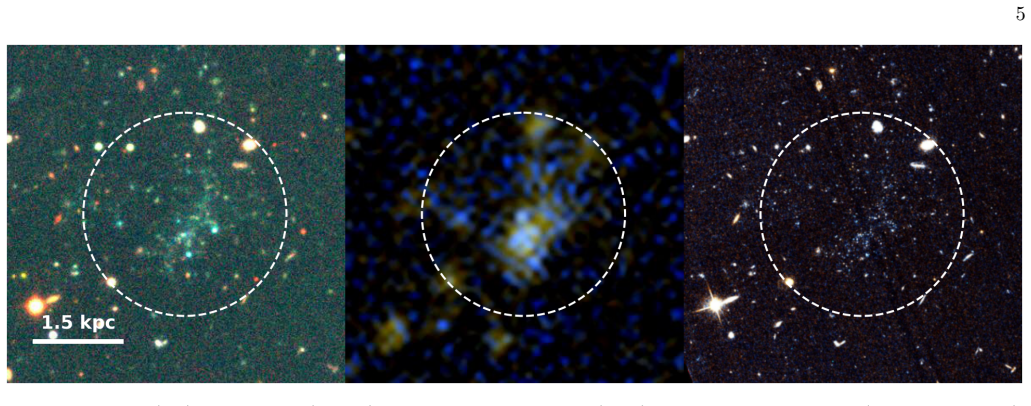
The central object is the 'blue blob,' defined here as a faint, blue, clumpy, isolated stellar system with very low stellar mass, ongoing star formation, and high gas-phase metallicity. The argument is carried by a two-stage machinery: a deliberately visual search in which volunteers examined 150,000 overlapping optical and ultraviolet cutouts and flagged blue, UV-bright, irregular objects, producing a ranked candidate list; and an emission-line spectroscopy stage that measures H$\alpha$ velocities and oxygen abundances to confirm cluster membership and pre-enrichment. A projected phase-space diagram then places the candidates relative to first, recent, intermediate, and ancient infall regions, which is what supports the conclusion about parent-galaxy orbits.
What would settle it
Measure redshifts for the unconfirmed rank 1 candidates BC15, BC18, BC31, and BC32; if their velocities fall well outside the Virgo range (roughly $-500$ to $3000$ km s$^{-1}$) or resolved imaging reveals stellar populations older than a few hundred megayears, the claim that they are young Virgo blue blobs, and the phase-space conclusion built on them, would be undercut.
Extended reading notes
Core claim
On the paper's own terms, the discovery is that isolated blue stellar systems form a substantial population in the Virgo cluster rather than a handful of curiosities. The 13 high-confidence candidates have blue colors ($g-i\lesssim 0$), clumpy irregular morphologies, strong ultraviolet emission, estimated stellar masses around $10^{2.5}$--$10^{5.5}\,M_\odot$, and NUV star formation rates near $10^{-4}$--$10^{-3}\,M_\odot\,\mathrm{yr}^{-1}$, while the six spectroscopically confirmed objects have velocities consistent with Virgo membership and metallicities near solar, matching earlier blue blobs. These properties are inconsistent with normal low-mass galaxies and instead point to young star-forming clouds made of pre-enriched gas, consistent with ram pressure stripping. The candidates concentrate along the cluster's filamentary structures while avoiding the cluster center, three are likely the optical counterparts of previously dark H I clouds, and their projected phase-space positions suggest their parent galaxies have been cluster members for several gigayears rather than falling in for the first time.
Load-bearing premise
The load-bearing assumption is that every candidate sits at the Virgo distance of $16.5\,\mathrm{Mpc}$; for candidates without H$\alpha$ or H I velocities, a larger distance would change their masses, star formation rates, gas fractions, and placement in the phase-space argument.
Editorial extensions
If this is right
- The confirmed blue blob sample grows from six to twelve objects, with thirteen high-confidence candidates overall, establishing blue blobs as a population rather than rare anomalies.
- The low stellar masses, low star formation rates, and high gas fractions of rank 1 candidates place them off the galaxy main sequence, reinforcing the interpretation that they are isolated star-forming clouds built from stripped, pre-enriched gas.
- The spatial avoidance of the cluster center and the concentration along filaments imply that blue blob formation tracks the infall paths of gas-rich galaxies into the cluster.
- Three candidates being the optical counterparts of previously dark H I clouds turns those gas clouds into observable star-forming systems and links blue blobs to the cluster's neutral gas reservoir.
- Further H$\alpha$ and H I follow-up of the remaining candidates can test how many rank 1 objects are true Virgo members, while resolved stellar populations would require deep space-based imaging.
Reading between the lines
- Extending the paper's logic, the implied space density of blue blobs in Virgo suggests similar systems should be searchable in other nearby clusters with deep ultraviolet imaging, provided the clusters are dynamically young enough to host them.
- The strong correlation between visual rank and estimated stellar mass hints that the ranks could later serve as training labels for automated searches once the confirmed sample is larger.
- For the most gas-rich candidates, high-resolution H I synthesis imaging could reveal kinematic links to candidate parent galaxies, testing the stripping scenario before deep stellar-population imaging becomes available.
- The paper's mention of a null search in Fornax points to a testable environmental dependence: comparing blue blob abundance across clusters of different mass and dynamical age would sharpen formation models.
Editorial analysis
A structured set of objections, weighed in public.
Referee Report
Summary. This paper presents a citizen science search for "blue blobs" — isolated, blue, clumpy, low-mass star-forming systems — across the Virgo cluster using NGVS and GALEX imaging. The Zooniverse project produced 658 candidate detections (with at least three volunteer classifications), which three team members ranked; 13 new rank 1 (high-confidence) and 21 rank 2 candidates are presented in Table 1. Six rank 1 candidates were followed up with LRS2-B on the HET, yielding Hα velocities and oxygen abundances consistent with Virgo membership and with the previously known blue blobs. The authors derive stellar masses, SFRs, H I masses, and gas fractions for all candidates under a common assumed distance of 16.5 Mpc, compare them with low-mass star-forming galaxies and the star-forming main sequence, and use a projected phase-space diagram to argue that the parents of blue blobs have not fallen into the cluster for the first time. Three new candidates are identified as likely stellar counterparts of known dark H I clouds.
Significance. The six spectroscopically confirmed objects double the confirmed blue blob population (from 6 to 12) and provide a solid basis for the class. The citizen science methodology is well documented and reproducible, and the full catalog of 34 candidates is valuable for future follow-up. The HET spectra clearly show Hα, Hβ, and [O III] (with [N II] in most cases) and yield velocities and metallicities that independently support membership for the confirmed subset. The paper is unusually candid about its limitations: it explicitly discusses the possibility that rank 2 objects are background galaxies, the distance dependence of the derived properties, and the lack of HST resolution for new candidates. If the distance-independent sSFR/gas-fraction outliers are verified, the sample will strengthen the evidence that blue blobs are a distinct population of star-forming clouds in the intracluster medium.
major comments (3)
- [Abstract; Section 4.1; Table 1] The abstract states that "Our 13 high confidence candidates (including the six confirmed) have properties consistent with prior known blue blobs and are inconsistent with being low-mass galaxies." This statement is not yet supported for all 13: Table 1 shows that five rank 1 candidates (BC15, BC18, BC29, BC31, BC32) have no velocity measurement and two (BC16, BC26) have only H I velocities, while Section 4.1 assigns the 16.5 Mpc Virgo distance to every candidate before computing absolute magnitudes, stellar masses, and SFRs. The distance-independent sSFR versus gas-fraction plane in Figure 9 (right) is a useful mitigation, but the absolute masses and the "inconsistent with low-mass galaxies" claim rest on the assumed distance and on membership. Please qualify the abstract and conclusions so that the six spectroscopically confirmed objects are presented separately from the seven unconfirmed rank 1 candidates, and add a membership column to Table 1 that states the confirmation status (Hα velocity, H I velocity, or none).
- [Section 7; Figure 11] Section 7 and Figure 11 present a projected phase-space diagram and conclude that "the parent galaxies of blue blobs have likely been in the cluster for intermediate periods" and are "probably not on their first infall." The manuscript does not specify which BCs enter this diagram. Since BC15, BC18, BC29, BC31, and BC32 have no velocity measurement, they cannot appear in a velocity–radius plane; the sample that supports the phase-space conclusion must therefore consist of the six previously known blue blobs plus the six new HET-confirmed objects and the two new objects with H I velocities (BC16, BC26). Please state the exact sample used in Figure 11 and its caption, and discuss whether the conclusion is robust to excluding the unconfirmed candidates or to the possibility that some of them lie in the background.
- [Section 4.3; Equation (2); Figure 9] Equation (2) in Section 4.3 sets the H I mass upper limits using an assumed velocity width of Δv = 30 km/s, described as "typical for low-mass objects." This width directly determines the upper limits that appear as lower limits on gas fraction in Figure 9 (right), a plot used to argue that rank 1 BCs are inconsistent with galaxies and are among the most gas-rich stellar systems known. Please test the sensitivity of this result to Δv over a plausible range (e.g., 10–100 km/s) and confirm that the separation between rank 1 BCs and the comparison galaxies in that plane persists. In addition, the text should explicitly note that the plotted gas fractions for the non-detections are lower limits, not measurements.
minor comments (6)
- [Section 6.1] The sentence "the majority of the rank 1 BCs are significantly bluer (g − i ≲ 0) and fainter (g < 20)" appears to have the inequality reversed; the rank 1 g-band magnitudes in Table 1 are mostly fainter than 20 mag (g > 20), so the phrase should read "fainter (g > 20)" or similar.
- [Section 5.2.1] The expression "gas fraction of ∼20,000 MHI/M∗" should be dimensionless; please write "MHI/M∗ ∼ 20,000" throughout the paper.
- [Throughout] The survey name ALFALFA is consistently written as "ALF ALF A" in the manuscript; please correct it to the standard spelling.
- [Section 2.1] The description of cutouts as "approximately 3′ across (512 × 512 pixels with a pixel scale of 0.37′′" is missing a closing parenthesis; it should read "...a pixel scale of 0.37′′)."
- [Section 6.1] The comparison galaxy "GALF A-Dw4" should be spelled "GALFA-Dw4" (the survey is the Arecibo L-band Feed Array H I survey, GALFA).
- [Table 1] Column headers "logM∗" and "log SFRNUV" would be clearer as "log(M∗/M⊙)" and "log(SFRNUV/(M⊙ yr−1))" to avoid ambiguous dimensions; the NUV magnitude header also appears as "N U V" due to spacing.
Circularity Check
No significant circularity: the six spectroscopic confirmations and the dark-cloud associations rest on independent velocity and metallicity measurements, not on the selection criteria.
full rationale
The paper's central empirical claims are self-contained against the search inputs. Rank-1 candidates were selected by visual morphology, blue color, UV emission, and isolation, but the six new confirmations are established by HET H-alpha redshifts consistent with Virgo and by oxygen abundances, which are independent measurements not encoded in the selection (Section 3 and Figure 13). The associations with optically dark H I clouds are supported by velocity matches (e.g., BC17: H-alpha 1671 km/s vs H I 1691 km/s; BC25: 1311 vs 1297 km/s), again independent of morphology. Stellar masses, SFRs, and H I masses assume the stated 16.5 Mpc Virgo distance (Section 4.1), but the paper explicitly acknowledges this assumption and supplements it with a distance-independent sSFR versus gas-fraction comparison; the phase-space regions are imported from the external Mun et al. (2021) analysis. Self-citations to Jones et al. (2022a) define the blue-blob class and prior ram-pressure interpretation, but the new velocity and metallicity data do not reduce to those citations. The only mildly self-referential element is that rank-1 morphological criteria (clumpy, blue, UV-bright, isolated) overlap with morphological properties later summarized as consistent with previously known blue blobs; this is a descriptive restatement, not a load-bearing derivation. Unconfirmed rank-1 candidates without velocities are a membership/background risk, which the paper itself flags, rather than a circularity.
Assumptions & free parameters
free parameters (4)
- Assumed velocity width for H I mass upper limits (Delta-v) =
30 km/s
- H I detection threshold =
5 sigma
- Isolation search radius =
50 kpc in projection
- Parent galaxy stellar mass range =
8.3 <= log M*/M_sun <= 10.1
assumptions (4)
- domain assumption All blue blob candidates are at a distance of 16.5 Mpc
- standard math Color-based stellar mass scaling relations (Z09 and T11) remain valid for very low mass, very blue stellar systems
- domain assumption Rank 1 candidates without a measured velocity are members of the Virgo cluster
- domain assumption Phase-space infall regions derived for galaxies apply to blue blobs
Cite this review
Pith. "Pith review of Citizen Science Identification of Isolated Blue Stellar Systems in the Virgo cluster." pith.science (2026). https://pith.science/paper/42RTWTN4
@misc{pith2026241114526,
  author       = {Pith},
  title        = {Pith review of: Citizen Science Identification of Isolated Blue Stellar Systems in the Virgo cluster},
  year         = {2026},
  howpublished = {\url{https://pith.science/paper/42RTWTN4}},
  note         = {Machine review of arXiv:2411.14526}
}
read the original abstract
We present a catalog of 34 new candidate (13 high confidence) isolated, young stellar systems within the Virgo galaxy cluster identified through a citizen science search of public optical and ultraviolet imaging. "Blue blobs" are a class of blue, faint, isolated, extremely low stellar mass, and metal-rich star-forming clouds embedded in the hot intracluster medium of the Virgo cluster. Only six blue blobs were known previously and here we confirm an additional six of our candidates through velocity and metallicity measurements from follow-up optical spectroscopy on the Hobby-Eberly Telescope (HET). Our 13 high confidence candidates (including the six confirmed) have properties consistent with prior known blue blobs and are inconsistent with being low-mass galaxies. Most candidates are concentrated in relatively dense regions, roughly following filamentary structures within the cluster, but avoiding its center. Three of our candidates are likely the stellar counterparts of known 'optically dark' clouds of neutral hydrogen in the cluster, while a further four are widely separated extensions to previously known blue blobs. The properties of our new candidates are consistent with previous conclusions that blue blobs likely originated from ram pressure stripping events, however, their locations in velocity--projected cluster-centric radius phase-space imply that their parent galaxies are not on their first infall into the cluster. Through our ongoing follow-up program with HET we aim to confirm additional candidates, however, detailed understanding of the stellar populations and star formation histories of blue blobs will require JWST observations.
Figures


Figures from the paper (11 more)


Reference graph
Works this paper leans on
-
[1]
, " * write output.state after.block = add.period write newline
ENTRY address archivePrefix author booktitle chapter doi edition editor eprint howpublished institution journal key month number organization pages publisher school series title misctitle type volume year version url label extra.label sort.label short.list INTEGERS output.state before.all mid.sentence after.sentence after.block FUNCTION init.state.consts ...
-
[2]
write newline
" write newline "" before.all 'output.state := FUNCTION format.url url empty "" new.block "" url * "" * if FUNCTION format.eprint eprint empty "" archivePrefix empty "" archivePrefix "arXiv" = new.block " " eprint * " " * new.block " " eprint * " " * if if if FUNCTION format.doi doi empty "" " " doi * " " * if FUNCTION format.pid doi empty eprint empty ur...
-
[3]
xu Q w ,Xi jR!;kY*P Ww&d*+.:CA3T0jZ<x/` EJ)Ĩ bj ˨ao ` ; ZVrάk LJ و v5a :ńV/WY( a ue< _1
thebibliography [1] 20pt to REFERENCES 6pt =0pt -12pt 10pt plus 3pt =0pt =0pt =1pt plus 1pt =0pt =0pt -12pt =13pt plus 1pt =20pt =13pt plus 1pt \@M =10000 =-1.0em =0pt =0pt 0pt =0pt =1.0em @enumiv\@empty 10000 10000 `\.\@m \@noitemerr \@latex@warning Empty `thebibliography' environment \@ifnextchar \@reference \@latexerr Missing key on reference command E...
arXiv 2021
-
[4]
Abadi , M. G., Moore , B., & Bower , R. G. 1999, , 308, 947, 10.1046/j.1365-8711.1999.02715.x
arXiv 1999
-
[5]
Adams , E. A. K., Giovanelli , R., & Haynes , M. P. 2013, , 768, 77, 10.1088/0004-637X/768/1/77
-
[6]
Adams , E. A. K., Cannon , J. M., Rhode , K. L., et al. 2015, , 580, A134, 10.1051/0004-6361/201526857
-
[7]
Astropy Collaboration , Robitaille , T. P., Tollerud , E. J., et al. 2013, , 558, A33, 10.1051/0004-6361/201322068
-
[8]
Astropy Collaboration , Price-Whelan , A. M., Sip o cz , B. M., et al. 2018, , 156, 123, 10.3847/1538-3881/aabc4f
Show all 107 references
-
[9]
M., & McCarthy , I
Bah \'e , Y. M., & McCarthy , I. G. 2015, , 447, 969, 10.1093/mnras/stu2293
2015 doi
-
[10]
2017, , 465, 2189, 10.1093/mnras/stw2874
Beccari , G., Bellazzini , M., Magrini , L., et al. 2017, , 465, 2189, 10.1093/mnras/stw2874
2017 doi
-
[11]
2015, , 800, L15, 10.1088/2041-8205/800/1/L15
Bellazzini , M., Magrini , L., Mucciarelli , A., et al. 2015, , 800, L15, 10.1088/2041-8205/800/1/L15
2015 doi
-
[12]
2018, , 476, 4565, 10.1093/mnras/sty467
Bellazzini , M., Armillotta , L., Perina , S., et al. 2018, , 476, 4565, 10.1093/mnras/sty467
2018 doi
-
[13]
G., et al
Bellazzini , M., Magrini , L., Jones , M. G., et al. 2022, , 935, 50, 10.3847/1538-4357/ac7c6d
2022 doi
-
[14]
J., Crnojevi \'c , D., et al
Bennet , P., Sand , D. J., Crnojevi \'c , D., et al. 2022, , 924, 98, 10.3847/1538-4357/ac356c
2022 doi
-
[15]
A., Skillman , E
Berg , D. A., Skillman , E. D., Marble , A. R., et al. 2012, , 754, 98, 10.1088/0004-637X/754/2/98
2012 doi
-
[16]
2022, , 30, 3, 10.1007/s00159-022-00140-3
Boselli , A., Fossati , M., & Sun , M. 2022, , 30, 3, 10.1007/s00159-022-00140-3
2022 doi
-
[18]
C., et al
Boselli , A., Fossati , M., Cuillandre , J. C., et al. 2018 b , , 615, A114, 10.1051/0004-6361/201732410
2018 doi
-
[19]
2018 c , , 614, A56, 10.1051/0004-6361/201732407
Boselli , A., Fossati , M., Ferrarese , L., et al. 2018 c , , 614, A56, 10.1051/0004-6361/201732407
2018 doi
-
[20]
Bournaud , F., & Duc , P. A. 2006, , 456, 481, 10.1051/0004-6361:20065248
2006 doi
-
[21]
D., Zabel , N., et al
Brown , T., Wilson , C. D., Zabel , N., et al. 2021, , 257, 21, 10.3847/1538-4365/ac28f5
2021 doi
-
[22]
M., Tumlinson , J., Geha , M., et al
Brown , T. M., Tumlinson , J., Geha , M., et al. 2014, , 796, 91, 10.1088/0004-637X/796/2/91
2014 doi
-
[23]
2020, , 499, 5873, 10.1093/mnras/staa3133
Calura , F., Bellazzini , M., & D'Ercole , A. 2020, , 499, 5873, 10.1093/mnras/staa3133
2020 doi
-
[24]
M., Martinkus , C
Cannon , J. M., Martinkus , C. P., Leisman , L., et al. 2015, , 149, 72, 10.1088/0004-6256/149/2/72
2015 doi
-
[25]
O., Trujillo , C
Chandler , C. O., Trujillo , C. A., Oldroyd , W. J., et al. 2024, , 167, 156, 10.3847/1538-3881/ad1de2
2024 doi
-
[26]
2020, , 496, 4654, 10.1093/mnras/staa1868
Chen , H., Sun , M., Yagi , M., et al. 2020, , 496, 4654, 10.1093/mnras/staa1868
2020 doi
-
[27]
S., Hill , G
Chonis , T. S., Hill , G. J., Lee , H., et al. 2016, in Society of Photo-Optical Instrumentation Engineers (SPIE) Conference Series, Vol. 9908, Ground-based and Airborne Instrumentation for Astronomy VI, ed. C. J. Evans , L. Simard , & H. Takami , 99084C, 10.1117/12.2232209
2016 doi
-
[28]
H., Kenney , J
Chung , A., van Gorkom , J. H., Kenney , J. D. P., & Vollmer , B. 2007, , 659, L115, 10.1086/518034
2007 doi
-
[29]
2021, CARTA: Cube Analysis and Rendering Tool for Astronomy , Astrophysics Source Code Library, record ascl:2103.031
Comrie , A., Wang , K.-S., Hsu , S.-C., et al. 2021, CARTA: Cube Analysis and Rendering Tool for Astronomy , Astrophysics Source Code Library, record ascl:2103.031
2021
-
[30]
2021, , 38, e035, 10.1017/pasa.2021.18
Cortese , L., Catinella , B., & Smith , R. 2021, , 38, e035, 10.1017/pasa.2021.18
2021 doi
-
[31]
H., & Kenney , J
Crowl , H. H., & Kenney , J. D. P. 2008, , 136, 1623, 10.1088/0004-6256/136/4/1623
2008 doi
-
[32]
V., van Zee , L., Lee , H., et al
Croxall , K. V., van Zee , L., Lee , H., et al. 2009, , 705, 723, 10.1088/0004-637X/705/1/723
2009 doi
-
[33]
I., Davies , L
Davies , J. I., Davies , L. J. M., & Keenan , O. C. 2016, , 456, 1607, 10.1093/mnras/stv2719
2016 doi
-
[34]
J., Lang , D., et al
Dey , A., Schlegel , D. J., Lang , D., et al. 2019, , 157, 168, 10.3847/1538-3881/ab089d
2019 doi
-
[35]
2024, , 964, 85, 10.3847/1538-4357/ad234f
Du , L., Du , W., Cheng , C., et al. 2024, , 964, 85, 10.3847/1538-4357/ad234f
2024 doi
-
[36]
A., Braine , J., Lisenfeld , U., Brinks , E., & Boquien , M
Duc , P. A., Braine , J., Lisenfeld , U., Brinks , E., & Boquien , M. 2007, , 475, 187, 10.1051/0004-6361:20078335
2007 doi
-
[37]
A., & Mirabel , I
Duc , P. A., & Mirabel , I. F. 1998, , 333, 813
1998
-
[38]
A., Crone Odekon , M., et al
Durbala , A., Finn , R. A., Crone Odekon , M., et al. 2020, , 160, 271, 10.3847/1538-3881/abc018
2020 doi
-
[39]
2012, , 200, 4, 10.1088/0067-0049/200/1/4
Ferrarese , L., C \^o t \'e , P., Cuillandre , J.-C., et al. 2012, , 200, 4, 10.1088/0067-0049/200/1/4
2012 doi
-
[40]
1987, , 186, L1
Gavazzi , G., & Jaffe , W. 1987, , 186, L1
1987
-
[41]
H., Mao , Y.-Y., et al
Geha , M., Wechsler , R. H., Mao , Y.-Y., et al. 2017, , 847, 4, 10.3847/1538-4357/aa8626
2017 doi
-
[42]
P., Kent , B
Giovanelli , R., Haynes , M. P., Kent , B. R., et al. 2005, , 130, 2598, 10.1086/497431
2005 doi
-
[43]
P., Adams , E
Giovanelli , R., Haynes , M. P., Adams , E. A. K., et al. 2013, , 146, 15, 10.1088/0004-6256/146/1/15
2013 doi
- [44]
-
[45]
P., Giovanelli , R., Kent , B
Haynes , M. P., Giovanelli , R., Kent , B. R., et al. 2018, , 861, 49, 10.3847/1538-4357/aac956
2018 doi
-
[46]
J., Lee , H., MacQueen , P
Hill , G. J., Lee , H., MacQueen , P. J., et al. 2021, , 162, 298, 10.3847/1538-3881/ac2c02
2021 doi
-
[47]
S., Salzer , J
Hirschauer , A. S., Salzer , J. J., Skillman , E. D., et al. 2016, , 822, 108, 10.3847/0004-637X/822/2/108
2016 doi
-
[48]
J., Prochaska , J
Hsyu , T., Cooke , R. J., Prochaska , J. X., & Bolte , M. 2017, , 845, L22, 10.3847/2041-8213/aa821f
2017 doi
-
[49]
Hunter , J. D. 2007, Computing in Science and Engineering, 9, 90, 10.1109/MCSE.2007.55
2007 doi
-
[50]
T., et al
Iglesias-P \'a ramo , J., Buat , V., Takeuchi , T. T., et al. 2006, , 164, 38, 10.1086/502628
2006 doi
-
[51]
I., Thuan , T
Izotov , Y. I., Thuan , T. X., & Guseva , N. G. 2019, , 483, 5491, 10.1093/mnras/sty3472
2019 doi
-
[52]
J \'a chym , P., Kenney , J. D. P., Sun , M., et al. 2019, , 883, 145, 10.3847/1538-4357/ab3e6c
2019 doi
-
[53]
G., Sand , D
Jones , M. G., Sand , D. J., Bellazzini , M., et al. 2022 a , , 935, 51, 10.3847/1538-4357/ac7c6c
2022 doi
-
[54]
2022 b , , 926, L15, 10.3847/2041-8213/ac51dc
---. 2022 b , , 926, L15, 10.3847/2041-8213/ac51dc
2022 doi
-
[55]
G., Mutlu-Pakdil , B., Sand , D
Jones , M. G., Mutlu-Pakdil , B., Sand , D. J., et al. 2023, , 957, L5, 10.3847/2041-8213/ad0130
2023 doi
-
[56]
G., Janowiecki , S., Dey , S., et al
Jones , M. G., Janowiecki , S., Dey , S., et al. 2024 a , , 966, L15, 10.3847/2041-8213/ad3ef5
2024 doi
-
[57]
G., Sand , D
Jones , M. G., Sand , D. J., Mutlu-Pakdil , B., et al. 2024 b , , 971, L37, 10.3847/2041-8213/ad676e
2024 doi
-
[58]
A., & Mandel , E
Joye , W. A., & Mandel , E. 2003, in Astronomical Society of the Pacific Conference Series, Vol. 295, Astronomical Data Analysis Software and Systems XII, ed. H. E. Payne , R. I. Jedrzejewski , & R. N. Hook , 489
2003
- [59]
-
[60]
G., Karachentsev , I
Kashibadze , O. G., Karachentsev , I. D., & Karachentseva , V. E. 2020, , 635, A135, 10.1051/0004-6361/201936172
2020 doi
-
[61]
Kenney , J. D. P., & Koopmann , R. A. 1999, , 117, 181, 10.1086/300683
1999 doi
-
[62]
Kenney , J. D. P., van Gorkom , J. H., & Vollmer , B. 2004, , 127, 3361, 10.1086/420805
2004 doi
-
[63]
Kent , B. R. 2010, , 725, 2333, 10.1088/0004-637X/725/2/2333
2010 doi
-
[64]
R., Spekkens , K., Giovanelli , R., et al
Kent , B. R., Spekkens , K., Giovanelli , R., et al. 2009, , 691, 1595, 10.1088/0004-637X/691/2/1595
2009 doi
-
[65]
R., Giovanelli , R., Haynes , M
Kent , B. R., Giovanelli , R., Haynes , M. P., et al. 2007, , 665, L15, 10.1086/521100
2007 doi
-
[66]
2014, , 215, 22, 10.1088/0067-0049/215/2/22
Kim , S., Rey , S.-C., Jerjen , H., et al. 2014, , 215, 22, 10.1088/0067-0049/215/2/22
2014 doi
-
[67]
N., Cohen , J
Kirby , E. N., Cohen , J. G., Guhathakurta , P., et al. 2013, , 779, 102, 10.1088/0004-637X/779/2/102
2013 doi
-
[68]
R., Gorjian , V., Rebull , L
Laher , R. R., Gorjian , V., Rebull , L. M., et al. 2012, , 124, 737, 10.1086/666883
2012 doi
-
[69]
P., Spekkens , K., et al
Lee-Waddell , K., Madrid , J. P., Spekkens , K., et al. 2018, , 480, 2719, 10.1093/mnras/sty2042
2018 doi
-
[70]
J., Schawinski , K., Slosar , A., et al
Lintott , C. J., Schawinski , K., Slosar , A., et al. 2008, , 389, 1179, 10.1111/j.1365-2966.2008.13689.x
2008
-
[71]
H., et al
Mao , Y.-Y., Geha , M., Wechsler , R. H., et al. 2021, , 907, 85, 10.3847/1538-4357/abce58
2021 doi
- [72]
-
[73]
C., Fanson , J., Schiminovich , D., et al
Martin , D. C., Fanson , J., Schiminovich , D., et al. 2005, , 619, L1, 10.1086/426387
2005 doi
-
[74]
McQuinn , K. B. W., Skillman , E. D., Dolphin , A., et al. 2015, , 812, 158, 10.1088/0004-637X/812/2/158
2015 doi
-
[75]
McQuinn , K. B. W., Berg , D. A., Skillman , E. D., et al. 2020, , 891, 181, 10.3847/1538-4357/ab7447
2020 doi
-
[76]
P., C \^o t \'e , P., et al
Mei , S., Blakeslee , J. P., C \^o t \'e , P., et al. 2007, , 655, 144, 10.1086/509598
2007 doi
-
[77]
J., & Aivazis , M
Millman , K. J., & Aivazis , M. 2011, Computing in Science and Engineering, 13, 9, 10.1109/MCSE.2011.36
2011 doi
-
[78]
A., et al
Morrissey , P., Conrow , T., Barlow , T. A., et al. 2007, , 173, 682, 10.1086/520512
2007 doi
-
[79]
Y., Hwang , H
Mun , J. Y., Hwang , H. S., Lee , M. G., et al. 2021, Journal of Korean Astronomical Society, 54, 17, 10.5303\
2021
-
[80]
Oliphant , T. E. 2007, Computing in Science and Engineering, 9, 10, 10.1109/MCSE.2007.58
2007 doi
-
[81]
2020, pandas-dev/pandas: Pandas, latest, Zenodo, 10.5281/zenodo.3509134
pandas development team, T. 2020, pandas-dev/pandas: Pandas, latest, Zenodo, 10.5281/zenodo.3509134
2020 doi
-
[82]
2020, arXiv e-prints, arXiv:2008.12633, 10.48550/arXiv.2008.12633
Peletier , R., Iodice , E., Venhola , A., et al. 2020, arXiv e-prints, arXiv:2008.12633, 10.48550/arXiv.2008.12633
2020 doi
-
[83]
M., Gullieuszik , M., Tonnesen , S., et al
Poggianti , B. M., Gullieuszik , M., Tonnesen , S., et al. 2019, , 482, 4466, 10.1093/mnras/sty2999
2019 doi
-
[84]
M., et al
Ramatsoku , M., Serra , P., Poggianti , B. M., et al. 2019, , 487, 4580, 10.1093/mnras/stz1609
2019 doi
-
[85]
W., Adams , M
Ramsey , L. W., Adams , M. T., Barnes , T. G., et al. 1998, in Society of Photo-Optical Instrumentation Engineers (SPIE) Conference Series, Vol. 3352, Advanced Technology Optical/IR Telescopes VI, ed. L. M. Stepp , 34--42, 10.1117/12.319287
1998 doi
-
[86]
2017, , 843, 128, 10.3847/1538-4357/aa6d6c
Rhee , J., Smith , R., Choi , H., et al. 2017, , 843, 128, 10.3847/1538-4357/aa6d6c
2017 doi
-
[87]
D., van Weeren , R
Roberts , I. D., van Weeren , R. J., Timmerman , R., et al. 2022, , 658, A44, 10.1051/0004-6361/202142294
2022 doi
-
[88]
2020, reproject: Python-based astronomical image reprojection
Robitaille , T., Deil , C., & Ginsburg , A. 2020, reproject: Python-based astronomical image reprojection . 2011.023
2020
-
[89]
J., Crnojevi \'c , D., Bennet , P., et al
Sand , D. J., Crnojevi \'c , D., Bennet , P., et al. 2015, , 806, 95, 10.1088/0004-637X/806/1/95
2015 doi
-
[90]
J., Seth , A
Sand , D. J., Seth , A. C., Crnojevi \'c , D., et al. 2017, , 843, 134, 10.3847/1538-4357/aa7557
2017 doi
-
[91]
F., & Finkbeiner , D
Schlafly , E. F., & Finkbeiner , D. P. 2011, , 737, 103, 10.1088/0004-637X/737/2/103
2011 doi
-
[92]
D., Salzer , J
Skillman , E. D., Salzer , J. J., Berg , D. A., et al. 2013, , 146, 3, 10.1088/0004-6256/146/1/3
2013 doi
-
[93]
M., Manrique , A., Garc \' a-G \'o mez , C., et al
Solanes , J. M., Manrique , A., Garc \' a-G \'o mez , C., et al. 2001, , 548, 97, 10.1086/318672
2001 doi
-
[94]
N., Hopkins , A
Taylor , E. N., Hopkins , A. M., Baldry , I. K., et al. 2011, , 418, 1587, 10.1111/j.1365-2966.2011.19536.x
2011
-
[95]
I., Auld , R., & Minchin , R
Taylor , R., Davies , J. I., Auld , R., & Minchin , R. F. 2012, , 423, 787, 10.1111/j.1365-2966.2012.20914.x
2012
-
[96]
I., J \'a chym , P., et al
Taylor , R., Davies , J. I., J \'a chym , P., et al. 2016, , 461, 3001, 10.1093/mnras/stw1475
2016 doi
-
[97]
2020, , 159, 218, 10.3847/1538-3881/ab6988
Taylor , R., K \"o ppen , J., J \'a chym , P., et al. 2020, , 159, 218, 10.3847/1538-3881/ab6988
2020 doi
-
[98]
L., & van Gorkom , J
Tonnesen , S., Bryan , G. L., & van Gorkom , J. H. 2007, , 671, 1434, 10.1086/523034
2007 doi
-
[99]
C., & Varoquaux , G
van der Walt , S., Colbert , S. C., & Varoquaux , G. 2011, Computing in Science and Engineering, 13, 22, 10.1109/MCSE.2011.37
2011 doi
-
[100]
Vollmer , B., Beck , R., Kenney , J. D. P., & van Gorkom , J. H. 2004, , 127, 3375, 10.1086/420802
2004 doi
-
[101]
Vollmer , B., Cayatte , V., Balkowski , C., & Duschl , W. J. 2001, , 561, 708, 10.1086/323368
2001 doi
-
[102]
M., Duc , P
Weilbacher , P. M., Duc , P. A., & Fritze-v. Alvensleben , U. 2003, , 397, 545, 10.1051/0004-6361:20021522
2003 doi
-
[103]
2010, in P roceedings of the 9th P ython in S cience C onference, ed
W es M c K inney. 2010, in P roceedings of the 9th P ython in S cience C onference, ed. S t\'efan van der W alt & J arrod M illman, 56 -- 61, 10.25080/Majora-92bf1922-00a
2010 doi
-
[104]
K., Martin , D
Wyder , T. K., Martin , D. C., Schiminovich , D., et al. 2007, , 173, 293, 10.1086/521402
2007 doi
-
[105]
2002, , 567, 118, 10.1086/338353
Yoshida , M., Yagi , M., Okamura , S., et al. 2002, , 567, 118, 10.1086/338353
2002 doi
-
[106]
2008, , 688, 918, 10.1086/592430
Yoshida , M., Yagi , M., Komiyama , Y., et al. 2008, , 688, 918, 10.1086/592430
2008 doi
-
[107]
2017, Classical and Quantum Gravity, 34, 064003, 10.1088/1361-6382/aa5cea
Zevin , M., Coughlin , S., Bahaadini , S., et al. 2017, Classical and Quantum Gravity, 34, 064003, 10.1088/1361-6382/aa5cea
2017 doi
-
[108]
2009, , 400, 1181, 10.1111/j.1365-2966.2009.15528.x
Zibetti , S., Charlot , S., & Rix , H.-W. 2009, , 400, 1181, 10.1111/j.1365-2966.2009.15528.x
2009
Reviewed August 12, 2026 · model on record in the stance chip above.
Discussion (0). Continue with ORCID to comment.