REVIEW 4 major objections 5 minor 36 references
Label Calibration in Source Free Domain Adaptation
T0 review · 4 major / 5 minor · reviewed 2026-08-10 · deepseek-v4-flash
Pith's one-line read By modeling prediction uncertainty with a Dirichlet prior and adding a constant to logits before softmax, this paper refines noisy pseudolabels in source-free domain adaptation, reporting gains over the SHOT and KSHOT baselines on…
desk verdict A sensible integration of evidential deep learning and calibrated softmax into SFDA, but the paper's consistent-outperformance claim is contradicted by its own Office31 table and the per-dataset tuning of gamma. read the letter →
The pith
A machine-rendered reading of the paper's core claim, the machinery that carries it, and where it could break.
The reading
What carries the argument
The load-bearing mechanism is the evidential Dirichlet head: instead of a single point-estimate softmax vector, the target network outputs evidence $\alpha_{ik}=e^{o_{ik}}+\lambda$ that parameterizes a Dirichlet distribution over class probabilities. The EDL loss penalizes both the negative log marginal likelihood $L_{nll}$ and the KL divergence to the uniform Dirichlet $L_{kl}$, which together suppress evidence for wrong pseudolabels. A second mechanism, the calibrated softmax $\hat{\delta}_{ik}=(e^{o_{ik}}+\gamma)/\sum_j(e^{o_{ij}}+\gamma)$, breaks the translation invariance of standard softmax by making predictions depend on absolute logit magnitudes; it is inserted into the entropy and diversity terms of information maximization so that confident but miscalibrated predictions are not rewarded. The two mechanisms are combined in $L_{total}=w_1(L_{nll}+\beta L_{kl})+w_2(\hat{L}_{ent}+\hat{L}_{div})$, with weights $w_1=0.3$, $w_2=1.0$ in both EKS and ES.
What would settle it
Use the released code to run EKS on DomainNet40, Office-Home, and Office31 with a single constant $\gamma$ (or with $\gamma$ selected on a held-out validation split) and compare average accuracy to KSHOT; if the margin over the baseline disappears or reverses, the claimed improvement is an artifact of per-dataset tuning rather than of the evidential and calibrated-softmax losses.
Extended reading notes
Core claim
The central claim is that predictive uncertainty and softmax miscalibration, not just domain shift, are responsible for noisy pseudolabels in SFDA. By training the target network to output evidence for a Dirichlet prior over class probabilities, the model can express uncertainty in a single forward pass; the EDL loss ($L_{nll}+\beta L_{kl}$) then suppresses evidence for false labels. Replacing the translation-invariant softmax with the calibrated form $\hat{\delta}_{ik}=(e^{o_{ik}}+\gamma)/\sum_j(e^{o_{ij}}+\gamma)$ in both entropy and diversity terms of information maximization prevents overconfident predictions that entropy minimization would otherwise encourage. The full objective $w_1 L_{edl}+w_2 \hat{L}_{im}$ is applied either with prior knowledge (unary and binary bounds) in EKS or without it in ES. On the paper's reported benchmarks, this combination outperforms the SHOT and KSHOT baselines on DomainNet40 and Office-Home, with the largest margin on the large-domain-gap task C→P.
Load-bearing premise
The reported gains hinge on selecting the calibrated softmax constant $\gamma$ separately for each dataset through extensive experimentation; if $\gamma$ must be fixed in advance or chosen without test data, the improvements over the baselines may shrink or reverse.
Editorial extensions
If this is right
- Existing SFDA methods that rely on pseudolabel self-training can adopt the evidential head and calibrated softmax without accessing source data, since both operate entirely on target logits.
- The calibrated softmax should make entropy minimization safer when the source model is trained on small or far-distribution data, because it prevents confidence from being built on logit differences alone.
- The EDL loss gives a per-sample uncertainty estimate at inference that can be used to filter or weight pseudolabels, complementing the prior-knowledge bounds in EKS.
- Because the approach is a loss and head modification rather than a new architecture, it can be stacked with other SFDA methods, as the paper demonstrates by turning TransDA into E-TransDA.
Reading between the lines
- The per-dataset values of $\gamma$ (1 for DomainNet40, 1.5 for Office-Home, 0.2 for Office31) suggest the method would benefit from an automatic or validation-based selection of the calibration constant; the paper leaves this as manual tuning.
- If the uncertainty estimates from the evidential head are reliable, they could also support active SFDA, sample selection, or out-of-distribution rejection on the target domain, applications not explored in the paper.
- The translation-invariance argument applies to any softmax-based self-training, so the calibrated softmax may transfer to semi-supervised learning or noisy-label learning beyond domain adaptation.
- A direct extension would test whether the improvement scales with the number of classes, since the Dirichlet prior and the KL regularization term both depend on $K$; the paper does not report such an analysis.
Editorial analysis
A structured set of objections, weighed in public.
Referee Report
Summary. The paper proposes two source-free domain adaptation (SFDA) methods, EKS and ES, which combine evidential deep learning (EDL) with information maximization (IM) and a calibrated softmax function. EKS incorporates unary-bound and binary-relationship prior knowledge following KSHOT, while ES is the prior-free analogue built on SHOT. The authors report classification accuracies on DomainNet40, Office-Home, Office-31, and digit datasets, together with ablations and ECE/NLL calibration measurements, and claim consistent improvements over state-of-the-art baselines.
Significance. If the reported gains were robust, the paper would offer a useful connection between evidential deep learning and pseudo-label refinement in SFDA, and it draws attention to a genuine limitation of the standard softmax (translation invariance). The manuscript provides a code link, ablations showing that adding IM to EDL helps (Table 7), and ECE/NLL improvements on DomainNet40. However, the current evidence is weakened by an inconsistency on Office-31 and by per-dataset selection of the key calibrated-softmax constant without a validation protocol; these issues must be addressed before the contribution can be assessed.
major comments (4)
- [§6.1 and Table 4] The statement that 'EKS and ES consistently achieve better classification accuracies' is not supported by Table 4. On Office-31, EKS under UB(0.0) averages 90.5 versus KSHOT's 91.0; under BR it averages 90.4 versus 90.5; ES averages 88.67 versus SHOT's 88.6. The text in §6.1 highlights only A→D (+0.5%) and omits the dataset-level deficit. Please either restrict the central claim to DomainNet40, Office-Home, and Digits, or analyze why Office-31 behaves differently; the abstract's 'outperforms other state-of-the-art methods on benchmark datasets' should be revised accordingly.
- [§5, Implementation Details] The calibrated softmax constant γ is set separately per dataset (1.0 for DomainNet40, 1.5 for Office-Home, 0.2 for Office-31, 1.0 for Digits) 'based on extensive experimentation,' but no validation protocol, search range, or sensitivity analysis is given. Because Eq. (9) reduces to the standard softmax when γ=0, selecting γ on the same test data makes the reported gains partly a result of test-time tuning. The constant λ in Eq. (2) is also never assigned a value. Please specify how γ (and, if varied, β, w1, w2) are chosen on a validation split or report accuracy as a function of γ; otherwise the comparison to KSHOT/SHOT is not a fair apples-to-apples evaluation.
- [§5 and Tables 1–6] The paper reports means over three random seeds but no standard deviations, confidence intervals, or paired significance tests. Several reported advantages are small: ES vs SHOT on Office-Home is +0.05 points, ES vs SHOT on Office-31 is +0.07 points, and EKS vs KSHOT on Office-31 is negative by 0.1–0.5 points. Without variance estimates, these differences cannot be distinguished from seed noise, and the claim of consistent improvement is not statistically grounded. Please report per-seed results or error bars at least for the headline averages.
- [§6.2.3 and Table 8] The ablation in Table 8 does not support 'consistent improvement' from calibrated softmax: under UB(0.5), UB(1.0), and UB(2.0) the calibrated variant is worse than the standard-softmax variant on Office-Home (72.72 vs 72.76, 72.01 vs 72.19, 71.66 vs 71.92). The gain appears only for UB(0.0), UB(0.1), and BR. The text should be revised to state which operating points benefit, and the analysis should discuss why the effect reverses as σ grows.
minor comments (5)
- [Throughout] There are several typos and wording errors: 'drichilet' in §4.2, 'demonstarted' in §4.4, 'psedolabeling' in §2.1, and 'EKS ans ES' in §6.1.
- [Algorithm 1] Algorithm 1 has a duplicate 'Output: Output:' line; the input/output formatting should be cleaned.
- [Tables 1–11] The tables use a 'κ' column that is never defined in the text or captions; define it or remove it. Also, several entries in Table 4 lack spacing (e.g., '75.3999.27').
- [Eq. (1)] Equation (1) uses both ρ_i and ρ_ik for the Dirichlet variable and its components; the notation should be made consistent.
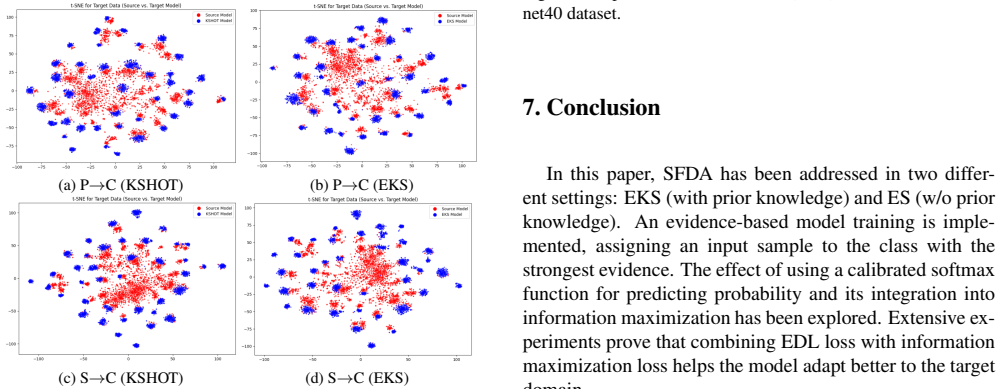
- [Figure 2] The t-SNE visualizations in Figure 2 would be more informative with a quantitative cluster-quality metric; as presented they only support a qualitative claim.
Circularity Check
Headline gains on Domainnet40/Office-Home follow per-dataset γ chosen by 'extensive experimentation'; EDL and IM equations themselves are not circular.
-
fitted input called prediction
[Section 5 (Implementation Details) and Section 4.3 Eq. (9)]
"The different values of γ are 1, 1.5, and 0.2 for Domainnet40, Office-Home and Office31 respectively for softmax calibration, based on the extensive experimentation."
The calibrated softmax in Eq. (9) is δ̂_ik = (e^{o_ik}+γ)/Σ_j(e^{o_ij}+γ), so γ directly controls the predicted probabilities used in the IM loss. The paper selects γ separately for each benchmark 'based on the extensive experimentation' and then reports the resulting EKS accuracies (e.g., +2.74% over KSHOT on Domainnet40 UB, +0.34% on Office-Home) as evidence of outperformance. Because no validation split or sensitivity analysis is reported, the headline comparison is partly the result of test-set hyperparameter tuning rather than an out-of-sample prediction of the method.
full rationale
The derivation of the EDL loss (Eqs. 1-5) and calibrated IM loss (Eqs. 9-13) is self-contained; the Dirichlet prior and information maximization are standard formulations applied to SFDA, not defined in terms of the target accuracy. The paper does not rely on load-bearing self-citations: the only author self-citation [12] is background. The main circularity-adjacent issue is the dataset-specific γ chosen by 'extensive experimentation' with no validation protocol, which makes the claimed improvements partly a product of test-set selection. Separately, the claim in Sec. 6.1 that EKS/ES 'consistently achieve better classification accuracies' is contradicted by Table 4 (Office31 averages are lower than KSHOT), but that is an internal inconsistency / overclaim, not circularity. Overall, the core method has independent content; only the evaluation of the γ-dependent gain is partially circular.
Assumptions & free parameters
free parameters (4)
- gamma (calibrated softmax constant) =
1 (Domainnet40), 1.5 (Office-Home), 0.2 (Office31), 1 (Digits)
- beta (EDL balance) =
0.5
- w1, w2 (loss weights) =
0.3 and 1.0
- lambda (in alpha = exp(o) + lambda) =
not specified
assumptions (3)
- domain assumption Dirichlet prior over class probabilities is appropriate for uncertainty modeling
- domain assumption Prior knowledge constraints (unary and binary bounds) are correctly estimated and useful
- ad hoc to paper Calibrated softmax with additive constant gamma improves calibration and adaptation
Cite this review
Pith. "Pith review of Label Calibration in Source Free Domain Adaptation." pith.science (2026). https://pith.science/paper/44IFUYZS
@misc{pith2026250107072,
  author       = {Pith},
  title        = {Pith review of: Label Calibration in Source Free Domain Adaptation},
  year         = {2026},
  howpublished = {\url{https://pith.science/paper/44IFUYZS}},
  note         = {Machine review of arXiv:2501.07072}
}
read the original abstract
Source-free domain adaptation (SFDA) utilizes a pre-trained source model with unlabeled target data. Self-supervised SFDA techniques generate pseudolabels from the pre-trained source model, but these pseudolabels often contain noise due to domain discrepancies between the source and target domains. Traditional self-supervised SFDA techniques rely on deterministic model predictions using the softmax function, leading to unreliable pseudolabels. In this work, we propose to introduce predictive uncertainty and softmax calibration for pseudolabel refinement using evidential deep learning. The Dirichlet prior is placed over the output of the target network to capture uncertainty using evidence with a single forward pass. Furthermore, softmax calibration solves the translation invariance problem to assist in learning with noisy labels. We incorporate a combination of evidential deep learning loss and information maximization loss with calibrated softmax in both prior and non-prior target knowledge SFDA settings. Extensive experimental analysis shows that our method outperforms other state-of-the-art methods on benchmark datasets.
Figures


Reference graph
Works this paper leans on
-
[34]
Dirichlet-based prediction calibra- tion for learning with noisy labels
Chen-Chen Zong, Ye-Wen Wang, Ming-Kun Xie, and Sheng-Jun Huang. Dirichlet-based prediction calibra- tion for learning with noisy labels. In Proceedings of the AAAI Conference on Artificial Intelligence, vol- ume 38, pages 17254–17262, 2024. 2
work page 2024
-
[1]
Continual evidential deep learning for out-of-distribution detection
Eduardo Aguilar, Bogdan Raducanu, Petia Radeva, and Joost Van de Weijer. Continual evidential deep learning for out-of-distribution detection. In Proceed- ings of the IEEE/CVF International Conference on Computer Vision, pages 3444–3454, 2023. 2
work page 2023
-
[2]
Alexander Amini, Wilko Schwarting, Ava Soleimany, and Daniela Rus. Deep evidential regression. Ad- vances in neural information processing systems , 33:14927–14937, 2020. 1, 2
work page 2020
-
[3]
Awais Ashfaq, Markus Lingman, Murat Sensoy, and Sławomir Nowaczyk. Deed: Deep evidential doctor. Artificial Intelligence, 325:104019, 2023. 2
work page 2023
-
[4]
Evidential deep learning for open set action recognition
Wentao Bao, Qi Yu, and Yu Kong. Evidential deep learning for open set action recognition. In Proceed- ings of the IEEE/CVF International Conference on Computer Vision, pages 13349–13358, 2021. 2
work page 2021
-
[5]
Deep clustering for unsupervised learning of visual features
Mathilde Caron, Piotr Bojanowski, Armand Joulin, and Matthijs Douze. Deep clustering for unsupervised learning of visual features. In Proceedings of the Eu- ropean conference on computer vision (ECCV), pages 132–149, 2018. 2
work page 2018
-
[6]
Source-free domain adaptive fundus image segmentation with denoised pseudo- labeling
Cheng Chen, Quande Liu, Yueming Jin, Qi Dou, and Pheng-Ann Heng. Source-free domain adaptive fundus image segmentation with denoised pseudo- labeling. In Medical Image Computing and Computer Assisted Intervention–MICCAI 2021: 24th Interna- tional Conference, Strasbourg, France, September 27– October 1, 2021, Proceedings, Part V 24, pages 225–
work page 2021
-
[7]
Jiayi Chen, Benteng Ma, Hengfei Cui, and Yong Xia. Think twice before selection: Federated evidential ac- tive learning for medical image analysis with domain shifts. In Proceedings of the IEEE/CVF Conference on Computer Vision and Pattern Recognition , pages 11439–11449, 2024. 2
work page 2024
Show all 36 references
-
[8]
Uncertainty estimation by fisher information-based evidential deep learning
Danruo Deng, Guangyong Chen, Yang Yu, Furui Liu, and Pheng-Ann Heng. Uncertainty estimation by fisher information-based evidential deep learning. In International Conference on Machine Learning, pages 7596–7616. PMLR, 2023. 1
2023
-
[9]
Unsupervised domain adapta- tion via calibrating uncertainties
Ligong Han, Yang Zou, Ruijiang Gao, Lezi Wang, and Dimitris Metaxas. Unsupervised domain adapta- tion via calibrating uncertainties. InCVPR Workshops, volume 9, 2019. 1
2019
-
[10]
Deep residual learning for image recognition
Kaiming He, Xiangyu Zhang, Shaoqing Ren, and Jian Sun. Deep residual learning for image recognition. In Proceedings of the IEEE conference on computer vision and pattern recognition, pages 770–778, 2016. 5
2016
-
[11]
Cycada: Cycle-consistent adversar- ial domain adaptation
Judy Hoffman, Eric Tzeng, Taesung Park, Jun-Yan Zhu, Phillip Isola, Kate Saenko, Alexei Efros, and Trevor Darrell. Cycada: Cycle-consistent adversar- ial domain adaptation. In International conference on machine learning, pages 1989–1998. Pmlr, 2018. 5
1989
-
[12]
Kurmi, Venkatesh K
Vinod K. Kurmi, Venkatesh K. Subramanian, and Vinay P. Namboodiri. Domain impression: A source data free domain adaptation method. In Proceedings of the IEEE/CVF Winter Conference on Applications of Computer Vision (WACV), pages 615–625, January
-
[13]
Unsupervised domain adaptation based on the predictive uncertainty of mod- els
JoonHo Lee and Gyemin Lee. Unsupervised domain adaptation based on the predictive uncertainty of mod- els. Neurocomputing, 520:183–193, 2023. 1
2023
-
[14]
A comprehensive survey on source- free domain adaptation
Jingjing Li, Zhiqi Yu, Zhekai Du, Lei Zhu, and Heng Tao Shen. A comprehensive survey on source- free domain adaptation. IEEE Transactions on Pattern Analysis and Machine Intelligence, 2024. 1
2024
-
[15]
Do we re- ally need to access the source data? source hypoth- esis transfer for unsupervised domain adaptation
Jian Liang, Dapeng Hu, and Jiashi Feng. Do we re- ally need to access the source data? source hypoth- esis transfer for unsupervised domain adaptation. In International conference on machine learning , pages 6028–6039. PMLR, 2020. 2, 6, 7
2020
-
[16]
Guiding pseudo-labels with uncertainty estima- tion for source-free unsupervised domain adaptation
Mattia Litrico, Alessio Del Bue, and Pietro More- rio. Guiding pseudo-labels with uncertainty estima- tion for source-free unsupervised domain adaptation. In Proceedings of the IEEE/CVF Conference on Com- puter Vision and Pattern Recognition , pages 7640– 7650, 2023. 2
2023
-
[17]
Deep unsupervised domain adaptation: A review of recent advances and perspectives
Xiaofeng Liu, Chaehwa Yoo, Fangxu Xing, Hyejin Oh, Georges El Fakhri, Je-Won Kang, Jonghye Woo, et al. Deep unsupervised domain adaptation: A review of recent advances and perspectives. APSIPA Trans- actions on Signal and Information Processing , 11(1),
-
[18]
Uncertainty-aware source-free do- main adaptive semantic segmentation
Zhihe Lu, Da Li, Yi-Zhe Song, Tao Xiang, and Timo- thy M Hospedales. Uncertainty-aware source-free do- main adaptive semantic segmentation. IEEE Transac- tions on Image Processing, 2023. 2
2023
-
[19]
Comparison of parameter tuning strategies for team orienteering problem (top) solved with gurobi
Calvin Nau, Prashant Sankaran, and Katie McConky. Comparison of parameter tuning strategies for team orienteering problem (top) solved with gurobi. In IIE Annual Conference. Proceedings, pages 1–6. Institute of Industrial and Systems Engineers (IISE), 2022. 5
2022
-
[20]
Learn to accumulate evidence from all training samples: theory and prac- tice
Deep Shankar Pandey and Qi Yu. Learn to accumulate evidence from all training samples: theory and prac- tice. In International Conference on Machine Learn- ing, pages 26963–26989. PMLR, 2023. 2
2023
-
[21]
Active learn- ing for object detection with evidential deep learn- ing and hierarchical uncertainty aggregation
Younghyun Park, Wonjeong Choi, Soyeong Kim, Dong-Jun Han, and Jaekyun Moon. Active learn- ing for object detection with evidential deep learn- ing and hierarchical uncertainty aggregation. In The Eleventh International Conference on Learning Rep- resentations, 2023. 2
2023
-
[22]
Moment matching for multi-source domain adaptation
Xingchao Peng, Qinxun Bai, Xide Xia, Zijun Huang, Kate Saenko, and Bo Wang. Moment matching for multi-source domain adaptation. In Proceedings of the IEEE/CVF international conference on computer vision, pages 1406–1415, 2019. 5
2019
-
[23]
Prior- guided source-free domain adaptation for human pose estimation
Dripta S Raychaudhuri, Calvin-Khang Ta, Arindam Dutta, Rohit Lal, and Amit K Roy-Chowdhury. Prior- guided source-free domain adaptation for human pose estimation. In Proceedings of the IEEE/CVF Interna- tional Conference on Computer Vision, pages 14996– 15006, 2023. 2
2023
-
[24]
Uncertainty-guided source-free domain adaptation
Subhankar Roy, Martin Trapp, Andrea Pilzer, Juho Kannala, Nicu Sebe, Elisa Ricci, and Arno Solin. Uncertainty-guided source-free domain adaptation. In European conference on computer vision, pages 537–
-
[25]
Adapting visual category models to new do- mains
Kate Saenko, Brian Kulis, Mario Fritz, and Trevor Darrell. Adapting visual category models to new do- mains. In Computer Vision–ECCV 2010: 11th Eu- ropean Conference on Computer Vision, Heraklion, Crete, Greece, September 5-11, 2010, Proceedings, Part IV 11, pages 213–226. Spr...
2010
-
[26]
Evidential deep learning to quantify classification un- certainty
Murat Sensoy, Lance Kaplan, and Melih Kandemir. Evidential deep learning to quantify classification un- certainty. Advances in neural information processing systems, 31, 2018. 1, 2
2018
-
[27]
Prior knowl- edge guided unsupervised domain adaptation
Tao Sun, Cheng Lu, and Haibin Ling. Prior knowl- edge guided unsupervised domain adaptation. In Eu- ropean conference on computer vision , pages 639–
-
[28]
Prior and posterior networks: A survey on eviden- tial deep learning methods for uncertainty estimation
Dennis Ulmer, Christian Hardmeier, and Jes Frellsen. Prior and posterior networks: A survey on eviden- tial deep learning methods for uncertainty estimation. arXiv preprint arXiv:2110.03051, 2021. 2
2021 arXiv
-
[29]
Deep hashing network for unsupervised domain adaptation
Hemanth Venkateswara, Jose Eusebio, Shayok Chakraborty, and Sethuraman Panchanathan. Deep hashing network for unsupervised domain adaptation. In Proceedings of the IEEE conference on computer vision and pattern recognition , pages 5018–5027,
-
[30]
Upl-sfda: Uncertainty- aware pseudo label guided source-free domain adapta- tion for medical image segmentation
Jianghao Wu, Guotai Wang, Ran Gu, Tao Lu, Yi- nan Chen, Wentao Zhu, Tom Vercauteren, S ´ebastien Ourselin, and Shaoting Zhang. Upl-sfda: Uncertainty- aware pseudo label guided source-free domain adapta- tion for medical image segmentation. IEEE Transac- tions on Medical Imagin...
2023
-
[31]
Dirichlet-based uncertainty calibration for active domain adaptation
Mixue Xie, Shuang Li, Rui Zhang, and Chi Harold Liu. Dirichlet-based uncertainty calibration for active domain adaptation. arXiv preprint arXiv:2302.13824,
-
[32]
Deep evidential fusion network for medical im- age classification
Shaoxun Xu, Yufei Chen, Chao Ma, and Xiaodong Yue. Deep evidential fusion network for medical im- age classification. International Journal of Approxi- mate Reasoning, 150:188–198, 2022. 2
2022
-
[33]
Transformer-based source-free domain adaptation
Guanglei Yang, Hao Tang, Zhun Zhong, Mingli Ding, Ling Shao, Nicu Sebe, and Elisa Ricci. Transformer-based source-free domain adaptation. arXiv:2105.14138, 2021. 7
2021 arXiv
-
[235]
Springer, 2021. 1, 2
2021
-
[655]
2, 3, 5, 6, 7, 8
Springer, 2022. 2, 3, 5, 6, 7, 8
2022
Reviewed August 10, 2026 · model on record in the stance chip above.
Discussion (0). Continue with ORCID to comment.