REVIEW 3 major objections 5 minor 2 cited by
Beyond Prompt Content: Enhancing LLM Performance via Content-Format Integrated Prompt Optimization
T0 review · 3 major / 5 minor · reviewed 2026-08-08 · deepseek-v4-flash
Pith's one-line read Jointly optimizing a prompt's content and its formatting—layout, labels, separators—improves LLM accuracy beyond optimizing content alone.
desk verdict The format-optimization idea is sensible and practical, but the evidence for its superiority over content-only search is currently undercut by an evaluation-budget imbalance and noisy 50-example selection sets. read the letter →
The pith
A machine-rendered reading of the paper's core claim, the machinery that carries it, and where it could break.
The reading
What carries the argument
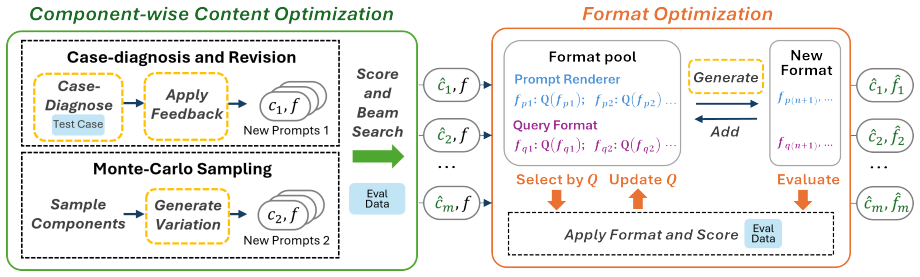
The central object is the structured prompt template, which splits a prompt into content components (Task Instruction, Task Detail, Output Format, Few-shot Examples, Query) and format components (Prompt Renderer and Query Format). CFPO carries out optimization as a dual loop: a content optimizer proposes mutated candidates through case-diagnosis and Monte-Carlo sampling, and a format optimizer assigns each candidate the best format from a dynamically growing pool, using an Upper Confidence Bounds (UCT) score to balance trying new formats against reusing well-scored ones, with new formats generated by an LLM from descriptions and rendered code. This decoupling is what lets the method search the two dimensions separately while evaluating them together.
What would settle it
Run CFPO and a content-only baseline on the 50-example Big-Bench task multiple times with different seeds and report the confidence interval of the chosen prompt's test accuracy; if the CFPO advantage is not consistently outside the noise, the joint-optimization claim fails there. A complementary test is to give the content-only baseline the same number of format evaluations per round and check whether the gap shrinks.
Extended reading notes
Core claim
CFPO's claim is that treating prompt content and prompt format as interdependent and optimizing them jointly yields measurable gains over optimizing content alone. The optimizer alternates between a content stage—which revises individual components (task instruction, task detail, output format, few-shot examples) using both correct and incorrect cases plus Monte Carlo sampling—and a format stage, which scores and refines a dynamic pool of format configurations under a UCT selection rule. In the paper's experiments, full CFPO outperforms its own content-only, format-only, and sequential variants, and beats ProTeGi and SAMMO on nearly every model-task pair, for example reaching 53.22 on GSM8K with Mistral-7B versus ProTeGi's 45.72.
Load-bearing premise
The method's success rests on the assumption that a prompt's score on the small evaluation subset (as few as 50 examples) reliably predicts which prompt will generalize best to the test set.
Editorial extensions
If this is right
- Prompt formatting should be reported and treated as a variable in future prompt-optimization and evaluation studies, since it can change accuracy by several points on the same prompt content.
- Pre-trained (base) models may benefit systematically from longer prompts and more in-context examples, whereas instruction-tuned models need less explicit scaffolding, which could guide default prompt designs.
- Because format optimization appears to converge faster than content optimization, a schedule that spends more format-search budget early and content budget later could lower optimization cost.
- CFPO's gains do not require a top-tier optimizer model: using Qwen2.5-14B as the optimizer still improves over content-only baselines, suggesting the approach transfers to cheaper setups.
Reading between the lines
- An untested implication is that the optimal format for a task may transfer across models of the same family or even across tasks; the format pool design makes this plausible, but the paper does not report cross-model format transfer.
- A matched-budget comparison would be needed to confirm that the gains come from content-format coupling rather than from CFPO spending extra evaluations per round on format candidates.
- On the 50-example Big-Bench split, the reported 8-point gap over SAMMO is within the standard error of about 5 points; repeated runs with confidence intervals are the natural way to test whether the joint-optimization advantage is real on small evaluation sets.
Editorial analysis
A structured set of objections, weighed in public.
Referee Report
Summary. The paper introduces CFPO, an iterative prompt optimization method that jointly optimizes prompt content and formatting. It decomposes prompts into content and format components, mutates content via case diagnosis and Monte-Carlo sampling, and explores formats through a dynamic pool scored by UCT selection plus LLM-generated formats. Experiments on Big-Bench Classification, ARC-Challenge, GSM8K, and MATH500 across four open-source LLMs report consistent improvements over content-only baselines such as ProTeGi and SAMMO, with ablations attributing gains to format generation, UCT selection, and joint content-format optimization.
Significance. If the reported results are reliable, the paper makes a useful contribution by treating prompt format as a searchable, model-dependent dimension rather than a fixed design choice. The methodology is clearly described, the code is released, and the evaluation includes multiple target models and tasks. The paper also provides useful stability and cost analyses (Tables 6 and 7) and a format-generation-model ablation (Table 9). However, the significance of the central claim is currently limited by two methodological gaps: the comparison between CFPO and content-only baselines is not matched on evaluation budget, and the small selection subsets (especially 50 examples for Big-Bench) make the reported differences statistically fragile. These issues can be addressed with additional experiments and uncertainty quantification.
major comments (3)
- [Section 3.3.3 (Algorithm 1) and Table 7] The comparison between CFPO and content-only baselines is confounded by evaluation budget. In Algorithm 1, CFPO evaluates each content candidate under 2k formats (k=4, so 8 evaluations) per round, while content-only baselines such as ProTeGi and SAMMO evaluate a single format. Table 7 reports CFPO's per-round cost of 237 API calls, but no comparable budget or cost is reported for CFPOc, ProTeGi, or SAMMO. Consequently, the improvements in Tables 1 and 2 may reflect additional target-model evaluations rather than the format dimension itself. Please provide a matched-budget comparison, for example by allowing content-only baselines the same number of evaluations per content candidate or by reporting CFPOc with an equivalent evaluation budget.
- [Section 4.1 and Section B.3] The final prompt is selected as the argmax on a very small evaluation subset: 50 examples for Big-Bench Classification, 500 for GSM8K, 500 for ARC-C, and 300 for MATH500. On the 50-example task, the reported gaps (e.g., 94 vs. 86 for Mistral-7B in Table 1) are within roughly two standard errors of a binomial proportion, so the ranking of methods may be noise. No confidence intervals, significance tests, or repeated baseline runs are reported; Table 6 reports standard deviations for CFPO only. To support the claim of consistent improvements, please report variance or confidence intervals for all methods, or use larger selection sets.
- [Table 2 and Section 4.3] The ablation comparing full CFPO with the sequential variant CFPOc+f does not isolate the benefit of joint optimization. CFPOc+f performs 'a separate, single-step format optimization,' whereas full CFPO performs format optimization in every iteration with 2k format evaluations per content candidate. Without matching the number of format evaluations or optimization iterations, the gap between full CFPO and CFPOc+f may simply reflect a larger total search budget. To establish that joint optimization is superior to sequential optimization, the sequential variant should be given the same evaluation budget as the full pipeline.
minor comments (5)
- [Section 2.2] The subsection title 'Prefix Tunning' contains a typo; it should read 'Prefix Tuning.'
- [Appendix A.2.2] In the Monte-Carlo Sampling meta-prompt for examples, 'shoud' should be 'should'.
- [Related Work] The references to Voronov et al. 2024a and 2024b refer to the same paper published in two venues; please consolidate them into a single citation to avoid duplication.
- [Table 5] The caption of Table 5 repeats the caption of Table 3 ('Ablation of format generation and comparison of format selection strategies') but the table reports MMLU results; the caption should describe the MMLU experiment.
- [Section 4.1] The text says optimization uses subsets sampled from the 'training split' while Section B.3 refers to an 'evaluation set' and then reports results on a 'test set.' Please clarify the terminology and whether the reported numbers are on held-out test sets.
Circularity Check
No significant circularity: CFPO's claims are empirical comparisons on held-out test sets, with no definitional or self-citation loop in the derivation chain.
full rationale
The paper makes no mathematical derivation whose conclusion is equivalent to its assumptions. The central quantity, the format score Q(f), is defined as an accumulating empirical statistic Q(f) <- Q(f) + m(c, f) over evaluated prompts, and the final reported numbers are obtained by evaluating the best-scoring prompt on held-out test sets (Section B.3). This is a standard fit-and-evaluate procedure, not a quantity defined in terms of the claimed outcome. The UCT selection criterion in Eq. 1 combines the same empirical score with an exploration term; it selects candidates but does not by construction determine the final comparison, which is made on the test set. The ablation variants CFPOc, CFPOf, and CFPOc+f are defined by holding either format, content, or the order of optimization fixed, and their comparisons are empirical. There is no self-citation load-bearing argument: the paper cites prior work for background and baselines, and the compared methods are external baselines (ProTeGi, SAMMO, APE, GRIPS), not results derived from the authors' own prior theorems. The absence of confidence intervals and the possibility of evaluation-budget confounds are threats to the validity of the empirical comparison, but they are not circularity: the reported gains are not forced by definition or by the paper's own equations. Accordingly, the circularity score is 0.
Assumptions & free parameters
free parameters (3)
- UCT exploration coefficient alpha =
1e-3
- Number of format candidates k =
4
- Beam size for content mutations =
8
assumptions (4)
- domain assumption Small sampled subsets of training data are representative enough to rank prompt candidates and transfer to test performance.
- domain assumption Content and format can be meaningfully decoupled and optimized separately.
- domain assumption The LLM optimizer can reliably generate valid content mutations, format descriptions, and executable renderer code.
- domain assumption UCT bandit selection is an appropriate search strategy for the format pool under non-stationary rewards.
Cite this review
Pith. "Pith review of Beyond Prompt Content: Enhancing LLM Performance via Content-Format Integrated Prompt Optimization." pith.science (2026). https://pith.science/paper/455ANJKW
@misc{pith2026250204295,
  author       = {Pith},
  title        = {Pith review of: Beyond Prompt Content: Enhancing LLM Performance via Content-Format Integrated Prompt Optimization},
  year         = {2026},
  howpublished = {\url{https://pith.science/paper/455ANJKW}},
  note         = {Machine review of arXiv:2502.04295}
}
read the original abstract
Large Language Models (LLMs) have shown significant capability across various tasks, with their real-world effectiveness often driven by prompt design. While recent research has focused on optimizing prompt content, the role of prompt formatting, a critical but often overlooked dimension, has received limited systematic investigation. In this paper, we introduce Content-Format Integrated Prompt Optimization (CFPO), an innovative methodology that jointly optimizes both prompt content and formatting through an iterative refinement process. CFPO leverages natural language mutations to explore content variations and employs a dynamic format exploration strategy that systematically evaluates diverse format options. Our extensive evaluations across multiple tasks and open-source LLMs demonstrate that CFPO demonstrates measurable performance improvements compared to content-only optimization methods. This highlights the importance of integrated content-format optimization and offers a practical, model-agnostic approach to enhancing LLM performance. Code is available at https://github.com/HenryLau7/CFPO.
Figures


Figures from the paper (3 more)


Forward citations
Cited by 2 Pith papers
-
Knowing How to Edit: Reliable Evaluation Signals for Diagnosing and Optimizing Prompts at Query Level
An execution-free evaluator that predicts prompt-quality metrics guides per-query prompt rewriting, but the reported consistent gains are not supported by the paper's own tables.
-
Prompt Orchestration Markup Language
POML is a markup language that structures LLM prompts, embeds multimodal data, and decouples formatting via stylesheets, with case studies showing strong prompt format sensitivity.
Reference graph
Works this paper leans on
-
[3]
Please present the results without indicating which action was taken
Modification: Changing the content of an example while maintaining its contextual relevance. Please present the results without indicating which action was taken. Each refined EXAMPLES segment is marked by <START> and <END>. The [NUMBER OF GENERATED EXAMPLES] revised EXAMPLES are: A.2.2 Monte-Carlo Sampling Monte-Carlo Sampling Meta-Prompt explores a wide...
-
[4]
In scenarios involving complex numbers, represent answers in their standard form (a + bi ), ensuring both 'a' and 'b' are presented in their simplest, most refined state. This emphasizes the need for a clear, coherent representation of solutions encompassing complex numbers
-
[5]
Conclude your explanation with the statement: "The answer is: \[<ANSWER>\].", reinforcing consistency and clarity across various mathematical challenges. This concluding statement should encapsulate the solution in its simplest and most direct form, reflecting a thorough simplification and rationalization process. Your explanation must delineate a detaile...
-
[8]
Addition: Incorporating one new example into the existing set
-
[9]
Deletion: Eliminating one single example from the current set
-
[10]
Modification: Changing the content of an example while maintaining its contextual relevance. Please present the results without indicating which action was taken. The varied EXAMPLES segment is as follows: A.3 Format Generation Our format generation process is a two-step pro- cedure designed to create diverse and effective prompt formats. We focus on gene...
work page 2023
-
[12]
Avoid the use of decimals unless the question explicitly requires it or they are necessary for conveying the most precise value possible
-
[13]
Present solutions involving square roots in their reduced radical form, ensuring the simplification process enhances comprehension without diluting mathematical integrity
Show all 13 references
-
[18]
The answer is: <ANSWER>
The answer is 18. Question: Grandma wants to order 5 personalized backpacks for each of her grandchildren 's first days of school. The backpacks are 20% off of $20 .00, and having their names monogrammed on the backpack will cost $12.00 each. How much will the backpacks cost i...
-
[2020]
In Proceedings of the Annual Conference on Neural Information Processing Systems (NeurIPS)
Language models are few-shot learners. In Proceedings of the Annual Conference on Neural Information Processing Systems (NeurIPS). Tianle Cai, Xuezhi Wang, Tengyu Ma, Xinyun Chen, and Denny Zhou. 2024. Large language models as tool makers. Anwoy Chatterjee, H S V N S Kowndinya...
2024 arXiv
-
[2022]
In Proceedings of the 60th Annual Meeting of the Association for Computational Linguistics (V olume1: Long Papers), pages 8410–8423, Dublin, Ireland
PPT: Pre-trained prompt tuning for few-shot learning. In Proceedings of the 60th Annual Meeting of the Association for Computational Linguistics (V olume1: Long Papers), pages 8410–8423, Dublin, Ireland. Association for Computational Linguistics. Yanhui Guo, Shaoyuan Xu, Jinmi...
2024 arXiv
-
[2023]
gradient descent
Let’s verify step by step. arXiv preprint arXiv:2305.20050. Meta. 2024a. Introducing meta llama3: The most capa- ble openly available llm to date. Meta. 2024b. The llama 3 herd of models. Preprint, arXiv:2407.21783. Microsoft. 2024. Phi-3 technical report: A highly capa- ble l...
2024 arXiv
-
[2024]
""[CURRENT PROMPT]
The prompt report: A systematic survey of prompting techniques. Melanie Sclar, Yejin Choi, Yulia Tsvetkov, and Alane Suhr. 2024. Quantifying Language Models’ Sensitiv- ity to Spurious Features in Prompt Design or: How I learned to start worrying about prompt formatting. In Pro...
2024 arXiv
Reviewed August 8, 2026 · model on record in the stance chip above.
Discussion (0). Continue with ORCID to comment.