REVIEW 4 major objections 6 minor 75 references
Non-intrusive reduced-order modeling for dynamical systems with spatially localized features
T0 review · 4 major / 6 minor · reviewed 2026-08-10 · deepseek-v4-flash
Pith's one-line read A domain split lets reduced models predict beyond the training data.
desk verdict OpInf-sFOM domain-decomposed non-intrusive ROM is a useful new combination, but the Burgers 'beyond training' claim doesn't cover the full periodic horizon, and the glacier nonlinearity is underspecified. read the letter →
The pith
A machine-rendered reading of the paper's core claim, the machinery that carries it, and where it could break.
The reading
What carries the argument
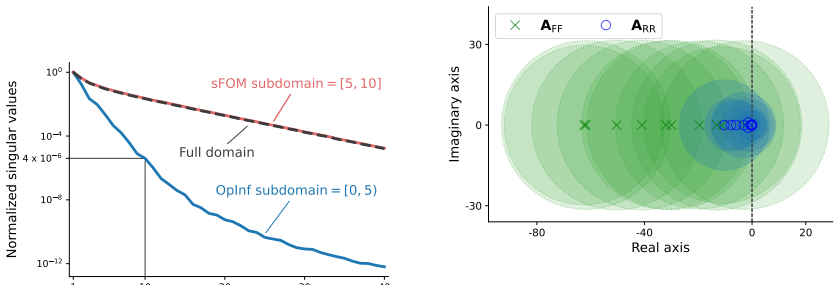
The central mechanism is the domain decomposition of the state vector into an OpInf subdomain and an sFOM subdomain, selected by comparing normalized singular value decays of subdomain snapshot matrices. OpInf learns a low-dimensional quadratic (or linear) model from projected snapshots, while sFOM learns adjacency-based stencil coefficients at full order for each DOF; coupling terms across the interface enter each subproblem as inputs. To promote stable inferred operators, the paper adds a Gershgorin-disk-based regularizer that penalizes the L2 norm of operator rows (bounding disk radii) and adds a diagonal penalty that pushes disk centers toward the left half-plane, both with closed-form least-squares solutions. A post-processing interpolation over an overlapping strip enforces solution smoothness across the interface.
What would settle it
Run the coupled OpInf-sFOM on a transport-dominated test case whose localized feature crosses the prescribed interface during the prediction period; the model should show accuracy collapse or instability (as the paper's Appendix A already does for a Burgers interface beyond a=5.5), confirming the fixed partition is the decisive limit.
Extended reading notes
Core claim
The central claim is that coupling a projection-based ROM to a full-order inferred model through domain decomposition yields non-intrusive predictions that are not confined to the span of the training snapshots. In the proposed formulation, the domain is partitioned a priori based on the gap in singular value decay: the subdomain with fast decay is reduced through Operator Inference, while the subdomain exhibiting slow decay is modeled by sparse full-order inference, which is not bound to a reduced basis. The two subproblems are coupled by interface DOFs, and a Gershgorin-disk-based regularization with closed-form solution drives inferred linear operators toward stability. The paper demonstrates the coupled model on a 1D Burgers' equation with a propagating wave beyond the training interval and on a parametric 2D ice-thickness model of Pine Island Glacier, reporting average prediction errors on the order of 1% and an average online speedup of 7.89x, roughly 8x, over the full-order code.
Load-bearing premise
The load-bearing premise is that the subdomain partition is fixed before training: the moving front or localized feature must remain inside the chosen sFOM subdomain over the whole prediction horizon, since there is no adaptive mechanism to move the interface.
Editorial extensions
If this is right
- Accurate non-intrusive predictions are possible for transport-dominated features that evolve beyond the span of the training snapshots, as shown by the Burgers' wave test.
- A parametric ROM can be trained on extreme parameter values and predict intermediate cases, as demonstrated by the ice-thickness model trained only at alpha=0 and alpha=100 m/yr.
- The online cost savings grow as the slow-decay region shrinks relative to the full domain and as the OpInf dimension decreases; the paper gives explicit cost ratios for estimating this.
- Stable inferred linear operators are promoted by the proposed Gershgorin regularization, which the paper shows produces negative-real-part eigenvalues for both OpInf and sFOM operators in the test cases.
Reading between the lines
- An adaptive interface that moves the sFOM subdomain to track a propagating feature would extend the method to problems where the localized region travels; the paper's appendix shows that a fixed interface fails once transport-dominated dynamics enter the OpInf subdomain.
- The singular-value-decay gap indicator could be combined with an online error estimator to trigger subdomain re-partitioning, opening a path to reliable a posteriori control of the decomposition.
- The same Gershgorin penalty idea applies to any least-squares-based non-intrusive model with a linear term, so it may improve robustness in other inference pipelines beyond OpInf-sFOM.
- Because full-order inference can represent local dynamics that a basis cannot, the method may be suited to predicting local bifurcations, although the paper only lists this as future work.
Editorial analysis
A structured set of objections, weighed in public.
Referee Report
Summary. This paper proposes a domain-decomposition framework coupling Operator Inference (OpInf) in subdomains with fast singular value decay and sparse Full-Order Model (sFOM) inference in subdomains with slow decay, together with a Gershgorin-theorem-based regularization that promotes stability of the inferred linear operators. The coupled OpInf-sFOM method is applied to a 1D Burgers equation with periodic boundary conditions (training on t<=9 s, evaluation to T=18 s) and to a 2D parametric Pine Island Glacier ice-thickness model (training on 15 years at the extreme melt rates alpha=0 and alpha=100 m/yr, evaluation for intermediate alpha and up to 20 years). The paper claims accurate predictions beyond the span of the training snapshots, with an approximately 8x online speedup in the glacier test. A parametric cost analysis for offline and online phases is included, along with a released Python code for the Burgers example.
Significance. If the central claims are established, the work offers a practical way to extend non-intrusive model reduction to problems with spatially localized, transport-dominated features, and the Gershgorin regularization is a useful addition to the OpInf/sFOM toolkit. The Burgers code is publicly available, and the parametric cost formulas are a helpful planning tool. However, as detailed below, the evidence for the headline extrapolation claim is incomplete, and the treatment of the nonlinear threshold in the glacier test needs clarification.
major comments (4)
- [Section 5.1, Appendix A] The Burgers test with periodic boundary conditions and T=18 s does not establish the claimed 'beyond training' predictions for the full stated horizon. With the interface at z=5, the front, which travels at speed roughly c*w, exits through z=10 near t=10 s and re-enters the OpInf subdomain [0,5) via the periodic boundary. Appendix A shows that when transport-dominated dynamics enter the OpInf subdomain (interface a>=5.5), the inferred models become unstable. Since no error metrics are reported separately for t in [9,10] versus t in [10,18], the demonstration only supports extrapolation before the wrap-around. The authors should either restrict the claim to that interval, provide time-resolved errors showing the model remains accurate after wrap, or add an explicit periodic-interface treatment.
- [Section 5.2.2, Eq. (37)] The role of the nonlinear basal-melt threshold in the sFOM inference is underspecified. The sFOM formulation in Sections 2.3 and 3.1 assumes the quadratic structure of Eq. (2)/(18), but the indicator forcing m_b(h,alpha)=alpha*1_{h>h_f} in Eq. (37) is not polynomial. The text states that 'we infer ... a nonlinear sFOM model (due to (36)) by solving (16)', but Eq. (16) is the linear coupled system, not an inference problem, and it is not explained how the threshold is represented in the least-squares problem (11) or in the coupled equations (18). Without this explanation, the glacier test cannot be evaluated as a demonstration of the proposed OpInf-sFOM framework. Please clarify whether m_b is a known state-dependent forcing, an additional unknown operator, or a precomputed input, and how the non-smooth indicator is handled during inference and online integration.
- [Abstract and Section 5.2.2, Figure 13] The abstract and conclusions claim 'an average prediction error on the order of 1%', but Figure 13 reports median errors that rise to around 1% only at later times, with boxplot maxima of order 10%. The exact metric (spatial average, time average, or median) is not defined in the text, which makes the headline claim difficult to reproduce. Please define the error metric precisely and report it separately for the OpInf and sFOM subdomains, as the spatial distribution of error is directly relevant to the domain-decomposition claim.
- [Section 3.1.1, Appendix A, Section 6] The fixed a priori subdomain partition is a limiting assumption that should be stated more prominently. The paper acknowledges in Section 6 that an adaptive decomposition is future work, but the abstract and introduction present the method as enabling predictions 'beyond those sampled in the training data set' without this caveat. Since Appendix A shows that a slightly larger OpInf subdomain leads to unstable models, the method's validity depends on the localized feature remaining inside the manually chosen sFOM subdomain for the entire prediction horizon. The authors should state this condition in the abstract and conclusions and discuss how the singular-value-decay indicator of Section 3.1.1 could be used to check it beyond the training window.
minor comments (6)
- [Section 5.2.2] The phrase 'by solving (16)' should be 'by solving (17)' or '(18)', since Eq. (16) is the coupled system, not the inference problem.
- [Section 2.3] The statement '(x(t) (x) x(t))_{E_i} = x_{Q_i}(t) (x) x_{Q_i}(t)' relies on an implicit ordering of the Kronecker product; please define the index set E_i accordingly so that this identity holds.
- [Figure 5] The axis labels in the left and right panels are inconsistent with the text: the left panel's x-axis reads 'ROM dimension / global sFOM DOFs' while the right panel refers to 'ROM dimension / global ROM dimension'; please align the labels with the text and with Eqs. (30)-(31).
- [Section 5.1] The sentence 'equation (2) with T and all higher order terms equal to zero' contains an undefined symbol T; presumably a typo for the quadratic term.
- [Data & Code Availability] Only the Burgers code is released; please state explicitly that the glacier data and code are not publicly available, and where possible provide the sFOM inference details needed to reproduce the glacier results.
- [Section 4.1] The cost analysis assumes n_T >> m; it would be helpful to state the actual values of n_T and m for the two test cases to verify that this assumption is satisfied.
Circularity Check
No significant circularity: the coupled OpInf-sFOM derivation is a forward composition of independent methods, and the headline predictions are evaluated on unseen times and parameters.
full rationale
The paper's central claim is that coupling OpInf with sFOM via domain decomposition enables non-intrusive predictions beyond the span of the training snapshots for systems with spatially localized slow singular value decay. This claim is not circular: the sFOM component infers local stencil coefficients from training data and then integrates forward in time, while the OpInf component is bound to its reduced basis; the 'beyond training' statement is established by evaluating on times after the training window (Burgers, t in (9,18] s) and on parameter values not used in training (glacier, intermediate alpha and t in (15,20] yr). The subdomain selection via singular value decay of training data is a data-driven design choice, not a quantity that is later reported as a prediction. The Gershgorin regularization is a stability-promoting heuristic with a closed-form solution; it does not encode the benchmark errors or the extrapolated outputs. Self-citations to prior OpInf and sFOM works are methodological and are not load-bearing in the sense of invoking a self-authored uniqueness theorem or forbidding alternatives. The paper explicitly acknowledges limitations, including the fixed a priori partition, the instability documented in Appendix A when the interface moves beyond a=5.5, and the statement that stability of each submodel does not guarantee stability of the coupled system. These are correctness risks, not circularities. No derivation step was found that reduces by construction to its own inputs.
Assumptions & free parameters
free parameters (7)
- Reduced dimension r (Burgers and PIG) =
10 in both test cases
- sFOM stencil width s =
3-point stencil in 1D; 3-point per coordinate in 2D cost analysis
- Regularization weights eta1 and eta2 for OpInf and sFOM =
Burgers: etaOpInf2=0.05*etaOpInf1, etaSfom2=50*etaSfom1; PIG: etaOpInf2=2e3*etaOpInf1, etaSfom2 in [1e-2,1e2]*etaSfom1
- Quadratic-term regularization scaling factors =
Burgers: 200x for OpInf, 10x for sFOM
- Number of concatenated sFOM rows for uniform mesh =
5 randomly selected DOFs per 1D stencil inference
- OpInf-sFOM interface position / subdomain partition =
Burgers interface at z=5; PIG with 4,585 sFOM DOFs and 7,909 OpInf DOFs
- Overlap region width / interpolation scheme =
narrow overlap; bilinear interpolation for PIG
assumptions (6)
- domain assumption The governing discretized dynamics have a known polynomial structure (linear in (15) or quadratic in (2)), with operators A, H, B, c unknown.
- domain assumption Full state snapshot data and time-derivative data are available for training.
- domain assumption The full-order operators have an adjacency-based sparsity pattern and the mesh adjacency information is accessible.
- domain assumption The OpInf and sFOM subdomains can be chosen a priori from training data and remain valid over the prediction horizon.
- ad hoc to paper Penalizing the L2 norm of operator rows and the diagonal entries of the linear operator promotes stability of the inferred model.
- domain assumption The simplified ice thickness model (35)-(37) with fixed velocity field v is an adequate representation of Pine Island Glacier dynamics, and the ISSM simulations used for training are ground truth.
Cite this review
Pith. "Pith review of Non-intrusive reduced-order modeling for dynamical systems with spatially localized features." pith.science (2026). https://pith.science/paper/45ZFUJKZ
@misc{pith2026250104400,
  author       = {Pith},
  title        = {Pith review of: Non-intrusive reduced-order modeling for dynamical systems with spatially localized features},
  year         = {2026},
  howpublished = {\url{https://pith.science/paper/45ZFUJKZ}},
  note         = {Machine review of arXiv:2501.04400}
}
abstract
This work presents a non-intrusive reduced-order modeling framework for dynamical systems with spatially localized features characterized by slow singular value decay. The proposed approach builds upon two existing methodologies for reduced and full-order non-intrusive modeling, namely Operator Inference (OpInf) and sparse Full-Order Model (sFOM) inference. We decompose the domain into two complementary subdomains that exhibit fast and slow singular value decay. The dynamics of the subdomain exhibiting slow singular value decay are learned with sFOM while the dynamics with intrinsically low dimensionality on the complementary subdomain are learned with OpInf. The resulting, coupled OpInf-sFOM formulation leverages the computational efficiency of OpInf and the high resolution of sFOM, and thus enables fast non-intrusive predictions for conditions beyond those sampled in the training data set. A novel regularization technique with a closed-form solution based on the Gershgorin disk theorem is introduced to promote stable sFOM and OpInf models. We also provide a data-driven indicator for subdomain selection and ensure solution smoothness over the interface via a post-processing interpolation step. We evaluate the efficiency of the approach in terms of offline and online speedup through a quantitative, parametric computational cost analysis. We demonstrate the coupled OpInf-sFOM formulation for two test cases: a one-dimensional Burgers' model for which accurate predictions beyond the span of the training snapshots are presented, and a two-dimensional parametric model for the Pine Island Glacier ice thickness dynamics, for which the OpInf-sFOM model achieves an average prediction error on the order of $1 \%$ with an online speedup factor of approximately $8\times$ compared to the numerical simulation.
Figures


Figures from the paper (13 more)




Reference graph
Works this paper leans on
-
[1]
P. J. Baddoo, B. Herrmann, B. J. McKeon, J. Kutz, N., and S. L. Brunton. Physics-informed dynamic mode decomposition. Proceedings of the Royal Society A: Mathematical, Physical and Engineering Sciences , 479(2271), 2023. doi:10.1098/rspa.2022.0576
arXiv 2023
-
[2]
J. Bamber, J. Gomez-Dans, and J. Griggs. A new 1 km digital elevation model of the Antarctic derived from combined satellite radar and laser data - Part 1: Data and methods. The Cryosphere, 3(1):101–111, 2009. doi:10.5194/tc-3-101-2009 . 23
-
[3]
J. Barnett, I. Tezaur, and A. Mota. The Schwarz alternating method for the seamless coupling of nonlinear reduced order models and full order models, 2022. arXiv:2210.12551
work page Pith review arXiv 2022
-
[4]
P. Benner, P. Goyal, J. Heiland, and I. Pontes Duff. Operator Inference and physics-informed learning of low-dimensional models for incompressible flows. Electronic Transactions on Nu- merical Analysis, 56:28–51, 2021. doi:10.1553/ETNA_VOL56S28
-
[5]
P. Benner, S. Grivet-Talocia, A. Quarteroni, G. Rozza, W. H. A. Schilders, and L. M. Silveira, editors. Model Order Reduction. De Gruyter, Berlin, 2021. doi:10.1515/9783110671490
- [6]
- [7]
-
[8]
M. Bergmann, A. Ferrero, A. Iollo, E. Lombardi, A. Scardigli, and H. Telib. A zonal Galerkin- free POD model for incompressible flows. Journal of Computational Physics , 352:301–325,
Show all 75 references
-
[9]
S. Binder. ´Etude de l’observation et de la mod´ elisation des ondes de surface en eau peu profonde. GitHub repository. https://github.com/sachabinder/Burgers_equation_ simulation, 2013
2013
-
[10]
S. L. Brunton, J. L. Proctor, and J. N. Kutz. Discovering governing equations from data by sparse identification of nonlinear dynamical systems. Proceedings of the National Academy of Sciences of the United States of America , 113(15):3932–3937, 2016. doi:10.1073/pnas. 1517384113
2016 doi
-
[11]
Buffoni, H
M. Buffoni, H. Telib, and A. Iollo. Iterative methods for model reduction by domain decom- position. Computers & Fluids , 38(6):1160–1167, 2009. doi:10.1016/j.compfluid.2008.11. 008
2009 doi
-
[12]
de Castro, P
A. de Castro, P. Bochev, P. Kuberry, and I. Tezaur. Explicit synchronous partitioned scheme for coupled reduced order models based on composite reduced bases. Computer Methods in Applied Mechanics and Engineering , 417:116398, 2023. A Special Issue in Honor of the Lifetime Ach...
2023
-
[13]
de Castro, P
A. de Castro, P. Kuberry, I. Tezaur, and P. Bochev. A Novel Partitioned Approach for Reduced Order Model—Finite Element Model (ROM-FEM) and ROM-ROM Coupling. In Earth and Space 2022 , pages 475–489. doi:10.1061/9780784484470.044
2022 doi
-
[14]
A. N. Diaz, Y. Choi, and M. Heinkenschloss. A fast and accurate domain decomposition nonlinear manifold reduced order model. Computer Methods in Applied Mechanics and Engi- neering, 425:116943, 2024. doi:10.1016/j.cma.2024.116943
2024
-
[15]
J. L. Eftang and A. T. Patera. Port reduction in parametrized component static condensation: approximation and a posteriori error estimation. International Journal for Numerical Methods in Engineering, 96(5):269–302, 2013. doi:10.1002/nme.4543
2013 doi
-
[16]
Farcas, R
I.-G. Farcas, R. P. Gundevia, R. Munipalli, and K. E. Willcox. Domain decomposition for data-driven reduced modeling of large-scale systems. AIAA Journal, 62(11):4071–4086, 2024. doi:10.2514/1.J063715
2024 doi
-
[17]
Gastaldi, A
F. Gastaldi, A. Quarteroni, and G. Landriani. Coupling of two-dimensional hyperbolic and elliptic equations. Computer Methods in Applied Mechanics and Engineering , 80(1):347–354,
-
[18]
Geelen, S
R. Geelen, S. Wright, and K. Willcox. Operator inference for non-intrusive model reduc- tion with quadratic manifolds. Computer Methods in Applied Mechanics and Engineering , 403:115717, 2023. doi:10.1016/j.cma.2022.115717. 24
2023
-
[19]
S. A. Gershgorin. ¨Uber die Abgrenzung der Eigenwerte einer Matrix. Bulletin de l’Acad´ emie des Sciences de l’URSS, Classe des Sciences Math´ ematiques et Naturelles, 6:749–754, 1931
1931
-
[20]
Gkimisis, T
L. Gkimisis, T. Richter, and P. Benner. Adjacency-based, non-intrusive reduced-order model- ing for fluid-structure interactions. Proceedings in Applied Mathematics & Mechanics , 23(4),
-
[21]
Gkimisis, T
L. Gkimisis, T. Richter, and P. Benner. Adjacency-based, non-intrusive model reduction for vortex-induced vibrations. Computers & Fluids , 275:106248, 2024. doi:10.1016/j. compfluid.2024.106248
2024
-
[22]
Goyal and P
P. Goyal and P. Benner. Generalized quadratic embeddings for nonlinear dynamics using deep learning. Physica D: Nonlinear Phenomena , 463:134158, 2024. doi:10.1016/j.physd.2024. 134158
2024 doi
-
[23]
Goyal, I
P. Goyal, I. P. Duff, and P. Benner. Guaranteed Stable Quadratic Models and their applica- tions in SINDy and Operator Inference, 2023. arXiv:2308.13819
2023 arXiv
-
[24]
Greve and H
R. Greve and H. Blatter. Dynamics of Ice Sheets and Glaciers . Springer Science & Business Media, 2009. doi:10.1007/978-3-642-03415-2
2009 doi
-
[25]
Griggs and J
J. Griggs and J. Bamber. A new 1 km digital elevation model of Antarctica derived from combined radar and laser data - Part 2: Validation and error estimates. The Cryosphere , 3(1):113–123, 2009. doi:10.5194/tc-3-113-2009
2009 doi
-
[26]
P. C. Hansen. Analysis of discrete ill-posed problems by means of the l-curve. SIAM Review, 34(4):561–580, 1992. doi:10.1137/1034115
1992 doi
-
[27]
Holmes, J
P. Holmes, J. L. Lumley, and G. Berkooz. Turbulence, Coherent Structures, Dynamical Sys- tems and Symmetry . Cambridge Monographs on Mechanics. Cambridge University Press,
-
[28]
D. B. P. Huynh, D. J. Knezevic, and A. T. Patera. A static condensation reduced basis element method: approximation and a posteriori error estimation. ESAIM: Mathematical Modelling and Numerical Analysis , 47(1):213–251, 2013. doi:10.1051/m2an/2012022
2013
-
[29]
Ivagnes, N
A. Ivagnes, N. Tonicello, P. Cinnella, and G. Rozza. Enhancing non-intrusive reduced order models with space-dependent aggregation methods. Acta Mechanica, 2024. doi:10.1007/ s00707-024-04007-9
2024
-
[30]
Iyengar, D
N. Iyengar, D. Rajaram, and D. Mavris. Domain decomposition strategy for combin- ing nonlinear and linear reduced-order models. AIAA Journal , 62(4):1375–1389, 2024. doi:10.2514/1.J063361
2024 doi
-
[31]
A. A. Kaptanoglu, J. L. Callaham, A. Aravkin, C. J. Hansen, and S. L. Brunton. Promoting global stability in data-driven models of quadratic nonlinear dynamics.Physical Review Fluids, 6:094401, 2021. doi:10.1103/PhysRevFluids.6.094401
2021 doi
-
[32]
D. S. Karachalios, I. V. Gosea, L. Gkimisis, and A. C. Antoulas. Data-driven quadratic modeling in the loewner framework from input-output time-domain measurements. SIAM Journal on Applied Dynamical Systems , 24(1):457–500, 2025. doi:10.1137/22M153567X
2025 doi
-
[33]
G. E. Karniadakis, I. G. Kevrekidis, L. Lu, P. Perdikaris, S. Wang, and L. Yang. Physics- informed machine learning. Nature Reviews Physics , 3:422–440, 2021. doi:10.1038/ s42254-021-00314-5
2021
-
[34]
B. Kramer. Stability domains for quadratic-bilinear reduced-order models. SIAM Journal on Applied Dynamical Systems , 20(2):981–996, 2021. doi:10.1137/20M1364849
2021 doi
-
[35]
Kramer, B
B. Kramer, B. Peherstorfer, and K. E. Willcox. Learning Nonlinear Reduced Models from Data with Operator Inference. Annual Review of Fluid Mechanics , 56:521–548, 2024. doi: 10.1146/annurev-fluid-121021-025220 . 25
2024 doi
-
[36]
Larour, H
E. Larour, H. Seroussi, M. Morlighem, and E. Rignot. Continental scale, high order, high spatial resolution, ice sheet modeling using the Ice Sheet System Model (ISSM). Journal of Geophysical Research: Earth Surface , 117(F1), 2012. doi:10.1029/2011JF002140
2012 doi
-
[37]
D. J. Lucia, P. I. King, and P. S. Beran. Reduced order modeling of a two-dimensional flow with moving shocks. Computers & Fluids , 32(7):917–938, 2003. doi:10.1016/S0045-7930(02) 00035-X
2003 doi
-
[38]
D. J. Lucia, P. I. King, P. S. Reran, and M. E. Oxley. Reduced order modeling for a one-dimensional nozzle flow with moving shocks. In 15th AIAA Computational Fluid Dynamics Conference . American Institute of Aeronautics and Astronautics, 2001. doi: 10.2514/6.2001-2602
2001 doi
-
[39]
Maddu, D
S. Maddu, D. Sturm, B. L. Cheeseman, C. L. M¨ uller, and I. F. Sbalzarini. STENCIL-NET for equation-free forecasting from data. Scientific Reports, 13(1):12787, 2023. doi:10.1038/ s41598-023-39418-6
2023
-
[40]
S. A. McQuarrie, C. Huang, and K. E. Willcox. Data-driven reduced-order models via reg- ularised Operator Inference for a single-injector combustion process. Journal of the Royal Society of New Zealand , 51(2):194–211, 2021. doi:10.1080/03036758.2020.1863237
2021
-
[41]
M. A. Mendez, A. Ianiro, B. R. Noack, and S. L. Brunton, editors. Data-Driven Fluid Mechan- ics: Combining First Principles and Machine Learning . Cambridge University Press, 2023. doi:10.1017/9781108896214
2023 doi
-
[42]
Mlinari´ c and S
P. Mlinari´ c and S. Gugercin.L2-optimal Reduced-order Modeling Using Parameter-separable Forms. SIAM Journal on Scientific Computing , 45(2):A554–A578, Apr. 2023. doi:10.1137/ 22M1500678
2023
-
[43]
Moore, C
I. Moore, C. Wentland, A. Gruber, and I. Tezaur. Domain decomposition-based coupling of Operator Inference reduced order models via the Schwarz alternating method, 2024. arXiv: 2409.01433
2024 arXiv
-
[44]
Nitsche, S
F. Nitsche, S. Jacobs, R. Larter, and K. Gohl. Bathymetry of the Amundsen Sea continental shelf: Implications for geology, oceanography, and glaciology. Geochemistry, Geophysics, Geosystems, 8(10), 2007. doi:10.1029/2007GC001694
2007 doi
-
[45]
Ohlberger and S
M. Ohlberger and S. Rave. Nonlinear reduced basis approximation of parameterized evolution equations via the method of freezing. Comptes Rendus Math´ ematique, 351:901–906, 2013. doi:10.1016/j.crma.2013.10.028
2013 doi
-
[46]
Peherstorfer
B. Peherstorfer. Model Reduction for Transport-Dominated Problems via Online Adaptive Bases and Adaptive Sampling. SIAM Journal on Scientific Computing , 42(5):A2803–A2836,
-
[47]
Peherstorfer and K
B. Peherstorfer and K. Willcox. Data-driven Operator Inference for nonintrusive projection- based model reduction. Computer Methods in Applied Mechanics and Engineering , 306:196– 215, 2016. doi:10.1016/j.cma.2016.03.025
2016 doi
-
[48]
Prakash and Y
A. Prakash and Y. J. Zhang. Data-driven identification of stable sparse differential opera- tors using constrained regression. Computer Methods in Applied Mechanics and Engineering , 429:117149, 2024. doi:10.1016/j.cma.2024.117149
2024
-
[49]
Prusak, M
I. Prusak, M. Nonino, D. Torlo, F. Ballarin, and G. Rozza. An optimisation–based do- main–decomposition reduced order model for the incompressible Navier-Stokes equations. Computers and Mathematics with Applications , 151:172–189, 2023. doi:10.1016/j.camwa. 2023.09.039
2023 doi
-
[50]
Raissi, P
M. Raissi, P. Perdikaris, and G. E. Karniadakis. Physics-informed neural networks: A deep learning framework for solving forward and inverse problems involving nonlinear par- tial differential equations. Journal of Computational Physics , 378:686–707, 2019. doi: 10.1016/j.jcp....
2019 doi
-
[51]
Rignot, S
E. Rignot, S. Jacobs, J. Mouginot, and B. Scheuchl. Ice-Shelf Melting Around Antarctica. Science, 341(6143):266–270, 2013. doi:10.1126/science.1235798
2013 doi
-
[52]
Rignot, J
E. Rignot, J. Mouginot, and B. Scheuchl. Ice Flow of the Antarctic Ice Sheet. Science, 333(6048):1427–1430, 2011. doi:10.1126/science.1208336
2011 doi
-
[53]
Rignot, J
E. Rignot, J. Mouginot, and B. Scheuchl. MEaSUREs InSAR-Based Antarctica Ice Velocity Map, Version 1, 2011. doi:10.5067/MEASURES/CRYOSPHERE/nsidc-0484.001
2011 doi
-
[54]
D. Rim, B. Peherstorfer, and K. T. Mandli. Manifold Approximations via Transported Sub- spaces: Model Reduction for Transport-Dominated Problems. SIAM Journal on Scientific Computing, 45(1):A170–A199, 2023. doi:10.1137/20M1316998
2023 doi
-
[55]
Sawant, B
N. Sawant, B. Kramer, and B. Peherstorfer. Physics-informed regularization and structure preservation for learning stable reduced models from data with Operator Inference. Computer Methods in Applied Mechanics and Engineering , 404:115836, 2023. doi:10.1016/j.cma. 2022.115836
2023
-
[56]
Schaeffer
H. Schaeffer. Learning partial differential equations via data discovery and sparse optimiza- tion. Proceedings of the Royal Society A: Mathematical, Physical and Engineering Sciences , 473(2197):20160446, 2017. doi:10.1098/rspa.2016.0446
2017
-
[57]
Schaeffer, G
H. Schaeffer, G. Tran, and R. Ward. Extracting sparse high-dimensional dynamics from limited data. SIAM Journal on Applied Mathematics , 78(6):3279–3295, 2018. doi:10.1137/ 18M116798X
2018
-
[58]
Schlegel and B
M. Schlegel and B. R. Noack. On long-term boundedness of Galerkin models. Journal of Fluid Mechanics, 765:325–352, 2015. doi:10.1017/jfm.2014.736
2015 doi
-
[59]
P. J. Schmid. Dynamic mode decomposition of numerical and experimental data. Journal of Fluid Mechanics, 656:5–28, 2010. doi:10.1017/S0022112010001217
2010 doi
-
[60]
P. J. Schmid, L. Li, M. P. Juniper, and O. Pust. Applications of the dynamic mode de- composition. Theoretical and Computational Fluid Dynamics , 25(1-4):249–259, 2011. doi: 10.1007/s00162-010-0203-9
2011 doi
-
[61]
Schumann and P
Y. Schumann and P. Neumann. Towards data-driven inference of stencils for discrete differen- tial operators. In Proceedings of the Platform for Advanced Scientific Computing Conference, PASC 2022, 2022. doi:10.1145/3539781.3539787
2022
-
[62]
Schumann and P
Y. Schumann and P. Neumann. On linear models for discrete Operator Inference in time dependent problems. Journal of Computational and Applied Mathematics , 425:115022, 2023. doi:10.1016/j.cam.2022.115022
2023
-
[63]
Seroussi, M
H. Seroussi, M. Morlighem, E. Rignot, J. Mouginot, E. Larour, M. Schodlok, and A. Khazen- dar. Sensitivity of the dynamics of Pine Island Glacier, West Antarctica, to climate forcing for the next 50 years. The Cryosphere, 8(5):1699–1710, 2014. doi:10.5194/tc-8-1699-2014
2014 doi
-
[64]
G. Strang. Introduction to Linear Algebra. Wellesley-Cambridge Press, 2023
2023
-
[65]
K. Sun, R. Glowinski, M. Heinkenschloss, and D. C. Sorensen. Domain decomposition and model reduction of systems with local nonlinearities. In K. Kunisch, G. Of, and O. Steinbach, editors, Numerical Mathematics and Advanced Applications , pages 389–396. Springer Berlin Heidelb...
2008 doi
-
[66]
D. G. Vaughan, J. L. Bamber, M. Giovinetto, J. Russell, and A. P. R. Cooper. Reassessment of net surface mass balance in Antarctica. Journal of Climate , 12(4):933–946, 1999. doi: 10.1175/1520-0442(1999)012<0933:RONSMB>2.0.CO;2
1999 doi
-
[67]
D. Xiao, F. Fang, A. Buchan, C. Pain, I. Navon, and A. Muggeridge. Non-intrusive reduced order modelling of the Navier–Stokes equations. Computer Methods in Applied Mechanics and Engineering, 293:522–541, 2015. doi:10.1016/j.cma.2015.05.015. 27
2015 doi
-
[68]
D. Xiao, F. Fang, C. E. Heaney, I. M. Navon, and C. C. Pain. A domain decomposition method for the non-intrusive reduced order modelling of fluid flow. Computer Methods in Applied Mechanics and Engineering , 354:307–330, 2019. doi:10.1016/j.cma.2019.05.039
2019 doi
-
[69]
D. Xiao, C. E. Heaney, F. Fang, L. Mottet, R. Hu, D. A. Bistrian, E. Aristodemou, I. M. Navon, and C. C. Pain. A domain decomposition non-intrusive reduced order model for turbulent flows. Computers & Fluids , 182:15–27, 2019. doi:10.1016/j.compfluid.2019.02.012. 28
2019 doi
-
[1990]
doi:10.1016/0045-7825(90)90039-O
-
[1996]
doi:10.1017/CBO9780511622700
-
[2017]
doi:10.1137/1.9781611974829
-
[2018]
doi:10.1016/j.jcp.2017.10.001
2017 doi
-
[2020]
doi:10.1137/19M1257275
-
[2023]
doi:10.1002/pamm.202300047
Reviewed August 10, 2026 · model on record in the stance chip above.
Discussion (0). Continue with ORCID to comment.