Strain-Induced Tuning of Third-Harmonic Generation in Monolayer Black Phosphorene
Pith reviewed 2026-06-27 15:42 UTC · model grok-4.3
The pith
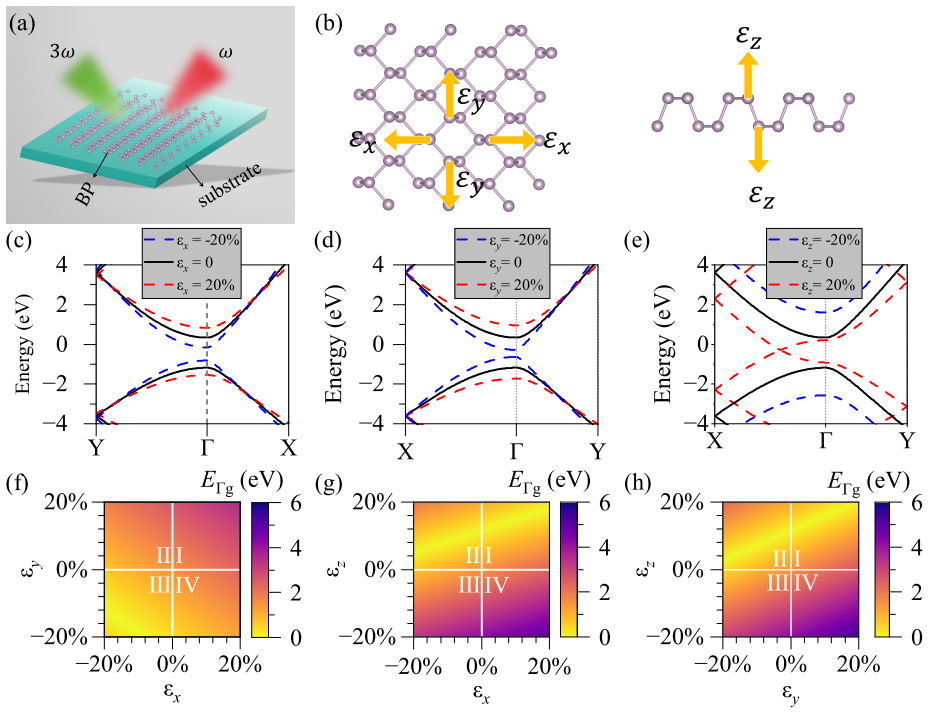
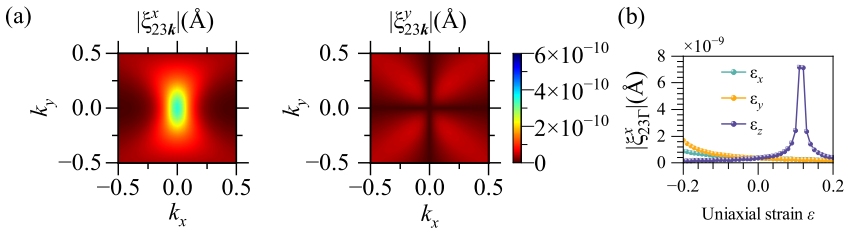
Strain along different axes in monolayer black phosphorene enhances or suppresses third-harmonic generation and shifts its spectrum by altering the bandgap and Berry connection.
A machine-rendered reading of the paper's core claim, the machinery that carries it, and where it could break.
Core claim
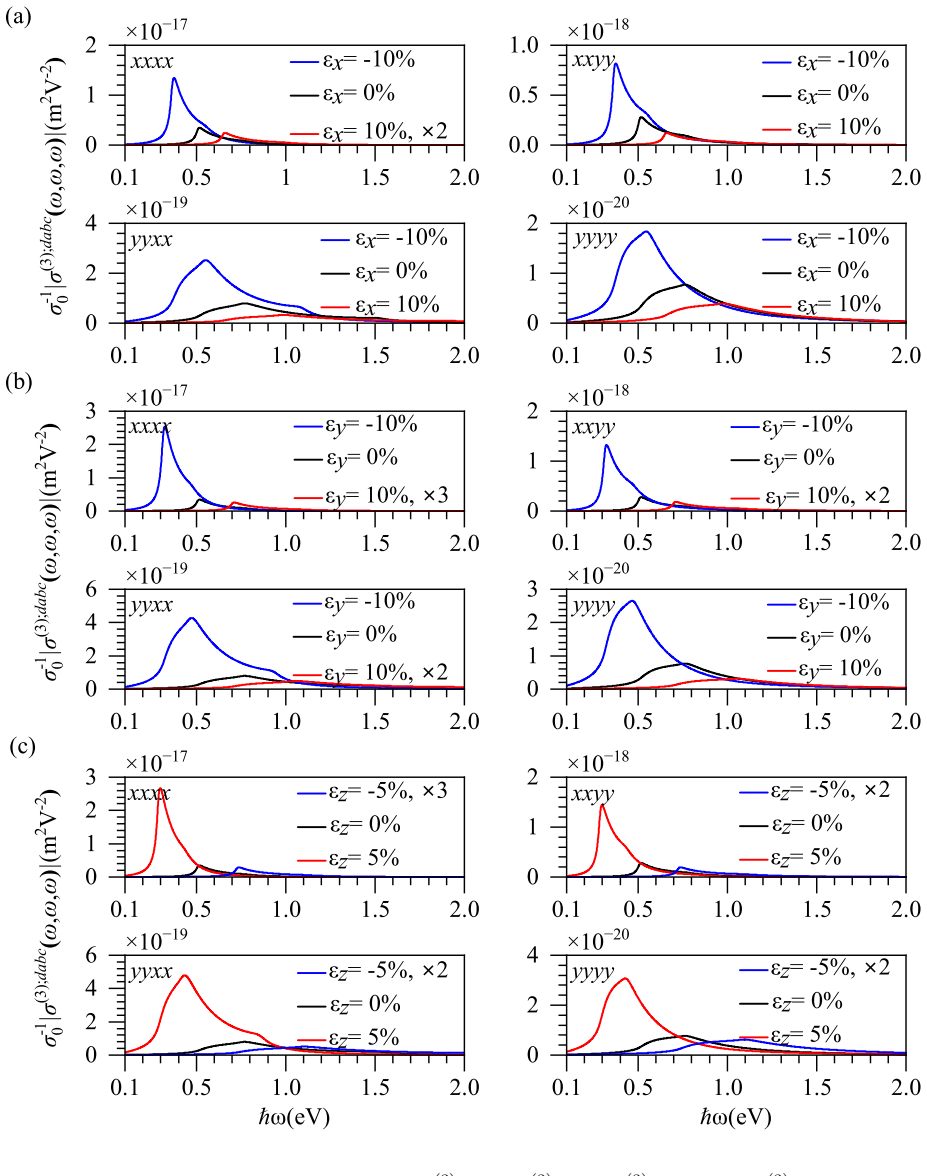
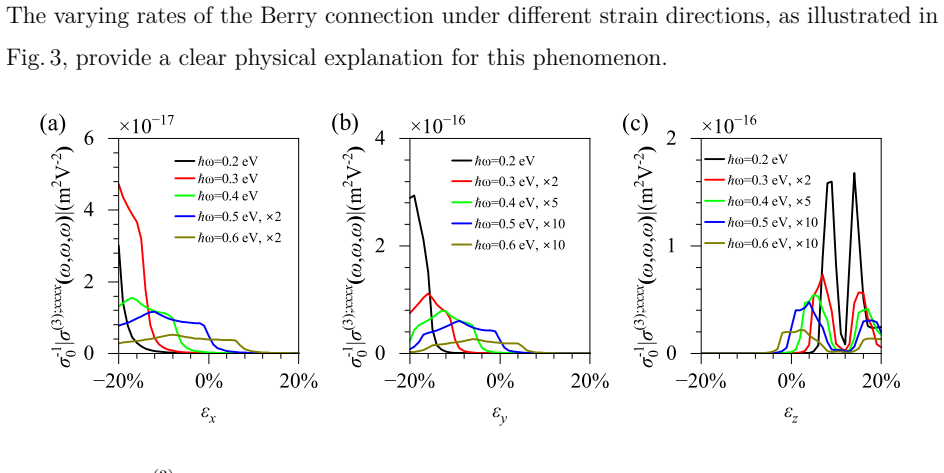
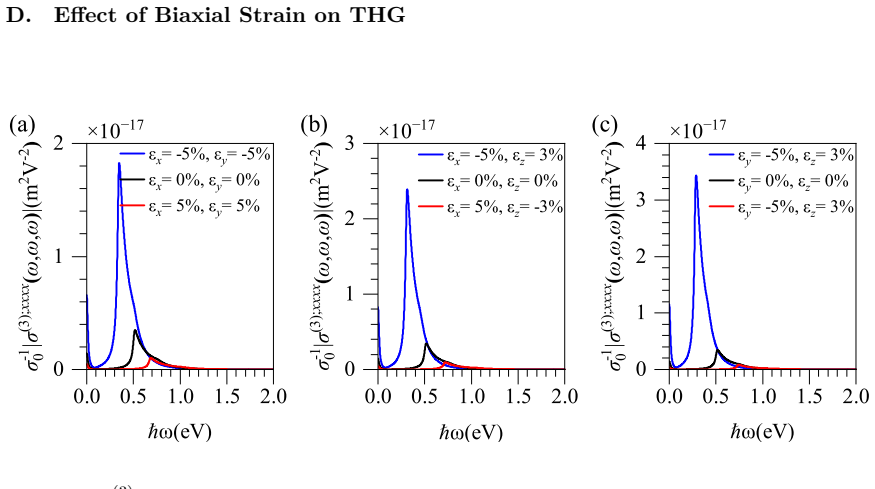
Under strain-free conditions monolayer black phosphorene shows pronounced in-plane anisotropy with a dominant third-order susceptibility χ^(3);xxxx = 1.8 × 10^{-17} m²/V² that matches experiment. Uniaxial and biaxial strains applied along the three principal directions produce strong directional dependence and characteristic spectral shifts: in-plane compression and out-of-plane tension both raise the THG conductivity and induce a redshift, whereas in-plane tension and out-of-plane compression suppress the conductivity and induce a blueshift, with tuning efficiency ordered z > y > x. Biaxial combinations add synergistic or competitive effects. The microscopic driver is the joint modulation o
What carries the argument
Synergistic modulation of the bandgap and Berry connection by strain, which directly alters the nonlinear optical susceptibility calculated from the semiconductor Bloch equations.
If this is right
- In-plane compressive strain and out-of-plane tensile strain both increase THG conductivity and produce a redshift.
- In-plane tensile strain and out-of-plane compressive strain decrease THG conductivity and produce a blueshift.
- Tuning efficiency is highest for out-of-plane strain, then zigzag, then armchair.
- Biaxial strain combinations can produce either reinforcing or opposing shifts in the THG signal.
- Strain therefore supplies a route to dynamic, reversible control of nonlinear optical processes in this two-dimensional material.
Where Pith is reading between the lines
- The same strain-induced modulation of bandgap and Berry connection may operate in other puckered two-dimensional semiconductors that share similar anisotropy.
- Combining strain with electrostatic gating could provide independent knobs for both the resonance position and the amplitude of the THG response.
- The efficiency ordering z > y > x suggests that devices engineered for out-of-plane deformation would require the smallest actuation forces to achieve a given optical change.
Load-bearing premise
The tight-binding parameters and the form of the semiconductor Bloch equations remain valid under applied strain without re-fitting.
What would settle it
An experiment that measures the third-harmonic spectrum of a strained monolayer black-phosphorene flake and finds that neither the peak intensity nor the resonance wavelength changes with strain would falsify the predicted tuning mechanism.
Figures
read the original abstract
Based on the tight-binding model and the semiconductor Bloch equations, this work systematically reveals the microscopic mechanism of strain engineering in turning of third-harmonic generation (THG) in monolayer black phosphorene (BP). % The results show that under strain-free conditions, monolayer BP exhibits significant in-plane anisotropy, and its dominant susceptibility component reaches a maximum of $\chi^{(3);xxxx} = 1.8 \times 10^{-17} \, \text{m}^2/\text{V}^2$, agreeing well with the experimental results. % By applying uniaxial and biaxial strains along the armchair ($x$), zigzag ($y$), and out-of-plane ($z$) directions, we find that the THG response presents strong direction dependence and unique spectral shifting behaviors: in-plane compressive strain and out-of-plane tensile strain both significantly enhance the THG conductivity and induce a redshift, whereas in-plane tensile strain and out-of-plane compression lead to suppression and a blueshift, with the tuning efficiency following the order of $z > y > x$. The microscopic origin of these phenomena is identified as the synergistic modulation of the bandgap and Berry connection by strain. % Furthermore, the synergistic or competitive effects of biaxial strain further enrich the manipulation of THG signals. % Strain engineering can serve as an effective strategy for dynamically controlling nonlinear optical processes in two-dimensional materials, and it also lays a theoretical foundation for the development of high-performance reconfigurable infrared photonic devices.
Editorial analysis
A structured set of objections, weighed in public.
Referee Report
Summary. The paper uses a tight-binding model and semiconductor Bloch equations to study third-harmonic generation (THG) in monolayer black phosphorene. It reports significant in-plane anisotropy under strain-free conditions, with the dominant component reaching χ^(3);xxxx = 1.8 × 10^{-17} m²/V² in agreement with experiment. Uniaxial and biaxial strains along armchair (x), zigzag (y), and out-of-plane (z) directions produce strong direction dependence and spectral shifts in THG, with in-plane compression/out-of-plane tension enhancing and redshifting the response while the opposites suppress and blueshift it; tuning efficiency follows z > y > x. The origin is identified as synergistic strain modulation of the bandgap and Berry connection, with biaxial strains adding further effects.
Significance. If the results hold, the work supplies a microscopic mechanism for strain-tunable THG in a 2D material, tracing changes to bandgap and Berry connection and demonstrating direction-dependent efficiencies plus biaxial synergies. The numerical match to the experimental susceptibility value in the unstrained limit provides a useful anchor, and the framework could guide reconfigurable infrared photonic devices based on strain engineering of nonlinear optics.
major comments (2)
- [Abstract and Methods] Abstract and Methods: The transferability of the fixed tight-binding hoppings and semiconductor Bloch equations to strained lattices is assumed without any reported re-fitting or direct comparison of strained band structures, velocity matrix elements, or Berry connections to DFT calculations. This assumption is load-bearing for all predicted strain-induced redshifts, enhancements, direction dependence, and the efficiency ordering z > y > x.
- [Abstract] Abstract: The stated numerical agreement of χ^(3);xxxx = 1.8 × 10^{-17} m²/V² with experiment is presented without error bars, k-grid convergence tests, or time-stepping checks, and without demonstration that the strain-induced shifts remain stable under changes in these numerical parameters.
minor comments (1)
- The range of applied strain values and any assumptions about structural preservation under strain should be stated explicitly in the main text or figure captions.
Simulated Author's Rebuttal
We thank the referee for the detailed review and valuable comments on our manuscript. We address each major comment below and outline the revisions we will make.
read point-by-point responses
-
Referee: [Abstract and Methods] Abstract and Methods: The transferability of the fixed tight-binding hoppings and semiconductor Bloch equations to strained lattices is assumed without any reported re-fitting or direct comparison of strained band structures, velocity matrix elements, or Berry connections to DFT calculations. This assumption is load-bearing for all predicted strain-induced redshifts, enhancements, direction dependence, and the efficiency ordering z > y > x.
Authors: The tight-binding parameters used in our model are standard ones established in the literature for monolayer black phosphorene, fitted to DFT for the equilibrium structure. Under strain, we adjust the lattice geometry while keeping the hoppings fixed, which is a common approximation for moderate strains in such models. Although we did not include explicit re-fitting or additional DFT validations for the strained configurations, the model's predictive power for strained BP has been supported by prior works. To address this concern, we will expand the Methods section to discuss the model's transferability, specify the strain range (typically |ε| < 5%), and cite supporting references. This revision will be partial as it adds clarification rather than new computations. revision: partial
-
Referee: [Abstract] Abstract: The stated numerical agreement of χ^(3);xxxx = 1.8 × 10^{-17} m²/V² with experiment is presented without error bars, k-grid convergence tests, or time-stepping checks, and without demonstration that the strain-induced shifts remain stable under changes in these numerical parameters.
Authors: We agree that providing details on numerical convergence would enhance the robustness of our results. The reported susceptibility value was obtained from converged calculations, but these tests were not documented in the manuscript. In the revised version, we will include convergence studies with respect to k-point sampling and time discretization in the supplementary information or a dedicated methods subsection. Additionally, we will verify and report that the qualitative strain-induced effects (enhancement/suppression and spectral shifts) persist under variations in these parameters. revision: yes
Circularity Check
No significant circularity; derivation applies standard TB + Bloch equations to strained lattice
full rationale
The paper computes χ^(3) by solving semiconductor Bloch equations on a strain-modified tight-binding Hamiltonian. The unstrained χ^(3);xxxx = 1.8 × 10^{-17} m²/V² is reported to match external experiment, providing an independent benchmark. Strained results (redshifts, enhancements, z > y > x ordering) follow from the same fixed model applied to deformed geometry; no equation reduces the output to a fitted parameter or self-citation by construction. No self-definitional steps, fitted-input predictions, or load-bearing self-citations appear in the abstract or described chain. The derivation remains self-contained against external data.
Axiom & Free-Parameter Ledger
axioms (2)
- domain assumption Tight-binding model for monolayer black phosphorene remains accurate under applied strain
- domain assumption Semiconductor Bloch equations with phenomenological dephasing capture the third-order nonlinear current
Reference graph
Works this paper leans on
-
[1]
, (2c) Dk = 2eik·b/2 cos(k · b/2)(t∥ 1 + t∥ 3e−ik·a) . (2d) Here the intralayer hopping energies are t∥ 1 = −1.220 eV, t∥ 2 = 3 .665 eV, t∥ 3 = −0.205 eV, t∥ 4 = −0.105 eV, and t∥ 5 = −0.055 eV, which are fitted from the first-principles calculation with GW corrections [38, 45, 46]. In crystalline materials, introducing strain can modify the electronic ho...
-
[2]
S. Ahmed, X. Jiang, C. Wang, U. e. Kalsoom, B. Wang, J. Khan, Y. Muhammad, Y. Duan, H. Zhu, X. Ren, and H. Zhang, An insightful picture of nonlinear photonics in 2D materials and their applications: Recent advances and future prospects, Advanced Optical Materials 9, 2001671 (2021), https://onlinelibrary.wiley.com/doi/pdf/10.1002/adom.202001671
-
[3]
L. Sirleto and G. C. Righini, An introduction to nonlinear integrated photonics devices: Non- linear effects and materials, Micromachines 14, 10.3390/mi14030604 (2023)
-
[4]
A. Dutt, A. Mohanty, A. L. Gaeta, and M. Lipson, Nonlinear and quantum photonics using integrated optical materials, Nature Reviews Materials 9, 321 (2024)
2024
-
[5]
L. Wang, H. Du, X. Zhang, and F. Chen, Optical nonlinearity of thin film lithium niobate: devices and recent progress, Journal of Physics D: Applied Physics 58, 023001 (2024)
2024
-
[6]
R. W. Boyd, Nonlinear Optics, 3rd ed. (Academic, 2008)
2008
-
[7]
C. J. S. de Matos, H. G. Rosa, J. D. Zapata, D. Steinberg, M. Maldonado, E. A. T. de Souza, A. M. de Paula, L. M. Malard, and A. S. L. Gomes, Nonlinear optics in 2D materials: focus on the contributions from latin america, J. Opt. Soc. Am. B 40, C111 (2023)
2023
-
[8]
Y. Yi, Z. Sun, J. Li, P. K. Chu, and X.-F. Yu, Optical and optoelectronic properties of black phosphorus and recent photonic and optoelectronic applications, Small Methods 3, 1900165 (2019), https://onlinelibrary.wiley.com/doi/pdf/10.1002/smtd.201900165
-
[9]
Ho and T
C.-H. Ho and T. M. Herninda, Growth, structures, properties, and applications of 2d mate- rials comprising black phosphorous-like structures with highly in-plane anisotropy, Materials Science and Engineering: R: Reports 166, 101052 (2025)
2025
-
[10]
Y. Sun, Y. Zhang, Z. Wei, X. Liu, Z. Wang, K. Wang, and X. Kang, Black phosphorus nanosheets in orthopedics: from material fabrications to therapeutic prospects, Biomedical Materials 20, 052002 (2025)
2025
-
[11]
Chang, Y
K. Chang, Y. Meng, Y. Qian, Y. Shan, L. Wang, and J. L. Cheng, Gate voltage tunable second harmonic generation in monolayer and bilayer black phosphene, Phys. Rev. B 113, 045408 (2026). 18
2026
-
[12]
J. Yang, C. Yang, Q. Li, and K. Peng, Tunable absorptance by the magnetic field in multilayer black phosphorene dielectric structures, Physics Letters A 457, 128569 (2023)
2023
-
[13]
Yarmohammadi, B
M. Yarmohammadi, B. D. Hoi, and L. T. T. Phuong, Systematic competition between strain and electric field stimuli in tuning EELS of phosphorene, Sci. Rep. 11, 3716 (2021)
2021
-
[14]
N. Youngblood, R. Peng, A. Nemilentsau, T. Low, and M. Li, Layer-tunable third- harmonic generation in multilayer black phosphorus, ACS Photonics 4, 8 (2017), https://doi.org/10.1021/acsphotonics.6b00639
-
[15]
S. Zhu, W. Chen, T. Temel, F. Wang, X. Xu, R. Duan, T. Wu, X. Mao, C. Yan, J. Yu, C. Wang, Y. Jin, J. Cui, J. Li, D. J. J. Hu, Z. Liu, R. T. Murray, Y. Luo, and Q. J. Wang, Broadband and efficient third-harmonic generation from black phosphorus– hybrid plasmonic metasurfaces in the mid-infrared, Science Advances 11, eadt3772 (2025), https://www.science.org...
-
[16]
G. Zhang, S. Huang, F. Wang, and H. Yan, Layer-dependent electronic and optical properties of 2D black phosphorus: Fundamentals and engineering, Laser & Photonics Reviews 15, 2000399 (2021), https://onlinelibrary.wiley.com/doi/pdf/10.1002/lpor.202000399
-
[17]
Zhong, Intrinsic and engineered properties of black phosphorus, Materials Today Physics 28, 100895 (2022)
Q. Zhong, Intrinsic and engineered properties of black phosphorus, Materials Today Physics 28, 100895 (2022)
2022
-
[18]
L. Huang and K.-W. Ang, Black phosphorus photonics toward on-chip applica- tions, Applied Physics Reviews 7, 031302 (2020), https://pubs.aip.org/aip/apr/article- pdf/doi/10.1063/5.0005641/19739978/031302_1_online.pdf
work page doi:10.1063/5.0005641/19739978/031302_1_online.pdf 2020
-
[19]
A. K. Katiyar and J.-H. Ahn, Strain-engineered 2D materials: Challenges, opportunities, and future perspectives, Small Methods 9, 2401404 (2025), https://onlinelibrary.wiley.com/doi/pdf/10.1002/smtd.202401404
-
[20]
C. Di Giorgio, E. Blundo, G. Pettinari, M. Felici, F. Bobba, and A. Polimeni, Mechanical, elastic, and adhesive properties of two-dimensional materials: From straining techniques to state-of-the-art local probe measurements, Advanced Materials Interfaces 9, 2102220 (2022), https://advanced.onlinelibrary.wiley.com/doi/pdf/10.1002/admi.202102220
-
[21]
Y. Ouyang, J. Dai, Z. Wan, W. Zhou, T. Xu, K. S. Novoselov, M. Koperski, Z. Chen, and J. He, Strain control of third harmonic generation in Nb2SiTe4 driven by tuneable anisotropic characteristics, Advanced Functional Materials 35, 2422428 (2025), https://advanced.onlinelibrary.wiley.com/doi/pdf/10.1002/adfm.202422428. 19
-
[22]
Q. Ji, B. Li, J. Christensen, C. Wang, and M. Kadic, Phonon-mediated superconductivity in magic-strain bilayer graphene, Phys. Rev. B 112, 064507 (2025)
2025
-
[23]
ASME 2011 Pacific Rim Technical Conference and Exhibition on Packaging and Integration of Electronic and Photonic Systems, MEMS and NEMS: Volume 1 (2011)
Two-Dimensional Strain-Distribution Sensor Using Carbon Nanotube-Dispersed Resin, In- ternational Electronic Packaging Technical Conference and Exhibition, Vol. ASME 2011 Pacific Rim Technical Conference and Exhibition on Packaging and Integration of Electronic and Photonic Systems, MEMS and NEMS: Volume 1 (2011)
2011
-
[24]
Y. K. Ryu, F. Carrascoso, R. López-Nebreda, N. Agraït, R. Frisenda, and A. Castellanos- Gomez, Microheater actuators as a versatile platform for strain engineering in 2D materials, Nano Lett. 20, 5339 (2020)
2020
-
[25]
Henríquez-Guerra, L
E. Henríquez-Guerra, L. Almonte, H. Li, D. Elvira, M. R. Calvo, and A. Castellanos-Gomez, Modulation of the superconducting phase transition in multilayer 2H-NbSe2 induced by uni- form biaxial compressive strain, Nano Lett. 24, 10504 (2024)
2024
-
[26]
S. P. Koenig, N. G. Boddeti, M. L. Dunn, and J. S. Bunch, Ultrastrong adhesion of graphene membranes, Nature Nanotechnology 6, 543 (2011)
2011
-
[27]
Elibol, B
K. Elibol, B. C. Bayer, S. Hummel, J. Kotakoski, G. Argentero, and J. C. Meyer, Visualis- ing the strain distribution in suspended two-dimensional materials under local deformation, Scientific Reports 6, 28485 (2016)
2016
-
[28]
Y. Wang, C. Cong, W. Yang, J. Shang, N. Peimyoo, Y. Chen, J. Kang, J. Wang, W. Huang, and T. Yu, Strain-induced direct-indirect bandgap transition and phonon modulation in mono- layer WS2, Nano Research 8, 2562 (2015)
2015
-
[29]
X. Peng, Q. Wei, and A. Copple, Strain-engineered direct-indirect band gap transition and its mechanism in two-dimensional phosphorene, Phys. Rev. B 90, 085402 (2014)
2014
-
[30]
Zhang, M
Y. Zhang, M. Zhang, W. Yang, H. Yu, M. S. Si, S. Xue, and H. Du, Defects of the nearest- neighbor tight-binding model in the study of solid harmonics, Phys. Rev. A 108, 043508 (2023)
2023
-
[31]
Taghizadeh Sisakht, M
E. Taghizadeh Sisakht, M. H. Zare, and F. Fazileh, Scaling laws of band gaps of phosphorene nanoribbons: A tight-binding calculation, Phys. Rev. B 91, 085409 (2015)
2015
-
[32]
Castellanos-Gomez, L
A. Castellanos-Gomez, L. Vicarelli, E. Prada, J. O. Island, K. L. Narasimha-Acharya, S. I. Blanter, D. J. Groenendijk, M. Buscema, G. A. Steele, J. V. Alvarez, H. W. Zandbergen, J. J. Palacios, and H. S. J. van der Zant, Isolation and characterization of few-layer black phosphorus, 2D Mater. 1, 025001 (2014). 20
2014
-
[33]
S. Yuan, E. van Veen, M. I. Katsnelson, and R. Roldán, Quantum Hall effect and semiconductor-to-semimetal transition in biased black phosphorus, Phys. Rev. B 93, 245433 (2016)
2016
-
[34]
Zare and E
M. Zare and E. Sadeghi, Exchange interaction of magnetic impurities in a biased bilayer phosphorene nanoribbon, Phys. Rev. B 98, 205401 (2018)
2018
-
[35]
P. T. T. Le, K. Mirabbaszadeh, M. Davoudiniya, and M. Yarmohammadi, Charged impurity- tuning of midgap states in biased bernal bilayer black phosphorus: an anisotropic electronic phase transition, Phys. Chem. Chem. Phys. 20, 25044 (2018)
2018
-
[36]
P. Le, M. Davoudiniya, K. Mirabbaszadeh, B. Hoi, and M. Yarmohammadi, Combined elec- tric and magnetic field-induced anisotropic tunable electronic phase transition in AB-stacked bilayer phosphorene, Physica E 106, 250 (2019)
2019
-
[37]
P. T. T. Le, M. Davoudiniya, and M. Yarmohammadi, Perturbation-induced magnetic phase transition in bilayer phosphorene, J. Appl. Phys 125, 213903 (2019)
2019
-
[38]
A. N. Rudenko, S. Yuan, and M. I. Katsnelson, Toward a realistic description of multilayer black phosphorus: From GW approximation to large-scale tight-binding simulations, Phys. Rev. B 92, 085419 (2015)
2015
-
[39]
A. N. Rudenko and M. I. Katsnelson, Quasiparticle band structure and tight-binding model for single- and bilayer black phosphorus, Phys. Rev. B 89, 201408 (2014)
2014
-
[40]
P. T. T. Le, K. Mirabbaszadeh, and M. Yarmohammadi, Blue shift in the interband optical transitions of gated monolayer black phosphorus, J. Appl. Phys. 125, 193101 (2019)
2019
-
[41]
K. D. Pham, N. N. Hieu, M. Davoudiniya, L. T. Phuong, B. D. Hoi, C. V. Nguyen, H. V. Phuc, P. T. Van, and T. C. Phong, Electric field tuning of dynamical dielectric function in phosphorene, Chem. Phys. Lett. 731, 136606 (2019)
2019
-
[42]
D. C. Hap, L. P. Q. Hung, L. T. Tung, L. T. T. Phuong, and T. C. Phong, Adjustment of optical absorption in phosphorene through electron–phonon coupling and an electric field, Phys. Chem. Chem. Phys. 26, 11825 (2024)
2024
-
[43]
Le and M
P. Le and M. Yarmohammadi, Perpendicular electric field effects on the propagation of elec- tromagnetic waves through the monolayer phosphorene, J. Magn. Magn. Mater. 491, 165629 (2019)
2019
-
[44]
Yang, H.-J
M. Yang, H.-J. Duan, and R.-Q. Wang, The tunable electronic structure and optic absorption properties of phosphorene by a normally applied electric field, Phys. Scr. 91, 105801 (2016). 21
2016
-
[45]
Ezawa, Topological origin of quasi-flat edge band in phosphorene, New J
M. Ezawa, Topological origin of quasi-flat edge band in phosphorene, New J. Phys. 16, 115004 (2014)
2014
-
[46]
S. Yuan, A. N. Rudenko, and M. I. Katsnelson, Transport and optical properties of single- and bilayer black phosphorus with defects, Phys. Rev. B 91, 115436 (2015)
2015
-
[47]
Takao and A
Y. Takao and A. Morita, Electronic structure of black phosphorus: Tight binding approach, Physica B 105, 93 (1981)
1981
-
[48]
Xiao, M.-C
D. Xiao, M.-C. Chang, and Q. Niu, Berry phase effects on electronic properties, Rev. Mod. Phys. 82, 1959 (2010)
1959
-
[49]
J. E. Sipe and A. I. Shkrebtii, Second-order optical response in semiconductors, Phys. Rev. B 61, 5337 (2000)
2000
-
[50]
A versa and J
C. A versa and J. E. Sipe, Nonlinear optical susceptibilities of semiconductors: Results with a length-gauge analysis, Phys. Rev. B 52, 14636 (1995)
1995
-
[51]
Hipolito, T
F. Hipolito, T. G. Pedersen, and V. M. Pereira, Nonlinear photocurrents in two-dimensional systems based on graphene and boron nitride, Phys. Rev. B 94, 045434 (2016)
2016
-
[52]
Grillo, E
S. Grillo, E. Cannuccia, M. Palummo, O. Pulci, and C. Attaccalite, Tunable second harmonic generation in 2D materials: Comparison of different strategies, SciPost Phys. Core 7, 081 (2024)
2024
-
[53]
Prussel, R
L. Prussel, R. Maji, E. Degoli, E. Luppi, and V. Véniard, Ab initio nonlinear optics in solids: linear electro-optic effect and electric-field induced second-harmonic generation, Eur. Phys. J. Spec. Top. 232, 2231 (2023)
2023
-
[54]
J. L. Cheng, N. Vermeulen, and J. E. Sipe, Third-order nonlinearity of graphene: Effects of phenomenological relaxation and finite temperature, Phys. Rev. B 91, 235320 (2015)
2015
-
[55]
T. G. Pedersen, Intraband effects in excitonic second-harmonic generation, Phys. Rev. B 92, 235432 (2015)
2015
-
[56]
Hipolito and T
F. Hipolito and T. G. Pedersen, Optical third harmonic generation in black phosphorus, Phys. Rev. B 97, 035431 (2018)
2018
-
[57]
Jiang, B.-S
J.-W. Jiang, B.-S. Wang, and H. S. Park, Interlayer breathing and shear modes in few-layer black phosphorus, J. Phys.: Condens. Matter 28, 165401 (2016)
2016
-
[58]
J. L. Cheng, N. Vermeulen, and J. E. Sipe, Third order optical nonlinearity of graphene, New Journal of Physics 16, 053014 (2014). 22
2014
discussion (0)
Sign in with ORCID, Apple, or X to comment. Anyone can read and Pith papers without signing in.