REVIEW 3 major objections 5 minor 65 references
Positive solutions to general semilinear overdetermined boundary problems
T0 review · 3 major / 5 minor · reviewed 2026-08-11 · deepseek-v4-flash
Pith's one-line read For dimensions up to four, any smooth periodic admissible choice of coefficients and nonlinearity, together with any prescribed q-weighted volume, yields a bounded domain with smooth boundary on which the semilinear overdetermined problem…
desk verdict Genuinely new existence theorem for overdetermined semilinear problems, well worth refereeing, but Section 8 Step 3 has a real gap between truncated and original minimization. read the letter →
The pith
A machine-rendered reading of the paper's core claim, the machinery that carries it, and where it could break.
The reading
What carries the argument
The load-bearing object is the variational problem for $F_0(u)=\int_{\mathbb{R}^n}\big(\nabla u A\nabla u^T-2F(x,u)\big)\,dx$ over the class $K_{\leq m}=\{u\in H^1(\mathbb{R}^n): u\geq 0,\ \operatorname{Vol}_q(\{u>0\})\leq m\}$, with $F$ the primitive of $f$ and the overdetermined constant $c$ emerging as a Lagrange multiplier $\Lambda$. The proof is a complete one-phase free-boundary program on the unbounded space: an approximate mean-value formula for inhomogeneous divergence-form equations, uniform boundedness of minimizers through subharmonic comparison with Newtonian potentials, Lipschitz regularity and non-degeneracy from comparison with harmonic replacements, compact support from a corkscrew condition, and a modified almost-monotone scaling identity whose derivative is only bounded below, enough to prove that blow-up limits are $1$-homogeneous. Those limits are then classified, forcing the viscosity Neumann condition $\nabla u A\nabla u^T=\Lambda q$; a regularity theorem for divergence-form free boundaries then gives the $C^{1,\alpha}$ regular set and the $n-5$ singular-set bound. Periodicity enters in the final step: it lets each enlarged connected component of the support be translated by whole periods into a fixed large ball without increasing the energy, which gives uniform support bounds and lets the truncated nonlinearity be replaced by the original $F$.
What would settle it
Compute the energy of a first-eigenfunction spike for the supercritical quadratic nonlinearity: with $F(x,u)=b u^2$, $A=I$, $q=1$ and $b>\lambda_1(B_m)/2$, one gets $F_0(\tau\varphi_1)=\tau^2(\lambda_1(B_m)-2b)\int\varphi_1^2\to -\infty$, so no minimizer exists and the growth assumption (HF4) is sharp. Independently, the Appendix A two-bump example shows that dropping periodicity makes the support diameter of minimizers arbitrarily large, contradicting the uniform support bound on which Theorem 1.2 depends.
Extended reading notes
Core claim
The central claim is Theorem 1.2: for any $m>0$ and admissible $x$-periodic data, the energy $F_0$ has a Lipschitz minimizer $u$ in $K_{\leq m}$ that saturates the volume constraint, $\operatorname{Vol}_q(\{u>0\})=m$; the set $\Omega=\{u>0\}$ is open and bounded, and in $\Omega$ the minimizer solves $-\operatorname{div}(A\nabla u)=F'(x,u)$, while on $\partial\Omega$ it satisfies $\nabla u A\nabla u^T=\Lambda q$ in the viscosity sense for some positive constant $\Lambda$, which is the $c$ of the overdetermined problem. The free boundary splits into a regular part $\operatorname{Reg}(\partial\Omega)$, a $C^{1,\alpha}$ hypersurface open in $\partial\Omega$ on which the Neumann condition holds classically and which is smooth when $A,q,f$ are smooth, and a singular part $\operatorname{Sing}(\partial\Omega)$ of Hausdorff dimension at most $n-5$, empty for $n\leq 4$ and at most countable for $n=5$. Taking $v=u|_{\Omega}$ gives Theorem 1.1: in dimensions $n\leq 4$ the boundary is smooth, so the overdetermined problem has a positive $C^{\infty}$ solution on a bounded domain of any prescribed $q$-volume. A key point of the paper is that the construction uses no free eigenvalue parameter and does not start from a small perturbation of a ball.
Load-bearing premise
The load-bearing hypothesis is $x$-periodicity of $A$, $q$ and $F$: it is what allows each enlarged connected component of a minimizer's support to be translated into one fixed large ball without increasing the energy, and Appendix A shows that without periodicity admissible problems can have minimizers whose support diameter is arbitrarily large; the quadratic growth of $F$ must also stay below the coercivity threshold $b<\lambda\lambda_1(B_m)/2$.
Editorial extensions
If this is right
- For $n\leq 4$ and any $m>0$, the construction yields a bounded domain with smooth boundary and $q$-volume $m$ on which the overdetermined problem (1.2) has a positive smooth solution; no eigenvalue parameter is needed.
- The free boundary of the minimizer is mostly smooth: a regular part that is $C^{1,\alpha}$ (smooth for smooth data) and a singular part of Hausdorff dimension at most $n-5$, empty for $n\leq 4$ and at most countable for $n=5$.
- The minimizer always saturates the constraint, $\operatorname{Vol}_q(\{u>0\})=m$, so the full prescribed mass is used.
- The same argument proves the Laplace--Beltrami analogue on compact Riemannian manifolds of dimension $n\leq 4$ for any $0<m<\operatorname{Vol}_{q,g}(M)$.
- The theorem covers the Poisson equation $-\Delta v=g(x)$ with constant Neumann data, a case not previously handled.
Reading between the lines
- The $n\leq 4$ restriction probably comes from the standing $n-5$ bound on the singular set: if that bound were improved, the identical construction would yield smooth domains in higher dimensions, while a minimizer in $n=5$ with an isolated conical boundary point would show the threshold is sharp.
- Periodicity acts as a compactness normalization: the Appendix A two-bump example suggests that without it minimizers can be translated arbitrarily far apart, so a non-periodic theory would have to add a selection mechanism, such as pinning the support or working in a quotient.
- In the constant-coefficient torsion case ($A=I$, $q=1$, $f\equiv 1$), the classical symmetry theorem forces the domain to be a ball; comparing the Lagrange constant $c$ with the explicit value $|\nabla u|=R/n$ on that ball would be a direct check of the free-boundary machinery.
- Because the proof only needs the almost-monotone scaling identity to have derivative bounded below, one could try to weaken the smoothness of $A,q,f$ from $C^{1,1}$ to H\"older classes and still obtain Lipschitz minimizers with the same free-boundary structure.
Editorial analysis
A structured set of objections, weighed in public.
Referee Report
Summary. The paper proves existence of bounded open sets with prescribed q-volume supporting positive solutions to the overdetermined semilinear elliptic problem (1.2) with position-dependent, periodic coefficients, in dimensions n <= 4, with a codimension-5 bound on the singular set in higher dimensions. The method is variational: one minimizes a one-phase Alt-Caffarelli energy over H^1(R^n) under a volume constraint, derives Lipschitz regularity, non-degeneracy, boundedness of the support, free-boundary regularity and the overdetermined Neumann condition for an assumed minimizer, and then constructs minimizers for truncated periodic energies in Section 8. A compact-manifold version and an appendix showing the necessity of periodicity for uniform support bounds are included.
Significance. If correct, this is a substantial advance: it supplies a non-perturbative existence theory for a general class of overdetermined problems without a free parameter, and is new even for the Poisson equation with constant Neumann data. The proof is detailed and builds on the Alt-Caffarelli program, Velichkov's monograph, and the De Silva-Ferrari-Salsa regularity theory. The paper is unusually honest about its fragile inputs: it flags the non-positivity of the Weiss derivative, repairs the initial non-negativity of the Lagrange multiplier, and shows in Appendix A that periodicity is genuinely needed for uniform support control. These strengths make the result worth publishing after the Section 8 gaps described below are repaired.
major comments (3)
- [§8, Step 1] The truncated energy is defined as F0,R(v,D) := ∫_D |∇v|^2 dx − 2∫_D FR(x,v) dx, without the coefficient matrix A(x) that appears in the original energy (1.5). Step 2 then invokes Corollary 5.4 and Proposition 7.9, whose variational and Euler-Lagrange structure is built on the operator L = −div(A∇·). With the displayed definition, the minimizer would satisfy −Δu = F_R'(x,u), not the equation in (1.6). Please replace |∇v|^2 by ∇v A∇v^T, or explicitly justify a reduction to A ≡ I, and recheck (8.2) and the lower-semicontinuity estimates accordingly. As written, the construction in Step 1 is for a different functional.
- [§8, Step 3] The final conclusion 'so is ũ0' and 'u := ũ0 has all the properties listed in Theorem 1.2' includes the assertion that u minimizes the original functional F0. The displayed argument only proves F0,R(ũ0) = inf F0,R and FR ≡ F on Ω_{ũ0}. For an arbitrary v ∈ K≤m one has F0(v) ≤ F0,R(v) (since F ≥ 0 and φR ≤ 1), while the inequality obtained is F0(ũ0) ≤ F0,R(ũ0) ≤ F0,R(v); this does not imply F0(ũ0) ≤ F0(v). The translation device applies to the constructed minimizer, not to arbitrary competitors, and Proposition 6.2 provides no diameter bound for general elements of K≤m. A limiting argument R→∞, using the uniform H^1 and support bounds to extract a subsequential limit, is needed to obtain a genuine minimizer of F0. Without that step, Theorem 1.2's existence-of-minimizer assertion is unsupported as written, although the PDE and free-boundary conclusions may still be recoverable from truncated minimality.
- [§8, Step 3] The step chooses R large enough after translating the enlarged connected components, relying on the assertion that N and D are independent of R. However, Propositions 5.3, 5.6 and 6.2 produce constants L, κ0, r0, N, D that depend on the Lagrange multiplier Λ from Lemma 4.1, and Lemma 4.1 only guarantees the existence of some Λ ≥ 0 for each minimizer; no uniform bound for Λ_R, and hence for L_R, κ0,R, is proved. Unless such uniformity is established, the constants N,D used to fix R may themselves depend on R, making the choice of R circular. Please provide a uniformity argument or an alternative construction that avoids this dependence.
minor comments (5)
- [§1.1] The sentence 'Our main result can the be stated' should read 'can then be stated'.
- [§3] The phrase 'even with he admissibility and periodicity assumptions' contains a typo: 'he' should be 'the'.
- [References] The reference [DEP1] is listed twice with different titles; the second entry, for the Arch. Ration. Mech. Anal. 239 (2021) paper on stationary Euler flows, should be given a distinct key such as [DEP2] or a new label.
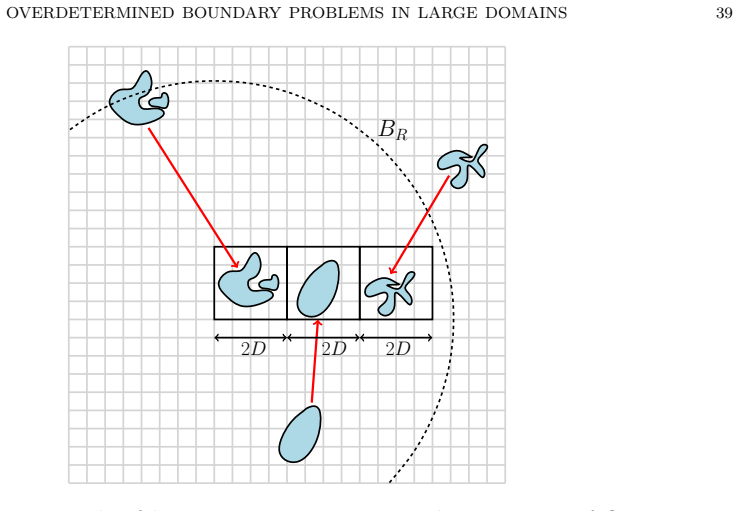
- [Figure 3] The caption refers to 'cubes of length K', while the text uses 2D and 2DN′; please align the notation.
- [§7.2] In Proposition 7.9, Step 1, the passage from u0 to bu0 and back is implicit when deriving the bound on |∇φ(0)|; a brief sentence clarifying that the displayed inequality is after undoing the change of variables would help the reader.
Circularity Check
No significant circularity: the existence proof is a self-contained variational construction with R-independent bounds; self-citations are contextual only, and the flagged Step 3 concern is a proof gap, not a circular reduction.
full rationale
The central claim (Theorem 1.1) is proved by a minimization argument: Sections 3-7 develop properties of minimizers under the conditional hypothesis (H*), and Section 8 removes the existence assumption by the direct method on the truncated energy F0,R, using the periodicity hypothesis (HPer) only to translate the finitely many enlarged connected components (uniformly bounded in number and diameter by Proposition 6.2) into a fixed ball. No quantity is fitted to a target: the constant c in (1.2) emerges as the Lagrange multiplier Λ multiplying q(x), with positivity proven in Proposition 5.5, and the overdetermined boundary condition is obtained, not imposed. The load-bearing regularity and classification inputs ([AC], [V], [DFS], [GT], [LSW], [KN], [LZ]) are external works, not authored by the present authors; the adaptations of [V, Prop. 11.10], [V, Lemma 9.8] and [V, Prop. 9.18] are made explicit, with the needed modifications described in the text. Self-citations ([DEP1], [DEP2], [EFR], [EFRS]) appear only in the introduction as descriptions of prior perturbation results (λ ≫ 1) that the paper explicitly does not use, so they are not load-bearing. One flagged concern, weighed here: in Section 8, Step 3, the final sentence asserts that the translated truncation minimizer has all properties of Theorem 1.2, including minimality for the original F0, but the displayed comparison only controls F0,R (since F0,R(v) ≥ F0(v) for competitors v, the inequality F0,R(ũ0) ≤ F0,R(v) does not imply F0(ũ0) ≤ F0(v)); this is an omitted compactness argument in a strengthening, not a circularity, because the PDE and free-boundary conclusions underlying Theorem 1.1 follow from truncated minimality together with FR ≡ F on the support of ũ0. The stated hypotheses (HF4)-(HF6) and (HPer) are assumptions used exactly where needed (coercivity, nontriviality, uniform support control), and Appendix A honestly exhibits a counterexample showing periodicity is necessary. The derivation is therefore self-contained and non-circular.
Assumptions & free parameters
assumptions (5)
- standard math Standard elliptic regularity and maximum principle results (Gilbarg-Trudinger) are used throughout for the equation Lu = F'(x,u).
- standard math Alt-Caffarelli free boundary theory and its presentation in Velichkov's monograph [V], including [V, Prop. 10.13] for the dimension of the singular set, are assumed.
- standard math De Silva-Ferrari-Salsa [DFS, Th. 1.4] gives C^{1,alpha} free-boundary regularity for a class of divergence-form problems with right-hand side.
- standard math Faber-Krahn and the existence of Faber-Krahn minimizers on compact manifolds (Lamboley-Sicbaldi [LS, Th. 1.1]) provide the Poincare inequality in K≤m.
- domain assumption The admissibility and periodicity hypotheses (Definition 2.1), especially f ≥ 0 (HF3), quadratic growth bound (HF4) with b < λ λ1(B_m)/2, and periodicity (HPer), are accepted as domain assumptions.
Cite this review
Pith. "Pith review of Positive solutions to general semilinear overdetermined boundary problems." pith.science (2026). https://pith.science/paper/4ARCQVV3
@misc{pith2026241211902,
  author       = {Pith},
  title        = {Pith review of: Positive solutions to general semilinear overdetermined boundary problems},
  year         = {2026},
  howpublished = {\url{https://pith.science/paper/4ARCQVV3}},
  note         = {Machine review of arXiv:2412.11902}
}
abstract
We establish the existence of positive solutions to a general class of overdetermined semilinear elliptic boundary problems on suitable bounded open sets $\Omega\subset\mathbb{R}^n$. Specifically, for $n\leq 4$ and under mild technical hypotheses on the coefficients and the nonlinearity, we show that there exist open sets $\Omega\subset\mathbb{R}^n$ with smooth boundary and of any prescribed volume where the overdetermined problem admits a positive solution. The proof builds on ideas of Alt and Caffarelli on variational problems for functions defined on a bounded region. In our case, we need to consider functions defined on the whole $\mathbb{R}^n$, so the key challenge is to obtain uniform bounds for the minimizer and for the diameter of its support. Our methods extend to higher dimensions, although in this case the free boundary $\partial\Omega$ could have a singular set of codimension 5. The results are new even in the case of the Poisson equation $-\Delta v =g(x)$ with constant Neumann data.
Figures

Figures from the paper (1 more)

Reference graph
Works this paper leans on
-
[1]
R.A. Adams, and J.J.F. Fournier, Sobolev spaces, Elsevier, Vol. 140, 2003
work page 2003
-
[2]
A. Aftalion, and J. Busca, Radial symmetry of overdetermined boundary value problems in exterior domains, Arch. Rat. Mech. Anal. 143 (1998) 195--206
work page 1998
-
[3]
A. Aftalion, J. Busca, and W. Reichel, Approximate radial symmetry for overdetermined boundary value problems, Adv. Diff. Eqs. 4 (1999) 907--932
work page 1999
-
[4]
N. Aguilera, H.W. Alt, and L.A. Caffarelli, An optimization problem with volume constraint, SIAM J. Control Optim. 24 (1986), 191--198
work page 1986
-
[5]
G. Alessandrini, and N. Garofalo, Symmetry for degenerate parabolic equations, Arch. Rat. Mech. Anal. 108 (1989) 161--174
work page 1989
-
[6]
H.W. Alt, and L.A. Caffarelli, Existence and regularity for a minimum problem with free boundary, J. Reine Angew. Math. 325 (1981), 105--144
work page 1981
-
[7]
I. Blank, and Z. Hao, The mean value theorem and basic properties of the obstacle problem for divergence form elliptic operators, Commun. Anal. Geom. 23 (2015), 129--158
work page 2015
-
[8]
B. Brandolini, C. Nitsch, P. Salani, and C. Trombetti, Serrin-type overdetermined problems: an alternative proof, Arch. Rat. Mech. Anal. 190 (2008) 267--280
work page 2008
Show all 65 references
-
[9]
Caffarelli, The Obstacle Problem
L.A. Caffarelli, The Obstacle Problem. The Fermi Lectures, Accademia Nazionale Dei Lincei Scuola Normale Superiore, 1998
1998
-
[10]
Caffarelli, E.B
L.A. Caffarelli, E.B. Fabes, S. Mortola, and S. Salsa, Boundary behavior of non-negative solutions of elliptic operators in divergence form, Indiana Univ. Math. J. 30 (1981), 621--640
1981
-
[11]
Caffarelli, E.B
L.A. Caffarelli, E.B. Fabes and C.E. Kenig, Completely singular elliptic-harmonic measures, Indiana Univ. Math. J. 30 (1981), 917--924
1981
-
[12]
Cianchi, and P
A. Cianchi, and P. Salani, Overdetermined anisotropic elliptic problems, Math. Ann. 345 (2009) 859--881
2009
-
[13]
Damascelli, F
L. Damascelli, F. Pacella, and M. Ramaswamy, Symmetry of ground states of p -Laplace equations via the moving plane method, Arch. Rat. Mech. Anal. 148 (1999) 291--308
1999
-
[14]
De Silva, Free boundary regularity for a problem with right hand side, Interfaces Free Bound
D. De Silva, Free boundary regularity for a problem with right hand side, Interfaces Free Bound. 13 (2011), 223--238
2011
-
[15]
De Silva, F
D. De Silva, F. Ferrari, and S. Salsa, Two-phase problems with distributed sources: regularity of the free boundary, Anal. PDE 7 (2014), 267--310
2014
-
[16]
De Silva, F
D. De Silva, F. Ferrari, and S. Salsa, Regularity of the free boundary for two-phase problems governed by divergence form equations and applications, Nonlinear Anal. 138 (2016), 3--30
2016
-
[17]
Del Pino, F
M. Del Pino, F. Pacard, and J. Wei, Serrin's overdetermined problem and constant mean curvature surfaces, Duke Math. J. 164 (2015) 2643--2722
2015
-
[18]
Delay, and P
E. Delay, and P. Sicbaldi, Extremal domains for the first eigenvalue in a general compact Riemannian manifold, Discrete Contin.\ Dyn.\ Syst.\ 35 (2015) 5799--5825
2015
-
[19]
Dom\'inguez-V\'azquez, A
M. Dom\'inguez-V\'azquez, A. Enciso, and D. Peralta-Salas, Solutions to the overdetermined boundary problem for semilinear equations with position-dependent nonlinearities, Adv. Math. 351 (2019), 718--760
2019
-
[20]
Dom\' nguez-V\'azquez, A
M. Dom\' nguez-V\'azquez, A. Enciso, D. Peralta-Salas, Piecewise smooth stationary Euler flows with compact support via overdetermined boundary problems, Arch. Ration. Mech. Anal. 239 (2021), 1327--1347
2021
-
[21]
Dom\'inguez-V\'azquez, A
M. Dom\'inguez-V\'azquez, A. Enciso, and D. Peralta-Salas, Overdetermined boundary problems with non constant Dirichlet and Neumann data, Anal. PDE 16 (2023), 1989--2003
2023
-
[22]
Evans, Partial Differential Equations, American Mathematical Society, Providence, 1998
L.C. Evans, Partial Differential Equations, American Mathematical Society, Providence, 1998
1998
-
[23]
Enciso, A
A. Enciso, A. Fern\'andez, and D. Ruiz, Smooth nonradial stationary Euler flows on the plane with compact support, preprint (2406.04414)
-
[24]
Enciso, A
A. Enciso, A. Fern\'andez, D. Ruiz, and P. Sicbaldi, A Schiffer-type problem for annuli with applications to stationary planar Euler flows, Duke Math. J., in press
-
[25]
Farina, and E
A. Farina, and E. Valdinoci, Flattening results for elliptic PDEs in unbounded domains with applications to overdetermined problems, Arch. Rat. Mech. Anal. 195 (2010) 1025--1058
2010
-
[26]
Farina, and E
A. Farina, and E. Valdinoci, On partially and globally overdetermined problems of elliptic type, Amer. J. Math. 135 (2013) 1699--1726
2013
-
[27]
M.M. Fall, I. A. Minlend and T. Weth, Unbounded periodic solutions to Serrin's overdetermined boundary value problem, Arch. Ration. Mech. Anal. 233 (2017), no. 2, 737--759
2017
-
[28]
M.M. Fall, I. A. Minlend and T. Weth, Serrin's overdetermined problem on the sphere, Calc. Var. Partial Differential Equations 57 (2018), no. 1, Art. 3, 24 pp
2018
-
[29]
M. M. Fall, I. A. Minlend and T. Weth, The Schiffer problem on the cylinder and on the 2-sphere, J. Eur. Math. Soc., in press
-
[30]
Figalli and Y.RY
A. Figalli and Y.RY. Zhang, Serrin's overdetermined problem in rough domains, arxiv.org/abs/2407.02293
-
[31]
Folland, Introduction to Partial Differential Equations, Princeton University Press, 1995
G.B. Folland, Introduction to Partial Differential Equations, Princeton University Press, 1995
1995
-
[32]
Fragal\`a, and F
I. Fragal\`a, and F. Gazzola, Partially overdetermined elliptic boundary value problems, J. Differential Eqs. 245 (2008) 1299--1322
2008
-
[33]
Fragal\`a, F
I. Fragal\`a, F. Gazzola, and B. Kawohl, Overdetermined problems with possibly degenerate ellipticity, a geometric approach, Math. Z. 254 (2006) 117--132
2006
-
[34]
Garofalo, and J.L
N. Garofalo, and J.L. Lewis, A symmetry result related to some overdetermined boundary value problems, Amer. J. Math. 111 (1989) 9--33
1989
-
[35]
Garofalo, and E
N. Garofalo, and E. Sartori, Symmetry in exterior boundary value problems for quasilinear elliptic equations via blow-up and a priori estimates, Adv. Diff. Eq. 4 (1999) 137--161
1999
-
[36]
Gilbarg, and N.S
D. Gilbarg, and N.S. Trudinger, Elliptic Partial Differential Equations of Second Order, Grundlehren der Mathematischen Wissenschaften, Springer-Verlag, Berlin-New York (1977)
1977
-
[37]
Gustafsson, and H
B. Gustafsson, and H. Shahgholian, Existence and geometric properties of solutions of a free boundary problem in potential theory, J. Reine Angew. Math. 473 (1996), 137--179
1996
-
[38]
Haziot, V.M
S.V. Haziot, V.M. Hur, W.A. Strauss, J.F. Toland, E Wahl\'en, S. Walsh, M.H. Wheeler, Traveling water waves --- the ebb and flow of two centuries, Quart. Appl. Math. 80 (2022) 317--401
2022
-
[39]
Heinonen, T
J. Heinonen, T. Kilpeläinen, and O. Martio, Nonlinear potential theory of degenerate elliptic equations, Dover Publications, Inc., Mineola, NY, 2006, Unabridged republication of the 1993 original
2006
-
[40]
Hofmann, and S
S. Hofmann, and S. Kim, The Green function estimates for strongly elliptic systems of second order, Manuscripta Math. 124 (2007), 139--172
2007
-
[41]
Kawohl, Symmetry or not?, Math
B. Kawohl, Symmetry or not?, Math. Intelligencer 20 (1998) 16--22
1998
-
[42]
Kinderlehrer, and L
D. Kinderlehrer, and L. Nirenberg, Regularity in free boundary problems, Ann. Sc. Norm. Sup. Pisa 4 (1977), 373--391
1977
-
[43]
Kumaresan, and J
S. Kumaresan, and J. Prajapat, Serrin's result for hyperbolic space and sphere, Duke Math. J. 91 (1998) 17--28
1998
-
[44]
Lamboley and P
J. Lamboley and P. Sicbaldi, Existence and regularity of Faber-Krahn minimizers in a Riemannian manifold, J. Math. Pures Appl. 141 (2020), 137--183
2020
-
[45]
Lederman, A free boundary problem with a volume penalization, Ann
C. Lederman, A free boundary problem with a volume penalization, Ann. Sc. Norm. Super. Pisa Cl. Sci. 23 (1996), 249--300
1996
-
[46]
Leoni, A First Course in Sobolev Spaces, American Mathematical Society, Providence, RI, 2009
G. Leoni, A First Course in Sobolev Spaces, American Mathematical Society, Providence, RI, 2009
2009
-
[47]
Lian, and K
Y. Lian, and K. Zhang, Boundary pointwise regularity and applications to the regularity of free boundaries, Calc. Var. 62 (2023), 32 pp
2023
-
[48]
Littman, G
W. Littman, G. Stampacchia, and H.F. Weinberger, Regular points for elliptic equations with discontinuous coefficients, Ann. Scuola Norm.-Sci. 17 (1963), 43--77
1963
-
[49]
Magnanini, and G
R. Magnanini, and G. Poggesi, Nearly optimal stability for Serrin's problem and the soap bubble theorem, Calc. Var. PDE 59 (2020) 35
2020
-
[50]
Magnanini, and G
R. Magnanini, and G. Poggesi, Serrin's problem and Alexandrov's soap bubble theorem: enhanced stability via integral identities, Indiana Univ. Math. J. 69 (2020), 1181--1205
2020
-
[51]
Modica and S
L. Modica and S. Mortola, Construction of a singular elliptic-harmonic measure, Manuscripta Math. 33 (1980), 81--98
1980
-
[52]
Pacard, and P
F. Pacard, and P. Sicbaldi, Extremal domains for the first eigenvalue of the Laplace-Beltrami operator, Ann.\ Inst.\ Fourier 59 (2009), 515--542
2009
-
[53]
Prajapat, Serrin's result for domains with a corner or cusp, Duke Math
J. Prajapat, Serrin's result for domains with a corner or cusp, Duke Math. J. 91 (1998), 29--31
1998
-
[54]
Rayleigh, The Theory of Sound , Macmillan, London, 1877
J.W.S. Rayleigh, The Theory of Sound , Macmillan, London, 1877
-
[55]
A. Ros, D. Ruiz, and P. Sicbaldi, Solutions to overdetermined elliptic problems in nontrivial exterior domains, J. Eur. Math. Soc. 22 (2020) 253--281
2020
-
[56]
Ruiz, Symmetry Results for Compactly Supported Steady Solutions of the 2D Euler Equations, Arch
D. Ruiz, Symmetry Results for Compactly Supported Steady Solutions of the 2D Euler Equations, Arch. Ration. Mech. Anal. 247 (2023), no. 3, Paper No. 40, 25 pp
2023
-
[57]
Ruiz, Nonsymmetric sign-changing solutions to overdetermined elliptic problems in bounded domains, J
D. Ruiz, Nonsymmetric sign-changing solutions to overdetermined elliptic problems in bounded domains, J. Eur. Math. Soc., in press
-
[58]
D. Ruiz, P. Sicbaldi, J. Wu. Overdetermined elliptic problems in onduloid-type domains with general nonlinearities, J. Functional Analysis 283 (2022), 26 pp
2022
-
[59]
Safonov, On the boundary estimates for second-order elliptic equations, Complex Var
M. Safonov, On the boundary estimates for second-order elliptic equations, Complex Var. Elliptic Equ. 63 (2018), 1123--1141
2018
-
[60]
Serrin, A symmetry problem in potential theory, Arch
J. Serrin, A symmetry problem in potential theory, Arch. Rat. Mech. Anal. 43 (1971), 304--318
1971
-
[61]
Sirakov, Overdetermined Elliptic Problems in Physics
B. Sirakov, Overdetermined Elliptic Problems in Physics. In: Berestycki, H., Pomeau, Y. (eds), Nonlinear PDE's in Condensed Matter and Reactive Flows. NATO Science Series, vol 569. Springer, Dordrecht, 2002
2002
-
[62]
Stein, Singular Integrals and Differentiability Properties of Functions, Princeton Math
E.M. Stein, Singular Integrals and Differentiability Properties of Functions, Princeton Math. Ser., vol. 30, Princeton University Press, Princeton, NJ, 1970
1970
-
[63]
J. F. Toland, Stokes waves, Topol. Methods Nonlinear Anal. 7 (1996) 1--48
1996
-
[64]
Traizet, Classification of the solutions to an overdetermined elliptic problem in the plane, Geom
M. Traizet, Classification of the solutions to an overdetermined elliptic problem in the plane, Geom. Func. Anal. 24 (2014) 690--720
2014
-
[65]
Velichkov, Regularity of the One-Phase Free Boundaries, Lect
B. Velichkov, Regularity of the One-Phase Free Boundaries, Lect. Notes Unione Mat. Ital., Springer, Cham, 2023
2023
Reviewed August 11, 2026 · model on record in the stance chip above.
Discussion (0). Continue with ORCID to comment.