Tachyonic Encore: A universal shift of inflationary observables
Pith reviewed 2026-06-27 08:44 UTC · model grok-4.3
The pith
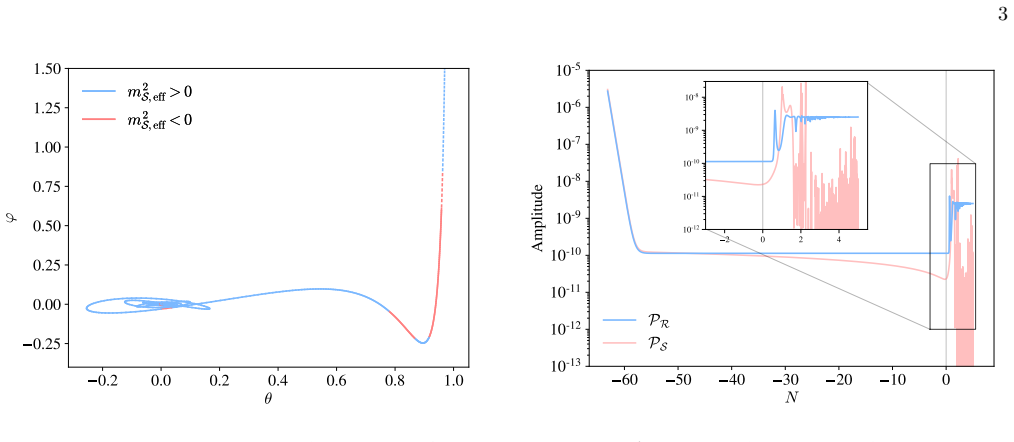
A light axion spectator that rolls only after inflation triggers tachyonic phases on super-horizon scales and enhances the curvature power spectrum.
A machine-rendered reading of the paper's core claim, the machinery that carries it, and where it could break.
Core claim
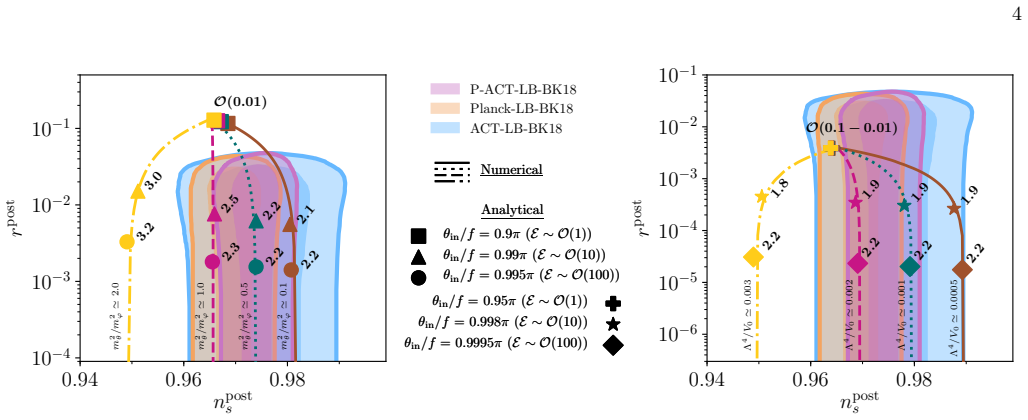
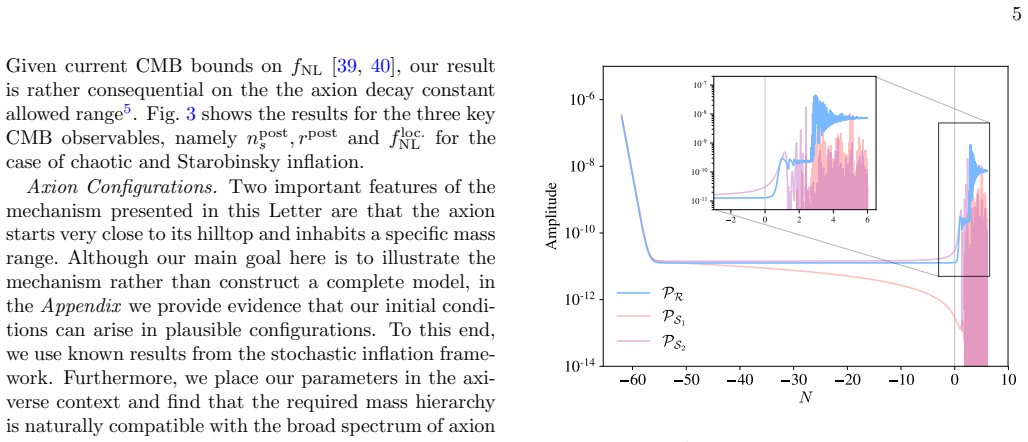
The paper establishes that the tachyonic encore from the axion's post-inflationary roll reshapes inflationary observables through purely gravitational multi-field dynamics, generating a nearly scale-invariant enhancement of the curvature power spectrum that suppresses the tensor-to-scalar ratio and shifts the scalar tilt to a weighted combination of adiabatic and entropic tilts at horizon crossing, while predicting local non-Gaussianity of order one.
What carries the argument
The light axion spectator initialized near the hilltop of its potential, which stays frozen during inflation and rolls afterward to induce field-space turns and tachyonic phases of the isocurvature mode on super-horizon scales.
If this is right
- The curvature power spectrum receives a nearly scale-invariant enhancement from the tachyonic phases.
- The tensor-to-scalar ratio is suppressed relative to single-field expectations.
- The scalar spectral index becomes a weighted combination of adiabatic and entropic tilts at horizon crossing.
- Inflaton potentials otherwise inconsistent with CMB data can be reconciled with observations.
- Local non-Gaussianity of order one is generated and lies within reach of upcoming surveys.
Where Pith is reading between the lines
- The mechanism could extend to other single-field potentials without any change to the inflaton sector itself.
- Future measurements of the running of the spectral index might reveal additional signatures from the post-inflationary turn.
- The approach highlights how spectator fields active only after inflation can still alter observables extracted from CMB scales.
- Similar tachyonic enhancements might appear in other multi-field setups where one field remains light and displaced after the main expansion.
Load-bearing premise
The extra axion field must stay frozen during inflation and begin rolling only afterward to produce the tachyonic effects after the main expansion phase.
What would settle it
A measurement finding that the tensor-to-scalar ratio stays high or the scalar tilt shows no shift for the tested inflaton potentials, or that local non-Gaussianity lies well outside order one, would falsify the claimed enhancement mechanism.
Figures
read the original abstract
We propose a generic, largely inflaton-potential-independent mechanism in which a light axion spectator, initialized near the hilltop of its potential, reshapes inflationary observables through purely gravitational multi-field dynamics. During inflation the axion is frozen and the background follows an effectively single-field trajectory. After inflation ends, the axion rolls, inducing a turn in field space and transient tachyonic phases of the isocurvature mode. The resulting ``tachyonic encore'' occurs entirely on super-horizon scales. These phases generate a nearly scale-invariant enhancement of the curvature power spectrum, suppressing the tensor-to-scalar ratio and shifting the scalar tilt to a weighted combination of adiabatic and entropic tilts at horizon crossing. We show that these effects can reconcile otherwise disfavored inflaton potentials with current CMB constraints. The same dynamics predict local non-Gaussianity, $f_{\rm NL}^{\rm loc.}\sim \mathcal{O}(1)$, within reach of upcoming surveys.
Editorial analysis
A structured set of objections, weighed in public.
Referee Report
Summary. The paper proposes a generic, largely inflaton-potential-independent mechanism in which a light axion spectator initialized near the hilltop of its potential remains frozen during inflation (yielding an effectively single-field background) but rolls afterward. This induces a turn in field space and transient tachyonic phases of the isocurvature mode entirely on super-horizon scales, generating a nearly scale-invariant enhancement of the curvature power spectrum that suppresses the tensor-to-scalar ratio, shifts the scalar tilt to a weighted combination of adiabatic and entropic tilts at horizon crossing, reconciles otherwise disfavored inflaton potentials with CMB constraints, and predicts local non-Gaussianity f_NL^loc ~ O(1).
Significance. If the derivations hold, the result would be significant because it supplies a universal gravitational multi-field channel for reshaping inflationary observables without fine-tuning the inflaton potential itself, while also furnishing a concrete, falsifiable prediction for local non-Gaussianity accessible to upcoming surveys.
major comments (2)
- Abstract and visible manuscript content: the central claims of a nearly scale-invariant enhancement of the curvature power spectrum, suppression of r, and reconciliation with CMB data are asserted without any derivations, explicit equations, or numerical evidence, so the support for these statements cannot be evaluated.
- The load-bearing assumption that the axion remains light, is initialized near the hilltop, stays frozen throughout inflation, and only rolls afterward (producing tachyonic phases exclusively on super-horizon scales) is stated but receives no explicit verification, parameter-range checks, or stability analysis against the paper's own dynamics.
minor comments (1)
- The phrase 'weighted combination of adiabatic and entropic tilts' would benefit from an explicit expression or definition even at the level of the abstract.
Simulated Author's Rebuttal
We thank the referee for their constructive comments. The full manuscript contains the derivations and checks referenced in the body, but we agree the presentation can be strengthened to make the supporting material more immediately visible. We address each point below and will revise accordingly.
read point-by-point responses
-
Referee: Abstract and visible manuscript content: the central claims of a nearly scale-invariant enhancement of the curvature power spectrum, suppression of r, and reconciliation with CMB data are asserted without any derivations, explicit equations, or numerical evidence, so the support for these statements cannot be evaluated.
Authors: The abstract summarizes results whose derivations appear in Sections 3–4 (explicit expressions for the curvature power spectrum enhancement via the tachyonic isocurvature transfer, the resulting shift in n_s, and the suppression of r) together with numerical evidence in Figures 2–5. To make this support visible at the level of the abstract and introduction, we will insert a short paragraph in the introduction that quotes the key transfer-function equation and references the relevant figures and sections. revision: yes
-
Referee: The load-bearing assumption that the axion remains light, is initialized near the hilltop, stays frozen throughout inflation, and only rolls afterward (producing tachyonic phases exclusively on super-horizon scales) is stated but receives no explicit verification, parameter-range checks, or stability analysis against the paper's own dynamics.
Authors: We acknowledge that while the assumption is stated in Section 2, a dedicated verification subsection with analytic bounds (m_a/H ≪ 1 during inflation, initial displacement θ_0 near π) and numerical scans confirming post-inflation rolling and super-horizon tachyonic growth is absent. We will add this subsection, including the relevant parameter ranges and a brief stability analysis against the background trajectory. revision: yes
Circularity Check
No significant circularity; derivation self-contained
full rationale
The paper outlines a multi-field spectator mechanism in which a light axion remains frozen during inflation (due to its mass and hilltop initialization) and rolls only afterward, inducing super-horizon tachyonic phases via standard gravitational turns. This sequence is presented as following directly from the stated initial conditions and dynamics without any quoted equations that reduce the claimed power-spectrum enhancement, tilt shift, or f_NL prediction to a fitted input or self-citation by construction. The abstract frames the outcome as a generic consequence of the setup rather than a renaming or ansatz-smuggled result, and no load-bearing self-citation chain is visible in the provided text.
Axiom & Free-Parameter Ledger
free parameters (2)
- axion initial position near hilltop
- axion mass scale
axioms (2)
- domain assumption The multi-field dynamics are purely gravitational with no direct couplings between axion and inflaton.
- domain assumption Tachyonic phases occur entirely on super-horizon scales after inflation ends.
Reference graph
Works this paper leans on
-
[1]
A. D. Linde,Particle physics and inflationary cosmology, Vol. 5 (1990) arXiv:hep-th/0503203
Pith/arXiv arXiv 1990
-
[2]
A. D. Linde, Inflationary Cosmology, Lect. Notes Phys. 738, 1 (2008), arXiv:0705.0164 [hep-th]
Pith/arXiv arXiv 2008
-
[3]
A. Ach´ ucarro and et al., Inflation: Theory and Observa- 6 tions, (2022), arXiv:2203.08128 [astro-ph.CO]
arXiv 2022
- [4]
-
[5]
R. Kallosh and A. Linde, On the present status of in- flationary cosmology, Gen. Rel. Grav.57, 135 (2025), arXiv:2505.13646 [hep-th]
arXiv 2025
-
[6]
Akramiet al.(Planck), Planck 2018 results
Y. Akramiet al.(Planck), Planck 2018 results. X. Con- straints on inflation, Astron. Astrophys.641, A10 (2020), arXiv:1807.06211 [astro-ph.CO]
Pith/arXiv arXiv 2018
-
[7]
P. A. R. Adeet al.(BICEP, Keck), Improved Con- straints on Primordial Gravitational Waves using Planck, WMAP, and BICEP/Keck Observations through the 2018 Observing Season, Phys. Rev. Lett.127, 151301 (2021), arXiv:2110.00483 [astro-ph.CO]
arXiv 2018
-
[8]
T. Louiset al.(Atacama Cosmology Telescope), The Atacama Cosmology Telescope: DR6 power spectra, likelihoods and ΛCDM parameters, JCAP11, 062, arXiv:2503.14452 [astro-ph.CO]
-
[9]
A. Arvanitaki, S. Dimopoulos, S. Dubovsky, N. Kaloper, and J. March-Russell, String Axiverse, Phys. Rev. D81, 123530 (2010), arXiv:0905.4720 [hep-th]
Pith/arXiv arXiv 2010
-
[10]
M. Cicoli, M. Goodsell, and A. Ringwald, The type IIB string axiverse and its low-energy phenomenology, JHEP 10, 146, arXiv:1206.0819 [hep-th]
-
[11]
M. Demirtas, C. Long, L. McAllister, and M. Still- man, The Kreuzer-Skarke Axiverse, JHEP04, 138, arXiv:1808.01282 [hep-th]
-
[12]
N. Gendler, D. J. E. Marsh, L. McAllister, and J. Moritz, Glimmers from the Axiverse, (2023), arXiv:2309.13145 [hep-th]
arXiv 2023
-
[13]
A. Arzaet al., The COSMIC WISPers White Paper: The physics case for Weakly Interacting Slim Particles, (2026), arXiv:2603.03433 [hep-ph]
arXiv 2026
-
[14]
Albertuset al., WISPedia – the WISPs Encyclopedia, (2026), arXiv:2602.09089 [hep-ph]
C. Albertuset al., WISPedia – the WISPs Encyclopedia, (2026), arXiv:2602.09089 [hep-ph]
arXiv 2026
-
[15]
M. M. Anber and L. Sorbo, Naturally inflating on steep potentials through electromagnetic dissipation, Phys. Rev. D81, 043534 (2010), arXiv:0908.4089 [hep-th]
Pith/arXiv arXiv 2010
-
[16]
E. Dimastrogiovanni and M. Peloso, Stability analysis of chromo-natural inflation and possible evasion of Lyth’s bound, Phys. Rev. D87, 103501 (2013), arXiv:1212.5184 [astro-ph.CO]
Pith/arXiv arXiv 2013
-
[17]
R. Namba, M. Peloso, M. Shiraishi, L. Sorbo, and C. Unal, Scale-dependent gravitational waves from a rolling axion, JCAP1601(01), 041, arXiv:1509.07521 [astro-ph.CO]
-
[18]
M. Peloso, L. Sorbo, and C. Unal, Rolling axions during inflation: perturbativity and signatures, JCAP09, 001, arXiv:1606.00459 [astro-ph.CO]
-
[19]
G. D’Amico, N. Kaloper, and A. Westphal, Double Mon- odromy Inflation: A Gravity Waves Factory for CMB-S4, LiteBIRD and LISA, Phys. Rev. D104, L081302 (2021), arXiv:2101.05861 [hep-th]
arXiv 2021
-
[20]
G. D’Amico, N. Kaloper, and A. Westphal, General dou- ble monodromy inflation, Phys. Rev. D105, 103527 (2022), arXiv:2112.13861 [hep-th]
arXiv 2022
-
[21]
E. Dimastrogiovanni, M. Fasiello, J. M. Leedom, M. Putti, and A. Westphal, Gravitational axiverse spec- troscopy: seeing the forest for the axions, JHEP08, 072, arXiv:2312.13431 [hep-th]
-
[22]
E. Pajer and M. Peloso, A review of Axion Inflation in the era of Planck, Class. Quant. Grav.30, 214002 (2013), arXiv:1305.3557 [hep-th]
Pith/arXiv arXiv 2013
-
[23]
R. Gonzalez Quaglia, M. Michelotti, D. Roest, J. J. Car- rasco, R. Kallosh, and A. Linde, Post-inflationary en- hancement of adiabatic perturbations in modular cosmol- ogy, JCAP10, 045, arXiv:2507.03610 [astro-ph.CO]
-
[24]
Wands, Multiple field inflation, Lect
D. Wands, Multiple field inflation, Lect. Notes Phys.738, 275 (2008), arXiv:astro-ph/0702187
Pith/arXiv arXiv 2008
-
[25]
N. Bartolo, S. Matarrese, and A. Riotto, Adiabatic and isocurvature perturbations from inflation: Power spec- tra and consistency relations, Physical Review D64, 10.1103/physrevd.64.123504 (2001)
-
[26]
D. S. Gorbunov and A. G. Panin, Scalaron the mighty: producing dark matter and baryon asymmetry at reheat- ing, Phys. Lett. B700, 157 (2011), arXiv:1009.2448 [hep- ph]
Pith/arXiv arXiv 2011
-
[27]
L. Dai, M. Kamionkowski, and J. Wang, Reheating con- straints to inflationary models, Phys. Rev. Lett.113, 041302 (2014), arXiv:1404.6704 [astro-ph.CO]
Pith/arXiv arXiv 2014
-
[28]
J. L. Cook, E. Dimastrogiovanni, D. A. Easson, and L. M. Krauss, Reheating predictions in single field inflation, JCAP04, 047, arXiv:1502.04673 [astro-ph.CO]
-
[29]
M. Eshaghi, M. Zarei, N. Riazi, and A. Kiasatpour, CMB and reheating constraints toα-attractor infla- tionary models, Phys. Rev. D93, 123517 (2016), arXiv:1602.07914 [astro-ph.CO]
Pith/arXiv arXiv 2016
-
[30]
G. Germ´ an, R. G. Quaglia, and A. M. M. Colorado, Model independent bounds for the number of e-folds during the evolution of the universe, JCAP03, 004, arXiv:2212.03730 [gr-qc]
-
[31]
M. A. G. Garcia, G. Germ´ an, R. Gonzalez Quaglia, and A. M. M. Colorado, Reheating constraints and consis- tency relations of the Starobinsky model and some of its generalizations, JCAP12, 015, arXiv:2306.15831 [astro- ph.CO]
- [32]
-
[33]
German, Perturbative analysis of the reheating dy- namics ofα-attractors, Int
G. German, Perturbative analysis of the reheating dy- namics ofα-attractors, Int. J. Mod. Phys. D34, 2550065 (2025), arXiv:2504.14082 [astro-ph.CO]
arXiv 2025
- [34]
-
[35]
A. D. Linde, Chaotic Inflation, Phys. Lett. B129, 177 (1983)
1983
-
[36]
D. J. Mulryne and J. W. Ronayne, PyTransport: A Python package for the calculation of inflationary cor- relation functions, J. Open Source Softw.3, 494 (2018), arXiv:1609.00381 [astro-ph.CO]
Pith/arXiv arXiv 2018
-
[37]
M. Sasaki and E. D. Stewart, A General analytic formula for the spectral index of the density perturbations pro- duced during inflation, Prog. Theor. Phys.95, 71 (1996), arXiv:astro-ph/9507001
Pith/arXiv arXiv 1996
-
[38]
D. H. Lyth, K. A. Malik, and M. Sasaki, A General proof of the conservation of the curvature perturbation, JCAP 05, 004, arXiv:astro-ph/0411220
-
[39]
Aghanimet al.(Planck), Planck 2018 results
N. Aghanimet al.(Planck), Planck 2018 results. I. Overview and the cosmological legacy of Planck, Astron. Astrophys.641, A1 (2020), arXiv:1807.06205 [astro- ph.CO]
Pith/arXiv arXiv 2018
-
[40]
Akramiet al.(Planck), Planck 2018 results
Y. Akramiet al.(Planck), Planck 2018 results. IX. Con- straints on primordial non-Gaussianity, Astron. Astro- phys.641, A9 (2020), arXiv:1905.05697 [astro-ph.CO]
Pith/arXiv arXiv 2018
-
[41]
E. Chaussidonet al., Constraining primordial non- 7 Gaussianity with DESI 2024 LRG and QSO samples, JCAP06, 029, arXiv:2411.17623 [astro-ph.CO]
arXiv 2024
-
[42]
A. J. Rosado-Mar´ ınet al., Local primordial non- Gaussianity using cross-correlations of DESI tracers, (2026), arXiv:2604.05213 [astro-ph.CO]
Pith/arXiv arXiv 2026
-
[43]
Riotto, Inflation and the theory of cosmological perturbations, ICTP Lect
A. Riotto, Inflation and the theory of cosmological perturbations, ICTP Lect. Notes Ser.14, 317 (2003), arXiv:hep-ph/0210162
Pith/arXiv arXiv 2003
-
[44]
J. M. Maldacena, Non-Gaussian features of primordial fluctuations in single field inflationary models, JHEP05, 013, arXiv:astro-ph/0210603
-
[45]
O. Iarygina, M. C. D. Marsh, and G. Salinas, Non- Gaussianity in rapid-turn multi-field inflation, JCAP03, 014, arXiv:2303.14156 [astro-ph.CO]
-
[46]
O. Dor´ eet al.(SPHEREx), Cosmology with the SPHEREX All-Sky Spectral Survey, (2014), arXiv:1412.4872 [astro-ph.CO]
Pith/arXiv arXiv 2014
-
[47]
D. H. Lyth and D. Wands, Generating the curvature perturbation without an inflaton, Phys. Lett. B524, 5 (2002), arXiv:hep-ph/0110002
Pith/arXiv arXiv 2002
-
[48]
K. Enqvist and M. S. Sloth, Adiabatic CMB perturba- tions in pre - big bang string cosmology, Nucl. Phys. B 626, 395 (2002), arXiv:hep-ph/0109214
Pith/arXiv arXiv 2002
-
[49]
T. Moroi and T. Takahashi, Effects of cosmological mod- uli fields on cosmic microwave background, Phys. Lett. B522, 215 (2001), [Erratum: Phys.Lett.B 539, 303–303 (2002)], arXiv:hep-ph/0110096
Pith/arXiv arXiv 2001
-
[50]
N. Bartolo and A. R. Liddle, The Simplest curvaton model, Phys. Rev. D65, 121301 (2002), arXiv:astro- ph/0203076
arXiv 2002
-
[51]
N. Bartolo, S. Matarrese, and A. Riotto, Adiabatic and isocurvature perturbations from inflation: Power spec- tra and consistency relations, Phys. Rev. D64, 123504 (2001), arXiv:astro-ph/0107502
Pith/arXiv arXiv 2001
-
[52]
J. Fonseca and D. Wands, Primordial non-Gaussianity from mixed inflaton-curvaton perturbations, JCAP06, 028, arXiv:1204.3443 [astro-ph.CO]
-
[53]
C. T. Byrnes, M. Cortˆ es, and A. R. Liddle, Curvaton in light of ACT results, Phys. Rev. D113, 063568 (2026), arXiv:2505.09682 [astro-ph.CO]
arXiv 2026
- [54]
-
[55]
G. Dvali, A. Gruzinov, and M. Zaldarriaga, Cosmological perturbations from inhomogeneous reheating, freezeout, and mass domination, Phys. Rev. D69, 083505 (2004), arXiv:astro-ph/0305548
Pith/arXiv arXiv 2004
-
[56]
L. Kofman, Probing string theory with modulated cos- mological fluctuations, (2003), arXiv:astro-ph/0303614
Pith/arXiv arXiv 2003
-
[57]
M. Benaco, D. Karamitros, S. Nurmi, and K. Tuominen, Stochastic gravitational waves from modulated reheat- ing, JCAP04, 046, arXiv:2510.05967 [astro-ph.CO]
-
[58]
Nambu and M
Y. Nambu and M. Sasaki, Stochastic Stage of an Infla- tionary Universe Model, Phys. Lett. B205, 441 (1988)
1988
-
[59]
Nambu and M
Y. Nambu and M. Sasaki, Stochastic approach to chaotic inflation and the distribution of universes, Phys. Lett. B 219, 240 (1989)
1989
-
[60]
Mollerach, S
S. Mollerach, S. Matarrese, A. Ortolan, and F. Lucchin, Stochastic inflation in a simple two field model, Phys. Rev. D44, 1670 (1991)
1991
-
[61]
A. A. Starobinsky, Stochastic De Sitter (inflationary) stage in the Early Universe,In Field Theory, Quantum Gravity and Strings, Lect. Notes Phys.246, 107 (1986)
1986
-
[62]
A. A. Starobinsky and J. Yokoyama, Equilibrium state of a selfinteracting scalar field in the De Sitter background, Phys. Rev.D50, 6357 (1994), arXiv:astro-ph/9407016 [astro-ph]
Pith/arXiv arXiv 1994
-
[63]
V. Vennin and A. A. Starobinsky, Correlation Functions in Stochastic Inflation, Eur. Phys. J. C75, 413 (2015), arXiv:1506.04732 [hep-th]
Pith/arXiv arXiv 2015
-
[64]
R. J. Hardwick, V. Vennin, C. T. Byrnes, J. Torrado, and D. Wands, The stochastic spectator, JCAP10, 018, arXiv:1701.06473 [astro-ph.CO]
-
[65]
A. Hebecker, S. Leonhardt, J. Moritz, and A. Westphal, Thraxions: Ultralight Throat Axions, JHEP04, 158, arXiv:1812.03999 [hep-th]
- [66]
- [67]
-
[68]
M. Demirtas, N. Gendler, C. Long, L. McAllister, and J. Moritz, PQ axiverse, JHEP06, 092, arXiv:2112.04503 [hep-th]
-
[69]
E. Sheridan, F. Carta, N. Gendler, M. Jain, D. J. E. Marsh, L. McAllister, N. Righi, K. K. Rogers, and A. Schachner, Fuzzy Axions and Associated Relics, (2024), arXiv:2412.12012 [hep-th]
arXiv 2024
-
[70]
J. Cheng and N. Gendler, Universality in the Axiverse, (2025), arXiv:2507.12516 [hep-th]
arXiv 2025
-
[71]
P. Agrawal, M. Nee, and M. Reig, Axion couplings in heterotic string theory, JHEP02, 188, arXiv:2410.03820 [hep-ph]
-
[72]
M. Reig and T. Weigand, Testing the heterotic string with the axion-photon coupling, JHEP01, 006, arXiv:2509.08042 [hep-th]
-
[73]
J. M. Leedom, M. Putti, and A. Westphal, Towards a Heterotic Axiverse, (2025), arXiv:2509.03578 [hep-th]
arXiv 2025
-
[74]
A. Hebecker and M. Trapletti, Gauge unification in highly anisotropic string compactifications, Nucl. Phys. B713, 173 (2005), arXiv:hep-th/0411131
Pith/arXiv arXiv 2005
-
[75]
M. Cicoli, S. de Alwis, and A. Westphal, Heterotic Mod- uli Stabilisation, JHEP10, 199, arXiv:1304.1809 [hep- th]
-
[76]
McDonald, Reheating temperature and inflaton mass bounds from thermalization after inflation, Phys
J. McDonald, Reheating temperature and inflaton mass bounds from thermalization after inflation, Phys. Rev. D 61, 083513 (2000), arXiv:hep-ph/9909467
Pith/arXiv arXiv 2000
-
[77]
E. W. Kolb, A. Notari, and A. Riotto, On the Reheating Stage after Inflation, Phys. Rev. D68, 123505 (2003), arXiv:hep-ph/0307241. APPENDIX Stochastic framework.Let us first address the hilltop initial condition of the axion. Considering the axion to be effectively massless throughout inflation, we can as- sume that its initial value is uniformly distribu...
Pith/arXiv arXiv 2003
discussion (0)
Sign in with ORCID, Apple, or X to comment. Anyone can read and Pith papers without signing in.