Active Particles Destabilize Passive Membranes
Pith reviewed 2026-05-22 11:51 UTC · model grok-4.3
The pith
Active particles reduce the tension and bending modulus of passive membranes while adding non-local mechanical contributions.
A machine-rendered reading of the paper's core claim, the machinery that carries it, and where it could break.
Core claim
By explicitly solving for the pressure exerted by the active particles, we show that they reduce the membrane tension and bending modulus and introduce novel non-local contributions to the membrane mechanics. This theory predicts activity-induced instabilities and their morphology are in agreement with recent experimental and simulation data.
What carries the argument
the explicitly solved pressure exerted by active particles, which is used to derive reduced effective tension, reduced bending modulus, and new non-local terms in the membrane mechanics
If this is right
- Membranes become unstable to deformations once activity exceeds a threshold set by the lowered effective tension and modulus.
- The spatial patterns of the resulting instabilities are determined by the non-local contributions to the mechanics.
- Effective material parameters of the membrane decrease steadily as the density or activity of the particles increases.
- Deformations can propagate across larger distances than in the passive case because of the added non-local terms.
Where Pith is reading between the lines
- The same pressure-based reduction might be tested in biological membranes by introducing controlled active particles and measuring changes in fluctuation spectra.
- Engineered systems could use particle activity to tune membrane curvature or induce folding on demand.
- The approach suggests checking whether similar pressure effects appear at other active-passive boundaries, such as in colloidal films or lipid bilayers with motor proteins.
Load-bearing premise
The pressure from active particles can be solved explicitly so that it directly and uniformly lowers the membrane's effective tension and bending modulus while adding non-local terms, without extra boundary conditions or detailed particle-membrane coupling.
What would settle it
An experiment or simulation that measures membrane tension and bending modulus under active particles and finds no reduction, or that records instability shapes inconsistent with the predicted non-local mechanics, would falsify the central claim.
Figures



read the original abstract
We present a theory for the interaction between active particles and a passive flexible membrane. By explicitly solving for the pressure exerted by the active particles, we show that they reduce the membrane tension and bending modulus and introduce novel non-local contributions to the membrane mechanics. This theory predicts activity-induced instabilities and their morphology are in agreement with recent experimental and simulation data.
Editorial analysis
A structured set of objections, weighed in public.
Referee Report
Summary. The manuscript develops a theory for the interaction between active particles and a passive flexible membrane. By explicitly solving for the pressure exerted by the active particles, the authors claim that activity reduces the membrane tension and bending modulus while introducing novel non-local contributions to the mechanics. The resulting theory predicts activity-induced instabilities whose morphologies are stated to agree with recent experimental and simulation data.
Significance. If the central derivation is sound, the work supplies a mechanistic route from active-particle pressure to effective membrane parameters and instability morphologies, which could inform models of biological membranes in active environments. The explicit (rather than fitted) pressure solution is a methodological strength that supports falsifiable predictions. The claimed agreement with data, however, remains plausible but requires fuller verification of the derivations and error analysis to establish robustness.
major comments (2)
- [Theory section deriving effective membrane parameters] The explicit solution for active-particle pressure (central to the reductions in tension and bending modulus and to the non-local terms) is obtained from a bulk or mean-field description. This step is load-bearing for the instability predictions, yet the manuscript does not appear to specify additional interface conditions or the density profile at the particle-membrane boundary. Without these, the effective parameters may be incomplete or regime-dependent.
- [Results section on instability morphology] The comparison to experimental and simulation data (used to support the morphology predictions) reports qualitative agreement but lacks quantitative metrics, error bars, or sensitivity tests to the interaction parameters. This weakens the claim that the instabilities and their morphologies are robustly predicted by the explicit pressure solution.
minor comments (1)
- [Membrane energy functional] Clarify the notation for the non-local contributions to the membrane energy functional so that the distinction from standard Helfrich terms is immediate.
Simulated Author's Rebuttal
We thank the referee for their careful reading of the manuscript and for the constructive comments. We address each major point below and have revised the manuscript to improve clarity and robustness where appropriate.
read point-by-point responses
-
Referee: [Theory section deriving effective membrane parameters] The explicit solution for active-particle pressure (central to the reductions in tension and bending modulus and to the non-local terms) is obtained from a bulk or mean-field description. This step is load-bearing for the instability predictions, yet the manuscript does not appear to specify additional interface conditions or the density profile at the particle-membrane boundary. Without these, the effective parameters may be incomplete or regime-dependent.
Authors: We appreciate the referee drawing attention to this point. The pressure solution is derived under a mean-field approximation for the active particle density in the bulk, which is appropriate for the dilute regime considered in the work. The membrane boundary enters through the pressure field acting on the membrane height fluctuations, with the density profile assumed uniform away from the interface. To address the concern, we have added a dedicated paragraph in the Theory section that explicitly states the boundary conditions used at the particle-membrane interface and justifies the uniform-density assumption in the dilute limit. This addition clarifies the regime of validity without altering the central derivation. revision: yes
-
Referee: [Results section on instability morphology] The comparison to experimental and simulation data (used to support the morphology predictions) reports qualitative agreement but lacks quantitative metrics, error bars, or sensitivity tests to the interaction parameters. This weakens the claim that the instabilities and their morphologies are robustly predicted by the explicit pressure solution.
Authors: The referee correctly notes that the data comparison is qualitative. Quantitative metrics are limited by the stochastic character of the referenced simulations and the variability across experimental realizations. In the revised manuscript we have added a sensitivity analysis with respect to the key interaction parameters (activity strength and particle-membrane coupling) and included error estimates derived from multiple simulation runs. We have also inserted a short discussion of the robustness of the predicted morphologies. Full statistical error bars on experimental data remain unavailable from the cited sources, but the added tests strengthen the support for the explicit-pressure predictions. revision: partial
Circularity Check
No significant circularity; derivation is self-contained via explicit pressure solution
full rationale
The paper's central derivation proceeds by explicitly solving for the pressure exerted by active particles on the membrane, which is then used to obtain effective reductions in tension and bending modulus plus non-local terms. This step is presented as a direct calculation from the active-particle model rather than a fit to membrane instability data or a self-citation that closes the argument. No equations or claims in the provided text reduce the final predictions to the inputs by construction; the agreement with experiment/simulation is offered as external validation, not as an input that forces the result. The derivation therefore remains independent of the target outcomes.
Axiom & Free-Parameter Ledger
axioms (1)
- domain assumption Active particles exert a pressure that can be explicitly solved for and directly incorporated into membrane mechanics.
Lean theorems connected to this paper
-
IndisputableMonolith/Cost/FunctionalEquation.leanwashburn_uniqueness_aczel unclear?
unclearRelation between the paper passage and the cited Recognition theorem.
By explicitly solving for the pressure exerted by the active particles, we show that they reduce the membrane tension and bending modulus and introduce novel non-local contributions to the membrane mechanics.
-
IndisputableMonolith/Foundation/AlexanderDuality.leanalexander_duality_circle_linking unclear?
unclearRelation between the paper passage and the cited Recognition theorem.
Equations (1-4) are closed... adiabatic approximation... WKB approximation for ψ
What do these tags mean?
- matches
- The paper's claim is directly supported by a theorem in the formal canon.
- supports
- The theorem supports part of the paper's argument, but the paper may add assumptions or extra steps.
- extends
- The paper goes beyond the formal theorem; the theorem is a base layer rather than the whole result.
- uses
- The paper appears to rely on the theorem as machinery.
- contradicts
- The paper's claim conflicts with a theorem or certificate in the canon.
- unclear
- Pith found a possible connection, but the passage is too broad, indirect, or ambiguous to say the theorem truly supports the claim.
Forward citations
Cited by 1 Pith paper
-
An agitated oscillator chain
Coupling a passive harmonic oscillator chain to a persistent run-and-tumble particle bath induces negative friction, instability, and nonlinear stabilization into many-body Rayleigh-like self-sustained dynamics with p...
Reference graph
Works this paper leans on
-
[1]
leads to an “active pressure”, Pact(ρ) = ζℓ0v0ρV(ρ)/ [d(d − 1)] = kBTα 2ρV(ρ), due to forces generated by the particles’ swimming, whose scale is set by both their density and activity [ 37, 39], defined here by: α =ℓ0/ Λ d[d(d − 1)2]− 1/ 2, where Λ d = [DTτr/ (d − 1)]1/ 2 is the “diffusion length”. It is well known that above certain activities and densi- ...
-
[2]
& ( 3), a membrane perturbation with q ≪ b relaxes at a rate ∝ q3 when γ ≈ 0, while it relaxes more rapidly in the ABP density, ∝ q2. This suggests an “adiabatic approx- imation”: at each instant, the ABPs are assumed to be in steady state with the membrane profile. A finite sur- face tension requires α to be sufficiently large for this to hold, and it will d...
-
[3]
to satisfy Eqs. ( 5). Both Pact and Pc are func- tions of ρ, so their first-order corrections are related by the chain rule: pact(µ,ξ ) = ˙P act(ρ0(ξ)) ˙P c(ρ0(ξ)) pc(µ,ξ ) ≡ χ (ξ)pc(µ,ξ ). (8) Here ρ0 is the flat-wall density profile, which determines χ (ξ). In the non-interacting limit χ =α 2, allowing exact solutions [Eqs. ( B10)]. With interactions, χ is...
-
[4]
& ( 6) in the non-interacting limit (χ = α 2) at fixed ρ∞ . From Eqs. ( 11) α γ c de- pends only on γ, while α κ c depends only on κ. In Fig. 2 we plot α γ c (red line) and α κ c (blue line) at ϕ ∞ /ϕ max = 0. 05 as a function of the dimensionless mem- brane tension g = γV d(b)/ (kBT Λ d) and bending mod- ulus k = κV d(b)/ (kBT Λ 3 d) respectively, where V...
-
[5]
R. C. May and L. M. Machesky, Phagocytosis and the actin cytoskeleton, Journal of Cell Science 114, 1061 (2001)
work page 2001
-
[6]
T. D. Pollard and J. A. Cooper, Actin, a central player in cell shape and movement, Science 326, 1208 (2009)
work page 2009
-
[7]
K. Rottner and M. Schaks, Assembling actin filaments for protrusion, Current Opinion in Cell Biology 56, 53 (2019)
work page 2019
-
[8]
E. S. Welf, C. E. Miles, J. Huh, E. Sapoznik, J. Chi, M. K. Driscoll, T. Isogai, J. Noh, A. D. Weems, T. Pohlkamp, K. Dean, R. Fiolka, A. Mogilner, and G. Danuser, Actin- membrane release initiates cell protrusions, Developmen- tal Cell 55, 723 (2020)
work page 2020
-
[9]
S. C. Takatori and A. Sahu, Active contact forces drive nonequilibrium fluctuations in membrane vesicles, Phys- ical Review Letters 124, 158102 (2020)
work page 2020
-
[10]
H. R. Vutukuri, M. Hoore, C. Abaurrea-Velasco, L. van Buren, A. Dutto, T. Auth, D. A. Fedosov, G. Gompper, and J. Vermant, Active particles induce large shape de- formations in giant lipid vesicles, Nature 586, 52 (2020)
work page 2020
-
[11]
P. Y. Kim, S. Zhu, J. Forth, G. Xie, D. A. King, B. A. Helms, P. D. Ashby, A. K. Omar, and T. P. Russell, Shape-evolving structured liquids, Advanced Materials 37 (2025)
work page 2025
-
[12]
A. Sahu, R. A. Sauer, and K. K. Mandadapu, Irreversible thermodynamics of curved lipid membranes, Physical Re- view E 96, 042409 (2017)
work page 2017
-
[13]
A. Sahu, A. Glisman, J. Tchoufag, and K. K. Man- dadapu, Geometry and dynamics of lipid membranes: The scriven-love number, Physical Review E 101, 052401 (2020)
work page 2020
-
[14]
R. D. Kamien, The geometry of soft materials: a primer, Reviews of Modern Physics 74, 953 (2002)
work page 2002
-
[15]
R. Granek, From semi-flexible polymers to membranes: Anomalous diffusion and reptation, Journal de Physique II 7, 1761 (1997)
work page 1997
-
[16]
J. Happel and H. Brenner, Low Reynolds number hydro- dynamics, Vol. 1 (Springer Netherlands, 1983)
work page 1983
- [17]
- [18]
-
[19]
Hydrodynamic interactions between the ABPs and the membrane can be approximately incorporated via an ef- fective medium theory renormalizing ˜M [ 52–54]
-
[20]
W. Helfrich, Elastic properties of lipid bilayers: Theory and possible experiments, Zeitschrift f¨ ur Naturforschung C 28, 693 (1973)
work page 1973
-
[21]
P. Canham, The minimum energy of bending as a possi- ble explanation of the biconcave shape of the human red 6 blood cell, Journal of Theoretical Biology 26, 61 (1970)
work page 1970
-
[22]
electro- static), P must be determined by integrating over the entire suspension domain [ 55]
Generally, for finite-ranged interactions (e.g. electro- static), P must be determined by integrating over the entire suspension domain [ 55]
-
[23]
M. E. Fisher, Interfaces: fluctuations, interactions and related transitions, in Statistical Mechanics of Mem- branes and Surfaces , edited by D. Nelson, T. Piran, and S. Weinberg (World Scientific, 2004) pp. 19–47
work page 2004
-
[24]
R. D. Kamien, Entropic attraction and ordering, in Soft Matter , edited by G. Gompper and M. Schick (Wiley,
-
[25]
A. D. Dinsmore, A. G. Yodh, and D. J. Pine, En- tropic control of particle motion using passive surface microstructures, Nature 383, 239 (1996)
work page 1996
-
[26]
P. D. Kaplan, J. L. Rouke, A. G. Yodh, and D. J. Pine, Entropically driven surface phase separation in bi- nary colloidal mixtures, Physical Review Letters 72, 582 (1994)
work page 1994
-
[27]
E. M. Blokhuis, Existence of a bending rigidity for a hard- sphere liquid near a curved hard wall: Validity of the hadwiger theorem, Physical Review E 87, 022401 (2013)
work page 2013
-
[28]
I. Urrutia, Bending rigidity and higher-order curvature terms for the hard-sphere fluid near a curved wall, Phys- ical Review E 89, 032122 (2014)
work page 2014
-
[29]
H. H. Wensink and H. L¨ owen, Aggregation of self- propelled colloidal rods near confining walls, Physical Re- view E 78, 031409 (2008)
work page 2008
-
[30]
J. Elgeti and G. Gompper, Wall accumulation of self- propelled spheres, EPL (Europhysics Letters) 101, 48003 (2013)
work page 2013
-
[31]
C. F. Lee, Active particles under confinement: aggrega- tion at the wall and gradient formation inside a channel, New Journal of Physics 15, 055007 (2013)
work page 2013
-
[32]
B. Ezhilan, R. Alonso-Matilla, and D. Saintillan, On the distribution and swim pressure of run-and-tumble parti- cles in confinement, Journal of Fluid Mechanics 781, R4 (2015)
work page 2015
- [33]
- [34]
-
[35]
A. Duzgun and J. V. Selinger, Active brownian particles near straight or curved walls: Pressure and boundary layers, Physical Review E 97, 032606 (2018)
work page 2018
- [36]
- [37]
-
[38]
A. K. Omar, H. Row, S. A. Mallory, and J. F. Brady, Mechanical theory of nonequilibrium coexistence and motility-induced phase separation, Proceedings of the National Academy of Sciences 120 (2023)
work page 2023
- [39]
-
[40]
J. M. Epstein, K. Klymko, and K. K. Mandadapu, Sta- tistical mechanics of transport processes in active fluids. ii. equations of hydrodynamics for active brownian par- ticles, The Journal of Chemical Physics 150 (2019)
work page 2019
-
[41]
A. K. Omar, Z.-G. Wang, and J. F. Brady, Microscopic origins of the swim pressure and the anomalous surface tension of active matter, Physical Review E 101, 012604 (2020)
work page 2020
-
[42]
S. A. Mallory, A. K. Omar, and J. F. Brady, Dynamic overlap concentration scale of active colloids, Physical Review E 104, 044612 (2021)
work page 2021
-
[43]
S. C. Takatori, W. Yan, and J. F. Brady, Swim pressure: Stress generation in active matter, Physical Review Let- ters 113, 028103 (2014)
work page 2014
-
[44]
M. E. Cates and J. Tailleur, Motility-induced phase sep- aration, Annual Review of Condensed Matter Physics 6, 219 (2015)
work page 2015
- [45]
-
[46]
Despite appearances, these are essential: derivatives holding z and a component of x constant are different from those holding ξ and the corresponding component of µ fixed
-
[47]
C. M. Bender and S. A. Orszag, Advanced Mathemati- cal Methods for Scientists and Engineers (McGraw-Hill Book Company, 1978)
work page 1978
-
[48]
R. B. Dingle, Asymptotic Expansions: Their Derivation and Interpretation (Academic Press, 1973)
work page 1973
-
[49]
See supplemental material for details
-
[50]
Note that the q0 term is always absent: c1(q = 0) exactly cancels the contribution from the second term in Eq. ( 7a)
-
[51]
P. K. Maini and T. E. Woolley, The turing model for bio- logical pattern formation, in The Dynamics of Biological Systems., edited by A. Bianchi, T. Hillen, M. Lewis, and Y. Yi (Springer, Cham, 2019) pp. 189–204
work page 2019
- [52]
-
[53]
A. K. Omar, K. Klymko, T. GrandPre, and P. L. Geissler, Phase diagram of active brownian spheres: Crystalliza- tion and the metastability of motility-induced phase sep- aration, Physical Review Letters 126, 188002 (2021)
work page 2021
-
[54]
M. Bergert, S. Lembo, S. Sharma, L. Russo, D. Milo- vanovi´ c, K. H. Gretarsson, M. B¨ ormel, P. A. Neveu, J. A. Hackett, E. Petsalaki, and A. Diz-Mu˜ noz, Cell surface mechanics gate embryonic stem cell differentiation, Cell Stem Cell 28, 209 (2021)
work page 2021
-
[55]
H. D. Belly, A. Stubb, A. Yanagida, C. Labouesse, P. H. Jones, E. K. Paluch, and K. J. Chalut, Membrane tension gates erk-mediated regulation of pluripotent cell fate, Cell Stem Cell 28, 273 (2021)
work page 2021
-
[56]
S. F. Edwards and K. F. Freed, Theory of the dynamical viscosity of polymer solutions, The Journal of Chemical Physics 61, 1189 (1974)
work page 1974
-
[57]
K. F. Freed and S. F. Edwards, Polymer viscosity in con- centrated solutions, The Journal of Chemical Physics 61, 3626 (1974)
work page 1974
-
[58]
E. S. G. Shaqfeh and G. H. Fredrickson, The hydrody- namic stress in a suspension of rods, Physics of Fluids A: Fluid Dynamics 2, 7 (1990)
work page 1990
-
[59]
D. Henderson, An exact formula for the contact value of the density profile of a system of charged hard spheres near a charged wall, Journal of Electroanalytical Chem- istry 102, 315 (1979)
work page 1979
-
[60]
E. C. Aifantis and J. B. Serrin, Equilibrium solutions in the mechanical theory of fluid microstructures, Journal of Colloid and Interface Science 96, 530 (1983)
work page 1983
-
[61]
E. C. Aifantis and J. B. Serrin, The mechanical theory of fluid interfaces and maxwell’s rule, Journal of Colloid and Interface Science 96, 517 (1983) . 7 Appendix A: Separation of Timescales Consider a perturbation to a uniform density and po- larization state along the membrane , i.e. ρ =ρ0 +δρ(x,t ) and F = F0 + δF (x,t ). Linearizing Eqns. ( 3) in the ...
work page 1983
-
[62]
(A3) For the adiabatic approximation to hold, the ABP den- sity must relax faster than h, i.e
in d = 3 to be: Tdτ− 1 h = 3g(Λ dq) + 3k(Λ dq)3/ 4. (A3) For the adiabatic approximation to hold, the ABP den- sity must relax faster than h, i.e. τ− 1 ρ > τ− 1 h . Thus, we conclude that the adiabatic approximation can only be accurate if α 2 ≳ 3√ gk − 1 and it describes wavenumbers g/ (1+α 2) ≲ Λ dq ≲ (1+α 2)/k . The first condition means α ≫ 1, for typi...
-
[63]
to linear order in ∇ h before taking the expansions in Eqs. ( 7). The first order corrections to the conservative and ac- tive pressures are linked by their shared dependence on the density profile, ρ(µ,ξ ). Let ρ0(ξ) be the flat wall den- sity profile and ρ1(µ,ξ ) its first order correction. The conservative (or active) pressure outside the deformed membrane ...
-
[64]
Supplemental Material: Active Particles Destabilize Passive Membra nes David A
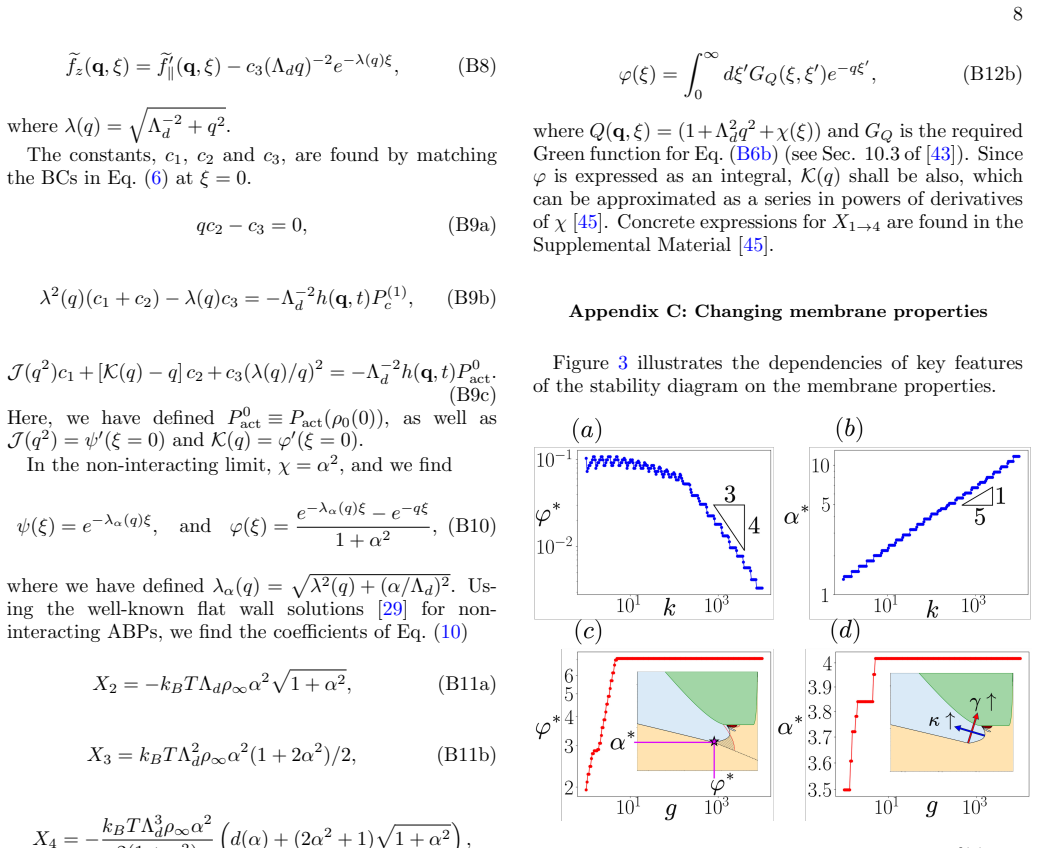
These show how the blue region of short wavelength instability shrinks when γ or κ are increased, as shown by the red and blue arrows in the inset of panel (d). Supplemental Material: Active Particles Destabilize Passive Membra nes David A. King, 1, 2, ∗ Thomas P. Russell, 3, 1 and Ahmad K. Omar 1, 2, † 1Materials Science Division, Lawrence Berkeley Natio...
-
[65]
and ( 14) allow each of these coefficients to be computed from the quantities, ρ0(0) and P (1) c which are determined by the equations of state Pc(ρ) and Pact(ρ) as well as the bulk density, ρ∞ and activity α . II. ORIGINS OF THE EFFECTIVE NON-LOCAL TERMS In this section we discuss the origins of the X1 andX3 terms in the pressure exerted by the active part...
-
[66]
For a full discussion, see [ 3]
Although, this naming convention does not appropriately a pportion the credit for its discovery. For a full discussion, see [ 3]
-
[67]
C. M. Bender and S. A. Orszag, Advanced Mathematical Methods for Scientists and Engineer s (McGraw-Hill Book Company, 1978)
work page 1978
-
[68]
R. B. Dingle, Asymptotic Expansions: Their Derivation and Interpretatio n (Academic Press, 1973)
work page 1973
- [69]
- [70]
-
[71]
A. Duzgun and J. V. Selinger, Active brownian particles near s traight or curved walls: Pressure and boundary layers, Physical Review E 97, 032606 (2018)
work page 2018
-
[72]
D. Saintillan and M. J. Shelley, Theory of active suspensio ns, in Complex Fluids in Biological Systems , edited by S. Spagnolie (Springer, 2015) pp. 319–355
work page 2015
-
[73]
H. R. Vutukuri, M. Hoore, C. Abaurrea-Velasco, L. van Buren, A. Dutto, T. Auth, D. A. Fedosov, G. Gompper, and J. Vermant, Active particles induce large shape deformations in g iant lipid vesicles, Nature 586, 52 (2020)
work page 2020
discussion (0)
Sign in with ORCID, Apple, or X to comment. Anyone can read and Pith papers without signing in.