REVIEW 3 major objections 4 minor 79 references
Understanding Behavioral Metric Learning: A Large-Scale Study on Distracting Reinforcement Learning Environments
T0 review · 3 major / 4 minor · reviewed 2026-08-07 · deepseek-v4-flash
Pith's one-line read A large-scale study of five behavioral-metric methods in reinforcement learning finds that the standalone benefit of the metric loss for filtering task-irrelevant noise is marginal; self-prediction and normalization carry the gains.
desk verdict A careful, unusually transparent large-scale benchmark whose central negative result on metric losses is plausible and mostly supported, but method rankings need caveats because several implementations were modified and one uses a near-disabled metric loss. read the letter →
The pith
A machine-rendered reading of the paper's core claim, the machinery that carries it, and where it could break.
The reading
What carries the argument
The paper's organizing device is the isometric embedding definition (Eq. 2), which frames each method as an encoder that tries to make representation distances reproduce a target behavioral distance approximated from rewards and transitions. Its evaluation machinery consists of the denoising factor (DF, Eq. 9), which measures an encoder's ability to pull together observations that share a task-relevant state (positive pairs) while separating random pairs, and the isolated metric estimation setting (Sec. 4.4), in which a separate encoder is trained solely by the metric loss so that the metric's contribution can be measured without interference from RL, reward-prediction, and self-prediction losses.
What would settle it
Re-run the isolated metric estimation experiment with metric targets computed from on-policy rollout data, or with an off-policy correction, on the same six state-based tasks; if encoders trained with the metric loss then achieve clearly higher denoising factors than encoders trained with self-prediction alone, the paper's marginality conclusion would be an artifact of target misspecification rather than a property of metric learning.
Extended reading notes
Core claim
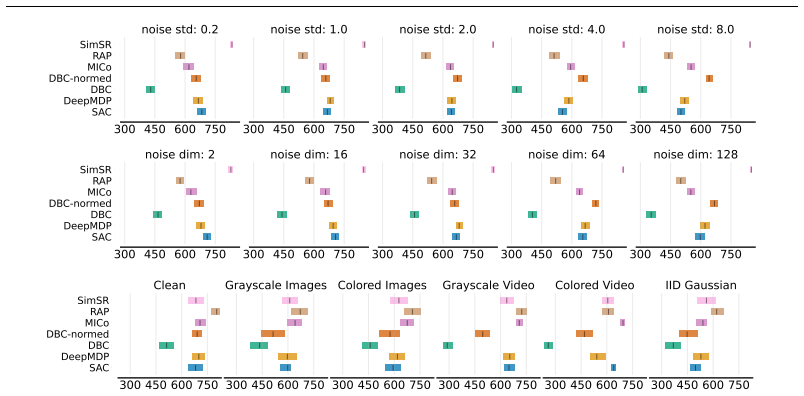
The paper claims that when the encoder is influenced solely by the metric loss, the standalone benefit of learning a metric by an explicit metric loss becomes marginal (Sec. 5.3). In the full benchmarks, SimSR—which combines a metric loss with self-prediction and L2 normalization—outperforms all methods on state-based tasks, and ablations show its success is largely driven by the self-prediction loss and feature normalization; DeepMDP with LayerNorm performs comparably to SimSR, while DBC, the most commonly used metric-learning baseline, consistently performs worst. The paper also reports that SAC and DeepMDP are strong baselines, and that the widely used grayscale-video distraction is not harder than a clean background for several methods, while IID Gaussian noise with random projection is the challenging setting.
Load-bearing premise
The benchmarked methods compute on-policy metric targets using rewards and transitions sampled from an off-policy replay buffer, and the comparison's validity depends on this off-policy data standing in for the on-policy distances the theory requires.
Editorial extensions
If this is right
- If the claims hold, previously reported robustness gains of bisimulation-metric methods should be re-attributed to self-prediction losses and normalization rather than to the metric objective itself.
- The denoising factor gives the field a quantitative measure of distraction filtering that can be reported alongside returns in future benchmarks.
- Adding LayerNorm to the representation space improves both reward and denoising for most methods, including DeepMDP, making normalization a first-class design choice in noisy environments.
- Simple baselines SAC and DeepMDP remain competitive on both state- and pixel-based distracting tasks, raising the bar for what a metric-based method must demonstrate.
- The commonly used grayscale-video OOD benchmark is not harder than a clean background for several methods; IID Gaussian noise with random projection is a more discriminating test.
Reading between the lines
- A testable extension: if the on-policy/off-policy gap in target estimation is closed by computing metric targets from on-policy rollouts, the marginal benefit of the metric loss might reappear, which would localize the cause of the observed marginality to target misspecification rather than to metric learning in principle.
- The marginality result suggests that future metric-based methods should be designed to complement self-prediction and normalization, or to show value on settings like random projection where simple baselines struggle.
- The denoising factor could be borrowed as an auditing tool for representation learning beyond behavioral metrics, for example to compare data augmentation and self-supervised losses on distraction filtering.
- One could extend the isolated setting to discrete control and other base algorithms to check whether the marginality is specific to SAC-based continuous control.
Editorial analysis
A structured set of objections, weighed in public.
Referee Report
Summary. The paper presents a large-scale empirical study of behavioral metric learning methods in distracting reinforcement learning environments. It unifies five recent metric-based representation learning methods (DBC, DBC-normed, MICo, RAP, SimSR) under an isometric-embedding framework, introduces a denoising factor (DF) to quantify an encoder's ability to filter task-irrelevant noise, and proposes an isolated metric estimation setting to evaluate the metric loss alone. The authors benchmark seven methods (including SAC and DeepMDP baselines) across 20 state-based and 14 pixel-based DeepMind Control tasks under multiple noise settings, with both ID and OOD generalization evaluations. Main findings are that SimSR performs best in state-based tasks, RAP performs best in pixel-based tasks, SAC and DeepMDP are strong baselines, DBC performs worst, and in the isolated setting, an explicit metric loss offers only marginal denoising benefit compared with self-prediction (ZP) loss. The paper also includes theoretical analyses of denoising properties of bisimulation metrics and releases an open-source codebase.
Significance. If the findings hold, they substantially qualify the robustness gains previously attributed to bisimulation metrics in deep RL, suggesting that self-prediction and feature normalization are the main drivers. The study is unusually comprehensive: 12 seeds for state-based and 5 seeds for pixel-based tasks, 95% confidence intervals, per-task tables accompanying every aggregated figure, and a modular open-source implementation. The introduction of the denoising factor and the isolated estimation setting are useful evaluation tools for future work. The theoretical claims (denoising properties of BSM and PBSM, transition-distance preservation under isometry) are supported by proofs in Appendix D. The benchmarking itself is internally consistent, and the paper is transparent about many of its design choices. However, the central negative result in the isolated setting is conditional on an acknowledged but uncontrolled theory-practice gap: the on-policy behavioral metric targets are estimated from off-policy replay data, which may handicap metric losses relative to policy-independent baselines.
major comments (3)
- [Sec. 5.3, Eq. (15), Eq. (24); Sec. 3.4] The paper's strongest claim—that explicit metric losses provide only marginal standalone denoising benefit—is not yet fully supported because the evaluated metric methods estimate on-policy PBSM/MICo targets from off-policy replay data. The authors explicitly flag this gap in Sec. 3.4 ('both PBSM and MICo are on-policy metrics, but the sampled rewards used in d_R are from a replay buffer'), and Eq. (15) and Eq. (24) indeed use rewards and next-state samples from a replay buffer that contains a mixture of past behavior policies. The comparison baselines in the isolated setting (ZP, RP) are policy-independent, so this off-policy mismatch biases only the metric methods. As a result, the observed 'marginal benefit of an explicit metric loss' could reflect a misspecified target rather than an inherent property of metric learning. I recommend adding a control experiment in which the metric targets are computed using data collected by a fixed policy that matches the target policy (e.g., a frozen SAC policy), or at least an analysis that quantifies the degree of off-policyness and its effect on DF. Absent such a control, the central conclusion should be tempered to state that current off-policy implementations of metric losses provide marginal benefit.
- [Sec. 3.3, Sec. 5.1] The benchmarking results in Sec. 5.1, including the finding that 'DBC consistently performs the worst,' are based on modified versions of the published methods. As stated in Sec. 3.3, DBC-normed is stripped of its intrinsic-reward and inverse-dynamics components, DBC's observation reconstruction is removed, and DBC-normed and SimSR use a single probabilistic transition model instead of their original components. These modifications are reasonable for isolating the metric loss, but the paper's headline claims are then not directly about the original methods. This is a serious attribution issue: readers may conclude that the original DBC algorithm is inferior, when in fact the study evaluates a reduced variant. The authors should either clearly rephrase the findings as applying only to the stripped-down versions, or add a brief experiment showing the original versions perform similarly.
- [Sec. 4.3, Sec. 5.1] The denoising factor is computed using the Euclidean (L2) distance dΨ = ||·||_2, but the encoders being evaluated have different output scales: SimSR applies L2 normalization, DBC-normed applies max normalization, other pixel-based encoders use LayerNorm, and state-based encoders may use no normalization. While the ratio form of DF provides some scale invariance, the comparability of DF across methods with differently scaled representation spaces is not fully established. The paper should clarify whether the encoder outputs are re-normalized before computing DF and discuss the potential impact of output scale on the DF comparisons in Fig. 5 and Fig. 12.
minor comments (4)
- [Sec. 3.1, Eq. (2)] The definition of isometric embedding (Eq. 2) assumes an equality between the target metric d_X and the representation metric d_Ψ, but the target metric is a pseudometric or diffuse metric in the methods studied (PBSM, MICo). This is a minor conceptual inconsistency; the paper might mention that the embedding is into a pseudometric space.
- [Sec. 5.2, Fig. 3] The ablation in Fig. 3 compares 'SimSR (Basic)' with and without ZP loss, but the caption does not specify which hyperparameters (e.g., loss coefficients) are used for the 'No ZP' variant. I assume the ZP loss coefficient is set to zero; this should be stated explicitly.
- [Appendix F.1] In the hyperparameter exceptions, the authors note that for MICo they use a hidden unit size of 256 rather than the original 1024 and a reward scale of 1 rather than 0.1. This is a significant deviation from the original method; a sentence explaining the potential effect on MICo's performance and why this choice is necessary for fairness would be useful.
- [Sec. 5.4, Fig. 6] The reward-difference plots in Fig. 6 aggregate over 14 pixel-based tasks, but the y-axis label says 'Reward difference' without units; please add a caption that explains the difference is OOD reward minus ID reward (or vice versa), as the color direction is not immediately clear.
Circularity Check
The isolated-setting denoising comparison is partially self-referential because the denoising factor (DF) is defined through the same representation distance that the metric losses directly optimize; the broader empirical benchmark is otherwise self-contained.
-
self definitional
[Sec. 4.3, Definition 4 (Eq. 9); related to Sec. 3.2, Eq. 6]
"DFπdΨ(ϕ) := NegπdΨ(ϕ) − PosπdΨ(ϕ) / NegπdΨ(ϕ) + PosπdΨ(ϕ) ∈ [−1,1]. ... It also provides insight into how the behavioral metrics are approximated, given that exact behavioral metrics are nearly inaccessible via fixed-point iteration in high-dimensional state or action spaces."
DF is defined as a normalized difference of Pos (Eq. 7) and Neg (Eq. 8), both expectations of the representation distance dΨ(ϕ(x),ϕ(·)). The metric loss JM in Eq. 6 is ℓ(dΨ(ϕ(x1),ϕ(x2)) − d̂X(x1,x2)), i.e., it drives the very same dΨ quantities to match a behavioral-metric target. Since positive pairs (same task-relevant state) have near-zero target distance and negative pairs have large target distance, an encoder that satisfactorily minimizes JM will by construction produce small positive scores and large negative scores, hence a high DF. Thus the DF measured in the isolated setting is partly a measure of whether the metric loss was satisfied, not an independent measure of denoising.
full rationale
The paper's headline findings are empirical benchmarks over many tasks and seeds, not derivations that collapse into fitted constants. No parameter is fitted to a subset and then reported as a prediction. Self-citations such as Ni et al. (2024) for the ZP/DeepMDP baseline are not load-bearing: they supply an algorithm and implementation detail, not an unverified uniqueness theorem, and the comparison against external SAC and environment benchmarks gives independent content. The one genuine circularity concern is the denoising factor: DF (Eq. 9) is built from the same representation distance dΨ that metric losses (Eq. 6) optimize, so isolated-setting DF comparisons are partially self-referential, as the paper itself acknowledges in Sec. 4.3. The paper also explicitly flags the on-policy/off-policy gap in Sec. 3.4 ('both PBSM and MICo are on-policy metrics, but the sampled rewards used in d̂R are from a replay buffer'); this is a real confound for the metric methods but is a correctness/validity concern, not circularity. Overall, the central empirical contribution remains self-contained against external benchmarks, so the score is low.
Assumptions & free parameters
free parameters (4)
- beta (angular distance coefficient) =
0.1 for MICo; 1e-6 for RAP
- metric coefficients c_R and c_T =
c_R = 1, c_T = 0.99
- metric loss coefficient lambda_M =
0.5
- DF sample counts =
16 positive and 16 negative examples per anchor
assumptions (6)
- domain assumption EX-BMDP factorization: latent state z = (s, xi) with independent noise evolution and reward depending only on s
- domain assumption Block structure of BMDP and existence of oracle encoders q^-1 and phi*
- standard math Existence and uniqueness of fixed points for BSM, PBSM, and MICo distances
- ad hoc to paper Isometric embedding assumption (Eq. 2) and transition distance preservation (Eq. 5)
- domain assumption Off-policy replay samples adequately approximate the on-policy metric targets
- standard math Convergence of the iterative bisimulation operator
invented entities (2)
-
Denoising factor (DF)
independent evidence
-
Isolated metric encoder phi-tilde
independent evidence
Cite this review
Pith. "Pith review of Understanding Behavioral Metric Learning: A Large-Scale Study on Distracting Reinforcement Learning Environments." pith.science (2026). https://pith.science/paper/4IVL4FSO
@misc{pith2026250600563,
  author       = {Pith},
  title        = {Pith review of: Understanding Behavioral Metric Learning: A Large-Scale Study on Distracting Reinforcement Learning Environments},
  year         = {2026},
  howpublished = {\url{https://pith.science/paper/4IVL4FSO}},
  note         = {Machine review of arXiv:2506.00563}
}
read the original abstract
A key approach to state abstraction is approximating behavioral metrics (notably, bisimulation metrics) in the observation space and embedding these learned distances in the representation space. While promising for robustness to task-irrelevant noise, as shown in prior work, accurately estimating these metrics remains challenging, requiring various design choices that create gaps between theory and practice. Prior evaluations focus mainly on final returns, leaving the quality of learned metrics and the source of performance gains unclear. To systematically assess how metric learning works in deep reinforcement learning (RL), we evaluate five recent approaches, unified conceptually as isometric embeddings with varying design choices. We benchmark them with baselines across 20 state-based and 14 pixel-based tasks, spanning 370 task configurations with diverse noise settings. Beyond final returns, we introduce the evaluation of a denoising factor to quantify the encoder's ability to filter distractions. To further isolate the effect of metric learning, we propose and evaluate an isolated metric estimation setting, in which the encoder is influenced solely by the metric loss. Finally, we release an open-source, modular codebase to improve reproducibility and support future research on metric learning in deep RL.
Figures


Figures from the paper (43 more)


Reference graph
Works this paper leans on
-
[1]
Contrastive behavioral similarity embeddings for generalization in reinforcement learning
Rishabh Agarwal, Marlos C Machado, Pablo Samuel Castro, and Marc G Bellemare. Contrastive behavioral similarity embeddings for generalization in reinforcement learning. arXiv preprint arXiv:2101.05265, 2021 a
arXiv 2021
-
[2]
Deep reinforcement learning at the edge of the statistical precipice
Rishabh Agarwal, Max Schwarzer, Pablo Samuel Castro, Aaron C Courville, and Marc Bellemare. Deep reinforcement learning at the edge of the statistical precipice. Advances in neural information processing systems, 34: 0 29304--29320, 2021 b
work page 2021
-
[3]
Jimmy Lei Ba, Jamie Ryan Kiros, and Geoffrey E Hinton. Layer normalization. arXiv preprint arXiv:1607.06450, 2016
arXiv 2016
-
[4]
Aditya Bhatt, Daniel Palenicek, Boris Belousov, Max Argus, Artemij Amiranashvili, Thomas Brox, and Jan Peters. Crossq: Batch normalization in deep reinforcement learning for greater sample efficiency and simplicity. arXiv preprint arXiv:1902.05605, 2019
arXiv 1902
-
[5]
Online abstraction with mdp homomorphisms for deep learning
Ondrej Biza and Robert Platt. Online abstraction with mdp homomorphisms for deep learning. arXiv preprint arXiv:1811.12929, 2018
arXiv 2018
-
[6]
Scalable methods for computing state similarity in deterministic markov decision processes
Pablo Samuel Castro. Scalable methods for computing state similarity in deterministic markov decision processes. In Proceedings of the AAAI Conference on Artificial Intelligence, volume 34, pp.\ 10069--10076, 2020
2020
-
[7]
Mico: Improved representations via sampling-based state similarity for markov decision processes
Pablo Samuel Castro, Tyler Kastner, Prakash Panangaden, and Mark Rowland. Mico: Improved representations via sampling-based state similarity for markov decision processes. Advances in Neural Information Processing Systems, 34: 0 30113--30126, 2021
work page 2021
-
[8]
A Kernel Perspective on Behavioural Metrics for Markov Decision Processes
Pablo Samuel Castro, Tyler Kastner, Prakash Panangaden, and Mark Rowland. A kernel perspective on behavioural metrics for markov decision processes. arXiv preprint arXiv:2310.19804, 2023
work page Pith review arXiv 2023
Show all 79 references
-
[9]
Learning representations via a robust behavioral metric for deep reinforcement learning
Jianda Chen and Sinno Pan. Learning representations via a robust behavioral metric for deep reinforcement learning. Advances in Neural Information Processing Systems, 35: 0 36654--36666, 2022
2022
-
[10]
State chrono representation for enhancing generalization in reinforcement learning
Jianda Chen, Zichen Chen, Sinno Pan, Tianwei Zhang, et al. State chrono representation for enhancing generalization in reinforcement learning. Advances in Neural Information Processing Systems, 37: 0 73309--73336, 2024
2024
-
[11]
Offline reinforcement learning with pseudometric learning
Robert Dadashi, Shideh Rezaeifar, Nino Vieillard, L \'e onard Hussenot, Olivier Pietquin, and Matthieu Geist. Offline reinforcement learning with pseudometric learning. In International Conference on Machine Learning, pp.\ 2307--2318. PMLR, 2021
2021
-
[12]
Bisimulation for labelled markov processes
Jos \'e e Desharnais, Abbas Edalat, and Prakash Panangaden. Bisimulation for labelled markov processes. Information and Computation, 179 0 (2): 0 163--193, 2002
2002
-
[13]
Provably efficient rl with rich observations via latent state decoding
Simon Du, Akshay Krishnamurthy, Nan Jiang, Alekh Agarwal, Miroslav Dudik, and John Langford. Provably efficient rl with rich observations via latent state decoding. In International Conference on Machine Learning, pp.\ 1665--1674. PMLR, 2019
2019
-
[14]
Differential privacy
Cynthia Dwork. Differential privacy. In International colloquium on automata, languages, and programming, pp.\ 1--12. Springer, 2006
2006
-
[15]
Provable rl with exogenous distractors via multistep inverse dynamics
Yonathan Efroni, Dipendra Misra, Akshay Krishnamurthy, Alekh Agarwal, and John Langford. Provable rl with exogenous distractors via multistep inverse dynamics. arXiv preprint arXiv:2110.08847, 2021
2021 arXiv
-
[16]
Metrics for finite markov decision processes
Norm Ferns, Prakash Panangaden, and Doina Precup. Metrics for finite markov decision processes. In Proceedings of the 20th conference on Uncertainty in artificial intelligence, pp.\ 162--169, 2004
2004
-
[17]
Bisimulation metrics for continuous markov decision processes
Norm Ferns, Prakash Panangaden, and Doina Precup. Bisimulation metrics for continuous markov decision processes. SIAM Journal on Computing, 40 0 (6): 0 1662--1714, 2011
2011
-
[18]
For sale: State-action representation learning for deep reinforcement learning
Scott Fujimoto, Wei-Di Chang, Edward Smith, Shixiang Shane Gu, Doina Precup, and David Meger. For sale: State-action representation learning for deep reinforcement learning. Advances in neural information processing systems, 36: 0 61573--61624, 2023
2023
-
[19]
Deepmdp: Learning continuous latent space models for representation learning
Carles Gelada, Saurabh Kumar, Jacob Buckman, Ofir Nachum, and Marc G Bellemare. Deepmdp: Learning continuous latent space models for representation learning. In International conference on machine learning, pp.\ 2170--2179. PMLR, 2019
2019
-
[20]
Fully homomorphic encryption using ideal lattices
Craig Gentry. Fully homomorphic encryption using ideal lattices. In Proceedings of the forty-first annual ACM symposium on Theory of computing, pp.\ 169--178, 2009
2009
-
[21]
Equivalence notions and model minimization in markov decision processes
Robert Givan, Thomas Dean, and Matthew Greig. Equivalence notions and model minimization in markov decision processes. Artificial intelligence, 147 0 (1-2): 0 163--223, 2003
2003
-
[22]
Measuring visual generalization in continuous control from pixels, 2020
Jake Grigsby and Yanjun Qi. Measuring visual generalization in continuous control from pixels, 2020
2020
-
[23]
Bootstrap your own latent-a new approach to self-supervised learning
Jean-Bastien Grill, Florian Strub, Florent Altch \'e , Corentin Tallec, Pierre Richemond, Elena Buchatskaya, Carl Doersch, Bernardo Avila Pires, Zhaohan Guo, Mohammad Gheshlaghi Azar, et al. Bootstrap your own latent-a new approach to self-supervised learning. Advances in neur...
2020
-
[24]
Soft actor-critic: Off-policy maximum entropy deep reinforcement learning with a stochastic actor
Tuomas Haarnoja, Aurick Zhou, Pieter Abbeel, and Sergey Levine. Soft actor-critic: Off-policy maximum entropy deep reinforcement learning with a stochastic actor. In International conference on machine learning, pp.\ 1861--1870. Pmlr, 2018
2018
-
[25]
Generalization in reinforcement learning by soft data augmentation
Nicklas Hansen and Xiaolong Wang. Generalization in reinforcement learning by soft data augmentation. In International Conference on Robotics and Automation, 2021
2021
-
[26]
Td-mpc2: Scalable, robust world models for continuous control
Nicklas Hansen, Hao Su, and Xiaolong Wang. Td-mpc2: Scalable, robust world models for continuous control. arXiv preprint arXiv:2310.16828, 2023
2023 arXiv
-
[27]
Bisimulation makes analogies in goal-conditioned reinforcement learning
Philippe Hansen-Estruch, Amy Zhang, Ashvin Nair, Patrick Yin, and Sergey Levine. Bisimulation makes analogies in goal-conditioned reinforcement learning. In International Conference on Machine Learning, pp.\ 8407--8426. PMLR, 2022
2022
-
[28]
Dropout q-functions for doubly efficient reinforcement learning
Takuya Hiraoka, Takahisa Imagawa, Taisei Hashimoto, Takashi Onishi, and Yoshimasa Tsuruoka. Dropout q-functions for doubly efficient reinforcement learning. arXiv preprint arXiv:2110.02034, 2021
2021 arXiv
-
[29]
Offline rl with observation histories: Analyzing and improving sample complexity
Joey Hong, Anca Dragan, and Sergey Levine. Offline rl with observation histories: Analyzing and improving sample complexity. arXiv preprint arXiv:2310.20663, 2023
2023 arXiv
-
[30]
Robust estimation of a location parameter
Peter J Huber. Robust estimation of a location parameter. In Breakthroughs in statistics: Methodology and distribution, pp.\ 492--518. Springer, 1992
1992
-
[31]
Dissecting deep rl with high update ratios: Combatting value divergence
Marcel Hussing, Claas Voelcker, Igor Gilitschenski, Amir-massoud Farahmand, and Eric Eaton. Dissecting deep rl with high update ratios: Combatting value divergence. arXiv preprint arXiv:2403.05996, 2024
2024 arXiv
-
[32]
Agent-controller representations: Principled offline rl with rich exogenous information
Riashat Islam, Manan Tomar, Alex Lamb, Yonathan Efroni, Hongyu Zang, Aniket Didolkar, Dipendra Misra, Xin Li, Harm Van Seijen, Remi Tachet des Combes, et al. Agent-controller representations: Principled offline rl with rich exogenous information. arXiv preprint arXiv:2211.00164, 2022
2022 arXiv
-
[33]
Notes on state abstractions, 2018
Nan Jiang. Notes on state abstractions, 2018
2018
-
[34]
The kinetics human action video dataset
Will Kay, Joao Carreira, Karen Simonyan, Brian Zhang, Chloe Hillier, Sudheendra Vijayanarasimhan, Fabio Viola, Tim Green, Trevor Back, Paul Natsev, et al. The kinetics human action video dataset. arXiv preprint arXiv:1705.06950, 2017
2017 arXiv
-
[35]
Towards robust bisimulation metric learning
Mete Kemertas and Tristan Aumentado-Armstrong. Towards robust bisimulation metric learning. Advances in Neural Information Processing Systems, 34: 0 4764--4777, 2021
2021
-
[36]
Actor-critic algorithms
Vijay Konda and John Tsitsiklis. Actor-critic algorithms. Advances in neural information processing systems, 12, 1999
1999
-
[37]
On the necessity of abstraction
George Konidaris. On the necessity of abstraction. Current opinion in behavioral sciences, 29: 0 1--7, 2019
2019
-
[38]
Towards a unified theory of state abstraction for mdps
Lihong Li, Thomas J Walsh, and Michael L Littman. Towards a unified theory of state abstraction for mdps. AI&M, 1 0 (2): 0 3, 2006
2006
-
[39]
Normalization enhances generalization in visual reinforcement learning
Lu Li, Jiafei Lyu, Guozheng Ma, Zilin Wang, Zhenjie Yang, Xiu Li, and Zhiheng Li. Normalization enhances generalization in visual reinforcement learning. arXiv preprint arXiv:2306.00656, 2023
2023 arXiv
-
[40]
Does self-supervised learning really improve reinforcement learning from pixels? Advances in Neural Information Processing Systems, 35: 0 30865--30881, 2022
Xiang Li, Jinghuan Shang, Srijan Das, and Michael Ryoo. Does self-supervised learning really improve reinforcement learning from pixels? Advances in Neural Information Processing Systems, 35: 0 30865--30881, 2022
2022
-
[41]
Policy-independent behavioral metric-based representation for deep reinforcement learning
Weijian Liao, Zongzhang Zhang, and Yang Yu. Policy-independent behavioral metric-based representation for deep reinforcement learning. In Proceedings of the AAAI Conference on Artificial Intelligence, volume 37, pp.\ 8746--8754, 2023
2023
-
[42]
Robust representation learning by clustering with bisimulation metrics for visual reinforcement learning with distractions
Qiyuan Liu, Qi Zhou, Rui Yang, and Jie Wang. Robust representation learning by clustering with bisimulation metrics for visual reinforcement learning with distractions. In Proceedings of the AAAI conference on artificial intelligence, volume 37, pp.\ 8843--8851, 2023
2023
-
[43]
A calculus of communicating systems
Robin Milner. A calculus of communicating systems. Springer, 1980
1980
-
[44]
Learning temporal distances: Contrastive successor features can provide a metric structure for decision-making
Vivek Myers, Chongyi Zheng, Anca Dragan, Sergey Levine, and Benjamin Eysenbach. Learning temporal distances: Contrastive successor features can provide a metric structure for decision-making. arXiv preprint arXiv:2406.17098, 2024
2024 arXiv
-
[45]
Overestimation, overfitting, and plasticity in actor-critic: the bitter lesson of reinforcement learning
Michal Nauman, Micha Bortkiewicz, Piotr Mi o \'s , Tomasz Trzci \'n ski, Mateusz Ostaszewski, and Marek Cygan. Overestimation, overfitting, and plasticity in actor-critic: the bitter lesson of reinforcement learning. arXiv preprint arXiv:2403.00514, 2024
2024 arXiv
-
[46]
Bridging state and history representations: Understanding self-predictive rl
Tianwei Ni, Benjamin Eysenbach, Erfan Seyedsalehi, Michel Ma, Clement Gehring, Aditya Mahajan, and Pierre-Luc Bacon. Bridging state and history representations: Understanding self-predictive rl. arXiv preprint arXiv:2401.08898, 2024
2024 arXiv
-
[47]
Control-oriented model-based reinforcement learning with implicit differentiation
Evgenii Nikishin, Romina Abachi, Rishabh Agarwal, and Pierre-Luc Bacon. Control-oriented model-based reinforcement learning with implicit differentiation. In Proceedings of the AAAI Conference on Artificial Intelligence, volume 36, pp.\ 7886--7894, 2022
2022
-
[48]
Labelled Markov Processes
Prakash Panangaden. Labelled Markov Processes. Imperial College Press, 2009
2009
-
[49]
Policy gradient methods in the presence of symmetries and state abstractions
Prakash Panangaden, Sahand Rezaei-Shoshtari, Rosie Zhao, David Meger, and Doina Precup. Policy gradient methods in the presence of symmetries and state abstractions. Journal of Machine Learning Research, 25 0 (71): 0 1--57, 2024
2024
-
[50]
Concurrency and automata on infinite sequences
David Park. Concurrency and automata on infinite sequences. In Theoretical Computer Science: 5th GI-Conference Karlsruhe, March 23-25, 1981, volume 104, pp.\ 167. Springer, 1981
1981
-
[51]
State-action similarity-based representations for off-policy evaluation
Brahma Pavse and Josiah Hanna. State-action similarity-based representations for off-policy evaluation. Advances in Neural Information Processing Systems, 36: 0 42298--42329, 2023
2023
-
[52]
An algebraic approach to abstraction in reinforcement learning
Balaraman Ravindran. An algebraic approach to abstraction in reinforcement learning. University of Massachusetts Amherst, 2004
2004
-
[53]
Model minimization in hierarchical reinforcement learning
Balaraman Ravindran and Andrew G Barto. Model minimization in hierarchical reinforcement learning. In Abstraction, Reformulation, and Approximation: 5th International Symposium, SARA 2002 Kananaskis, Alberta, Canada August 2--4, 2002 Proceedings 5, pp.\ 196--211. Springer, 2002
2002
-
[54]
Continuous mdp homomorphisms and homomorphic policy gradient
Sahand Rezaei-Shoshtari, Rosie Zhao, Prakash Panangaden, David Meger, and Doina Precup. Continuous mdp homomorphisms and homomorphic policy gradient. Advances in Neural Information Processing Systems, 35: 0 20189--20204, 2022
2022
-
[55]
Learning action-based representations using invariance
Max Rudolph, Caleb Chuck, Kevin Black, Misha Lvovsky, Scott Niekum, and Amy Zhang. Learning action-based representations using invariance. arXiv preprint arXiv:2403.16369, 2024
2024 arXiv
-
[56]
Facenet: A unified embedding for face recognition and clustering
Florian Schroff, Dmitry Kalenichenko, and James Philbin. Facenet: A unified embedding for face recognition and clustering. In Proceedings of the IEEE conference on computer vision and pattern recognition, pp.\ 815--823, 2015
2015
-
[57]
Data-efficient reinforcement learning with self-predictive representations
Max Schwarzer, Ankesh Anand, Rishab Goel, R Devon Hjelm, Aaron Courville, and Philip Bachman. Data-efficient reinforcement learning with self-predictive representations. arXiv preprint arXiv:2007.05929, 2020
2007 arXiv
-
[58]
Bisimulation metric for model predictive control
Yutaka Shimizu and Masayoshi Tomizuka. Bisimulation metric for model predictive control. arXiv preprint arXiv:2410.04553, 2024
2024 arXiv
-
[59]
Reinforcement learning with soft state aggregation
Satinder Singh, Tommi Jaakkola, and Michael Jordan. Reinforcement learning with soft state aggregation. Advances in neural information processing systems, 7, 1994
1994
-
[60]
A walk in the park: Learning to walk in 20 minutes with model-free reinforcement learning
Laura Smith, Ilya Kostrikov, and Sergey Levine. A walk in the park: Learning to walk in 20 minutes with model-free reinforcement learning. arXiv preprint arXiv:2208.07860, 2022
2022 arXiv
-
[61]
The distracting control suite--a challenging benchmark for reinforcement learning from pixels
Austin Stone, Oscar Ramirez, Kurt Konolige, and Rico Jonschkowski. The distracting control suite--a challenging benchmark for reinforcement learning from pixels. arXiv preprint arXiv:2101.02722, 2021
2021 arXiv
-
[62]
Approximate information state for approximate planning and reinforcement learning in partially observed systems
Jayakumar Subramanian, Amit Sinha, Raihan Seraj, and Aditya Mahajan. Approximate information state for approximate planning and reinforcement learning in partially observed systems. Journal of Machine Learning Research, 23 0 (12): 0 1--83, 2022
2022
-
[63]
Deepmind control suite
Yuval Tassa, Yotam Doron, Alistair Muldal, Tom Erez, Yazhe Li, Diego de Las Casas, David Budden, Abbas Abdolmaleki, Josh Merel, Andrew Lefrancq, et al. Deepmind control suite. arXiv preprint arXiv:1801.00690, 2018
2018 arXiv
-
[64]
Lax probabilistic bisimulation
Jonathan Taylor. Lax probabilistic bisimulation. 2008
2008
-
[65]
Learning representations for pixel-based control: What matters and why? arXiv preprint arXiv:2111.07775, 2021
Manan Tomar, Utkarsh A Mishra, Amy Zhang, and Matthew E Taylor. Learning representations for pixel-based control: What matters and why? arXiv preprint arXiv:2111.07775, 2021
2021 arXiv
-
[66]
dm\_control: Software and tasks for continuous control
Saran Tunyasuvunakool, Alistair Muldal, Yotam Doron, Siqi Liu, Steven Bohez, Josh Merel, Tom Erez, Timothy Lillicrap, Nicolas Heess, and Yuval Tassa. dm\_control: Software and tasks for continuous control. Software Impacts, 6: 0 100022, 2020
2020
-
[67]
Plannable approximations to mdp homomorphisms: Equivariance under actions
Elise Van der Pol, Thomas Kipf, Frans A Oliehoek, and Max Welling. Plannable approximations to mdp homomorphisms: Equivariance under actions. arXiv preprint arXiv:2002.11963, 2020 a
2002 arXiv
-
[68]
Mdp homomorphic networks: Group symmetries in reinforcement learning
Elise Van der Pol, Daniel Worrall, Herke van Hoof, Frans Oliehoek, and Max Welling. Mdp homomorphic networks: Group symmetries in reinforcement learning. Advances in Neural Information Processing Systems, 33: 0 4199--4210, 2020 b
2020
-
[69]
When does self-prediction help? understanding auxiliary tasks in reinforcement learning
Claas Voelcker, Tyler Kastner, Igor Gilitschenski, and Amir-massoud Farahmand. When does self-prediction help? understanding auxiliary tasks in reinforcement learning. arXiv preprint arXiv:2406.17718, 2024
2024 arXiv
-
[70]
Efficient potential-based exploration in reinforcement learning using inverse dynamic bisimulation metric
Yiming Wang, Ming Yang, Renzhi Dong, Binbin Sun, Furui Liu, et al. Efficient potential-based exploration in reinforcement learning using inverse dynamic bisimulation metric. Advances in Neural Information Processing Systems, 36: 0 38786--38797, 2023
2023
-
[71]
Rethinking exploration in reinforcement learning with effective metric-based exploration bonus
Yiming Wang, Kaiyan Zhao, Furui Liu, et al. Rethinking exploration in reinforcement learning with effective metric-based exploration bonus. Advances in Neural Information Processing Systems, 37: 0 57765--57792, 2024
2024
-
[72]
Mastering visual continuous control: Improved data-augmented reinforcement learning
Denis Yarats, Rob Fergus, Alessandro Lazaric, and Lerrel Pinto. Mastering visual continuous control: Improved data-augmented reinforcement learning. arXiv preprint arXiv:2107.09645, 2021 a
2021 arXiv
-
[73]
Improving sample efficiency in model-free reinforcement learning from images
Denis Yarats, Amy Zhang, Ilya Kostrikov, Brandon Amos, Joelle Pineau, and Rob Fergus. Improving sample efficiency in model-free reinforcement learning from images. In Proceedings of the aaai conference on artificial intelligence, volume 35, pp.\ 10674--10681, 2021 b
2021
-
[74]
Rl-vigen: A reinforcement learning benchmark for visual generalization
Zhecheng Yuan, Sizhe Yang, Pu Hua, Can Chang, Kaizhe Hu, and Huazhe Xu. Rl-vigen: A reinforcement learning benchmark for visual generalization. Advances in Neural Information Processing Systems, 36: 0 6720--6747, 2023
2023
-
[75]
Simsr: Simple distance-based state representations for deep reinforcement learning
Hongyu Zang, Xin Li, and Mingzhong Wang. Simsr: Simple distance-based state representations for deep reinforcement learning. In Proceedings of the AAAI conference on artificial intelligence, volume 36, pp.\ 8997--9005, 2022
2022
-
[76]
Understanding and addressing the pitfalls of bisimulation-based representations in offline reinforcement learning
Hongyu Zang, Xin Li, Leiji Zhang, Yang Liu, Baigui Sun, Riashat Islam, Remi Tachet des Combes, and Romain Laroche. Understanding and addressing the pitfalls of bisimulation-based representations in offline reinforcement learning. Advances in Neural Information Processing Syste...
2023
-
[77]
Natural environment benchmarks for reinforcement learning
Amy Zhang, Yuxin Wu, and Joelle Pineau. Natural environment benchmarks for reinforcement learning. arXiv preprint arXiv:1811.06032, 2018
2018 arXiv
-
[78]
Learning invariant representations for reinforcement learning without reconstruction
Amy Zhang, Rowan McAllister, Roberto Calandra, Yarin Gal, and Sergey Levine. Learning invariant representations for reinforcement learning without reconstruction. arXiv preprint arXiv:2006.10742, 2020
2006 arXiv
-
[79]
write newline
" write newline "" before.all 'output.state := FUNCTION n.dashify 't := "" t empty not t #1 #1 substring "-" = t #1 #2 substring "--" = not "--" * t #2 global.max substring 't := t #1 #1 substring "-" = "-" * t #2 global.max substring 't := while if t #1 #1 substring * t #2 gl...
Reviewed August 7, 2026 · model on record in the stance chip above.
Discussion (0). Sign in to comment.