Mode-locking in a colloidal ring driven by power-modulated optical tweezers
Pith reviewed 2026-06-25 19:43 UTC · model grok-4.3
The pith
Power modulation in optical tweezers locks colloidal ring clusters to discrete directions and velocities governed by square-lattice symmetry in a synthetic space.
A machine-rendered reading of the paper's core claim, the machinery that carries it, and where it could break.
Core claim
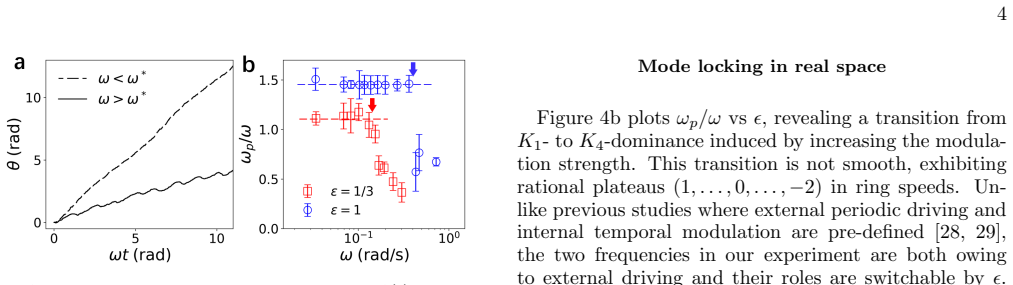
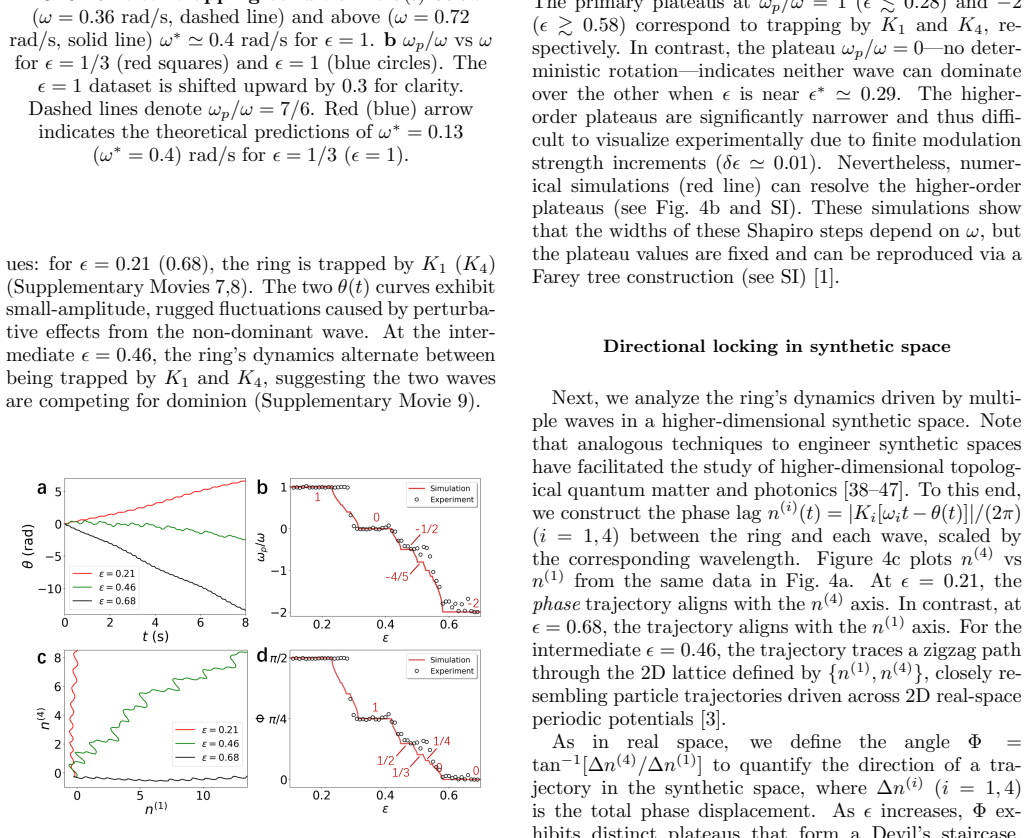
Power modulation of the traps generates coexisting, distinct potential waves whose relative displacements with the cluster trace zigzag trajectories across a synthetic two-dimensional lattice. By tuning the relative wave amplitudes, both the cluster's direction in synthetic space and its velocity in real space exhibit discrete plateaus, both governed by square-lattice symmetry. The formation of superlattices between the particles and potential wave minima mirrors the characteristic features of kinetically locked two-dimensional clusters, demonstrating the capability to explore driven cluster dynamics within higher-dimensional potentials using lower-dimensional setups.
What carries the argument
The synthetic two-dimensional lattice formed by relative displacements between the colloidal cluster and multiple coexisting potential waves created by power modulation of the circular tweezer array.
If this is right
- Cluster velocity in real space takes only discrete values set by the amplitude ratio of the coexisting waves.
- Direction in synthetic space locks to specific lattice vectors determined by the same amplitude ratio.
- Superlattices form between particles and wave minima exactly as seen in two-dimensional kinetically locked clusters.
- Higher-dimensional driven dynamics become accessible in an experimental geometry that remains physically one-dimensional.
Where Pith is reading between the lines
- The same power-modulation method could be tested on non-ring clusters or different lattice geometries to check whether the square symmetry is universal.
- Velocity plateaus imply that small changes in laser power could be used for precise, stepwise transport control in microfluidic devices.
- The synthetic-space locking may appear in other periodically driven systems whenever multiple waves coexist, such as in modulated magnetic or acoustic traps.
- Measuring the dependence of plateau widths on modulation frequency would test whether the lattice picture remains valid outside the reported regime.
Load-bearing premise
Power modulation generates multiple distinct potential waves whose relative positions to the cluster produce zigzag trajectories on a square lattice.
What would settle it
Continuous smooth variation in cluster direction or velocity, rather than discrete plateaus with square symmetry, when relative wave amplitudes are varied.
Figures

read the original abstract
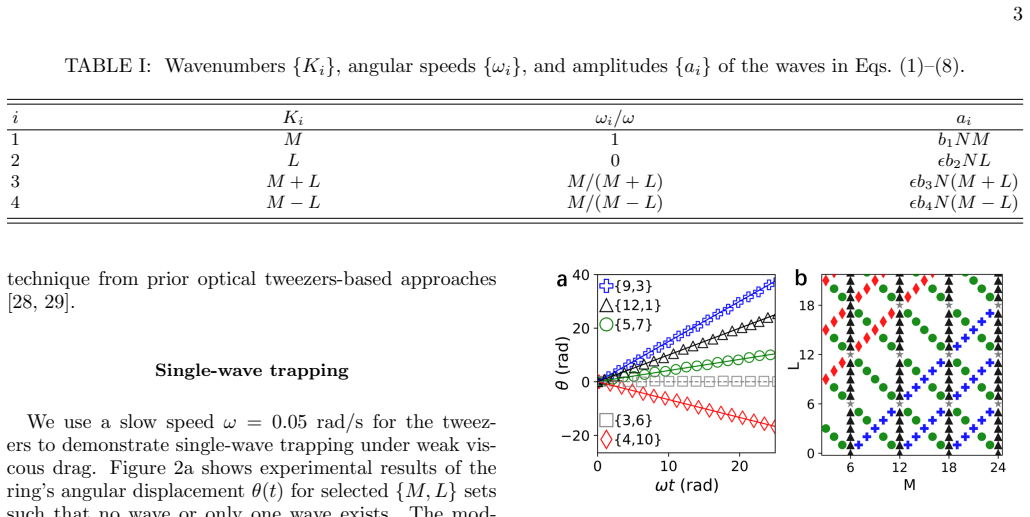
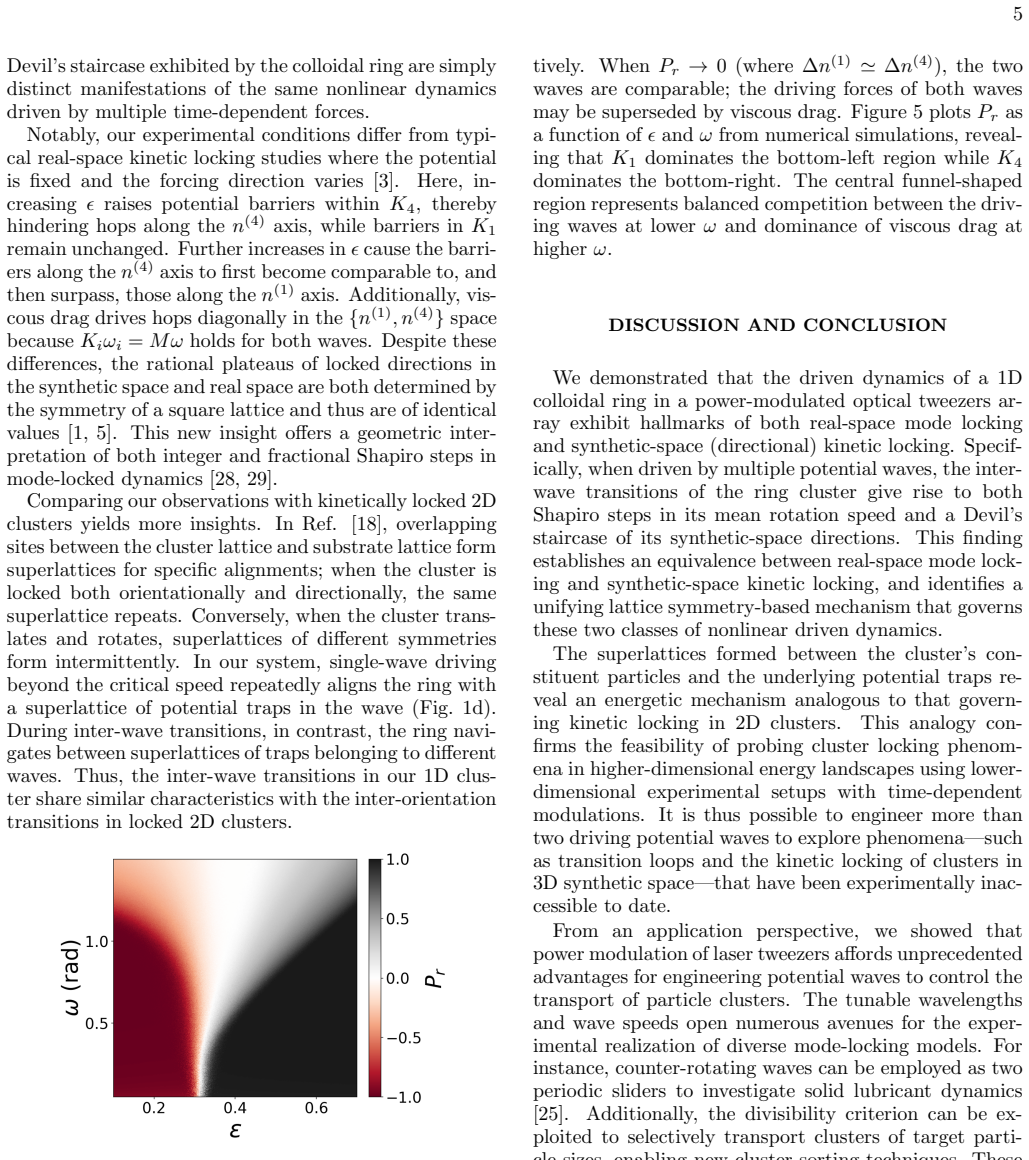
Particles and clusters moving across real-space periodic potentials can become locked to discrete directions or orientations due to competing symmetries. Here, we demonstrate an analogous locking phenomenon within a synthetic frequency space. We drive ring-shaped colloidal clusters using a circular optical tweezer array, where power modulation of the traps generates coexisting, distinct potential waves. Relative displacements between the cluster and these waves trace zigzag trajectories across a synthetic two-dimensional lattice, mirroring directionally locked motion in real-space periodic potentials. By tuning the relative wave amplitudes, both the cluster's direction in synthetic space and its velocity in real space exhibit discrete plateaus, both governed by square-lattice symmetry. Furthermore, the formation of superlattices between the particles and potential wave minima mirrors the characteristic features of kinetically locked two-dimensional clusters, demonstrating the capability to explore driven cluster dynamics within higher-dimensional potentials using lower-dimensional setups. Our findings establish new strategies for controlling transport of particle clusters via power-modulated laser tweezers.
Editorial analysis
A structured set of objections, weighed in public.
Referee Report
Summary. The manuscript claims to demonstrate mode-locking in a synthetic two-dimensional frequency space for ring-shaped colloidal clusters driven by a circular array of power-modulated optical tweezers. Power modulation is said to generate coexisting distinct potential waves whose relative displacements with the cluster produce zigzag trajectories across a synthetic lattice; tuning the relative wave amplitudes then yields discrete plateaus in both the cluster direction (synthetic space) and velocity (real space), both governed by square-lattice symmetry. The work further asserts that particle-potential superlattices mirror features of kinetically locked two-dimensional clusters, thereby enabling study of higher-dimensional driven dynamics in lower-dimensional experimental setups.
Significance. If the experimental observations and quantitative relations hold, the result would extend conventional real-space mode-locking concepts to synthetic dimensions and supply a practical route for controlling colloidal-cluster transport with modulated laser tweezers. The analogy to square-lattice directional locking is standard, but a verified experimental realization in a colloidal system could open new avenues in soft-matter transport and optical manipulation.
major comments (1)
- [Abstract] Abstract: the central claims rest on observations of discrete plateaus and lattice-governed trajectories, yet the text supplies no data, error bars, methods details, or quantitative fits; the claims therefore cannot be verified from the provided manuscript.
Simulated Author's Rebuttal
We thank the referee for their review. Below we address the single major comment on the abstract. The full manuscript contains the experimental data, error bars, methods, and quantitative fits referenced in the claims.
read point-by-point responses
-
Referee: [Abstract] Abstract: the central claims rest on observations of discrete plateaus and lattice-governed trajectories, yet the text supplies no data, error bars, methods details, or quantitative fits; the claims therefore cannot be verified from the provided manuscript.
Authors: Abstracts are concise summaries and do not include raw data, error bars, methods, or fits, which is standard practice. The full manuscript text supplies these elements in the results, methods, and supplementary sections, including quantitative analysis of the observed plateaus and trajectories. The claims are therefore verifiable from the complete manuscript. We can revise the abstract to include explicit references to the supporting figures and data tables if that improves clarity. revision: partial
Circularity Check
No significant circularity; experimental demonstration is self-contained
full rationale
The paper reports an experimental observation of directional and velocity locking in a colloidal cluster driven by power-modulated circular tweezers. The mechanism is described directly from the modulation protocol creating coexisting waves whose relative motion traces lattice trajectories; no equations, fitted parameters, or derivations are presented that reduce any claimed prediction to its own inputs by construction. The abstract and described results contain no self-definitional steps, fitted-input predictions, or load-bearing self-citations. The work is therefore self-contained against external benchmarks.
Axiom & Free-Parameter Ledger
Reference graph
Works this paper leans on
-
[1]
Reichhardt and F
C. Reichhardt and F. Nori, Phase locking, devil’s stair- cases, farey trees, and arnold tongues in driven vortex lattices with periodic pinning, Physical Review Letters 82, 414 (1999)
1999
-
[2]
Pierre-Louis and M
O. Pierre-Louis and M. I. Haftel, Oscillatory driving of crystal surfaces: A route to controlled pattern formation, Physical Review Letters87, 48701 (2001)
2001
-
[3]
P. T. Korda, M. B. Taylor, and D. G. Grier, Kinetically locked-in colloidal transport in an array of optical tweez- ers, Physical Review Letters89, 128301 (2002)
2002
-
[4]
M. P. MacDonald, G. C. Spalding, and K. Dholakia, Mi- crofluidic sorting in an optical lattice, Nature426, 421 (2003)
2003
-
[5]
Gopinathan and D
A. Gopinathan and D. G. Grier, Statistically locked-in transport through periodic potential landscapes, Physical Review Letters92, 130602 (2004)
2004
-
[6]
L. R. Huang, E. C. Cox, R. H. Austin, and J. C. Sturm, Continuous particle separation through deterministic lat- eral displacement, Science304, 987 (2004)
2004
-
[7]
Reichhardt and C
C. Reichhardt and C. J. Olson Reichhardt, Directional locking effects and dynamics for particles driven through a colloidal lattice, Physical Review E69, 41405 (2004)
2004
-
[8]
Roichman, V
Y. Roichman, V. Wong, and D. G. Grier, Colloidal trans- port through optical tweezer arrays, Physical Review E 75, 11407 (2007)
2007
-
[9]
Balvin, E
M. Balvin, E. Sohn, T. Iracki, G. Drazer, and J. Frechette, Directional locking and the role of irre- versible interactions in deterministic hydrodynamics sep- arations in microfluidic devices, Physical Review Letters 103, 78301 (2009)
2009
-
[10]
Bohlein and C
T. Bohlein and C. Bechinger, Experimental observation of directional locking and dynamical ordering of colloidal monolayers driven across quasiperiodic substrates, Phys- ical Review Letters109, 58301 (2012)
2012
-
[11]
Ma, P.-Y
X.-g. Ma, P.-Y. Lai, B. J. Ackerson, and P. Tong, Col- loidal transport and diffusion over a tilted periodic po- tential: dynamics of individual particles, Soft Matter11, 1182 (2015)
2015
-
[12]
Ma, P.-Y
X.-g. Ma, P.-Y. Lai, B. J. Ackerson, and P. Tong, Col- loidal dynamics over a tilted periodic potential: Nonequi- librium steady-state distributions, Phys. Rev. E91, 042306 (2015)
2015
-
[13]
X.-g. Ma, Y. Su, P.-Y. Lai, and P. Tong, Colloidal dy- namics over a tilted periodic potential: Forward and re- verse transition probabilities and entropy production in a nonequilibrium steady state, Phys. Rev. E96, 012601 (2017)
2017
-
[14]
N. C. X. Stuhlm¨ uller, T. M. Fischer, and D. de las Heras, Colloidal transport in twisted lattices of optical tweezers, Physical Review E106, 34601 (2022)
2022
-
[15]
Wiersig and K.-H
J. Wiersig and K.-H. Ahn, Devil’s staircase in the mag- netoresistance of a periodic array of scatterers, Physical Review Letters87, 26803 (2001)
2001
-
[16]
Togawa, K
Y. Togawa, K. Harada, T. Akashi, H. Kasai, T. Matsuda, F. Nori, A. Maeda, and A. Tonomura, Direct observation of rectified motion of vortices in a niobium superconduc- tor, Physical Review Letters95, 087002 (2005)
2005
-
[17]
Bohlein, J
T. Bohlein, J. Mikhael, and C. Bechinger, Observation of kinks and antikinks in colloidal monolayers driven across ordered surfaces, Nature Materials11, 126 (2012)
2012
-
[18]
X. Cao, E. Panizon, A. Vanossi, N. Manini, and C. Bechinger, Orientational and directional locking of colloidal clusters driven across periodic surfaces, Nature Physics15, 776 (2019)
2019
-
[19]
Tierno, A moir´ e foray, Nature Physics15, 733 (2019)
P. Tierno, A moir´ e foray, Nature Physics15, 733 (2019)
2019
-
[20]
R. L. Stoop, A. V. Straube, T. H. Johansen, and P. Tierno, Collective directional locking of colloidal monolayers on a periodic substrate, Physical Review Let- ters124, 58002 (2020)
2020
-
[21]
Shapiro, Josephson currents in superconducting tun- neling: The effect of microwaves and other observations, Phys
S. Shapiro, Josephson currents in superconducting tun- neling: The effect of microwaves and other observations, Phys. Rev. Lett.11, 80 (1963)
1963
-
[22]
C. C. Grimes and S. Shapiro, Millimeter-wave mixing with josephson junctions, Phys. Rev.169, 397 (1968)
1968
-
[23]
A. B. Kolton, D. Dom´ ınguez, and N. Grønbech-Jensen, Mode locking in ac-driven vortex lattices with random pinning, Phys. Rev. Lett.86, 4112 (2001)
2001
-
[24]
Reichhardt, C
C. Reichhardt, C. J. Olson, and M. B. Hastings, Rec- tification and phase locking for particles on symmetric two-dimensional periodic substrates, Phys. Rev. Lett.89, 024101 (2002)
2002
-
[25]
Vanossi, N
A. Vanossi, N. Manini, G. Divitini, G. E. Santoro, and E. Tosatti, Exactly quantized dynamics of classi- cal incommensurate sliders, Phys. Rev. Lett.97, 056101 (2006). 8
2006
-
[26]
C. K. Thomas and A. A. Middleton, Irrational mode lock- ing in quasiperiodic systems, Phys. Rev. Lett.98, 148001 (2007)
2007
-
[27]
Vanossi, N
A. Vanossi, N. Manini, F. Caruso, G. E. Santoro, and E. Tosatti, Static friction on the fly: Velocity depinning transitions of lubricants in motion, Phys. Rev. Lett.99, 206101 (2007)
2007
-
[28]
M. P. N. Juniper, A. V. Straube, R. Besseling, D. G. A. L. Aarts, and R. P. A. Dullens, Microscopic dynamics of synchronization in driven colloids, Nature Communi- cations6, 7187 (2015)
2015
-
[29]
A. P. Stikuts, S. Mishra, A. Ryabov, P. Maass, and P. Tierno, Engineering tunable fractional shapiro steps in colloidal transport, Nature Communications16, 2966 (2025)
2025
-
[30]
M. D. Gratale, X. Ma, Z. S. Davidson, T. Still, P. Hab- das, and A. G. Yodh, Vibrational properties of quasi-two- dimensional colloidal glasses with varying interparticle attraction, Phys. Rev. E94, 042606 (2016)
2016
-
[31]
X. Ma, J. Liu, Y. Zhang, P. Habdas, and A. G. Yodh, Excess entropy and long-time diffusion in colloidal fluids with short-range interparticle attraction, The Journal of Chemical Physics150, 144907 (2019)
2019
-
[32]
X. Ma, C. K. Mishra, P. Habdas, and A. G. Yodh, Struc- tural and short-time vibrational properties of colloidal glasses and supercooled liquids in the vicinity of the re- entrant glass transition, The Journal of Chemical Physics 155, 074902 (2021)
2021
-
[33]
A. Hill, M. Tanaka, K. B. Aptowicz, C. K. Mishra, A. G. Yodh, and X. Ma, Depletion-driven antiferro- magnetic, paramagnetic, and ferromagnetic behavior in quasi-two-dimensional buckled colloidal solids, The Jour- nal of Chemical Physics158, 194903 (2023)
2023
-
[34]
Bewerunge and S
J. Bewerunge and S. U. Egelhaaf, Experimental creation and characterization of random potential-energy land- scapes exploiting speckle patterns, Phys. Rev. A93, 013806 (2016)
2016
-
[35]
M. P. N. Juniper, A. V. Straube, D. G. A. L. Aarts, and R. P. A. Dullens, Colloidal particles driven across periodic optical-potential-energy landscapes, Phys. Rev. E93, 012608 (2016)
2016
-
[36]
Gieseler, J
J. Gieseler, J. R. Gomez-Solano, A. Magazz` u, I. P´ erez Castillo, L. P´ erez Garc´ ıa, M. Gironella-Torrent, X. Viader-Godoy, F. Ritort, G. Pesce, A. V. Arzola, K. Volke-Sep´ ulveda, and G. Volpe, Optical tweezers — from calibration to applications: A tutorial, Advances in Optics and Photonics13, 74 (2021)
2021
-
[37]
See Supplemental Material at [URL will be inserted by publisher] for the details
-
[38]
Boada, A
O. Boada, A. Celi, J. I. Latorre, and M. Lewenstein, Quantum simulation of an extra dimension, Physical Re- view Letters108, 133001 (2012)
2012
-
[39]
J. M. Edge, J. Tworzyd lo, and C. W. J. Beenakker, Metallic phase of the quantum hall effect in four- dimensional space, Physical Review Letters109, 135701 (2012)
2012
-
[40]
Y. E. Kraus, Y. Lahini, Z. Ringel, M. Verbin, and O. Zilberberg, Topological states and adiabatic pump- ing in quasicrystals, Physical Review Letters109, 106402 (2012)
2012
-
[41]
Y. E. Kraus, Z. Ringel, and O. Zilberberg, Four- dimensional quantum hall effect in a two-dimensional quasicrystal, Physical Review Letters111, 226401 (2013)
2013
-
[42]
Verbin, O
M. Verbin, O. Zilberberg, Y. E. Kraus, Y. Lahini, and Y. Silberberg, Observation of topological phase transi- tions in photonic quasicrystals, Physical Review Letters 110, 76403 (2013)
2013
-
[43]
Manai, J.-F
I. Manai, J.-F. Cl´ ement, R. Chicireanu, C. Hainaut, J. C. Garreau, P. Szriftgiser, and D. Delande, Experimen- tal observation of two-dimensional anderson localization with the atomic kicked rotor, Physical Review Letters 115, 240603 (2015)
2015
-
[44]
Lohse, C
M. Lohse, C. Schweizer, O. Zilberberg, M. Aidelsburger, and I. Bloch, A thouless quantum pump with ultracold bosonic atoms in an optical superlattice, Nature Physics 12, 350 (2016)
2016
-
[45]
Nakajima, T
S. Nakajima, T. Tomita, S. Taie, T. Ichinose, H. Ozawa, L. Wang, M. Troyer, and Y. Takahashi, Topological thou- less pumping of ultracold fermions, Nature Physics12, 296 (2016)
2016
-
[46]
L. Yuan, Q. Lin, M. Xiao, and S. Fan, Synthetic dimen- sion in photonics, Optica5, 1396 (2018)
2018
-
[47]
Ozawa and H
T. Ozawa and H. M. Price, Topological quantum matter in synthetic dimensions, Nature Reviews Physics1, 349 (2019)
2019
discussion (0)
Sign in with ORCID, Apple, or X to comment. Anyone can read and Pith papers without signing in.