Constraint-Aware Quantum Optimization of Defect Configurations in Doped ZrO2: XY-Mixer QAOA and Grover Adaptive Search
Pith reviewed 2026-06-26 11:56 UTC · model grok-4.3
The pith
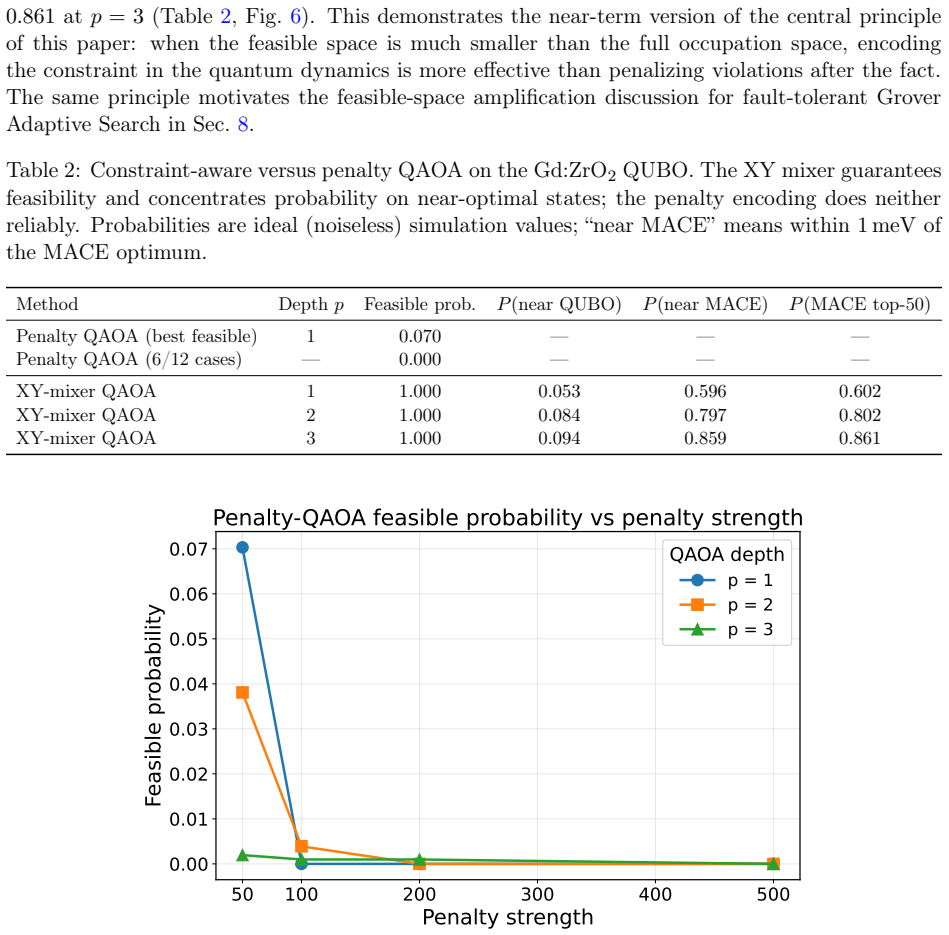
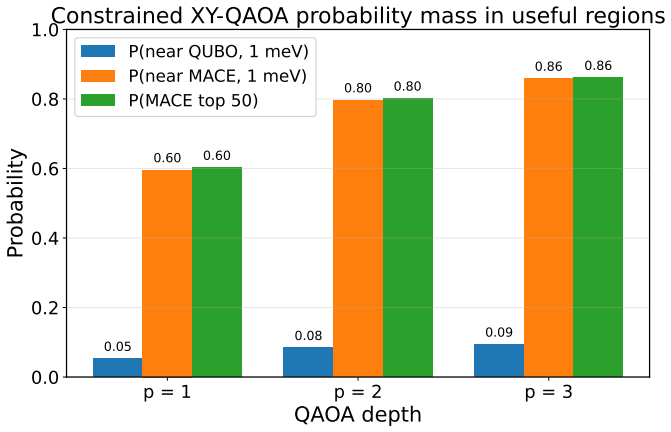
Constraint-preserving XY-mixer QAOA confines sampling to feasible defect configurations in doped ZrO2 and achieves 86% probability on near-optima at depth p=3.
A machine-rendered reading of the paper's core claim, the machinery that carries it, and where it could break.
Core claim
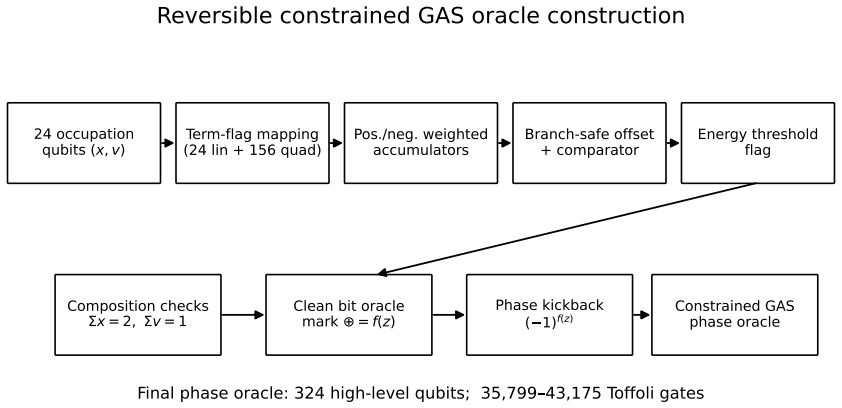
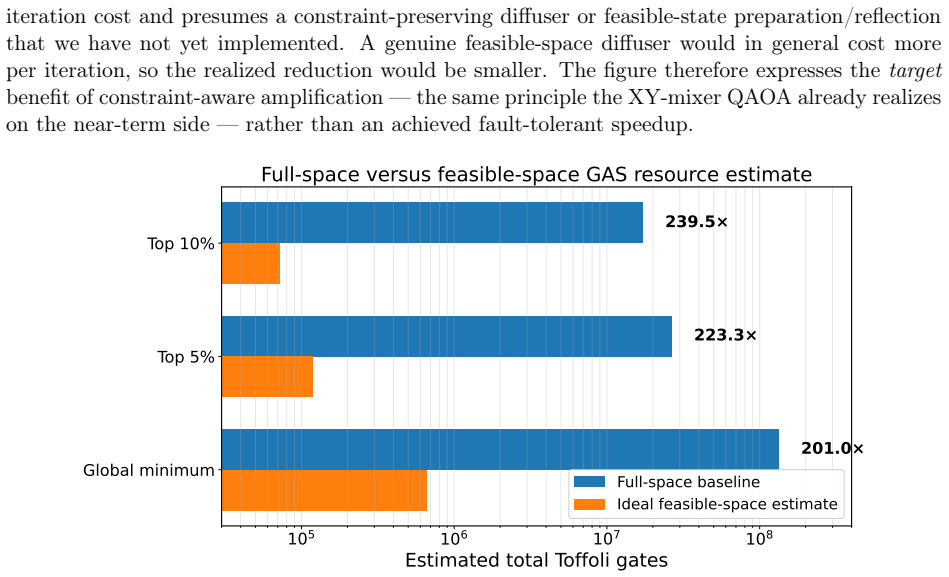
The central claim is that the XY-mixer QAOA, by construction, confines all sampling to the feasible subspace of the 24-variable QUBO and places 86% of the probability mass within 1 meV of the MACE optimum at depth p = 3, while the constrained Grover Adaptive Search provides explicit resource counts of 324 high-level logical qubits and 3.6 to 4.3 times 10 to the 4 Toffoli gates per iteration, with an idealized amplification factor suggesting up to 240 times Toffoli reduction.
What carries the argument
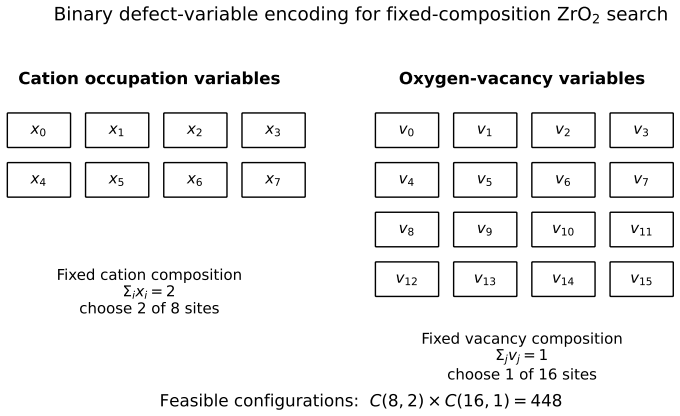
The constraint-preserving XY-mixer Hamiltonian in QAOA, which generates transitions only between feasible bit strings that satisfy the exact two-substitution and one-vacancy rules.
If this is right
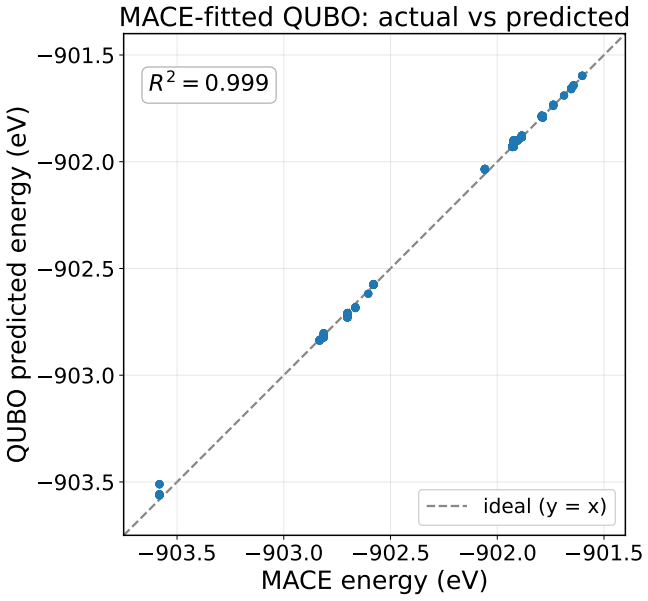
- The QUBO surrogate reproduces held-out MACE energies with R-squared of 0.997.
- QAOA at depth 3 recovers near-optimal configurations without needing post-selection or penalty terms.
- The Grover oracle implements feasibility checking, fixed-point arithmetic, and phase kickback within the stated gate counts.
- Feasible-space amplification yields up to 240 times reduction in total Toffoli cost relative to the full 2 to the 24 space.
Where Pith is reading between the lines
- The same mixer construction could be applied to other materials problems with similar cardinality constraints on defect numbers.
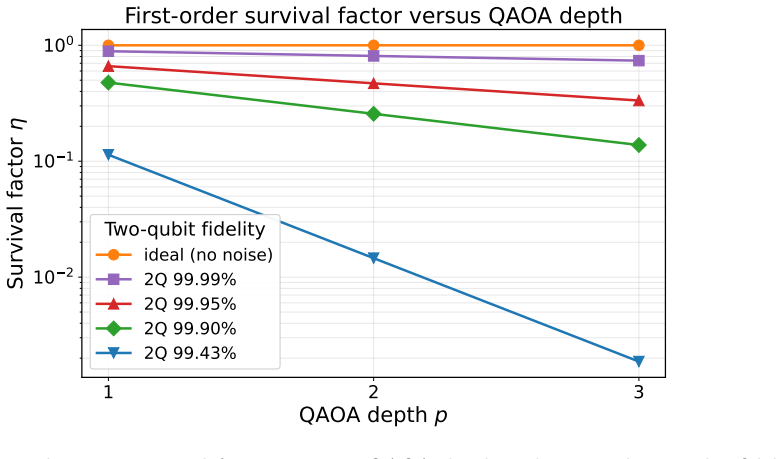
- Resource estimates assume ideal fault-tolerant hardware; real-device noise would require additional error-correction overhead not accounted for here.
- Direct experimental validation of the lowest-energy configurations predicted by the QUBO would test whether the surrogate landscape matches physical behavior.
- Hybrid workflows combining the QAOA warm-start with classical refinement might further reduce quantum resource demands.
Load-bearing premise
The 24-variable QUBO fitted to the MACE-MPA-0 dataset serves as a faithful surrogate for the true energy landscape of the constrained defect configurations.
What would settle it
Running exact diagonalization or additional first-principles calculations on configurations outside the training set and checking whether the QUBO ranking of energies matches the true ranking.
Figures

read the original abstract
Quantum optimization offers a route to searching the large defect-configuration spaces that arise in materials design. We develop an end-to-end, constraint-aware quantum optimization workflow for composition-defect search in a doped ZrO2 thermal-barrier-coating (TBC) material system, using a MACE-MPA-0 energy dataset to fit a 24-variable QUBO over 8 cation-occupation and 16 oxygen-vacancy variables with exactly two rare-earth substitutions and one oxygen vacancy, yielding 448 feasible configurations. The QUBO surrogate reproduces the MACE energies with held-out R2 = 0.997 (full-data R2 = 0.999, RMSE = 17 meV). We validate two complementary quantum pathways against exact enumeration: a constraint-preserving XY-mixer QAOA that confines sampling to the feasible subspace and places 86% of probability mass within 1 meV of the MACE optimum at depth p = 3, and a fault-tolerant constrained Grover Adaptive Search oracle with explicit fixed-point arithmetic, branch-safe comparison, feasibility checking, and phase kickback. Across threshold cases, the validated oracle uses 324 high-level logical qubits, or 352 to 358 with conservative clean-ancilla v-chain accounting, and requires 3.6 to 4.3 x 10⁴ Toffoli gates per Grover (GAS) iteration. An idealized feasible-space amplification estimate suggests up to a 240x reduction in total Toffoli cost relative to the full 224 occupation space, providing a resource-estimation bridge between materials-informed QUBO modeling, constraint-aware QAOA, and fault-tolerant threshold search.
Editorial analysis
A structured set of objections, weighed in public.
Referee Report
Summary. The manuscript develops an end-to-end constraint-aware quantum optimization workflow for defect-configuration search in doped ZrO2, fitting a 24-variable QUBO (8 cation + 16 oxygen-vacancy variables, exactly two rare-earth substitutions and one vacancy) to MACE-MPA-0 energies over the 448 feasible configurations. It reports held-out R²=0.997 for the surrogate and validates two quantum algorithms against exact enumeration: an XY-mixer QAOA that confines sampling to the feasible subspace and places 86% probability mass within 1 meV of the MACE optimum at depth p=3, plus a fault-tolerant constrained Grover Adaptive Search oracle using 324 logical qubits and 3.6–4.3×10⁴ Toffoli gates per iteration, with an idealized 240× Toffoli reduction from feasible-space amplification.
Significance. If the QUBO surrogate is shown to be faithful for optimization (not merely regression), the work supplies a concrete materials-to-quantum pipeline with explicit resource estimates that could inform near-term and fault-tolerant algorithm design for constrained combinatorial search in materials. The exact-enumeration validation of both QAOA and GAS, together with the constraint-preserving mixer and oracle construction, are positive features that strengthen the algorithmic claims.
major comments (2)
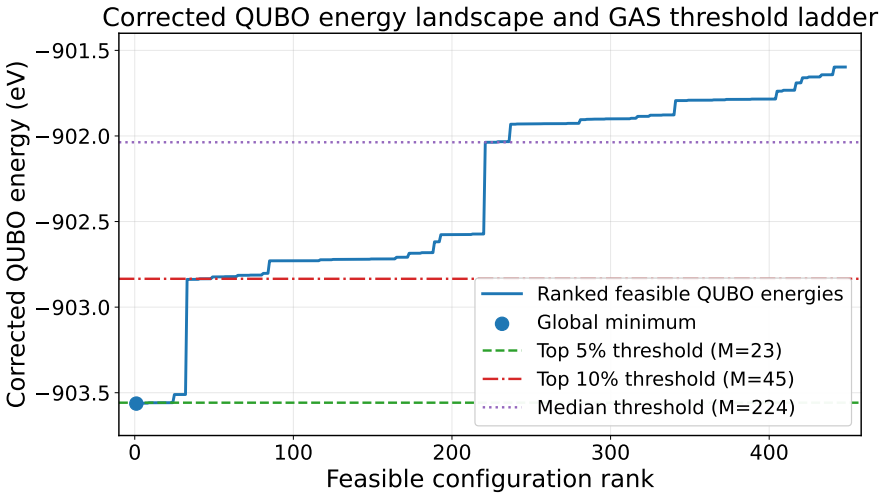
- [Abstract / QUBO construction] Abstract and QUBO construction paragraph: the central claim that QAOA performance on the QUBO informs real defect energies rests on the surrogate being faithful in the low-energy tail. The reported held-out R²=0.997 is a global regression metric; no explicit check is provided that the QUBO minimum coincides with the MACE minimum or that the lowest-energy configurations are correctly ranked. Because QAOA samples are post-evaluated on MACE, any systematic bias in the low-energy region would render the 86% probability-mass figure an artifact of the fit rather than evidence of materials-relevant performance.
- [GAS resource estimation] GAS resource paragraph: the Toffoli counts (3.6–4.3×10⁴ per iteration) and qubit counts (324 logical, 352–358 with v-chain) are presented as validated, yet the manuscript does not supply the explicit circuit decomposition or the precise fixed-point arithmetic and branch-safe comparison subroutines used to obtain these numbers. Without those details or a reference to a machine-checked implementation, the 240× reduction estimate cannot be independently verified.
minor comments (2)
- [Abstract] The abstract states “full-data R²=0.999, RMSE=17 meV” but does not specify the train/test split sizes or whether the split respects the constraint structure; this should be stated explicitly.
- [QUBO construction] Notation for the 24-variable QUBO (8 cation + 16 vacancy) is introduced without an equation defining the precise mapping from occupation variables to the QUBO coefficients; adding this equation would improve reproducibility.
Simulated Author's Rebuttal
We thank the referee for the constructive feedback and positive evaluation of the manuscript's contributions. We address each major comment below with targeted revisions to strengthen the claims.
read point-by-point responses
-
Referee: [Abstract / QUBO construction] Abstract and QUBO construction paragraph: the central claim that QAOA performance on the QUBO informs real defect energies rests on the surrogate being faithful in the low-energy tail. The reported held-out R²=0.997 is a global regression metric; no explicit check is provided that the QUBO minimum coincides with the MACE minimum or that the lowest-energy configurations are correctly ranked. Because QAOA samples are post-evaluated on MACE, any systematic bias in the low-energy region would render the 86% probability-mass figure an artifact of the fit rather than evidence of materials-relevant performance.
Authors: We agree that an explicit verification of the low-energy tail is necessary to support the claim. Since the feasible space is fully enumerated (448 configurations), we will add a direct comparison in the revised manuscript (new table or figure) confirming that the QUBO minimum matches the MACE minimum and that the lowest-energy configurations are correctly ranked by the surrogate. This addresses the potential for bias in the relevant region. revision: yes
-
Referee: [GAS resource estimation] GAS resource paragraph: the Toffoli counts (3.6–4.3×10⁴ per iteration) and qubit counts (324 logical, 352–358 with v-chain) are presented as validated, yet the manuscript does not supply the explicit circuit decomposition or the precise fixed-point arithmetic and branch-safe comparison subroutines used to obtain these numbers. Without those details or a reference to a machine-checked implementation, the 240× reduction estimate cannot be independently verified.
Authors: The manuscript describes the oracle components (explicit fixed-point arithmetic, branch-safe comparison, feasibility checking, and phase kickback), but we acknowledge that full circuit decompositions are not provided. In revision we will add detailed pseudocode and gate-level breakdowns of the key subroutines to the supplementary material, enabling independent verification of the reported Toffoli and qubit counts. revision: yes
Circularity Check
No circularity; algorithmic claims validated by exact enumeration on external MACE energies
full rationale
The paper constructs a QUBO surrogate by fitting to the external MACE-MPA-0 dataset and reports regression metrics (held-out R2=0.997). It then runs QAOA and GAS on the QUBO Hamiltonian but validates performance by exact enumeration over all 448 feasible configurations, comparing sampled bitstrings directly to MACE-computed energies and the MACE optimum. This external benchmark (MACE energies, full enumeration) is independent of the QUBO fit and of any self-citation chain. No step reduces a claimed prediction or uniqueness result to a fitted parameter or prior self-citation by construction. The derivation chain for the quantum algorithms and resource estimates is therefore self-contained against the stated external benchmarks.
Axiom & Free-Parameter Ledger
free parameters (1)
- QUBO coefficients for 24 variables
axioms (2)
- domain assumption MACE-MPA-0 machine-learning potential yields reliable energies for the doped ZrO2 defect system
- domain assumption Exactly two rare-earth substitutions and one oxygen vacancy define the physically relevant feasible configurations
Reference graph
Works this paper leans on
-
[1]
Padture, Maurice Gell, and Eric H
Nitin P. Padture, Maurice Gell, and Eric H. Jordan. Thermal barrier coatings for gas-turbine engine applications.Science, 296(5566):280–284, 2002. doi: 10.1126/science.1068609
-
[2]
David R. Clarke and Carlos G. Levi. Materials design for the next generation thermal barrier coatings.Annual Review of Materials Research, 33:383–417, 2003. doi: 10.1146/annurev. matsci.33.011403.113718
-
[3]
Jie Wu, Xuezheng Wei, Nitin P. Padture, Paul G. Klemens, Maurice Gell, Eugenio García, Pilar Miranzo, and Maria I. Osendi. Low-thermal-conductivity rare-earth zirconates for potential thermal-barrier-coating applications.Journal of the American Ceramic Society, 85(12):3031– 3035, 2002. doi: 10.1111/j.1151-2916.2002.tb00574.x
-
[4]
Yanhao Dong, Liang Qi, Ju Li, and I-Wei Chen. A computational study of yttria-stabilized zirconia: I. using crystal chemistry to search for the ground state on a glassy energy landscape. Acta Materialia, 127:73–84, 2017. doi: 10.1016/j.actamat.2017.01.006. arXiv:1701.05089
work page internal anchor Pith review Pith/arXiv arXiv doi:10.1016/j.actamat.2017.01.006 2017
-
[5]
Ilyes Batatia, Dávid P. Kovács, Gregor N. C. Simm, Christoph Ortner, and Gábor Csányi. MACE: Higher order equivariant message passing neural networks for fast and accurate force fields. InAdvances in Neural Information Processing Systems (NeurIPS), 2022. arXiv:2206.07697
arXiv 2022
-
[6]
A foundation model for atomistic materials chemistry
Ilyes Batatia, Philipp Benner, Yuan Chiang, Alin M. Elena, Dávid P. Kovács, Janosh Riebesell, et al. A foundation model for atomistic materials chemistry.The Journal of Chemical Physics, 163(18):184110, 2025. doi: 10.1063/5.0297006. MACE-MPA-0; arXiv:2401.00096
work page internal anchor Pith review Pith/arXiv arXiv doi:10.1063/5.0297006 2025
-
[7]
Ising formulations of many NP problems
Andrew Lucas. Ising formulations of many np problems.Frontiers in Physics, 2:5, 2014. doi: 10.3389/fphy.2014.00005
-
[8]
Fred Glover, Gary Kochenberger, Rick Hennig, and Yu Du. Quantum bridge analytics I: A tutorial on formulating and using QUBO models.Annals of Operations Research, 314(1):141– 183, 2022. doi: 10.1007/s10479-022-04634-2. Extended version of arXiv:1811.11538
-
[9]
Effect of anisotropy on small magnetic clusters.Phys
Alfred Hucht, Sanjubala Sahoo, Shreekantha Sil, and Peter Entel. Effect of anisotropy on small magnetic clusters.Phys. Rev. B, 84:104438, 2011. doi: 10.1103/PhysRevB.84.104438
-
[10]
A quantum approximate optimization algorithm.arXiv preprint, 2014
Edward Farhi, Jeffrey Goldstone, and Sam Gutmann. A quantum approximate optimization algorithm.arXiv preprint, 2014. arXiv:1411.4028
Pith/arXiv arXiv 2014
-
[11]
Grover adaptive search for constrained polynomial binary optimization.Quantum, 5:428, 2021
Austin Gilliam, Stefan Woerner, and Constantin Gonciulea. Grover adaptive search for constrained polynomial binary optimization.Quantum, 5:428, 2021. doi: 10.22331/ q-2021-04-08-428. arXiv:1912.04088
arXiv 2021
-
[12]
Algorithms 12(2):34, ://dx.doi.org/10.3390/a12020034
Stuart Hadfield, Zhihui Wang, Bryan O’Gorman, Eleanor G. Rieffel, Davide Venturelli, and Ru- pak Biswas. From the quantum approximate optimization algorithm to a quantum alternating operator ansatz.Algorithms, 12(2):34, 2019. doi: 10.3390/a12020034
-
[13]
Fuchs, Kjetil Olsen Lye, Halvor Møll Nilsen, Alexander J
Franz G. Fuchs, Kjetil Olsen Lye, Halvor Møll Nilsen, Alexander J. Stasik, and Giorgio Sartor. Constraintpreservingmixersforthequantumapproximateoptimizationalgorithm.Algorithms, 15(6):202, 2022. doi: 10.3390/a15060202. arXiv:2203.06095. 17
-
[14]
J.M.Sanchez, F.Ducastelle, andD.Gratias. Generalizedclusterdescriptionofmulticomponent systems.Physica A: Statistical Mechanics and its Applications, 128(1):334–350, 1984. doi: 10.1016/0378-4371(84)90096-7
-
[15]
Automatingfirst-principlesphasediagramcalculations
AxelvandeWalleandGerbrandCeder. Automatingfirst-principlesphasediagramcalculations. Journal of Phase Equilibria, 23:348–359, 2002. doi: 10.1361/105497102770331596
-
[16]
Ridge Regression: Appli- cations to Nonorthogonal Problems
Arthur E. Hoerl and Robert W. Kennard. Ridge regression: Biased estimation for nonorthog- onal problems.Technometrics, 12(1):55–67, 1970. doi: 10.1080/00401706.1970.10488634
-
[17]
Lov K. Grover. A fast quantum mechanical algorithm for database search. InProceedings of the 28th Annual ACM Symposium on Theory of Computing (STOC), pages 212–219, 1996. doi: 10.1145/237814.237866
-
[18]
Tight bounds on quantum search- ing.Fortschritte der Physik, 46(4-5):493–505, 1998
Michel Boyer, Gilles Brassard, Peter Høyer, and Alain Tapp. Tight bounds on quantum search- ing.Fortschritte der Physik, 46(4-5):493–505, 1998. arXiv:quant-ph/9605034
Pith/arXiv arXiv 1998
-
[19]
A quantum algorithm for finding the minimum.arXiv preprint, 1996
Christoph Dürr and Peter Høyer. A quantum algorithm for finding the minimum.arXiv preprint, 1996. arXiv:quant-ph/9607014
Pith/arXiv arXiv 1996
-
[20]
Quantum Networks for Elementary Arithmetic Operations
Vlatko Vedral, Adriano Barenco, and Artur Ekert. Quantum networks for elementary arith- metic operations.Physical Review A, 54(1):147–153, 1996. doi: 10.1103/PhysRevA.54.147. arXiv:quant-ph/9511018
work page internal anchor Pith review Pith/arXiv arXiv doi:10.1103/physreva.54.147 1996
-
[21]
Steven A. Cuccaro, Thomas G. Draper, Samuel A. Kutin, and David Petrie Moulton. A new quantum ripple-carry addition circuit.arXiv preprint, 2004. arXiv:quant-ph/0410184
Pith/arXiv arXiv 2004
-
[22]
Bennett, Richard Cleve, David P
Adriano Barenco, Charles H. Bennett, Richard Cleve, David P. DiVincenzo, Norman Margolus, Peter Shor, Tycho Sleator, John A. Smolin, and Harald Weinfurter. Elementary gates for quantum computation.Physical Review A, 52(5):3457–3467, 1995. doi: 10.1103/PhysRevA.52
-
[23]
arXiv:quant-ph/9503016
-
[24]
Nielsen and Isaac L
Michael A. Nielsen and Isaac L. Chuang.Quantum Computation and Quantum Information. Cambridge University Press, 10th anniversary edition, 2010
2010
-
[25]
Ákos Nagy, Jaime Park, Cindy Zhang, Atithi Acharya, and Alex Khan. Fixed-point grover adaptive search for quadratic binary optimization problems.IEEE Transactions on Quantum Engineering, 5, 2024. arXiv:2311.05592. 18
arXiv 2024
discussion (0)
Sign in with ORCID, Apple, or X to comment. Anyone can read and Pith papers without signing in.