Hadronic exceptional points
Pith reviewed 2026-07-01 04:45 UTC · model grok-4.3
The pith
Imaginary magnetic fields induce exceptional points in neutral meson mass spectra under QCD models.
A machine-rendered reading of the paper's core claim, the machinery that carries it, and where it could break.
Core claim
Imaginary magnetic fields provide a simple realization of non-Hermitian dynamics in hadronic systems. Computations within a hadronic effective Lagrangian and a constituent quark model yield mass spectra of neutral mesons that contain exceptional points separating the real-spectrum regime from the complex-eigenvalue regime. Small imaginary fields produce level attraction between hadronic states; larger fields induce deconfinement through an inverted potential.
What carries the argument
Imaginary magnetic fields inserted into the mass matrices of neutral mesons within effective hadronic models, producing coalescence of eigenvalues at exceptional points.
If this is right
- Level attraction appears between hadronic states at small imaginary magnetic fields.
- Hadrons deconfine at larger fields through an inverted potential.
- Exceptional points divide the real-mass and complex-mass regimes in the computed spectra.
- The same non-Hermitian mechanism can be applied to other neutral hadronic states.
Where Pith is reading between the lines
- The approach supplies a controlled setting in which to test whether non-Hermitian effects alter confinement criteria beyond the models used here.
- Similar exceptional-point structures may appear when the same imaginary-field term is added to models of baryons or glueballs.
Load-bearing premise
The hadronic effective Lagrangian and constituent quark model can be extended to non-Hermitian regimes by imaginary magnetic fields while still describing QCD dynamics.
What would settle it
A recalculation of the neutral-meson mass matrices in either model that shows no coalescence of eigenvalues for any finite value of the imaginary magnetic field.
Figures

read the original abstract
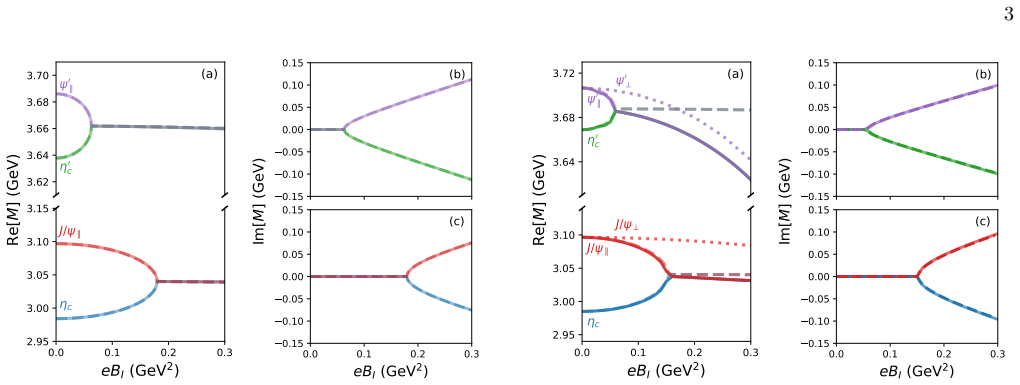
Exceptional points, where eigenvalues and eigenvectors coalesce, are a defining feature of non-Hermitian systems and have been extensively observed in photonic, atomic, and condensed matter systems. However, they have received little attention in quantum chromodynamics (QCD), which is the fundamental theory of quarks, gluons, and hadrons. We propose that imaginary magnetic fields provide a simple realization of non-Hermitian dynamics in hadronic systems. Based on two theoretical approaches, a hadronic effective Lagrangian and a constituent quark model, we compute mass spectra of neutral mesons and find exceptional points separating the real-spectrum and complex-eigenvalue regimes. In small fields, the real spectrum exhibits level attraction between hadronic states, whereas in larger fields, hadrons are deconfined, which is a signature of a field-induced inverted potential. Our findings open a new avenue for studying QCD dynamics in non-Hermitian environments.
Editorial analysis
A structured set of objections, weighed in public.
Referee Report
Summary. The manuscript proposes that imaginary magnetic fields realize non-Hermitian dynamics in hadronic systems. Using a hadronic effective Lagrangian and a constituent quark model, it computes mass spectra of neutral mesons and locates exceptional points separating real-spectrum and complex-eigenvalue regimes. In small fields the real spectrum shows level attraction; in larger fields the models exhibit deconfinement interpreted as a field-induced inverted potential.
Significance. If the model extensions remain valid proxies for QCD, the work would introduce exceptional-point phenomenology to hadronic physics and provide a concrete route to non-Hermitian QCD-inspired calculations. The deployment of two independent modeling frameworks is a positive feature that could strengthen the result once the validity of the non-Hermitian extension is established.
major comments (2)
- [Abstract and model sections] The central claim that the hadronic effective Lagrangian and constituent quark model remain valid when extended by an imaginary magnetic-field term rests on an unproven assumption. No matching condition, renormalization argument, or small-field limit matched to known Hermitian QCD results is supplied to control how the non-Hermitian perturbation affects confinement or chiral symmetry; the models were calibrated only in the Hermitian regime.
- [Results on mass spectra] Because the exceptional-point locations and the reported level attraction are obtained directly from the extended models, the absence of a control on the validity of the extension makes the interpretation that these features reflect QCD dynamics load-bearing and currently unsupported.
minor comments (2)
- Notation for the imaginary magnetic field and the precise definition of the non-Hermitian term should be stated explicitly at first use.
- The manuscript would benefit from a brief statement of the numerical method used to locate the exceptional points and any checks on numerical stability.
Simulated Author's Rebuttal
We thank the referee for the careful reading and constructive comments on our manuscript. We respond point by point to the major comments below.
read point-by-point responses
-
Referee: [Abstract and model sections] The central claim that the hadronic effective Lagrangian and constituent quark model remain valid when extended by an imaginary magnetic-field term rests on an unproven assumption. No matching condition, renormalization argument, or small-field limit matched to known Hermitian QCD results is supplied to control how the non-Hermitian perturbation affects confinement or chiral symmetry; the models were calibrated only in the Hermitian regime.
Authors: We agree that the models were calibrated exclusively in the Hermitian regime and that no explicit renormalization-group matching or control on confinement/chiral symmetry breaking under the non-Hermitian perturbation is provided. The imaginary magnetic-field term is introduced phenomenologically as the minimal extension that realizes non-Hermitian dynamics while vanishing identically in the zero-field limit, thereby recovering the original Hermitian spectra by construction. This limit supplies a basic consistency check, though it does not constitute a full matching to QCD. We will add an explicit paragraph in the model sections stating this assumption and the zero-field recovery. revision: yes
-
Referee: [Results on mass spectra] Because the exceptional-point locations and the reported level attraction are obtained directly from the extended models, the absence of a control on the validity of the extension makes the interpretation that these features reflect QCD dynamics load-bearing and currently unsupported.
Authors: The exceptional points, level attraction, and deconfinement signatures are computed within the two extended effective models and are presented as such. The manuscript frames them as features of QCD-inspired frameworks rather than direct QCD predictions, with the dual-model agreement offered as internal robustness. We do not claim these results are model-independent QCD phenomena; the interpretation remains conditional on the validity of the extension, which is stated as an assumption. No further revision is required on this point. revision: no
Circularity Check
No circularity; models extended by assumption but spectra computed independently
full rationale
The paper introduces imaginary magnetic fields to realize non-Hermitian dynamics and then applies two standard modeling frameworks (hadronic effective Lagrangian and constituent quark model) to compute neutral meson mass spectra, locating exceptional points as an output of the eigenvalue problem. No quoted step shows a fitted parameter or self-citation being renamed as a prediction, nor any self-definitional loop where the exceptional-point location is presupposed by the input parameters. The extension to imaginary fields is an explicit modeling choice whose validity is assumed rather than derived from the spectra themselves; the central results therefore remain independent of the inputs by construction.
Axiom & Free-Parameter Ledger
Reference graph
Works this paper leans on
-
[1]
We emphasize that the location of the EP is solely determined by the mass gap and its coupling strength of the M1 transition be- tween them
The location of the EP is analytically determined by ∆ = 0 [181]: eBEP I = m2 J/ψ −m 2 ηc 2gJ/ψηcγ .(5) Using the experimental charmonium masses [177],m ηc = 2984.1 MeV andm J/ψ = 3096.9 MeV, andg J/ψηcγ = 1.912, we obtaineB EP I ≈0.18 GeV 2. We emphasize that the location of the EP is solely determined by the mass gap and its coupling strength of the M1 ...
2025
- [2]
-
[3]
El-Ganainy, K
R. El-Ganainy, K. G. Makris, M. Khajavikhan, Z. H. Musslimani, S. Rotter, and D. N. Christodoulides, Non- Hermitian physics and PT symmetry, Nature Phys.14, 11 (2018)
2018
- [4]
- [5]
- [6]
-
[7]
Kato,Perturbation Theory for Linear Operators (Springer, 1966)
T. Kato,Perturbation Theory for Linear Operators (Springer, 1966)
1966
-
[8]
Dembowski, H
C. Dembowski, H. D. Graf, H. L. Harney, A. Heine, W. D. Heiss, H. Rehfeld, and A. Richter, Experimental observation of the topological structure of exceptional points, Phys. Rev. Lett.86, 787 (2001)
2001
-
[9]
A. Guo, G. J. Salamo, D. Duchesne, R. Morandotti, M. Volatier-Ravat, V. Aimez, G. A. Siviloglou, and D. N. Christodoulides, Observation ofPT-symmetry breaking in complex optical potentials, Phys. Rev. Lett. 103, 093902 (2009)
2009
-
[10]
C. E. R¨ uter, K. G. Makris, R. El-Ganainy, D. N. Christodoulides, M. Segev, and D. Kip, Observation of parity–time symmetry in optics, Nature Phys.6, 192 (2010)
2010
-
[11]
Gamow, Zur Quantentheorie des Atomkernes, Z
G. Gamow, Zur Quantentheorie des Atomkernes, Z. Phys.51, 204 (1928)
1928
-
[12]
Breit and E
G. Breit and E. Wigner, Capture of Slow Neutrons, Phys. Rev.49, 519 (1936)
1936
-
[13]
A. J. F. Siegert, On the Derivation of the Dispersion Formula for Nuclear Reactions, Phys. Rev.56, 750 (1939)
1939
-
[14]
Fano, Effects of Configuration Interaction on Inten- sities and Phase Shifts, Phys
U. Fano, Effects of Configuration Interaction on Inten- sities and Phase Shifts, Phys. Rev.124, 1866 (1961)
1961
-
[15]
Feshbach, Unified theory of nuclear reactions, Annals Phys.5, 357 (1958)
H. Feshbach, Unified theory of nuclear reactions, Annals Phys.5, 357 (1958)
1958
-
[16]
Aguilar and J
J. Aguilar and J. M. Combes, A class of analytic pertur- bations for one-body schroedinger hamiltonians, Com- mun. Math. Phys.22, 269 (1971)
1971
-
[17]
Y. K. Ho, The method of complex coordinate rotation and its applications to atomic collision processes, Phys. Rept.99, 1 (1983)
1983
-
[18]
Moiseyev, Quantum theory of resonances: calculat- ing energies, widths and cross-sections by complex scal- ing, Phys
N. Moiseyev, Quantum theory of resonances: calculat- ing energies, widths and cross-sections by complex scal- ing, Phys. Rept.302, 212 (1998)
1998
-
[19]
K. Nawa, S. Ozaki, H. Nagahiro, D. Jido, and A. Hosaka, Complex 2D matrix model and geometri- cal map on the complex-Nc plane, PTEP2013, 083D01 (2013), arXiv:1109.0426 [hep-ph]
work page internal anchor Pith review Pith/arXiv arXiv 2013
-
[20]
Other related discussions of exceptional points and hadron physics can be found in Ref. [193]
-
[21]
G. S. Bali, F. Bruckmann, G. Endr˝ odi, Z. Fodor, S. D. Katz, S. Krieg, A. Sch¨ afer, and K. K. Szab´ o, The QCD phase diagram for external magnetic fields, JHEP02, 044, arXiv:1111.4956 [hep-lat]
work page internal anchor Pith review Pith/arXiv arXiv
-
[22]
E. V. Luschevskaya and O. V. Larina, TheρandA mesons in a strong abelian magnetic field inSU(2) lattice gauge theory, Nucl. Phys. B884, 1 (2014), arXiv:1203.5699 [hep-lat]
work page internal anchor Pith review Pith/arXiv arXiv 2014
-
[23]
Charged vector mesons in a strong magnetic field
Y. Hidaka and A. Yamamoto, Charged vector mesons in a strong magnetic field, Phys. Rev. D87, 094502 (2013), arXiv:1209.0007 [hep-ph]
work page internal anchor Pith review Pith/arXiv arXiv 2013
-
[24]
E. V. Luschevskaya, O. E. Solovjeva, O. A. Kochetkov, and O. V. Teryaev, Magnetic polarizabilities of light mesons inSU(3) lattice gauge theory, Nucl. Phys. B 898, 627 (2015), arXiv:1411.4284 [hep-lat]
work page internal anchor Pith review Pith/arXiv arXiv 2015
-
[25]
Anisotropy of the quark-antiquark potential in a magnetic field
C. Bonati, M. D’Elia, M. Mariti, M. Mesiti, F. Negro, and F. Sanfilippo, Anisotropy of the quark-antiquark potential in a magnetic field, Phys. Rev. D89, 114502 (2014), arXiv:1403.6094 [hep-lat]
work page internal anchor Pith review Pith/arXiv arXiv 2014
-
[26]
E. V. Luschevskaya, O. E. Solovjeva, and O. V. Teryaev, Magnetic polarizability of pion, Phys. Lett. B761, 393 (2016), arXiv:1511.09316 [hep-lat]
work page internal anchor Pith review Pith/arXiv arXiv 2016
-
[27]
Magnetic field effects on the static quark potential at zero and finite temperature
C. Bonati, M. D’Elia, M. Mariti, M. Mesiti, F. Negro, A. Rucci, and F. Sanfilippo, Magnetic field effects on the static quark potential at zero and finite temperature, Phys. Rev. D94, 094007 (2016), arXiv:1607.08160 [hep- lat]
work page internal anchor Pith review Pith/arXiv arXiv 2016
-
[28]
G. S. Bali, B. B. Brandt, G. Endr˝ odi, and B. Gl¨ aßle, Meson masses in electromagnetic fields with Wil- son fermions, Phys. Rev. D97, 034505 (2018), arXiv:1707.05600 [hep-lat]
work page internal anchor Pith review Pith/arXiv arXiv 2018
-
[29]
G. S. Bali, B. B. Brandt, G. Endr˝ odi, and B. Gl¨ aßle, Weak decay of magnetized pions, Phys. Rev. Lett.121, 072001 (2018), arXiv:1805.10971 [hep-lat]
work page internal anchor Pith review Pith/arXiv arXiv 2018
-
[30]
E. V. Luschevskaya, O. V. Teryaev, D. Y. Golubkov, O. V. Solovjeva, and R. A. Ishkuvatov, Tensor polariz- ability of the vector mesons fromSU(3) lattice gauge theory, JHEP11, 186, arXiv:1811.02344 [hep-lat]
work page internal anchor Pith review Pith/arXiv arXiv
-
[31]
Meson deformation by magnetic fields in lattice QCD
K. Hattori and A. Yamamoto, Meson deformation by magnetic fields in lattice QCD, PTEP2019, 043B04 (2019), arXiv:1901.10182 [hep-lat]
work page internal anchor Pith review Pith/arXiv arXiv 2019
-
[32]
G. Endr˝ odi and G. Mark´ o, Magnetized baryons and the QCD phase diagram: NJL model meets the lattice, JHEP08, 036, arXiv:1905.02103 [hep-lat]. 11
-
[33]
R. Bignell, W. Kamleh, and D. Leinweber, Pion in a uni- form background magnetic field with clover fermions, Phys. Rev. D100, 114518 (2019), arXiv:1910.14244 [hep-lat]
-
[34]
R. Bignell, W. Kamleh, and D. Leinweber, Pion mag- netic polarisability using the background field method, Phys. Lett. B811, 135853 (2020), arXiv:2005.10453 [hep-lat]
- [35]
- [36]
- [37]
-
[38]
H.-T. Ding, J.-B. Gu, S.-T. Li, and R. Thakkar, Chiral condensates and screening masses of neutral pseudoscalar mesons from lattice QCD at physical quark masses, Phys. Rev. D111, 074513 (2025), arXiv:2501.11262 [hep-lat]
-
[39]
Chiral Properties of $(2\!+\!1)$-Flavor QCD in Magnetic Fields at Zero Temperature
H.-T. Ding and D. Zhang, Chiral properties of (2+1)- flavor QCD in magnetic fields at zero temperature, Phys. Rev. D113, 094503 (2026), arXiv:2601.18354 [hep-lat]
work page internal anchor Pith review Pith/arXiv arXiv 2026
-
[40]
G. Endr˝ odi, QCD with background electromagnetic fields on the lattice: A review, Prog. Part. Nucl. Phys. 141, 104153 (2025), arXiv:2406.19780 [hep-lat]
-
[41]
H. R. Fiebig, W. Wilcox, and R. M. Woloshyn, A study of hadron electric polarizability in quenched lat- tice QCD, Nucl. Phys. B324, 47 (1989)
1989
- [42]
-
[43]
Neutron electric polarizability from unquenched lattice QCD using the background field approach
M. Engelhardt (LHPC Collaboration), Neutron electric polarizability from unquenched lattice QCD using the background field approach, Phys. Rev. D76, 114502 (2007), arXiv:0706.3919 [hep-lat]
work page internal anchor Pith review Pith/arXiv arXiv 2007
-
[44]
Extracting Electric Polarizabilities from Lattice QCD
W. Detmold, B. C. Tiburzi, and A. Walker-Loud, Ex- tracting Electric Polarizabilities from Lattice QCD, Phys. Rev. D79, 094505 (2009), arXiv:0904.1586 [hep- lat]
work page internal anchor Pith review Pith/arXiv arXiv 2009
-
[45]
W. Detmold, B. C. Tiburzi, and A. Walker-Loud, Ex- tracting Nucleon Magnetic Moments and Electric Po- larizabilities from Lattice QCD in Background Electric Fields, Phys. Rev. D81, 054502 (2010), arXiv:1001.1131 [hep-lat]
work page internal anchor Pith review Pith/arXiv arXiv 2010
-
[46]
Susceptibility of the QCD vacuum to CP-odd electromagnetic background fields
M. D’Elia, M. Mariti, and F. Negro, Susceptibility of the QCD vacuum to CP-odd electromagnetic back- ground fields, Phys. Rev. Lett.110, 082002 (2013), arXiv:1209.0722 [hep-lat]
work page internal anchor Pith review Pith/arXiv arXiv 2013
-
[47]
Electric polarizability of neutral hadrons from dynamical lattice QCD ensembles
M. Lujan, A. Alexandru, W. Freeman, and F. Lee, Elec- tric polarizability of neutral hadrons from dynamical lattice QCD ensembles, Phys. Rev. D89, 074506 (2014), arXiv:1402.3025 [hep-lat]
work page internal anchor Pith review Pith/arXiv arXiv 2014
-
[48]
Sea contributions to the electric polarizability of the hadrons
W. Freeman, A. Alexandru, M. Lujan, and F. X. Lee, Sea quark contributions to the electric polariz- ability of hadrons, Phys. Rev. D90, 054507 (2014), arXiv:1407.2687 [hep-lat]
work page internal anchor Pith review Pith/arXiv arXiv 2014
-
[49]
Finite volume effects on the electric polarizability of neutral hadrons in lattice QCD
M. Lujan, A. Alexandru, W. Freeman, and F. X. Lee, Fi- nite volume effects on the electric polarizability of neu- tral hadrons in lattice QCD, Phys. Rev. D94, 074506 (2016), arXiv:1606.07928 [hep-lat]
work page internal anchor Pith review Pith/arXiv arXiv 2016
- [50]
-
[51]
J.-C. Yang, X.-T. Chang, and J.-X. Chen, Study of the Roberge-Weiss phase caused by external uniform classi- cal electric field using lattice QCD approach, JHEP10, 053, arXiv:2207.11796 [hep-lat]
-
[52]
G. Endr˝ odi and G. Mark´ o, QCD phase diagram and equation of state in background electric fields, Phys. Rev. D109, 034506 (2024), arXiv:2309.07058 [hep-lat]
- [53]
-
[54]
As other techniques for real electric fields, there are methods with partially quenched real electric fields [194, 195] and isospin electric fields [196]
-
[55]
More re- cently, a few phenomenological studies [199, 200] have investigated physical consequences of imaginary mag- netic fields in non-Hermitian environments
Imaginary magnetic fields have historically been intro- duced as an artificial but useful parameter, for example, in the context of Lee-Yang zeros [197, 198]. More re- cently, a few phenomenological studies [199, 200] have investigated physical consequences of imaginary mag- netic fields in non-Hermitian environments
- [56]
-
[57]
Quarkonium dissociation in quark-gluon plasma via ionization in magnetic field
K. Marasinghe and K. Tuchin, Quarkonium dissociation in quark-gluon plasma via ionization in magnetic field, Phys. Rev. C84, 044908 (2011), arXiv:1103.1329 [hep- ph]
work page internal anchor Pith review Pith/arXiv arXiv 2011
-
[58]
J/Psi dissociation in parity-odd bubbles
K. Tuchin, J/ψdissociation in parity-odd bubbles, Phys. Lett. B705, 482 (2011), arXiv:1105.5360 [nucl- th]
work page internal anchor Pith review Pith/arXiv arXiv 2011
-
[59]
$J/\psi$ Production by Magnetic Excitation of $\eta_c$
D.-L. Yang and B. M¨ uller,J/ψproduction by mag- netic excitation ofη c, J. Phys. G39, 015007 (2012), arXiv:1108.2525 [hep-ph]
work page internal anchor Pith review Pith/arXiv arXiv 2012
-
[60]
Particle production in strong electromagnetic fields in relativistic heavy-ion collisions
K. Tuchin, Particle production in strong electromag- netic fields in relativistic heavy-ion collisions, Adv. High Energy Phys.2013, 490495 (2013), arXiv:1301.0099 [hep-ph]
work page internal anchor Pith review Pith/arXiv arXiv 2013
-
[61]
C. S. Machado, F. S. Navarra, E. G. de Oliveira, J. Noronha, and M. Strickland, Heavy quarkonium pro- duction in a strong magnetic field, Phys. Rev. D88, 034009 (2013), arXiv:1305.3308 [hep-ph]
work page internal anchor Pith review Pith/arXiv arXiv 2013
-
[62]
Charmonia and Bottomonia in a Magnetic Field
J. Alford and M. Strickland, Charmonia and bottomo- nia in a magnetic field, Phys. Rev. D88, 105017 (2013), arXiv:1309.3003 [hep-ph]
work page internal anchor Pith review Pith/arXiv arXiv 2013
-
[63]
S. Cho, K. Hattori, S. H. Lee, K. Morita, and S. Ozaki, QCD sum rules for magnetically induced mixing be- tweenη c andJ/ψ, Phys. Rev. Lett.113, 172301 (2014), arXiv:1406.4586 [hep-ph]
work page internal anchor Pith review Pith/arXiv arXiv 2014
-
[64]
S. Cho, K. Hattori, S. H. Lee, K. Morita, and S. Ozaki, Charmonium Spectroscopy in Strong Magnetic Fields by QCD Sum Rules: S-Wave Ground States, Phys. Rev. D91, 045025 (2015), arXiv:1411.7675 [hep-ph]
work page internal anchor Pith review Pith/arXiv arXiv 2015
-
[65]
The melting of charmonium in a magnetic field from an effective AdS/QCD model
D. Dudal and T. G. Mertens, Melting of charmonium in a magnetic field from an effective AdS/QCD model, Phys. Rev. D91, 086002 (2015), arXiv:1410.3297 [hep- 12 th]
work page internal anchor Pith review Pith/arXiv arXiv 2015
-
[66]
Heavy quarkonia in strong magnetic fields
C. Bonati, M. D’Elia, and A. Rucci, Heavy quarkonia in strong magnetic fields, Phys. Rev. D92, 054014 (2015), arXiv:1506.07890 [hep-ph]
work page internal anchor Pith review Pith/arXiv arXiv 2015
-
[67]
X. Guo, S. Shi, N. Xu, Z. Xu, and P. Zhuang, Mag- netic field effect on charmonium production in high en- ergy nuclear collisions, Phys. Lett. B751, 215 (2015), arXiv:1502.04407 [hep-ph]
work page internal anchor Pith review Pith/arXiv arXiv 2015
-
[68]
The charmonium dissociation in an "anomalous wind"
A. V. Sadofyev and Y. Yin, The charmonium dis- sociation in an “anomalous wind”, JHEP01, 052, arXiv:1510.06760 [hep-th]
work page internal anchor Pith review Pith/arXiv arXiv
-
[69]
Cigar-shaped quarkonia under strong magnetic field
K. Suzuki and T. Yoshida, Cigar-shaped quarkonia un- der strong magnetic field, Phys. Rev. D93, 051502 (2016), arXiv:1601.02178 [hep-ph]
work page internal anchor Pith review Pith/arXiv arXiv 2016
-
[70]
Heavy meson spectroscopy under strong magnetic field
T. Yoshida and K. Suzuki, Heavy meson spectroscopy under strong magnetic field, Phys. Rev. D94, 074043 (2016), arXiv:1607.04935 [hep-ph]
work page internal anchor Pith review Pith/arXiv arXiv 2016
-
[71]
Delayed versus accelerated quarkonium formation in a magnetic field
K. Suzuki and S. H. Lee, Delayed versus accelerated quarkonium formation in a magnetic field, Phys. Rev. C96, 035203 (2017), arXiv:1610.09853 [hep-ph]
work page internal anchor Pith review Pith/arXiv arXiv 2017
-
[72]
Heavy Quark Potential in a static and strong homogeneous magnetic field
M. Hasan, B. Chatterjee, and B. K. Patra, Heavy quark potential in a static and strong homogeneous magnetic field, Eur. Phys. J. C77, 767 (2017), arXiv:1703.10508 [hep-ph]
work page internal anchor Pith review Pith/arXiv arXiv 2017
-
[73]
Majorana flipping of quarkonium spin states in transient magnetic field
N. Dutta and S. Mazumder, Majorana flipping of quarkonium spin states in transient magnetic field, Eur. Phys. J. C78, 525 (2018), arXiv:1704.04094 [nucl-th]
work page internal anchor Pith review Pith/arXiv arXiv 2018
-
[74]
Heavy quark complex potential in a strongly magnetized hot QGP medium
B. Singh, L. Thakur, and H. Mishra, Heavy quark complex potential in a strongly magnetized hot QGP medium, Phys. Rev. D97, 096011 (2018), arXiv:1711.03071 [hep-ph]
work page internal anchor Pith review Pith/arXiv arXiv 2018
-
[75]
Electromagnetic field effects on $\Upsilon$-meson dissociation in PbPb collisions at LHC energies
J. Hoelck and G. Wolschin, Electromagnetic field effects on Υ-meson dissociation in PbPb collisions at LHC en- ergies, Eur. Phys. J. A53, 241 (2017), arXiv:1712.06871 [hep-ph]
work page internal anchor Pith review Pith/arXiv arXiv 2017
-
[76]
N. R. F. Braga and L. F. Ferreira, Heavy meson disso- ciation in a plasma with magnetic fields, Phys. Lett. B 783, 186 (2018), arXiv:1802.02084 [hep-ph]
work page internal anchor Pith review Pith/arXiv arXiv 2018
-
[77]
S. Iwasaki, M. Oka, K. Suzuki, and T. Yoshida, Hadronic Paschen–Back effect, Phys. Lett. B790, 71 (2019), arXiv:1802.04971 [hep-ph]
work page internal anchor Pith review Pith/arXiv arXiv 2019
-
[78]
Landau Damping in a strong magnetic field: Dissociation of Quarkonia
M. Hasan, B. K. Patra, B. Chatterjee, and P. Bagchi, Landau Damping in a strong magnetic field: Dissocia- tion of Quarkonia, Nucl. Phys. A995, 121688 (2020), arXiv:1802.06874 [hep-ph]
work page internal anchor Pith review Pith/arXiv arXiv 2020
-
[79]
A. Jahan C. S., N. Dhale, S. Reddy P., S. Kesar- wani, and A. Mishra, Charmonium states in strong magnetic fields, Phys. Rev. C98, 065202 (2018), arXiv:1803.04322 [nucl-th]
work page internal anchor Pith review Pith/arXiv arXiv 2018
- [80]
discussion (0)
Sign in with ORCID, Apple, or X to comment. Anyone can read and Pith papers without signing in.