Regularised Arbitrary Gauge non-Relativistic QED
Pith reviewed 2026-06-27 18:26 UTC · model grok-4.3
The pith
A regularised arbitrary-gauge formulation of nonrelativistic QED allows direct comparison of Coulomb and multipolar descriptions.
A machine-rendered reading of the paper's core claim, the machinery that carries it, and where it could break.
Core claim
We develop a regularised arbitrary-gauge formulation of nonrelativistic quantum electrodynamics and use it to compare Coulomb and multipolar descriptions with a Lorentzian form factor. We analyse the effect of regularisation in perturbation theory, including alternative partitions of the Hamiltonian into free and interaction parts, and the limits of the electric dipole approximation. The regularised multipolar gauge exhibits a cut-off-dependent trade-off between the strength of individual interaction terms and the localisation of material subsystems that suppresses direct inter-atomic interactions.
What carries the argument
The regularised arbitrary-gauge formulation of nonrelativistic QED, built around a Lorentzian form factor that preserves gauge invariance while enabling controlled comparisons between different gauge choices.
If this is right
- The multipolar gauge shows a cut-off-dependent trade-off that weakens direct inter-atomic interactions through increased localisation of material subsystems.
- Regularisation affects the strength of interaction terms in perturbation theory depending on how the Hamiltonian is partitioned.
- The framework applies to short-range phenomena including Dicke criticality.
- The electric dipole approximation has defined limits once regularization is included.
Where Pith is reading between the lines
- This formulation could be used to check gauge independence in numerical simulations of light-matter systems.
- The observed trade-off may alter predictions for collective effects in dense atomic ensembles.
- Extensions might explore other form factors to see if the trade-off persists.
Load-bearing premise
The Lorentzian form factor remains suitable when the formulation is extended to arbitrary gauges for the purpose of comparing descriptions and extracting the cut-off trade-off.
What would settle it
An explicit calculation in the regularised multipolar gauge that fails to exhibit the cut-off-dependent trade-off between interaction strength and subsystem localisation would contradict the reported analysis.
Figures

read the original abstract
We develop a regularised arbitrary-gauge formulation of nonrelativistic quantum electrodynamics and use it to compare Coulomb and multipolar descriptions with a Lorentzian form factor. We analyse the effect of regularisation in perturbation theory, including alternative partitions of the Hamiltonian into free and interaction parts, and the limits of the electric dipole approximation. The regularised multipolar gauge exhibits a cut-off-dependent trade-off between the strength of individual interaction terms and the localisation of material subsystems that suppresses direct inter-atomic interactions. We discuss the implications of the framework for short-range phenomena, including Dicke criticality.
Editorial analysis
A structured set of objections, weighed in public.
Referee Report
Summary. The manuscript develops a regularised arbitrary-gauge formulation of nonrelativistic quantum electrodynamics (NRQED) employing a Lorentzian form factor. It compares the Coulomb and multipolar gauges, analyses the impact of regularisation within perturbation theory (including alternative partitions of the Hamiltonian into free and interaction parts), and examines the limits of the electric dipole approximation. A key result is that the regularised multipolar gauge exhibits a cut-off-dependent trade-off between interaction-term strength and material-subsystem localisation that suppresses direct inter-atomic interactions; implications for short-range phenomena such as Dicke criticality are discussed.
Significance. If the central derivations hold, the framework supplies a systematic way to compare gauges under consistent regularisation, which is useful for short-range light-matter problems where gauge artefacts and cut-off dependence can be pronounced. The explicit treatment of alternative Hamiltonian partitions and the localisation trade-off constitute concrete, falsifiable predictions that could be tested in few-atom or cavity-QED settings.
minor comments (2)
- The abstract states that a Lorentzian form factor is used but does not specify its explicit functional form or the precise manner in which it is inserted into the arbitrary-gauge vector potential; adding this definition early would aid readability.
- No numerical values or plots illustrating the cut-off-dependent trade-off are referenced in the provided summary; if such results exist in the manuscript, a brief mention of the relevant figure or table would strengthen the abstract.
Simulated Author's Rebuttal
We thank the referee for their summary of our work on a regularised arbitrary-gauge formulation of NRQED. The report provides an accurate overview of the manuscript's scope and notes its potential utility, but lists no specific major comments under the MAJOR COMMENTS section. We therefore provide no point-by-point responses.
Circularity Check
No significant circularity detected
full rationale
The provided abstract and description outline a constructive development of a regularised arbitrary-gauge NRQED formulation using a Lorentzian form factor, followed by perturbative analysis and comparisons of gauges. No derivation chain, equations, or self-citations are exhibited that reduce a claimed prediction or result to its inputs by construction. The regularization scheme is presented as an adopted tool for comparison rather than a self-referential fit or renamed known result. Without load-bearing steps that match the enumerated circularity patterns, the framework remains self-contained against external benchmarks.
Axiom & Free-Parameter Ledger
free parameters (1)
- cut-off
Reference graph
Works this paper leans on
-
[1]
(51) that results from the choices φ .= 1 and gT = 0
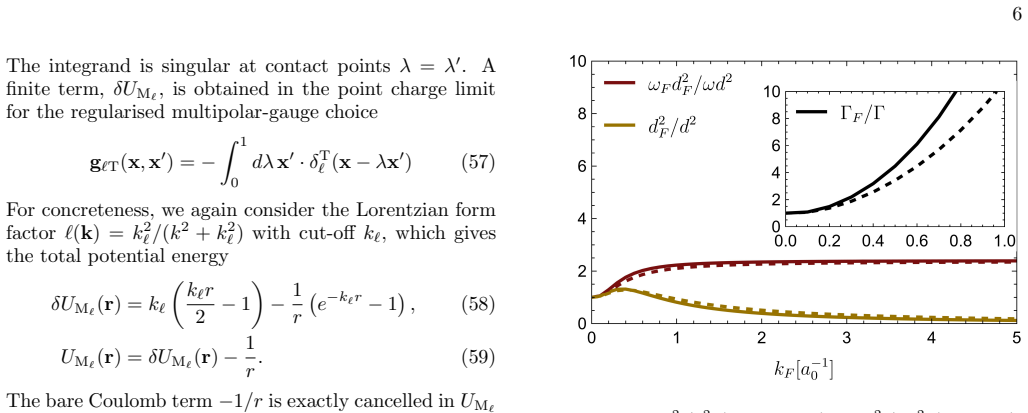
Coulomb gauge The natural definition for comparison is the well- known material Hamiltonian in Eq. (51) that results from the choices φ .= 1 and gT = 0. In units such that q2/(4πϵ0) = 1 the standard Coulomb potential therein is UC(r) = −1/r (ignoring the infinite self-term). More generally, a prototypical (spherically symmetric) choice of form factor is t...
-
[2]
depolarisation shift
Multipolar gauges The standard multipolar gauge choice ofgT in Eq. (10) yields, in the point charge limit kφ → ∞ (with q2/(4πϵ0) = 1), δUM(r) = 2π Z 1 0 dλdλ′r · δT([λ − λ′]r) · r. (56) 6 The integrand is singular at contact points λ = λ′. A finite term, δUMℓ, is obtained in the point charge limit for the regularised multipolar-gauge choice gℓT(x, x′) = −...
-
[3]
Coulomb gauge We denote by λ0 a relevant resonant wavelength and then suppose that kφ ∼ λ−1 c , so the energy scale of interest spans λ−1 0 up to λ−1 c (Fig. 1). If λ0 satisfies λ0 ≫ a0 ∼ r ≫ λc, the variation in ATφ(r) with r is ignorable. We then have ATφ(r) ≈ ATφ(0), which is the EDA. The single atom, Coulomb gauge ( gT = 0), regularised Hamiltonian th...
-
[4]
(74) Thus, H F M = Hm + 1 2 Z d3x [Π(x) + PMF T(x)]2 + B(x)2
Dipole gauge A dipole gauge Hamiltonian H F M can be defined as H F M = RF H F C R† F where F = φ, ℓ and the re- quired Power-Zienau-Woolley (PZW) transformation in the EDA is RF = exp [−id · ATF (0)] , (73) which displaces p by qATF (0) and Π by the dipolar transverse polarisation PMF T(x) = d · δT F (x). (74) Thus, H F M = Hm + 1 2 Z d3x [Π(x) + PMF T(x...
-
[5]
(47) is simply the overlap of the electrostatic fields of the two atoms UCF12 = Z d3x EF L1(x) · EF L2(x) = Z d3xd3x′ ρF 1(x)ρF 2(x′) 4π|x − x′|
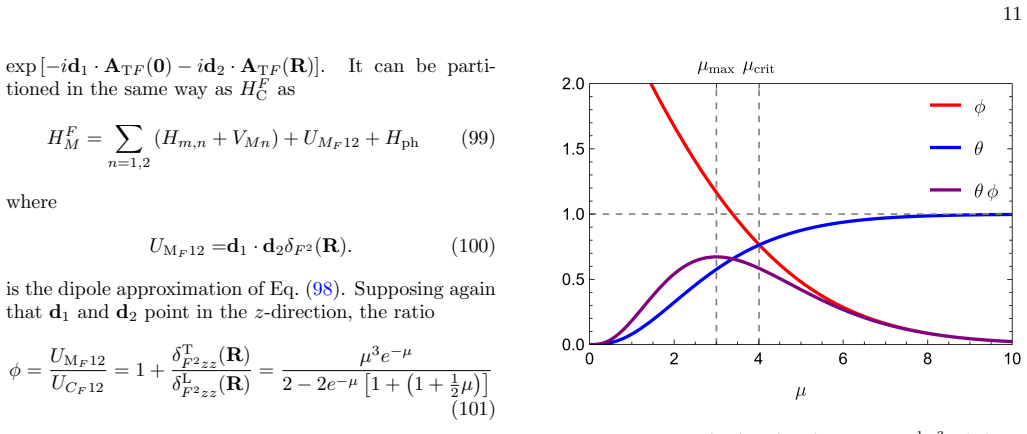
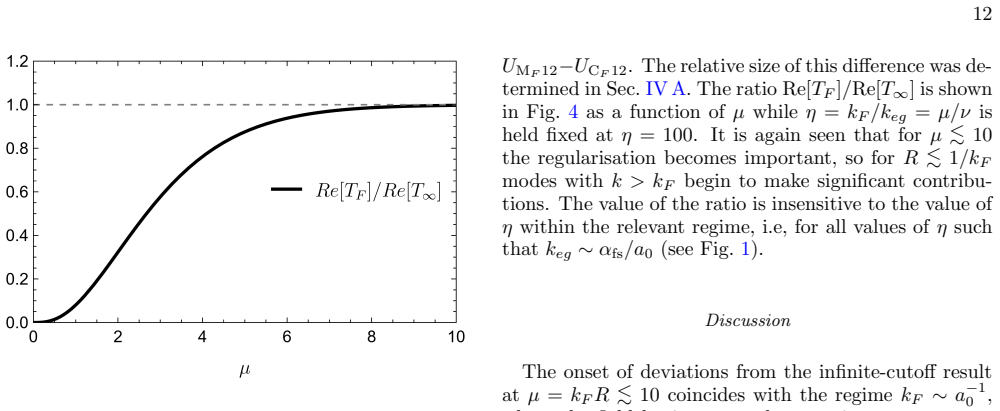
Coulomb gauge In the Coulomb gauge (gT = 0), Eq. (47) is simply the overlap of the electrostatic fields of the two atoms UCF12 = Z d3x EF L1(x) · EF L2(x) = Z d3xd3x′ ρF 1(x)ρF 2(x′) 4π|x − x′| . (92) For a relativistic cut-off kM ∼ λ−1 c this interaction is es- sentially indistinguishable from the bar electrostatic in- teraction. In the EDA one obtains t...
-
[6]
(61) the contribu- tions of the longitudinal and transverse polarisations are independently regularised via φ and ℓ respectively [cf
Dipole gauge For the multipolar choice in Eq. (61) the contribu- tions of the longitudinal and transverse polarisations are independently regularised via φ and ℓ respectively [cf. Eq. (63)]. This gives the total direct material inter- action UMφℓ12 = UCφ12 + δUMℓ12 (96) where δUMℓ12 := Z d3x PℓT,1(x) · PℓT,2(x). (97) If kℓ = kφ and we take the point limit...
-
[7]
Cohen-Tannoudji, J
C. Cohen-Tannoudji, J. Dupont-Roc, and G. Grynberg, Photons and Atoms: Introduction to Quantum Electro- dynamics (Wiley, 1989)
1989
-
[8]
D. P. Craig and T. Thirunamachandran, Molecu- lar Quantum Electrodynamics: An Introduction to Radiation-molecule Interactions (Courier Corporation, 1998)
1998
-
[9]
H. Spohn, Dynamics of Charged Particles and their Radiation Field (Cambridge University Press, Cambridge, 2004), ISBN 978-0-521-83697- 5, URL https://www.cambridge.org/core/books/ dynamics-of-charged-particles-and-their-radiation-field/ 92D241C60F65E559EB1B7AFCD9E47F43
2004
-
[10]
E. A. Power, S. Zienau, and H. S. W. Massey, Philo- sophical Transactions of the Royal Society of London. Series A, Mathematical and Physical Sciences 251, 427 (1959), URL https://royalsocietypublishing.org/ doi/10.1098/rsta.1959.0008
-
[11]
W. E. Lamb, Physical Review 85, 259 (1952), URL https://link.aps.org/doi/10.1103/PhysRev.85.259
-
[12]
R. G. Woolley and C. A. Coulson, Proceedings of the Royal Society of London. A. Mathematical and Phys- ical Sciences 321, 557 (1971), publisher: Royal Soci- ety, URL https://royalsocietypublishing.org/doi/ 10.1098/rspa.1971.0049
-
[13]
R. G. Woolley, Journal of Physics B: Atomic and Molecular Physics 7, 488 (1974), ISSN 0022-3700, pub- lisher: IOP Publishing, URL https://doi.org/10. 1088/0022-3700/7/4/023
1974
-
[14]
R. G. Woolley, Annales de l’I.H.P. Physique th´ eorique23, 365 (1975), URL http://www.numdam.org/item/AIHPA_ 1975__23_4_365_0/
1975
-
[15]
J. Javanainen, J. Ruostekoski, Y. Li, and S.-M. Yoo, Physical Review A 96, 033835 (2017), publisher: Ameri- 15 can Physical Society, URL https://link.aps.org/doi/ 10.1103/PhysRevA.96.033835
-
[16]
Quesada and J
N. Quesada and J. E. Sipe, Optics Letters 42, 3443 (2017), ISSN 1539-4794, publisher: Optical Society of America, URL https://www.osapublishing.org/ol/ abstract.cfm?uri=ol-42-17-3443
2017
-
[17]
A. Stokes and A. Nazir, arXiv:2009.10662 [cond- mat, physics:physics, physics:quant-ph] (2021), arXiv: 2009.10662, URL http://arxiv.org/abs/2009.10662
arXiv 2009
-
[18]
Stokes and A
A. Stokes and A. Nazir, Physical Review Re- search 3, 013116 (2021), publisher: American Physi- cal Society, URL https://link.aps.org/doi/10.1103/ PhysRevResearch.3.013116
2021
-
[19]
Stokes and A
A. Stokes and A. Nazir, Nature Communications 10, 499 (2019), URL https://www.nature.com/articles/ s41467-018-08101-0
2019
-
[20]
A. Drezet, Physical Review A 94, 053826 (2016), pub- lisher: American Physical Society, URL https://link. aps.org/doi/10.1103/PhysRevA.94.053826
-
[21]
R. Grinter and G. A. Jones, The Journal of Chemi- cal Physics 145, 074107 (2016), ISSN 0021-9606, pub- lisher: American Institute of Physics, URL https:// aip.scitation.org/doi/abs/10.1063/1.4960732
-
[22]
Messina, R
R. Messina, R. Vasile, and R. Passante, Physical Re- view A 82, 062501 (2010), publisher: American Physi- cal Society, URL https://link.aps.org/doi/10.1103/ PhysRevA.82.062501
2010
-
[23]
Stokes, Journal of Physics B: Atomic, Molecular and Optical Physics 46, 145505 (2013), URL http://stacks
A. Stokes, Journal of Physics B: Atomic, Molecular and Optical Physics 46, 145505 (2013), URL http://stacks. iop.org/0953-4075/46/i=14/a=145505
2013
-
[25]
Y. Komninos, T. Mercouris, and C. A. Nicolaides, The European Physical Journal D 71, 8 (2017), ISSN 1434-6079, URL https://doi.org/10.1140/epjd/ e2016-60706-8
-
[26]
K. A. Forbes and D. L. Andrews, Optics Letters 43, 435 (2018), ISSN 1539-4794, publisher: Optical Society of America, URL https://www.osapublishing.org/ol/ abstract.cfm?uri=ol-43-3-435
2018
-
[27]
V. Y. Chernyak, P. Saurabh, and S. Mukamel, The Jour- nal of Chemical Physics 143, 164107 (2015), ISSN 0021- 9606, publisher: American Institute of Physics, URL https://aip.scitation.org/doi/10.1063/1.4934231
-
[28]
Tokman, Z
M. Tokman, Z. Long, S. AlMutairi, Y. Wang, V. Vdovin, M. Belkin, and A. Belyanin, APL Photonics 4, 034403 (2019), publisher: American Institute of Physics, URL https://aip.scitation.org/doi/full/10.1063/ 1.5044539
2019
-
[29]
Good quantum error-correcting codes exist
D. De Bernardis, P. Pilar, T. Jaako, S. De Liberato, and P. Rabl, Physical Review A 98, 053819 (2018), URL https://link.aps.org/doi/10.1103/PhysRevA. 98.053819
-
[30]
A. Stokes, A. Kurcz, T. P. Spiller, and A. Beige, Physical Review A 85, 053805 (2012), URL https://link.aps. org/doi/10.1103/PhysRevA.85.053805
-
[31]
H. Safari, D.-G. Welsch, S. Y. Buhmann, and S. Scheel, Physical Review A 78, 062901 (2008), publisher: Ameri- can Physical Society, URL https://link.aps.org/doi/ 10.1103/PhysRevA.78.062901
-
[32]
S. A. R. Horsley and M. Babiker, Physical Review A 78, 012107 (2008), publisher: American Physi- cal Society, URL https://link.aps.org/doi/10.1103/ PhysRevA.78.012107
2008
-
[33]
P. G. Brooke, K.-P. Marzlin, J. D. Cresser, and B. C. Sanders, Physical Review A 77, 033844 (2008), pub- lisher: American Physical Society, URL https://link. aps.org/doi/10.1103/PhysRevA.77.033844
-
[34]
K. Cho, Journal of Physics: Condensed Matter 20, 175202 (2008), ISSN 0953-8984, publisher: IOP Publish- ing, URL https://doi.org/10.1088/0953-8984/20/ 17/175202
-
[35]
S. Pipolo, S. Corni, and R. Cammi, The Journal of Chemical Physics 140, 164114 (2014), ISSN 0021-9606, publisher: American Institute of Physics, URL https: //aip.scitation.org/doi/abs/10.1063/1.4871373
-
[36]
A. Vukics, T. Grießer, and P. Domokos, Physical Review A 92, 043835 (2015), URL https://link.aps.org/doi/ 10.1103/PhysRevA.92.043835
-
[37]
Ruggenthaler, D
M. Ruggenthaler, D. Sidler, and A. Rubio, Chemical Re- views 123, 11191 (2023), ISSN 1520-6890
2023
-
[38]
Ritsch, P
H. Ritsch, P. Domokos, F. Brennecke, and T. Esslinger, Reviews of Modern Physics 85, 553 (2013)
2013
-
[39]
T. Grießer, A. Vukics, and P. Domokos, Physical Review A 94, 033815 (2016), URL https://link.aps.org/doi/ 10.1103/PhysRevA.94.033815
-
[40]
Stokes and A
A. Stokes and A. Nazir, Physical Review Letters 125, 143603 (2020), publisher: American Physi- cal Society, URL https://link.aps.org/doi/10.1103/ PhysRevLett.125.143603
2020
-
[41]
R. G. Woolley, Physical Review Research 2 (2020), ISSN 2643-1564
2020
-
[42]
R. G. Woolley, Physical Review A 110, 012204 (2024), ISSN 2469-9934
2024
-
[43]
Stokes and A
A. Stokes and A. Nazir, Reviews of Modern Physics 94, 045003 (2022), publisher: American Physi- cal Society, URL https://link.aps.org/doi/10.1103/ RevModPhys.94.045003
2022
-
[44]
Stokes, H
A. Stokes, H. Riley, and A. Nazir, Open Systems & In- formation Dynamics 30, 2350016 (2023)
2023
-
[45]
Stokes and A
A. Stokes and A. Nazir, Nature Physics 20, 376 (2023), ISSN 1745-2481
2023
-
[46]
1002/%28SICI%291097-461X%281999%2974%3A5%3C531% 3A%3AAID-QUA9%3E3.0.CO%3B2-H
Woolley, International Journal of Quantum Chem- istry 74, 531 (1999), ISSN 0020-7608, URL https://onlinelibrary.wiley.com/doi/abs/10. 1002/%28SICI%291097-461X%281999%2974%3A5%3C531% 3A%3AAID-QUA9%3E3.0.CO%3B2-H
1999
-
[47]
Stokes and A
A. Stokes and A. Nazir, Physical Review A 104, 032227 (2021), URL https://link.aps.org/doi/10. 1103/PhysRevA.104.032227
2021
-
[48]
R. G. Woolley, Physical Review Research 2, 013206 (2020), publisher: American Physical So- ciety, URL https://link.aps.org/doi/10.1103/ PhysRevResearch.2.013206
2020
-
[49]
Vukics and P
A. Vukics and P. Domokos, Physical Review A 86, 053807 (2012), URL https://link.aps.org/doi/10. 1103/PhysRevA.86.053807
2012
-
[50]
D. De Bernardis, T. Jaako, and P. Rabl, Physical Review A 97, 043820 (2018), URL https://link.aps.org/doi/ 10.1103/PhysRevA.97.043820
-
[51]
A. Stokes, Physical Review E 106, 034111 (2022), pub- lisher: American Physical Society, URL https://link. aps.org/doi/10.1103/PhysRevE.106.034111
-
[52]
R. G. Woolley, Molecular Physics 94, 409 (1998), URL https://www.tandfonline.com/doi/abs/10.1080/ 002689798167917
1998
-
[53]
[30], namely, δUMℓ(r) = k3 ℓ d2/(24πϵ0)
To be precise, changing units by reinserting a factor of 16 q2/(4πϵ0) yields the result given in Ref. [30], namely, δUMℓ(r) = k3 ℓ d2/(24πϵ0)
discussion (0)
Sign in with ORCID, Apple, or X to comment. Anyone can read and Pith papers without signing in.