Pseudo-Feature Padding: A Lightweight Defense Against False Data Injection in Power Grids
Pith reviewed 2026-06-26 18:04 UTC · model grok-4.3
The pith
Adding a pseudo-feature padding layer to DNN inputs defends power grid state estimation against false data injection attacks.
A machine-rendered reading of the paper's core claim, the machinery that carries it, and where it could break.
Core claim
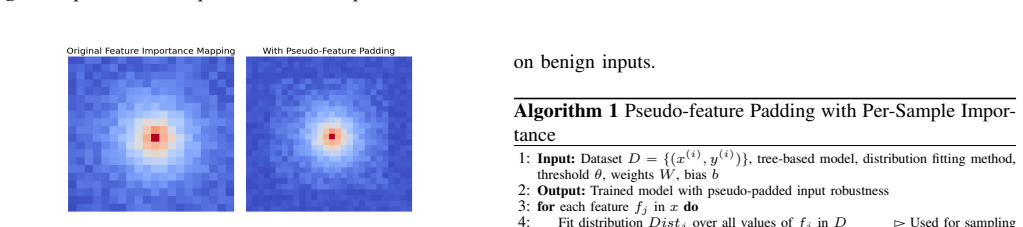
The central claim is that an additional input layer performing padding with pseudo-feature values derived from the inputs' statistical distribution increases input dimensionality in a randomized and data-aware manner, making adversarial attacks computationally infeasible due to the non-transferable nature of crafted perturbations and the unpredictability of the padded structure.
What carries the argument
The pseudo-feature padding layer, which pads input samples using values from the statistical distribution to expand dimensionality randomly and data-aware.
If this is right
- Model robustness against FDIA improves significantly while performance impact stays negligible.
- Attacks that bypass conventional defenses are mitigated in power grid state estimation tasks.
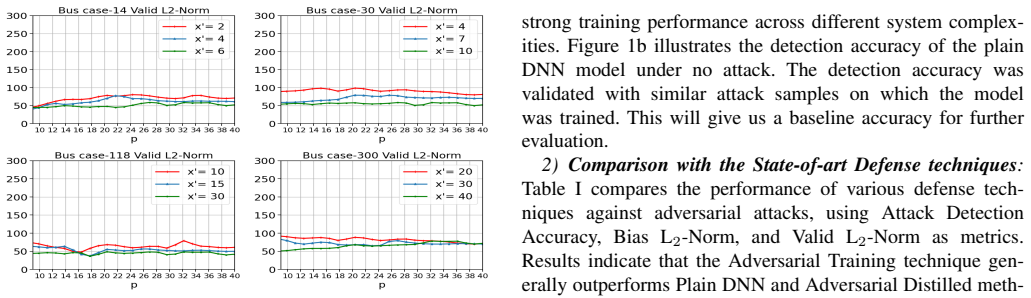
- The defense applies to IEEE 14-bus, 30-bus, 118-bus, and 300-bus systems without core architecture changes.
- The framework remains lightweight and model-agnostic for real-world CPS deployment.
Where Pith is reading between the lines
- The approach could extend to other sensor-based detection tasks in critical infrastructure where input statistics are stable.
- Long-term effectiveness would require periodic re-estimation of the statistical distribution if system conditions drift.
- Attackers facing this defense would likely shift effort toward learning the padding distribution rather than direct perturbation crafting.
Load-bearing premise
The pseudo-feature padding derived from statistical distribution remains unpredictable and non-transferable to attackers who may adapt their perturbations to the padded structure.
What would settle it
An adaptive attack that successfully generates perturbations accounting for the specific padding mechanism and achieves high evasion rates on the defended model across the IEEE bus test cases.
Figures


read the original abstract
Deep Neural Networks DNNs have achieved remarkable accuracy in various tasks including their application in CyberPhysical Systems CPS for detecting False Data Injection Attacks FDIA during critical operations However the unique infrastructure of CPS makes DNNs vulnerable to exploitation by attackers aiming to evade detection Additionally the distinct nature of CPS presents challenges for conventional defense mechanisms against FDIA This paper proposes an innovative defense framework that strengthens DNNs against such attacks by introducing an additional input layer that performs padding in the input samples using pseudofeature values derived from the inputs statistical distribution This padding increases the input dimensionality in a randomized and dataaware manner making adversarial attacks computationally infeasible due to the nontransferable nature of crafted perturbations and the unpredictability of the padded structure Our method is lightweight modelagnostic and requires no modifications to the core architecture making it highly deployable in realworld CPS settings We evaluated our framework on critical power grid applications such as state estimation using the IEEE 14bus 30bus 118bus and 300bus systems Experiments under adversarial settings demonstrate that our padding strategy significantly improves model robustness with negligible impact on performance and effectively mitigates attacks that would otherwise bypass conventional defenses
Editorial analysis
A structured set of objections, weighed in public.
Referee Report
Summary. The manuscript proposes a lightweight, model-agnostic defense called Pseudo-Feature Padding for DNN-based detection of False Data Injection Attacks (FDIA) in power-grid state estimation. An additional input layer pads samples with pseudo-feature values drawn from the input statistical distribution, increasing dimensionality in a randomized, data-aware manner. The central claim is that this renders crafted adversarial perturbations non-transferable and the padded structure unpredictable, making attacks computationally infeasible. Experiments on IEEE 14-, 30-, 118-, and 300-bus systems are reported to show substantially improved robustness with negligible impact on clean performance and better mitigation than conventional defenses.
Significance. If the non-transferability claim holds under realistic adaptive attacks, the approach would be a practical, deployable addition to CPS defenses that requires no core-model changes. The method is lightweight and architecture-agnostic, which is a genuine strength for real-world power-grid applications. However, the current evaluation does not yet establish this property.
major comments (3)
- [Abstract] Abstract and Evaluation section: the headline claim that the method 'significantly improves model robustness' and 'effectively mitigates attacks that would otherwise bypass conventional defenses' is asserted without any quantitative metrics (accuracy, detection rate, attack success rate), attack models, or baseline comparisons supplied in the abstract and without clear numerical results tied to the padding mechanism in the reported experiments.
- [Evaluation] Evaluation / adversarial settings: all reported results appear to use non-adaptive or black-box attacks that do not target the padding layer itself. No experiment is described in which the attacker is given knowledge of the distribution family used for padding or is allowed to optimize perturbations over the padded input structure, leaving the central non-transferability assumption untested.
- [§3] §3 (method description): the claim that padding 'makes adversarial attacks computationally infeasible due to the non-transferable nature of crafted perturbations' is presented as a direct consequence of sampling from the input distribution, yet no formal argument or complexity analysis is given showing why an adaptive attacker who observes or approximates the distribution cannot simply include the padding step in their optimization.
minor comments (2)
- [Abstract] Abstract: repeated missing spaces after acronyms (e.g., 'CyberPhysical Systems CPS', 'False Data Injection Attacks FDIA', 'DNNs have achieved') and run-on phrasing reduce readability.
- [Evaluation] The manuscript would benefit from an explicit statement of the threat model (white-box/black-box, knowledge of padding distribution) and from tables reporting clean vs. adversarial performance with and without padding on each bus system.
Simulated Author's Rebuttal
We thank the referee for their insightful comments, which help improve the clarity and rigor of our work. We provide point-by-point responses below and indicate where revisions will be made.
read point-by-point responses
-
Referee: [Abstract] Abstract and Evaluation section: the headline claim that the method 'significantly improves model robustness' and 'effectively mitigates attacks that would otherwise bypass conventional defenses' is asserted without any quantitative metrics (accuracy, detection rate, attack success rate), attack models, or baseline comparisons supplied in the abstract and without clear numerical results tied to the padding mechanism in the reported experiments.
Authors: We agree that including specific quantitative results in the abstract would better support the claims. In the revised manuscript, we will update the abstract to include key metrics from our experiments, such as the improvement in detection rates under FDIA on the IEEE 14-, 30-, 118-, and 300-bus systems, along with comparisons to conventional defenses like those without padding. revision: yes
-
Referee: [Evaluation] Evaluation / adversarial settings: all reported results appear to use non-adaptive or black-box attacks that do not target the padding layer itself. No experiment is described in which the attacker is given knowledge of the distribution family used for padding or is allowed to optimize perturbations over the padded input structure, leaving the central non-transferability assumption untested.
Authors: The current evaluation uses standard black-box and non-adaptive attack models as commonly reported in the FDIA literature. We acknowledge that testing fully adaptive attackers aware of the padding distribution would provide stronger evidence for the non-transferability claim. We will revise the evaluation section to explicitly state the attack models used and add a discussion on how the randomized, data-aware padding increases the difficulty for adaptive optimization, including why including the padding in the attacker's objective remains challenging due to the stochastic nature of the padding at inference time. revision: partial
-
Referee: [§3] §3 (method description): the claim that padding 'makes adversarial attacks computationally infeasible due to the non-transferable nature of crafted perturbations' is presented as a direct consequence of sampling from the input distribution, yet no formal argument or complexity analysis is given showing why an adaptive attacker who observes or approximates the distribution cannot simply include the padding step in their optimization.
Authors: The non-transferability arises because each inference uses a fresh random sample from the distribution for padding, making the effective input to the DNN stochastic and unpredictable to the attacker. We agree that a more formal argument would be beneficial. In the revision, we will include a brief analysis in §3 explaining the computational infeasibility, noting that an adaptive attacker would need to optimize over an expectation over the padding distribution, which significantly increases the complexity of the attack optimization problem compared to standard gradient-based attacks. revision: yes
Circularity Check
No circularity: empirical defense evaluated on external benchmarks
full rationale
The paper introduces pseudo-feature padding drawn from input statistics as a lightweight, model-agnostic defense and reports its effect on DNN robustness for FDIA detection on IEEE 14/30/118/300-bus systems. No equations, derivations, or fitted parameters are presented that reduce a claimed prediction back to the input by construction. The central claim rests on experimental results under adversarial settings rather than any self-referential loop, self-citation chain, or renamed known result. The non-transferability assumption is an empirical hypothesis tested (or not) by the reported experiments, not a definitional identity.
Axiom & Free-Parameter Ledger
Reference graph
Works this paper leans on
-
[1]
False data injection attacks with incomplete information against smart power grids,
3 Rahman, M. A. and Mohsenian-Rad, H., “False data injection attacks with incomplete information against smart power grids,” in2012 IEEE GLOBECOM. IEEE, 2012, pp. 3153–3158. 4 Goodfellow, I. J., Shlens, J., and Szegedy, C., “Explaining and harnessing adversarial examples,”arXiv preprint arXiv:1412.6572,
Pith/arXiv arXiv 2012
-
[2]
Mitigating adversarial effects of false data injection attacks in power grid,
6 Riya, F. F., Hoque, S., Sun, J. S., Li, J., and Qi, H., “Mitigating adversarial effects of false data injection attacks in power grid,”arXiv preprint arXiv:2301.12487,
-
[3]
False data injection attacks against state estimation in electric power grids,
7 Liu, Y ., Ning, P., and Reiter, M. K., “False data injection attacks against state estimation in electric power grids,” inProceedings of the 16th ACM conference on Computer and communications security, 2009, pp. 21–32. 8 Kosut, O., Jia, L., Thomas, R., and Tong, L., “Malicious data attacks on the smart grid,”IEEE Transactions on Smart Grid, vol. 2, no. ...
2009
-
[4]
False data injection attacks with incomplete information against smart power grids,
10 Rahman, M. and Mohsenian-Rad, H., “False data injection attacks with incomplete information against smart power grids,” inGlobal Commu- nications Conference (GLOBECOM), 2012 IEEE, December 2012, pp. 3153–3158. 11 Srivastava, A., Morris, T., Ernster, T., Vellaithurai, C., Pan, S., and Adhikari, U., “Modeling cyber-physical vulnerability of the smart gri...
2012
-
[5]
Power grid resilience against false data injection attacks,
12 Yan, J., Tang, Y ., Tang, B., He, H., and Sun, Y . L., “Power grid resilience against false data injection attacks,” inPower Energy Society General Meeting, 2016 IEEE, July 2016, accepted. 13 Jiongcong, C., Liang, G., Zexiang, C., Chunchao, H., Yan, X., Fengji, L., and Junhua, Z., “Impact analysis of false data injection attacks on power system static ...
2016
-
[6]
Energy grid state estimation under random and structured bad data,
14 Tajer, A., “Energy grid state estimation under random and structured bad data,” inProc. IEEE Sensor Array Multichannel Signal Process. Workshop (SAM), A Coruna, Spain, June 2014, pp. 65–68. 15 Bi, S. and Zhang, Y . J., “Defending mechanisms against false-data injection attacks in the power system state estimation,” inProc. IEEE GLOBECOM Workshops (GC W...
2014
-
[7]
Detecting stealthy false data injection attacks in power grids using deep learning,
18 Mohammad, A., Chakhchoukh, Y ., Jillepalli, A. A., Tosic, P. T., de Leon, D. C., Sheldon, F. T., and Johnson, B. K., “Detecting stealthy false data injection attacks in power grids using deep learning,” in 2018 14th International Wireless Communications & Mobile Computing Conference (IWCMC). IEEE, 2018, pp. 219–225. 19 JQ, J., Y , H., and VO, L., “Onli...
2018
-
[8]
Intriguing properties of neural networks,
20 Szegedy, C., Zaremba, W., Sutskever, I., Bruna, J., Erhan, D., Goodfel- low, I., and Fergus, R., “Intriguing properties of neural networks,”arXiv preprint arXiv:1312.6199,
-
[9]
Adversarial diversity and hard positive generation,
21 Rozsa, A., Rudd, E. M., and Boult, T. E., “Adversarial diversity and hard positive generation,” inProceedings of the IEEE CVPR Workshops, 2016, pp. 25–32. 22 Kurakin, A., Goodfellow, I., and Bengio, S., “Adversarial machine learn- ing at scale,”arXiv preprint arXiv:1611.01236,
Pith/arXiv arXiv 2016
-
[10]
Deepfool: a simple and accurate method to fool deep neural networks,
23 Moosavi-Dezfooli, S.-M., Fawzi, A., and Frossard, P., “Deepfool: a simple and accurate method to fool deep neural networks,” inProceedings of the IEEE CVPR, 2016, pp. 2574–2582. 24 Papernot, N., McDaniel, P., Wu, X., Jha, S., and Swami, A., “Distillation as a defense to adversarial perturbations against deep neural networks,” in2016 IEEE Symposium on S...
Pith/arXiv arXiv 2016
-
[11]
Towards deep neural network architectures robust to adversarial examples,
26 Gu, S. and Rigazio, L., “Towards deep neural network architectures robust to adversarial examples,”arXiv preprint arXiv:1412.5068,
-
[12]
Towards deep learning models resistant to adversarial attacks,
34 Madry, A., Makelov, A., Schmidt, L., Tsipras, D., and Vladu, A., “Towards deep learning models resistant to adversarial attacks,”arXiv preprint arXiv:1706.06083,
discussion (0)
Sign in with ORCID, Apple, or X to comment. Anyone can read and Pith papers without signing in.