REVIEW 2 major objections 4 minor 1 cited by
RIOJA. JWST and ALMA unveil the inhomogeneous and complex ISM structure in a star-forming galaxy at $z=6.81$
T0 review · 2 major / 4 minor · reviewed 2026-08-06 · deepseek-v4-flash
Pith's one-line read The galaxy COS-2987 at z=6.81 has an ionized ISM that cannot be described by one temperature and density; two gas phases are required.
desk verdict Solid JWST+ALMA case study confirming the two-phase ISM picture at z~7; the quantitative solution is underdetermined and the abstract oversells it, but the qualitative rejection of a single-phase model is robust. read the letter →
The pith
A machine-rendered reading of the paper's core claim, the machinery that carries it, and where it could break.
The reading
What carries the argument
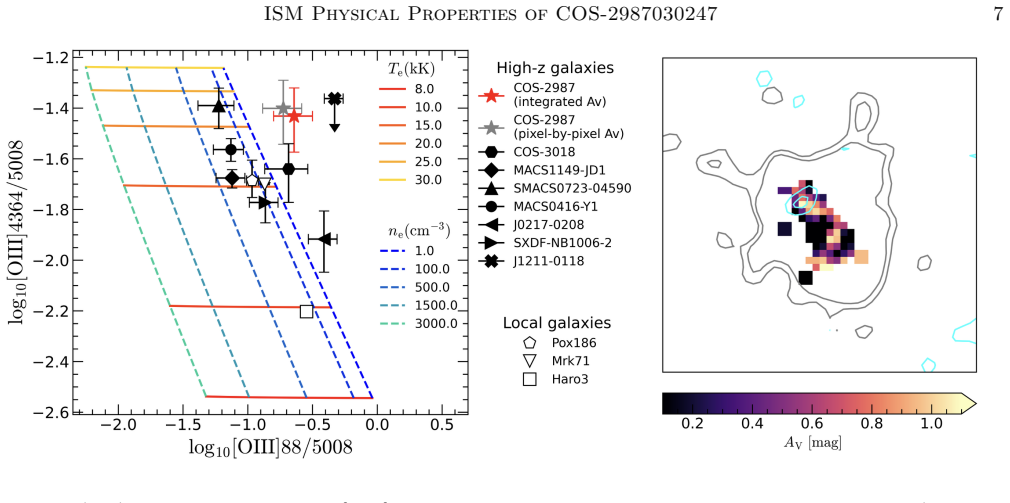
The load-bearing tool is the combined $[\mathrm{O\,III}]$ line-ratio diagnostic. Because $\lambda4364$, $\lambda5008$, and $88\,\mu$m are emitted by the same doubly ionized oxygen ion, their ratios determine $T_e$ and $n_e$ without abundance assumptions; the ratio $\lambda4364/\lambda5008$ is temperature-sensitive, while $88\,\mu$m$/\lambda5008$ is density- and temperature-sensitive. The large difference in critical densities—510 cm$^{-3}$ for $88\,\mu$m versus roughly $6.8\times10^5$ and $3.0\times10^6$ cm$^{-3}$ for $\lambda5008$ and $\lambda4364$—lets the three lines act as probes of different phases. The quantitative model is simple additivity of volume emissivities, $L_{\rm line}=\epsilon_{\rm line,1}V_1+\epsilon_{\rm line,2}V_2$, with emissivities computed under an assumed $\mathrm{O}^{++}/\mathrm{H}^+=10^{-4}$. A two-component mix places the composite ratios on the line connecting the two single-phase grid points, and matching the observed ratios fixes the volume ratio at roughly $1{:}300$.
What would settle it
Measure [OIII]88 and [OIII]5008 at sub-arcsecond resolution with ALMA and map their spatial extents: if [OIII]88 is not significantly more extended than [OIII]5008, the large-volume diffuse component that carries the model would be ruled out, and the ratio discrepancy would need a different mechanism. A second check would measure O++/H+ independently in the diffuse phase from a density-independent recombination line; if it differs from $10^{-4}$, the derived volume ratio is wrong.
Extended reading notes
Core claim
The central claim is that the three $[\mathrm{O\,III}]$ lines of COS-2987—the optical auroral line $\lambda4364$, the optical nebular line $\lambda5008$, and the far-infrared fine-structure line $88\,\mu$m—cannot all originate from a single phase of ionized gas with one density and one temperature. A homogeneous model that matches the high $[\mathrm{O\,III}]88/5008$ ratio would predict a $[\mathrm{O\,III}]4364/5008$ ratio that disagrees with the measurement, and vice versa. The paper's two-component toy model, with component 1 at $(T_e,n_e)=(26{,}000~\mathrm{K},500~\mathrm{cm}^{-3})$ and component 2 at $(8{,}000~\mathrm{K},50~\mathrm{cm}^{-3})$ and volume ratio $V_1/V_2\simeq 1/300$, reproduces both observed ratios simultaneously. The authors stress that this parameter set is not unique, and they rule out inhomogeneous dust as the primary explanation by showing that pixel-by-pixel dust corrections leave the discrepancy intact. The qualitative conclusion is that the galaxy's ionized ISM is density-stratified: compact hot regions embedded in a much larger reservoir of cool diffuse gas.
Load-bearing premise
The two-component solution assumes the ionized gas is exactly two internally uniform phases sharing the same oxygen abundance ratio O++/H+ = $10^{-4}$; if abundances differ between phases or the gas has continuous density and temperature gradients, the derived component properties and the 1:300 volume ratio would change.
Editorial extensions
If this is right
- JWST-only optical measurements of high-redshift galaxies systematically miss a diffuse ionized component, so densities and temperatures derived from optical lines alone are weighted toward dense gas.
- The same diagnostic applied to other high-$z$ galaxies with strong $[\mathrm{O\,III}]88$ shows the same offset from homogeneous grids, suggesting the two-phase pattern is common rather than unique to COS-2987.
- A large-volume, cool, low-density phase is the natural site for the strong far-infrared $[\mathrm{O\,III}]88$ emission, implying a porous, "picket-fence" geometry in which ionizing photons leak from dense regions into surrounding diffuse gas.
- For COS-2987 the inferred Lyman-continuum escape fraction of 4–14% is consistent with this porous geometry, connecting the ISM structure result to cosmic reionization.
- Higher-angular-resolution ALMA observations can map $[\mathrm{O\,III}]88$ directly and test whether the diffuse component is spatially extended, as the model predicts.
Reading between the lines
- If the two-phase structure is typical at high redshift, gas-phase metallicities from direct-$T_e$ methods may be biased because optical $[\mathrm{O\,III}]$ and $[\mathrm{O\,II}]$ lines weight different phases; combining far-infrared lines would be needed to recover a mass-weighted abundance.
- The exact volume ratio of 1:300 is model-dependent; the robust statement is qualitative stratification. A testable prediction is that high-resolution ALMA will find $[\mathrm{O\,III}]88$ more extended than $[\mathrm{O\,III}]5008$, something the current beam-smoothed radial profiles cannot yet rule out.
- One speculative route the authors leave open is that very massive stars produce the 26,000 K component; rest-frame UV spectra showing strong He II 1640 emission or an enhanced N/O ratio would support that interpretation.
Editorial analysis
A structured set of objections, weighed in public.
Referee Report
Summary. Usui et al. present JWST/NIRSpec IFS and ALMA observations of the z=6.81 star-forming galaxy COS-2987, detecting [OII] λλ3727,3730, [OIII] 4364, [OIII] λλ4960,5008, Hβ, Hα, and [OIII] 88 μm. From the optical lines alone they infer A_V ≈ 0.14 mag, T_e([OIII]) ≈ 2.0×10^4 K, n_e([OII]) ≈ 500 cm^-3, and 12+log(O/H) ≈ 7.67. The central diagnostic combines [OIII] 4364/5008 with [OIII] 88/5008; COS-2987 lies outside the PyNeb single-phase T_e–n_e grid, and a pixel-by-pixel dust correction does not bring it inside. The authors then introduce a two-component toy model with a hot/dense component (T_e ≈ 26,000 K, n_e ≈ 500 cm^-3) and a cool/diffuse component (T_e ≈ 8,000 K, n_e ≈ 50 cm^-3), showing that the observed ratios can be reproduced with V_1/V_2 ≈ 1/300. They explicitly note that this solution is not unique. The paper concludes that the ISM is density-stratified and that JWST-only measurements miss a diffuse low-density phase.
Significance. The qualitative result is important: it provides direct evidence at z ≈ 6.8 that a homogeneous, single-phase ionized-gas model fails to jointly explain optical and FIR [OIII] ratios, and it illustrates the need for ALMA to characterize high-redshift ISM. The inclusion of several literature galaxies strengthens the claim that the discrepancy is not unique to this object. The authors are transparent that the two-component solution is a toy and not unique, which is a strength. The weakness is that the specific numeric parameters in the abstract and conclusions (26,000 K / 8,000 K / 1:300) are not actually constrained by the data; the paper's robust product is the falsification of the single-phase model plus an illustrative stratified-ISM picture.
major comments (2)
- [§5.2, Eq. (4), Figure 4; abstract and Conclusion (4)] The quantitative two-component solution is underdetermined. The three [OIII] lines provide only two independent ratios, while the model in Eq. (4) has at least five free parameters (T_e,1, n_e,1, T_e,2, n_e,2, V_1/V_2) plus the fixed assumption O++/H+ = 10^-4 in both components. The paper explicitly notes that other parameter sets could reproduce the data, but the abstract and Conclusion (4) present (T_e,1, n_e,1) = (26,000 K, 500 cm^-3), (T_e,2, n_e,2) = (8,000 K, 50 cm^-3), and V_1/V_2 ~ 1/300 as the inferred result. Please add a caveat in the abstract and conclusions that these are illustrative values of a toy model, and provide at least a brief quantitative indication of the degeneracy (e.g., how V_1/V_2 changes if the two components are allowed to have different O++/H+, or if a continuous density/temperature distribution is assumed). The qualitative rejection of a homogeneous single-phase model does not depend on this issue, but the specific numeric claims do.
- [§5.1 and Figure 3 (right)] The clumpy-dust test is limited by the resolution of the Balmer-decrement map. The A_V map is constructed from Voronoi-binned Hα/Hβ and sets A_V = 0 outside the 3σ regions, so unresolved dust clumps would not be captured by this test. The conclusion that 'clumpy dust distribution is not the primary cause' should therefore be stated with the caveat that the test probes dust structure on the scales resolved by the PSF-matched map; an extreme unresolved clumpy geometry is not strictly excluded, although it would require fine-tuning. This does not change the main conclusion but makes the claim precise.
minor comments (4)
- [§2.1] Typo: 'one-dimentional' should be 'one-dimensional'.
- [§5.3] The section heading contains a duplicated article: 'Interpretation of the the density-stratified ionized ISM'.
- [Figure 4] The top-right panel would be easier to read if the two model curves were labeled (e.g., '88/5008' and '4364/5008') and if the intersections with the observed 1σ bands were marked to show the allowed range in V_1/V_2.
- [§5.2] The statement that 'other sets of physical conditions could reproduce the observed line ratios, such as a higher T_e for component 1 and a higher n_e for component 2' would be more informative with a concrete example or a small grid; as written, the reader cannot judge the size of the degeneracy.
Circularity Check
No significant circularity: the single-phase rejection is an independent model-grid result, and the two-component model is explicitly non-unique, non-predictive, and transparently constructed.
full rationale
The paper's central claim is that the observed [OIII]88/5008 and [OIII]4364/5008 ratios of COS-2987 cannot be reproduced by a homogeneous ionized gas with a single electron density and temperature. This claim is established by comparing the observed ratios with PyNeb model grids computed over a wide range of Te and ne, with no free parameters fitted to the target. That comparison is self-contained and does not reduce to anything the paper has assumed. The subsequent two-component model is presented as a toy model, with the paper explicitly stating: 'The aim of this analysis is not to determine best-fit parameters, but rather to assess whether the observed [Oiii] luminosity ratios can be reproduced within the framework of a density-stratified ionized ISM.' The component properties (Te,1, ne,1) = (26,000 K, 500 cm^-3) and (Te,2, ne,2) = (8,000 K, 50 cm^-3) are hand-picked, and the paper explicitly acknowledges non-uniqueness: 'We stress again that the specific combination of Te, ne, and V1/V2 parameters presented above is not a unique solution.' The derived volume ratio V1/V2 ~ 1/300 is therefore a consistency-check quantity, not an independent prediction, and the paper does not present it as a test. This is a modeling limitation or underdetermination concern, not circularity. Self-citations to companion papers (e.g., Mawatari et al. 2025) provide data-reduction details and supporting estimates such as f_esc, but the line fluxes and ratios analyzed here are measured and tabulated in this paper (Table 1), so the central diagnostic does not rest on a self-citation chain. No uniqueness theorem is imported from the authors' prior work, and no known result is merely renamed. Accordingly, no circular step can be exhibited and the appropriate score is 0.
Assumptions & free parameters
free parameters (5)
- T_e,1 (hot dense component electron temperature) =
26,000 K
- n_e,1 (hot dense component electron density) =
500 cm^-3
- T_e,2 (cool diffuse component electron temperature) =
8,000 K
- n_e,2 (cool diffuse component electron density) =
50 cm^-3
- V1/V2 (volume ratio) =
1/300
assumptions (4)
- domain assumption Case B recombination for H-alpha/H-beta and SMC extinction curve with R_V=2.74
- domain assumption PyNeb atomic data and the Campbell et al. (1986) relation Te([OII]) = 0.7 Te([OIII]) + 3000 K
- domain assumption The [OIII] lines originate only from O++ gas in HII regions, with no AGN or shock contribution
- ad hoc to paper O++/H+ = 10^-4 in both components
Cite this review
Pith. "Pith review of RIOJA. JWST and ALMA unveil the inhomogeneous and complex ISM structure in a star-forming galaxy at $z=6.81$." pith.science (2026). https://pith.science/paper/4RLFANNQ
@misc{pith2026250702054,
  author       = {Pith},
  title        = {Pith review of: RIOJA. JWST and ALMA unveil the inhomogeneous and complex ISM structure in a star-forming galaxy at $z=6.81$},
  year         = {2026},
  howpublished = {\url{https://pith.science/paper/4RLFANNQ}},
  note         = {Machine review of arXiv:2507.02054}
}
abstract
We report the discovery of a complex, density-stratified interstellar medium (ISM) in the star-forming galaxy COS-2987 at $z = 6.81$, revealed by the unprecedented synergy between JWST/NIRSpec IFS and ALMA observations. These observations detect key emission lines, including \oii~$\lambda\lambda$~3727, 3730, \oiii~4364, \oiii~$\lambda\lambda$~4960, 5008, \oiii\ 88 \micron, as well as H$\alpha$ and H$\beta$. JWST spectroscopy alone indicates ISM properties that are typical for galaxies at $z\sim7$. These include low dust extinction ($A_{\rm V} \approx 0.14$ mag), moderate electron density ($n_{\rm e} \approx 500$~cm$^{-3}$), and low gas-phase metallicity ($\sim10\%$). However, the strong far-infrared \oiii\ 88 \micron\ emission detected by ALMA cannot be explained by a single-component ionized medium with uniform electron density and temperature. Instead, a two-component ISM model, comprising compact, high-temperature, high-density gas components ($T_e \approx 26,000$\,K; $n_e \approx 600~\mathrm{cm}^{-3}$) and an extended, cooler, lower-density component ($T_e \approx 8,000$\,K; $n_e \approx 50~\mathrm{cm}^{-3}$), successfully reproduces the observed line ratios of \oiii~88~\micron/\oiii~5008~\AA\ and \oiii~4364/\oiii~5008~\AA, with a volume ratio of 1 : 300 between the two components. Our results demonstrate that JWST alone probes only a fraction of the ISM and highlight the critical importance of combining JWST and ALMA to reveal the density-stratified ISM of early galaxies.
Figures


Figures from the paper (1 more)

Forward citations
Cited by 1 Pith paper
-
Extremely UV-bright starbursts at the end of cosmic reionization
Very UV-bright galaxies at z~6 are ~6-Myr-old starbursts with high ionizing-photon efficiency, and one example shows evidence that dusty outflows push dust beyond the stars and boost its UV brightness.
Reference graph
Works this paper leans on
-
[1]
Abdurro’uf, Larson, R. L., Coe, D., et al. 2024, ApJ, 973, 47, doi: 10.3847/1538-4357/ad6001 ´Alvarez-M´ arquez, J., Crespo G´ omez, A., Colina, L., et al. 2025, A&A, 695, A250, doi: 10.1051/0004-6361/202451731
-
[2]
2024, A&A, 688, A146, doi: 10.1051/0004-6361/202348824
Arribas, S., Perna, M., Rodr ´ ıguez Del Pino, B., et al. 2024, A&A, 688, A146, doi: 10.1051/0004-6361/202348824
-
[3]
Asplund, M., Grevesse, N., Sauval, A. J., & Scott, P. 2009, ARA&A, 47, 481, doi: 10.1146/annurev.astro.46.060407.145222
arXiv 2009
-
[4]
Compilation of Technical Papers on ALMA Receivers
Bakx, T., & Conway, J. 2024, Compilation of Technical Papers on ALMA Receivers, ALMA Memo Series, 627, 2024, doi: 10.48550/arXiv.2409.02164
work page Pith review arXiv doi:10.48550/arxiv.2409.02164 2024
-
[5]
Bakx, T. J. L. C., Tamura, Y., Hashimoto, T., et al. 2020, MNRAS, 493, 4294, doi: 10.1093/mnras/staa509 B¨ oker, T., Arribas, S., L¨ utzgendorf, N., et al. 2022, A&A, 661, A82, doi: 10.1051/0004-6361/202142589 B¨ oker, T., Beck, T. L., Birkmann, S. M., et al. 2023, PASP, 135, 038001, doi: 10.1088/1538-3873/acb846 ISM Physical Properties of COS-298703024715
-
[6]
2024, JWST Calibration Pipeline, 1.14.0, Zenodo, doi: 10.5281/zenodo.6984365
Bushouse, H., Eisenhamer, J., Dencheva, N., et al. 2024, JWST Calibration Pipeline, 1.14.0, Zenodo, doi: 10.5281/zenodo.6984365
-
[7]
1986, MNRAS, 223, 811, doi: 10.1093/mnras/223.4.811
Campbell, A., Terlevich, R., & Melnick, J. 1986, MNRAS, 223, 811, doi: 10.1093/mnras/223.4.811
-
[8]
2009, arXiv e-prints, arXiv:0912.1303, doi: 10.48550/arXiv.0912.1303
Cappellari, M. 2009, arXiv e-prints, arXiv:0912.1303, doi: 10.48550/arXiv.0912.1303
Show all 81 references
-
[9]
2003, MNRAS, 342, 345, doi: 10.1046/j.1365-8711.2003.06541.x CASA Team, Bean, B., Bhatnagar, S., et al
Cappellari, M., & Copin, Y. 2003, MNRAS, 342, 345, doi: 10.1046/j.1365-8711.2003.06541.x CASA Team, Bean, B., Bhatnagar, S., et al. 2022, PASP, 134, 114501, doi: 10.1088/1538-3873/ac9642
2003
-
[10]
2023, Nature Astronomy, 7, 771, doi: 10.1038/s41550-023-01953-7
Chen, Y., Jones, T., Sanders, R., et al. 2023, Nature Astronomy, 7, 771, doi: 10.1038/s41550-023-01953-7
2023 doi
-
[11]
L., et al
Chen, Y., Jones, T., Sanders, R. L., et al. 2024, arXiv e-prints, arXiv:2405.18476, doi: 10.48550/arXiv.2405.18476
2024 doi
-
[12]
2024, MNRAS, 529, 3751, doi: 10.1093/mnras/stae776
Choustikov, N., Katz, H., Saxena, A., et al. 2024, MNRAS, 529, 3751, doi: 10.1093/mnras/stae776
2024 doi
-
[13]
C., Lebouteiller, V., et al
Cormier, D., Madden, S. C., Lebouteiller, V., et al. 2015, A&A, 578, A53, doi: 10.1051/0004-6361/201425207
2015 doi
-
[14]
P., Hony, S., et al
Cormier, D., Abel, N. P., Hony, S., et al. 2019, A&A, 626, A23, doi: 10.1051/0004-6361/201834457
2019 doi
-
[15]
A., Schnurr, O., Hirschi, R., et al
Crowther, P. A., Schnurr, O., Hirschi, R., et al. 2010, MNRAS, 408, 731, doi: 10.1111/j.1365-2966.2010.17167.x
2010
-
[16]
2024, A&A, 684, A75, doi: 10.1051/0004-6361/202346698
Curti, M., Maiolino, R., Curtis-Lake, E., et al. 2024, A&A, 684, A75, doi: 10.1051/0004-6361/202346698
2024 doi
-
[17]
L., F¨ orster Schreiber, N
Davies, R. L., F¨ orster Schreiber, N. M., Genzel, R., et al. 2021, ApJ, 909, 78, doi: 10.3847/1538-4357/abd551
2021 doi
-
[18]
L., Lester, D
Dinerstein, H. L., Lester, D. F., & Werner, M. W. 1985, ApJ, 291, 561, doi: 10.1086/163096
1985 doi
-
[19]
Draine, B. T. 2011, Physics of the Interstellar and Intergalactic Medium
2011
-
[20]
2024, ApJ, 964, 146, doi: 10.3847/1538-4357/ad235c
Fujimoto, S., Ouchi, M., Nakajima, K., et al. 2024, ApJ, 964, 146, doi: 10.3847/1538-4357/ad235c
2024 doi
-
[21]
P., Mather, J
Gardner, J. P., Mather, J. C., Abbott, R., et al. 2023, PASP, 135, 068001, doi: 10.1088/1538-3873/acd1b5
2023 doi
-
[22]
D., Clayton, G
Gordon, K. D., Clayton, G. C., Misselt, K. A., Landolt, A. U., & Wolff, M. J. 2003, ApJ, 594, 279, doi: 10.1086/376774
2003 doi
- [23]
-
[24]
K., et al
Harikane, Y., Ouchi, M., Inoue, A. K., et al. 2020, ApJ, 896, 93, doi: 10.3847/1538-4357/ab94bd
2020 doi
-
[25]
K., Ellis, R
Harikane, Y., Inoue, A. K., Ellis, R. S., et al. 2025a, ApJ, 980, 138, doi: 10.3847/1538-4357/ad9b2c
-
[26]
L., Ellis, R., et al
Harikane, Y., Sanders, R. L., Ellis, R., et al. 2025b, arXiv e-prints, arXiv:2505.09186, doi: 10.48550/arXiv.2505.09186
-
[27]
S., et al
Harshan, A., Tripodi, R., Martis, N. S., et al. 2024, ApJL, 977, L36, doi: 10.3847/2041-8213/ad9741
2024 doi
-
[28]
2018, Nature, 557, 392, doi: 10.1038/s41586-018-0117-z
Hashimoto, T., Laporte, N., Mawatari, K., et al. 2018, Nature, 557, 392, doi: 10.1038/s41586-018-0117-z
2018 doi
-
[29]
2023, ApJL, 955, L2, doi: 10.3847/2041-8213/acf57c
Hashimoto, T., ´Alvarez-M´ arquez, J., Fudamoto, Y., et al. 2023, ApJL, 955, L2, doi: 10.3847/2041-8213/acf57c
2023 doi
-
[30]
M., Borthakur, S., Overzier, R., et al
Heckman, T. M., Borthakur, S., Overzier, R., et al. 2011, ApJ, 730, 5, doi: 10.1088/0004-637X/730/1/5
2011 doi
-
[31]
K., Tamura, Y., Matsuo, H., et al
Inoue, A. K., Tamura, Y., Matsuo, H., et al. 2016, Science, 352, 1559, doi: 10.1126/science.aaf0714
2016 doi
-
[32]
2023, ApJ, 956, 139, doi: 10.3847/1538-4357/acf376
Isobe, Y., Ouchi, M., Nakajima, K., et al. 2023, ApJ, 956, 139, doi: 10.3847/1538-4357/acf376
2023 doi
-
[33]
2024, MNRAS, 535, 881, doi: 10.1093/mnras/stae2375
Ji, X., ¨Ubler, H., Maiolino, R., et al. 2024, MNRAS, 535, 881, doi: 10.1093/mnras/stae2375
2024 doi
-
[34]
2020, ApJ, 903, 150, doi: 10.3847/1538-4357/abb943
Jones, T., Sanders, R., Roberts-Borsani, G., et al. 2020, ApJ, 903, 150, doi: 10.3847/1538-4357/abb943
2020 doi
-
[35]
2011, PASJ, 63, 903, doi: 10.1093/pasj/63.4.903
Kawada, M., Takahashi, A., Yasuda, A., et al. 2011, PASJ, 63, 903, doi: 10.1093/pasj/63.4.903
2011 doi
-
[36]
J., Nicholls, D
Kewley, L. J., Nicholls, D. C., Sutherland, R., et al. 2019, ApJ, 880, 16, doi: 10.3847/1538-4357/ab16ed
2019 doi
-
[37]
2023, MNRAS, 521, 2526, doi: 10.1093/mnras/stad687
Killi, M., Watson, D., Fujimoto, S., et al. 2023, MNRAS, 521, 2526, doi: 10.1093/mnras/stad687
2023 doi
-
[38]
2024, MNRAS, 529, 781, doi: 10.1093/mnras/stae252
Kumari, N., Smit, R., Leitherer, C., et al. 2024, MNRAS, 529, 781, doi: 10.1093/mnras/stae252
2024 doi
-
[39]
S., et al
Laporte, N., Nakajima, K., Ellis, R. S., et al. 2017, ApJ, 851, 40, doi: 10.3847/1538-4357/aa96a8
2017 doi
-
[40]
H., Maseda, M
Laseter, I. H., Maseda, M. V., Curti, M., et al. 2024, A&A, 681, A70, doi: 10.1051/0004-6361/202347133
2024 doi
-
[41]
2022, A&A, 667, A34, doi: 10.1051/0004-6361/202243865
Lebouteiller, V., & Ramambason, L. 2022, A&A, 667, A34, doi: 10.1051/0004-6361/202243865
2022 doi
-
[42]
C., et al
Lebouteiller, V., Cormier, D., Madden, S. C., et al. 2012, A&A, 548, A91, doi: 10.1051/0004-6361/201218859
2012 doi
-
[43]
2013, A&A, 553, A106, doi: 10.1051/0004-6361/201118370
Leitet, E., Bergvall, N., Hayes, M., Linn´ e, S., & Zackrisson, E. 2013, A&A, 553, A106, doi: 10.1051/0004-6361/201118370
2013 doi
-
[44]
Luridiana, V., Morisset, C., & Shaw, R. A. 2015, A&A, 573, A42, doi: 10.1051/0004-6361/201323152
2015 doi
- [45]
-
[46]
A., Perna, M., Willott, C
Marshall, M. A., Perna, M., Willott, C. J., et al. 2023, A&A, 678, A191, doi: 10.1051/0004-6361/202346113
2023 doi
-
[47]
2025, arXiv e-prints, arXiv:2507.02053, doi: 10.48550/arXiv.2507.02053
Mawatari, K., Costantin, L., Usui, M., et al. 2025, arXiv e-prints, arXiv:2507.02053, doi: 10.48550/arXiv.2507.02053
2025 doi
-
[48]
L., Arellano-C´ ordova, K
Mingozzi, M., James, B. L., Arellano-C´ ordova, K. Z., et al. 2022, ApJ, 939, 110, doi: 10.3847/1538-4357/ac952c
2022 doi
-
[49]
2024, ApJ, 971, 43, doi: 10.3847/1538-4357/ad5290 16Usui et al
Morishita, T., Stiavelli, M., Grillo, C., et al. 2024, ApJ, 971, 43, doi: 10.3847/1538-4357/ad5290 16Usui et al
2024 doi
-
[50]
2023, ApJS, 269, 33, doi: 10.3847/1538-4365/acd556
Nakajima, K., Ouchi, M., Isobe, Y., et al. 2023, ApJS, 269, 33, doi: 10.3847/1538-4365/acd556
2023 doi
-
[51]
2023, ApJ, 953, 140, doi: 10.3847/1538-4357/ace25a
Nakazato, Y., Yoshida, N., & Ceverino, D. 2023, ApJ, 953, 140, doi: 10.3847/1538-4357/ace25a
2023 doi
-
[52]
E., & Ferland, G
Osterbrock, D. E., & Ferland, G. J. 2006, Astrophysics of gaseous nebulae and active galactic nuclei
2006
-
[53]
2023, A&A, 679, A89, doi: 10.1051/0004-6361/202346649
Perna, M., Arribas, S., Marshall, M., et al. 2023, A&A, 679, A89, doi: 10.1051/0004-6361/202346649
2023 doi
-
[54]
C., Aravena, M., Gonz´ alez-L´ opez, J., et al
Posses, A. C., Aravena, M., Gonz´ alez-L´ opez, J., et al. 2023, A&A, 669, A46, doi: 10.1051/0004-6361/202243399
2023 doi
-
[55]
2022a, A&A, 667, A35, doi: 10.1051/0004-6361/202243866 —
Ramambason, L., Lebouteiller, V., Bik, A., et al. 2022a, A&A, 667, A35, doi: 10.1051/0004-6361/202243866 —. 2022b, A&A, 667, A35, doi: 10.1051/0004-6361/202243866
-
[56]
W., Fudamoto, Y., Inoue, A
Ren, Y. W., Fudamoto, Y., Inoue, A. K., et al. 2023, ApJ, 945, 69, doi: 10.3847/1538-4357/acb8ab
2023 doi
-
[57]
E., Wold, I
Rhoads, J. E., Wold, I. G. B., Harish, S., et al. 2023, ApJL, 942, L14, doi: 10.3847/2041-8213/acaaaf
2023 doi
-
[58]
R., Vieira, J
Rigby, J. R., Vieira, J. D., Phadke, K. A., et al. 2025, ApJ, 978, 108, doi: 10.3847/1538-4357/ad7501
2025 doi
-
[59]
L., Shapley, A
Sanders, R. L., Shapley, A. E., Topping, M. W., Reddy, N. A., & Brammer, G. B. 2024, ApJ, 962, 24, doi: 10.3847/1538-4357/ad15fc
2024 doi
-
[60]
L., Shapley, A
Sanders, R. L., Shapley, A. E., Kriek, M., et al. 2016, ApJ, 816, 23, doi: 10.3847/0004-637X/816/1/23
2016 doi
-
[61]
2022, A&A, 665, L4, doi: 10.1051/0004-6361/202244556
Schaerer, D., Marques-Chaves, R., Barrufet, L., et al. 2022, A&A, 665, L4, doi: 10.1051/0004-6361/202244556
2022 doi
-
[62]
J., Finkbeiner, D
Schlegel, D. J., Finkbeiner, D. P., & Davis, M. 1998, ApJ, 500, 525, doi: 10.1086/305772
1998 doi
-
[63]
2025, MNRAS, 539, 2463, doi: 10.1093/mnras/staf518
Scholtz, J., Curti, M., D’Eugenio, F., et al. 2025, MNRAS, 539, 2463, doi: 10.1093/mnras/staf518
2025 doi
-
[64]
2008, in Ninteenth International Symposium on Space Terahertz Technology, ed
Sekimoto, Y., Iizuko, Y., Satou, N., et al. 2008, in Ninteenth International Symposium on Space Terahertz Technology, ed. W. Wild, 253–257
2008
-
[65]
P., et al
Senchyna, P., Plat, A., Stark, D. P., et al. 2024, ApJ, 966, 92, doi: 10.3847/1538-4357/ad235e
2024 doi
-
[66]
J., Franx, M., et al
Smit, R., Bouwens, R. J., Franx, M., et al. 2015, ApJ, 801, 122, doi: 10.1088/0004-637X/801/2/122
2015 doi
-
[67]
J., Carniani, S., et al
Smit, R., Bouwens, R. J., Carniani, S., et al. 2018, Nature, 553, 178, doi: 10.1038/nature24631 Stasi´ nska, G. 1982, A&AS, 48, 299
2018 doi
-
[68]
2023, ApJL, 957, L18, doi: 10.3847/2041-8213/ad0159
Stiavelli, M., Morishita, T., Chiaberge, M., et al. 2023, ApJL, 957, L18, doi: 10.3847/2041-8213/ad0159
2023 doi
-
[69]
2025, ApJ, 981, 135, doi: 10.3847/1538-4357/adb02a
Sugahara, Y., ´Alvarez-M´ arquez, J., Hashimoto, T., et al. 2025, ApJ, 981, 135, doi: 10.3847/1538-4357/adb02a
2025 doi
-
[70]
Tamura, Y., C. Bakx, T. J. L., Inoue, A. K., et al. 2023, ApJ, 952, 9, doi: 10.3847/1538-4357/acd637
2023 doi
-
[71]
K., Hashimoto, T., et al
Tokuoka, T., Inoue, A. K., Hashimoto, T., et al. 2022, The Astrophysical Journal Letters, 933, L19, doi: 10.3847/2041-8213/ac7447
2022 doi
-
[72]
W., Stark, D
Topping, M. W., Stark, D. P., Senchyna, P., et al. 2025, ApJ, 980, 225, doi: 10.3847/1538-4357/ada95c ¨Ubler, H., Maiolino, R., Curtis-Lake, E., et al. 2023, A&A, 677, A145, doi: 10.1051/0004-6361/202346137
2025 doi
-
[73]
2024, A&A, 686, A185, doi: 10.1051/0004-6361/202449184
Upadhyaya, A., Marques-Chaves, R., Schaerer, D., et al. 2024, A&A, 686, A185, doi: 10.1051/0004-6361/202449184
2024 doi
-
[74]
K., et al
Ura, R., Hashimoto, T., Inoue, A. K., et al. 2023, ApJ, 948, 3, doi: 10.3847/1538-4357/acc530
2023 doi
-
[75]
Vink, J. S. 2023, A&A, 679, L9, doi: 10.1051/0004-6361/202347827
2023 doi
-
[76]
S., Heger, A., Krumholz, M
Vink, J. S., Heger, A., Krumholz, M. R., et al. 2015, Highlights of Astronomy, 16, 51, doi: 10.1017/S1743921314004657
2015 doi
-
[77]
M., Hutchison, T
Welch, B., Olivier, G. M., Hutchison, T. A., et al. 2024, ApJ, 975, 196, doi: 10.3847/1538-4357/ad79ec
2024 doi
-
[78]
2022, MNRAS, 515, 1751, doi: 10.1093/mnras/stac1905
Witstok, J., Smit, R., Maiolino, R., et al. 2022, MNRAS, 515, 1751, doi: 10.1093/mnras/stac1905
2022 doi
-
[79]
Wootten, A., & Thompson, A. R. 2009, Proceedings of the IEEE, 97, 1463, doi: 10.1109/JPROC.2009.2017105
2009
-
[80]
2020, MNRAS, 499, 3417, doi: 10.1093/mnras/staa3000
Yang, S., & Lidz, A. 2020, MNRAS, 499, 3417, doi: 10.1093/mnras/staa3000
2020 doi
-
[81]
A., Castellano, M., Akins, H
Zavala, J. A., Castellano, M., Akins, H. B., et al. 2025, Nature Astronomy, 9, 155, doi: 10.1038/s41550-024-02397-3
2025 doi
Reviewed August 6, 2026 · model on record in the stance chip above.
Discussion (0). Continue with ORCID to comment.