REVIEW 3 major objections 4 minor 1 cited by
The chemodynamical memory of a major merger in a NIHAO-UHD Milky Way analogue -- I. A golden thread through time and space
T0 review · 3 major / 4 minor · reviewed 2026-08-04 · deepseek-v4-flash
Pith's one-line read A simulated Milky Way analogue shows that stars born in the core of its last major merger end up more tightly bound and more metal-rich than stars from the outskirts, preserving a 'golden thread' between birth place and present-day orbit.
desk verdict A genuinely useful cosmological test of the Skúladóttir/Mori stripping scenario with honest caveats, but the headline gradient is never derived in the body and the highest-energy bin is contaminated — worth reviewing, not desk-rejectable. read the letter →
The pith
A machine-rendered reading of the paper's core claim, the machinery that carries it, and where it could break.
The reading
What carries the argument
The argument is carried by three elements. First, birth-position tracing in 100 Myr time steps gives a clean, simulation-side classification of stars as in-situ, previously accreted, or currently accreting, without relying on orbital cuts. Second, the specific orbital energy E (per unit mass) and the radial action J_R, computed for every star particle, serve as the dynamical memory variables: the paper divides accreted stars into energy quartiles and shows that median chemistry, present-day radius, and birth radius all change with E. Third, the 'golden thread' - a spline-interpolated path through the progenitor's star-forming regions over time - visualises the accretion geometry and connects
What would settle it
A single calculation would settle it: repeat the birth-position tracing and energy sorting with different threshold choices, or on a different Milky Way analogue with no major merger, and check whether the energy-[Fe/H] gradient and the roughly 42% completeness number persist. If the gradient reverses or vanishes when the classification cut is varied, or if a galaxy without a major merger shows the same apparent gradient due to in-situ contamination, the central claim is falsified. Observationally, a targeted search for very metal-rich accreted stars ([Fe/H] above about -0.5) in the inner few
Extended reading notes
Core claim
The paper's central claim is that chemodynamical memory survives a major merger. Sorting stars accreted in the simulated last major merger by their present-day specific orbital energy into four quartiles, the authors find a monotonic trend: the most bound (lowest-energy) stars were born in the innermost regions of the progenitor, now lie within a few kiloparsecs of the centre, and have the highest [Fe/H]; the least bound stars were born in the outskirts and are most metal-poor. They interpret this as a stripping-from-outside-in process: outer stars were lost first onto higher-energy orbits, while the core arrived late and sank to the centre. Quantitatively they measure d[Fe/H]/dR_birth' ~ -0
Load-bearing premise
The classification of stars as 'previously accreted' depends on hand-tuned thresholds in the birth-position cut (birth radius greater than 50 kpc or |z_birth| greater than 5 kpc, combined with negative energy); if that cut misassigns stars born in the progenitor core during the final merger stages, the inferred energy-metallicity correlation could be partly an artifact of the selection.
Editorial extensions
If this is right
- Present-day orbital energy can serve as a proxy for birth radius inside the disrupted progenitor, so the internal structure of the accreted galaxy is partially recoverable from phase-space data.
- Observational samples selected by integrals of motion are incomplete by about 58% in the simulation, meaning reported metallicities and inferred masses for the last major merger are biased toward metal-poor, low-mass values.
- Metallicity preselection in the inner Galaxy, e.g. [Fe/H] below -0.5, can raise the accretion recovery fraction from about 2% to 10-30%, guiding future survey strategies.
- The energy dependence of [Fe/H] implies the progenitor had a radial metallicity gradient, i.e. it formed stars from the inside out before disruption.
- Mass estimates derived from the mass-metallicity relation shift by up to a factor of about 40 depending on which energy zone is sampled, which can explain part of the offset between surviving and disrupted dwarf galaxies.
Reading between the lines
- If the same memory operates in real Milky Way mergers, the most metal-rich accreted stars ([Fe/H] above about -0.5) should be concentrated in the bulge or inner Galaxy, and targeted searches there would be a sharper test than Solar-neighbourhood samples.
- The 42% completeness figure comes from one simulated merger; if it varies systematically with merger mass ratio or orbit, calibrating this bias across multiple simulations would let observers correct observed masses of the last major merger.
- The highest-energy quartile's up-to-50% contamination from unrelated small accretion events suggests that single-event reconstructions in the outer halo will be noisy; chemical tagging may be needed to isolate the major-merger stars.
- A direct extension would be to measure d[Fe/H]/dR_birth' in other simulated mergers to test whether the -0.05 dex/kpc slope is a universal feature or is set by the progenitor's own star-formation efficiency gradient.
Editorial analysis
A structured set of objections, weighed in public.
Referee Report
Summary. The paper uses a high-resolution NIHAO-UHD cosmological zoom-in simulation of a Milky Way analogue to test whether stars accreted in the last major merger retain a chemodynamical memory of their birth location within the progenitor. Tracing stellar birth positions in 100 Myr steps and computing present-day orbital energies, the authors report that stars born in the progenitor's core are now more tightly bound and more metal-rich, while stars born in the outskirts are less bound and more metal-poor, in line with the scenario of Skúladóttir et al. (2025). They additionally quantify the incompleteness of standard integrals-of-motion selections (finding ~42% completeness) and argue that such selections miss the chemically enriched core, biasing progenitor reconstructions. The paper presents qualitative support in Figs. 6, 8, and 9, and discusses implications for mass-metallicity relations and future inner-Galaxy surveys.
Significance. If the qualitative finding is robust, it provides an independent cosmological confirmation of a scenario previously inferred from idealized simulations and small stellar samples, and it carries practical implications for designing observational searches for GSE core stars. The paper's strengths include genuine 100 Myr birth-position tracing, a high-resolution fully cosmological setup, public analysis code and data, and explicit disclosure of several caveats. The selection-efficiency analysis (42%/28% completeness) is a useful, concrete contribution even if the quantitative gradient claim were removed. However, the quantitative headline gradient is not derived in the body, and the high-energy, metal-poor leg of the correlation is acknowledged to be contaminated by other accretion events, so the central quantitative claim is not yet established.
major comments (3)
- [Abstract / Sec. 3.3] The abstract (as supplied) advertises d[Fe/H]/dR_birth' ≈ -0.05 dex/kpc as a headline quantitative result. No such fit appears anywhere in the body; R_birth' is not defined, and no uncertainties, fitting method, or sample are given. The full-text abstract omits this number. Because this is the only quantitative measure of the central 'memory' claim and is vulnerable to the contamination issue below, it must either be derived with a well-defined estimator or removed from the abstract.
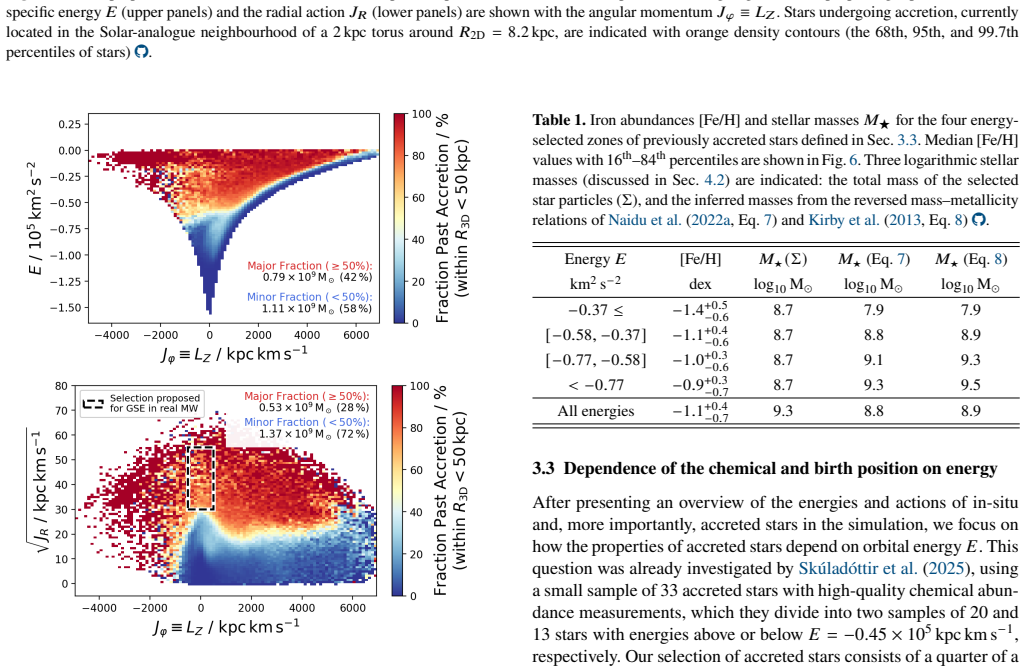
- [Sec. 3.3.1, Fig. 6] Sec. 3.3.1 states that in the highest-energy zone, comparing the overall past-accretion selection with stars following the golden thread yields contamination of up to 50% from other accretion events. This zone is precisely the metal-poor, high-energy leg of the trend in Fig. 6. Since small disrupting dwarfs are themselves metal-poor and on high-energy orbits, the energy-metallicity gradient could be partly produced or steepened by contamination. The paper does not report a contamination-corrected or golden-thread-only gradient. Because the clean sample is already constructed via Table A1, the analysis should be repeated on that sample and the sensitivity quantified before the correlation is presented as a property of the last major merger.
- [Sec. 3.1, Eq. (5)] The past-accretion selection in Eq. (5) uses R_birth,3D > 50 kpc or |z_birth| > 5 kpc together with E < 0. These thresholds are hand-tuned and are not restricted to the major merger; the paper's conclusions about 'the progenitor' assume that this sample is dominated by the GSE analogue. The authors validate broad purity (95% unbound for ongoing, 99% bound for past) but do not quantify contamination of the energy-quartile analysis by the other mergers visible in Fig. 1b. This matters because the energy quartiles are defined over this mixed sample. A quantitative decomposition by progenitor (golden-thread vs. others) should be provided, or the text should be reworded to refer to 'the accreted population' rather than 'the progenitor' where the mixed selection is used.
minor comments (4)
- [Throughout] Stray '/gtb' tokens appear in several figure captions and text passages (e.g. 'See/gtbfor individual figures', 'Table A1/gtb'). These proofing artifacts should be removed.
- [Sec. 3.1, Eq. (4)] The units in Eq. (4) are inconsistent: energy thresholds are given in 'kpc km s−1' while Eq. (3) and Table 1 use 'km^2 s^-2' (e.g. −0.58×10^5 kpc km s−1 vs. −0.58×10^5 km^2 s^-2). Please make units consistent throughout.
- [Sec. 2.1] Typo: 'build-tin tools' should be 'built-in tools'.
- [References / Sec. 5] The references to Naidu et al. (2022a) and (2022b) are used inconsistently; the text should clearly distinguish the arXiv paper from the ApJ paper and use consistent citation labels.
Circularity Check
No significant circularity: the simulation-based correlations are not forced by the selection or by self-citation.
full rationale
The paper's central claims—that accreted stars born in the progenitor's core are more tightly bound and more metal-rich, while those from the outskirts are less bound and more metal-poor—are empirical results from a cosmological zoom-in simulation with independent birth-position tracing. The 'past accretion' selection (Eq. 5) uses birth-radius thresholds (R_birth,3D > 50 kpc or |z_birth| > 5 kpc) to separate accreted from in-situ stars, but this binary classification does not by construction impose the continuous [Fe/H]-versus-energy trend seen in Fig. 6 or the energy-birth-radius correlation in Fig. 9. The 'golden thread' clean sample (Table A1) is selected by spatial and age boxes, not by metallicity or energy, so its use to illustrate the chemodynamical memory is not definitional. The scenario of Skúladóttir et al. (2025) is an external observational hypothesis being tested, not a fitted input; the self-citation is not load-bearing because the simulation results stand independently. The abstract's quantitative gradient d[Fe/H]/dR_birth' ≈ -0.05 dex/kpc is not derived in the body, but an omitted derivation is a support problem, not circularity. The acknowledged up-to-50% contamination in the highest-energy zone (Sec. 3.3.1) is a validity caveat about selection completeness, not a tautology: the contamination weakens but does not reduce the claim to its inputs. Overall, no step in the derivation chain is equivalent to its inputs by construction.
Assumptions & free parameters
free parameters (3)
- Birth-radius and height thresholds in past-accretion selection (Eq. 5) =
R_birth,3D > 50 kpc; |z_birth| > 5 kpc
- Ongoing-accretion criteria (Eq. 4) =
R3D>50 kpc or E>0 or (age<10 Gyr and [Fe/H]<-1)
- Energy quartile boundaries =
-0.37, -0.58, -0.77 10^5 km^2 s^-2
assumptions (5)
- domain assumption NIHAO-UHD sub-grid physics (star formation, feedback, turbulent diffusion) and Chempy enrichment with adopted yields reproduce the relevant chemodynamical trends.
- domain assumption Birth positions traced at 100 Myr cadence capture each star's formation site.
- domain assumption Simulation g8.26e11 is a representative analogue for the Milky Way's last major merger.
- domain assumption Stäckel fudge action finder (agama) provides adequate integrals of motion.
- domain assumption The 50 kpc boundary separates the main galaxy from infalling satellites.
Cite this review
Pith. "Pith review of The chemodynamical memory of a major merger in a NIHAO-UHD Milky Way analogue -- I. A golden thread through time and space." pith.science (2026). https://pith.science/paper/4S4CSL7A
@misc{pith2026251011284,
  author       = {Pith},
  title        = {Pith review of: The chemodynamical memory of a major merger in a NIHAO-UHD Milky Way analogue -- I. A golden thread through time and space},
  year         = {2026},
  howpublished = {\url{https://pith.science/paper/4S4CSL7A}},
  note         = {Machine review of arXiv:2510.11284}
}
abstract
Understanding how past major mergers shaped the Milky Way's present-day structure is a key goal of Galactic archaeology. The Galaxy's chemical and dynamical structure retains the imprint of such events, including a major accretion episode around 8-10 Gyr ago. Recent findings suggest that present-day orbital energy correlates with stellar chemistry and birth location within the merging progenitor galaxy. Using a high-resolution NIHAO-UHD cosmological zoom-in simulation of a Milky Way analogue, we trace the birth positions, ages, and present-day orbits of stars accreted in its last major merger. We show that stars born in the progenitor's core are more tightly bound to the Milky Way and more chemically enriched, while those from the outskirts are less bound and more metal-poor. This supports the Sk\'ulad\'ottir et al. (2025) scenario that accreted progenitor stars of different chemistry were deposited onto different orbital energies as the galaxy was stripped from the outside in, now in a cosmological context. Quantitatively, we measure a metallicity gradient with progenitor birth radius of $\mathrm{d[Fe/H]}/\mathrm{d}R_\mathrm{birth}^\prime \approx -0.05\,\mathrm{dex\,kpc^{-1}}$, demonstrating that abundance patterns retain measurable memory of formation location within the disrupted satellite. This chemodynamical memory is also evident in elemental planes such as [Al/Fe] vs. [Mg/Mn], consistent with gradients in progenitor star formation efficiency. We further show that common integrals-of-motion selections systematically miss stars from the chemically enriched core, biasing reconstructions toward the metal-poor outskirts. Together, our results demonstrate that chemodynamical memory survives the merger and can reconstruct the accreted galaxy's internal structure, while highlighting biases in current selections of accreted stars.
Figures


Figures from the paper (9 more)



Forward citations
Cited by 1 Pith paper
-
The chemodynamical memory of a major merger in a NIHAO-UHD Milky Way analogue -- II. Were Splash stars heated or already born hot?
In a NIHAO-UHD Milky Way analogue, Splash-like stars were already born on dynamically hot orbits; the last major merger did not significantly heat them.
Reference graph
Works this paper leans on
-
[1]
Abdurro'uf et al., 2022, @doi [ ] 10.3847/1538-4365/ac4414 , https://ui.adsabs.harvard.edu/abs/2022ApJS..259...35A 259, 35
-
[2]
Aguado D. S., et al., 2021, @doi [ ] 10.3847/2041-8213/abdbb8 , https://ui.adsabs.harvard.edu/abs/2021ApJ...908L...8A 908, L8
-
[3]
Arentsen A., et al., 2020a, @doi [ ] 10.1093/mnrasl/slz156 , https://ui.adsabs.harvard.edu/abs/2020MNRAS.491L..11A 491, L11
-
[4]
Arentsen A., et al., 2020b, @doi [ ] 10.1093/mnras/staa1661 , https://ui.adsabs.harvard.edu/abs/2020MNRAS.496.4964A 496, 4964
-
[5]
Asplund M., Grevesse N., Sauval A. J., Scott P., 2009, @doi [ ] 10.1146/annurev.astro.46.060407.145222 , http://adsabs.harvard.edu/abs/2009ARA
arXiv 2009
-
[6]
Astropy Collaboration et al., 2013, @doi [ ] 10.1051/0004-6361/201322068 , http://adsabs.harvard.edu/abs/2013A
-
[7]
Astropy Collaboration et al., 2018, @doi [ ] 10.3847/1538-3881/aabc4f , https://ui.adsabs.harvard.edu/abs/2018AJ....156..123A 156, 123
-
[8]
Barbuy B., Chiappini C., Gerhard O., 2018, @doi [ ] 10.1146/annurev-astro-081817-051826 , https://ui.adsabs.harvard.edu/abs/2018ARA&A..56..223B 56, 223
Show all 118 references
-
[9]
Belokurov V., Kravtsov A., 2022, @doi [ ] 10.1093/mnras/stac1267 , https://ui.adsabs.harvard.edu/abs/2022MNRAS.514..689B 514, 689
2022 doi
-
[10]
Belokurov V., et al., 2006, @doi [ ] 10.1086/504797 , http://adsabs.harvard.edu/abs/2006ApJ...642L.137B 642, L137
2006 doi
-
[11]
W., Koposov S
Belokurov V., Erkal D., Evans N. W., Koposov S. E., Deason A. J., 2018, @doi [ ] 10.1093/mnras/sty982 , https://ui.adsabs.harvard.edu/abs/2018MNRAS.478..611B 478, 611
2018 doi
-
[12]
L., Fattahi A., Smith M
Belokurov V., Sanders J. L., Fattahi A., Smith M. C., Deason A. J., Evans N. W., Grand R. J. J., 2020, @doi [ ] 10.1093/mnras/staa876 , https://ui.adsabs.harvard.edu/abs/2020MNRAS.494.3880B 494, 3880
2020 doi
-
[13]
S., 2014, @doi [ ] 10.1051/0004-6361/201322631 , http://adsabs.harvard.edu/abs/2014A
Bensby T., Feltzing S., Oey M. S., 2014, @doi [ ] 10.1051/0004-6361/201322631 , http://adsabs.harvard.edu/abs/2014A
2014 doi
-
[14]
Bensby T., et al., 2017, @doi [ ] 10.1051/0004-6361/201730560 , http://adsabs.harvard.edu/abs/2017A
2017 doi
-
[15]
Bensby T., et al., 2019, @doi [The Messenger] 10.18727/0722-6691/5123 , https://ui.adsabs.harvard.edu/abs/2019Msngr.175...35B 175, 35
2019 doi
-
[16]
Binney J., 2012, @doi [ ] 10.1111/j.1365-2966.2012.21757.x , http://adsabs.harvard.edu/abs/2012MNRAS.426.1324B 426, 1324
2012
-
[17]
C., Kazantzidis S., Weinberg D
Bird J. C., Kazantzidis S., Weinberg D. H., Guedes J., Callegari S., Mayer L., Madau P., 2013, @doi [ ] 10.1088/0004-637X/773/1/43 , http://adsabs.harvard.edu/abs/2013ApJ...773...43B 773, 43
2013 doi
-
[18]
Bland-Hawthorn J., Gerhard O., 2016, @doi [ ] 10.1146/annurev-astro-081915-023441 , http://adsabs.harvard.edu/abs/2016ARA
2016 doi
-
[19]
B., Kawata D., Gibson B
Brook C. B., Kawata D., Gibson B. K., Freeman K. C., 2004, @doi [ ] 10.1086/422709 , https://ui.adsabs.harvard.edu/abs/2004ApJ...612..894B 612, 894
2004 doi
-
[20]
Brown A. G. A., 2021, @doi [ ] 10.1146/annurev-astro-112320-035628 , https://ui.adsabs.harvard.edu/abs/2021ARA&A..59...59B 59, 59
2021 doi
-
[21]
Buck T., 2020, @doi [ ] 10.1093/mnras/stz3289 , https://ui.adsabs.harvard.edu/abs/2020MNRAS.491.5435B 491, 5435
2020 doi
-
[22]
V., Dutton A
Buck T., Macci \`o A. V., Dutton A. A., Obreja A., Frings J., 2019, @doi [ ] 10.1093/mnras/sty2913 , https://ui.adsabs.harvard.edu/abs/2019MNRAS.483.1314B 483, 1314
2019 doi
-
[23]
V., Minchev I., Dutton A
Buck T., Obreja A., Macci \`o A. V., Minchev I., Dutton A. A., Ostriker J. P., 2020, @doi [ ] 10.1093/mnras/stz3241 , https://ui.adsabs.harvard.edu/abs/2020MNRAS.491.3461B 491, 3461
2020 doi
-
[24]
V., Pfrommer C., Steinmetz M., Ness M., 2021, @doi [ ] 10.1093/mnras/stab2736 , https://ui.adsabs.harvard.edu/abs/2021MNRAS.508.3365B 508, 3365
Buck T., Rybizki J., Buder S., Obreja A., Macci \`o A. V., Pfrommer C., Steinmetz M., Ness M., 2021, @doi [ ] 10.1093/mnras/stab2736 , https://ui.adsabs.harvard.edu/abs/2021MNRAS.508.3365B 508, 3365
2021 doi
-
[25]
V., 2023, @doi [ ] 10.1093/mnras/stad1503 , https://ui.adsabs.harvard.edu/abs/2023MNRAS.523.1565B 523, 1565
Buck T., Obreja A., Ratcliffe B., Lu Y., Minchev I., Macci \`o A. V., 2023, @doi [ ] 10.1093/mnras/stad1503 , https://ui.adsabs.harvard.edu/abs/2023MNRAS.523.1565B 523, 1565
2023 doi
-
[26]
H., Buder S., 2025, @doi [arXiv e-prints] 10.48550/arXiv.2503.02456 , https://ui.adsabs.harvard.edu/abs/2025arXiv250302456B p
Buck T., G \"u nes B., Viterbo G., Oliver W. H., Buder S., 2025, @doi [arXiv e-prints] 10.48550/arXiv.2503.02456 , https://ui.adsabs.harvard.edu/abs/2025arXiv250302456B p. arXiv:2503.02456
2025 doi
-
[27]
Buder S., et al., 2022, @doi [ ] 10.1093/mnras/stab3504 , https://ui.adsabs.harvard.edu/abs/2022MNRAS.510.2407B 510, 2407
2022 doi
-
[28]
Buder S., Mijnarends L., Buck T., 2024, @doi [ ] 10.1093/mnras/stae1552 , https://ui.adsabs.harvard.edu/abs/2024MNRAS.532.1010B 532, 1010
2024 doi
-
[29]
Buder S., Buck T., Chen Q.-H., Grasha K., 2025, @doi [ ] 10.33232/001c.137295 , https://ui.adsabs.harvard.edu/abs/2025OJAp....8E..47B 8, 47
2025 doi
-
[30]
J., Katz H., Rey M
Cameron A. J., Katz H., Rey M. P., Saxena A., 2023, @doi [ ] 10.1093/mnras/stad1579 , https://ui.adsabs.harvard.edu/abs/2023MNRAS.523.3516C 523, 3516
2023 doi
-
[31]
J., Fattahi A., Callingham T
Carrillo A., Deason A. J., Fattahi A., Callingham T. M., Grand R. J. J., 2024, @doi [ ] 10.1093/mnras/stad3274 , https://ui.adsabs.harvard.edu/abs/2024MNRAS.527.2165C 527, 2165
2024 doi
-
[32]
Chabrier G., 2003, @doi [ ] 10.1086/376392 , https://ui.adsabs.harvard.edu/abs/2003PASP..115..763C 115, 763
2003 doi
-
[33]
Chiappini C., Matteucci F., Gratton R., 1997, @doi [ ] 10.1086/303726 , http://adsabs.harvard.edu/abs/1997ApJ...477..765C 477, 765
1997 doi
-
[34]
Chiappini C., et al., 2019, @doi [The Messenger] 10.18727/0722-6691/5122 , https://ui.adsabs.harvard.edu/abs/2019Msngr.175...30C 175, 30
2019 doi
-
[35]
Chieffi A., Limongi M., 2004, @doi [ ] 10.1086/392523 , 608, 405
2004 doi
-
[36]
P., Zaritsky D., Bonaca A., Cargile P., Johnson B
Conroy C., Naidu R. P., Zaritsky D., Bonaca A., Cargile P., Johnson B. D., Caldwell N., 2019, @doi [ ] 10.3847/1538-4357/ab5710 , https://ui.adsabs.harvard.edu/abs/2019ApJ...887..237C 887, 237
2019 doi
-
[37]
S., et al., 2019, @doi [ ] 10.1093/mnras/stz2550 , https://ui.adsabs.harvard.edu/abs/2019MNRAS.489.5900D 489, 5900
Da Costa G. S., et al., 2019, @doi [ ] 10.1093/mnras/stz2550 , https://ui.adsabs.harvard.edu/abs/2019MNRAS.489.5900D 489, 5900
2019 doi
-
[38]
Das P., Hawkins K., Jofr \'e P., 2020, @doi [ ] 10.1093/mnras/stz3537 , https://ui.adsabs.harvard.edu/abs/2020MNRAS.493.5195D 493, 5195
2020 doi
- [39]
-
[40]
M., Helmi A., Matsuno T., Ruiz-Lara T., Balbinot E., L \"o vdal S., 2023, @doi [ ] 10.1051/0004-6361/202244546 , https://ui.adsabs.harvard.edu/abs/2023A&A...670L...2D 670, L2
Dodd E., Callingham T. M., Helmi A., Matsuno T., Ruiz-Lara T., Balbinot E., L \"o vdal S., 2023, @doi [ ] 10.1051/0004-6361/202244546 , https://ui.adsabs.harvard.edu/abs/2023A&A...670L...2D 670, L2
2023 doi
-
[41]
arXiv:2509.06773
Ernandes H., Sk \'u lad \'o ttir \'A ., Feltzing S., Feuillet D., 2025, arXiv e-prints, https://ui.adsabs.harvard.edu/abs/2025arXiv250906773E p. arXiv:2509.06773
2025
-
[42]
K., Frankel N., Lind K., Frinchaboy P
Feuillet D. K., Frankel N., Lind K., Frinchaboy P. M., Garc \' a-Hern \'a ndez D. A., Lane R. R., Nitschelm C., Roman-Lopes A. r., 2019, @doi [ ] 10.1093/mnras/stz2221 , https://ui.adsabs.harvard.edu/abs/2019MNRAS.489.1742F 489, 1742
2019 doi
-
[43]
K., Feltzing S., Sahlholdt C
Feuillet D. K., Feltzing S., Sahlholdt C. L., Casagrande L., 2020, @doi [ ] 10.1093/mnras/staa1888 , https://ui.adsabs.harvard.edu/abs/2020MNRAS.497..109F 497, 109
2020 doi
-
[44]
K., Sahlholdt C
Feuillet D. K., Sahlholdt C. L., Feltzing S., Casagrande L., 2021, @doi [ ] 10.1093/mnras/stab2614 , https://ui.adsabs.harvard.edu/abs/2021MNRAS.508.1489F 508, 1489
2021 doi
-
[45]
Freeman K., Bland-Hawthorn J., 2002, @doi [ ] 10.1146/annurev.astro.40.060401.093840 , http://adsabs.harvard.edu/abs/2002ARA
2002
-
[46]
Gaia Collaboration et al., 2016, @doi [ ] 10.1051/0004-6361/201629512 , http://adsabs.harvard.edu/abs/2016A
2016 doi
-
[47]
Gaia Collaboration et al., 2018, @doi [ ] 10.1051/0004-6361/201833051 , http://adsabs.harvard.edu/abs/2018A
2018 doi
-
[48]
Gallazzi A., Charlot S., Brinchmann J., White S. D. M., Tremonti C. A., 2005, @doi [ ] 10.1111/j.1365-2966.2005.09321.x , https://ui.adsabs.harvard.edu/abs/2005MNRAS.362...41G 362, 41
2005
-
[49]
Gilmore G., Reid N., 1983, @doi [ ] 10.1093/mnras/202.4.1025 , http://adsabs.harvard.edu/abs/1983MNRAS.202.1025G 202, 1025
1983 doi
-
[50]
Grand R. J. J., et al., 2018, @doi [ ] 10.1093/mnras/stx3025 , http://adsabs.harvard.edu/abs/2018MNRAS.474.3629G 474, 3629
2018 doi
- [51]
-
[52]
Hawkins K., Jofr \'e P., Masseron T., Gilmore G., 2015, @doi [ ] 10.1093/mnras/stv1586 , http://adsabs.harvard.edu/abs/2015MNRAS.453..758H 453, 758
2015 doi
-
[53]
R., et al., 2015, @doi [ ] 10.1088/0004-637X/808/2/132 , http://adsabs.harvard.edu/abs/2015ApJ...808..132H 808, 132
Hayden M. R., et al., 2015, @doi [ ] 10.1088/0004-637X/808/2/132 , http://adsabs.harvard.edu/abs/2015ApJ...808..132H 808, 132
2015 doi
-
[54]
Helmi A., 2020, @doi [ ] 10.1146/annurev-astro-032620-021917 , https://ui.adsabs.harvard.edu/abs/2020ARA&A..58..205H 58, 205
2020 doi
-
[55]
H., Massari D., Veljanoski J., Brown A
Helmi A., Babusiaux C., Koppelman H. H., Massari D., Veljanoski J., Brown A. G. A., 2018, @doi [ ] 10.1038/s41586-018-0625-x , http://adsabs.harvard.edu/abs/2018Natur.563...85H 563, 85
2018 doi
-
[56]
Horta D., et al., 2021, @doi [ ] 10.1093/mnras/staa2987 , https://ui.adsabs.harvard.edu/abs/2021MNRAS.500.1385H 500, 1385
2021 doi
-
[57]
D., 2007, @doi [Comput Sci Eng] 10.1109/MCSE.2007.55 , 9, 90
Hunter J. D., 2007, @doi [Comput Sci Eng] 10.1109/MCSE.2007.55 , 9, 90
2007 doi
-
[58]
arXiv:2505.12505
Ji X., Belokurov V., Maiolino R., Monty S., Isobe Y., Kravtsov A., McClymont W., \"U bler H., 2025, @doi [arXiv e-prints] 10.48550/arXiv.2505.12505 , https://ui.adsabs.harvard.edu/abs/2025arXiv250512505J p. arXiv:2505.12505
2025 doi
-
[59]
I., Lugaro M., 2016, @doi [ApJ] 10.3847/0004-637X/825/1/26 , 825, 26
Karakas A. I., Lugaro M., 2016, @doi [ApJ] 10.3847/0004-637X/825/1/26 , 825, 26
2016 doi
-
[60]
Katz D., et al., 2023, @doi [ ] 10.1051/0004-6361/202244220 , https://ui.adsabs.harvard.edu/abs/2023A&A...674A...5K 674, A5
2023 doi
-
[61]
N., Cohen J
Kirby E. N., Cohen J. G., Guhathakurta P., Cheng L., Bullock J. S., Gallazzi A., 2013, @doi [ ] 10.1088/0004-637X/779/2/102 , https://ui.adsabs.harvard.edu/abs/2013ApJ...779..102K 779, 102
2013 doi
-
[62]
R., Knebe A., 2009, @doi [ ] 10.1088/0067-0049/182/2/608 , https://ui.adsabs.harvard.edu/abs/2009ApJS..182..608K 182, 608
Knollmann S. R., Knebe A., 2009, @doi [ ] 10.1088/0067-0049/182/2/608 , https://ui.adsabs.harvard.edu/abs/2009ApJS..182..608K 182, 608
2009 doi
-
[63]
H., Helmi A., Massari D., Price-Whelan A
Koppelman H. H., Helmi A., Massari D., Price-Whelan A. M., Starkenburg T. K., 2019, @doi [ ] 10.1051/0004-6361/201936738 , https://ui.adsabs.harvard.edu/abs/2019A&A...631L...9K 631, L9
2019 doi
-
[64]
Kunder A., et al., 2025, @doi [ ] 10.3847/1538-3881/adefdd , https://ui.adsabs.harvard.edu/abs/2025AJ....170..173K 170, 173
2025 doi
-
[65]
Lucey M., et al., 2019, @doi [ ] 10.1093/mnras/stz1847 , https://ui.adsabs.harvard.edu/abs/2019MNRAS.488.2283L 488, 2283
2019 doi
-
[66]
Lucey M., et al., 2022, @doi [ ] 10.1093/mnras/stab2878 , https://ui.adsabs.harvard.edu/abs/2022MNRAS.509..122L 509, 122
2022 doi
-
[67]
F., et al., 2024, @doi [ ] 10.1051/0004-6361/202347633 , https://ui.adsabs.harvard.edu/abs/2024A&A...692A.115M 692, A115
Martin N. F., et al., 2024, @doi [ ] 10.1051/0004-6361/202347633 , https://ui.adsabs.harvard.edu/abs/2024A&A...692A.115M 692, A115
2024 doi
-
[68]
Matsuno T., Hirai Y., Tarumi Y., Hotokezaka K., Tanaka M., Helmi A., 2021, @doi [ ] 10.1051/0004-6361/202040227 , https://ui.adsabs.harvard.edu/abs/2021A&A...650A.110M 650, A110
2021 doi
-
[69]
Minchev I., Chiappini C., Martig M., 2013, @doi [ ] 10.1051/0004-6361/201220189 , https://ui.adsabs.harvard.edu/abs/2013A&A...558A...9M 558, A9
2013 doi
-
[70]
Monty S., et al., 2024, @doi [ ] 10.1093/mnras/stae1895 , https://ui.adsabs.harvard.edu/abs/2024MNRAS.533.2420M 533, 2420
2024 doi
-
[71]
Mori A., Di Matteo P., Salvadori S., Khoperskov S., Pagnini G., Haywood M., 2024, @doi [ ] 10.1051/0004-6361/202449291 , https://ui.adsabs.harvard.edu/abs/2024A&A...690A.136M 690, A136
2024 doi
-
[72]
C., Evans N
Myeong G. C., Evans N. W., Belokurov V., Amorisco N. C., Koposov S. E., 2018, @doi [ ] 10.1093/mnras/stx3262 , https://ui.adsabs.harvard.edu/abs/2018MNRAS.475.1537M 475, 1537
2018 doi
-
[73]
C., Vasiliev E., Iorio G., Evans N
Myeong G. C., Vasiliev E., Iorio G., Evans N. W., Belokurov V., 2019, @doi [ ] 10.1093/mnras/stz1770 , https://ui.adsabs.harvard.edu/abs/2019MNRAS.488.1235M 488, 1235
2019 doi
-
[74]
P., Conroy C., Bonaca A., Johnson B
Naidu R. P., Conroy C., Bonaca A., Johnson B. D., Ting Y.-S., Caldwell N., Zaritsky D., Cargile P. A., 2020, @doi [ ] 10.3847/1538-4357/abaef4 , https://ui.adsabs.harvard.edu/abs/2020ApJ...901...48N 901, 48
2020 doi
-
[75]
P., et al., 2021, @doi [ ] 10.3847/1538-4357/ac2d2d , https://ui.adsabs.harvard.edu/abs/2021ApJ...923...92N 923, 92
Naidu R. P., et al., 2021, @doi [ ] 10.3847/1538-4357/ac2d2d , https://ui.adsabs.harvard.edu/abs/2021ApJ...923...92N 923, 92
2021 doi
-
[76]
P., et al., 2022a, arXiv e-prints, https://ui.adsabs.harvard.edu/abs/2022arXiv220409057N p
Naidu R. P., et al., 2022a, arXiv e-prints, https://ui.adsabs.harvard.edu/abs/2022arXiv220409057N p. arXiv:2204.09057
-
[77]
P., et al., 2022b, @doi [ ] 10.3847/2041-8213/ac5589 , https://ui.adsabs.harvard.edu/abs/2022ApJ...926L..36N 926, L36
Naidu R. P., et al., 2022b, @doi [ ] 10.3847/2041-8213/ac5589 , https://ui.adsabs.harvard.edu/abs/2022ApJ...926L..36N 926, L36
-
[78]
Ness M., et al., 2013a, @doi [ ] 10.1093/mnras/sts629 , http://adsabs.harvard.edu/abs/2013MNRAS.430..836N 430, 836
-
[79]
Ness M., et al., 2013b, @doi [ ] 10.1093/mnras/stt533 , http://adsabs.harvard.edu/abs/2013MNRAS.432.2092N 432, 2092
-
[80]
E., Schuster W
Nissen P. E., Schuster W. J., 2010, @doi [ ] 10.1051/0004-6361/200913877 , http://adsabs.harvard.edu/abs/2010A
2010 doi
-
[81]
E., Amarsi A
Nissen P. E., Amarsi A. M., Sk \'u lad \'o ttir \'A ., Schuster W. J., 2024, @doi [ ] 10.1051/0004-6361/202348392 , https://ui.adsabs.harvard.edu/abs/2024A&A...682A.116N 682, A116
2024 doi
-
[82]
V., 2022, @doi [ ] 10.1051/0004-6361/202140983 , https://ui.adsabs.harvard.edu/abs/2022A&A...657A..15O 657, A15
Obreja A., Buck T., Macci \`o A. V., 2022, @doi [ ] 10.1051/0004-6361/202140983 , https://ui.adsabs.harvard.edu/abs/2022A&A...657A..15O 657, A15
2022 doi
-
[83]
Orkney M. D. A., Laporte C. F. P., Grand R. J. J., Springel V., 2025, @doi [arXiv e-prints] 10.48550/arXiv.2506.07038 , https://ui.adsabs.harvard.edu/abs/2025arXiv250607038O p. arXiv:2506.07038
2025 doi
-
[84]
P., Frebel A., Naidu R
Ou X., Ji A. P., Frebel A., Naidu R. P., Limberg G., 2024, @doi [ ] 10.3847/1538-4357/ad6f9b , https://ui.adsabs.harvard.edu/abs/2024ApJ...974..232O 974, 232
2024 doi
- [85]
-
[86]
E., 2007, @doi [Comput Sci Eng] 10.1109/MCSE.2007.53 , 9, 21
P\'erez F., Granger B. E., 2007, @doi [Comput Sci Eng] 10.1109/MCSE.2007.53 , 9, 21
2007 doi
-
[87]
Planck Collaboration et al., 2014, @doi [ ] 10.1051/0004-6361/201321591 , https://ui.adsabs.harvard.edu/abs/2014A&A...571A..16P 571, A16
2014 doi
-
[88]
S., Woods R., 2013, pynbody: Astrophysics Simulation Analysis for Python , Astrophysics Source Code Library, record ascl:1305.002
Pontzen A., Ro s kar R., Stinson G. S., Woods R., 2013, pynbody: Astrophysics Simulation Analysis for Python , Astrophysics Source Code Library, record ascl:1305.002
2013
-
[89]
Portail M., Wegg C., Gerhard O., Ness M., 2017, @doi [ ] 10.1093/mnras/stx1293 , https://ui.adsabs.harvard.edu/abs/2017MNRAS.470.1233P 470, 1233
2017 doi
-
[90]
Queiroz A. B. A., et al., 2023, @doi [ ] 10.1051/0004-6361/202245399 , https://ui.adsabs.harvard.edu/abs/2023A&A...673A.155Q 673, A155
2023 doi
-
[91]
L., Ness M
Ratcliffe B. L., Ness M. K., Buck T., Johnston K. V., Sen B., Beraldo e Silva L., Debattista V. P., 2022, @doi [ ] 10.3847/1538-4357/ac3481 , https://ui.adsabs.harvard.edu/abs/2022ApJ...924...60R 924, 60
2022 doi
-
[92]
Ratcliffe B., et al., 2025, @doi [ ] 10.1051/0004-6361/202452658 , https://ui.adsabs.harvard.edu/abs/2025A&A...698A.267R 698, A267
2025 doi
-
[93]
Rybizki J., Just A., Rix H.-W., 2017, @doi [ ] 10.1051/0004-6361/201730522 , http://adsabs.harvard.edu/abs/2017A
2017 doi
-
[94]
L., Binney J., 2015, @doi [ ] 10.1093/mnras/stu2598 , https://ui.adsabs.harvard.edu/abs/2015MNRAS.447.2479S 447, 2479
Sanders J. L., Binney J., 2015, @doi [ ] 10.1093/mnras/stu2598 , https://ui.adsabs.harvard.edu/abs/2015MNRAS.447.2479S 447, 2479
2015 doi
-
[95]
A., et al., 2021, @doi [ ] 10.3847/1538-3881/ac2cbc , https://ui.adsabs.harvard.edu/abs/2021AJ....162..303S 162, 303
Santana F. A., et al., 2021, @doi [ ] 10.3847/1538-3881/ac2cbc , https://ui.adsabs.harvard.edu/abs/2021AJ....162..303S 162, 303
2021 doi
-
[96]
Sch \"o nrich R., Binney J., 2009, @doi [ ] 10.1111/j.1365-2966.2009.15365.x , http://adsabs.harvard.edu/abs/2009MNRAS.399.1145S 399, 1145
2009
-
[97]
R., et al., 2013, @doi [ ] 10.1093/mnras/sts402 , http://adsabs.harvard.edu/abs/2013MNRAS.429.1156S 429, 1156
Seitenzahl I. R., et al., 2013, @doi [ ] 10.1093/mnras/sts402 , http://adsabs.harvard.edu/abs/2013MNRAS.429.1156S 429, 1156
2013 doi
-
[98]
P., Rudie G
Senchyna P., Plat A., Stark D. P., Rudie G. C., Berg D., Charlot S., James B. L., Mingozzi M., 2024, @doi [ ] 10.3847/1538-4357/ad235e , https://ui.adsabs.harvard.edu/abs/2024ApJ...966...92S 966, 92
2024 doi
-
[99]
Sestito F., et al., 2021, @doi [ ] 10.1093/mnras/staa3479 , https://ui.adsabs.harvard.edu/abs/2021MNRAS.500.3750S 500, 3750
2021 doi
-
[100]
R., Bland-Hawthorn J., 2021, @doi [ ] 10.1093/mnras/stab2015 , https://ui.adsabs.harvard.edu/abs/2021MNRAS.507.5882S 507, 5882
Sharma S., Hayden M. R., Bland-Hawthorn J., 2021, @doi [ ] 10.1093/mnras/stab2015 , https://ui.adsabs.harvard.edu/abs/2021MNRAS.507.5882S 507, 5882
2021 doi
-
[101]
K., Mori A., Feltzing S., Lucchesi R
Sk \'u lad \'o ttir \'A ., Ernandes H., Feuillet D. K., Mori A., Feltzing S., Lucchesi R. E. R., Di Matteo P., 2025, @doi [ ] 10.3847/2041-8213/addc66 , https://ui.adsabs.harvard.edu/abs/2025ApJ...986L..21S 986, L21
2025 doi
-
[102]
D., Combes F., Katz D., G \'o mez A., 2015, @doi [ ] 10.1051/0004-6361/201424281 , https://ui.adsabs.harvard.edu/abs/2015A&A...578A..87S 578, A87
Snaith O., Haywood M., Di Matteo P., Lehnert M. D., Combes F., Katz D., G \'o mez A., 2015, @doi [ ] 10.1051/0004-6361/201424281 , https://ui.adsabs.harvard.edu/abs/2015A&A...578A..87S 578, A87
2015 doi
-
[103]
R., 2010, @doi [ ] 10.1146/annurev-astro-081309-130806 , http://adsabs.harvard.edu/abs/2010ARA
Soderblom D. R., 2010, @doi [ ] 10.1146/annurev-astro-081309-130806 , http://adsabs.harvard.edu/abs/2010ARA
2010 doi
-
[104]
Spitoni E., Silva Aguirre V., Matteucci F., Calura F., Grisoni V., 2019, @doi [ ] 10.1051/0004-6361/201834188 , https://ui.adsabs.harvard.edu/abs/2019A&A...623A..60S 623, A60
2019 doi
-
[105]
Starkenburg E., et al., 2017, @doi [ ] 10.1093/mnras/stx1068 , http://adsabs.harvard.edu/abs/2017MNRAS.471.2587S 471, 2587
2017 doi
-
[106]
Stinson G., Seth A., Katz N., Wadsley J., Governato F., Quinn T., 2006, @doi [ ] 10.1111/j.1365-2966.2006.11097.x , https://ui.adsabs.harvard.edu/abs/2006MNRAS.373.1074S 373, 1074
2006
-
[107]
S., Brook C., Macci \`o A
Stinson G. S., Brook C., Macci \`o A. V., Wadsley J., Quinn T. R., Couchman H. M. P., 2013, @doi [ ] 10.1093/mnras/sts028 , https://ui.adsabs.harvard.edu/abs/2013MNRAS.428..129S 428, 129
2013 doi
-
[108]
B., 2005, ASPC, http://adsabs.harvard.edu/abs/2005ASPC..347...29T 347, 29
Taylor M. B., 2005, ASPC, http://adsabs.harvard.edu/abs/2005ASPC..347...29T 347, 29
2005
-
[109]
H., Coronado J., Rix H.-W., 2019, @doi [ ] 10.1093/mnras/stz209 , http://adsabs.harvard.edu/abs/2019MNRAS.484.3291T 484, 3291
Trick W. H., Coronado J., Rix H.-W., 2019, @doi [ ] 10.1093/mnras/stz209 , http://adsabs.harvard.edu/abs/2019MNRAS.484.3291T 484, 3291
2019 doi
-
[110]
Vasiliev E., 2019, @doi [ ] 10.1093/mnras/sty2672 , https://ui.adsabs.harvard.edu/abs/2019MNRAS.482.1525V 482, 1525
2019 doi
-
[111]
Virtanen P., et al., 2020, @doi [Nature Methods] 10.1038/s41592-019-0686-2 , https://rdcu.be/b08Wh 17, 261
2020 doi
-
[112]
W., Keller B
Wadsley J. W., Keller B. W., Quinn T. R., 2017, @doi [ ] 10.1093/mnras/stx1643 , https://ui.adsabs.harvard.edu/abs/2017MNRAS.471.2357W 471, 2357
2017 doi
-
[113]
Walt S. v. d., Colbert S. C., Varoquaux G., 2011, @doi [Comput Sci Eng] 10.1109/MCSE.2011.37 , 13, 22
2011 doi
-
[114]
A., Stinson G
Wang L., Dutton A. A., Stinson G. S., Macci \`o A. V., Penzo C., Kang X., Keller B. W., Wadsley J., 2015, @doi [ ] 10.1093/mnras/stv1937 , http://adsabs.harvard.edu/abs/2015MNRAS.454...83W 454, 83
2015 doi
-
[115]
Yoshii Y., 1982, , http://adsabs.harvard.edu/abs/1982PASJ...34..365Y 34, 365
1982
-
[116]
Yuan Z., et al., 2020, @doi [ ] 10.3847/1538-4357/ab6ef7 , https://ui.adsabs.harvard.edu/abs/2020ApJ...891...39Y 891, 39
2020 doi
-
[117]
R., Smiljanic R., 2023, @doi [ ] 10.1051/0004-6361/202347229 , https://ui.adsabs.harvard.edu/abs/2023A&A...677A..74D 677, A74
da Silva A. R., Smiljanic R., 2023, @doi [ ] 10.1051/0004-6361/202347229 , https://ui.adsabs.harvard.edu/abs/2023A&A...677A..74D 677, A74
2023 doi
-
[118]
write newline
" write newline "" before.all 'output.state := FUNCTION fin.entry write newline FUNCTION new.block output.state before.all = 'skip after.block 'output.state := if FUNCTION new.sentence output.state after.block = 'skip output.state before.all = 'skip after.sentence 'output.stat...
Reviewed August 4, 2026 · model on record in the stance chip above.
Discussion (0). Continue with ORCID to comment.