REVIEW 2 major objections 7 minor 59 references
Relay synchronization and control of dynamics in multiplex networks with unidirectional inter layer coupling
T0 review · 2 major / 7 minor · reviewed 2026-08-10 · deepseek-v4-flash
Pith's one-line read Unidirectional feedback from a middle drive layer makes two identical outer layers relay-synchronize with amplified, phase-locked oscillations whose amplitude can be set by the coupling strength or the time-scale mismatch.
desk verdict Useful numerical study of relay synchronization with unidirectional coupling; the control claim needs robustness checks before being taken as general. read the letter →
The pith
A machine-rendered reading of the paper's core claim, the machinery that carries it, and where it could break.
The reading
What carries the argument
The load-bearing object is the unidirectional feedback term in Eq. (1): each node in L1 and L3 receives $\epsilon(x_{i2}, y_{i2})$ from its counterpart in L2, while L2 receives nothing back. Because the two response layers are forced by the identical drive signal, they inherit a common input and synchronize with each other even though no direct L1-L3 link exists; the same term also injects energy, which enlarges the response oscillations. The time-scale parameter $\tau$ multiplies the derivatives of L2, effectively making the drive faster or slower than the responses, and the paper shows this changes the balance between amplification and phase locking. The quantitative diagnostics are the intra- and interlayer synchronization errors and the average amplitude ratio $A(\epsilon)$ measured relative to the drive.
What would settle it
Integrate Eq. (1) for the same feedback coupling with a different network size and coupling range, e.g. $N=200$, $P=50$, and with initial conditions drawn from outside $(-1,1)$; if the interlayer synchronization error $S_{\text{inter}}$ between L1 and L3 does not fall to zero as $\epsilon$ grows, or the response amplitude does not increase with $\epsilon$ and decrease with $\tau$, the claimed mechanism is specific to the chosen ring parameters rather than generic.
Extended reading notes
Core claim
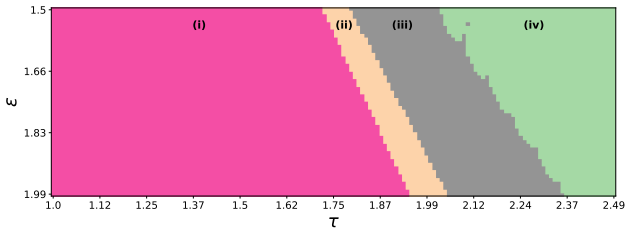
Starting from the system in Eq. (1), with $N=100$ Stuart-Landau oscillators per layer on a ring with nonlocal coupling range $P=25$, the authors find that when the middle layer L2 drives L1 and L3 through unidirectional feedback terms $\epsilon(x_{i2}, y_{i2})$, the two response layers synchronize completely with each other, while their oscillation amplitude grows above that of the drive and their average phase difference to the drive falls to zero. The synchronization errors $S_{\text{intra}}$ and $S_{\text{inter}}$ confirm that intralayer order in the responses and relay synchronization between them both set in as $\epsilon$ is raised. The same feedback with a time-scale mismatch $\tau$ inserted in the drive layer's equations tunes the response amplitude down to equality with the drive at $\tau=2.5$ and then into smaller-amplitude and quasi-periodic regimes at larger $\tau$, where relay synchronization is replaced by frequency synchronization between the responses. With unidirectional diffusive coupling, the identical-layer case yields complete synchronization across all three layers, while parameter mismatch (for example $\omega_{\text{response}}=1.5$ versus $\omega_{\text{drive}}=2$) preserves relay synchronization but gives only frequency synchronization with the drive.
Load-bearing premise
The results assume that the behavior observed for the single parameter set $N=100$, $P_1=P_2=P_3=25$, $K_2=5$, $\omega=2$, with quasi-periodicity judged by visual inspection, carries over to other network sizes, topologies, parameter values, and initial conditions.
Editorial extensions
If this is right
- A three-layer multiplex with one-way feedback can act as a remote synchronizer: nodes in two disconnected layers become fully synchronized through the middle layer alone.
- The response amplitude can be set by choosing $\epsilon$, and can be matched to the drive amplitude by choosing $\tau \approx 2.5$, giving a two-knob control scheme for remote layers.
- Changing the interlayer coupling from feedback to diffusive switches the outcome from amplified relay synchronization to complete synchronization when the layers are identical, and to reduced-amplitude relay synchronization when they are mismatched.
- Increasing $\tau$ beyond the equal-amplitude point destroys phase locking and eventually relay synchronization, leaving only frequency-synchronized quasi-periodic responses; applications needing exact phase locking must keep $\tau$ small.
- With a mismatch in intrinsic frequencies, relay synchronization between the responses survives but phase synchronization with the drive does not, so phase locking is not a generic feature of the unidirectional scheme.
- For experimental relay systems, the prediction that response amplitude grows with $\epsilon$ and shrinks as $\tau$ moves away from 1 can be tested directly by measuring the oscillation envelope of the remote layers while sweeping the drive amplitude or drive time scale.
Reading between the lines
- A direct extension the paper does not run: with three or more identical response layers all driven by the same L2 signal, relay synchronization should hold pairwise among all of them, with $\epsilon$ and $\tau$ controlling the common amplitude.
- The arrangement is structurally an auxiliary-system experiment: L1 and L3 are identical systems forced by the same drive, so their synchronization with each other is equivalent to each being in generalized synchronization with L2, a connection that suggests master-stability-function conditions for when relay synchronization should hold.
- The quasi-periodic region in Fig. 5 is identified by visual inspection of time series and phase portraits; a Lyapunov-exponent or power-spectrum scan would sharpen the region boundaries and determine whether part of region (iv) is chaotic rather than quasi-periodic.
- Because the feedback term injects drive-layer amplitude into both responses symmetrically, the mechanism may work for a wider class of limit-cycle and chaotic oscillators, not just Stuart-Landau systems, provided the driven response remains stable.
Editorial analysis
A structured set of objections, weighed in public.
Referee Report
Summary. The paper studies a three-layer multiplex network of Stuart-Landau oscillators with unidirectional interlayer coupling from a middle drive layer L2 to two identical response layers L1 and L3. For feedback-type coupling, numerical integration of Eq. (1) shows that the response layers achieve relay synchronization with amplified oscillations that are phase synchronized with the drive, and the response amplitude can be tuned by the interlayer coupling strength epsilon or the time-scale mismatch tau. For diffusive coupling, the identical layers achieve complete synchronization, while a time-scale or parameter mismatch leads to relay synchronization with frequency synchronization and reduced amplitude. A phase diagram in the (epsilon, tau) plane is presented, identifying regions of amplification, equal amplitude, reduced amplitude, and quasi-periodic dynamics.
Significance. If the reported effects are robust, the paper offers a simple mechanism for remotely controlling oscillation amplitudes in multiplex networks via unidirectional drive, which is relevant to applications such as neuronal relay systems and smart grids. The study is purely numerical but uses standard diagnostics (S_intra, S_inter, A(epsilon), phase difference) and clearly specifies the model and parameter values. Its main value is a credible demonstration of a phenomenon in a specific setup, not a general theory. The lack of ensemble statistics and the absence of quantitative measures for quasi-periodicity currently limit the strength of the central control claim.
major comments (2)
- [Section 2, Eq. (1), Figs. 2, 3, 6] The paper states that the system is 'integrated for random initial conditions between (-1,1)' (Section 2), but every displayed curve is evidently based on a single realization per parameter value. Coupled Stuart-Landau oscillators with nonlocal coupling are known to exhibit multistability, so the plotted S_intra, S_inter, and A(epsilon) values may belong to one of several coexisting attractors. In particular, the control claim in the abstract that the response-layer amplitude 'can be controlled by tuning' epsilon presupposes that the relay-synchronized amplified state is the unique or representative attractor for each (epsilon, tau). Please add an ensemble study: for a grid of (epsilon, tau) values, report the fraction of initial conditions that converge to relay synchronization and the mean plus or minus standard deviation of A(epsilon, tau) and of the synchronization errors. If multiple attractors coexist, characterize their basins and restrict the control claim to the parameter and initial-condition region where it holds.
- [Section 3, Fig. 5] The quasi-periodic region (iv) in Fig. 5 is assigned by visual inspection of time series and phase portraits (Fig. 4(a3,b3)), and no quantitative criterion (largest Lyapunov exponent, power spectrum with incommensurate peaks, or Poincare section) is given. Consequently the boundaries of region (iv) are not reproducible. Moreover, the axes of Fig. 5, as printed, cover tau in [1.0,2.49] and epsilon in [1.5,1.99], which does not include the values tau=4 and epsilon=3 used in Fig. 4 and Fig. 6. Please clarify the axis ranges and the classification algorithm, and report the quantitative measure used to define each of the four regions.
minor comments (7)
- [Section 2, Eq. (4) and Fig. 6] The notation A(epsilon) is used for a quantity that Fig. 6 plots against tau; rename it to A(tau) for fixed epsilon or use A(epsilon, tau) to avoid confusion. Also clarify that a(0) is the constant drive-layer amplitude, not the epsilon=0 value of the response layer.
- [Section 2] Please specify the integration method, step size, transient removal criterion, and whether the results in each figure come from one run or from averaging over runs; this information is necessary for reproducibility.
- [Fig. 2] The epsilon-axis ranges differ between panels (a1) (about 0 to 0.019) and (a2) (about 0 to 0.195), and both differ from the ranges used in Figs. 3 and 6 (up to 2.5 or 3). State the intended epsilon ranges in the captions and explain the different scales.
- [Fig. 4] The time axis in the time series panels is labeled only as 'Time'; state whether it is in dimensionless time units or in integration steps.
- [Section 3, last paragraph] The parameter mismatch results (omega_drive=2, omega_response=1.5) are described without any supporting figure or quantitative measure. Add a figure panel or explicitly present these statements as qualitative observations subject to further study.
- [Section 5] The Data Availability section states that computations use publicly available packages but provides no link to the code or data. A persistent link to the integration scripts would substantially improve reproducibility.
- [Eq. (1)] The intralayer coupling is only through the x variable, while the y equations do not contain coupling terms; state this explicitly in the text so that readers do not assume the standard complex-field coupling.
Circularity Check
No significant circularity: observational numerical study with no fitted inputs or self-citation chain; central claims read directly from simulations.
full rationale
This paper is an observational numerical study, not a derivation. The central claims—relay synchronization, amplitude amplification, phase/frequency synchronization, and quasi-periodic response—are read directly from time integration of Eq. (1) through standard diagnostics (S_intra, S_inter, amplitude ratio A(epsilon), and phase difference Delta_theta). No parameter is fitted to a subset of data and then presented as a prediction; the amplitude ratio A(epsilon) is defined as a direct ratio of measured oscillation amplitudes, and the synchronization errors are standard definitional quantities. The single self-citation, Ref. [12] (Vadakkan, Verma, and Ambika), is cited only as background for the revival of synchronized oscillations by time-scale tuning and is not load-bearing for the present results. No uniqueness theorem from prior author work is invoked, and no ansatz is smuggled in by citation. The numerical setup fixes a single parameter set (N=100, P1=P2=P3=25, K2=5, omega=2) and uses one set of random initial conditions per parameter value; this raises a legitimate concern about multistability and robustness of the control claim, and the quasi-periodic classification in Fig. 5 is made by visual inspection without Lyapunov exponents. Those are correctness/robustness limitations, not circularity. There is no step in the paper where a claimed output is equivalent by construction to an input, so the circularity score is 0.
Assumptions & free parameters
assumptions (3)
- domain assumption Stuart-Landau oscillators with diffusive intralayer coupling on a ring topology are a valid model for the claimed multiplex synchronization behavior.
- domain assumption The drive layer L2 is completely synchronized for K2=5, and this remains true for all epsilon and tau studied.
- standard math The synchronization errors defined in Eqs. (2) and (3) reliably indicate synchronization.
Cite this review
Pith. "Pith review of Relay synchronization and control of dynamics in multiplex networks with unidirectional inter layer coupling." pith.science (2026). https://pith.science/paper/4SSIPCQP
@misc{pith2026250102716,
  author       = {Pith},
  title        = {Pith review of: Relay synchronization and control of dynamics in multiplex networks with unidirectional inter layer coupling},
  year         = {2026},
  howpublished = {\url{https://pith.science/paper/4SSIPCQP}},
  note         = {Machine review of arXiv:2501.02716}
}
read the original abstract
Multiplex networks provide a proper framework for understanding the dynamics of complex systems with differing types of interactions. This study considers different dynamical states possible in a multiplex network of nonlinear oscillators, with a drive layer and two identical response layers where the interlayer interactions are unidirectional. We report how the directionality in coupling can lead to relay synchronization with amplification in the two response layers through feedback from the middle drive layer. The amplitude of synchronized oscillations of response layers can be controlled by tuning the strength of interlayer coupling. Moreover, we find the synchronization patterns that emerge in the response layers depend on the nature of interlayer coupling, whether feedback or diffusive, and the time scale or parameter mismatches between drive and response layers. Thus, the study indicates the potential for controlling and optimizing the dynamics of response layers remotely by adjusting the strength of interlayer coupling or tuning the dynamic time scale of the drive layer.
Figures


Figures from the paper (3 more)


Reference graph
Works this paper leans on
-
[1]
M. Kivela, A. Arenas, M. Barthelemy, J. P. Gleeson, Y . Moreno, M. A. Porter, Multilayer networks, J. Complex. Netw. 2 (2014) 203–271. 5 0 200 400 600 800 1000 1.5 1.0 0.5 0.0 0.5 1.0 1.5 xij (a1) 1.5 1.0 0.5 0.0 0.5 1.0 1.5 xij 1.5 1.0 0.5 0.0 0.5 1.0 1.5 yij (b1) 0 200 400 600 800 1000 1.00 0.75 0.50 0.25 0.00 0.25 0.50 0.75 1.00 xij (a2) 1.00 0.75 0.50...
work page 2014
-
[2]
Y . Wang, O. Zhao, L. Zhang, Multiplex networks in resilience modeling of critical infrastructure systems: A systematic review, Reliab. Eng. Syst. Saf. 250 (2024) 110300
work page 2024
- [3]
-
[4]
S. Pranesh, S. Gupta, Explosive death transitions in complex networks of limit cycle and chaotic systems, Chaos Solit. Fractals. 168 (2023) 113112
work page 2023
-
[5]
A. Koseska, E. V olkov, J. Kurths, Transition from amplitude to oscillation death via turing bifurcation, Phys. Rev. Lett. 111 (2013) 024103
work page 2013
-
[6]
A. Zakharova, M. Kapeller, E. Sch ¨oll, Chimera death: Symmetry break- ing in dynamical networks, Phys. Rev. Lett. 112 (2014) 154101
work page 2014
-
[7]
G. C. Sethia, A. Sen, Chimera states: The existence criteria revisited, Phys. Rev. Lett. 112 (2014) 144101
work page 2014
-
[8]
Banerjee, Mean-field-di ffusion–induced chimera death state, Euro- phys
T. Banerjee, Mean-field-di ffusion–induced chimera death state, Euro- phys. Lett. 110 (2015) 60003
work page 2015
Show all 59 references
-
[9]
S. Y . Makovkin, I. V . Shkerin, S. Y . Gordleeva, M. V . Ivanchenko, Astrocyte-induced intermittent synchronization of neurons in a minimal network, Chaos Solit. Fractals. 138 (2020) 109951
2020
-
[10]
Deville, C
P. Deville, C. Song, N. Eagle, V . D. Blondel, A. L. Barabasi, D. Wang, Scaling identity connects human mobility and social interactions, Proc. Natl. Acad. Sci. 113 (2016) 7047–7052
2016
-
[11]
G. A. Pagani, M. Aiello, The power grid as a complex network: A survey, Physica A. 392 (2013) 2688–2700
2013
-
[12]
A. T. Vadakkan, U. K. Verma, G. Ambika, Recovery of synchronized oscillations on multiplex networks by tuning dynamical time scales, Phys. Lett. A. 525 (2024) 129842
2024
-
[13]
P. Wang, G. Wen, X. Yu, W. Yu, T. Huang, Synchronization of multi-layer networks: From node-to-node synchronization to complete synchroniza- tion, IEEE Trans. Circuits Syst. I Regul. Pap. 66 (2019) 1141–1152
2019
-
[14]
Belykh, D
I. Belykh, D. Carter, R. Jeter, Synchronization in multilayer networks: When good links go bad, SIAM J. Appl. Dyn. Syst. 18 (2019) 2267– 2302
2019
-
[15]
Makovkin, T
S. Makovkin, T. Laptyeva, S. Jalan, M. Ivanchenko, Synchronization in multiplex models of neuron–glial systems: Small-world topology and inhibitory coupling, Chaos. 31 (2021) 113111
2021
-
[16]
M. S. Anwar, S. Rakshit, J. Kurths, D. Ghosh, Synchronization induced by layer mismatch in multiplex networks, Entropy. 25 (2023) 1083
2023
-
[17]
U. K. Verma, G. Ambika, Emergent dynamics and spatio temporal pat- terns on multiplex neuronal networks, Front. Comput. Neurosci. 15 (2021) 774969
2021
-
[18]
Jalan, A
S. Jalan, A. Singh, Cluster synchronization in multiplex networks, Euro- phys. Lett. 113 (2016) 30002
2016
-
[19]
F. D. Rossa, L. Pecora, K. Blaha, A. Shirin, I. Klickstein, F. Sorrentino, Symmetries and cluster synchronization in multilayer networks, Nat. Commun. 11 (2020) 3179
2020
-
[20]
Leyva, I
I. Leyva, I. Sendi ˜na Nadal, J. A. Almendral, A. Navas, S. Olmi, S. Boc- caletti, Explosive synchronization in weighted complex networks, Phys. Rev. E. 88 (2013) 042808
2013
-
[21]
Bayani, S
A. Bayani, S. Jafari, H. Azarnoush, F. Nazarimehr, S. Boccaletti, M. Perc, Explosive synchronization dependence on initial conditions: The minimal kuramoto model, Chaos Solit. Fractals. 169 (2023) 113243
2023
-
[22]
Zhang, S
X. Zhang, S. Boccaletti, S. Guan, Z. Liu, Explosive synchronization in adaptive and multilayer networks, Phys. Rev. Lett. 114 (2015) 038701
2015
-
[23]
U. K. Verma, G. Ambika, Explosive synchronization in coupled nonlinear oscillators on multiplex network, Phys. Lett. A. 450 (2022) 128391
2022
-
[24]
Kumar, S
A. Kumar, S. Jalan, A. D. Kachhvah, Interlayer adaptation-induced ex- plosive synchronization in multiplex networks, Phys. Rev. Res. 2 (2020) 023259
2020
-
[25]
L. V . Gambuzza, M. Frasca, J. G´omez-Garde˜nes, Intra-layer synchroniza- tion in multiplex networks, Europhys. Lett. 110 (2015) 20010
2015
-
[26]
Rakshit, B
S. Rakshit, B. K. Bera, E. M. Bollt, D. Ghosh, Intralayer synchroniza- 7 0.0 0.5 1.0 1.5 2.0 2.5 3.0 0.8 1.0 1.2 1.4 1.6A( ) Figure 6: Variation in the average amplitude measure, A(ϵ), with the time scale mismatchτ fixingϵ = 3 in the three-layer multiplex network for two types...
2020
-
[27]
Sevilla-Escoboza, I
R. Sevilla-Escoboza, I. Sendi ˜na-Nadal, I. Leyva, R. Guti ´errez, J. M. Buld´u, S. Boccaletti, Inter-layer synchronization in multiplex networks of identical layers, Chaos. 26 (2016) 065304
2016
-
[28]
Leyva, R
I. Leyva, R. Sevilla-Escoboza, I. Sendi ˜na-Nadal, R. Guti ´errez, J. Buld ´u, S. Boccaletti, Inter-layer synchronization in non-identical multi-layer net- works, Sci. Rep. 7 (2017) 45475
2017
-
[29]
Pitsik, V
E. Pitsik, V . Makarov, D. Kirsanov, N. Frolov, M. Goremyko, X. Li, Z. Wang, A. Hramov, S. Boccaletti, Inter-layer competition in adaptive multiplex network, New J. Phys. 20 (2018) 075004
2018
-
[30]
Majhi, S
S. Majhi, S. Ghosh, P. K. Pal, S. Pal, T. K. Pal, D. Ghosh, J. Zavr ˇsnik, M. Perc, Patterns of neuronal synchrony in higher-order networks, Phys. Life Rev. 52 (2025) 144–170
2025
-
[31]
P. K. Pal, M. S. Anwar, M. c. v. Perc, D. Ghosh, Global synchronization in generalized multilayer higher-order networks, Phys. Rev. Res. 6 (2024) 033003
2024
-
[32]
P. V . Kuptsov, A. V . Kuptsova, Variety of regimes of starlike networks of h´enon maps, Phys. Rev. E. 92 (2015) 042912
2015
-
[33]
Bergner, M
A. Bergner, M. Frasca, G. Sciuto, A. Buscarino, E. J. Ngamga, L. Fortuna, J. Kurths, Remote synchronization in star networks, Phys. Rev. E. 85 (2012) 026208
2012
-
[34]
Fischer, R
I. Fischer, R. Vicente, J. M. Buld ´u, M. Peil, C. R. Mirasso, M. C. Torrent, J. Garc´ıa-Ojalvo, Zero-lag long-range synchronization via dynamical re- laying, Phys. Rev. Lett. 97 (2006) 123902
2006
-
[35]
Banerjee, D
R. Banerjee, D. Ghosh, E. Padmanaban, R. Ramaswamy, L. M. Pecora, S. K. Dana, Enhancing synchrony in chaotic oscillators by dynamic re- laying, Phys. Rev. E. 85 (2012) 027201
2012
-
[36]
Gosak, M
M. Gosak, M. Milojevi ´c, M. Duh, K. Skok, M. Perc, Networks behind the morphology and structural design of living systems, Phys. Life Rev. 41 (2022) 1–21
2022
-
[37]
P. Ji, J. Ye, Y . Mu, W. Lin, Y . Tian, C. Hens, M. Perc, Y . Tang, J. Sun, J. Kurths, Signal propagation in complex networks, Phys. Rep. 1017 (2023) 1–96
2023
-
[38]
Guillery, S
R. Guillery, S. Sherman, Thalamic relay functions and their role in cor- ticocortical communication, Neuron. 33 (2002) 163–175
2002
-
[39]
S. M. Sherman, The thalamus is more than just a relay, Curr. Opin. Neurobiol. 17 (2007) 417–422
2007
-
[40]
A. S. Mitchell, S. M. Sherman, M. A. Sommer, R. G. Mair, R. P. Vertes, Y . Chudasama, Advances in understanding mechanisms of thalamic re- lays in cognition and behavior, J. Neurosci. 34 (2014) 15340–15346
2014
-
[41]
Vlasov, A
V . Vlasov, A. Bifone, Hub-driven remote synchronization in brain net- works, Sci. Rep. 7 (2017) 10403
2017
-
[42]
Drauschke, J
F. Drauschke, J. Sawicki, R. Berner, I. Omelchenko, E. Sch ¨oll, E ffect of topology upon relay synchronization in triplex neuronal networks, Chaos. 30 (2020) 051104
2020
-
[43]
M. S. Anwar, D. Ghosh, N. Frolov, Relay synchronization in a weighted triplex network, Mathematics. 9 (2021) 2135
2021
-
[44]
Leyva, I
I. Leyva, I. Sendi ˜na-Nadal, R. Sevilla-Escoboza, V . P. Vera-Avila, P. Chholak, S. Boccaletti, Relay synchronization in multiplex networks, Sci. Rep. 8 (2018) 8629
2018
-
[45]
Z. Wei, G. Sriram, K. Rajagopal, S. Jafari, Enhancing relay synchroniza- tion in multiplex networks by repulsive relay layer, Europhys. Lett. 145 (2024) 21003
2024
-
[46]
Sawicki, I
J. Sawicki, I. Omelchenko, A. Zakharova, E. Sch ¨oll, Delay controls chimera relay synchronization in multiplex networks, Phys. Rev. E. 98 (2018) 062224
2018
-
[47]
X. Li, T. Xu, J. Li, Synchronization and chimera states in a multilayer neuronal network with unidirectional interlayer links, Eur. Phys. J. Spec. Top. 228 (2019) 2419–2427
2019
-
[48]
Feudel, Rate-induced tipping in ecosystems and climate: the role of unstable states, basin boundaries and transient dynamics, Nonlinear Pro- cess
U. Feudel, Rate-induced tipping in ecosystems and climate: the role of unstable states, basin boundaries and transient dynamics, Nonlinear Pro- cess. Geophys. 30 (2023) 481–502
2023
-
[49]
Samek, D
W. Samek, D. A. Blythe, G. Curio, K.-R. M ¨uller, B. Blankertz, V . V . Nikulin, Multiscale temporal neural dynamics predict performance in a complex sensorimotor task, NeuroImage. 141 (2016) 291–303
2016
-
[50]
E. S. Boyden, F. Zhang, E. Bamberg, G. Nagel, K. Deisseroth, Millisecond-timescale, genetically targeted optical control of neural ac- tivity, Nat. Neurosci. 8 (2005) 1263–1268
2005
-
[51]
D. Das, D. S. Ray, Multiple time scale based reduction scheme for non- linear chemical dynamics, Eur. Phys. J. Spec. Top. 222 (2013) 785–798
2013
-
[52]
Radovick, M
S. Radovick, M. Nations, Y . Du, L. A. Berg, B. D. Weintraub, F. E. Wond- isford, A mutation in the pou-homeodomain of pit-1 responsible for com- bined pituitary hormone deficiency, Science. 257 (1992) 1115–1118
1992
-
[53]
I. Bena, M. Droz, J. Szwabi ´nski, A. Pekalski, Complex population dy- namics as a competition between multiple-time-scale phenomena, Phys. Rev. E. 76 (2007) 011908
2007
-
[54]
Gupta, G
K. Gupta, G. Ambika, Role of time scales and topology on the dynamics of complex networks, Chaos. 29 (2019) 033119
2019
-
[55]
Yang, Y .-W
W. Yang, Y .-W. Wang, Y . Shen, L. Pan, Cluster synchronization of cou- pled delayed competitive neural networks with two time scales, Nonlin- ear. Dyn. 90 (2017) 2767–2782
2017
-
[56]
Kachhara, G
S. Kachhara, G. Ambika, Frequency chimera state induced by di ffering dynamical timescales, Phys. Rev. E. 104 (2021) 064214
2021
-
[57]
Shang, M
Y . Shang, M. Chen, J. Kurths, Generalized synchronization of complex networks, Phys. Rev. E. 80 (2009) 027201
2009
-
[58]
D. Ning, X. Wu, H. Feng, Y . Chen, J. Lu, Inter-layer generalized syn- chronization of two-layer impulsively-coupled networks, Commun. Non- linear. Sci. Numer. Simul. 79 (2019) 104947
2019
-
[59]
D. Ning, X. Wu, J.-a. Lu, J. L ¨u, Driving-based generalized synchroniza- tion in two-layer networks via pinning control, Chaos. 25 (2015) 113104. 8
2015
Reviewed August 10, 2026 · model on record in the stance chip above.
Discussion (0). Continue with ORCID to comment.