pith. machine review for the scientific record. sign in

nlin.AO

Adaptation and Self-Organizing Systems

Adaptation, self-organizing systems, statistical physics, fluctuating systems, stochastic processes, interacting particle systems, machine learning

0
nlin.AO 2026-05-13 2 theorems

Asymmetric delay enlarges active ฯ€ state in 1D swarmalators

The role of asymmetric time delay and its structure in 1D swarmalators

Increasing delay in self-interaction models grows the ordered active ฯ€ region, unlike symmetric delays that boost unsteady states.
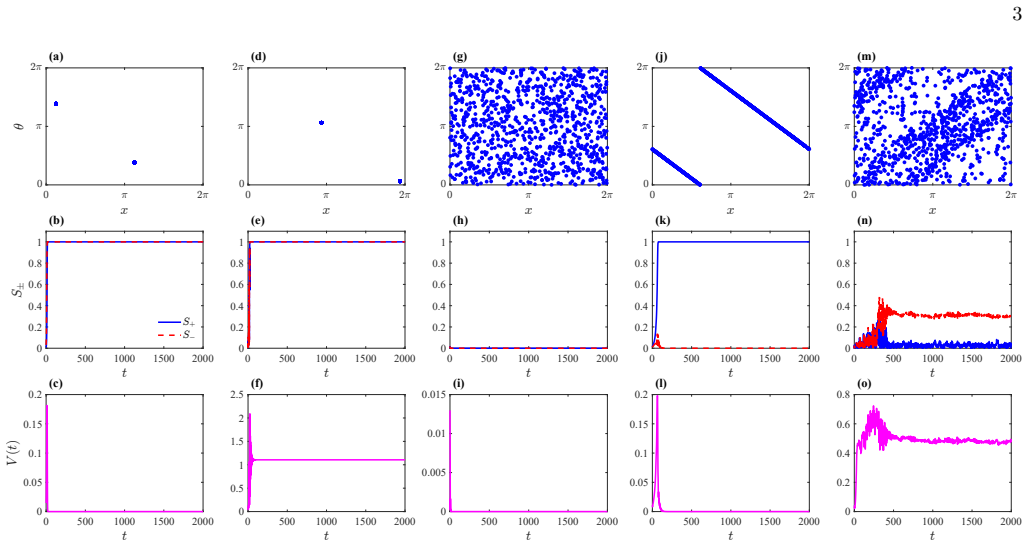
Figure from the paper full image
abstract click to expand
Swarmalators are a class of coupled oscillators that simultaneously synchronize in both space and phase, providing a minimal model for systems ranging from biological microswimmers to robotic swarms. Time delay is ubiquitous in such systems, arising from finite signal propagation speeds and sensory processing lags, yet its structural form, whether symmetric or asymmetric, has received little attention. Here, we study a one-dimensional swarmalator model with asymmetric time delay, in which the delay enters only the self-interaction terms of the spatial and phase dynamics, breaking the symmetry assumed in prior work. We identify various collective states such as async, static phase wave, static {\pi}, and active {\pi}, and derive analytical stability boundaries for each as a function of the coupling parameters and delay. Our analysis reveals that the asymmetric delay structure fundamentally reshapes the collective phase diagram: in particular, for the asymmetric delay models, increasing the delay systematically expands the active {\pi} state at the expense of other ordered states, in contrast to the symmetric delay model, which more strongly promotes the presence of unsteady states that are generally not well ordered. By providing closed-form stability conditions validated against numerical simulations, our work establishes that the internal structure of the delay, not merely its magnitude, is a decisive factor in determining the emergent collective behavior of swarmalator populations.
0
0
nlin.AO 2026-05-11 2 theorems

Lรฉvy noise turns synchronized waves into random walks

Extreme forcing and wave dynamics in weakly nonlocally coupled excitable FitzHugh-Nagumo systems

Periodic forcing organizes regular traveling waves in coupled excitable units while heavy-tailed noise drives opposing waves that randomize.

Figure from the paper full image
abstract click to expand
The influence of extreme external forcing on traveling-wave dynamics in an ensemble of weakly nonlocally coupled excitable FitzHugh--Nagumo systems is studied. Three types of external exposure are considered: periodic Gaussian pulses, periodic pulses modulated by Gaussian white noise, and L\'evy noise with tunable distribution parameters. Periodic forcing produces synchronization tongues with highly regular collective dynamics and may induce multiple traveling waves or coexistence of partial synchronization with wave propagation. In contrast, L\'evy noise suppresses regular behavior and generates a regime of counter-propagating waves, which with increasing intensity transitions to random walking dynamics. The study provides a comprehensive classification of the observed dynamical regimes and presents their organization in parameter space for different types of extreme external forcing.
0
0
nlin.AO 2026-05-11 2 theorems

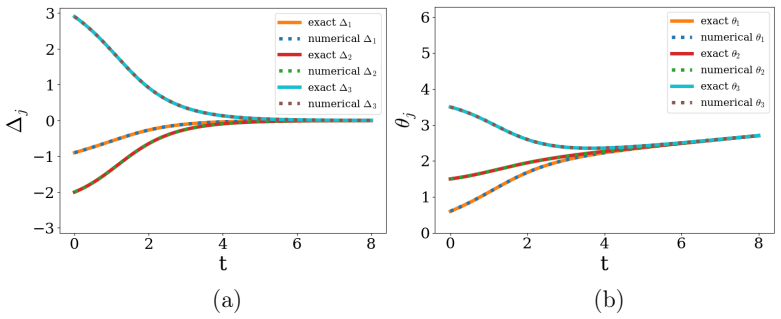
Exact algebraic phases derived for three identical Kuramoto oscillators

Global Analytical Solution of the Identical Kuramoto Model for N=3 via Koopman Eigenfunctions

Koopman eigenfunctions convert the dynamics to time-dependent quartics whose roots are fixed by initial conditions.

Figure from the paper full image
abstract click to expand
The Kuramoto model is a paradigmatic model of collective synchronization in coupled oscillator systems. Although its mathematical properties have been extensively investigated, exact phase trajectories from arbitrary initial conditions have been available only for the simplest case, N=2. In this study, we provide a global analytical solution for the phase trajectories of the all-to-all coupled Kuramoto model with identical oscillators for N=3. This solution is obtained by constructing Koopman eigenfunctions that relate the phases to time and reducing the phase dynamics to time-dependent quartic equations. The algebraic branch corresponding to the initial condition is then selected to recover the corresponding phase trajectory. This gives an explicit algebraic reconstruction of the nonlinear phase dynamics from Koopman eigenfunctions.
0
0
nlin.AO 2026-05-07

Nonequilibrium efficiency peaks at phase transitions

Thermodynamic efficiency of self-organisation in nonequilibrium steady states

In active Ising models thermodynamic and inferential efficiencies diverge with distance from equilibrium.

Figure from the paper full image
abstract click to expand
Active matter generates order or patterns through nonequilibrium dynamics. An open research challenge is to determine how efficiently a nonequilibrium self-organising system can convert consumed energy into macroscopic order. We study an information-theoretic quantity that directly addresses this challenge by estimating the entropy reduction induced by a small control-parameter perturbation, relative to the generalised work required for the perturbation. This quantity has previously been considered mainly in an equilibrium or near-equilibrium context, and here we extend this framework and apply it to two nonequilibrium self-organising systems: persistent and active Ising models. We observe that the thermodynamic efficiency of nonequilibrium systems maximises at phase transitions, as in equilibrium systems. Furthermore, we compare thermodynamic efficiency and inferential efficiency across control parameters. While these two quantities are equal in equilibrium as a consequence of the fluctuation-dissipation theorem, we report that they diverge out of equilibrium, and the gap reflects how far the system is from equilibrium.
0
0
nlin.AO 2026-05-04 3 theorems

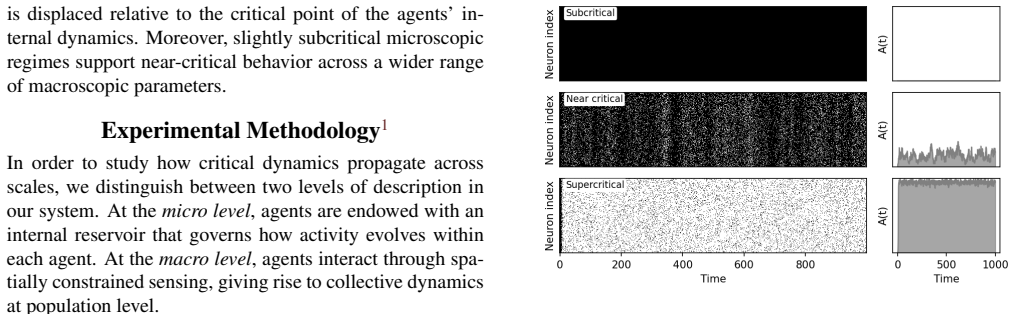
Slightly subcritical agents enable collective criticality

Emergent Macro-Criticality from Micro-Critical Agents

In light-signal multi-agent systems, micro regimes slightly below criticality support scale-free group avalanches over wider network ranges.

Figure from the paper full image
abstract click to expand
Criticality has been proposed as a key principle underlying complex behavior in biological and artificial systems; however, how criticality translates from individual dynamics to collective behavior remains unclear. We study this question using a multi-agent system with spatially constrained interactions in which agents sense neighboring light signals through exteroceptors and act by switching their own light on or off, thereby forming a dynamical interaction network at the macroscopic level. The agents' internal states are themselves governed by a reservoir dynamical system at the microscopic level. By varying the microscopic parameters around dynamical criticality, together with the macroscopic interaction topology, we systematically investigate the relation between the two levels. We find that near-critical dynamics within individual agents is not sufficient to produce collective critical-like avalanche statistics. Instead, scale-free behavior depends on the effective connectivity of the macroscopic interaction network, which controls activity propagation. As a result, macroscopic critical-like dynamics are enabled by microscopic regimes that deviate from criticality, with the required deviation depending on the properties of the interaction network. Investigating this relation, we find that slightly subcritical micro-level regimes support near-critical dynamics across a wider range of macroscopic parameters. These results show that in this multi-agent system, collective near-critical behavior depends on the interplay between internal dynamics and the interaction structure that governs activity propagation.
0
0
nlin.AO 2026-05-04

Kuramoto model on higher-D torus has first-order sync transition

Kuramoto model on the D-dimensional torus

Incoherent state stays stable always while sync appears via saddle-node, unlike continuous 1D case

Figure from the paper full image
abstract click to expand
We propose a generalization of the Kuramoto model of interacting oscillators in which the particles move on the surface of a $D$-dimensional torus. In contrast with the traditional one-dimensional version, this model has a first order phase transition. We establish its mean field dynamics by means of a multidimensional Ott-Antonsen ansatz, and show that synchronization arises from a saddle-node bifurcation, while the incoherent state is always stable. Our theoretical calculations are validated by numerical simulations.
0
0
nlin.AO 2026-04-27

Bayesian method recovers phase equations from traveling pattern data

Data-driven reconstruction of spatiotemporal phase dynamics for traveling and oscillating patterns via Bayesian inference

Time-series data yield the deterministic rules for pattern position and oscillation when noise is weak and symmetry holds.

Figure from the paper full image
abstract click to expand
Building on the phase reduction theory formulated for reaction-diffusion systems with spatial translational symmetry, we develop a data-driven method that reconstructs the spatiotemporal phase dynamics of traveling and oscillating patterns. Spatiotemporal phase dynamics are described by spatial and temporal phases that represent the position and oscillation of the pattern, respectively. Using Bayesian inference, our method directly reconstructs phase equations from time-series data. When tested on simulation data from coupled Gray-Scott models exhibiting traveling breathers, the method accurately reconstructs the deterministic part of the phase equations in the weak-noise regime, in which the phase dynamics converge to a linearly stable fixed point.
0
0
nlin.AO 2026-04-27

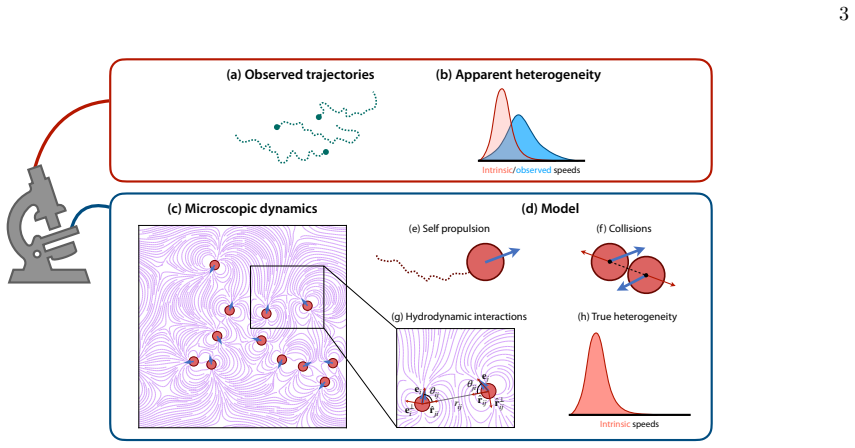
Hydrodynamics make uniform micro-collectives look heterogeneous

Hydrodynamic interactions mask the true heterogeneity of a microscopic collective

Measured speeds register diversity even when all agents share identical motilities if fluid interactions dominate.

Figure from the paper full image
abstract click to expand
Coordinated movement and self-organisation of active self-driven agents is common in nature and is seen across different scales, from herds of animals to collective motion in bacteria. Often, these systems are heterogeneous in composition, with different agents having different intrinsic motilities. Inferring these intrinsic characteristics and quantifying the level of heterogeneity in a collective system is crucial to understanding the observed emergent phenomena. However, when interaction effects dominate, i.e. the observed movement of an agent is strongly influenced by its interacting neighbours, inferring the intrinsic characteristics of agents becomes a challenge. We consider a collective system of agents that undergo purely physical interactions like collisions and long-range hydrodynamic interactions, which resembles a system of microswimmers immersed in a fluid medium. We incorporate heterogeneity into the system through variations in agent motility and examine how the perceived heterogeneity, inferred from measured speeds, depends on the strength of hydrodynamic interactions and the true intrinsic variability. The interplay between short-range collisions, long-range hydrodynamic interactions, and intrinsic heterogeneity makes the inference problem non-trivial. When hydrodynamic effects dominate, true heterogeneity is effectively masked, making even a homogeneous collective appear heterogeneous. The competing effects of collisions, which slow agents down, and hydrodynamic interactions, which enhance their motion, further complicate reliable inference. Hydrodynamic interactions also modify collision angles, rendering them more isotropic. Overall, the findings show highlight experimentally measured properties of microscopic collectives may not accurately reflect their true characteristics.
0
0
nlin.AO 2026-04-27

Forcing eliminates standing waves in bimodal inertial oscillators

Interplay of inertia and external forcing in Kuramoto model

External drive competes with frequency bimodality to remove intermediate states and make the backward transition discontinuous.

Figure from the paper full image
abstract click to expand
The impact of external forcing is well studied in the Kuramoto model without inertia, but remains unclear for inertial Kuramoto oscillators (KMI) with bimodal intrinsic frequency distributions. This article fills that gap, showing that competition between external forcing and intrinsic bimodality can suppress the intermediate standing wave states of bimodal KMI by entraining oscillators to the external forcing. Using a self-consistent analytical framework, we show that, for a bimodal distribution, forcing makes the backward transition discontinuous, unlike the continuous transition in the unimodal case. Further, for a bi-delta distribution, we derive a closed form expression for the backward solution branch. These results clarify how intrinsic frequency structure shapes the effect of external forcing, with implications for biological systems (e.g., photoreceptor and pacemaker cells) and for pinning-control strategies in multi-agent networks.
0
0
nlin.AO 2026-04-21

Unified edge weights give tighter stability conditions for networks

A Unified Theory of Edge Weights: Stability of General Laplacian Networks from Matrix Phases and Asymmetry Rayleigh Ratios

A general formulation for directed and multidimensional edges produces less conservative bounds in power grids and oscillator models.

Figure from the paper full image
abstract click to expand
We study the properties and stability of networks with arbitrary Laplacian coupling. Classic approaches to studying networked systems require unrealistic assumptions, including homogeneous node dynamics, one-dimensional and undirected edges, or constant edge weights. We develop a unified formulation of Laplacian-style couplings that drops these assumptions, providing a unified notion for the edge weights of adaptive, directed, and multi-dimensional edges. We show that the recently developed theory of matrix phases can capture essential stability properties of the network and its edges. We quantify the impact of the asymmetry of the higher-dimensional edge dynamics on the system's phase properties by introducing the Asymmetry Rayleigh Ratio. These theoretical advances allow us to derive new sufficient stability conditions for AC power grids, directed diffusion, and the Kuramoto-Sakaguchi model. The resulting conditions are less conservative than the specific results known for these systems.
0
0
nlin.AO 2026-04-20

Adaptive agents self-organize to ergodicity edge

Self-Organization to the Edge of Ergodicity Breaking in a Complex Adaptive System

At this boundary the system produces scale-free avalanches and higher collective rewards than any fixed regime.

Figure from the paper full image
abstract click to expand
Self-organized criticality (SOC) is widely proposed as a fundamental mechanism for collective behavior, yet its role in objective-driven, heterogeneous adaptive systems underpinning real complex systems remains less understood. We introduce EvoSK, a minimal evolutionary model in which agents perform memory dependent reinforcement learning on a rugged Sherrington-Kirkpatrick landscape while the population evolves through extremal replacement of the least fit agents. We demonstrate that this coupled dynamics drives the system to a critical state residing on the transition boundary between ergodic and non-ergodic phases. At this boundary, the system exhibits scale-free evolutionary avalanches with a mean-field exponent $\tau \approx -1.5$, while simultaneously achieving collective rewards that surpass those of any manually finetuned, non-evolutionary regime. Our results provide a mechanistic link between the statistical physics of ergodicity breaking and the functional optimality of complex adaptive systems, suggesting that the edge of ergodicity breaking acts as a robust attractor for systems adapting on rugged, high-dimensional landscapes.
0
0
nlin.AO 2026-04-17

OPUC theory reduces multiharmonic oscillator populations

Low-Dimensional Reduction Theory for Populations of Globally Coupled Phase Oscillators with Multiharmonic Coupling: A Method Based on OPUC Theory

Orthogonal polynomials supply a framework that lowers the dimension of phase-oscillator models with arbitrary multi-harmonic couplings.

Figure from the paper full image
abstract click to expand
Low-dimensional reduction theories, such as the Ott-Antonsen ansatz, have played a crucial role in the study of populations of globally coupled phase oscillators. However, most of these theories are applicable only to models in which the interaction is described by a single harmonic component, limiting their application to more realistic oscillator models. In this paper, by employing the theory of orthogonal polynomials on the unit circle (OPUC), we construct a framework that enables low-dimensional reduction for populations of globally coupled phase oscillators with multiharmonic coupling.
0
0
nlin.AO 2026-04-15

One oscillator reveals coupling strength in large populations

Inferring coupling strength and natural frequency distribution in coupled Stuart-Landau oscillators using linear response

Natural frequency distribution is extracted from collective responses using linear response in Stuart-Landau systems.

Figure from the paper full image
abstract click to expand
We propose a framework to infer the coupling strength and the natural frequency distribution in a coupled Stuart-Landau oscillator system with a large population. The inference method uses observation of linear response of a macroscopic quantity and of an oscillator. We first solve the direct problem on the response with transforming the system into the phase-amplitude equations. Solving the inverse problem, we show that the coupling strength is inferred from observation of an oscillator and the natural frequency distribution from macroscopic responses. The proposed method requires only one-dimensional observation in the two-dimensional Stuart-Landau system. Validity of the inference theory is examined by numerical simulations.
0
0
nlin.AO 2026-04-15 Recognition

Single oscillator response reveals coupling strength

Inferring coupling strength and natural frequency distribution in coupled Stuart-Landau oscillators using linear response

Linear responses of one unit and the population recover coupling and frequency distribution in large Stuart-Landau groups

Figure from the paper full image
abstract click to expand
We propose a framework to infer the coupling strength and the natural frequency distribution in a coupled Stuart-Landau oscillator system with a large population. The inference method uses observation of linear response of a macroscopic quantity and of an oscillator. We first solve the direct problem on the response with transforming the system into the phase-amplitude equations. Solving the inverse problem, we show that the coupling strength is inferred from observation of an oscillator and the natural frequency distribution from macroscopic responses. The proposed method requires only one-dimensional observation in the two-dimensional Stuart-Landau system. Validity of the inference theory is examined by numerical simulations.
0
0
nlin.AO 2026-04-13 1 theorem

Phase shift keeps Kuramoto transition discontinuous

Discontinuous transition to synchrony in the Kuramoto-Sakaguchi model with a uniform distribution of frequencies

The jump from incoherence to partial synchrony remains abrupt for any coupling phase shift and shrinks exponentially only near 90 degrees.

Figure from the paper full image
abstract click to expand
The transition to synchrony in the Kuramoto model of globally coupled phase oscillators with a uniform distribution of natural frequencies is discontinuous. We extend the theory of this transition to the Kuramoto-Sakaguchi model, taking into account a phase shift in coupling. In the thermodynamic limit, we derive dependencies of the order parameters on the coupling strength and the phase shift, and describe two transitions from disorder to partial synchrony and from partial synchrony to complete synchrony. In all cases, the first transition is discontinuous, although for phase shifts close to $\pi/2$, the jump is exponentially small.
0
0
nlin.AO 2026-04-13

Adaptive coupling erases abrupt forward sync jump in large inertial networks

Second-order Kuramoto model with adaptive simplicial complex

The backward transition stays pinned to the adaptation parameter while the discontinuous onset of coherence vanishes as system size grows to

Figure from the paper full image
abstract click to expand
We investigate the emergence of synchronization in the second-order Kuramoto model with adaptive simplicial interactions on a globally connected network. This inertial Kuramoto framework describes systems, where oscillator frequencies evolve over time. Unlike most previous work that ignores inertia, we examine how inertia combined with adaptive higher-order coupling alters synchronization transitions. Using self-consistency analysis, we derive the steady-state behavior and show that adaptation qualitatively reshapes the synchronization landscape. We find that the backward transition from synchronization to incoherence remains controlled by the adaptive feedback parameter, but the forward discontinuous jump to synchronization vanishes in the thermodynamic limit. In contrast, finite-size systems still display an abrupt transition to synchronization, with its onset precisely set by the adaptation control parameter. These results show how adaptive feedback and system size together govern the onset and robustness of synchronization in inertial oscillator networks with higher-order interactions.
0
0
nlin.AO 2026-04-10 1 theorem

Triadic couplings speed synchronization while higher-order terms delay it

On the role of higher-order interactions towards first synchronization time

An analytical expression for first synchronization time shows coupling accelerates it but interaction order produces non-monotonic effects.

Figure from the paper full image
abstract click to expand
Understanding how large complex networks achieve synchronization is a problem of fundamental interest, and is typically studied in the asymptotic steady-state regime. In contrast, this study investigates how higher-order interactions affect the time required to reach steady-state synchronization in a complex dynamical system. To this end, an analytical expression for the first synchronization time is derived using the Ott-Antonsen ansatz on a Kuramoto oscillator network with higher-order interactions. Subsequent numerics reveal that increasing coupling strengths accelerates the transition to synchronization, whereas increasing the interaction order produces non-monotonic behavior. In particular, the inclusion of triadic interactions accelerates synchronization, whereas further incorporating higher-order interactions progressively delays convergence to the steady state, in some regimes even falling below the pairwise case.
0
0
nlin.AO 2026-04-08 2 theorems

Noise induces cusp bifurcation in duplex voter model

Symmetry-Breaking and Hysteresis in a Duplex Voter Model

Symmetry breaking appears and the phase diagram prototypes shifts between explosive and non-explosive transitions in other networks.

Figure from the paper full image
abstract click to expand
We introduce and analyze a voter-type model on a two-layer multiplex network, where the presence of a state on one layer acts as a catalyst or inhibitor to the propagation of that state on the other layer. Despite the model's simplicity, our mathematical analysis reveals a rich phase diagram that includes spontaneous symmetry-breaking and a cusp bifurcation, which arises when noise is introduced into the model. In particular, this bifurcation mechanism can be viewed as a prototypical unfolding of the change between explosive and non-explosive transitions observed in various other network models. We cross-validate our analytic results by numerical simulations.
0
0
nlin.AO 2026-04-07 Recognition

Ghost attractors defined for higher-dimensional center manifolds

Generalized saddle-node ghosts and their composite structures in dynamical systems

Algorithms detect composite ghost channels and cycles, enabling analysis of long transients and their bifurcations in living-system models.

Figure from the paper full image
abstract click to expand
The study of dynamical systems has long focused on the characterization of their asymptotic dynamics such as fixed points, limit cycles and other types of attractors and how these invariant sets change their properties as systems parameters change. More recently, however, the importance of transient dynamics, especially of long transients and sequential transitions between them, has been increasingly recognized in various fields including ecology, neuroscience and cell biology. Among several possible origins of long transients, ghost attractors have received particular attention due to interesting dynamical properties in non-autonomous settings, new theoretical developments, and an increasing number of systems that empirically show dynamics consistent with ghost attractors. Despite this growing interest in transient dynamics generally and ghost attractors in particular, there are significantly fewer theoretical concepts and software tools available to researchers to classify and characterize their underlying mechanisms compared to asymptotic dynamics. To address this gap, we generalize saddle-nodes to account for higher-dimensional center manifolds and provide a definition for their ghost attractors. We then introduce algorithms to specifically identify and characterize ghost attractors and their composite structures such as ghost channels and ghost cycles and show how these concepts and algorithms can be used to gain new insights into the transient dynamics of a wide range of system models focusing on living systems, allowing, e.g., to describe bifurcations of ghosts. The algorithms are implemented in Python and available as PyGhostID, a user-friendly open-source software package.
0
0
nlin.AO 2026-04-07 2 theorems

Delays govern single or multi-step synchronization transitions

Delay-Controlled Heterogeneous Nucleation in Adaptive Dynamical Networks

Connection delays and frequency distributions select the form of heterogeneous nucleation that drives the transition in adaptive networks.

Figure from the paper full image
abstract click to expand
Phase transitions constitute fundamental mechanisms underlying abrupt or qualitative changes in the collective dynamics of interacting units across a wide range of natural and engineered systems. In dynamical networks, such transitions lead to significant reorganization in the coordinated behavior of coupled elements. In adaptive dynamical networks, the connectivity evolves dynamically in response to the states of the nodes, resulting in a coevolution of structure and dynamics. In this work, we report two distinct forms of heterogeneous nucleation that give rise to single-step and multi-step phase transitions toward global synchronization in finite-size adaptive networks with connection delays. We demonstrate that the nature of the nucleation transition is governed by both the presence and magnitude of the delay, as well as the class of natural frequency distribution. Using a collective coordinate framework, we develop a mean-field description of cluster dynamics and derive an analytical upper bound condition for the existence of two-cluster states, which shows excellent agreement with numerical simulations. Furthermore, we extend the analysis to systems with distributed delays and obtain corresponding analytical conditions. Our results provide a theoretical framework for understanding synchronization transitions in adaptive networks with time-delayed interactions.
0

browse all of nlin.AO โ†’ full archive ยท search ยท sub-categories