DT-GOL: Dual-Track Geometric Online Learning in Nonstationary Environment with Label Delay
Pith reviewed 2026-06-26 09:01 UTC · model grok-4.3
The pith
Dual-track geometric learning adapts online models to concept drift using feature topology as a surrogate during label delays.
A machine-rendered reading of the paper's core claim, the machinery that carries it, and where it could break.
Core claim
The central claim is that shifting from temporal compensation to spatial reasoning via real-time topological evolution of features allows proactive adaptation in the delay window. Dynamic evidence calibration produces soft labels that perceive uncertainty, and the decoupled dual-track architecture uses a master learner updated strictly from delayed ground truth alongside a transient branch for low-risk forward adaptation with geometric knowledge.
What carries the argument
A decoupled dual-track architecture where a master learner anchors on delayed ground truth and a transient branch applies soft labels distilled from geometric feature topology evolution.
If this is right
- Outperforms existing baselines especially under concept drift on real and synthetic datasets.
- Reduces confirmation bias by using uncertainty-aware soft labels rather than hard pseudo-labels.
- Enables adaptation within the label delay window without waiting for ground truth.
- Balances stability and plasticity by separating the roles of the two tracks.
Where Pith is reading between the lines
- The geometric surrogate idea might apply to other delayed-supervision settings like active learning or crowdsourced labeling.
- Further work could test whether the topological signals remain useful when delays vary in length or when multiple drifts occur simultaneously.
- Connecting this spatial approach to temporal methods could yield hybrid systems for streaming data.
Load-bearing premise
Real-time topological evolution of features serves as a reliable geometric surrogate for unobservable conceptual changes during the label delay window.
What would settle it
A controlled experiment on synthetic data where feature topology changes but no actual concept drift occurs, showing whether DT-GOL still improves over baselines or degrades.
Figures

read the original abstract
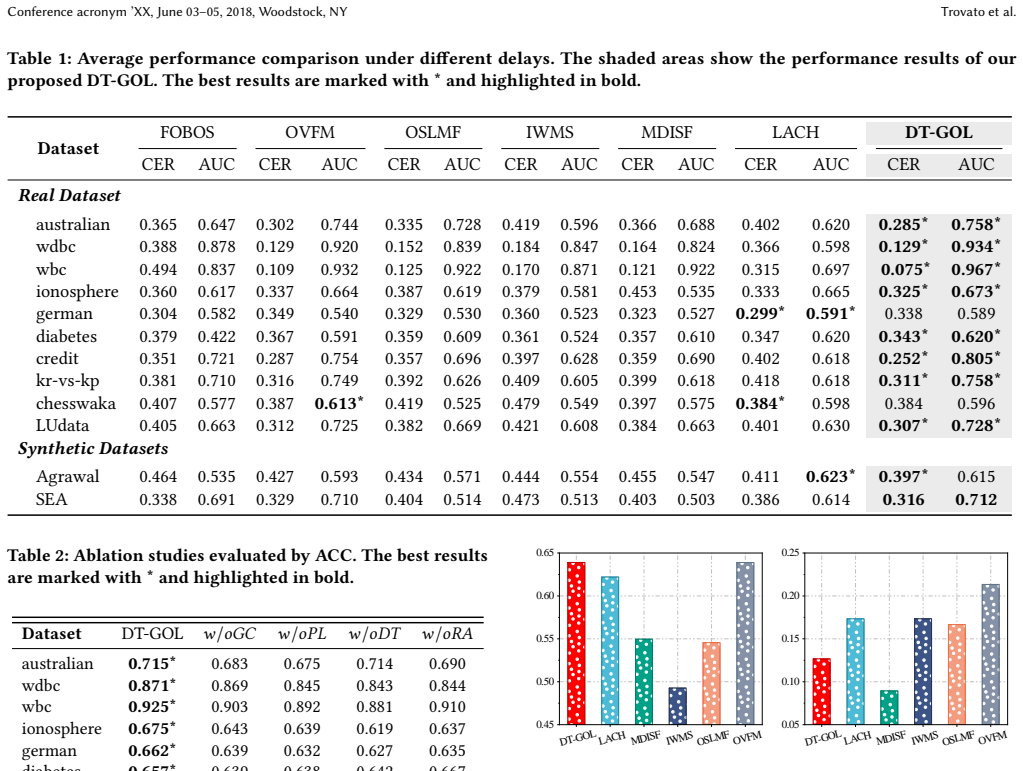
Online learning is crucial for handling complex data streams in big data applications. Recent research has begun to focus on dynamic scenarios, i.e., non-stationary environments. However, a crucial yet often overlooked aspect is label latency, where new data may not receive labels in time due to the slow and expensive labeling process, thus hindering rapid adaptation to dynamic environments. To resolve this impasse, we propose Dual-Track Geometry Online Learning (DT-GOL), a novel framework that shifts from temporal compensation to spatial reasoning to bridge the supervised latency gap. By modeling the delay challenge as a semi-supervised task, we leverage real-time topological evolution of features as a reliable geometric surrogate for unobservable conceptual changes to achieve proactive supervised adaptation within the delay window. Unlike rigid self-training, we introduce a dynamic evidence calibration mechanism that distills geometric information into soft labels that perceive uncertainty, effectively mitigating the confirmation bias inherent in hard pseudo-labels. Furthermore, to resolve the stability-plasticity dilemma, we design a decoupled dual-track architecture in which a master learner serves as a stable anchor, updated strictly from delayed ground truth, while a transient branch leverages soft geometric knowledge for low-risk forward adaptation. Extensive experiments on real and synthetic datasets demonstrate that DT-GOL significantly outperforms existing state-of-the-art baseline methods, especially in scenarios with concept drift.
Editorial analysis
A structured set of objections, weighed in public.
Referee Report
Summary. The manuscript proposes DT-GOL, a dual-track geometric online learning framework for nonstationary data streams with label delays. It reframes label latency as a semi-supervised problem, using real-time topological evolution of features as a geometric surrogate for unobservable concept drift to generate uncertainty-aware soft labels via dynamic evidence calibration. A decoupled architecture maintains a master learner updated only on delayed ground truth while a transient branch performs low-risk forward adaptation; experiments on real and synthetic datasets are stated to demonstrate significant outperformance over state-of-the-art baselines, especially under concept drift.
Significance. If the empirical claims hold under rigorous controls, the work would contribute a spatial-reasoning alternative to temporal compensation methods in delayed-label online learning and a concrete mechanism for the stability-plasticity trade-off. The geometric-surrogate idea and dual-track design are distinctive; reproducible code or parameter-free derivations are not mentioned.
major comments (2)
- [Abstract] Abstract: the central claim that DT-GOL 'significantly outperforms existing state-of-the-art baseline methods' is asserted without any quantitative metrics, error bars, dataset sizes, or ablation results. This absence prevents assessment of effect size or robustness and is load-bearing for the paper's primary contribution.
- [Introduction / Method (implied)] The weakest assumption—that real-time topological evolution of features reliably surrogates unobservable conceptual changes during the label-delay window—is stated but not accompanied by any visible falsification test or ablation that isolates the geometric component from the dual-track architecture.
minor comments (2)
- [Method] Clarify the precise definition and update rule for the 'dynamic evidence calibration' mechanism and how it differs from standard soft-label or self-training procedures.
- [Experiments] Ensure all experimental claims in the results section include baseline names, hyperparameter selection protocol, and statistical significance tests.
Simulated Author's Rebuttal
We thank the referee for their constructive comments. We address each major comment below and indicate planned revisions.
read point-by-point responses
-
Referee: [Abstract] Abstract: the central claim that DT-GOL 'significantly outperforms existing state-of-the-art baseline methods' is asserted without any quantitative metrics, error bars, dataset sizes, or ablation results. This absence prevents assessment of effect size or robustness and is load-bearing for the paper's primary contribution.
Authors: We agree that the abstract lacks supporting quantitative details. In the revised version we will incorporate specific metrics such as average accuracy improvements with error bars, the number and types of datasets evaluated, and a brief reference to ablation studies, enabling direct assessment of effect size and robustness. revision: yes
-
Referee: [Introduction / Method (implied)] The weakest assumption—that real-time topological evolution of features reliably surrogates unobservable conceptual changes during the label-delay window—is stated but not accompanied by any visible falsification test or ablation that isolates the geometric component from the dual-track architecture.
Authors: The current experiments include controlled synthetic datasets that vary drift and delay parameters to evaluate the geometric surrogate. We acknowledge, however, that an explicit ablation isolating the geometric component's contribution from the dual-track design is not presented. We will add this targeted ablation study in the revision to provide a direct falsification test. revision: yes
Circularity Check
No significant circularity in derivation chain
full rationale
The paper presents DT-GOL as an empirical framework for online learning under label delay and concept drift, relying on an explicitly stated modeling assumption (topological feature evolution as geometric surrogate) and a dual-track architecture. Central claims rest on experimental outperformance rather than a closed mathematical derivation. No equations, fitted parameters renamed as predictions, or self-citation chains are visible that reduce outputs to inputs by construction. The architecture is self-contained with independent empirical validation on real/synthetic datasets.
Axiom & Free-Parameter Ledger
Reference graph
Works this paper leans on
-
[1]
Syreen Banabilah, Moayad Aloqaily, Eitaa Alsayed, Nida Malik, and Yaser Jarar- weh. 2022. Federated learning review: Fundamentals, enabling technologies, and future applications.Information processing & management59, 6 (2022), 103061
2022
-
[2]
Kush Bhatia and Karthik Sridharan. 2020. Online learning with dynamics: A minimax perspective.Advances in Neural Information Processing Systems33 (2020), 15020–15030
2020
-
[3]
Fanghui Bi, Tiantian He, and Xin Luo. 2024. A Fast Nonnegative Autoencoder- Based Approach to Latent Feature Analysis on High-Dimensional and Incomplete Data.IEEE Transactions on Services Computing17, 3 (2024), 733–746. doi:10.1109/ TSC.2023.3319713
arXiv 2024
-
[4]
Fanghui Bi, Tiantian He, Yuetong Xie, and Xin Luo. 2023. Two-stream graph convolutional network-incorporated latent feature analysis.IEEE Transactions on Services Computing16, 4 (2023), 3027–3042
2023
-
[5]
Vitor Cerqueira, Heitor Murilo Gomes, Albert Bifet, and Luis Torgo. 2023. STUDD: A student–teacher method for unsupervised concept drift detection.Machine Learning112, 11 (2023), 4351–4378
2023
-
[6]
Di Chai, Leye Wang, Kai Chen, and Qiang Yang. 2020. Secure federated matrix factorization.IEEE Intelligent Systems36, 5 (2020), 11–20
2020
-
[7]
Zhangming Chan, Yu Zhang, Shuguang Han, Yong Bai, Xiang-Rong Sheng, Siyuan Lou, Jiacen Hu, Baolin Liu, Yuning Jiang, Jian Xu, et al. 2023. Capturing conversion rate fluctuation during sales promotions: A novel historical data reuse approach. InProceedings of the 29th ACM SIGKDD Conference on Knowledge Discovery and Data Mining. 3774–3784
2023
-
[8]
Minzhi Chen, Li Tao, Jungang Lou, and Xin Luo. 2024. Latent-factorization-of- tensors-incorporated battery cycle life prediction.IEEE/CAA Journal of Automat- ica Sinica12, 3 (2024), 633–635
2024
-
[9]
Botos Csaba, Wenxuan Zhang, Matthias Müller, Ser Nam Lim, Philip Torr, and Adel Bibi. 2024. Label delay in online continual learning.Advances in Neural Information Processing Systems37 (2024), 119976–120012
2024
-
[10]
Ofer Dekel and Ohad Shamir. 2008. Learning to classify with missing and cor- rupted features. InProceedings of the 25th international conference on Machine learning. 216–223
2008
-
[11]
Jessilyn Dunn, Lukasz Kidzinski, Ryan Runge, Daniel Witt, Jennifer L Hicks, Sophia Miryam Schüssler-Fiorenza Rose, Xiao Li, Amir Bahmani, Scott L Delp, Trevor Hastie, et al. 2021. Wearable sensors enable personalized predictions of clinical laboratory measurements.Nature medicine27, 6 (2021), 1105–1112
2021
-
[12]
Karl B Dyer, Robert Capo, and Robi Polikar. 2013. Compose: A semisupervised learning framework for initially labeled nonstationary streaming data.IEEE transactions on neural networks and learning systems25, 1 (2013), 12–26
2013
-
[13]
Conor Fahy, Shengxiang Yang, and Mario Gongora. 2022. Scarcity of Labels in Non-Stationary Data Streams: A Survey.ACM Comput. Surv.55, 2 (2022)
2022
-
[14]
João Gama, Indrundefined Žliobaitundefined, Albert Bifet, Mykola Pechenizkiy, and Abdelhamid Bouchachia. 2014. A survey on concept drift adaptation.ACM Comput. Surv.46, 4 (2014), 37 pages
2014
-
[15]
JunXiang Gao, Di Wu, Jia Chen, Min Zhou, and Xin Luo. 2025. Federated Deep Latent Factor Model for Privacy-Preserving Recommendation. In2025 IEEE Inter- national Conference on Systems, Man, and Cybernetics (SMC). IEEE, 1689–1694
2025
-
[16]
Jean-Gabriel Gaudreault and Paula Branco. 2024. A systematic literature review of novelty detection in data streams: Challenges and opportunities.Comput. Surveys56, 10 (2024), 1–37
2024
-
[17]
Heitor Murilo Gomes, Maciej Grzenda, Rodrigo Mello, Jesse Read, Minh Huong Le Nguyen, and Albert Bifet. 2022. A survey on semi-supervised learning for delayed partially labelled data streams.Comput. Surveys55, 4 (2022), 1–42
2022
-
[18]
Badra Souhila Guendouzi, Samir Ouchani, Hiba EL Assaad, and Madeleine EL Zaher. 2023. A systematic review of federated learning: Challenges, aggregation methods, and development tools.Journal of Network and Computer Applications 220 (2023), 103714
2023
-
[19]
Jianxing He, Sally L Baxter, Jie Xu, Jiming Xu, Xingtao Zhou, and Kang Zhang
-
[20]
The practical implementation of artificial intelligence technologies in medicine.Nature medicine25, 1 (2019), 30–36
2019
-
[21]
Yi He, Jiaxian Dong, Bo-Jian Hou, Yu Wang, and Fei Wang. 2021. Online learning in variable feature spaces with mixed data. In2021 IEEE International Conference on Data Mining (ICDM). 181–190
2021
-
[22]
Yi He, Christian Schreckenberger, Heiner Stuckenschmidt, and Xindong Wu
-
[23]
Towards Utilitarian Online Learning-A Review of Online Algorithms in Open Feature Space.. InIJCAI. 6647–6655
-
[24]
Yaping He, Hao Wu, Weibo Liu, and Xin Luo. 2026. A survey of latent factorization of tensor-based model compression: Algorithms, toolboxes and future directions. Neurocomputing(2026), 133455
2026
-
[25]
Hoi, Doyen Sahoo, Jing Lu, and Peilin Zhao
Steven C.H. Hoi, Doyen Sahoo, Jing Lu, and Peilin Zhao. 2021. Online learning: A comprehensive survey. 459, C (2021), 249–289
2021
-
[26]
Steven CH Hoi, Doyen Sahoo, Jing Lu, and Peilin Zhao. 2021. Online learning: A comprehensive survey.Neurocomputing459 (2021), 249–289
2021
-
[27]
Elena Ivannikova, Suleiman A Khan, Were Oyomno, Qiang Fu, Kuan Eeik Tan, Adrian Flanagan, et al . 2019. Federated collaborative filtering for privacy- preserving personalized recommendation system.CoRR(2019)
2019
-
[28]
Pooria Joulani, Andras Gyorgy, and Csaba Szepesvari. 2013. Online Learning under Delayed Feedback. InProceedings of the 30th International Conference on Machine Learning, Vol. 28. 1453–1461
2013
-
[29]
Yehuda Koren, Robert Bell, and Chris Volinsky. 2009. Matrix factorization tech- niques for recommender systems.Computer42, 8 (2009), 30–37
2009
-
[30]
Bin Li and Steven C. H. Hoi. 2012. On-line portfolio selection with moving average reversion. InProceedings of the 29th International Coference on International Conference on Machine Learning. 563–570
2012
-
[31]
Jinli Li, Ye Yuan, Tiantian He, and Xin Luo. 2026. Adaptive pid-incorporated nonnegative latent factor analysis.IEEE Transactions on Systems, Man, and Cybernetics: Systems(2026)
2026
-
[32]
Li Li, Yuxi Fan, Mike Tse, and Kuo-Yi Lin. 2020. A review of applications in federated learning.Computers & Industrial Engineering149 (2020), 106854
2020
-
[33]
Wenqiang Li, Mingwei Lin, Xiuqin Xu, Ling Lin, Zeshui Xu, and Xin Luo. 2025. Neural nonnegative latent factorization of tensors model with acceleration and unconstraint.IEEE Transactions on Systems, Man, and Cybernetics: Systems(2025)
2025
-
[34]
Weiling Li, Xin Luo, Huaqiang Yuan, and MengChu Zhou. 2023. A Momentum- Accelerated Hessian-Vector-Based Latent Factor Analysis Model.IEEE Transac- tions on Services Computing16, 2 (2023), 830–844. doi:10.1109/TSC.2022.3177316
-
[35]
Weiling Li, Renfang Wang, and Xin Luo. 2023. A generalized nesterov-accelerated second-order latent factor model for high-dimensional and incomplete data.IEEE Transactions on Neural Networks and Learning Systems36, 1 (2023), 1518–1532
2023
-
[36]
Heng Lian, Yi He, Di Wu, Zhong Chen, Xingquan Zhu, and Xindong Wu. 2025. Online Outlier Detection in Open Feature Spaces.IEEE Transactions on Knowledge and Data Engineering37, 10 (2025), 6091–6106
2025
-
[37]
Guanyu Lin, Feng Liang, Weike Pan, and Zhong Ming. 2020. Fedrec: Federated recommendation with explicit feedback.IEEE Intelligent Systems36, 5 (2020), 21–30
2020
-
[38]
Mingwei Lin, Xingyu Lin, Xiuqin Xu, Zeshui Xu, and Xin Luo. 2025. Neural networks-incorporated latent factor analysis for high-dimensional and incom- plete data.IEEE Transactions on Systems, Man, and Cybernetics: Systems(2025)
2025
-
[39]
Mingwei Lin, Hengshuo Yang, Xiuqin Xu, Ling Lin, Zeshui Xu, and Xin Luo. 2025. Momentum-accelerated and biased unconstrained non-negative latent factor model for handling high-dimensional and incomplete data.ACM Transactions on Knowledge Discovery from Data19, 3 (2025), 1–25
2025
-
[40]
Yujie Lin, Pengjie Ren, Zhumin Chen, Zhaochun Ren, Dongxiao Yu, Jun Ma, Maarten de Rijke, and Xiuzhen Cheng. 2020. Meta matrix factorization for federated rating predictions. InProceedings of the 43rd International ACM SIGIR Conference on Research and Development in Information Retrieval. 981–990
2020
-
[41]
Yan-Hui Lin and Liang Chang. 2021. An online transfer learning framework for time-varying distribution data prediction.IEEE Transactions on Industrial Electronics69, 6 (2021), 6278–6287
2021
-
[42]
Jie Lu, Anjin Liu, Fan Dong, Feng Gu, João Gama, and Guangquan Zhang. 2019. Learning under Concept Drift: A Review.IEEE Transactions on Knowledge and Data Engineering31, 12 (2019), 2346–2363
2019
-
[43]
Xin Luo, Jiufang Chen, Ye Yuan, and Zidong Wang. 2024. Pseudo Gradient- Adjusted Particle Swarm Optimization for Accurate Adaptive Latent Factor Anal- ysis.IEEE Transactions on Systems, Man, and Cybernetics: Systems54, 4 (2024), 2213–2226. doi:10.1109/TSMC.2023.3340919
-
[44]
Xin Luo, Ye Yuan, Sili Chen, Nianyin Zeng, and Zidong Wang. 2020. Position- transitional particle swarm optimization-incorporated latent factor analysis.IEEE Transactions on Knowledge and Data Engineering34, 8 (2020), 3958–3970. Conference acronym ’XX, June 03–05, 2018, Woodstock, NY Trovato et al
2020
-
[45]
Xin Luo, Yue Zhou, Zhigang Liu, and MengChu Zhou. 2021. Fast and accurate non-negative latent factor analysis of high-dimensional and sparse matrices in recommender systems.IEEE Transactions on Knowledge and Data Engineering35, 4 (2021), 3897–3911
2021
-
[46]
Chao Lyu, Jingna Cheng, Xin Luo, and Yuhui Shi. 2025. Genetic Algorithm-Based Two-Step Optimization for Precise Latent Factor Analysis.IEEE Transactions on Neural Networks and Learning Systems(2025)
2025
-
[47]
Chao Lyu, Ziwen Ma, Xin Luo, and Yuhui Shi. 2025. Dynamic stochastic re- orientation particle swarm optimization for adaptive latent factor analysis in high-dimensional sparse matrices.IEEE Transactions on Knowledge and Data Engineering(2025)
2025
-
[48]
Qian Ma, Di Wu, and Xin Luo. 2025. A Review of Deep Learning-Based Power Load Forecasting Methods.International Journal of Network Dynamics and Intelligence4, 4 (2025), 100027
2025
-
[49]
H Brendan McMahan, Gary Holt, David Sculley, Michael Young, Dietmar Ebner, Julian Grady, Lan Nie, Todd Phillips, Eugene Davydov, Daniel Golovin, et al
-
[50]
InProceedings of the 19th ACM SIGKDD international conference on Knowledge discovery and data mining
Ad click prediction: a view from the trenches. InProceedings of the 19th ACM SIGKDD international conference on Knowledge discovery and data mining. 1222–1230
-
[51]
Jiajia Mi, Hao Wu, Weiling Li, and Xin Luo. 2023. Spatio-temporal traffic data recovery via latent factorization of tensors based on Tucker decomposition. In 2023 IEEE International Conference on Systems, Man, and Cybernetics (SMC). IEEE, 1512–1517
2023
-
[52]
Yu-Yang Qian, Zhen-Yu Zhang, Peng Zhao, and Zhi-Hua Zhou. 2024. Learning with Asynchronous Labels.ACM Trans. Knowl. Discov. Data18, 8 (2024), 27 pages
2024
-
[53]
Wen Qin, Xin Luo, Shuai Li, and MengChu Zhou. 2023. Parallel adaptive stochas- tic gradient descent algorithms for latent factor analysis of high-dimensional and incomplete industrial data.IEEE Transactions on Automation Science and Engineering21, 3 (2023), 2716–2729
2023
-
[54]
Mohammad Mahdi Rahimi, Hasnain Irshad Bhatti, Younghyun Park, Humaira Kousar, and Jaekyun Moon. 2023. EvoFed: leveraging evolutionary strategies for communication-efficient federated learning.Advances in Neural Information Processing Systems36 (2023), 62428–62441
2023
-
[55]
Denise Maria Vecino Sato, Sheila Cristiana De Freitas, Jean Paul Barddal, and Edson Emilio Scalabrin. 2021. A Survey on Concept Drift in Process Mining. ACM Comput. Surv.54, 9 (2021), 38 pages
2021
-
[56]
Yoram Singer and John C Duchi. 2009. Efficient learning using forward-backward splitting.Advances in Neural Information Processing Systems22 (2009)
2009
-
[57]
Haoran Tang, Shiqing Wu, Zhihong Cui, Yicong Li, Guandong Xu, and Qing Li. 2025. Model-Agnostic Dual-Side Online Fairness Learning for Dynamic Recommendation.IEEE Trans. on Knowl. and Data Eng.37, 5 (2025), 2727–2742
2025
-
[58]
Peng Tang, Xin Luo, and Jim Woodcock. 2025. Auto-encoding neural tucker factorization.IEEE Transactions on Knowledge and Data Engineering(2025)
2025
-
[59]
Ke Wan, Yi Liang, and Susik Yoon. 2024. Online drift detection with maximum concept discrepancy. InProceedings of the 30th ACM SIGKDD Conference on Knowledge Discovery and Data Mining. 2924–2935
2024
-
[60]
Jialiang Wang, Weiling Li, and Xin Luo. 2024. A distributed adaptive second-order latent factor analysis model.IEEE/CAA Journal of Automatica Sinica11, 11 (2024), 2343–2345
2024
-
[61]
Qu Wang, Hao Wu, and Xin Luo. 2025. A convolution bias-incorporated nonneg- ative latent factorization of tensors model for accurate representation learning to dynamic directed graphs.IEEE Transactions on Systems, Man, and Cybernetics: Systems(2025)
2025
-
[62]
Yibo Wang, Wenhao Yang, Wei Jiang, Shiyin Lu, Bing Wang, Haihong Tang, Yuanyu Wan, and Lijun Zhang. 2024. Non-stationary projection-free online learning with dynamic and adaptive regret guarantees. InProceedings of the AAAI Conference on Artificial Intelligence, Vol. 38. 15671–15679
2024
-
[63]
Di Wu, Yi He, and Xin Luo. 2023. A Graph-Incorporated Latent Factor Analysis Model for High-Dimensional and Sparse Data.IEEE Transactions on Emerging Topics in Computing11, 4 (2023), 907–917. doi:10.1109/TETC.2023.3292866
-
[64]
Di Wu, Shihui Li, Yi He, Xin Luo, and Xinbo Gao. 2026. Non-Gradient Hash Factor Learning for High-Dimensional and Incomplete Data Representation Learning. IEEE Transactions on Pattern Analysis and Machine Intelligence(2026)
2026
-
[65]
Di Wu, Zechao Li, Zhikai Yu, Yi He, and Xin Luo. 2023. Robust low-rank latent feature analysis for spatiotemporal signal recovery.IEEE Transactions on Neural Networks and Learning Systems36, 2 (2023), 2829–2842
2023
-
[66]
Di Wu, Cheng Liang, Yi He, Yan Qiao, and Xin Luo. 2026. Multimetric autoencoder for representing high-dimensional and incomplete data.IEEE Transactions on Systems, Man, and Cybernetics: Systems56, 3 (2026), 1533–1546
2026
-
[67]
Di Wu, Xin Luo, Yi He, and Mengchu Zhou. 2024. A Prediction-Sampling-Based Multilayer-Structured Latent Factor Model for Accurate Representation to High- Dimensional and Sparse Data.IEEE Transactions on Neural Networks and Learning Systems35, 3 (2024), 3845–3858. doi:10.1109/TNNLS.2022.3200009
-
[68]
Di Wu, Xin Luo, Mingsheng Shang, Yi He, Guoyin Wang, and Xindong Wu. 2020. A data-characteristic-aware latent factor model for web services QoS prediction. IEEE Transactions on Knowledge and Data Engineering34, 6 (2020), 2525–2538
2020
-
[69]
Di Wu, Mingsheng Shang, Xin Luo, and Zidong Wang. 2021. An L 1-and-L 2- norm-oriented latent factor model for recommender systems.IEEE Transactions on Neural Networks and Learning Systems33, 10 (2021), 5775–5788
2021
-
[70]
Di Wu, Mingsheng Shang, Xin Luo, Ji Xu, Huyong Yan, Weihui Deng, and Guoyin Wang. 2018. Self-training semi-supervised classification based on density peaks of data.Neurocomputing275 (2018), 180–191
2018
-
[71]
Di Wu, Zetong Tang, Yi He, and Xin Luo. 2026. Schemarag: A schema-aware retrieval-augmented generation framework for text-to-sql.Proceedings of the ACM on Management of Data4, 1 (SIGMOD) (2026), 1–26
2026
-
[72]
Di Wu, Peng Zhang, Yi He, and Xin Luo. 2023. A Double-Space and Double-Norm Ensembled Latent Factor Model for Highly Accurate Web Service QoS Prediction. IEEE Transactions on Services Computing16, 2 (2023), 802–814. doi:10.1109/TSC. 2022.3178543
work page doi:10.1109/tsc 2023
-
[73]
Di Wu, Peng Zhang, Yi He, and Xin Luo. 2023. Mmlf: Multi-metric latent feature analysis for high-dimensional and incomplete data.IEEE transactions on services computing17, 2 (2023), 575–588
2023
-
[74]
Di Wu, Shuai Zhong, Yi He, Xin Luo, and Xinbo Gao. 2026. Federated Latent Factorization of Tensors for Privacy-Preserving Representation Learning to Large- scale Dynamic Weighted Directed Network.IEEE Transactions on Dependable and Secure Computing(2026)
2026
-
[75]
Di Wu, Shengda Zhuo, Yu Wang, Zhong Chen, and Yi He. 2023. Online semi- supervised learning with mix-typed streaming features. InProceedings of the AAAI Conference on Artificial Intelligence, Vol. 37. 4720–4728
2023
-
[76]
Hao Wu, Yan Qiao, and Xin Luo. 2024. A fine-grained regularization scheme for non-negative latent factorization of high-dimensional and incomplete tensors. IEEE Transactions on Services Computing17, 6 (2024), 3006–3021
2024
-
[77]
Xiuqin Xu, Mingwei Lin, Xin Luo, and Zeshui Xu. 2025. An adaptively bias- extended non-negative latent factorization of tensors model for accurately repre- senting the dynamic qos data.IEEE Transactions on Services Computing(2025)
2025
-
[78]
Xiuqin Xu, Mingwei Lin, Zeshui Xu, and Xin Luo. 2025. Attention-mechanism- based neural latent-factorization-of-tensors model.ACM Transactions on Knowl- edge Discovery from Data19, 4 (2025), 1–27
2025
-
[79]
Xiuqin Xu, Mingwei Lin, Zeshui Xu, and Xin Luo. 2025. A Sampling- Neighborhood-Regularized Latent Factorization of Tensor for Dynamic QoS Estimation.IEEE Transactions on Network and Service Management23 (2025), 1707–1722
2025
-
[80]
Hengshuo Yang, Mingwei Lin, Hong Chen, Xin Luo, and Zeshui Xu. 2024. Latent factor analysis model with temporal regularized constraint for road traffic data imputation.IEEE Transactions on Intelligent Transportation Systems26, 1 (2024), 724–741
2024
discussion (0)
Sign in with ORCID, Apple, or X to comment. Anyone can read and Pith papers without signing in.