REVIEW 4 major objections 4 minor 41 references
URNet: A Unified Reparameterized Network for Efficient RGB-D Semantic Segmentation
T0 review · 4 major / 4 minor · reviewed 2026-08-08 · deepseek-v4-flash
Pith's one-line read URNet claims a single reparameterized encoder with linear gated attention can match or beat dual-encoder transformer models on RGB-D semantic segmentation while using roughly half the compute.
desk verdict A promising efficiency-focused RGB-D architecture, but the unstated depth-source for ImageNet pretraining is a load-bearing omission that blocks verification. read the letter →
The pith
A machine-rendered reading of the paper's core claim, the machinery that carries it, and where it could break.
The reading
What carries the argument
The load-bearing mechanism is the Reparameterized Block (RepBlock): at training time it runs three parallel depthwise-convolution branches (a 3x3, a 1x1, and a decomposed 1x7+7x1) plus a skip connection, all of which fold into a single 3x3 depthwise convolution at inference, removing the extra branches' cost. Inside each block, the Linear Gated Attention (LGA) module produces a channel-wise gating signal from each modality via pooling and a 3x3 convolution, multiplies it onto the opposite modality, SE-refines both, and concatenates them into the block's fused output. Around the encoder, the Pyramid Merging Decoder (PMD) downsamples and adds adjacent-scale features then applies pyramid pooling with a residual connection. The whole framework is trained in two phases, RGB-D ImageNet-1k pretraining then segmentation fine-tuning, which the paper argues removes the modality mismatch of RGB-only pretrained encoders.
What would settle it
Retrain URNet-S on NYUDepth V2 with the same recipe but three pretraining depth sources: (a) the undisclosed original source, (b) a public monocular depth estimator on ImageNet, and (c) real sensor depth from NYUDepth V2 training images. If (b) and (c) reproduce the reported +1.2 mIoU gap over RGB-only pretraining within 0.3 mIoU, the claim survives; if the gap collapses for either, the pretraining mechanism is falsified. Simpler: check whether Table 4's numbers reproduce when the pretraining depth is explicitly documented.
Extended reading notes
Core claim
The paper's central discovery is that a unified RGB-D encoder, pretrained jointly on paired RGB and depth images and fused at every block, can match or surpass the accuracy of dual-encoder transformer models while consuming substantially less computation. Concretely, URNet-L achieves 58.8% mIoU on NYUDepth V2 and 53.4% on SUN-RGBD with 73.0G FLOPs, compared with DFormerV2-L's 58.4% and 53.3% at 124.1G FLOPs. The authors attribute this to three co-designed components: reparameterized token mixers that fold multi-branch convolutions into a single inference-time convolution, a Linear Gated Attention (LGA) fusion that re-weights each modality by the other's compact descriptor, and a Pyramid Merging Decoder (PMD) that merges multi-scale features top-down with pooling and addition. The same encoder also transfers to RGB-D salient object detection, where it reports competitive or better results than large saliency models at lower FLOPs.
Load-bearing premise
The load-bearing premise is that the RGB-D ImageNet-1k pretraining data, whose depth maps are never sourced (ImageNet has no real depth), matches the sensor depth distribution used at fine-tuning; if that match fails, the central pretraining benefit could weaken or disappear.
Editorial extensions
If this is right
- A single-encoder RGB-D architecture removes the duplicate feature-extraction branch, so inference cost grows like one backbone instead of two, with reported FPS up to 133 for URNet-T.
- Reparameterization means the training-time multi-branch structure costs nothing at deployment, yielding a roughly 5x speedup over a self-attention token mixer at comparable accuracy (100.35 vs 18.23 FPS).
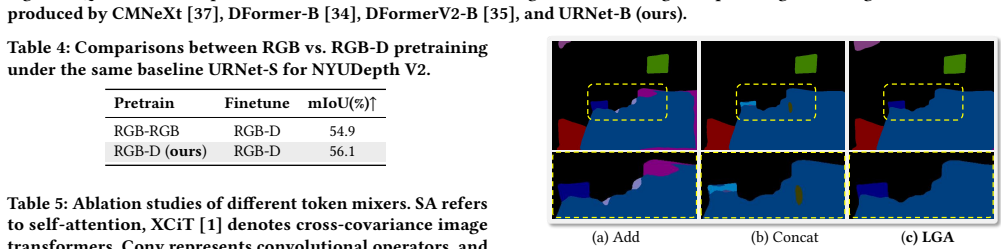
- RGB-D pretraining adds 1.2 mIoU over RGB-only pretraining under identical fine-tuning, implying the unified pretraining is doing real work.
- At the Large scale, URNet-L beats DFormerV2-L on both benchmarks with nearly half the FLOPs (73.0G vs 124.1G on NYUDepth V2).
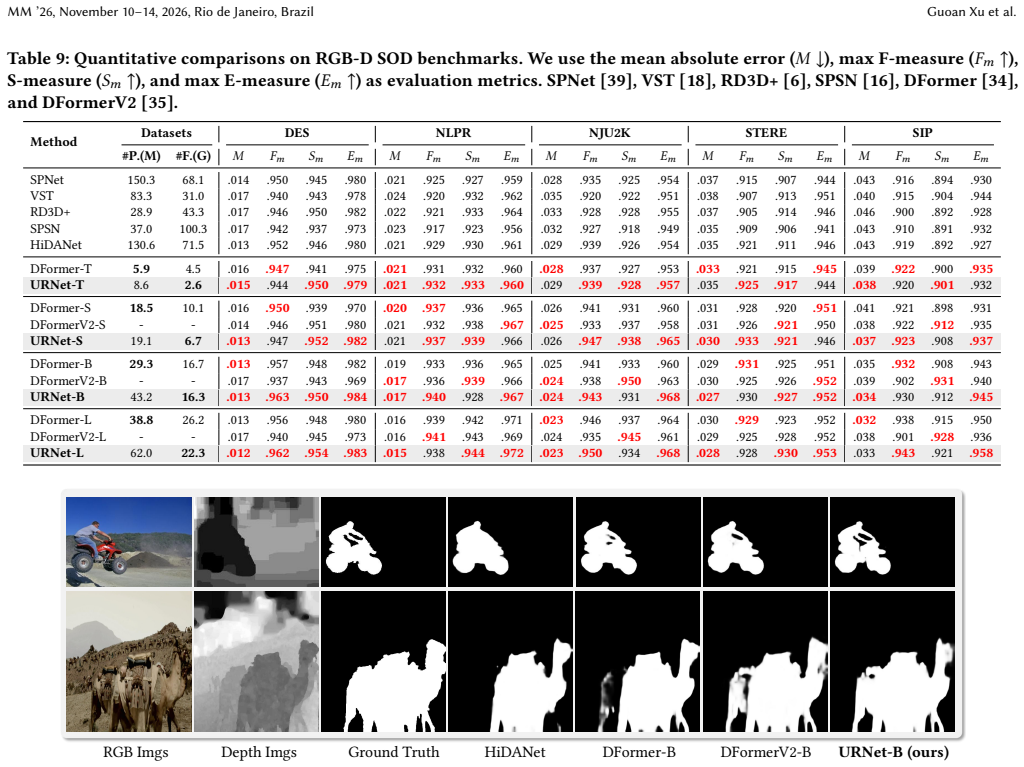
- The same pretrained encoder transfers to RGB-D salient object detection, outperforming HiDANet (130.6M, 71.5G) with 62.0M and 22.3G.
Reading between the lines
- Because ImageNet has no real depth maps, the pretraining depth must come from an undisclosed estimator or synthetic source; a direct test is to swap that source (e.g., monocular depth estimates vs real sensor depth from NYU) and re-measure the +1.2% pretraining gain.
- The LGA cross-gating and PMD decoder are modality-agnostic enough that the same architecture could be applied to other RGB-X tasks (thermal, event, polarization), where a single-encoder design would likely show similar savings.
- Table 8's encoder-decoder swaps suggest the encoder, not the decoder, drives most of the gain; a follow-up could ablate URNet's encoder with an even lighter decoder or a different fusion head to isolate where the remaining headroom is.
Editorial analysis
A structured set of objections, weighed in public.
Referee Report
Summary. The paper proposes URNet, a unified single-encoder RGB-D semantic segmentation network. The architecture combines a reparameterized block (RepBlock) with a linear gated attention (LGA) fusion module and a pyramid merging decoder (PMD). The model is first pretrained on paired RGB-D ImageNet-1k data and then fine-tuned on NYUDepth V2, SUN-RGBD, and several RGB-D salient object detection benchmarks. The authors report accuracy-efficiency advantages over dual-encoder transformer baselines, particularly DFormer and DFormerV2, and ablate the token mixer, fusion strategy, and decoder design.
Significance. If the reported results are correct, URNet would be a meaningful step toward efficient RGB-D segmentation: a single-encoder, reparameterized backbone with channel-gating fusion can match or exceed the accuracy of dual-encoder transformer models at substantially lower FLOPs and higher throughput. The paper also shows a plausible path to unified RGB-D pretraining and provides systematic ablations of the main components. The claims are, however, conditional on an underspecified pretraining data-generation protocol, and several internal numerical inconsistencies make it difficult to fully assess the efficiency and accuracy comparisons.
major comments (4)
- [Section 3.1 and Section 4.1] The Phase I pretraining uses an 'RGB-D ImageNet-1k' dataset, but ImageNet does not contain real depth maps and the paper never states how the paired depth images were obtained. This is load-bearing because Table 4 attributes a +1.2% mIoU gain to RGB-D pretraining, Figure 1 credits the unified pretraining for cross-modal quality, and Table 2 compares URNet with DFormer variants under a claimed 'same RGB-D setting.' If the depth maps come from a monocular estimator, from synthetic renderings, or from a sensor-based collection, the transfer behavior and the risk of leakage from indoor RGB-D domains differ materially. The authors must disclose the depth source, the generation algorithm, preprocessing, and any overlap between the pretraining data and the evaluation datasets, and ideally provide a robustness test with an alternative depth source.
- [Section 4.3, Table 7] The text states that the HAM decoder raises FLOPs from 13.98G to 28.40G, but Table 7 reports 18.40G for HAM. This discrepancy directly affects the claimed efficiency advantage of PMD over HAM. The correct value must be reported consistently, and the ablation conclusion should be restated with the corrected numbers.
- [Section 4.2, Table 3] Several headline comparisons rest on very small margins: URNet-S versus DFormerV2-S is 56.1% vs 56.0% on NYUDepth V2 and 51.8% vs 51.5% on SUN-RGBD, and URNet-L versus DFormerV2-L is 58.8% vs 58.4% and 53.4% vs 53.3%. No error bars, confidence intervals, or multiple-seed experiments are reported. Given that the paper claims state-of-the-art performance, the authors should report the number of runs and standard deviations for at least these key comparisons, or soften the claims accordingly.
- [Tables 1, 3, and 8] Parameter counts are inconsistent across tables for the same model: URNet-T is listed as 9.2M in Table 1 but 9.3M in Table 3; URNet-B is 44.1M versus 43.9M; URNet-L is 62.2M versus 61.8M; and Table 8 reports URNet-B with PMD as 43.9M. The authors should specify whether decoder parameters are included in each count and reconcile the numbers, since the efficiency comparisons are central to the paper.
minor comments (4)
- [Section 4.4] The paper refers to 'Supplements' for more ablation studies, but the submitted version contains no supplementary material; the file should be included or the mention removed.
- [Table 3] The label 'URNet (ours) 26 UR' in the method rows is unclear; it appears to be an artifact and should be replaced with a clear 'Ours' marker.
- [Table 9] DFormerV2-S and DFormerV2-L list '-' for parameter count and FLOPs, which makes the efficiency comparison incomplete; please provide these values or state why they are unavailable.
- [Section 3.1] Equation (1) writes the reparameterized token mixer with four additive branches, but the inference-time equivalence to a single convolution is not explicitly shown; a short derivation or reference to RepViT would help.
Circularity Check
No circularity found: URNet's results are empirical evaluations against external benchmarks, and the unspecified RGB-D ImageNet depth source is a reproducibility gap, not a self-referential derivation.
full rationale
I walked the claimed derivation chain. URNet's contributions are architectural (RepBlock, LGA, PMD) and are evaluated by fine-tuning on external benchmarks (NYUDepth V2, SUN-RGBD, RGB-D SOD). No quantity is fitted to a benchmark and then reported as a prediction; no equation is defined in terms of the quantity it is said to derive. The central pretraining claim (Section 3.1 and Section 4.1) is conditional on an unstated depth-generation source, since ImageNet-1k contains no real depth maps; this is a reproducibility and validity gap, not circularity, because the RGB-versus-RGB-D pretraining comparison in Table 4 is an empirical ablation whose outcome is not encoded in the definition of either training scheme. The self-citations [31, 32, 33] appear only as related-work context for backbones and dual-encoder designs; they do not justify the novel fusion or decoder, and no uniqueness theorem or external authority is invoked to forbid alternatives. The comparisons to DFormer and DFormerV2 rely on independently published external work, and the reported numbers stand or fall on experimental reproducibility rather than on any self-referential chain. Therefore no circular step meets the quoted-reduction standard.
Assumptions & free parameters
free parameters (2)
- Encoder stage channel widths and block counts (Table 1) =
URNet-T/S/B/L: e.g., stage1 channels 48/56/80/80; blocks 3/5/7/7
- Decoder hidden dimension =
256 for all scales
assumptions (4)
- domain assumption Paired RGB-D ImageNet-1k data exists and is usable for pretraining
- standard math Multi-branch depthwise convolutions can be folded into a single convolution at inference
- domain assumption Channel-level statistics from each modality are sufficient for effective cross-modal gating
- domain assumption Reported results from prior methods were produced under comparable training settings
Cite this review
Pith. "Pith review of URNet: A Unified Reparameterized Network for Efficient RGB-D Semantic Segmentation." pith.science (2026). https://pith.science/paper/4VLDLVT5
@misc{pith2026260805671,
  author       = {Pith},
  title        = {Pith review of: URNet: A Unified Reparameterized Network for Efficient RGB-D Semantic Segmentation},
  year         = {2026},
  howpublished = {\url{https://pith.science/paper/4VLDLVT5}},
  note         = {Machine review of arXiv:2608.05671}
}
read the original abstract
Previous RGB-D semantic segmentation methods commonly employ dual encoders to separately process RGB and depth inputs, followed by dedicated modules for cross-modal feature fusion. However, such designs often inadequately capture depth representations and consequently limit effective cross-modal interaction, while the additional encoder branch introduces redundant computation that hinders lightweight execution. To tackle these challenges, we propose URNet, a Unified Reparameterized RGB-D Network that performs simultaneous multi-modal feature extraction and cross-modal fusion within a single encoder. Specifically, we adopt a reparameterization strategy to compact the network architecture and facilitate fast inference. Within each Reparameterized Block (RepBlock), a Linear Gated Attention (LGA) module is introduced to fully exploit complementary RGB and depth cues across different feature scales. Furthermore, considering that decoder design has been relatively underexplored in existing RGB-D segmentation models, we develop a concise yet effective universal decoder, termed the Pyramid Merging Decoder (PMD). Extensive experiments on multiple RGB-D segmentation benchmarks demonstrate that URNet achieves state-of-the-art performance while maintaining high efficiency. Code will be available at https://github.com/Wild-Stephen/URNet.
Figures


Figures from the paper (4 more)


Reference graph
Works this paper leans on
-
[1]
Alaaeldin Ali, Hugo Touvron, Mathilde Caron, Piotr Bojanowski, Matthijs Douze, Armand Joulin, Ivan Laptev, Natalia Neverova, Gabriel Synnaeve, Jakob Verbeek, et al. 2021. Xcit: Cross-covariance image transformers.Advances in Neural Information Processing Systems34 (2021), 20014–20027
work page 2021
-
[2]
Roman Bachmann, David Mizrahi, Andrei Atanov, and Amir Zamir. 2022. Multi- mae: Multi-modal multi-task masked autoencoders. InProceedings of the European Conference on Computer Vision. Springer, 348–367
work page 2022
-
[3]
Lizhi Bai, Jun Yang, Chunqi Tian, Yaoru Sun, Maoyu Mao, Yanjun Xu, and Weirong Xu. 2025. DCANet: Differential convolution attention network for RGB-D se- mantic segmentation.Pattern Recognition162 (2025), 111379
work page 2025
-
[4]
Jinming Cao, Hanchao Leng, Dani Lischinski, Daniel Cohen-Or, Changhe Tu, and Yangyan Li. 2021. Shapeconv: Shape-aware convolutional layer for indoor rgb-d semantic segmentation. InProceedings of the IEEE/CVF International Conference on Computer Vision. 7088–7097
work page 2021
-
[5]
Lin-Zhuo Chen, Zheng Lin, Ziqin Wang, Yong-Liang Yang, and Ming-Ming Cheng
-
[6]
Qian Chen, Zhenxi Zhang, Yanye Lu, Keren Fu, and Qijun Zhao. 2022. 3-D convolutional neural networks for RGB-D salient object detection and beyond. IEEE Transactions on Neural Networks and Learning Systems35, 3 (2022), 4309– 4323
work page 2022
-
[7]
Xiaokang Chen, Kwan-Yee Lin, Jingbo Wang, Wayne Wu, Chen Qian, Hongsheng Li, and Gang Zeng. 2020. Bi-directional cross-modality feature propagation with separation-and-aggregation gate for RGB-D semantic segmentation. In Proceedings of the European Conference on Computer Vision. Springer, 561–577
work page 2020
-
[8]
Shaohua Dong, Yunhe Feng, Qing Yang, Yan Huang, Dongfang Liu, and Heng Fan. 2024. Efficient multimodal semantic segmentation via dual-prompt learning. InProceedings of the IEEE/RSJ International Conference on Intelligent Robots and Systems (IROS). IEEE, 14196–14203
work page 2024
Show all 41 references
-
[9]
Alexey Dosovitskiy. 2020. An image is worth 16x16 words: Transformers for image recognition at scale.arXiv preprint arXiv:2010.11929(2020)
2020 arXiv
-
[10]
Siqi Du, Weixi Wang, Renzhong Guo, Ruisheng Wang, and Shengjun Tang. 2024. Asymformer: Asymmetrical cross-modal representation learning for mobile plat- form real-time rgb-d semantic segmentation. InProceedings of the IEEE/CVF Conference on Computer Vision and Pattern Recognit...
2024
-
[11]
Rohit Girdhar, Mannat Singh, Nikhila Ravi, Laurens Van Der Maaten, Armand Joulin, and Ishan Misra. 2022. Omnivore: A single model for many visual modali- ties. InProceedings of the IEEE/CVF Conference on Computer Vision and Pattern Recognition. 16102–16112
2022
-
[12]
Yan Gong, Jianli Lu, Yongsheng Gao, Jie Zhao, Xiaojuan Zhang, and Susanto Rahardja. 2025. DiffPixelFormer: Differential Pixel-Aware Transformer for RGB-D Indoor Scene Segmentation.arXiv preprint arXiv:2511.13047(2025)
2025
-
[13]
Kaiming He, Xiangyu Zhang, Shaoqing Ren, and Jian Sun. 2016. Deep residual learning for image recognition. InProceedings of the IEEE/CVF Conference on Computer Vision and Pattern Recognition. 770–778
2016
-
[14]
Ding Jia, Jianyuan Guo, Kai Han, Han Wu, Chao Zhang, Chang Xu, and Xinghao Chen. 2024. GeminiFusion: Efficient Pixel-wise Multimodal Fusion for Vision Transformer. arXiv:2406.01210 [cs.CV]
2024 arXiv
-
[15]
Di Jia, Chen Zhao, Huilun Song, Huaxiu Zhang, and Wei Li. 2025. ECMRN: Efficient Cross-Modal Reparameterization Network for RGB-D Tasks via Prompt Tuning.Knowledge-Based Systems(2025), 114321
2025
-
[16]
Minhyeok Lee, Chaewon Park, Suhwan Cho, and Sangyoun Lee. 2022. Spsn: Superpixel prototype sampling network for rgb-d salient object detection. In Proceedings of the European Conference on Computer Vision. Springer, 630–647
2022
-
[17]
Bingyu Li, Da Zhang, Zhiyuan Zhao, Junyu Gao, and Xuelong Li. 2025. Stitch- fusion: Weaving any visual modalities to enhance multimodal semantic seg- mentation. InProceedings of the ACM International Conference on Multimedia. 1308–1317
2025
-
[18]
Nian Liu, Ni Zhang, Kaiyuan Wan, Ling Shao, and Junwei Han. 2021. Visual saliency transformer. InProceedings of the IEEE/CVF International Conference on Computer Vision. 4722–4732
2021
-
[19]
Ze Liu, Yutong Lin, Yue Cao, Han Hu, Yixuan Wei, Zheng Zhang, Stephen Lin, and Baining Guo. 2021. Swin transformer: Hierarchical vision transformer using shifted windows. InProceedings of the IEEE/CVF International Conference on Computer Vision. 10012–10022
2021
-
[20]
Sachin Mehta and Mohammad Rastegari. 2021. Mobilevit: light-weight, general- purpose, and mobile-friendly vision transformer.arXiv preprint arXiv:2110.02178 (2021)
2021 arXiv
-
[21]
Daniel Seichter, Söhnke Benedikt Fischedick, Mona Köhler, and Horst-Michael Groß. 2022. Efficient multi-task rgb-d scene analysis for indoor environments. InProceedings of the International Joint Conference on Neural Networks (IJCNN). IEEE, 1–10
2022
-
[22]
Daniel Seichter, Mona Köhler, Benjamin Lewandowski, Tim Wengefeld, and Horst-Michael Gross. 2021. Efficient rgb-d semantic segmentation for indoor scene analysis. InProceedings of the IEEE International Conference on Robotics and Automation (ICRA). IEEE, 13525–13531
2021
-
[23]
Zifu Wan, Pingping Zhang, Yuhao Wang, Silong Yong, Simon Stepputtis, Katia Sycara, and Yaqi Xie. 2025. Sigma: Siamese mamba network for multi-modal semantic segmentation. InProceedings of the IEEE/CVF Winter Conference on Applications of Computer Vision (W ACV). IEEE, 1734–1744
2025
-
[24]
Ao Wang, Hui Chen, Zijia Lin, Jungong Han, and Guiguang Ding. 2024. Repvit: Revisiting mobile cnn from vit perspective. InProceedings of the IEEE/CVF Con- ference on Computer Vision and Pattern Recognition. 15909–15920
2024
-
[25]
Wenhai Wang, Enze Xie, Xiang Li, Deng-Ping Fan, Kaitao Song, Ding Liang, Tong Lu, Ping Luo, and Ling Shao. 2021. Pyramid vision transformer: A versatile back- bone for dense prediction without convolutions. InProceedings of the IEEE/CVF International Conference on Computer Vis...
2021
-
[26]
Yikai Wang, Xinghao Chen, Lele Cao, Wenbing Huang, Fuchun Sun, and Yunhe Wang. 2022. Multimodal token fusion for vision transformers. InProceedings of the IEEE/CVF Conference on Computer Vision and Pattern Recognition. 12186–12195
2022
-
[27]
Yikai Wang, Wenbing Huang, Fuchun Sun, Tingyang Xu, Yu Rong, and Junzhou Huang. 2020. Deep multimodal fusion by channel exchanging.Advances in Neural Information Processing Systems33 (2020), 4835–4845
2020
-
[28]
Zongwei Wu, Guillaume Allibert, Fabrice Meriaudeau, Chao Ma, and Cédric Demonceaux. 2023. Hidanet: Rgb-d salient object detection via hierarchical depth awareness.IEEE Transactions on Image Processing32 (2023), 2160–2173
2023
-
[29]
Enze Xie, Wenhai Wang, Zhiding Yu, Anima Anandkumar, Jose M Alvarez, and Ping Luo. 2021. SegFormer: Simple and efficient design for semantic segmentation with transformers.Advances in Neural Information Processing Systems34 (2021), 12077–12090
2021
-
[30]
Cunlu Xu, Gang Ma, Feng Gao, Bin Wang, and Jun Liu. 2025. ADBNet: Asym- metric dual-branch network for indoor real-time RGB-D semantic segmentation. Knowledge-Based Systems326 (2025), 113885
2025
-
[31]
Guoan Xu, Jiaming Chen, Wenfeng Huang, Wenjing Jia, Guangwei Gao, and Guo- Jun Qi. 2026. SCASeg: Strip Cross-Attention for Efficient Semantic Segmentation. IEEE Transactions on Image Processing35 (2026), 4847–4860
2026
-
[32]
Guoan Xu, Wenfeng Huang, Wenjing Jia, Jiamao Li, Guangwei Gao, and Guo-Jun Qi. 2025. S2AFormer: Strip Self-Attention for Efficient Vision Transformer.IEEE Transactions on Image Processing34 (2025), 8243–8256
2025
-
[33]
Guoan Xu, Yang Xiao, Guangwei Gao, Dongchen Zhu, Guo-Jun Qi, and Wen- jing Jia. 2026. RSGMamba: Reliability-Aware Self-Gated State Space Model for Multimodal Semantic Segmentation.arXiv preprint arXiv:2604.12319(2026)
2026 arXiv
-
[34]
Bowen Yin, Xuying Zhang, Zhong-Yu Li, Li Liu, Ming-Ming Cheng, and Qibin Hou. 2024. DFormer: Rethinking RGBD Representation Learning for Semantic Segmentation. InICLR
2024
-
[35]
Bo-Wen Yin, Jiao-Long Cao, Ming-Ming Cheng, and Qibin Hou. 2025. DFormerv2: Geometry Self-Attention for RGBD Semantic Segmentation. InProceedings of the IEEE/CVF Conference on Computer Vision and Pattern Recognition Conference. 19345–19355
2025
-
[36]
Jiaming Zhang, Huayao Liu, Kailun Yang, Xinxin Hu, Ruiping Liu, and Rainer Stiefelhagen. 2023. CMX: Cross-modal fusion for RGB-X semantic segmentation with transformers.IEEE Transactions on intelligent transportation systems24, 12 (2023), 14679–14694
2023
-
[37]
Jiaming Zhang, Ruiping Liu, Hao Shi, Kailun Yang, Simon Reiß, Kunyu Peng, Haodong Fu, Kaiwei Wang, and Rainer Stiefelhagen. 2023. Delivering arbitrary- modal semantic segmentation. InProceedings of the IEEE/CVF Conference on Computer Vision and Pattern Recognition. 1136–1147
2023
-
[38]
Chuanyang Zheng. 2025. Iformer: Integrating ConvNet and transformer for mobile application.arXiv preprint arXiv:2501.15369(2025)
2025 arXiv
-
[39]
Tao Zhou, Huazhu Fu, Geng Chen, Yi Zhou, Deng-Ping Fan, and Ling Shao. 2021. Specificity-preserving RGB-D saliency detection. InProceedings of the IEEE/CVF International Conference on Computer Vision. 4681–4691
2021
-
[40]
Wujie Zhou, Enquan Yang, Jingsheng Lei, Jian Wan, and Lu Yu. 2022. PGDENet: Progressive guided fusion and depth enhancement network for RGB-D indoor scene parsing.IEEE Transactions on Multimedia25 (2022), 3483–3494
2022
-
[2021]
Spatial information guided convolution for real-time RGBD semantic segmentation.IEEE Transactions on Image Processing30 (2021), 2313–2324
2021
Reviewed August 8, 2026 · model on record in the stance chip above.
Discussion (0). Continue with ORCID to comment.