TGLF-WINN: Data-Efficient Deep Learning Surrogate for Turbulent Transport Modeling in Fusion
Pith reviewed 2026-05-21 23:02 UTC · model grok-4.3
The pith
TGLF-WINN matches full-data neural network accuracy for tokamak turbulent transport using only 25 percent of the training samples.
A machine-rendered reading of the paper's core claim, the machinery that carries it, and where it could break.
Core claim
TGLF-WINN demonstrates that wavenumber-informed regularization combined with Bayesian active learning produces a surrogate whose predictions of transport fluxes match those of a fully trained TGLF-NN when trained on only one-quarter of the data. Feature tuning and the regularization term together reduce relative RMSLE by 12.5 percent on the full dataset and limit degradation to an order of magnitude less than TGLF-NN when data is reduced to roughly one-ninth the original size. The resulting model remains fully differentiable and supports gradient-based coupling in whole-device simulations.
What carries the argument
The wavenumber-resolved regularization term, which imposes a physics-guided constraint on per-mode fluxes to improve generalization when training data are sparse.
If this is right
- The surrogate delivers a 45x speedup over direct TGLF evaluations in flux-matching workflows while preserving comparable reconstruction accuracy.
- TGLF-WINN maintains accuracy within 4.3 percent of its own full-data result when trained on only 25 percent of the samples.
- The same regularization and active-learning strategy reduces RMSLE degradation by an order of magnitude relative to TGLF-NN when training data are cut to approximately one-ninth the full set.
- The fully differentiable surrogate enables gradient-based optimization and coupling inside larger tokamak simulation codes.
Where Pith is reading between the lines
- The same combination of wavenumber regularization and uncertainty-driven sample selection could reduce data requirements for neural surrogates of other expensive plasma models such as full gyrokinetic codes.
- Because the method produces a differentiable surrogate, it could be embedded directly into real-time plasma control loops that adjust actuator settings based on predicted transport.
- Extending the active-learning loop to include new experimental data from tokamaks would allow the surrogate to improve continuously without requiring a new full offline training campaign.
Load-bearing premise
The wavenumber-resolved regularization improves generalization on sparse data without introducing systematic bias into the per-mode flux predictions.
What would settle it
A comparison of TGLF-WINN per-mode flux predictions against direct TGLF calculations on a held-out set of plasma conditions, trained with 25 percent of the data, that shows larger systematic deviations than the reported 2.8 percent offline accuracy difference.
Figures





read the original abstract
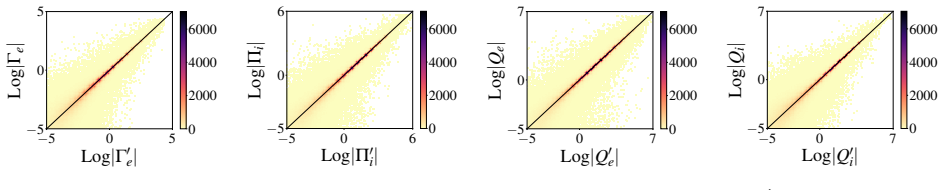
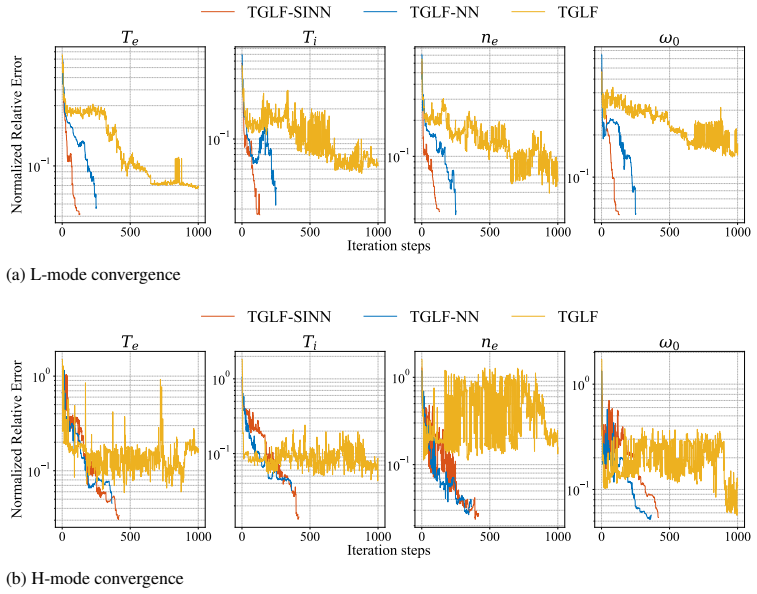
The Trapped Gyro-Landau Fluid (TGLF) model provides fast, accurate predictions of turbulent transport in tokamaks, but whole device simulations requiring thousands of evaluations remain computationally expensive. Neural network (NN) surrogates offer accelerated inference with fully differentiable approximations that enable gradient-based coupling but typically require large training datasets to capture transport flux variations across plasma conditions, creating significant training burden and limiting applicability to expensive gyrokinetic simulations. We propose TGLF-WINN (Wavenumber-Informed Neural Network) with three key innovations: (1) principled feature engineering that reduces target prediction range, simplifying the learning task; (2) physics-guided wavenumber-resolved regularization to improve generalization under sparse data; and (3) Bayesian Active Learning (BAL) to strategically select training samples based on model uncertainty, reducing data requirements while maintaining accuracy. Feature tuning and wavenumber regularization together deliver a 12.5% relative RMSLE reduction over TGLF-NN on the full dataset; under sparse, unfiltered training (approximately 1/9 the full size) they yield an order-of-magnitude smaller RMSLE degradation than TGLF-NN, with the wavenumber-informed regularization imposing a physics-guided constraint on per-mode fluxes. Adding Bayesian Active Learning, TGLF-WINN matches TGLF-NN's full-data offline accuracy using only 25% of the training data, within 2.8% of TGLF-NN's full-data baseline and 4.3% of our own full-data result. A downstream flux-matching workflow further shows practicality: the NN surrogate gives a 45x speedup over TGLF with comparable reconstruction accuracy.
Editorial analysis
A structured set of objections, weighed in public.
Referee Report
Summary. The manuscript introduces TGLF-WINN, a neural-network surrogate for the Trapped Gyro-Landau Fluid (TGLF) turbulent-transport model. It combines feature engineering that reduces target range, wavenumber-resolved regularization intended to supply a physics constraint, and Bayesian active learning to achieve accurate predictions with substantially reduced training data. Reported results include a 12.5 % RMSLE improvement over TGLF-NN on the full dataset, an order-of-magnitude smaller degradation on sparse unfiltered data, and, with BAL, matching TGLF-NN full-data accuracy using only 25 % of the training set while delivering a 45× speedup in a downstream flux-matching workflow.
Significance. If the accuracy and data-efficiency claims hold under rigorous validation, the approach would materially lower the training burden for differentiable surrogates of expensive plasma-transport models, enabling their routine use inside whole-device simulations and gradient-based optimization loops. The explicit combination of physics-guided regularization with uncertainty-driven sample selection is a concrete contribution to the data-scarcity problem that limits surrogate modeling in fusion research.
major comments (2)
- [Abstract / Results] Abstract, innovations paragraph 2 and associated results section: the assertion that wavenumber-resolved regularization 'imposes a physics-guided constraint on per-mode fluxes' without systematic bias rests on aggregate RMSLE values. No mode-resolved signed-error distributions or flux-spectrum comparisons versus the TGLF reference are shown on the sparse splits; such diagnostics are required to confirm that the regularization does not shift the predicted k-spectrum even while lowering scalar error.
- [Results] Data-efficiency results (25 % data claim): the manuscript reports concrete RMSLE numbers and speedups but provides no description of train/validation/test splits, hyperparameter-search protocol, or statistical significance tests for the reported differences. These omissions leave the central data-reduction claim only moderately supported.
minor comments (2)
- [Abstract] Clarify the precise relationship between the 'approximately 1/9 the full size' unfiltered sparse set and the 25 % BAL-selected set; a table or explicit statement would remove ambiguity.
- [Methods] The regularization coefficient and the exact functional form of the wavenumber term should be stated explicitly (including any dependence on local plasma parameters) so that the method can be reproduced.
Simulated Author's Rebuttal
We thank the referee for their constructive review and for recognizing the potential significance of TGLF-WINN for reducing training burdens in plasma-transport surrogate modeling. We address the two major comments below and will revise the manuscript to incorporate additional diagnostics and experimental details as requested.
read point-by-point responses
-
Referee: [Abstract / Results] Abstract, innovations paragraph 2 and associated results section: the assertion that wavenumber-resolved regularization 'imposes a physics-guided constraint on per-mode fluxes' without systematic bias rests on aggregate RMSLE values. No mode-resolved signed-error distributions or flux-spectrum comparisons versus the TGLF reference are shown on the sparse splits; such diagnostics are required to confirm that the regularization does not shift the predicted k-spectrum even while lowering scalar error.
Authors: We agree that the current presentation relies primarily on aggregate RMSLE to support the claim of a physics-guided constraint without systematic bias. To strengthen this, the revised manuscript will include mode-resolved signed-error distributions and direct comparisons of the predicted versus reference flux spectra (across wavenumber bins) specifically for the sparse training splits. These additions will explicitly verify that the regularization preserves the k-spectrum shape and does not introduce per-mode shifts, thereby providing the requested confirmation. revision: yes
-
Referee: [Results] Data-efficiency results (25 % data claim): the manuscript reports concrete RMSLE numbers and speedups but provides no description of train/validation/test splits, hyperparameter-search protocol, or statistical significance tests for the reported differences. These omissions leave the central data-reduction claim only moderately supported.
Authors: We acknowledge that the manuscript currently lacks explicit documentation of these experimental details. In the revised version we will add a dedicated subsection describing the train/validation/test split construction (including how the 25% subset was selected), the full hyperparameter-search protocol (search space, optimization method, and final choices), and statistical significance testing (e.g., results from multiple random seeds with error bars or paired statistical tests on the RMSLE differences). These additions will make the data-efficiency results more rigorously supported. revision: yes
Circularity Check
No circularity: empirical ML surrogate validated against external TGLF baselines
full rationale
The paper reports empirical accuracy and data-efficiency results for TGLF-WINN via direct comparisons of RMSLE and reconstruction error against TGLF and TGLF-NN on held-out plasma data. Feature engineering, wavenumber regularization, and Bayesian active learning are implemented as standard training components whose effects are measured by performance deltas rather than by any equation that reduces a reported prediction to a fitted input by construction. No self-citation load-bearing steps, uniqueness theorems, or ansatz smuggling appear in the derivation of the central claims; the 25% data result and 12.5% RMSLE improvement are outcomes of experimental splits and hyperparameter choices, not tautological redefinitions of the inputs.
Axiom & Free-Parameter Ledger
free parameters (2)
- Wavenumber regularization coefficient
- BAL acquisition function hyperparameters
axioms (1)
- domain assumption TGLF model outputs constitute accurate enough targets for surrogate training across the sampled plasma conditions
Lean theorems connected to this paper
-
IndisputableMonolith/Foundation/AlexanderDuality.leanalexander_duality_circle_linking unclear?
unclearRelation between the paper passage and the cited Recognition theorem.
TGLF computes total turbulent fluxes by summing contributions from each linear mode at different wavenumbers
What do these tags mean?
- matches
- The paper's claim is directly supported by a theorem in the formal canon.
- supports
- The theorem supports part of the paper's argument, but the paper may add assumptions or extra steps.
- extends
- The paper goes beyond the formal theorem; the theorem is a base layer rather than the whole result.
- uses
- The paper appears to rely on the theorem as machinery.
- contradicts
- The paper's claim conflicts with a theorem or certificate in the canon.
- unclear
- Pith found a possible connection, but the passage is too broad, indirect, or ambiguous to say the theorem truly supports the claim.
Reference graph
Works this paper leans on
-
[1]
P. Bonoli, L. C. McInnes, C. Sovinec, D. Brennan, T. Rognlien, P. Snyder, J. Candy, C. Kessel, J. Hittinger, L. Chacon, and . others. Report of the workshop on integrated simulations for magnetic fusion energy sciences. Office of Fusion Energy Sci. and the Office of Adv. Sci. Comput. Res., Tech. Rep, 2015
work page 2015
-
[2]
E. Suchyta, S. Klasky, N. Podhorszki, M. Wolf, A. Adesoji, C. Chang, J. Choi, P. E. Davis, J. Dominski, S. Ethier, and . others. The exascale framework for high fidelity coupled simulations (effis): Enabling whole device modeling in fusion science.The International Journal of High Performance Computing Applications, 36(1):106–128, 2022
work page 2022
-
[3]
O. Meneghini, T. Slendebroek, B.C. Lyons, K. McLaughlin, J. McClenaghan, L. Stagner, J. Harvey, T.F. Neiser, A. Ghiozzi, G. Dose, J. Guterl, A. Zalzali, T. Cote, N. Shi, D. Weisberg, S.P. Smith, B.A. Grierson, and J. Candy. FUSE (Fusion Synthesis Engine): A Next Generation Framework for Integrated Design of Fusion Pilot Plants. arXiv, 2024
work page 2024
-
[4]
S. Hirshman and D. Sigmar. Neoclassical transport of impurities in tokamak plasmas.Nuclear Fusion, 21(9):1079, 1981
work page 1981
-
[5]
E. A. Belli and J. Candy. Full linearized fokker–planck collisions in neoclassical transport simulations.Plasma Physics and Controlled Fusion, 54(1):015015, dec 2011
work page 2011
- [6]
- [7]
-
[8]
L. Lao, K. Burrell, T. Casper, V . Chan, M. Chu, J. DeBoo, E. Doyle, R. Durst, C. Forest, C. Greenfield, and . others. Rotational and magnetic shear stabilization of magnetohydrodynamic modes and turbulence in diii-d high performance discharges.Physics of plasmas, 3(5):1951–1958, 1996
work page 1951
-
[9]
B. C. Lyons, J. McClenaghan, T. Slendebroek, O. Meneghini, T. F. Neiser, S. P. Smith, D. B. Weisberg, E. A. Belli, J. Candy, J. M. Hanson, L. L. Lao, N. C. Logan, S. Saarelma, O. Sauter, P. B. Snyder, G. M. Staebler, K. E. Thome, and A. D. Turnbull. Flexible, integrated modeling of tokamak stability, transport, equilibrium, and pedestal physics.Physics of...
work page 2023
-
[10]
T. Slendebroek, J. McClenaghan, O. M. Meneghini, B. C. Lyons, S. P. Smith, T. F. Neiser, N. Shi, and J. Candy. Elevating zero dimensional global scaling predictions to self-consistent theory-based simulations.Physics of Plasmas, 30(7):072511, 07 2023
work page 2023
-
[11]
J. McClenaghan, A. Marinoni, A. O. Nelson, T. Neiser, L. L. Lao, G. M. Staebler, S. P. Smith, O. M. Meneghini, B. C. Lyons, P. B. Snyder, and M. Austin. Examining transport and integrated modeling predictive capabilities for negative-triangularity scenarios.Plasma Physics and Controlled Fusion, 66(11):115008, sep 2024
work page 2024
- [12]
-
[13]
J. Candy and R. Waltz. An eulerian gyrokinetic-maxwell solver.Journal of Computational Physics, 186(2):545– 581, 2003
work page 2003
- [14]
- [15]
-
[16]
T. F. Neiser, F. Jenko, T. A. Carter, L. Schmitz, D. Told, G. Merlo, A. Bañón Navarro, P. C. Crandall, G. R. McKee, and Z. Yan. Gyrokinetic GENE simulations of DIII-D near-edge L-mode plasmas.Physics of Plasmas, 26(9):092510, 2019
work page 2019
- [17]
- [18]
- [19]
-
[20]
G. Staebler, J. Kinsey, and R. Waltz. A theory-based transport model with comprehensive physics.Physics of Plasmas, 14(5), 2007
work page 2007
-
[21]
G. Staebler, J. Kinsey, and R. Waltz. Gyro-landau fluid equations for trapped and passing particles.Physics of Plasmas, 12(10), 2005
work page 2005
- [22]
- [23]
- [24]
-
[25]
Y . Cao, M. Chai, M. Li, and C. Jiang. Efficient learning of mesh-based physical simulation with bi-stride multi-scale graph neural network. InInternational conference on machine learning, pages 3541–3558. PMLR, 2023
work page 2023
- [26]
-
[27]
I. Char, Y . Chung, W. Neiswanger, K. Kandasamy, A. O. Nelson, M. Boyer, E. Kolemen, and J. Schneider. Offline contextual bayesian optimization.Advances in Neural Information Processing Systems, 32, 2019
work page 2019
-
[28]
J. Seo, S. Kim, A. Jalalvand, R. Conlin, A. Rothstein, J. Abbate, K. Erickson, J. Wai, R. Shousha, and E. Kolemen. Avoiding fusion plasma tearing instability with deep reinforcement learning.Nature, 626(8000):746–751, 2024
work page 2024
- [29]
-
[30]
M. E. Fenstermacher, . DIII-D Team:, J. Abbate, S. Abe, T. Abrams, M. Adams, B. Adamson, N. Aiba, T. Akiyama, P. Aleynikov, E. Allen, S. Allen, H. Anand, J. Anderson, Y . Andrew, T. Andrews, D. Appelt, R. Arbon, N. Ashikawa, A. Ashourvan, M. Aslin, Y . Asnis, M. Austin, D. Ayala, J. Bak, I. Bandyopadhyay, S. Banerjee, K. Barada, L. Bardoczi, J. Barr, E. B...
work page 2022
-
[31]
V . Gopakumar, S. Pamela, L. Zanisi, Z. Li, A. Gray, D. Brennand, N. Bhatia, G. Stathopoulos, M. Kusner, M. P. Deisenroth, and . others. Plasma surrogate modelling using fourier neural operators.Nuclear Fusion, 64(5):056025, 2024
work page 2024
-
[32]
M. M. Rahman, Z. Bai, J. R. King, C. R. Sovinec, X. Wei, S. Williams, and Y . Liu. Sparsified time-dependent fourier neural operators for fusion simulations.Physics of Plasmas, 31(12), 2024
work page 2024
- [33]
-
[34]
O. Meneghini, S. P. Smith, P. B. Snyder, G. M. Staebler, J. Candy, E. Belli, L. Lao, M. Kostuk, T. Luce, T. Luda, and . others. Self-consistent core-pedestal transport simulations with neural network accelerated models.Nuclear Fusion, 57(8):086034, 2017
work page 2017
- [35]
-
[36]
K. L. Plassche, J. Citrin, C. Bourdelle, Y . Camenen, F. J. Casson, V . I. Dagnelie, F. Felici, A. Ho, S. Van Mulders, and J. Contributors. Fast modeling of turbulent transport in fusion plasmas using neural networks.Physics of Plasmas, 27(2), 2020
work page 2020
-
[37]
E. Fransson, A. Gillgren, A. Ho, J. Borsander, O. Lindberg, W. Rieck, M. Åqvist, and P. Strand. A fast neural network surrogate model for the eigenvalues of qualikiz.Physics of Plasmas, 30(12), 2023
work page 2023
- [38]
-
[39]
B. Settles.Active Learning, volume 6 ofSynthesis Lectures on Artificial Intelligence and Machine Learning. Morgan & Claypool Publishers, 2012. 17
work page 2012
-
[40]
T. Neiser, O. Meneghini, S. Smith, J. McClenaghan, T. Slendebroek, D. Orozco, B. Sammuli, G. Staebler, J. Hall, E. Belli, and J. Candy. Multi-fidelity neural network representation of gyrokinetic turbulence. InAPS Division of Plasma Physics Meeting Abstracts, volume 2023 ofAPS Meeting Abstracts, page PP11.039, January 2023
work page 2023
-
[41]
R. Waltz and R. Miller. Ion temperature gradient turbulence simulations and plasma flux surface shape.Physics of Plasmas, 6(11):4265–4271, 1999
work page 1999
- [42]
-
[43]
G. M. Staebler, J. Candy, E. A. Belli, J. E. Kinsey, N. Bonanomi, and B. Patel. Geometry dependence of the fluctuation intensity in gyrokinetic turbulence.Plasma Physics and Controlled Fusion, 63(1):015013, nov 2020
work page 2020
-
[44]
G.M. Staebler, E. A. Belli, J. Candy, J.E. Kinsey, H. Dudding, and B. Patel. Verification of a quasi-linear model for gyrokinetic turbulent transport.Nuclear Fusion, 61(11):116007, sep 2021
work page 2021
-
[45]
H. G. Dudding, F. Casson, D. Dickinson, B. Patel, C. Roach, E. Belli, and G. Staebler. A new quasilinear saturation rule for tokamak turbulence with application to the isotope scaling of transport.Nuclear Fusion, 62(9):096005, 2022
work page 2022
-
[46]
G.M. Staebler, J.M. Park, E. Hassan, C. Angioni, E. Fable, C. Bourdelle, J.E. Kinsey, C. Holland, E.A. Belli, T. Neiser, J. Candy, and R.E. Waltz. Successful prediction of tokamak transport in the l-mode regime.Nuclear Fusion, 64(8):085002, jul 2024
work page 2024
-
[47]
R. Fischer, C. Wendland, A. Dinklage, S. Gori, V . Dose, W. team, and . others. Thomson scattering analysis with the bayesian probability theory.Plasma physics and controlled fusion, 44(8):1501, 2002
work page 2002
-
[48]
J. Svensson, A. Dinklage, J. Geiger, and R. Fischer. An integrated data analysis model for the w7-as stellarator. In 30th EPS Conference on Contr. Fusion and Plasma Phys., St. Petersburg, volume 27, 2003
work page 2003
-
[49]
J. Svensson, A. Dinklage, J. Geiger, A. Werner, and R. Fischer. Integrating diagnostic data analysis for w 7-as using bayesian graphical models.Review of Scientific Instruments, 75(10):4219–4221, 2004
work page 2004
-
[50]
J. Svensson, A. Werner, J. Contributors, and . others. Current tomography for axisymmetric plasmas.Plasma Physics and Controlled Fusion, 50(8):085002, 2008
work page 2008
-
[51]
O. P. Ford.Tokamak plasma analysis through Bayesian diagnostic modelling. PhD thesis, Imperial College London, 2010
work page 2010
-
[52]
S. Kwak, J. Svensson, S. Bozhenkov, J. Flanagan, M. Kempenaars, A. Boboc, Y . Ghim, and J. Contributors. Bayesian modelling of thomson scattering and multichannel interferometer diagnostics using gaussian processes. Nuclear Fusion, 60(4):046009, 2020
work page 2020
-
[53]
S. Kwak, J. Svensson, O. Ford, L. Appel, Y . Ghim, and J. Contributors. Bayesian inference of axisymmetric plasma equilibrium.Nuclear Fusion, 62(12):126069, 2022
work page 2022
-
[54]
P. Rodriguez-Fernandez, N. Howard, A. Saltzman, S. Kantamneni, J. Candy, C. Holland, M. Balandat, S. Ament, and A. White. Enhancing predictive capabilities in fusion burning plasmas through surrogate-based optimization in core transport solvers.Nuclear Fusion, 64(7):076034, 2024
work page 2024
-
[55]
J. B. Lestz, G. Avdeeva, T. F. Neiser, M. V . Gorelenkova, F. D. Halpern, S. M. Kaye, J. McClenaghan, A. Y . Pankin, and K. E. Thome. Assessing time-dependent temperature profile predictions using reduced transport models for high performing nstx plasmas, 2025
work page 2025
- [56]
-
[57]
T. F. Neiser, D. Sun, B. Agnew, T. Slendebroek, O. Meneghini, B. C. Lyons, A. G. Ghiozzi, J. T. McClenaghan, G. M. Staebler, and J. Candy. TJLF: The quasi-linear model of gyrokinetic transport TGLF translated to Julia. In Bulletin of the American Physical Society, 2024
work page 2024
-
[58]
Q. Pratt, V . Hall-Chen, T.F. Neiser, R. Hong, J. Damba, T.L. Rhodes, K.E. Thome, J. Yang, S.R. Haskey, T. Cote, and T. Carter. Density wavenumber spectrum measurements, synthetic diagnostic development, and tests of quasilinear turbulence modeling in the core of electron-heated diii-d h-mode plasmas.Nuclear Fusion, 64(1):016001, nov 2023. 19 A Complete A...
work page 2023
discussion (0)
Sign in with ORCID, Apple, or X to comment. Anyone can read and Pith papers without signing in.