Diffusive-to-Ballistic transition in a Persistent Random Walk
Pith reviewed 2026-05-20 03:25 UTC · model grok-4.3
The pith
A persistent random walk with reversal probability decaying as a power law switches from super-diffusive to ballistic motion exactly at exponent alpha equals one.
A machine-rendered reading of the paper's core claim, the machinery that carries it, and where it could break.
Core claim
For a persistent random walk whose reversal probability follows p(t) ~ t^{-alpha}, the system undergoes a transition at alpha=1 that separates a super-diffusive regime (alpha<1) from a ballistic regime (alpha >=1). The transition is diagnosed by changes in velocity autocorrelation decay, persistence properties, and finite-time scaling of the Binder cumulant together with displacement fluctuations. The transition criterion extends to other time-dependent reversal probabilities that satisfy the same integral condition and remains valid in arbitrary dimensions when isotropy of the velocity space is preserved.
What carries the argument
The time-dependent reversal probability p(t) ~ t^{-alpha} together with the integral criterion on its long-time tail that distinguishes super-diffusive from ballistic scaling of the mean-squared displacement.
If this is right
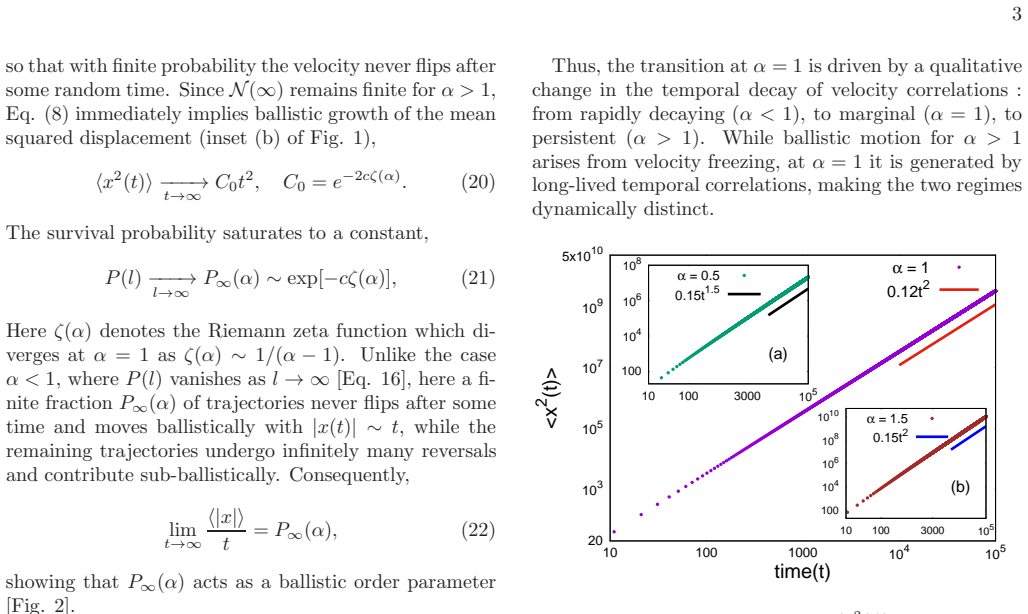
- When alpha is greater than or equal to one the mean-squared displacement grows quadratically with time, indicating ballistic motion.
- For alpha less than one the mean-squared displacement grows faster than linearly but slower than quadratically, indicating super-diffusion.
- The location of the transition is independent of spatial dimension provided velocity isotropy is maintained.
- Finite-time scaling collapses of the Binder cumulant and displacement fluctuations locate the transition point and characterize its critical properties.
- The transition criterion applies to any reversal probability whose long-time tail satisfies the same integral condition as the power-law case.
Where Pith is reading between the lines
- The transition may appear in models of biological motility where turning rates decrease slowly with time, offering a mechanism for persistent directed motion without external bias.
- Numerical tests in higher dimensions could confirm whether isotropy alone is sufficient to protect the ballistic regime against dimensional effects.
- Experiments with colloidal particles or active matter whose reorientation probability is engineered to follow a power law could directly observe the predicted change in scaling.
Load-bearing premise
The reversal probability decays as a power law or satisfies an equivalent integral condition while the directions of the velocity remain statistically isotropic at all times.
What would settle it
A direct measurement of the mean-squared displacement scaling exponent or the Binder cumulant crossing point in a simulation or experiment that tunes the reversal probability exponent through alpha=1.
Figures


read the original abstract
We study persistent random walk with time dependent velocity reversal probabilities and identify a criterion for a non-equilibrium dynamical transition. As a representative example, we consider a power law reversal probability $p(t)\sim t^{-\alpha}$ and show that the system undergoes a transition at $\alpha=1$, separating a super-diffusive regime for $\alpha<1$ from ballistic regime for $\alpha \geq 1$. Using the results for velocity correlations and persistence statistics, together with finite time scaling of the Binder cumulant and displacement fluctuations, we characterize the transition and its properties in detail. We further argue that the transition is not limited to the power law form, but can also arise for several other time dependent reversal probabilities satisfying the same criterion. The transition persists in arbitrary spatial dimensions provided isotropy of the velocity space is preserved.
Editorial analysis
A structured set of objections, weighed in public.
Referee Report
Summary. The manuscript examines persistent random walks with time-dependent velocity reversal probabilities, using the power-law form p(t)∼t^{-α} as a representative example. It claims to identify a non-equilibrium dynamical transition at α=1 that separates a super-diffusive regime for α<1 from a ballistic regime for α≥1. The transition is characterized via velocity correlations, persistence statistics, finite-time scaling of the Binder cumulant, and displacement fluctuations. The authors further argue that the same integral criterion for the transition applies to other reversal probability forms and persists in arbitrary dimensions when velocity-space isotropy is preserved.
Significance. If the central claim were correct, the work would supply a general criterion for the onset of ballistic transport in persistent random walks with decaying reversal rates, with possible relevance to non-equilibrium transport problems. The combination of correlation functions with Binder-cumulant scaling provides a concrete route to locating the transition.
major comments (2)
- [Abstract and §3 (velocity correlations)] Abstract and the section deriving the transport regimes: the assignment of super-diffusion to α<1 contradicts the standard evaluation of the long-time diffusion coefficient from the velocity autocorrelation. With p(t)∼t^{-α} and α<1 the survival probability decays as a stretched exponential, so that C(t) is integrable and the mean-square displacement is asymptotically linear in t (normal diffusion), not super-diffusive. The claimed transition at α=1 therefore rests on an incorrect identification of the resulting transport exponent.
- [§5 (finite-time scaling)] The finite-time scaling analysis of the Binder cumulant and displacement fluctuations (presumably §5) presupposes the super-diffusive versus ballistic regimes derived earlier; once the transport exponents are corrected, the scaling forms and the location of the apparent transition must be re-derived.
minor comments (2)
- [§2 (model definition)] Define the reversal probability p(t) and its relation to the persistence-time distribution explicitly at first use and maintain consistent notation thereafter.
- [Figures 3–5] Label the axes and state the scaling collapse explicitly in all figures that display Binder cumulants or displacement fluctuations so that the claimed transition is immediately visible.
Simulated Author's Rebuttal
We thank the referee for their careful reading of our manuscript and for providing detailed comments. We address each major comment point by point below. We agree that the transport regimes require correction and will revise the manuscript to reflect the proper asymptotic behaviors while preserving the core criterion for the transition.
read point-by-point responses
-
Referee: [Abstract and §3 (velocity correlations)] Abstract and the section deriving the transport regimes: the assignment of super-diffusion to α<1 contradicts the standard evaluation of the long-time diffusion coefficient from the velocity autocorrelation. With p(t)∼t^{-α} and α<1 the survival probability decays as a stretched exponential, so that C(t) is integrable and the mean-square displacement is asymptotically linear in t (normal diffusion), not super-diffusive. The claimed transition at α=1 therefore rests on an incorrect identification of the resulting transport exponent.
Authors: We thank the referee for this important observation. After verifying the velocity autocorrelation, we concur that for α < 1, the survival probability S(t) decays as a stretched exponential exp(−const × t^{1−α}), making C(t) integrable. Thus, the diffusion coefficient is finite, and the mean-square displacement grows linearly with time at long times, indicating normal diffusion. We will update the abstract, §3, and related sections to correctly classify the regime for α < 1 as normal diffusion. The transition at α = 1, where the survival probability transitions to a power-law decay leading to non-integrable correlations and ballistic behavior for α > 1, remains valid. This revision strengthens the manuscript by aligning with standard transport theory. revision: yes
-
Referee: [§5 (finite-time scaling)] The finite-time scaling analysis of the Binder cumulant and displacement fluctuations (presumably §5) presupposes the super-diffusive versus ballistic regimes derived earlier; once the transport exponents are corrected, the scaling forms and the location of the apparent transition must be re-derived.
Authors: We acknowledge that the scaling analysis in §5 was predicated on the original regime assignments. With the corrected regimes (normal diffusion for α < 1 and ballistic for α ≥ 1), we will re-derive the finite-time scaling forms for the Binder cumulant and displacement fluctuations. The location of the transition at α = 1 is determined by the integrability of the velocity autocorrelation, which is independent of the misidentified super-diffusive label. We will provide updated scaling functions and confirm that the Binder cumulant analysis still locates the transition correctly at α = 1. These changes will be incorporated in the revised manuscript. revision: yes
Circularity Check
No circularity: derivation proceeds from explicit reversal probability to velocity correlations without self-referential reduction
full rationale
The paper starts from an externally specified reversal probability p(t)∼t^{-α} (or analogous integral criterion) and computes velocity autocorrelation C(t) and persistence statistics directly from the survival probability and reversal process. The claimed transition location α=1 and the super-diffusive vs. ballistic regimes are obtained by examining the long-time behavior of the mean-squared displacement and the integral of C(t), using finite-time scaling of the Binder cumulant as an independent diagnostic. No parameter is fitted to the target transport exponent, no uniqueness theorem is imported from prior self-work, and the central mapping does not reduce to a renaming or tautological re-expression of the input p(t). The derivation remains self-contained against the stated assumptions of velocity-space isotropy.
Axiom & Free-Parameter Ledger
axioms (1)
- domain assumption Persistent random walk is defined by a time-dependent velocity reversal probability while preserving isotropy in velocity space.
Lean theorems connected to this paper
-
IndisputableMonolith/Cost/FunctionalEquationwashburn_uniqueness_aczel unclear?
unclearRelation between the paper passage and the cited Recognition theorem.
when N(∞) remains finite ... ⟨x²(t)⟩∼t²; when N(t) grows ... ⟨x²(t)⟩∼∑1/p(u) (Eqs. 8,10)
-
IndisputableMonolith/Foundation/RealityFromDistinctionreality_from_one_distinction unclear?
unclearRelation between the paper passage and the cited Recognition theorem.
transition at α=1 separating super-diffusive (α<1) from ballistic (α≥1)
What do these tags mean?
- matches
- The paper's claim is directly supported by a theorem in the formal canon.
- supports
- The theorem supports part of the paper's argument, but the paper may add assumptions or extra steps.
- extends
- The paper goes beyond the formal theorem; the theorem is a base layer rather than the whole result.
- uses
- The paper appears to rely on the theorem as machinery.
- contradicts
- The paper's claim conflicts with a theorem or certificate in the canon.
- unclear
- Pith found a possible connection, but the passage is too broad, indirect, or ambiguous to say the theorem truly supports the claim.
Reference graph
Works this paper leans on
-
[1]
3), in excellent agreement with the analytical prediction
ln t (Fig. 3), in excellent agreement with the analytical prediction. In addition, the displacement distribution at criticality becomes exceptionally broad (see Fig. S3 in [31]), directly reflecting the strong fluctuations associated with the transition. The logarithmic scaling variable implies an exponen- tially large characteristic timescale t∗ (α ) ∼ e 1...
-
[2]
E. Renshaw and R. HENDER, The correlated random walk, J. Appl. Prob. 18, 403 (1981)
work page 1981
-
[3]
J. W. Hanneken, D. R. Franceschetti, Exact distribution function for discrete time correlated random walks in one dimension, J. Chem. Phys. 109, 6533–6539 (1998)
work page 1998
-
[4]
G. H. Weiss, Some applications of persistent random walks and the telegrapher’s equation , Physica A 311, 381 (2002)
work page 2002
-
[5]
M. Kac, A Stochastic Model Related to the Telegrapher’s Equation, Rocky Mountain Journal of Mathematics 4, 497–509 (1974)
work page 1974
-
[6]
Rossetto, The one-dimensional asymmetric persistent random walk , J
V. Rossetto, The one-dimensional asymmetric persistent random walk , J. Stat. Mech. 043204 (2018)
work page 2018
-
[7]
Z. Sadjadi, M. Miri, Persistent random walk on a one- dimensional lattice with random asymmetric transmit- tances, Phys. Rev. E 78, 061114 (2008)
work page 2008
-
[8]
A. Svenkeson, B. J. West, Persistent random motion with maximally correlated fluctuations , Phys. Rev. E 100, 022119 (2019)
work page 2019
-
[9]
M. Chupeau, O. B´ enichou, R. Voituriez,Mean cover time of one-dimensional persistent random walks , Phys. Rev. E 89, 062129 (2014)
work page 2014
-
[10]
A. L. P. Livorati, T. Kroetz,C. P. Dettmann, I. L. Caldas, and E. D. Leonel, Transition from normal to ballistic dif- fusion in a one-dimensional impact system , Phys. Rev. E. 97, 032205 (2018)
work page 2018
-
[11]
P. C´ enac, A. Le Ny, B. de Loynes and Y. Offret,Persistent random walks. I. Recurrence versus transience , J. Theor. Probab. 31(1), 232 (2018). 6
work page 2018
-
[12]
P. C´ enac, A. Le Ny, B. de L. and Y. Offret, Persistent Random Walks. II. Functional Scaling Limits , J. Theor. Prob., 32(2), 633 (2019)
work page 2019
-
[13]
J. Masoliver, J. M. Porra, G. H. Weiss, Solutions of the telegrapher’s equation in the presence of traps, Phys. Rev. A 45, 2222 (1992)
work page 1992
-
[14]
Z. Sadjadi, M. R. Shaebani and H. Rieger, and L. Santen, Persistent random walk approach to anomalous trans- port of self-propelled particles , Phys. Rev. E 91, 062715 (2015)
work page 2015
-
[15]
H. C. Berg, Random Walks in Biology , Princeton Uni- versity Press, 1993
work page 1993
-
[16]
H. C. Berg, D. A. Brown, Chemotaxis in Escherichia coli analysed by Three-dimensional Tracking , Nature 239, 500–504 (1972)
work page 1972
-
[17]
J. Tailleur, M. E. Cates, Statistical Mechanics of Inter- acting Run-and-Tumble Bacteria , Phys. Rev. Lett. 100, 218103 (2008)
work page 2008
-
[18]
O. B´ enichou, C. Loverdo, M. Moreau, and R. Voituriez, Intermittent search strategies , Rev. Mod. Phys. 83, 81 (2011)
work page 2011
-
[19]
O. B´ enichou and R. Voituriez, From first-passage times of random walks in confinement to geometry-controlled kinetics, Phys. Rep. 539, 225 (2014)
work page 2014
-
[20]
M. C. Marchetti et al., Hydrodynamics of soft active mat- ter, Rev. Mod. Phys. 85, 1143 (2013)
work page 2013
-
[21]
Bechinger et al., Active particles in complex and crowded environments , Rev
C. Bechinger et al., Active particles in complex and crowded environments , Rev. Mod. Phys. 88, 045006 (2016)
work page 2016
- [22]
-
[23]
A. P. Solon et al., Pressure and Phase Equilibria in In- teracting Active Brownian Spheres, Phys. Rev. Lett. 114, 198301 (2015)
work page 2015
-
[24]
V. Zaburdaev, S. Denisov, and J. Klafter, L´ evy walks, Rev. Mod. Phys. 87, 483 (2015)
work page 2015
-
[25]
R. Metzler and J. Klafter, The random walk’s guide to anomalous diffusion: a fractional dynamics approach , Phys. Rep. 339, 1 (2000)
work page 2000
-
[26]
R. Metzler et al., Anomalous diffusion models and their properties: non-stationarity, non-ergodicity, and agein g at the centenary of single particle tracking , Phys. Chem. Chem. Phys. 16, 24128 (2014)
work page 2014
- [27]
-
[28]
Fedotov, Subdiffusion, chemotaxis, and anomalous ag- gregation , Phys
S. Fedotov, Subdiffusion, chemotaxis, and anomalous ag- gregation , Phys. Rev. E 83, 021110 (2011)
work page 2011
-
[29]
E. Barkai and Y. Cheng, Aging continuous time random walks, J. Chem. Phys. 118, 6167 (2003)
work page 2003
-
[30]
J. H. Jeon and R. Metzler, Fractional Brownian motion and motion governed by the fractional Langevin equation in confined geometries , Phys. Rev. E 81, 021103 (2010)
work page 2010
-
[31]
J. H. P. Schulz, E. Barkai, R. Metzler, Aging Effects and Population Splitting in Single-Particle Trajectory Aver- ages, Phys. Rev. Lett. 110, 020602 (2013)
work page 2013
-
[32]
Diffusive-to-Ballistic transition in a Persistent Random Walk
See Supplemental Material for detailed additional der iva- tions along with other related discussions. 1 Supplemental Material for “Diffusive-to-Ballistic transition in a Persistent Random Walk” Amit Pradhan 1, Reshmi Roy 2 and Purusattam Ray 3 1Department of Physics, University of Calcutta, 92 Acharya P rafulla Chandra Road, Kolkata 700009 2Department of ...
discussion (0)
Sign in with ORCID, Apple, or X to comment. Anyone can read and Pith papers without signing in.