Hybrid Expansion Cosmology in f(T) Gravity: Late-Time Evolution and Observational Bounds
Pith reviewed 2026-06-29 15:53 UTC · model grok-4.3
The pith
Exponential f(T) gravity with a hybrid scale factor produces a quintessence universe that approaches the Lambda CDM scenario at late times.
A machine-rendered reading of the paper's core claim, the machinery that carries it, and where it could break.
Core claim
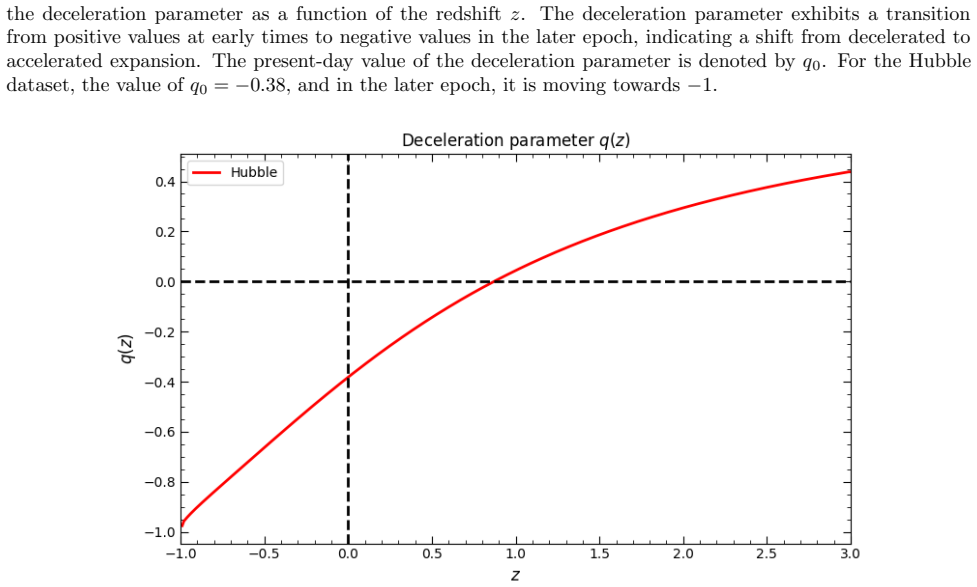
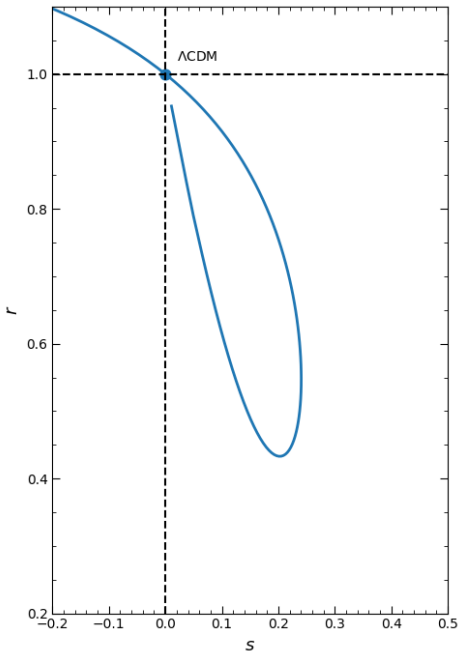
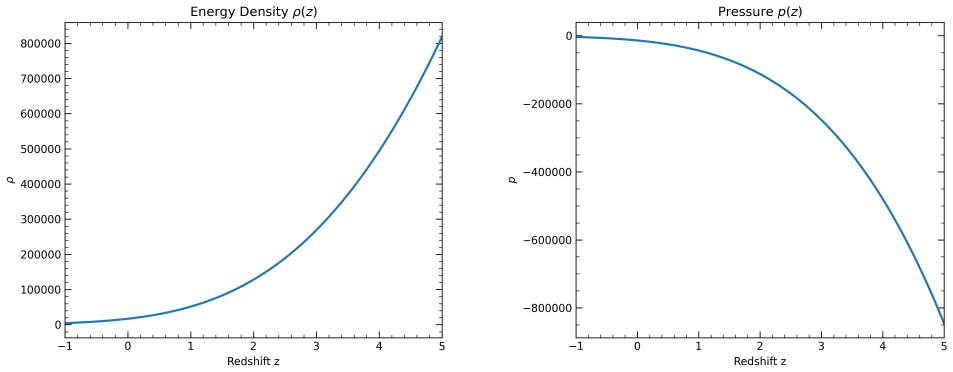
In an exponential f(T) gravity model combined with a hybrid scale factor, the parameters fitted to 31 Hubble observations yield matter-energy density and pressure evolution that is consistent with the observed cosmic acceleration; the model stays inside the quintessence regime and asymptotically approaches the Lambda CDM scenario.
What carries the argument
The hybrid scale factor, chosen to encode the smooth shift from early deceleration to late acceleration and thereby permit exact cosmological solutions.
If this is right
- Classical energy conditions remain satisfied throughout the evolution.
- Cosmographic parameters stay compatible with current observations.
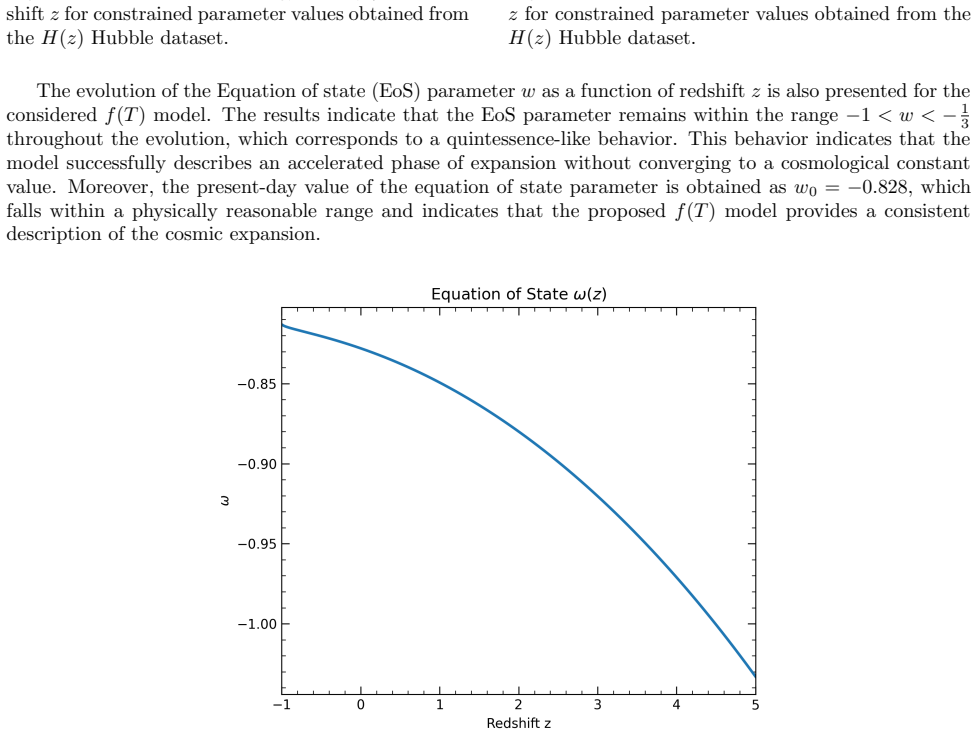
- The equation-of-state parameter remains greater than -1, confirming quintessence behavior.
- The late-time limit recovers the standard Lambda CDM expansion history.
Where Pith is reading between the lines
- Alternative scale-factor choices could be tested against the same Hubble data to see whether the quintessence approach to Lambda CDM is robust or specific to the hybrid form.
- The model offers a concrete target for future surveys that measure the growth of structure or the equation-of-state evolution at intermediate redshifts.
- If the same f(T) functional form can be matched to early-universe data, the framework might describe both inflation and late acceleration within one modified-gravity setting.
Load-bearing premise
The hybrid scale factor is imposed by hand to produce the observed transition from deceleration to acceleration rather than being derived from the field equations.
What would settle it
A statistically significant mismatch between the model's predicted Hubble parameter at redshifts beyond the current 31-point sample and new, higher-precision measurements would falsify the claimed consistency with acceleration.
Figures


read the original abstract
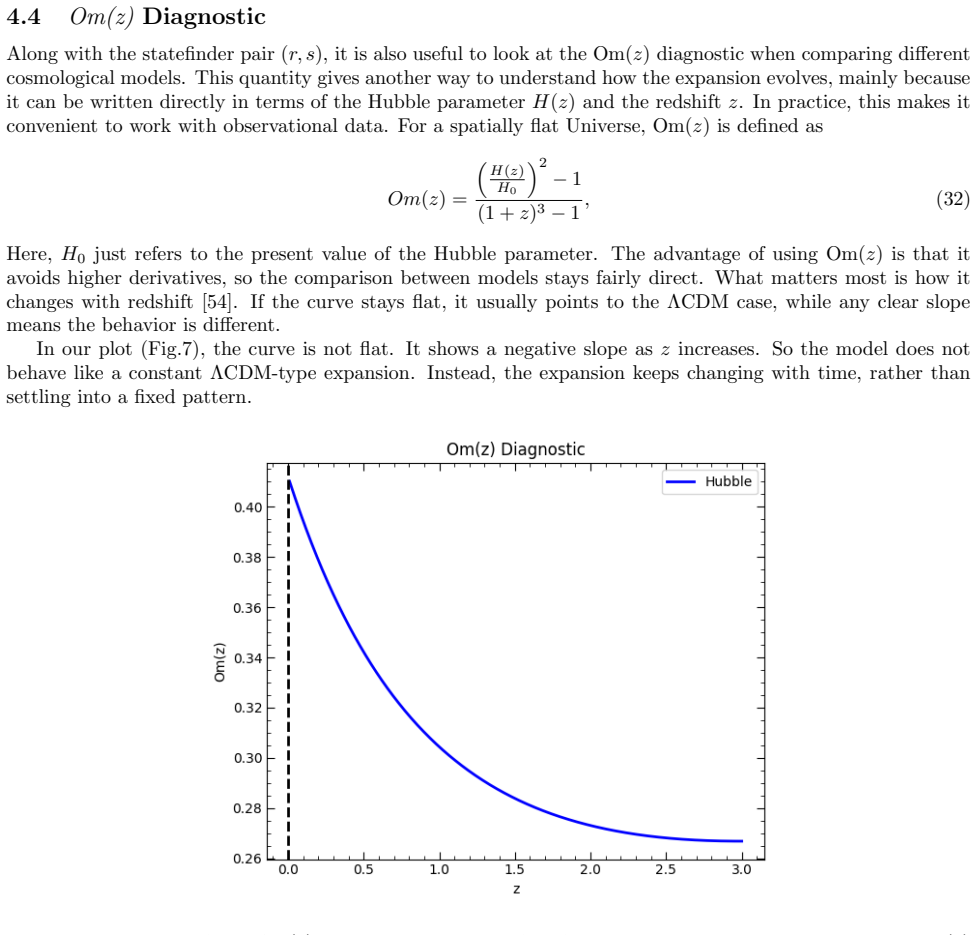
This study investigates the cosmological dynamics of an accelerating universe within the framework of teleparallel gravity using an exponential f(T) functional form. To obtain exact cosmological solutions, a hybrid scale factor is employed to model the smooth transition from an early decelerated phase to the present accelerated expansion of the Universe. The physical consistency of the model is analyzed through classical energy conditions and cosmographic parameters. By constraining the model parameters using 31 Hubble data points, we find that the resulting matter-energy density and pressure evolution remain consistent with the observed cosmic acceleration. Diagnostic analysis confirms that the model remains within the quintessence regime and asymptotically approaches the {\Lambda}CDM scenario.
Editorial analysis
A structured set of objections, weighed in public.
Referee Report
Summary. The paper investigates late-time cosmology in exponential f(T) gravity, employing a hybrid scale factor ansatz to obtain exact solutions that model the transition from early deceleration to present acceleration. It analyzes energy conditions and cosmographic parameters, constrains parameters using 31 Hubble data points, and claims that the resulting density/pressure evolution is consistent with observed acceleration, remains in the quintessence regime, and asymptotically approaches the ΛCDM scenario.
Significance. If the central claims hold after addressing the ansatz dependence, the work would supply an exactly solvable f(T) model with observational constraints that reproduces key late-time features of standard cosmology. The use of Hubble data for parameter fitting and diagnostic checks provides a concrete link to observations, though the overall significance is reduced by the ad-hoc functional form chosen to enable the solutions.
major comments (1)
- [Abstract] Abstract: The claim that 'diagnostic analysis confirms that the model ... asymptotically approaches the ΛCDM scenario' is not an independent outcome of the f(T) dynamics. The hybrid scale factor is introduced precisely 'to model the smooth transition from an early decelerated phase to the present accelerated expansion' and is constructed with late-time exponential behavior that forces the effective equation-of-state parameter to approach −1 regardless of the specific exponential f(T) form. Once a(t) is fixed, the torsion scalar and matter content are solved to be consistent with that imposed expansion history, so the approach to ΛCDM tests consistency with the ansatz rather than testing whether f(T) itself drives the universe toward de Sitter. This is load-bearing for the strongest claim.
minor comments (2)
- The manuscript supplies no derivation details, error bars, or explicit checks against post-hoc parameter choices for the consistency with the 31 Hubble points; this makes the soundness of the observational bounds difficult to assess.
- The hybrid scale factor is stated to be employed 'to obtain exact cosmological solutions' but is not derived from the field equations; a brief discussion of its motivation beyond enabling solvability would improve clarity.
Simulated Author's Rebuttal
We thank the referee for their insightful comments on our manuscript. We address the major comment regarding the abstract claim about the asymptotic approach to the ΛCDM scenario.
read point-by-point responses
-
Referee: [Abstract] Abstract: The claim that 'diagnostic analysis confirms that the model ... asymptotically approaches the ΛCDM scenario' is not an independent outcome of the f(T) dynamics. The hybrid scale factor is introduced precisely 'to model the smooth transition from an early decelerated phase to the present accelerated expansion' and is constructed with late-time exponential behavior that forces the effective equation-of-state parameter to approach −1 regardless of the specific exponential f(T) form. Once a(t) is fixed, the torsion scalar and matter content are solved to be consistent with that imposed expansion history, so the approach to ΛCDM tests consistency with the ansatz rather than testing whether f(T) itself drives the universe toward de Sitter. This is load-bearing for the strongest claim.
Authors: We agree with the referee that the hybrid scale factor ansatz is specifically chosen to incorporate the late-time exponential behavior, which inherently leads to the effective equation of state approaching -1. Therefore, the asymptotic approach to ΛCDM is indeed a feature built into the ansatz rather than an emergent property solely from the f(T) dynamics. The diagnostic analysis verifies that our constructed model remains consistent with this imposed history, satisfies the energy conditions, and fits the Hubble data within the quintessence regime. We will revise the abstract to more accurately reflect that the model, through the combination of the exponential f(T) and the hybrid scale factor, reproduces the key late-time features including the approach to ΛCDM, while emphasizing the exact solvability and observational constraints. This clarification will strengthen the presentation without overstating the independence from the ansatz. revision: yes
Circularity Check
Hybrid scale factor ansatz and Hubble data fitting render late-time Lambda CDM approach and acceleration consistency tautological by construction.
specific steps
-
self definitional
[Abstract]
"To obtain exact cosmological solutions, a hybrid scale factor is employed to model the smooth transition from an early decelerated phase to the present accelerated expansion of the Universe."
The scale factor functional form is chosen precisely to produce the desired late-time accelerated behavior that mimics de Sitter; any subsequent 'confirmation' that the model asymptotically approaches the Lambda CDM scenario is therefore equivalent to the input ansatz by construction, independent of the specific f(T) dynamics.
-
fitted input called prediction
[Abstract]
"By constraining the model parameters using 31 Hubble data points, we find that the resulting matter-energy density and pressure evolution remain consistent with the observed cosmic acceleration. Diagnostic analysis confirms that the model remains within the quintessence regime and asymptotically approaches the {\Lambda}CDM scenario."
Model parameters are fitted directly to the Hubble data set that already encodes the observed acceleration; the claimed consistency of density/pressure evolution and the asymptotic Lambda CDM approach are therefore statistically forced by the fit and the scale-factor ansatz rather than constituting an independent prediction from f(T) gravity.
full rationale
The paper selects a hybrid scale factor specifically to enforce a smooth transition to late-time acceleration (mimicking de Sitter), then fits parameters to the 31 Hubble points that already encode that acceleration. The diagnostic 'confirmation' of quintessence regime and asymptotic Lambda CDM approach therefore follows directly from the imposed a(t) and the fit, rather than emerging as an independent outcome of the f(T) equations. This is a clear case of ansatz-driven self-definition plus fitted-input-called-prediction, producing a score of 6 with no load-bearing self-citations involved.
Axiom & Free-Parameter Ledger
free parameters (2)
- hybrid scale factor parameters
- exponential f(T) parameters
axioms (2)
- standard math FLRW metric in teleparallel equivalent of general relativity
- domain assumption Classical energy conditions must hold for physical viability
Reference graph
Works this paper leans on
-
[1]
A. G. Riess et al. Observational evidence from supernovae for an accelerating universe and a cosmological constant.The astronomical journal, 116(3):1009–1038, 1998
1998
-
[2]
A. G. Riess et al. Type Ia supernova discoveries atz >1 from the hubble space telescope: Evidence for past deceleration and constraints on dark energy evolution.The Astrophysical Journal, 607(2):665–687, June 2004
2004
-
[3]
Komatsu et al
E. Komatsu et al. Five year wilkinson microwave anisotropy probe observationals: cosmological interpre- tation.The Astrophysical Journal Supplement Series, 180(2):330, 2009
2009
-
[4]
D. J. Eisenstein et al. Detection of the baryon acoustic peak in the large-scale correlation function of SDSS luminous red galaxies.The Astrophysical Journal, 633(2):560–574, 2005
2005
-
[5]
Tegmark et al
M. Tegmark et al. Cosmological parameters from SDSS and WMAP.Physical review D, 69(10):103501, 2004
2004
-
[6]
Seljak et al
U. Seljak et al. Cosmological parameter analysis including sdss lyαforest and galaxy bias: Constraints on the primordial spectrum of fluctuations, neutrino mass, and dark energy.Physical Review D—Particles, Fields, Gravitation, and Cosmology, 71(10):103515, 2005. 13
2005
-
[7]
Y. F. Cai et al.f(T) teleparallel gravity and cosmology.Reports on Progress in Physics, 79(10):106901, 2016
2016
-
[8]
Hinshaw et al
G. Hinshaw et al. Nine-year wilkinson microwave anisotropy probe (wmap) observations: cosmological parameter results.The Astrophysical Journal Supplement Series, 208(2):19, 2013
2013
-
[9]
Perlmutter et al
S. Perlmutter et al. Measurements ofωandλfrom 42 high-redshift supernovae.The Astrophysical Journal, 517(2):565–586, 1999
1999
-
[10]
Y. Wang. Model-independent distance measurements from gamma-ray bursts and constraints on dark energy.Phys. Rev. D, 78:123532, Dec 2008
2008
-
[11]
Weinberg
S. Weinberg. The cosmological constant problem.Reviews of modern physics, 61(1):1, 1989
1989
-
[12]
In the realm of the hubble tension—a review of solutions.Classical and Quantum Gravity, 38(15):153001, 2021
Eleonora Di Valentino et al. In the realm of the hubble tension—a review of solutions.Classical and Quantum Gravity, 38(15):153001, 2021
2021
-
[13]
E. J. Copeland, M. Sami, and S. Tsujikawa. Dynamics of dark energy.Int. J. Mod. Phys. D, 15(11):1753– 1935, 2006
1935
-
[14]
Padmanabhan
T. Padmanabhan. Cosmological constant—the weight of the vacuum.Physics reports, 380(5-6):235–320, 2003
2003
-
[15]
S. M. Carroll. The cosmological constant.Living reviews in relativity, 4(1):1–56, 2001
2001
-
[16]
Clifton, Pedro G
T. Clifton, Pedro G. Ferreira, A. Padilla, and C. Skordis. Modified gravity and cosmology.Physics Reports, 513(1–3):1–189, 2012
2012
-
[17]
Nojiri, S.D
S. Nojiri, S.D. Odintsov, and V.K. Oikonomou. Modified gravity theories on a nutshell: Inflation, bounce and late-time evolution.Physics Reports, 692:1–104, June 2017
2017
-
[18]
P Sotiriou and V
T. P Sotiriou and V. Faraoni.f(R) theories of gravity.Reviews of Modern Physics, 82(1):451–497, 2010
2010
-
[19]
De Felice and S
A. De Felice and S. Tsujikawa.f(R) theories.Living Reviews in Relativity, 13(1):1–161, 2010
2010
-
[20]
Nojiri and S
S. Nojiri and S. D. Odintsov. Unified cosmic history in modified gravity: fromF(R) theory to lorentz non-invariant models.Physics Reports, 505(2-4):59–144, 2011
2011
-
[21]
Harko et al.f(R, T) gravity.Physical Review D, 84(2):024020, 2011
T. Harko et al.f(R, T) gravity.Physical Review D, 84(2):024020, 2011
2011
-
[22]
Myrzakulov
R. Myrzakulov. FRW cosmology inf(R, T) gravity.The European Physical Journal C, 72(11):2203, 2012
2012
-
[23]
F. S. N. Lobo T. Harko.f(R, L m) gravity.The European Physical Journal C, 70(1-2):373–379, 2010
2010
-
[24]
Mishra Y
B. Mishra Y. Kalpana Devi, S. A. Narawade. Constraining parameters for the accelerating universe in f(R,L m) gravity.Physics of the Dark Universe, 46:101640, 2024
2024
-
[25]
Narawade Y
S.A. Narawade Y. Kalpana Devi and B. Mishra. Late time behavior inf(R,L m) gravity through gaussian reconstruction and dynamical stability.Physics of the Dark Universe, 50:102172, 2025
2025
-
[26]
De Felice and S
A. De Felice and S. Tsujikawa. Solar system constraints onf(G) gravity models.Phys. Rev. D, 80:063516, Sep 2009
2009
-
[27]
Nojiri and S
S. Nojiri and S. D. Odintsov. Modified gauss–bonnet theory as gravitational alternative for dark energy. Physics Letters B, 631(1-2):1–6, December 2005
2005
-
[28]
Koussour, S
M. Koussour, S. H. Shekh, and M. Bennai. Cosmic acceleration and energy conditions in symmetric teleparallelf(Q) gravity.Journal of High Energy Astrophysics, 35:43–51, 2022
2022
-
[29]
Heisenberg
L. Heisenberg. Review onf(Q) gravity.Physics Reports, 1066:1–78, 2024
2024
-
[30]
Bahamonde, C
S. Bahamonde, C. G. B¨ ohmer, and M. Wright. Modified teleparallel theories of gravity.Physical Review D, 92(10), 2015. 14
2015
-
[31]
Bahamonde, K
S. Bahamonde, K. F. Dialektopoulos, C. Escamilla-Rivera, and et al. Teleparallel gravity: from theory to cosmology.Reports on Progress in Physics, 86(2):026901, 2023
2023
-
[32]
Y. Xu, G. Li, T. Harko, and S. Liang.f(Q, T) gravity.The European Physical Journal C, 79(8):708, 2019
2019
-
[33]
R Bengochea and R
G. R Bengochea and R. Ferraro. Dark torsion as the cosmic speed-up.Physical Review D, 79(12):124019, 2009
2009
-
[34]
Aldrovandi and J
R. Aldrovandi and J. G. Pereira.Teleparallel gravity: an introduction, volume 173. Springer Science & Business Media, 2012
2012
-
[35]
Camera V
S. Camera V. F.Cardone, N. Radicella. Accelerating f(T) gravity models constrained by recent cosmological data.Phys. Rev. D, page 124007, 2012
2012
-
[36]
J Copeland, M
E. J Copeland, M. Sami, and S. Tsujikawa. Dynamics of dark energy.International Journal of Modern Physics D, 15(11):1753–1935, 2006
1935
-
[37]
A Bassett, S
B. A Bassett, S. Tsujikawa, and D. Wands. Inflation dynamics and reheating.Reviews of Modern Physics, 78(2):537–589, 2006
2006
-
[38]
Capozziello, V
S. Capozziello, V. F. Cardone, H. Farajollahi, and A. Ravanpak. Cosmography inf(T) gravity.Physical Review D, 84(4):043527, 2011
2011
-
[39]
Di Valentino et al
E. Di Valentino et al. The cosmoverse white paper: Addressing observational tensions in cosmology with systematics and fundamental physics.Physics of the Dark Universe, 49:101965, 2025
2025
-
[40]
Beltr´ an Jim´ enez, L
J. Beltr´ an Jim´ enez, L. Heisenberg, and T. S. Koivisto. The geometrical trinity of gravity.Universe, 5(7):173, 2019
2019
-
[41]
S. V. Lohakare, B. Mishra, et al. Analyzing the geometrical and dynamical parameters of modified teleparallel–gauss–bonnet model.Physics of the Dark Universe, 39:101164, 2023
2023
-
[42]
Kofinas and E
G. Kofinas and E. N. Saridakis. Teleparallel equivalent of gauss-bonnet gravity and its modifications. Physical Review D, 90(8), 2014
2014
-
[43]
K Tripathy, S
S. K Tripathy, S. Pal, and B. Mishra. Non-minimally coupled teleparallel scalar field reconstruction of matter bounce scenario.The European Physical Journal C, 84(11):1202, 2024
2024
-
[44]
Paliathanasis, J
A. Paliathanasis, J. D. Barrow, and P.G.L. Leach. Cosmological solutions off(T) gravity.Physical Review D, 94(2):023525, 2016
2016
-
[45]
I. G. Salako, M. E. Rodrigues, A. V. Kpadonou, M. J. S. Houndjo, and J. Tossa. ΛCDM model inf(T) gravity: reconstruction, thermodynamics and stability.Journal of Cosmology and Astroparticle Physics, 2013(11):060–060, 2013
2013
-
[46]
Farooq and B
O. Farooq and B. Ratra. Hubble parameter measurement constraints on the cosmological deceleration- acceleration transition redshift.Astrophysical Journal Letters, 766(1):L7, March 2013
2013
-
[47]
Aghanim et al
N. Aghanim et al. Planck 2018 results. VI. Cosmological parameters.Astron. Astrophys., 641:A6, 2020
2018
-
[48]
A. G. Riess et al. A comprehensive measurement of the local value of the hubble constant with 1 km s −1 mpc−1 uncertainty from the hubble space telescope and the sh0es team.The Astrophysical Journal Letters, 934(1):L7, 2022
2022
-
[49]
Foreman-Mackey, D
D. Foreman-Mackey, D. W Hogg, D. Lang, and J. Goodman. emcee: the mcmc hammer.Publications of the Astronomical Society of the Pacific, 125(925):306–312, 2013
2013
-
[50]
H. Akaike. A new look at the statistical model identification.IEEE Transactions on Automatic Control, 19(6):716–723, 1974
1974
-
[51]
A. R. Liddle. Information criteria for astrophysical model selection.Monthly Notices of the Royal Astro- nomical Society: Letters, 377(1):L74–L78, 2007. 15
2007
-
[52]
Sahni, T
V. Sahni, T. D. Saini, A. A. Starobinsky, and U. Alam. Statefinder—a new geometrical diagnostic of dark energy.Journal of Experimental and Theoretical Physics Letters, 77(5):201–206, 2003
2003
-
[53]
E. V. Linder. Einstein’s other gravity and the acceleration of the universe.Physical Review D, 81(12):127301, 2010
2010
-
[54]
Sahni, A
V. Sahni, A. Shafieloo, and A. A. Starobinsky. Two new diagnostics of dark energy.Physical Review D, 78(10):103502, 2008
2008
-
[55]
S. W. Hawking and G. F. R. Ellis.The large scale structure of space-time. Cambridge University Press, 2023
2023
-
[56]
Raychaudhuri
A. Raychaudhuri. Relativistic cosmology. I.Phys. Rev., 98:1123–1126, 1955
1955
-
[57]
Capozziello, S
S. Capozziello, S. Nojiri, and S. D. Odintsov. The role of energy conditions inf(R)cosmology.Physics Letters B, 781:99–106, 2018
2018
-
[58]
Capozziello, R
S. Capozziello, R. D’Agostino, and O. Luongo. Extended gravity cosmography.International Journal of Modern Physics D, 28(10):1930016, 2019. 16
2019
discussion (0)
Sign in with ORCID, Apple, or X to comment. Anyone can read and Pith papers without signing in.