REVIEW 5 major objections 5 minor 64 references
Genetic Transformer-Assisted Quantum Neural Networks for Optimal Circuit Design
T0 review · 5 major / 5 minor · reviewed 2026-08-07 · deepseek-v4-flash
Pith's one-line read A transformer encoder paired with an NSGA-II genetic search finds quantum classifiers that match or exceed published accuracies while using far fewer gates.
desk verdict A reasonable hybrid-pipeline idea with clearly presented circuit results, but the headline accuracy claim rests on uncontrolled baseline comparisons that would likely not survive a fair re-run. read the letter →
The pith
A machine-rendered reading of the paper's core claim, the machinery that carries it, and where it could break.
The reading
What carries the argument
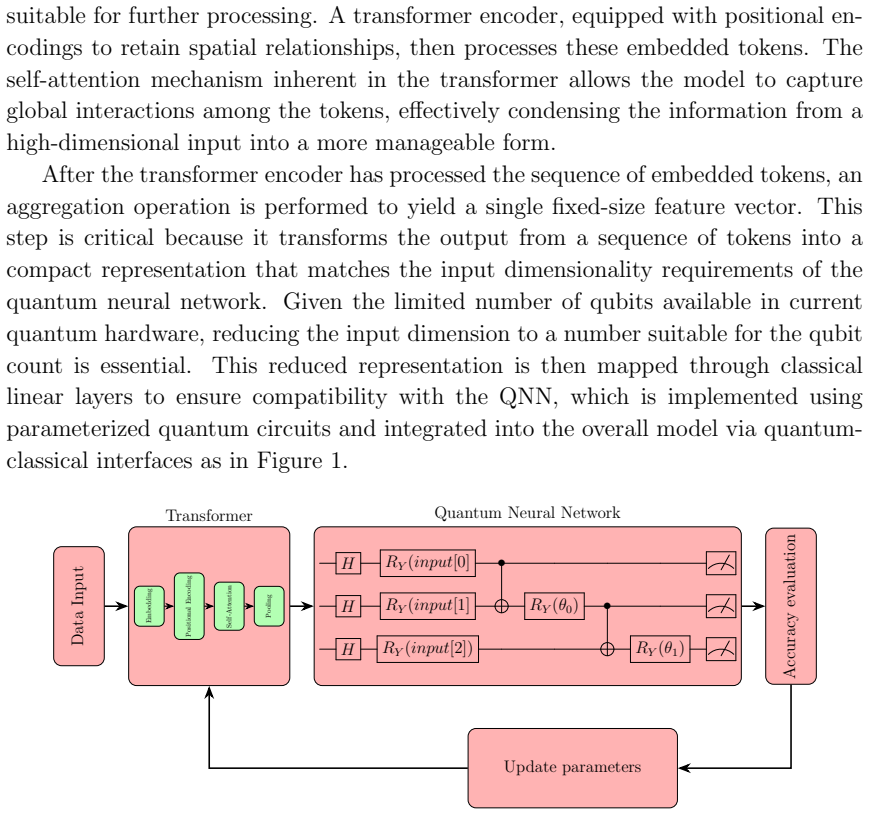
The load-bearing object is the GTQNN pipeline itself. Its classical stage is a transformer encoder: each input token is linearly projected to queries, keys, and values; self-attention re-weights the tokens into a content-adaptive kernel; and average pooling followed by a linear layer produces a feature vector whose length equals the number of qubits. Its quantum stage is a shallow circuit of Hadamard gates, RY rotations whose angles come from the transformer output, and CNOT gates whose placement is encoded in a binary chromosome of length N(N−1)/2. NSGA-II evolves a population of these chromosomes under two objectives—classification accuracy and total primitive-gate count—and returns a Pareto front of circuits, of which the ten most accurate are retrained and the best retained. A complementary diagnostic partitions the empirical Fisher information matrix into transformer and QNN blocks and measures the fraction of each leading eigenvector's energy in each block, which is how the paper argues the model avoids barren plateaus.
What would settle it
Run the three baseline models cited in the paper on the exact train/test splits, class subsets, and training budgets used here; if any of them reaches the same accuracy with no more gates, the paper's central comparison fails. A complementary check is to compute the variance of parameter gradients over many random initializations of the found circuits: exponential decay in qubit count would indicate a flat training landscape even if the reported curvature eigenvalues look healthy.
Extended reading notes
Core claim
On the paper's own terms, the claim is that the GTQNN pipeline—transformer compression plus NSGA-II circuit search—finds Pareto-optimal circuits that match or exceed the best published QNN accuracies on Iris, Breast Cancer Wisconsin, MNIST (digits 1, 2, 3), and Heart Disease while using substantially fewer primitive gates. The reported numbers support the claim: a 3-qubit GTQNN reaches perfect Iris accuracy with 8 gates, Breast Cancer accuracy stays near 0.974 with 10–12 gates, MNIST accuracy stays above 0.95 with 8–64 gates, and Heart Disease accuracy reaches 0.985 with 10 gates; the cited baselines use more gates for comparable or lower accuracy. The paper also claims that the empirical Fisher spectra of the trained models have leading eigenvalues of order one and that the leading curvature directions concentrate increasingly in the QNN subspace as qubit count grows, which it reads as evidence that the models are far from barren plateaus and that the transformer has already compressed the data.
Load-bearing premise
The claim rests on the premise that the accuracy numbers quoted from other papers are fairly comparable even though those papers used different data splits, different class sets (for example, only three MNIST digits here), and different training procedures; it also rests on the premise that a single trained model's curvature spectrum can reveal whether training landscapes are flat.
Editorial extensions
If this is right
- On near-term devices, the studied classification problems become feasible with 3 to 10 qubits and no more than a few tens of primitive gates, because the transformer absorbs the input-dimensionality burden.
- The Pareto front makes the accuracy-versus-hardware trade-off an explicit design choice: on MNIST, raising the qubit budget from 3 to 10 multiplies the gate count by eight while accuracy moves only from 0.973 to 0.993, so cheap circuits give up almost nothing.
- A Fisher spectrum with order-one leading eigenvalues and quantum-dominated leading modes can serve as a practical trainability check for hybrid models of this type.
- Qubit count no longer has to scale with raw feature dimension, since the transformer output is matched to the qubit budget rather than to the input size.
Reading between the lines
- A natural extension of the same architecture is to swap the accuracy fitness for regression or generative objectives, since nothing in the pipeline is classification-specific.
- An ablation that would sharpen the claim is to compare the genetic search against randomly sampled circuits at the same gate budgets, which would show how much of the gain comes from NSGA-II as opposed to the transformer compression.
- A complementary trainability diagnostic to the Fisher spectrum would be a direct measurement of gradient variance over random initializations; if it decays exponentially in qubit count, the found circuits would still face barren-plateau-like behavior.
- Extending the search to hardware-aware costs, such as two-qubit-gate depth and qubit routing, would test whether the Pareto fronts persist under real device noise.
Editorial analysis
A structured set of objections, weighed in public.
Referee Report
Summary. The paper introduces GTQNNs, a hybrid quantum-classical model in which a transformer encoder compresses classical features into a small vector that is fed into a shallow variational quantum circuit, whose architecture is optimized by the NSGA-II genetic algorithm under two objectives: classification accuracy and primitive gate count. Experiments are reported on Iris, Breast-Cancer Wisconsin, MNIST (restricted to digits 1-3), and Heart Disease, and the results are compared with accuracies quoted from three prior papers. The paper further analyzes the empirical Fisher information spectrum of the trained models and claims that the networks avoid barren plateaus and that curvature concentrates in the QNN subspace as the qubit count grows. The central claim is that GTQNNs match or exceed state-of-the-art quantum models while using many fewer gates.
Significance. If the central claim were properly supported, GTQNNs would be a useful contribution to resource-efficient quantum machine learning on NISQ devices: the combination of a learned classical compressor with evolutionary circuit search is a reasonable idea, and the explicit multi-objective treatment of gate count is well motivated. The paper also ships no code and gives no reproducible experimental protocol, so its value currently rests entirely on the reported tables and figures. The Fisher-spectrum diagnostic is an interesting idea but is not validated and, as written, contains a direct contradiction. The proposed framework is coherent enough that a substantially revised version with controlled baselines and rigorous statistics could be publishable, but the present evidence does not support the headline claims.
major comments (5)
- [§4.4, Tables 3–4] The central accuracy claim is based on uncontrolled comparisons to accuracies quoted from other papers. For MNIST, the GTQNN is trained only on digits 1, 2, and 3 (Section 4.4), whereas the EfficientSU2 baseline [4] is quoted as 0.85 with no statement of its class set, train/test split, or preprocessing; if that baseline is evaluated on the full 10-class task, the comparison is invalid. The same problem affects Tables 1, 2, and 4, where the baseline numbers from [2] and [30] come from different architectures, different feature pre-processing (e.g., PCA to 7 features), and unknown splits. Without re-running these baselines under the exact GTQNN task configuration, the abstract's claim that GTQNNs 'match or exceed state-of-the-art quantum models' is unsupported.
- [§4.1, Tables 1–4] No error bars, repeated-seed statistics, or statistical tests are reported anywhere. Every accuracy in Tables 1–4 is a single number from a single run of a stochastic pipeline that includes random initialization, NSGA-II variation operators, and 1024-shot QASM sampling. It is therefore impossible to know whether the reported differences, e.g., 0.9737 repeated across many qubit counts in Table 2 or the 0.8829/0.8488 drop in Table 4, are real effects or sampling noise. The authors should report means and standard deviations over multiple independent runs and, where appropriate, significance tests or confidence intervals.
- [§5.2] The Fisher-spectrum analysis contains an internal contradiction and an unvalidated diagnostic assumption. In the paragraph after Figures 7 and 8, the text first states that the model is 'far from a barren plateau,' then immediately writes 'so TQNN does sit in a barren plateau.' This is not a minor typo: the two statements assert opposite conclusions. More fundamentally, the empirical Fisher matrix evaluated at one trained parameter point cannot diagnose barren-plateau behavior, which is defined by the expected variance of gradients over random initializations and training trajectories. The additional claim that the leading curvature directions 'increasingly align with the quantum subspace' is computed on the trained model and used as evidence of data condensation, but no comparison to an untrained or randomly initialized model, and no theoretical link between this eigen-spectrum and barren plateaus, is provided.
- [§3.1] The paper states that 'TQNN-assisted NSGA-II improves prediction accuracies compared with the classical version,' but no experiment comparing GTQNN against NSGA-II without the transformer, or against a non-genetic training baseline, is reported. This sentence is therefore an unsupported claim, not a result. Such an ablation is necessary to attribute any accuracy gain to the genetic search or to the transformer component.
- [§3.2, Eq. (3.1)] The resource-efficiency claim is partly circular by construction: gate count is one of the two NSGA-II objectives, so the algorithm is explicitly selecting circuits that minimize gates. The comparison with baselines should therefore be framed as 'GTQNN circuits are optimized for gate count,' not as an independent finding that GTQNNs happen to require fewer gates. In addition, the tables compare GTQNN 'gate count' (primitive gates) with baseline values sometimes described as 'parameters' or 'gates (parameters),' which are not necessarily the same quantity; these differences must be clarified before the gate savings can be assessed.
minor comments (5)
- [Figure 6 caption] The caption contains a typo: 'Heart Diseast dataset' should be 'Heart Disease dataset.'
- [§4.2] The text refers to 'Table 3' and 'Table 4' when describing optimal circuits for Iris and Breast Cancer, but the circuits are shown in Figures 3 and 4; the table/figure references should be corrected.
- [§5.1] There is a duplicated phrase: 'the notion of the contribution of contribution' should be 'the notion of the contribution.'
- [§4.1] The experimental section omits essential details needed for reproducibility: the transformer architecture hyperparameters (number of layers, heads, d_model, embedding size), the exact train/test splits for each dataset, the number of independent runs, and the random seeds. The statement that 'code will be available upon request' is not a sufficient data/code availability statement for a computational paper.
- [References] References [19] and [63] are duplicates of the same work; one should be removed and the citation list cleaned.
Circularity Check
Partial circularity: the low-gate-count result is the NSGA-II objective restated, and the Fisher 'far from barren plateau' conclusion is read off the fitted model rather than the landscape; the accuracy claims retain independent empirical content.
-
fitted input called prediction
[Abstract; Section 3.2 Eq. (3.1); Tables 1–4]
"NSGA-II searches for Pareto optimal circuits that (i) maximize classification accuracy and (ii) minimize primitive gate count—an essential constraint for noisy intermediate-scale quantum (NISQ) hardware. Experiments on four benchmarks ... show that GTQNNs match or exceed state of the art quantum models while requiring much fewer gates for most cases. ... (maximize)Fitness 1 = Classification accuracy (minimize)Fitness 2 = Gate count (3.1)"
The low-gate-count claim is the second NSGA-II objective restated as a result. Because gate count is literally Fitness 2 in Eq. (3.1), any circuit selected by the Pareto search has been optimized for few gates; reporting 'requiring much fewer gates' is not an independent prediction but a description of the selection criterion. The accuracy part of the claim remains empirical and is not circular, so this is only partial circularity.
-
other
[Section 5.2 (Fisher spectrum experiments)]
"Recall that a barren-plateau regime would force tr(Eθ[F(θ)]) to vanish exponentially in the number of qubits [1]. Our empirical spectrum shows λ0 = O(1), Σ λk >> 0, so TQNN does sit in a barren plateau. ... The hybrid Fisher spectrum indicates that the model is far from a barren plateau, its leading curvature is concentrated in more QNN direction as the qubit number increases, confirming that additional qubits enlarge the expressivity and that the transformer front-end has already compressed the input features into a lower-dimensional representation."
The paper's own quoted barren-plateau diagnostic is an expectation over random parameter initializations, tr(Eθ[F(θ)]), but the experiment evaluates the empirical Fisher at one converged, NSGA-II-selected parameter vector (Eq. 5.3). A large O(1) eigenvalue at the trained point is a property of a model that has already been successfully fitted, not a measurement of the landscape; hence 'far from a barren plateau' is read off from the same fitted input used to define the model rather than derived from the definition. The printed sentence even states the opposite ('does sit in a barren plateau'), and no random-initialization average is reported, making the Fisher 'confirmation' a restatement of the fitted model rather than a predictive test.
full rationale
The paper is primarily an empirical architecture-and-optimization study, and its accuracy headline is not circular: the reported GTQNN accuracies are measured on held-out data and compared with external baselines. However, two load-bearing conclusions reduce to their own inputs. First, the resource-efficiency claim ('requiring much fewer gates') is not a discovered prediction but the direct output of Fitness 2 = Gate count in Eq. (3.1); the genetic search is explicitly asked to minimize gates, so the low gate counts in Tables 1–4 are selected for by construction. Second, the Fisher-spectrum claim that the trained networks are 'far from barren plateaus' is not a valid test of the paper's own definition: the quoted criterion is an expectation over random parameter initializations, while the experiment computes the empirical Fisher at the converged, search-selected parameters, where O(1) curvature is expected for a successfully trained model. The sentence as printed even asserts the opposite ('TQNN does sit in a barren plateau'), which further undermines the confirmation. The accuracy comparisons to quoted baselines are uncontrolled (different class subsets, splits, and preprocessing), but that is a correctness and validity concern, not circularity, because the baselines are external. The self-citations [36, 37] are used to ground the fitness-function design and are not the source of the headline numbers, so they do not materially raise the score. Overall, the central 'match or exceed state of the art' accuracy claim has independent empirical content, but the companion resource-efficiency and barren-plateau confirmations are partially circular, warranting a 6 rather than a higher score.
Assumptions & free parameters
free parameters (6)
- Transformer architecture hyperparameters (layers, heads, d_model, embedding size)
- NSGA-II population and offspring size =
20
- Crossover and mutation probabilities =
pc=0.90, pm=1/string length
- Number of generations =
50 or 60
- Internal training epochs and outer retraining epochs =
50 inner; 100/250/400/500 outer
- Number of selected Pareto solutions =
k=10
assumptions (4)
- domain assumption The empirical Fisher information matrix computed from 256 data samples is a consistent estimator of the true Fisher information.
- ad hoc to paper The Fisher spectrum evaluated at a trained parameter vector can diagnose whether the model lies in a barren-plateau regime.
- domain assumption A noiseless QASM simulation with 1024 shots is a faithful proxy for NISQ hardware.
- ad hoc to paper The transformer can compress arbitrarily structured data (e.g., 784-pixel MNIST images) to n_qubits features without losing classification-relevant information.
Cite this review
Pith. "Pith review of Genetic Transformer-Assisted Quantum Neural Networks for Optimal Circuit Design." pith.science (2026). https://pith.science/paper/55GYJIQA
@misc{pith2026250609205,
  author       = {Pith},
  title        = {Pith review of: Genetic Transformer-Assisted Quantum Neural Networks for Optimal Circuit Design},
  year         = {2026},
  howpublished = {\url{https://pith.science/paper/55GYJIQA}},
  note         = {Machine review of arXiv:2506.09205}
}
read the original abstract
We introduce Genetic Transformer Assisted Quantum Neural Networks (GTQNNs), a hybrid learning framework that combines a transformer encoder with a shallow variational quantum circuit and automatically fine tunes the circuit via the NSGA-II multi objective genetic algorithm. The transformer reduces high-dimensional classical data to a compact, qubit sized representation, while NSGA-II searches for Pareto optimal circuits that (i) maximize classification accuracy and (ii) minimize primitive gate count an essential constraint for noisy intermediate-scale quantum (NISQ) hardware. Experiments on four benchmarks (Iris, Breast Cancer, MNIST, and Heart Disease) show that GTQNNs match or exceed state of the art quantum models while requiring much fewer gates for most cases. A hybrid Fisher information analysis further reveals that the trained networks operate far from barren plateaus; the leading curvature directions increasingly align with the quantum subspace as the qubit budget grows, confirming that the transformer front end has effectively condensed the data. Together, these results demonstrate that GTQNNs deliver competitive performance with a quantum resource budget well suited to present-day NISQ devices.
Figures


Figures from the paper (5 more)


Reference graph
Works this paper leans on
-
[4]
C.-Y. Liu, E. J. Kuo, C. H. A. Lin et al. Training classical neural networks by quantum machine learning. 2024 IEEE International Conference on Quantum Computing and Engineering (QCE), 2024, Volume: 2, Pages: 34-38 DOI 10.1109/QCE60285.2024.10248 arXiv:2402.16465, 2024
arXiv 2024
-
[2]
M. Alam and S. Ghosh. DeepQMLP: A scalable quantum–classical hybrid deep neural network architecture for classification. In Proc. 35th Int. Conf. VLSI Design & 21st Int. Conf. Embedded Systems (VLSID) , pages 275–280. IEEE, 2022
work page 2022
- [30]
-
[1]
A. Abbas, D. Sutter, C. Zoufal, A. Lucchi, A. Figalli, and S. Woerner. The power of quantum neural networks. Nature Computational Science , 1(6):403– 409, 2021. DOI: 10.1038/s43588-021-00084-1
-
[3]
H.-Y. Chen, Y.-J. Chang, S.-W. Liao, and C.-R. Chang. Deep Q-learning with hybrid quantum neural network on solving maze problems. Quantum Machine Intelligence, 2024, 6:2 https://doi.org/10.1007/s42484-023-00137-w
-
[5]
I. MacCormack, C. Delaney, A. Galda, N. Aggarwal, and P. Narang. Branch- ing quantum convolutional neural networks. Physical Review Research , 4(1):013117, 2022. DOI: 10.1103/PhysRevResearch.4.013117
-
[6]
Do Quantum Neural Networks have Simplicity Bias?
J. Pointing. Do quantum neural networks have simplicity bias? arXiv preprint arXiv:2407.03266, 2024. 19
work page Pith review arXiv 2024
-
[8]
S.-I. Amari. Natural gradient works efficiently in learning. Neural computation, 10(2):251–276, 1998. DOI: 10.1162/089976698300017746
Show all 64 references
-
[9]
Kunstner, P
F. Kunstner, P. Hennig, and L. Balles. Limitations of the empirical Fisher approximation for natural-gradient descent. InAdvances in Neural Information Processing Systems 32, pages 4156–4167, 2019
2019
-
[10]
B. R. Frieden. Science from Fisher Information: A Unification . Cambridge University Press, 2004. DOI: 10.1017/CBO9780511616907
2004 doi
-
[11]
J. J. Rissanen. Fisher information and stochastic complexity. IEEE Transac- tions on Information Theory , 42(1):40–47, 1996. DOI: 10.1109/18.481776
1996 doi
-
[12]
W. Ji, D. Liu, Y. Meng, and Y. Xue. A review of genetic-based evolutionary al- gorithms in SVM parameter optimisation. Evolutionary Intelligence, 14:1389– 1414, 2021. DOI: 10.1007/s12065-020-00439-z
2021 doi
-
[13]
Lahoz-Beltra
R. Lahoz-Beltra. Quantum genetic algorithms for computer scientists. Com- puters, 5(4):24, 2016. DOI: 10.3390/computers5040024
2016 doi
-
[14]
Acampora and A
G. Acampora and A. Vitiello. Implementing evolutionary optimisation on actual quantum processors. Information Sciences , 575:542–562, 2021. https://doi.org/10.1016/j.ins.2021.06.049
2021 doi
-
[15]
Altares-L´ opez, A
S. Altares-L´ opez, A. Ribeiro, and J. J. Garc ´ ıa-Ripoll. Automatic design of quantum feature maps. Quantum Science and Technology , 6(4):045010, 2021. https://iopscience.iop.org/article/10.1088/2058-9565/ac1ab1
2021 doi
-
[16]
Chivilikhin, A
D. Chivilikhin, A. Samarin, V. Ulyantsev, I. Iorsh, A. R. Oganov, and O. Kyri- ienko. MoG-VQE: Multi-objective genetic variational quantum eigensolver. arXiv preprint arXiv:2007.04424, 2020
2007 arXiv
-
[17]
K. Deb, S. Agrawal, A. Pratap, and T. Meyarivan. A fast and elitist multi- objective genetic algorithm: NSGA-II. IEEE Transactions on Evolutionary Computation, 6(2):182–197, 2002. DOI: 10.1109/4235.996017
2002
-
[18]
Miettinen
K. Miettinen. Nonlinear Multiobjective Optimization . Kluwer Academic Pub- lishers, Boston, 1998
1998
-
[19]
Alaia, I.H
E.B. Alaia, I.H. Dridi, H. Bouchriha and P. Borne, Genetic algorithm with pareto front selection for multi-criteria optimization of multi-depots and multi- vehicle pickup and delivery problems with time windows , 2014 15th Interna- tional Conference on Sciences and Techniques ...
2014
-
[20]
Bar´ an, A
B. Bar´ an, A. Carballude and M. Villagra, Neighbor Optimization of N- Dimensional Quantum Circuits , SN Computer Science 2, 2021
2021
-
[21]
Cerezo et al
M. Cerezo et al. Challenges and opportunities in quantum machine learning. Nat. Comput. Sci. 2, 567 (2022)
2022
-
[22]
Beer et al
K. Beer et al. Training deep quantum neural networks. Nat. Commun. 11, 808 (2020)
2020
-
[23]
Havl ´ ıˇ ceket al
V. Havl ´ ıˇ ceket al. Supervised learning with quantum-enhanced feature spaces. Nature 567, 209–212 (2019)
2019
-
[24]
D. P. Garc ´ ıa, J. Cruz-Benito, F. J. Garc ´ ıa-Pe˜ nalvo. Systematic literature re- view: quantum machine learning and its applications. Computer Science Re- view : 51, 100619(2024)
2024
-
[25]
S. Sim, P. D. Johnson, A. Aspuru-Guzik. Expressibility and entangling capa- bility of parameterized quantum circuits. Adv. Quantum Technol. 2, 1900070 (2019)
2019
-
[26]
S. X. Zhang et al. TensorCircuit: a quantum software framework for the NISQ era. Quantum 7, 912 (2023)
2023
-
[27]
Farhi, H
E. Farhi, H. Neven. Classification with quantum neural networks on near-term processors. arXiv :1802.06002 (2018)
2018 arXiv
-
[28]
Sharma et al
K. Sharma et al. Trainability of dissipative perceptron-based quantum neural networks. Phys. Rev. Lett. 128, 180505 (2022)
2022
-
[29]
Sagingalieva et al
A. Sagingalieva et al. Hybrid quantum neural network for drug response pre- diction. Cancers 15, 2705 (2023)
2023
-
[31]
M. Schuld. Supervised quantum machine learning models are kernel methods. arXiv :2101.11020 (2021)
2021 arXiv
-
[32]
Vaswani et al
A. Vaswani et al. Attention is all you need. In Advances in Neural Information Processing Systems 30, pages 5998–6008, 2017
2017
-
[33]
Devlin, M.-W
J. Devlin, M.-W. Chang, K. Lee, and K. Toutanova. BERT: Pre-training of deep bidirectional transformers for language understanding. In Proceedings of NAACL, pages 4171–4186, 2019. https://doi.org/10.18653/v1/N19-1423
2019 doi
-
[34]
Dosovitskiy et al
A. Dosovitskiy et al. An image is worth 16 times16 words: Transformers for image recognition at scale.International Con- ference on Learning Representations, 2021. https://arxiv.org/abs/2010.11929 21
2021 arXiv
-
[35]
Jennewein, Douglas M. et al. The Sol Supercomputer at Arizona State Uni- versity. PEARC ’23: Practice and Experience in Advanced Research Com- puting 2023: Computing for the Common Good Pages 296 - 301, 2023. https://doi.org/10.1145/3569951.3597573
2023
-
[36]
Wang Several fitness functions and entanglement gates in quantum kernel generation
H. Wang Several fitness functions and entanglement gates in quantum kernel generation. Quantum Mach. Intell. , 7, 7 (2025). https://doi.org/10.1007/s42484-024-00233-5
2025 doi
-
[37]
Wang A novel feature selection method based on quantum support vec- tor machine
H. Wang A novel feature selection method based on quantum support vec- tor machine. Physica Scripta , 99 056006 (2024). , Volume 99, Number 5 https://doi.org/DOI 10.1088/1402-4896/ad36ef
2024 doi
-
[38]
Antonio Ben ´ ıtez-Hidalgo, Antonio J. Nebro, Jos´ e Garc ´ ıa-Nieto, Izaskun Oregi, Javier Del Ser, jMetalPy: A Python framework for multi-objective optimiza- tion with metaheuristics, Swarm and Evolutionary Computation , 51, 100598, 2019 https://doi.org/10.1016/j.swevo.2019.100598
2019
-
[39]
Schuld and F
M. Schuld and F. Petruccione. Machine Learning with Quan- tum Computers . Springer International Publishing, Cham, 2021. https://link.springer.com/book/10.1007/978-3-030-83098-4
2021 doi
-
[40]
M. A. Nielsen and I. L. Chuang. Quantum Computation and Quantum Infor- mation (10th-anniv. ed.). Cambridge University Press, Cambridge, 2011
2011
-
[41]
Biamonte, P
J. Biamonte, P. Wittek, N. Pancotti, P. Rebentrost, N. Wiebe, and S. Lloyd. Quantum machine learning. Nature, 549(7671):195–202, 2017. DOI: 10.1038/nature23474
2017 doi
-
[42]
Schuld, I
M. Schuld, I. Sinayskiy, and F. Petruccione. An introduction to quan- tum machine learning. Contemporary Physics , 56(2):172–185, 2015. DOI: 10.1080/00107514.2014.964942
2015
-
[43]
Havl ´ ıˇ cek, A
V. Havl ´ ıˇ cek, A. D. C´ orcoles, K. Temme et al. Supervised learning with quantum-enhanced feature spaces. Nature, 567(7747):209–212, 2019. DOI: 10.1038/s41586-019-0980-2
2019 doi
-
[44]
D. P. Garc ´ ıa, J. Cruz-Benito, and F. J. Garc ´ ıa-Pe˜ nalvo. Systematic literature review: Quantum machine learning and its applications. arXiv:2201.04093,
-
[45]
D. N. Diep. Some quantum neural networks. International Journal of Theoret- ical Physics, 59:1179–1190, 2020. DOI: 10.1007/s10773-020-04397-1
2020 doi
-
[46]
Chalumuri, R
A. Chalumuri, R. Kune, and B. S. Manoj. A hybrid classical-quantum approach for multi-class classification. Quantum Information Processing , 20:119, 2021. DOI: 10.1007/s11128-021-03029-9. 22
2021 doi
-
[47]
B. Q. Chen and X. F. Niu. Quantum Neural Network with Improved Quan- tum Learning Algorithm. International Journal of Theoretical Physics , 59:1978–1990, 2020. DOI: 10.1007/s10773-020-04470-9
1978 doi
-
[48]
Tacchino, S
F. Tacchino, S. Mangini, P. K. Barkoutsoset al. Variational Learning for Quan- tum Artificial Neural Networks. IEEE Transactions on Quantum Engineering, 2:1–10, 2021. DOI: 10.1109/TQE.2021.3062494
2021
- [49]
-
[50]
Y. Li, R. G. Zhou, R. Xu, J. Luo, and W. Hu. A quantum deep convolu- tional neural network for image recognition. Quantum Science and Technology, 5:044003, 2020. DOI: 10.1088/2058-9565/ab9f93
2020 doi
-
[51]
S. L. Wu et al. Application of quantum ensemble learning to particle- physics analysis at the LHC. Physical Review Research , 3:033221, 2021. DOI: 10.1103/PhysRevResearch.3.033221
2021 doi
-
[52]
K. H. Wan, O. Dahlsten, H. Kristj´ ansson, R. Gardner, and M. S. Kim. Quan- tum generalisation of feed-forward neural networks. npj Quantum Information, 3:36, 2017. DOI: 10.1038/s41534-017-0032-4
2017 doi
-
[53]
K. Beer, D. Bondarenko, T. Farrelly et al. Training deep quan- tum neural networks. Nature Communications , 11:808, 2020. DOI: 10.1038/s41467-020-14454-2
2020 doi
-
[54]
I. Cong, S. Choi, and M. D. Lukin. Quantum convolutional neural networks. Nature Physics, 15:1273–1278, 2019. DOI: 10.1038/s41567-019-0648-8
2019 doi
-
[55]
Sharma, M
K. Sharma, M. Cerezo, L. Cincio, and P. J. Coles. Trainability of dissipa- tive perceptron-based quantum neural networks. Physical Review Letters , 128:180505, 2022. DOI: 10.1103/PhysRevLett.128.180505
2022 doi
-
[56]
M. G. Zhou, Z. P. Liu, H. L. Yin et al. Quantum Neural Network for Quantum Neural Computing. Research, 6:0134, 2023. DOI: 10.34133/research.0134
2023 doi
-
[57]
Preskill
J. Preskill. Quantum computing in the NISQ era and beyond. Quantum, 2:79,
-
[58]
E. A. Cherrat, I. Kerenidis, N. Mathur, J. Landman, M. Strahm, and Y. Y. Li. Quantum vision transformers. Quantum, 8:1265, 2024. DOI: 10.22331/q-2024-02-22-1265
2024 doi
-
[59]
H. Ma, H. Shang, and J. Yang. Quantum embedding method with transformer neural network quantum states for strongly correlated materials. npj Compu- tational Materials , 10:220, 2024. DOI: 10.1038/s41524-024-01406-3. 23
2024 doi
-
[60]
Zhang and Q
H. Zhang and Q. Zhao. A survey of quantum transformers: Tech- nical approaches, challenges and outlooks. arXiv:2504.03192, 2025. arXiv:2504.03192
2025
-
[61]
, Wang, X
Li, G., Zhao, X. , Wang, X. Quantum self-attention neural net- works for text classification. Sci. China Inf. Sci. 67, 142501 (2024). https://doi.org/10.1007/s11432-023-3879-7
2024 doi
-
[62]
Baevski, Y
A. Baevski, Y. Zhou, A. Mohamed, and M. Auli. wav2vec 2.0: A frame- work for self-supervised learning of speech representations. In Advances in Neural Information Processing Systems 33 , pages 12449–12460, 2020. https://arxiv.org/abs/2006.11477
2020 arXiv
-
[63]
Alaia, I.H
E.B. Alaia, I.H. Dridi, H. Bouchriha and P. Borne, Genetic algorithm with pareto front selection for multi-criteria optimization of multi-depots and multi- vehicle pickup and delivery problems with time windows , 2014 15th Interna- tional Conference on Sciences and Techniques ...
2014
-
[2018]
DOI: 10.22331/q-2018-08-06-79
2018 doi
- [2022]
Reviewed August 7, 2026 · model on record in the stance chip above.
Discussion (0). Sign in to comment.