Observation of psi(3770)to pbar p and Measurement of Electromagnetic Form Factors of Proton at sqrt{s} = 3.510-4.946 GeV
Pith reviewed 2026-06-26 06:41 UTC · model grok-4.3
The pith
The BESIII experiment observes the decay ψ(3770) to proton-antiproton with 6.6 sigma significance and measures proton electromagnetic form factors.
A machine-rendered reading of the paper's core claim, the machinery that carries it, and where it could break.
Core claim
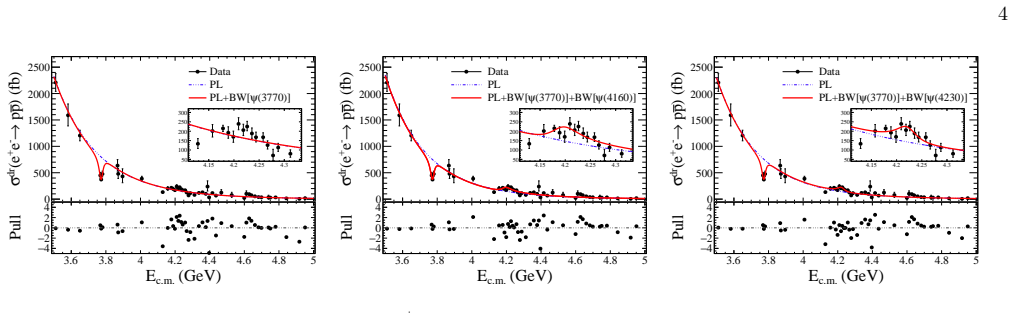
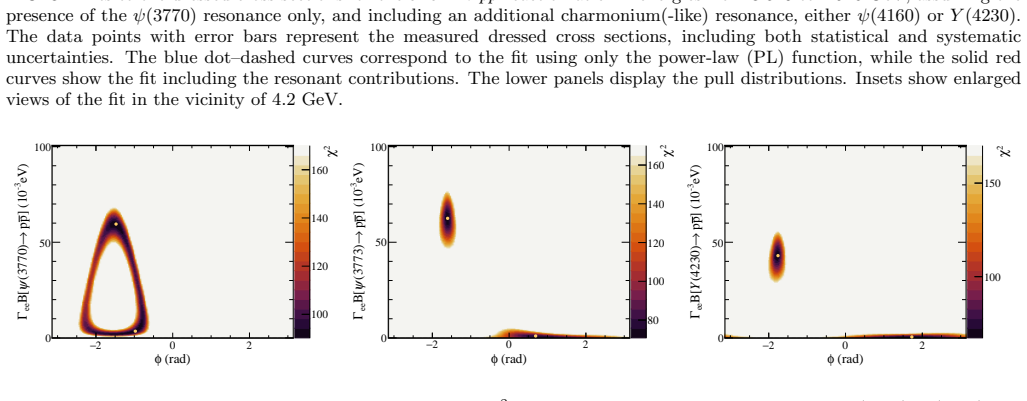
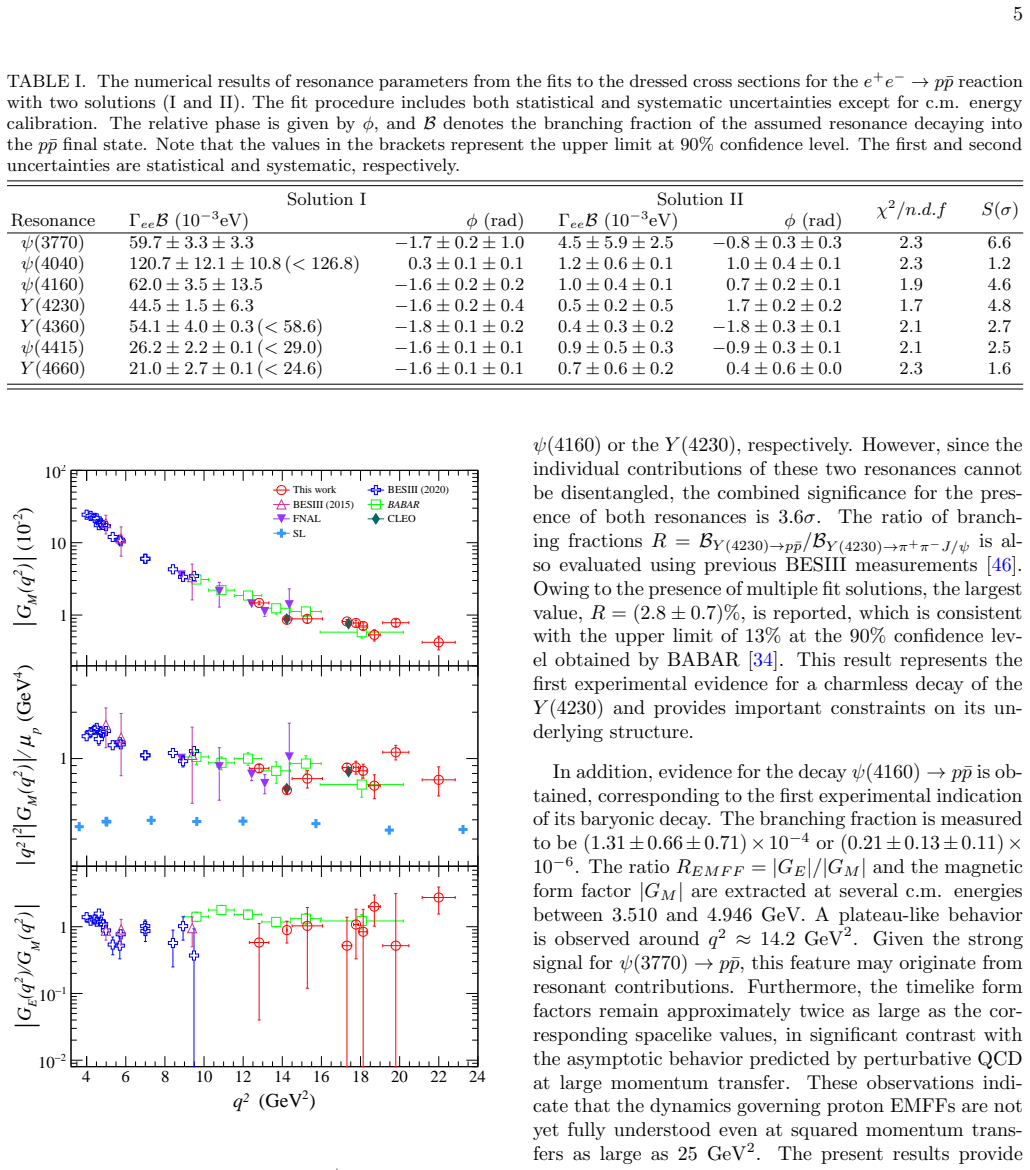
The decay ψ(3770)→p p-bar is observed with a significance of 6.6σ including systematic uncertainties. A structure near 4.2 GeV is observed with significances of 4.6σ or 4.8σ for the ψ(4160) or Y(4230) hypotheses including systematic uncertainties, respectively. The moduli of the form factor ratios |G_E/G_M| and of the magnetic form factors |G_M| are extracted by analyzing the proton polar angle distribution with higher precision at large time-like squared momentum transfer.
What carries the argument
Fit to the Born cross section of e^+e^- → p p-bar across 47 center-of-mass energies from 3.510 to 4.946 GeV combined with analysis of the proton polar angle distribution.
Load-bearing premise
The background model and resonance line shapes used in the fit to the Born cross section do not produce a spurious excess at the ψ(3770) mass.
What would settle it
A re-analysis of the same or larger dataset with an alternative background parametrization that reduces the excess at 3.77 GeV below 5 sigma significance.
Figures

read the original abstract
We search for possible charmonium(-like) states decaying into the $p\bar{p}$ final state by studying the Born cross sections of the $e^+e^-\to p\bar{p}$ reaction, and we determine the proton electromagnetic form factors by analyzing the proton angular distribution. The measurement is performed using a sample of $e^+e^-$ collision data collected at 47 center-of-mass energies from 3.510 to 4.946 GeV, corresponding to an integrated luminosity of 26 fb$^{-1}$, recorded by the BESIII detector collected at the BEPCII collider. The decay $\psi(3770)\to p\bar{p}$ is observed with a significance of 6.6$\sigma$ including systematic uncertainties. Furthermore, a structure near 4.2 GeV is observed with significances of $4.6\sigma$ or $4.8\sigma$ for the $\psi(4160)$ or $Y(4230)$ hypotheses including systematic uncertainties, respectively; these interpretations cannot presently be distinguished. In addition, the moduli of the form factor ratios $|G_{E}/G_{M}|$ and of the magnetic form factors $|G_{M}|$ are extracted by analyzing the proton polar angle distribution with higher precision at large time-like squared momentum transfer. These results provide important experimental insights into both the decay mechanisms of charmonium(-like) states in the open charm region and the internal structure of proton.
Editorial analysis
A structured set of objections, weighed in public.
Referee Report
Summary. The manuscript claims the observation of the decay ψ(3770)→p¯p with a significance of 6.6σ (including systematic uncertainties) from a study of the Born cross section of e⁺e⁻→p¯p at 47 center-of-mass energies between 3.510 and 4.946 GeV using 26 fb⁻¹ of BESIII data. It also reports a structure near 4.2 GeV with significances of 4.6σ or 4.8σ depending on the resonance hypothesis, and extracts the moduli of the proton electromagnetic form factor ratios |G_E/G_M| and |G_M| from the proton angular distributions.
Significance. If the central observation holds, this would constitute the first reported observation of ψ(3770) decaying to p¯p, offering experimental input on charmonium decay mechanisms in the open-charm region. The form-factor results add precision data on the proton in the time-like domain at large |q²|. The analysis rests on direct extraction from collision data rather than any parameter-free or circular derivation, which is a methodological strength.
major comments (1)
- [Born cross section measurement and subsequent global fit] The 6.6σ significance for ψ(3770)→p¯p is obtained from a global fit to the 47-point Born cross-section scan. The manuscript does not demonstrate that this significance remains stable under reasonable variations of the background functional form or under the inclusion/exclusion of additional nearby resonances, leaving open the possibility that the quoted excess could be influenced by the choice of parametrization.
minor comments (2)
- [Abstract and fit description] The abstract states that significances include systematic uncertainties; the main text should explicitly describe how these uncertainties are propagated into the global fit likelihood.
- [Form factor extraction section] The description of the proton angular distribution analysis would benefit from a clearer statement of the efficiency correction procedure and any acceptance corrections applied before extracting |G_E/G_M| and |G_M|.
Simulated Author's Rebuttal
We thank the referee for the detailed review and the constructive comment on the robustness of our fit. We address the point below and will revise the manuscript to incorporate additional checks as requested.
read point-by-point responses
-
Referee: The 6.6σ significance for ψ(3770)→p¯p is obtained from a global fit to the 47-point Born cross-section scan. The manuscript does not demonstrate that this significance remains stable under reasonable variations of the background functional form or under the inclusion/exclusion of additional nearby resonances, leaving open the possibility that the quoted excess could be influenced by the choice of parametrization.
Authors: We agree that explicit demonstration of fit stability is necessary for a robust claim. In the revised manuscript we will add a dedicated subsection presenting the results of systematic variations: (i) alternative background parametrizations (different polynomial degrees and exponential forms), and (ii) fits with and without the nearby structures near 4.2 GeV. The resulting significances for the ψ(3770) signal will be tabulated; preliminary internal checks indicate the observation remains above 5σ in all tested configurations, but the full study and tables will be included in the revision. revision: yes
Circularity Check
No circularity: direct experimental measurement from collision data
full rationale
This is an experimental hep-ex paper reporting Born cross sections, decay significances, and proton form factors extracted from 47 energy points of e+e- collision data. The claimed observation (6.6σ for ψ(3770)→p p-bar) and |G_E/G_M|, |G_M| values arise from standard fits to angular distributions and invariant-mass spectra; no derivation chain reduces these quantities to their own inputs by construction. No self-definitional equations, fitted parameters renamed as predictions, or load-bearing self-citations of uniqueness theorems appear. The analysis is self-contained against external benchmarks.
Axiom & Free-Parameter Ledger
Reference graph
Works this paper leans on
-
[1]
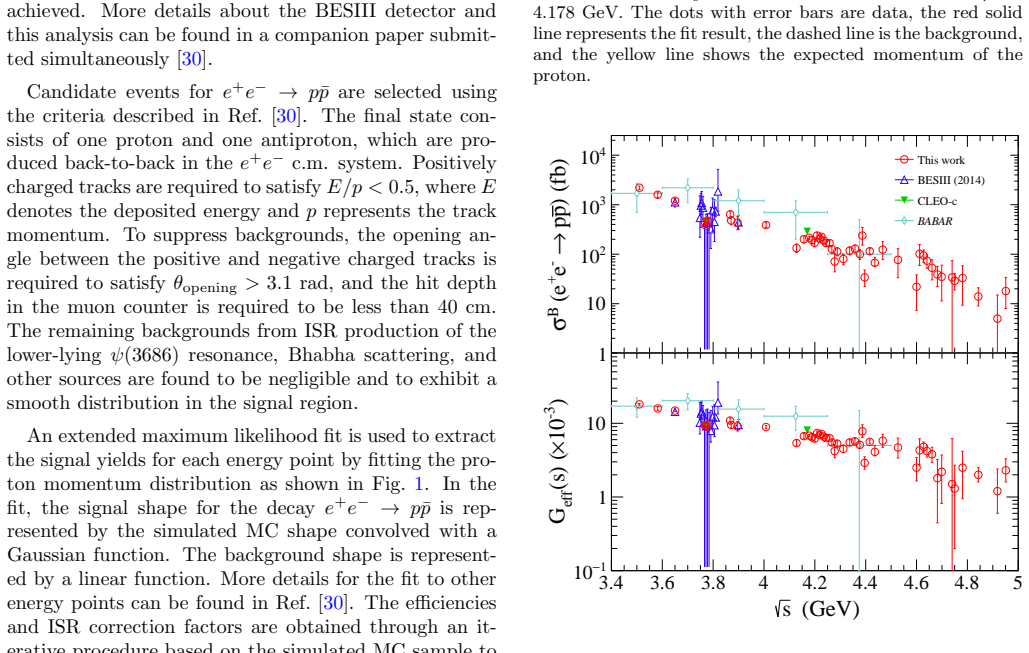
(fb)p p→ -e+ (eBσT his workBESIII (2014) CLEO-c B ABAR3.4 3.6 3.8 4 4.2 4.4 4.6 4.8 5 (GeV) s1 −101 10 ) -310×(s) (effG FIG. 2. The measured Born cross sections (top) and proton effective form factors (bottom) fore +e− →p¯pas a function of the c.m. energy, in comparison to the previous measurements from BESIII [32], CLEO-c [33], andBABAR[34]. The uncer- t...
arXiv 2014
-
[2]
J. J. Aubertet al.(E598 Collaboration), Phys. Rev. Lett. 33, 1404 (1974)
1974
-
[3]
J. E. Augustinet al.(SLAC-SP-017), Phys. Rev. Lett. 33, 1406 (1974)
1974
-
[4]
Navaset al.(Particle Data Group), Phys
S. Navaset al.(Particle Data Group), Phys. Rev. D110, 030001 (2024)
2024
-
[5]
Eichten, K
E. Eichten, K. Gottfried, T. Kinoshita, J. B. Kogut, K. D. Lane, and T.-M. Yan, Phys. Rev. Lett.34, 369 (1975), [Erratum: Phys.Rev.Lett. 36, 1276 (1976)]
1975
-
[6]
Eichten, K
E. Eichten, K. Gottfried, T. Kinoshita, K. D. Lane, and T.-M. Yan, Phys. Rev. D17, 3090 (1978)
1978
-
[7]
Eichten, K
E. Eichten, K. Gottfried, T. Kinoshita, K. D. Lane, and T.-M. Yan, Phys. Rev. D21, 203 (1980)
1980
-
[8]
Barnes, S
T. Barnes, S. Godfrey, and E. S. Swanson, Phys. Rev. D72, 054026 (2005)
2005
-
[9]
S. F. Radford and W. W. Repko, Phys. Rev. D75, 074031 (2007)
2007
-
[10]
M. A. Sultan, N. Akbar, B. Masud, and F. Akram, Phys. Rev. D90, 054001 (2014)
2014
-
[11]
H.-X. Chen, W. Chen, X. Liu, and S.-L. Zhu, Phys. Rept.639, 1 (2016)
2016
-
[12]
S. L. Olsen, T. Skwarnicki, and D. Zieminska, Rev. Mod. Phys.90, 015003 (2018)
2018
-
[13]
F.-K. Guo, C. Hanhart, U.-G. Meißner, Q. Wang, Q. Zhao, and B.-S. Zou, Rev. Mod. Phys.90, 015004 (2018)
2018
-
[14]
H.-X. Chen, W. Chen, X. Liu, Y.-R. Liu, and S.-L. Zhu, Rept. Prog. Phys.86, 026201 (2023)
2023
-
[15]
Wang and Q
Q. Wang and Q. Zhao, Chin. Phys. Lett.42, 110201 (2025)
2025
-
[16]
X. Wang, X. Liu, and Y. Gao, Rev. Mod. Phys.98, 021001 (2026)
2026
- [17]
-
[18]
Pakhlovaet al.(Belle Collaboration), Phys
G. Pakhlovaet al.(Belle Collaboration), Phys. Rev. Lett. 101, 172001 (2008)
2008
-
[19]
Ablikimet al.(BESIII Collaboration), Phys
M. Ablikimet al.(BESIII Collaboration), Phys. Rev. Lett.120, 132001 (2018)
2018
-
[20]
Ablikimet al.(BESIII), Phys
M. Ablikimet al.(BESIII), Phys. Rev. Lett.131, 191901 (2023)
2023
-
[21]
K. G. Wilson, Phys. Rev. D10, 2445 (1974)
1974
-
[22]
Fritzsch and M
H. Fritzsch and M. Gell-Mann, eConfC720906V2, 135 (1972)
1972
-
[23]
Hofstadter and R
R. Hofstadter and R. W. McAllister, Phys. Rev.98, 217 (1955)
1955
-
[24]
Pacetti, R
S. Pacetti, R. Baldini Ferroli, and E. Tomasi-Gustafsson, Phys. Rept.550-551, 1 (2015)
2015
-
[25]
S. J. Brodsky and G. R. Farrar, Phys. Rev. Lett.31, 1153 (1973)
1973
-
[26]
K. K. Seth, S. Dobbs, Z. Metreveli, A. Tomaradze, T. Xiao, and G. Bonvicini, Phys. Rev. Lett.110, 022002 (2013)
2013
-
[27]
Ablikimet al.(BESIII Collaboration), Chin
M. Ablikimet al.(BESIII Collaboration), Chin. Phys. C 39, 093001 (2015)
2015
-
[28]
Ablikimet al.(BESIII Collaboration), Chin
M. Ablikimet al.(BESIII Collaboration), Chin. Phys. C 46, 113003 (2022)
2022
-
[29]
Ablikimet al.(BESIII Collaboration), Nucl
M. Ablikimet al.(BESIII Collaboration), Nucl. Instrum. Meth. A614, 345 (2010)
2010
-
[30]
Yuet al., in7th International Particle Accelerator Conference(2016) p
C. Yuet al., in7th International Particle Accelerator Conference(2016) p. TUYA01
2016
-
[31]
Ablikimet al.(BESIII Collaboration),Accompanied PRD version, Phys
M. Ablikimet al.(BESIII Collaboration),Accompanied PRD version, Phys. Rev. Dxx, xxxx (xxx)
-
[32]
W. Sun, T. Liu, M. Jing, L. Wang, B. Zhong, and W. Song, Front. Phys. (Beijing)16, 64501 (2021)
2021
-
[33]
Ablikimet al.(BESIII Collaboration), Phys
M. Ablikimet al.(BESIII Collaboration), Phys. Lett. B 735, 101 (2014)
2014
-
[34]
Dobbs, K
S. Dobbs, K. K. Seth, A. Tomaradze, T. Xiao, and G. Bonvicini, Phys. Rev. D96, 092004 (2017)
2017
-
[35]
Aubertet al.(BABARCollaboration), Phys
B. Aubertet al.(BABARCollaboration), Phys. Rev. D 73, 012005 (2006)
2006
-
[36]
Mo, HEPNP30, 140 (2006)
X.-H. Mo, HEPNP30, 140 (2006)
2006
-
[37]
Mo, HEPNP31, 745 (2007)
X.-H. Mo, HEPNP31, 745 (2007)
2007
-
[38]
Mo and Y
X.-H. Mo and Y. S. Zhu, HEPNP27, 747 (2003)
2003
-
[39]
Mo and Y
X.-H. Mo and Y. S. Zhu, HEPNP27, 371 (2003)
2003
-
[40]
Bai and D.-Y
Y. Bai and D.-Y. Chen, Phys. Rev. D99, 072007 (2019)
2019
-
[41]
Ablikimet al.(BESIII Collaboration), Chin
M. Ablikimet al.(BESIII Collaboration), Chin. Phys. C 45, 103001 (2021)
2021
-
[42]
Ablikimet al.(BESIII Collaboration), Phys
M. Ablikimet al.(BESIII Collaboration), Phys. Rev. D 91, 112004 (2015)
2015
-
[43]
Ablikimet al.(BESIII Collaboration), Phys
M. Ablikimet al.(BESIII Collaboration), Phys. Rev. Lett.124, 042001 (2020)
2020
-
[44]
J. P. Leeset al.(BABARCollaboration), Phys. Rev. D 88, 072009 (2013)
2013
-
[45]
Andreottiet al., Phys
M. Andreottiet al., Phys. Lett. B559, 20 (2003)
2003
-
[46]
A. F. Sillet al., Phys. Rev. D48, 29 (1993)
1993
-
[47]
Ablikimet al.(BESIII Collaboration), Phys
M. Ablikimet al.(BESIII Collaboration), Phys. Rev. Lett.118, 092001 (2017). 7 M. Ablikim1 , M. N. Achasov 4,c , P. Adlarson81 , X. C. Ai 87 , C. S. Akondi 31A,31B , R. Aliberti 39 , A. Amoroso80A,80C , Q. An 77,64,†, Y. H. An 87 , Y. Bai 62 , O. Bakina 40 , H.-R. Bao 70 , X. L. Bao 49 , M. Barbagiovanni80C , V. Batozskaya1,48 , K. Begzsuren 35, N. Berger ...
2017
discussion (0)
Sign in with ORCID, Apple, or X to comment. Anyone can read and Pith papers without signing in.