Simultaneous Dalitz-plot decomposition of the e^+ e^- to J/psi \, π \, π \, (K bar{K}) processes in the 4.13-4.36 GeV region using dispersive final-state interactions
Pith reviewed 2026-06-27 21:51 UTC · model grok-4.3
The pith
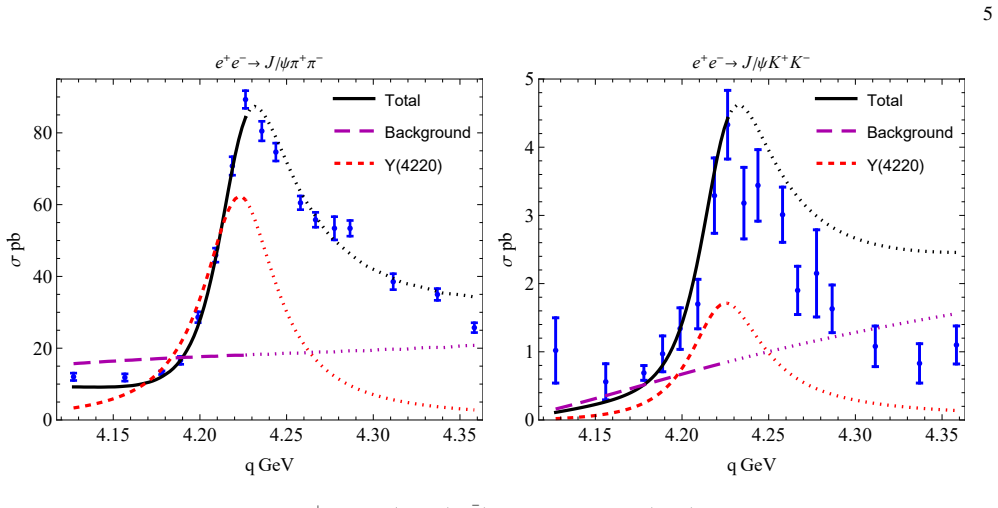
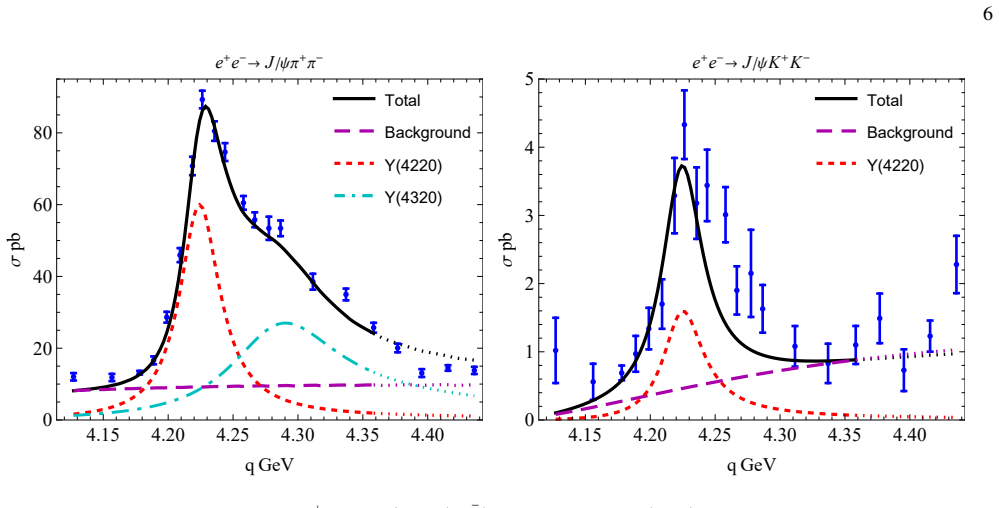
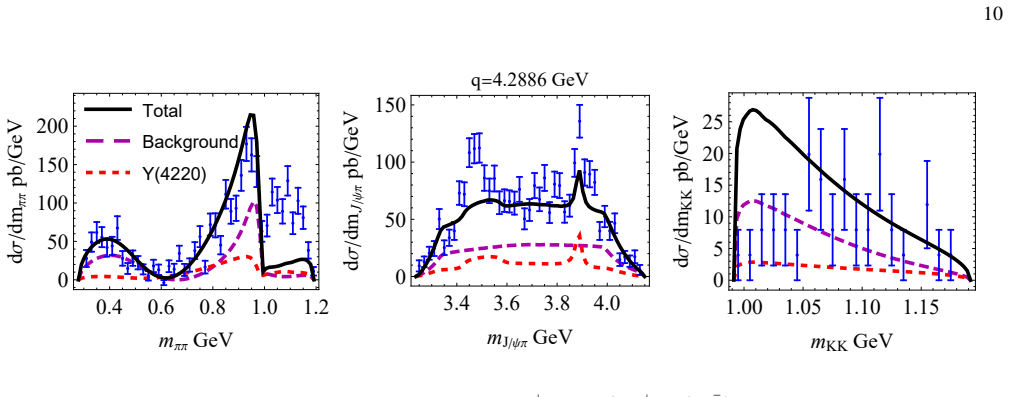
The e+e- to J/psi pi pi and J/psi KK data in the 4.13-4.36 GeV region cannot be described by resonant Y states alone and require an additional non-resonant amplitude that undergoes pi pi / KK rescattering.
A machine-rendered reading of the paper's core claim, the machinery that carries it, and where it could break.
Core claim
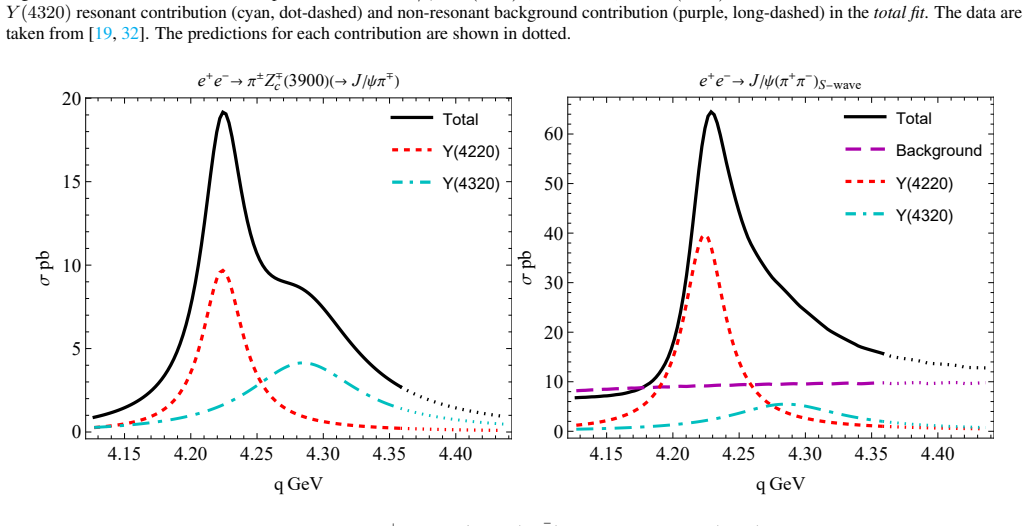
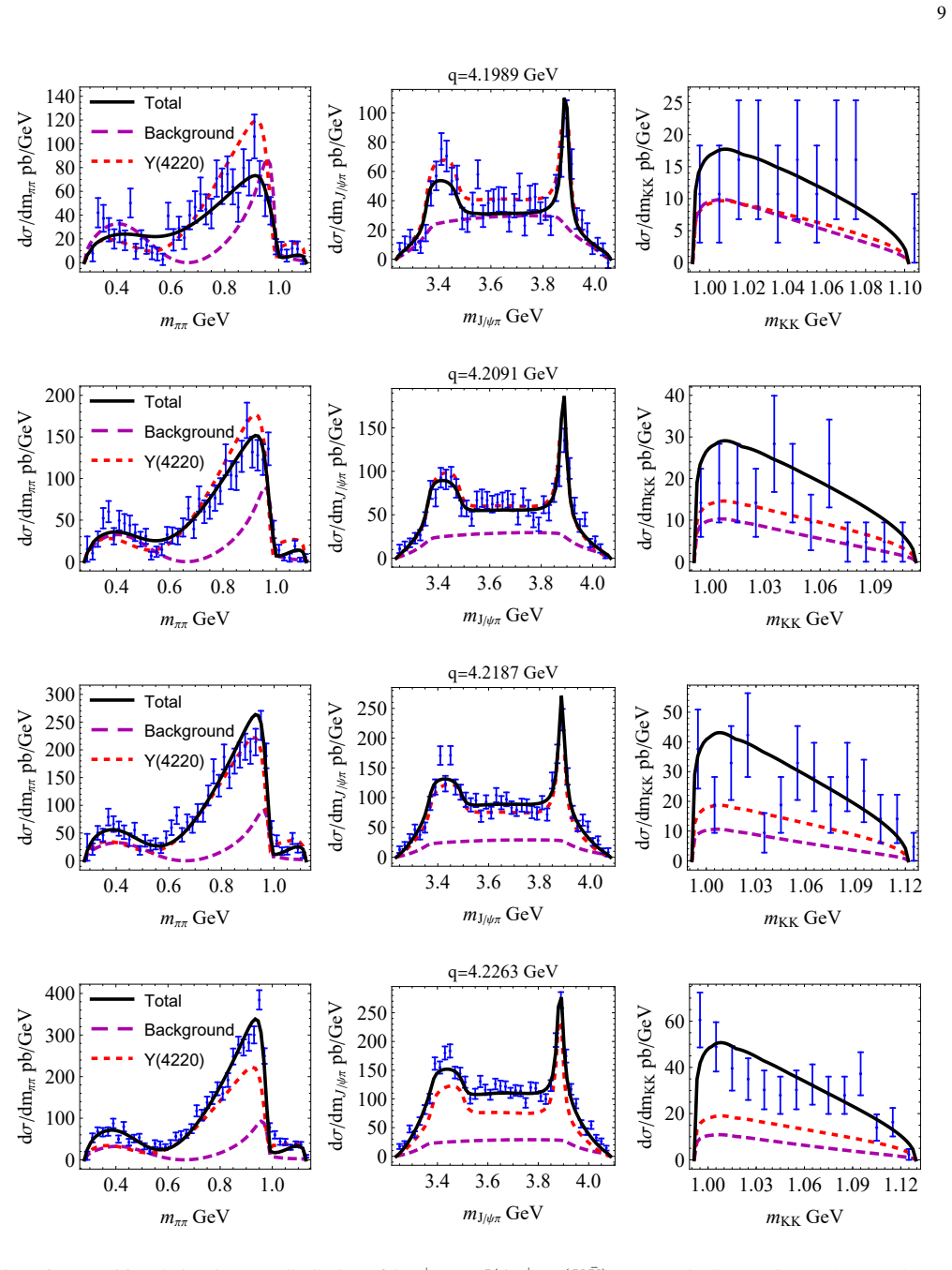
A joint analysis of e+e- to J/psi pi+ pi- and e+e- to J/psi K+ K- at center-of-mass energies 4.13-4.36 GeV shows that the BESIII data require both the Y(4220) and Y(4320) resonant structures and a non-resonant production mechanism; the scalar pi pi / K Kbar final-state interactions are incorporated dispersively via a coupled-channel Omnès representation that uses only prior scattering input, allowing the total cross sections and one-dimensional mass distributions to be described with one set of energy-independent parameters and yielding Breit-Wigner parameters for Zc(3900), Y(4220), and Y(4320).
What carries the argument
Coupled-channel Omnès representation for the scalar pi pi / K Kbar final-state interaction, used inside a Dalitz-plot decomposition of the amplitudes that includes two Y resonances plus one non-resonant term.
If this is right
- Both channels are described by the same energy-independent parameters.
- Breit-Wigner masses and widths are extracted for Zc(3900), Y(4220), and Y(4320).
- Subprocess cross sections for the contributing mechanisms are determined.
- The non-resonant term must itself undergo pi pi / KK rescattering to match the data.
Where Pith is reading between the lines
- If confirmed, the necessity of the non-resonant term implies additional production mechanisms operate in this energy window beyond the two identified Y states.
- The method supplies a template that could be applied to related final states sharing the same scalar rescattering.
Load-bearing premise
The scalar pi pi and KK final-state interactions are fully captured by one energy-independent coupled-channel Omnès function taken from scattering data, while production is exhausted by the two specified Y resonances plus a single non-resonant term.
What would settle it
A fit of comparable quality to the same total cross sections and invariant-mass distributions achieved without the non-resonant term at the amplitude level.
Figures




read the original abstract
We present a joint analysis of the processes $e^+e^- \to J/\psi\pi^+\pi^-$ and $e^+e^- \to J/\psi K^+K^-$ at center-of-mass energies from 4.13 to 4.36 GeV. The amplitudes are constructed using the Dalitz-plot decomposition formalism, with the $e^+e^-$ energy dependence encoded through the $Y(4220)$ and $Y(4320)$ resonant structures together with a non-resonant production mechanism. The scalar $\pi\pi/K\bar K$ final-state interaction is treated dispersively using a coupled-channel Omn\`es representation. This allows us to describe the measured total cross sections and one-dimensional invariant-mass distributions with a single set of energy-independent parameters. We find that a purely resonant description of the BESIII data is insufficient, requiring a non-resonant term at the amplitude level which undergoes $\pi\pi/K\bar{K}$ rescattering. Within the present isobar model, we extract Breit-Wigner parameters for the $Z_c(3900)$, $Y(4220)$, and $Y(4320)$ states, and determine the corresponding subprocess cross sections.
Editorial analysis
A structured set of objections, weighed in public.
Referee Report
Summary. The manuscript performs a simultaneous Dalitz-plot analysis of e⁺e⁻ → J/ψ π⁺π⁻ and e⁺e⁻ → J/ψ K⁺K⁻ at √s = 4.13–4.36 GeV. Amplitudes are built in an isobar framework with Y(4220) and Y(4320) resonances plus a non-resonant production term, the Zc(3900) isobar, and scalar ππ/KK̄ final-state interactions implemented via a single coupled-channel Omnès function taken from independent scattering data. The central result is that a purely resonant description fails to describe the BESIII data, necessitating the non-resonant term that undergoes rescattering; Breit-Wigner parameters for the three states and subprocess cross sections are extracted with a single set of energy-independent parameters.
Significance. If the production-FSI factorization holds, the work supplies a data-driven, dispersive extraction of resonance parameters and cross sections that can be tested against future measurements. The use of an Omnès function fixed entirely by prior ππ/KK̄ scattering data is a methodological strength that reduces the number of free parameters and makes the non-resonant requirement falsifiable within the stated model.
major comments (3)
- [Amplitude construction] § Amplitude construction (paragraph following Eq. (production amplitude)): The claim that a purely resonant description is insufficient rests on the factorization Ansatz (production amplitude × single energy-independent Omnès function). No explicit test is shown of whether allowing an additional subtraction constant or a mild energy dependence in the production vertex would absorb the non-resonant term; such a test is load-bearing for the central conclusion.
- [Fit results] § Fit results (Table of fit parameters and χ² values): The necessity of the non-resonant term is asserted, yet the manuscript does not report the χ²/dof for the resonant-only hypothesis versus the full model. Without this quantitative comparison, it is impossible to judge whether the improvement is statistically required or an artifact of the chosen isobar + Omnès setup.
- [Zc(3900) treatment] § Zc(3900) treatment (isobar definition): The Zc(3900) is introduced as an independent isobar with no interference term beyond the Omnès rescattering. Given that the Zc lies in the same Dalitz region as the ππ/KK̄ FSI, a brief check that its coupling does not induce additional production-FSI entanglement would strengthen the robustness of the extracted parameters.
minor comments (2)
- [Notation] Notation for the non-resonant production amplitude strength and phase should be defined explicitly in the text rather than only in the fit-parameter table.
- [Figures] Figure captions for the Dalitz projections should state the center-of-mass energy binning used for each panel.
Simulated Author's Rebuttal
We thank the referee for the careful reading and constructive comments. We respond point by point to the major comments below.
read point-by-point responses
-
Referee: [Amplitude construction] The claim that a purely resonant description is insufficient rests on the factorization Ansatz (production amplitude × single energy-independent Omnès function). No explicit test is shown of whether allowing an additional subtraction constant or a mild energy dependence in the production vertex would absorb the non-resonant term; such a test is load-bearing for the central conclusion.
Authors: The analysis is performed strictly within the stated factorization Ansatz, with the production amplitude (resonant terms plus constant non-resonant term) multiplied by the fixed, energy-independent Omnès function taken from independent scattering data. Within this minimal, energy-independent framework the non-resonant term is required. Alternative models with energy-dependent production vertices or extra subtraction constants would introduce additional free parameters and lie outside the present approach. We will add an explicit statement clarifying that the necessity of the non-resonant term is established inside the adopted Ansatz. revision: partial
-
Referee: [Fit results] The necessity of the non-resonant term is asserted, yet the manuscript does not report the χ²/dof for the resonant-only hypothesis versus the full model. Without this quantitative comparison, it is impossible to judge whether the improvement is statistically required or an artifact of the chosen isobar + Omnès setup.
Authors: We agree that the χ²/dof comparison is needed for a quantitative assessment. In the revised manuscript we will report the χ²/dof values obtained for the resonant-only hypothesis and for the full model. revision: yes
-
Referee: [Zc(3900) treatment] The Zc(3900) is introduced as an independent isobar with no interference term beyond the Omnès rescattering. Given that the Zc lies in the same Dalitz region as the ππ/KK̄ FSI, a brief check that its coupling does not induce additional production-FSI entanglement would strengthen the robustness of the extracted parameters.
Authors: The Zc(3900) enters the Dalitz decomposition as an isobar whose contribution is multiplied by the same coupled-channel Omnès function that encodes the ππ/KK̄ FSI. Because the Omnès function is applied uniformly to the final-state pair, no additional production-FSI entanglement is generated beyond the model definition. We will insert a short clarifying paragraph in the revised text. revision: partial
Circularity Check
No significant circularity; Omnès input independent of present fit
full rationale
The amplitude is constructed as (Y(4220) + Y(4320) + non-resonant term) imes coupled-channel Omnès function, with the Omnès taken from prior independent au o3 u and au o KK u data on au o3 u and au o KK u scattering (explicitly stated as energy-independent and fixed). Resonance parameters and non-resonant strength are fitted to BESIII Dalitz distributions; the claim that a purely resonant description fails is a direct outcome of that fit, not a redefinition of the input. No equation equates a fitted quantity to itself by construction, and the Omnès is externally constrained rather than self-cited as a uniqueness theorem.
Axiom & Free-Parameter Ledger
free parameters (3)
- Breit-Wigner masses, widths and couplings for Zc(3900), Y(4220), Y(4320)
- non-resonant production amplitude strength and phase
- coupled-channel Omnès parameters
axioms (2)
- standard math Unitarity and analyticity of two-body scattering amplitudes
- domain assumption Isobar decomposition of the three-body Dalitz plot
Forward citations
Cited by 1 Pith paper
-
Vector charmonium(-like) states in the energy range of 4.1-4.6 GeV
A coupled-channel framework is developed and fitted to BESIII data on vector charmonium-like states in the 4.1-4.6 GeV range, concluding that coupled-channel effects with dynamically generated poles explain the line shapes.
Reference graph
Works this paper leans on
-
[1]
N. Brambilla, S. Eidelman, C. Hanhart, A. Nefediev, C.-P. Shen, C. E. Thomas, A. Vairo, and C.-Z. Yuan, Phys. Rept.873, 1 (2020), arXiv:1907.07583 [hep-ex]
arXiv 2020
-
[2]
H.-X. Chen, W. Chen, X. Liu, and S.-L. Zhu, Phys. Rept.639, 1 (2016), arXiv:1601.02092 [hep-ph]
Pith/arXiv arXiv 2016
-
[3]
H.-X. Chen, W. Chen, X. Liu, Y .-R. Liu, and S.-L. Zhu, Rept. Prog. Phys.86, 026201 (2023), arXiv:2204.02649 [hep-ph]
arXiv 2023
-
[4]
S. L. Olsen, T. Skwarnicki, and D. Zieminska, Rev. Mod. Phys. 90, 015003 (2018), arXiv:1708.04012 [hep-ph]
Pith/arXiv arXiv 2018
-
[5]
M. Karliner, J. L. Rosner, and T. Skwarnicki, Ann. Rev. Nucl. Part. Sci.68, 17 (2018), arXiv:1711.10626 [hep-ph]
Pith/arXiv arXiv 2018
-
[6]
F.-K. Guo, C. Hanhart, U.-G. Meißner, Q. Wang, Q. Zhao, and B.-S. Zou, Rev. Mod. Phys.90, 015004 (2018), [Erratum: Rev.Mod.Phys. 94, 029901 (2022)], arXiv:1705.00141 [hep-ph]
Pith/arXiv arXiv 2018
-
[7]
Y .-R. Liu, H.-X. Chen, W. Chen, X. Liu, and S.-L. Zhu, Prog. Part. Nucl. Phys.107, 237 (2019), arXiv:1903.11976 [hep-ph]
Pith/arXiv arXiv 2019
-
[8]
B. Aubertet al.(BaBar), Phys. Rev. Lett.95, 142001 (2005), arXiv:hep-ex/0506081
Pith/arXiv arXiv 2005
-
[9]
C. Z. Yuanet al.(Belle), Phys. Rev. Lett.99, 182004 (2007), arXiv:0707.2541 [hep-ex]
Pith/arXiv arXiv 2007
-
[10]
J. P. Leeset al.(BaBar), Phys. Rev. D86, 051102 (2012), arXiv:1204.2158 [hep-ex]
Pith/arXiv arXiv 2012
-
[11]
Z. Q. Liuet al.(Belle), Phys. Rev. Lett.110, 252002 (2013), [Erratum: Phys.Rev.Lett. 111, 019901 (2013)], arXiv:1304.0121 [hep-ex]
Pith/arXiv arXiv 2013
-
[12]
B. Aubertet al.(BaBar), Phys. Rev. Lett.98, 212001 (2007), arXiv:hep-ex/0610057
Pith/arXiv arXiv 2007
-
[13]
J. P. Leeset al.(BaBar), Phys. Rev. D89, 111103 (2014), arXiv:1211.6271 [hep-ex]
Pith/arXiv arXiv 2014
-
[14]
X. L. Wanget al.(Belle), Phys. Rev. Lett.99, 142002 (2007), arXiv:0707.3699 [hep-ex]
Pith/arXiv arXiv 2007
-
[15]
X. L. Wanget al.(Belle), Phys. Rev. D91, 112007 (2015), arXiv:1410.7641 [hep-ex]
Pith/arXiv arXiv 2015
-
[16]
M. Ablikimet al.(BESIII), Phys. Rev. Lett.118, 092001 (2017), arXiv:1611.01317 [hep-ex]
Pith/arXiv arXiv 2017
-
[17]
M. Ablikimet al.(BESIII), Phys. Rev. D102, 012009 (2020), arXiv:2004.13788 [hep-ex]
arXiv 2020
-
[18]
M. Ablikimet al.(BESIII), Phys. Rev. D107, 092005 (2023), arXiv:2211.08561 [hep-ex]
arXiv 2023
-
[19]
M. Ablikimet al.(BESIII), Chin. Phys. C46, 111002 (2022), arXiv:2204.07800 [hep-ex]
arXiv 2022
-
[20]
M. Ablikimet al.(BESIII), Phys. Rev. D96, 032004 (2017), [Erratum: Phys.Rev.D 99, 019903 (2019)], arXiv:1703.08787 [hep-ex]
Pith/arXiv arXiv 2017
-
[21]
M. Ablikimet al.(BESIII), Phys. Rev. D104, 052012 (2021), arXiv:2107.09210 [hep-ex]
arXiv 2021
-
[22]
M. Ablikimet al.(BESIII), Phys. Rev. Lett.118, 092002 (2017), arXiv:1610.07044 [hep-ex]
Pith/arXiv arXiv 2017
-
[23]
M. Ablikimet al.(BESIII), Phys. Rev. Lett.114, 092003 (2015), arXiv:1410.6538 [hep-ex]
Pith/arXiv arXiv 2015
-
[24]
M. Ablikimet al.(BESIII), Phys. Rev. D99, 091103 (2019), arXiv:1903.02359 [hep-ex]
Pith/arXiv arXiv 2019
-
[25]
M. Ablikimet al.(BESIII), Phys. Rev. Lett.122, 102002 (2019), arXiv:1808.02847 [hep-ex]
Pith/arXiv arXiv 2019
-
[26]
M. Ablikimet al.(BESIII), Phys. Rev. D102, 031101 (2020), arXiv:2003.03705 [hep-ex]
arXiv 2020
-
[27]
M. Ablikimet al.(BESIII), Phys. Rev. D109, 092012 (2024), arXiv:2310.03361 [hep-ex]
arXiv 2024
-
[28]
Ablikimet al.(BESIII), (2026), arXiv:2603.05564 [hep-ex]
M. Ablikimet al.(BESIII), (2026), arXiv:2603.05564 [hep-ex]
arXiv 2026
-
[29]
M. Ablikimet al.(BESIII), Phys. Rev. D112, 092013 (2025), arXiv:2505.13222 [hep-ex]
arXiv 2025
-
[30]
M. Ablikimet al.(BESIII), Phys. Rev. Lett.110, 252001 (2013), arXiv:1303.5949 [hep-ex]
Pith/arXiv arXiv 2013
-
[31]
M. Ablikimet al.(BESIII), Phys. Rev. Lett.111, 242001 (2013), arXiv:1309.1896 [hep-ex]
Pith/arXiv arXiv 2013
-
[32]
M. Ablikimet al.(BESIII), Phys. Rev. D106, 072001 (2022), arXiv:2206.08554 [hep-ex]
arXiv 2022
-
[33]
Ablikimet al.(BESIII), (2025), arXiv:2504.04096 [hep-ex]
M. Ablikimet al.(BESIII), (2025), arXiv:2504.04096 [hep-ex]
arXiv 2025
-
[34]
Ablikimet al.(BESIII), (2026), arXiv:2601.02136 [hep-ex]
M. Ablikimet al.(BESIII), (2026), arXiv:2601.02136 [hep-ex]
arXiv 2026
-
[35]
M. Ablikimet al.(BESIII), Phys. Rev. Lett.119, 072001 (2017), arXiv:1706.04100 [hep-ex]
Pith/arXiv arXiv 2017
-
[36]
I. Danilkin, D. A. S. Molnar, and M. Vanderhaeghen, Phys. Rev. D102, 016019 (2020), arXiv:2004.13499 [hep-ph]
arXiv 2020
-
[37]
M. Mikhasenkoet al.(JPAC), Phys. Rev. D101, 034033 (2020), arXiv:1910.04566 [hep-ph]
arXiv 2020
-
[38]
V . Ermolina, I. Danilkin, and M. Vanderhaeghen, Phys. Lett. B 864, 139450 (2025), arXiv:2410.19946 [hep-ph]
arXiv 2025
-
[39]
S. U. Chung, Phys. Rev. D57, 431 (1998)
1998
-
[40]
B. S. Zou and D. V . Bugg, Eur. Phys. J. A16, 537 (2003), arXiv:hep-ph/0211457
Pith/arXiv arXiv 2003
-
[41]
V on Hippel and C
F. V on Hippel and C. Quigg, Phys. Rev. D5, 624 (1972)
1972
-
[42]
I. Danilkin, O. Deineka, and M. Vanderhaeghen, Phys. Rev. D 103, 114023 (2021), arXiv:2012.11636 [hep-ph]
arXiv 2021
-
[43]
R. Garcia-Martin, R. Kaminski, J. R. Pelaez, J. Ruiz de Elvira, and F. J. Yndurain, Phys. Rev. D83, 074004 (2011), arXiv:1102.2183 [hep-ph]
Pith/arXiv arXiv 2011
-
[44]
J. R. Peláez and A. Rodas, Phys. Rept.969, 1 (2022), arXiv:2010.11222 [hep-ph]
arXiv 2022
-
[45]
Y .-H. Chen, M.-L. Du, and F.-K. Guo, (2026), arXiv:2604.25607 [hep-ph]
Pith/arXiv arXiv 2026
-
[46]
L. von Detten, V . Baru, C. Hanhart, Q. Wang, D. Winney, and Q. Zhao, Phys. Rev. D109, 116002 (2024), arXiv:2402.03057 [hep-ph]
arXiv 2024
-
[47]
Navaset al.(Particle Data Group), Phys
S. Navaset al.(Particle Data Group), Phys. Rev. D110, 030001 (2024). 8 Total Background Y(4220) 0.4 0.6 0.8 1.0 0 20 40 60 80 100 mππ GeV dσ/dmππ pb/GeV 3.4 3.6 3.8 4.0 0 10 20 30 40 mJ/ψπ GeV dσ/dmJ /ψπ pb/GeV q=4.1271 GeV 1.00 1.01 1.02 1.03 0 20 40 60 80 100 120 mKK GeV dσ/dmKK pb/GeV Total Background Y(4220) 0.4 0.6 0.8 1.0 0 20 40 60 80 100 mππ GeV d...
2024
discussion (0)
Sign in with ORCID, Apple, or X to comment. Anyone can read and Pith papers without signing in.