REVIEW 3 major objections 3 minor 40 references
Localization of Dirac modes in a finite temperature SU(2) Higgs model
T0 review · 3 major / 3 minor · reviewed 2026-08-10 · deepseek-v4-flash
Pith's one-line read Low Dirac modes localize wherever the Polyakov loop orders, including the Higgs phase of an SU(2) gauge theory with scalar matter.
desk verdict A clean proceedings summary of a PRD result; the physics is sound but the standalone paper adds no new data and the confined-phase null result rests on two small volumes. read the letter →
The pith
A machine-rendered reading of the paper's core claim, the machinery that carries it, and where it could break.
The reading
What carries the argument
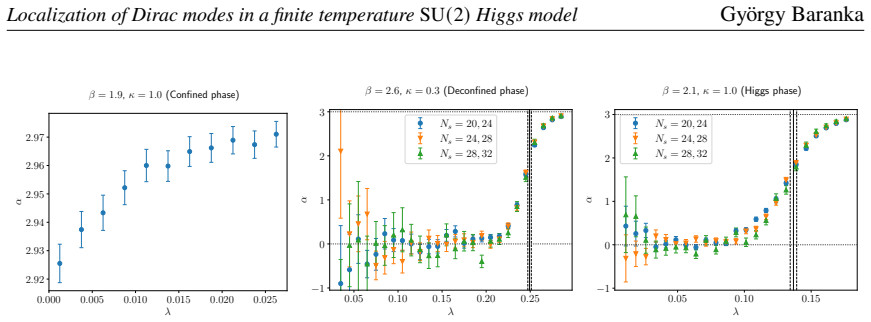
The central object is the sea/islands picture of Dirac-mode localization. In the deconfined and Higgs phases the Polyakov loop takes values near one almost everywhere, forming a sea, and low Dirac modes are trapped on islands, localized regions where fluctuations weaken temporal gauge-field correlation. The operative diagnostic is the fractal dimension alpha(lambda) obtained from the scaling of the inverse participation ratio with spatial volume (alpha=0 localized, alpha=3 delocalized), supplemented by the level-spacing statistic I_s0, whose crossing of its universal critical value I_s0,c locates the mobility edge lambda_c.
What would settle it
Take the confined-phase parameters (beta=1.9, kappa=1.0), compute the fractal dimension at N_s=24, 28, and 32: if alpha(lambda) stays near 3 and I_s0 stays at the random-matrix value across the whole low spectrum, the claim of no localization in the confined phase survives; if a downward trend toward alpha=0 and Poisson statistics appears in some spectral window, the claim fails and a weak mobility edge is present.
Extended reading notes
Core claim
The paper establishes that in the fixed-length SU(2) Higgs model at N_t=4, the low-lying staggered Dirac spectrum has a mobility edge in both ordered phases, the usual deconfined phase and the Higgs phase, with fractal dimension near zero and Poisson level statistics below the edge, crossing to fully delocalized modes with symplectic random-matrix statistics above it. In the confined phase, no mobility edge is seen: modes are delocalized across the low spectrum. The mobility edge moves toward zero as one approaches the confined phase from either ordered phase and vanishes inside the crossover region, while across the deconfined-to-Higgs transition it stays nonzero and simply changes its functional dependence on the couplings. The authors read this as confirmation that localization of low Dirac modes is driven by ordering of the Polyakov loop, independent of the matter content (scalar here, not fermionic) and of whether the ordered phase is deconfined or Higgs.
Load-bearing premise
The claim that the confined phase has no localized modes rests on fractal-dimension estimates from only two lattice sizes, N_s=16 and 20; if those sizes are too small to show the asymptotic scaling, a weak mobility edge in the confined phase could be hidden.
Editorial extensions
If this is right
- In ordered-Polyakov-loop phases of other gauge theories, including those with scalar or no dynamical matter, low Dirac modes should localize with a mobility edge; the matter type is not the controlling factor.
- The mobility edge can serve as a marker of Polyakov-loop ordering: the vanishing of lambda_c marks the crossover boundary where localized low modes disappear.
- The sea/islands mechanism is confirmed as a general explanation of low-mode localization in finite-temperature gauge theories, not a peculiarity of QCD or pure gauge theories.
- A practical consequence for lattice studies is that single-volume I_s0 crossings with a universal I_s0,c can map the mobility edge across the whole parameter plane at moderate cost.
Reading between the lines
- The same logic predicts localization across any transition where the Polyakov loop orders for a different reason, such as center-symmetry deformation, imaginary chemical potential, or an external field, provided the ordering is strong enough; this is checkable in deformed Yang-Mills and Z_N gauge models.
- The assumption that I_s0,c is universal enough to transfer from two parameter sets to single-volume estimates could be tested directly by carrying out finite-size crossings at several points in the parameter plane, including the confined phase.
- If Polyakov-loop ordering alone controls localization, the near-zero spectral density in the Higgs phase should be depleted just as in the deconfined phase, with consequences for the chiral condensate via the Banks-Casher relation; a direct spectral-density study would test this.
- Repeating the analysis for covariant Laplacian eigenmodes, as the authors suggest, would show whether the trapping mechanism is operator-independent or specific to the Dirac operator, and might clarify the disagreement between spin-glass and gauge-fixed transition lines in the low-beta, large-kappa region.
Editorial analysis
A structured set of objections, weighed in public.
Referee Report
Summary. The manuscript studies Dirac-mode localization in the fixed-length SU(2) Higgs model at finite temperature (N_t=4). After mapping the (beta, kappa) phase diagram, the authors compute the fractal dimension alpha from the scaling of the inverse participation ratio and the level-spacing statistic I_s0 for low staggered Dirac modes. They find a mobility edge in the deconfined and Higgs phases, where the Polyakov loop is ordered, and report alpha ≈ 3 and RMT-like I_s0 in the confined phase, concluding that localization is absent there. They then study the beta- and kappa-dependence of the mobility edge along three transition lines, fitting the data with a power law or a crossover form, and locating the disappearance of the mobility edge in the crossover regions.
Significance. If the central claim holds, the paper extends the sea/islands picture of Dirac-mode localization to a theory with scalar, rather than fermionic, dynamical matter and to an ordered phase (Higgs) that is not a conventional deconfined phase. This would strengthen the case that Polyakov-loop ordering, rather than the specific matter content, controls low-mode localization. The combination of an IPR-based fractal dimension and a spectral-statistics diagnostic is methodologically appropriate, and the two measures agree in the ordered phases. The empirical mobility-edge fits are used only as a crossover locator, not as a parameter-free derivation, so the central claim is not circular. The main weakness is that the confined-phase delocalization claim rests on very small volumes and lacks statistical detail, which I detail below.
major comments (3)
- [Sec. 3, Fig. 3 (left)] The central claim that localization is absent in the confined phase is supported only by the fractal dimension from the volume pair N_s=16,20, as acknowledged in the figure caption. If the localization length in this phase is comparable to or larger than these lattice sizes, both alpha ≈ 3 and RMT-like spectral statistics can be mimicked, and a weak mobility edge at very small lambda would be missed. This is load-bearing for the conclusion that localization appears exactly when the Polyakov loop orders, so this null result needs support from at least one additional volume pair deeper in the confined phase, or an explicit demonstration that the volumes are in the asymptotic scaling regime.
- [Sec. 4, Fig. 4 (left)] The I_s0 data in the confined phase are also restricted to the same two small volumes, N_s=16 and 20, so the fractal-dimension and spectral-statistics diagnostics are not independent in the confined phase. In addition, the manuscript reports no statistical uncertainties and no configuration counts anywhere, making it impossible to assess whether the flat alpha ≈ 3 and I_s0 ≈ I_s0,RMT are significant. Please provide error bars and configuration counts, and either add a larger volume for the confined phase or state explicitly that this analysis is deferred to Ref. [30] and summarize its volume coverage.
- [Sec. 5] The mobility-edge scans use a single volume, N_s=20, with the critical value I_s0,c transferred from a volume study performed at only two phase points. The universality of I_s0,c is expected, but it is not verified along each scan, and without uncertainties the fitted parameters in Eqs. (9) and (10) and the conclusion that lambda_c vanishes in the crossover region cannot be assessed quantitatively. A consistency check at one or two representative parameter points with a second volume, or at least quoted errors on the crossing points, would materially strengthen the beta- and kappa-dependence results.
minor comments (3)
- [All figures] The manuscript should state the number of gauge configurations, the number of eigenvalues retained, and the statistics used for each figure; this information is essential for reproducibility and for judging the significance of the flat curves in Figs. 3 and 4.
- [Fig. 3 and Fig. 4] The legend entries in the center and right panels of Fig. 3 and the axis label appearing as '□1' in Fig. 3 seem garbled in the manuscript version; please check the figure rendering.
- [Sec. 2] The sentence 'The phase diagram was studied also at low temperature resulting in a similar picture' is ambiguous: it presumably refers to zero temperature, and it would be clearer to say 'at zero temperature' and to cite the specific figure or result.
Circularity Check
No circularity: the empirical localization analysis and mobility-edge fits do not reduce by construction to their inputs.
full rationale
The paper's central claim is an empirical observation—low Dirac modes are localized in the deconfined and Higgs phases and delocalized in the confined phase—supported by standard diagnostics (fractal dimension from inverse participation ratios and the level-spacing statistic I_s0). The mobility-edge fits in Eqs. (9) and (10) are used only to locate crossovers in lambda_c and are compared against independent susceptibility peaks; no fitted parameter is renamed as a prediction. The 'sea/islands' picture is invoked as an interpretive framework rather than as an input that forces the data, and the cited prior work (including the authors' own Ref. [30]) is background support, not a load-bearing self-citation. The confined-phase conclusion relies on relatively small volumes (N_s=16,20), which is a statistical and extrapolation concern, not a circularity. Therefore the derivation chain is self-contained with respect to the claims made.
Assumptions & free parameters
free parameters (3)
- Eq. (9) power-law parameters a, b, beta_c =
not reported in this contribution
- Eq. (10) crossover-fit parameters a, b, c, d, kappa_c =
not reported in this contribution
- Critical spectral statistic I_s0,c =
from volume crossings in deconfined and Higgs phases, numerical value not given
assumptions (4)
- domain assumption The unfolded level-spacing distribution for staggered SU(2) Dirac modes is the symplectic Wigner surmise with Dyson index beta=4.
- domain assumption At the mobility edge, the critical level-spacing statistics are universal, so I_s0,c determined at one parameter set can be used at other couplings.
- standard math Fractal dimension alpha=3 for delocalized modes and alpha=0 for localized modes in the thermodynamic limit, with Eq. (7) used as a finite-size estimator.
- standard math The Banks-Casher relation connects the spectral density at zero to the chiral condensate.
Cite this review
Pith. "Pith review of Localization of Dirac modes in a finite temperature SU(2) Higgs model." pith.science (2026). https://pith.science/paper/573B7HHV
@misc{pith2026250113177,
  author       = {Pith},
  title        = {Pith review of: Localization of Dirac modes in a finite temperature SU(2) Higgs model},
  year         = {2026},
  howpublished = {\url{https://pith.science/paper/573B7HHV}},
  note         = {Machine review of arXiv:2501.13177}
}
read the original abstract
Low-lying Dirac modes become localized at the finite-temperature transition in QCD and other gauge theories, indicating a strong connection between localization and deconfinement. This phenomenon can be understood through the "sea/islands" picture: in the deconfined phase, modes become trapped on "islands" of Polyakov loop fluctuations within a "sea" of ordered Polyakov loops. To test the universality of the "sea/islands" mechanism, we investigate whether changes in the localization properties of low modes occur across other thermal transitions where the Polyakov loop becomes ordered, beyond the usual deconfinement transition. The fixed-length SU(2)-Higgs model is appropriate for this study. After mapping out the phase diagram, we find that low Dirac modes become localized in the deconfined and Higgs phases, where the Polyakov loop is ordered. However, localization is absent in the confined phase. These findings confirm the "sea/islands" picture of localization.
Figures


Figures from the paper (4 more)


Reference graph
Works this paper leans on
-
[30]
G. Baranka and M. Giordano,Localization of Dirac modes in the SU(2) Higgs model at finite temperature, Phys. Rev. D108 (2023) 114508 [2310.03542]
arXiv 2023
-
[1]
Y. Aoki, G. Endrődi, Z. Fodor, S.D. Katz and K.K. Szabó,The order of the Quantum Chromodynamics transition predicted by the Standard Model of particle physics, Nature 443 (2006) 675 [hep-lat/0611014]
arXiv 2006
-
[2]
Bazavov et al.,The chiral and deconfinement aspects of the QCD transition,Phys
A. Bazavov et al.,The chiral and deconfinement aspects of the QCD transition,Phys. Rev. D 85 (2012) 054503 [1111.1710]
arXiv 2012
-
[3]
T. Banks and A. Casher,Chiral symmetry breaking in confining theories, Nucl. Phys. B169 (1980) 103
work page 1980
-
[4]
Absence of correlations in the QCD Dirac spectrum at high temperature
T.G. Kovács,Absence of correlations in the QCD Dirac spectrum at high temperature,Phys. Rev. Lett.104 (2010) 031601 [0906.5373]
work page Pith review arXiv 2010
-
[5]
Anderson Localization in Quark-Gluon Plasma
T.G. Kovács and F. Pittler,Anderson Localization in Quark-Gluon Plasma, Phys. Rev. Lett. 105 (2010) 192001 [1006.1205]
work page Pith review arXiv 2010
-
[6]
Deconfinement, chiral transition and localisation in a QCD-like model
M. Giordano, S.D. Katz, T.G. Kovács and F. Pittler,Deconfinement, chiral transition and localisation in a QCD-like model,J. High Energy Phys.02(2017) 055 [1611.03284]
work page Pith review arXiv 2017
-
[7]
T.G. Kovács and R.Á. Vig,Localization transition in SU(3) gauge theory,Phys. Rev. D97 (2018) 014502 [1706.03562]
arXiv 2018
Show all 40 references
-
[8]
Giordano,Localisation in 2+1 dimensional SU(3) pure gauge theory at finite temperature, J
M. Giordano,Localisation in 2+1 dimensional SU(3) pure gauge theory at finite temperature, J. High Energy Phys.05 (2019) 204 [1903.04983]
2019 arXiv
-
[9]
Vig and T.G
R.Á. Vig and T.G. Kovács,Localization with overlap fermions,Phys. Rev. D101 (2020) 094511 [2001.06872]
2020 arXiv
-
[10]
Bonati, M
C. Bonati, M. Cardinali, M. D’Elia, M. Giordano and F. Mazziotti,Reconfinement, localization and thermal monopoles in𝑆𝑈(3) trace-deformed Yang-Mills theory,Phys. Rev. D 103 (2021) 034506 [2012.13246]
2021 arXiv
-
[11]
Baranka and M
G. Baranka and M. Giordano,Localization of Dirac modes in finite-temperatureZ2 gauge theory on the lattice, Phys. Rev. D104 (2021) 054513 [2104.03779]
2021 arXiv
-
[12]
Cardinali, M
M. Cardinali, M. D’Elia, F. Garosi and M. Giordano,Localization properties of Dirac modes at the Roberge-Weiss phase transition, Phys. Rev. D105 (2022) 014506 [2110.10029]
2022 arXiv
-
[13]
Baranka and M
G. Baranka and M. Giordano,Deconfinement transition and localization of Dirac modes in finite-temperature Z3 gauge theory on the lattice, Phys. Rev. D106 (2022) 094508 [2210.00840]
2022 arXiv
-
[14]
Giordano and T.G
M. Giordano and T.G. Kovács,Localization of Dirac Fermions in Finite-Temperature Gauge Theory,Universe 7 (2021) 194 [2104.14388]
2021
-
[15]
García-García and J.C
A.M. García-García and J.C. Osborn,Chiral phase transition and Anderson localization in the Instanton Liquid Model for QCD, Nucl. Phys.A770 (2006) 141 [hep-lat/0512025]. 9 Localization of Dirac modes in a finite temperatureSU(2) Higgs model György Baranka
2006 arXiv
-
[16]
García-García and J.C
A.M. García-García and J.C. Osborn,Chiral phase transition in lattice QCD as a metal-insulator transition, Phys. Rev. D75 (2007) 034503 [hep-lat/0611019]
2007 arXiv
-
[17]
Kovács and F
T.G. Kovács and F. Pittler,Poisson to Random Matrix Transition in the QCD Dirac Spectrum,Phys. Rev. D86(2012) 114515 [1208.3475]
2012 arXiv
-
[18]
Giordano, T.G
M. Giordano, T.G. Kovács and F. Pittler,Universality and the QCD Anderson Transition, Phys. Rev. Lett.112 (2014) 102002 [1312.1179]
2014 arXiv
-
[19]
Nishigaki, M
S.M. Nishigaki, M. Giordano, T.G. Kovács and F. Pittler,Critical statistics at the mobility edge of QCD Dirac spectra,PoS LATTICE2013(2014) 018 [1312.3286]
2014 arXiv
-
[20]
Ujfalusi, M
L. Ujfalusi, M. Giordano, F. Pittler, T.G. Kovács and I. Varga,Anderson transition and multifractals in the spectrum of the Dirac operator of Quantum Chromodynamics at high temperature, Phys. Rev. D92(2015) 094513 [1507.02162]
2015 arXiv
-
[21]
Cossu and S
G. Cossu and S. Hashimoto,Anderson Localization in high temperature QCD: background configuration properties and Dirac eigenmodes,J. High Energy Phys.06(2016) 056 [1604.00768]
2016 arXiv
-
[22]
Holicki, E.-M
L. Holicki, E.-M. Ilgenfritz and L. von Smekal,The Anderson transition in QCD with 𝑁 𝑓 = 2+ 1+ 1 twisted mass quarks: overlap analysis, PoS LATTICE2018(2018) 180 [1810.01130]
2018 arXiv
-
[23]
R. Kehr, D. Smith and L. von Smekal,QCD Anderson transition with overlap valence quarks on a twisted-mass sea,Phys. Rev. D109(2024) 074512 [2304.13617]
2024 arXiv
-
[24]
Bonanno and M
C. Bonanno and M. Giordano,Continuum limit of the mobility edge and taste-degeneracy effects in high-temperature lattice QCD with staggered quarks,Phys. Rev. D109(2024) 054510 [2312.02857]
2024 arXiv
-
[25]
Bruckmann, T.G
F. Bruckmann, T.G. Kovács and S. Schierenberg,Anderson localization through Polyakov loops: Lattice evidence and random matrix model,Phys. Rev. D84(2011) 034505 [1105.5336]
2011 arXiv
-
[26]
Giordano, T.G
M. Giordano, T.G. Kovács and F. Pittler,An Ising-Anderson model of localisation in high-temperature QCD, J. High Energy Phys.04(2015) 112 [1502.02532]
2015 arXiv
-
[27]
Giordano, T.G
M. Giordano, T.G. Kovács and F. Pittler,An Anderson-like model of the QCD chiral transition,J. High Energy Phys.06(2016) 007 [1603.09548]
2016 arXiv
-
[28]
Giordano, T.G
M. Giordano, T.G. Kovács and F. Pittler,Localization and chiral properties near the ordering transition of an Anderson-like toy model for QCD, Phys. Rev. D95(2017) 074503 [1612.05059]
2017 arXiv
-
[29]
Fradkin and S.H
E.H. Fradkin and S.H. Shenker,Phase Diagrams of Lattice Gauge Theories with Higgs Fields,Phys. Rev. D19(1979) 3682. 10 Localization of Dirac modes in a finite temperatureSU(2) Higgs model György Baranka
1979
-
[31]
Bonati, G
C. Bonati, G. Cossu, M. D’Elia and A. Di Giacomo,Phase diagram of the lattice SU(2) Higgs model, Nucl. Phys. B828 (2010) 390 [0911.1721]
2010 arXiv
-
[32]
Stathopoulos and J.R
A. Stathopoulos and J.R. McCombs,PRIMME: PReconditioned Iterative MultiMethod Eigensolver: Methods and software description, ACM Trans. Math. Softw.37 (2010) 21
2010
-
[33]
Evers and A.D
F. Evers and A.D. Mirlin,Anderson transitions,Rev. Mod. Phys.80(2008) 1355 [0707.4378]
2008 arXiv
-
[34]
Al’tshuler and B.I
B.L. Al’tshuler and B.I. Shklovski˘ı, Repulsion of energy levels and conductivity of small metal samples,Sov. Phys. JETP64(1986) 127
1986
-
[35]
Mehta,Random Matrices, vol
M.L. Mehta,Random Matrices, vol. 142 ofPure and Applied Mathematics, Academic Press, 3 ed. (2004)
2004
-
[36]
Verbaarschot and T
J.J.M. Verbaarschot and T. Wettig,Random matrix theory and chiral symmetry in QCD, Annu. Rev. Nucl. Part. Sci.50(2000) 343 [hep-ph/0003017]
2000 arXiv
-
[37]
Shklovski˘ı, B
B.I. Shklovski˘ı, B. Shapiro, B.R. Sears, P. Lambrianides and H.B. Shore,Statistics of spectra of disordered systems near the metal-insulator transition,Phys. Rev. B47(1993) 11487
1993
-
[38]
Greensite, Š
J. Greensite, Š. Olejník, M. Polikarpov, S. Syritsyn and V. Zakharov,Localized eigenmodes of covariant Laplacians in the Yang-Mills vacuum, Phys. Rev. D71(2005) 114507 [hep-lat/0504008]
2005 arXiv
-
[39]
Greensite, A.V
J. Greensite, A.V. Kovalenko, Š. Olejník, M.I. Polikarpov, S.N. Syritsyn and V.I. Zakharov, Peculiarities in the spectrum of the adjoint scalar kinetic operator in Yang-Mills theory, Phys. Rev. D74 (2006) 094507 [hep-lat/0606008]
2006 arXiv
-
[40]
Greensite and K
J. Greensite and K. Matsuyama,Higgs phase as a spin glass and the transition between varieties of confinement, Phys. Rev. D101 (2020) 054508 [2001.03068]. 11
2020 arXiv
Reviewed August 10, 2026 · model on record in the stance chip above.
Discussion (0). Continue with ORCID to comment.