REVIEW 2 major objections 5 minor 89 references
Flip-flop QPO changes during state transitions: a case study of GX339-4 and theoretical discussion
T0 review · 2 major / 5 minor · reviewed 2026-08-07 · deepseek-v4-flash
Pith's one-line read In the black hole binary GX339-4, the bright and dim flip-flop states share nearly identical X-ray spectra while swapping between a 5-6 Hz QPO and strong broadband noise, implying the corona does not change between states.
desk verdict A careful, useful observational case study of GX339-4 flip-flops; the spectral-invariance conclusion is underconstrained, but the timing results stand. read the letter →
The pith
A machine-rendered reading of the paper's core claim, the machinery that carries it, and where it could break.
The reading
What carries the argument
The central observational tool is the dynamical power spectrum computed from 8.192-second light-curve segments and sorted by time, soft count rate, or hardness; this sorting exposes the smooth QPO frequency evolution and the mutual exclusion of QPO and broadband noise. The central theoretical mechanism is the comparison between the accretion speed |u_r| and the sound speed c_s in the hot flow: QPO models based on radially propagating waves (oscillating corona models and Lense-Thirring solid-body precession) require sub-sonic flow, so a transition from |u_r| < c_s to |u_r| > c_s could switch the QPO off without changing the coronal spectrum. The paper also uses the spectral energy distribution ratio between states as the evidence that coronal properties do not change.
What would settle it
Point a hard X-ray instrument with sensitivity above 10 keV (for example NuSTAR or Insight-HXMT) at GX339-4 during a flip-flop and extract separate spectra for the bright and dim intervals: if the power-law photon index or high-energy cutoff differs between the two states, the corona has changed and the paper's central conclusion fails. Alternatively, find a single 8-second segment with both a strong 5-6 Hz QPO and strong low-frequency broadband noise at high signal-to-noise, which would break the claimed mutual exclusion.
Extended reading notes
Core claim
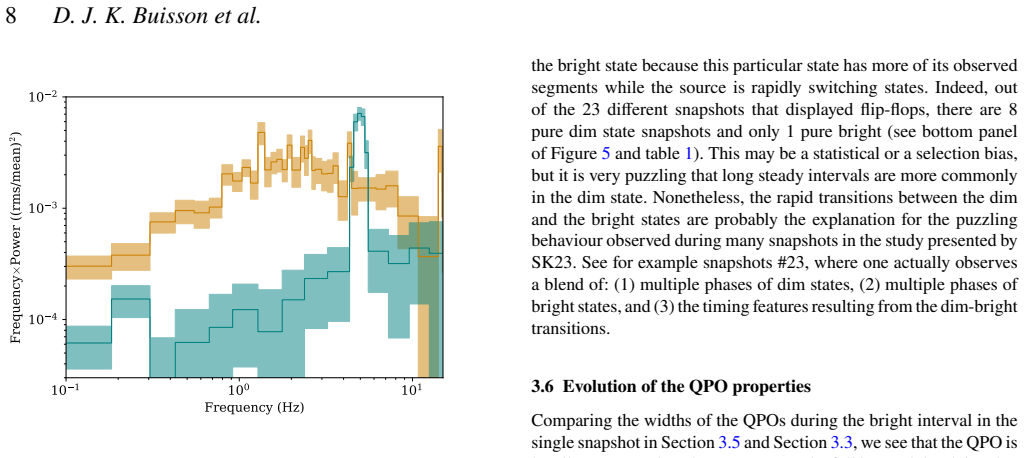
For the 2021 outburst of GX339-4, the paper establishes that the bright and dim flip-flop states have nearly identical spectral energy distributions, with the power-law (coronal) component unchanged up to at least 10 keV and only minor soft-band blackbody differences, while their fast variability is opposite: the bright state shows a narrow 5-6 Hz Type-B QPO with low broadband noise, and the dim state shows strong low-frequency broadband noise with no QPO, at an upper limit 3-30 times lower in power than the bright-state QPO. The QPO frequency rises with both count rate and hardness, and the QPO is locally narrower (Q ~ 17) than in time-averaged spectra, indicating that its frequency drifts. The states can alternate almost 50 times in ~1200 s or remain stable for at least 1000 s, and sorting segments by count rate or hardness reveals a smooth evolution in which the QPO appears to emerge from the broadband noise. The authors conclude that the QPO and broadband noise are two rapidly interchangeable configurations of a spectrally stable corona, and that the most plausible switch is the accretion speed crossing the sound speed, because QPO models requiring wave propagation in the hot flow would fail in a supersonic regime.
Load-bearing premise
The conclusion that the corona does not change between the bright and dim states rests on the measured 0.3-10 keV spectra being nearly identical; if the corona changed in ways that leave this band unchanged, for example through compensating changes or changes only above 10 keV, the claim that the QPO switches on and off without a coronal change would fail.
Editorial extensions
If this is right
- In GX339-4, the Type-B QPO can appear and disappear in tens of seconds while the X-ray spectrum stays nearly unchanged, so the trigger for the QPO is not a spectral state change.
- The QPO frequency is not constant but tracks count rate and hardness on short timescales, so any viable QPO model must couple the oscillation frequency to the same accretion-flow parameters that set the spectrum.
- The dim and bright flip-flop states connect smoothly to the preceding hard and following soft-intermediate states when ordered by rate or hardness, suggesting the observational division into intermediate states may be artificial rather than physical.
- The QPO and broadband noise are mutually exclusive during the flip-flops, and the QPO appears to emerge from the noise when segments are sorted by rate, supporting a common origin for the two variability components.
Reading between the lines
- If confirmed in other sources, sorting dynamical power spectra by count rate or hardness could become a diagnostic for uncovering hidden state transitions in sparse or unevenly sampled observations.
- The sound-speed crossing scenario predicts a specific threshold: the QPO should switch off when the mass accretion rate (or a related parameter) crosses a critical value; simultaneous X-ray and radio monitoring across several outbursts could test whether this threshold is universal across black hole X-ray binaries.
- A coronal geometry that preserves the 0.3-10 keV spectral ratio while changing its wave-propagation properties, for example a change in vertical scale height or viscosity parameter that leaves the emitted spectrum nearly fixed, would reconcile the near-identical SEDs with the variability switch; this is a testable model extension the paper does not pursue.
Editorial analysis
A structured set of objections, weighed in public.
Referee Report
Summary. This paper analyzes NICER observations of the black hole X-ray binary GX339-4 during its 2021 outburst, focusing on the hard-to-soft transition where the source exhibits rapid flip-flops between a bright and a dim state. The main observational claims are: (i) the bright state shows a narrow 5-6 Hz Type-B QPO with weak broadband noise, while the dim state shows strong low-frequency broadband noise and no QPO, with an upper limit 3-30 times lower in QPO power; (ii) the two states have very similar SEDs, differing by at most about 10% up to 10 keV; (iii) the QPO frequency increases with count rate and hardness; and (iv) flip-flops can occur on timescales of tens of seconds, with nearly 50 state changes within ~1200 s, while both states can also remain stable for over 1000 s. The paper discusses theoretical implications, proposing that the corona's accretion speed relative to the sound speed may switch QPOs on and off, and reviews several QPO models in this context.
Significance. If correct, the central result—that the QPO and broadband noise can exchange rapidly while the 0.3-10 keV spectral energy distribution stays nearly constant—provides a strong new constraint on models of low-frequency QPOs in black hole X-ray binaries. The analysis is careful in several respects: the periodogram fitting uses a statistically appropriate exponential likelihood, includes posterior predictive checks, and the upper-limit calculation on QPO power in the dim state is well documented. The use of rate- and hardness-sorted dynamical power spectra is a useful visualization tool. However, the spectral inference is limited to the 0.3-10 keV band, and the conclusion that the corona is physically unchanged depends on the absence of degeneracy in the Comptonized emission, which is not demonstrated.
major comments (2)
- [§3.2, Fig. 3; invoked in §4.1 and §4.3] The conclusion that the corona is spectrally unchanged between the bright and dim states rests on the near-equality of the 0.3-10 keV SEDs (Figure 3, bottom panel). However, the Comptonized power-law component in this band is degenerate under simultaneous changes of electron temperature, optical depth, and seed-photon flux: a higher kTe with lower tau can keep the 2-10 keV ratio constant to within 10% while the coronal properties change substantially. The citation to Yang et al. (2023) for harder-band coverage (footnote 4) is not sufficient, because that work uses a different flip-flop definition and does not model this degeneracy for the present state pair. Since the model discussion in Section 4.3 (especially 4.3.1 and 4.3.3) assumes unchanged coronal temperature, density, and geometry, this is a load-bearing inference. I recommend either (a) fitting a physical Comptonization model (e.g., nthcomp or eqpair) to time-resolved spectra of the two states, including any available harder X-ray data, and showing the allowed parameter ranges, or (b) explicitly weakening the conclusion to 'no spectral change detectable in the 0.3-10 keV band' and discussing the degeneracy.
- [§3.1, §3.4, and Fig. 5] The division of the light curve into five sections, and in particular the bright/dim classification during the transition, is performed manually and is partly informed by the same count-rate and hardness properties that are later used to sort the dynamical power spectra. This does not invalidate the observed dichotomy in the average power spectra, which is clear from the single-snapshot analysis (Fig. 6), but it does weaken the quantitative statements about 'almost 50 state changes within ~1200 s' (abstract, §3.4) and about the smooth evolution seen in the rate- and hardness-sorted dynamical power spectra (§3.3.2, §3.3.3), since a reordering by the defining variable will necessarily produce adjacency of similar states. The authors acknowledge the lack of physical grounds for the sorting, but a robustness test (e.g., varying the rate threshold, or using an objective segmentation algorithm such as a hidden Markov model) would strengthen these particular claims.
minor comments (5)
- [§3.3.2–3.3.3] The phrase 'the QPO ... emerges from the BBN' (Section 3.3.2) is a visual impression based on re-ordered data; the authors correctly label it as not a direct demonstration, but the wording in the conclusion ('These states are clearly distinguishable, as illustrated by the dynamical power spectrum sorted by soft count rate') should clarify that this is an empirical reordering rather than a physical causal sequence.
- [§3.4] Please state the criterion used to identify individual state changes (e.g., a count-rate threshold) and provide the light curve with the identified intervals marked; this would make the 'almost 50 state changes' claim verifiable and reproducible.
- [§3.7] The upper-limit calculation assumes Q=6; given that the fitted QPO width depends on hardness and rate (Section 3.6, Table B3), the factor of 3-30 in the limit could vary with the assumed Q. Please state how the limit would change for the range of fitted Q values.
- [Appendix B, Eq. after 'Lorentzian'] The notation for the Lorentzian width is inconsistent in a few places: '𝜈w' is used in the definition, while '𝜈_w' appears in the surrounding text. Also, in Figures 4 and 6, the axis label 'Frequency × Power' should be accompanied by the normalization (rms/mean)² explicitly on the axis, not only in the caption.
- [§4.3.3, footnote 10] The dismissal of Marcel & Neilsen (2021)'s argument against Lense-Thirring solid-body precession is important for the viability of the proposed model; consider moving this caveat into the main text rather than a footnote, since it directly affects the interpretation.
Circularity Check
Minor self-referential sorting in Section 3.3; otherwise the observational chain is self-contained and the theoretical discussion is explicitly speculative.
-
other
[Section 3.3.2 (Rate sorting), Figure 5 middle panel]
"Following the idea that QPO properties are tightly linked to the count rate of the source (e.g. Nespoli et al. 2003), we sort segments by soft(2-4keV) rate... More importantly, this figure illustrates a major characteristic of the flip-flops: when ordered by count rate, the dynamical power-spectrum draws a smooth picture of the variability."
The sorting variable is the same soft 2-4 keV count rate that is used to separate the dim and bright states. Placing all bright, QPO-bearing segments together and all dim, BBN-dominated segments together makes the sorted dynamical power spectrum appear continuous and makes the QPO frequency appear to increase smoothly with the x-axis coordinate. The apparent QPO-rate correlation is therefore partly a restatement of the state classification rather than an independent measurement. The paper acknowledges this limitation, noting that the re-organization 'is not a direct demonstration,' and it provides independent support via single-snapshot power spectra, upper limits, and a Taylor-expansion fit of the QPO parameters, so the effect is minor and not central to the main results.
full rationale
The core observational results — the bright state showing a 5-6 Hz Type-B QPO with weak broadband noise, the dim state showing strong low-frequency BBN with no QPO (upper limit 3-30 times lower in power), nearly identical SEDs across flip-flops, and rapid state switching within a single NICER snapshot — are derived directly from the data and do not depend on any fitted theoretical model. The main self-referential element is the rate/hardness sorting in Section 3.3, where the ordering variable is the same soft count rate used to separate the dim and bright states; this makes the sorted dynamical power spectra appear artificially smooth and makes the QPO-frequency trend partly a restatement of the classification. The paper explicitly flags this as a re-organization rather than a direct demonstration, and the independent checks in Sections 3.4-3.5, 3.7, and Appendix B establish the timing dichotomy and frequency evolution without relying on the sorting. The theoretical discussion in Section 4 is clearly speculative; the appeal to Marcel & Neilsen (2021) for near-sound-speed accretion is a co-authored citation used as input to a plausibility argument, not as the basis of the reported measurements, so it is not load-bearing. Overall the central claim is self-contained against the data, and the only circularity-like element is minor and acknowledged by the authors.
Assumptions & free parameters
free parameters (8)
- Manual state-section boundaries =
not quantified
- Type-B QPO centroid at median hardness =
5.12 Hz
- Type-B QPO width at median hardness =
0.419 Hz
- QPO normalization at median hardness =
4.34e-4 (rms/mean)^2
- Broadband noise normalization at median hardness =
1.25e-4 (rms/mean)^2
- Assumed QPO width for dim-state upper limit =
Q=6
- Disk aspect ratio H/R =
1e-2
- Disk density and optical depth =
n~1e22 cm^-3, tau~400
assumptions (9)
- domain assumption NICER default screening yields clean data without instrumental features
- domain assumption GX339-4 is a 10 solar mass black hole with spin a=0.94
- domain assumption The 2-10 keV band is adequate to characterize the coronal power-law component
- domain assumption Similarity of the 0.3-10 keV SED between states implies coronal properties are unchanged
- domain assumption Flip-flop states are intrinsic accretion states rather than variable absorption or instrument effects
- standard math Periodogram points are exponentially distributed and independent for the PSD fits
- ad hoc to paper The corona's accretion speed is near the sound speed, as argued in Marcel and Neilsen 2021
- ad hoc to paper Lense-Thirring precession configurations can produce the QPO despite Marcel and Neilsen's concerns
- domain assumption Radiation pressure dominates over gas pressure by a factor greater than 30 in both flip-flop states
Cite this review
Pith. "Pith review of Flip-flop QPO changes during state transitions: a case study of GX339-4 and theoretical discussion." pith.science (2026). https://pith.science/paper/57DJE4LI
@misc{pith2026250208718,
  author       = {Pith},
  title        = {Pith review of: Flip-flop QPO changes during state transitions: a case study of GX339-4 and theoretical discussion},
  year         = {2026},
  howpublished = {\url{https://pith.science/paper/57DJE4LI}},
  note         = {Machine review of arXiv:2502.08718}
}
read the original abstract
We analyse the 2021 outburst from the black hole X-ray binary GX339-4 observed by NICER around the hard to soft transition, when the system exhibits flip-flops between two distinct luminosity states: a bright state with a 5-6 Hz quasi-periodic oscillation (QPO) and a dim state showing only strong broadband noise. Despite the marked differences in variability patterns between these states, the spectral energy distributions remain strikingly similar, with only minor changes in the black body component in the soft X-ray range. We find that the QPO frequency correlates with the X-ray count rates and hardness, suggesting a tight coupling between the QPO mechanism and the accretion disc's spectral properties. Additionally, we demonstrate that flip-flops can occur on very short timescales, with almost 50 state changes within ~1200 s, while both states can also remain stable over longer periods (at least 1000 s). We explore various QPO models to explain these observations, including the possibility that the corona's accretion speed is near the sound speed, affecting the presence of QPOs. However, the exact mechanism driving the flip-flops and the QPOs remains unclear. Our findings emphasize the complexity of these phenomena and the necessity for further theoretical and observational studies to unravel the intricacies of QPO and flip-flop behaviours in X-ray binaries.
Figures


Figures from the paper (4 more)



Reference graph
Works this paper leans on
-
[1]
write newline
" write newline "" before.all 'output.state := FUNCTION fin.entry write newline FUNCTION new.block output.state before.all = 'skip after.block 'output.state := if FUNCTION new.sentence output.state after.block = 'skip output.state before.all = 'skip after.sentence 'output.state := if if FUNCTION not #0 #1 if FUNCTION and 'skip pop #0 if FUNCTION or pop #1...
-
[2]
Abramowicz M. A., Czerny B., Lasota J. P., Szuszkiewicz E., 1988, @doi [ ] 10.1086/166683 , https://ui.adsabs.harvard.edu/abs/1988ApJ...332..646A 332, 646
doi:10.1086/166683 1988
-
[3]
Alabarta K., et al., 2021, @doi [ ] 10.1093/mnras/stab2241 , https://ui.adsabs.harvard.edu/abs/2021MNRAS.507.5507A 507, 5507
-
[4]
Andrew B. H., Purton C. R., 1968, @doi [ ] 10.1038/218855a0 , https://ui.adsabs.harvard.edu/abs/1968Natur.218..855A 218, 855
-
[5]
Bellavita C., Garc \' a F., M \'e ndez M., Karpouzas K., 2022, @doi [ ] 10.1093/mnras/stac1922 , https://ui.adsabs.harvard.edu/abs/2022MNRAS.515.2099B 515, 2099
-
[6]
Belloni T. M., Motta S. E., 2016, in Bambi C., ed., Astrophysics and Space Science Library Vol. 440, Astrophysics of Black Holes: From Fundamental Aspects to Latest Developments. p. 61 ( @eprint arXiv 1603.07872 ), @doi 10.1007/978-3-662-52859-4_2
arXiv 2016
-
[7]
Belloni T., van der Klis M., Lewin W. H. G., van Paradijs J., Dotani T., Mitsuda K., Miyamoto S., 1997a, , https://ui.adsabs.harvard.edu/abs/1997A&A...322..857B 322, 857
-
[8]
Belloni T., M \'e ndez M., King A. R., van der Klis M., van Paradijs J., 1997b, @doi [ ] 10.1086/310595 , https://ui.adsabs.harvard.edu/abs/1997ApJ...479L.145B 479, L145
Show all 89 references
-
[9]
Belloni T., Psaltis D., van der Klis M., 2002, @doi [ ] 10.1086/340290 , https://ui.adsabs.harvard.edu/abs/2002ApJ...572..392B 572, 392
2002 doi
-
[10]
Bogensberger D., et al., 2020, @doi [ ] 10.1051/0004-6361/202037657 , https://ui.adsabs.harvard.edu/abs/2020A&A...641A.101B 641, A101
2020 doi
-
[11]
T., Chubb T
Bowyer S., Byram E. T., Chubb T. A., Friedman H., 1964, @doi [ ] 10.1038/2011307a0 , https://ui.adsabs.harvard.edu/abs/1964Natur.201.1307B 201, 1307
1964 doi
-
[13]
Casella P., Belloni T., Homan J., Stella L., 2004, @doi [ ] 10.1051/0004-6361:20041231 , https://ui.adsabs.harvard.edu/abs/2004A&A...426..587C 426, 587
2004 doi
-
[14]
Casella P., Belloni T., Stella L., 2005, @doi [ ] 10.1086/431174 , https://ui.adsabs.harvard.edu/abs/2005ApJ...629..403C 629, 403
2005 doi
-
[15]
E., Belloni T
De Marco B., Motta S. E., Belloni T. M., 2022, in , Handbook of X-ray and Gamma-ray Astrophysics. p. 58, @doi 10.1007/978-981-16-4544-0_129-1
2022 doi
-
[16]
Done C., Gierli \'n ski M., Kubota A., 2007, @doi [ ] 10.1007/s00159-007-0006-1 , https://ui.adsabs.harvard.edu/abs/2007A&ARv..15....1D 15, 1
2007 doi
-
[17]
Dunn R. J. H., Fender R. P., K \"o rding E. G., Belloni T., Cabanac C., 2010, @doi [ ] 10.1111/j.1365-2966.2010.16114.x , https://ui.adsabs.harvard.edu/abs/2010MNRAS.403...61D 403, 61
2010
-
[18]
A., Narayan R., Ostriker E., Yi I., 1996, @doi [ ] 10.1086/177421 , https://ui.adsabs.harvard.edu/abs/1996ApJ...465..312E 465, 312
Esin A. A., Narayan R., Ostriker E., Yi I., 1996, @doi [ ] 10.1086/177421 , https://ui.adsabs.harvard.edu/abs/1996ApJ...465..312E 465, 312
1996 doi
-
[19]
Ferreira J., et al., 2022, @doi [ ] 10.1051/0004-6361/202040165 , https://ui.adsabs.harvard.edu/abs/2022A&A...660A..66F 660, A66
2022 doi
-
[20]
W., Lang D., Goodman J., 2013, @doi [ ] 10.1086/670067 , https://ui.adsabs.harvard.edu/abs/2013PASP..125..306F 125, 306
Foreman-Mackey D., Hogg D. W., Lang D., Goodman J., 2013, @doi [ ] 10.1086/670067 , https://ui.adsabs.harvard.edu/abs/2013PASP..125..306F 125, 306
2013 doi
-
[21]
J., Fenton A
Francey R. J., Fenton A. G., 1967, @doi [ ] 10.1038/216773a0 , https://ui.adsabs.harvard.edu/abs/1967Natur.216..773F 216, 773
1967 doi
-
[22]
R., Lasota J
Frank J., King A. R., Lasota J. P., 1987, , https://ui.adsabs.harvard.edu/abs/1987A&A...178..137F 178, 137
1987
-
[23]
J., 2002, Accretion Power in Astrophysics: Third Edition
Frank J., King A., Raine D. J., 2002, Accretion Power in Astrophysics: Third Edition
2002
-
[24]
Garc \' a F., Karpouzas K., M \'e ndez M., Zhang L., Zhang Y., Belloni T., Altamirano D., 2022, @doi [ ] 10.1093/mnras/stac1202 , https://ui.adsabs.harvard.edu/abs/2022MNRAS.513.4196G 513, 4196
2022 doi
-
[25]
Goodman J., Weare J., 2010, @doi [Communications in Applied Mathematics and Computational Science] 10.2140/camcos.2010.5.65 , https://ui.adsabs.harvard.edu/abs/2010CAMCS...5...65G 5, 65
2010 doi
-
[26]
G., Torres M
Heida M., Jonker P. G., Torres M. A. P., Chiavassa A., 2017, @doi [ ] 10.3847/1538-4357/aa85df , https://ui.adsabs.harvard.edu/abs/2017ApJ...846..132H 846, 132
2017 doi
-
[27]
M., Wade C
Hjellming R. M., Wade C. M., 1971, @doi [ ] 10.1086/180777 , https://ui.adsabs.harvard.edu/abs/1971ApJ...168L..21H 168, L21
1971 doi
-
[28]
Homan J., Wijnands R., van der Klis M., Belloni T., van Paradijs J., Klein-Wolt M., Fender R., M \'e ndez M., 2001, @doi [ ] 10.1086/318954 , https://ui.adsabs.harvard.edu/abs/2001ApJS..132..377H 132, 377
2001 doi
-
[29]
Homan J., et al., 2020, @doi [ ] 10.3847/2041-8213/ab7932 , https://ui.adsabs.harvard.edu/abs/2020ApJ...891L..29H 891, L29
2020 doi
-
[30]
R., Motta S
Ingram A. R., Motta S. E., 2019, @doi [ ] 10.1016/j.newar.2020.101524 , https://ui.adsabs.harvard.edu/abs/2019NewAR..8501524I 85, 101524
2019
-
[31]
C., 2009, @doi [ ] 10.1111/j.1745-3933.2009.00693.x , https://ui.adsabs.harvard.edu/abs/2009MNRAS.397L.101I 397, L101
Ingram A., Done C., Fragile P. C., 2009, @doi [ ] 10.1111/j.1745-3933.2009.00693.x , https://ui.adsabs.harvard.edu/abs/2009MNRAS.397L.101I 397, L101
2009
-
[32]
Janiuk A., Czerny B., Siemiginowska A., 2000, @doi [ ] 10.1086/312911 , https://ui.adsabs.harvard.edu/abs/2000ApJ...542L..33J 542, L33
2000 doi
-
[33]
C., Wang J., Walton D
Jiang J., Fabian A. C., Wang J., Walton D. J., Garc \' a J. A., Parker M. L., Steiner J. F., Tomsick J. A., 2019, @doi [ ] 10.1093/mnras/stz095 , https://ui.adsabs.harvard.edu/abs/2019MNRAS.484.1972J 484, 1972
2019 doi
-
[34]
Kalamkar M., Homan J., Altamirano D., van der Klis M., Casella P., Linares M., 2011, @doi [ ] 10.1088/2041-8205/731/1/L2 , https://ui.adsabs.harvard.edu/abs/2011ApJ...731L...2K 731, L2
2011 doi
-
[35]
Kalamkar M., van der Klis M., Heil L., Homan J., 2015, @doi [ ] 10.1088/0004-637X/808/2/144 , https://ui.adsabs.harvard.edu/abs/2015ApJ...808..144K 808, 144
2015 doi
-
[36]
M., Altamirano D., Blaes O., Garc \' a F., 2020, @doi [ ] 10.1093/mnras/stz3502 , https://ui.adsabs.harvard.edu/abs/2020MNRAS.492.1399K 492, 1399
Karpouzas K., M \'e ndez M., Ribeiro E. M., Altamirano D., Blaes O., Garc \' a F., 2020, @doi [ ] 10.1093/mnras/stz3502 , https://ui.adsabs.harvard.edu/abs/2020MNRAS.492.1399K 492, 1399
2020 doi
-
[37]
Kotov O., Churazov E., Gilfanov M., 2001, @doi [ ] 10.1046/j.1365-8711.2001.04769.x , https://ui.adsabs.harvard.edu/abs/2001MNRAS.327..799K 327, 799
2001
-
[38]
Kuulkers E., et al., 2013, @doi [ ] 10.1051/0004-6361/201219447 , https://ui.adsabs.harvard.edu/abs/2013A&A...552A..32K 552, A32
2013 doi
-
[39]
A., Darbro W., Elsner R
Leahy D. A., Darbro W., Elsner R. F., Weisskopf M. C., Sutherland P. G., Kahn S., Grindlay J. E., 1983, @doi [ ] 10.1086/160766 , https://ui.adsabs.harvard.edu/abs/1983ApJ...266..160L 266, 160
1983 doi
-
[40]
P., Eardley D
Lightman A. P., Eardley D. M., 1974, @doi [ ] 10.1086/181377 , https://ui.adsabs.harvard.edu/abs/1974ApJ...187L...1L 187, L1
1974 doi
-
[41]
Liu H., Jiang J., Zhang Z., Bambi C., Ji L., Kong L., Zhang S., 2022a, @doi [ ] 10.1093/mnras/stac1178 , https://ui.adsabs.harvard.edu/abs/2022MNRAS.513.4308L 513, 4308
-
[42]
X., et al., 2022b, @doi [ ] 10.3847/1538-4357/ac88c6 , https://ui.adsabs.harvard.edu/abs/2022ApJ...938..108L 938, 108
Liu H. X., et al., 2022b, @doi [ ] 10.3847/1538-4357/ac88c6 , https://ui.adsabs.harvard.edu/abs/2022ApJ...938..108L 938, 108
-
[43]
Liu H., et al., 2023, @doi [ ] 10.3847/1538-4357/acca17 , https://ui.adsabs.harvard.edu/abs/2023ApJ...950....5L 950, 5
2023 doi
-
[44]
E., 1997, @doi [ ] 10.1093/mnras/292.3.679 , https://ui.adsabs.harvard.edu/abs/1997MNRAS.292..679L 292, 679
Lyubarskii Y. E., 1997, @doi [ ] 10.1093/mnras/292.3.679 , https://ui.adsabs.harvard.edu/abs/1997MNRAS.292..679L 292, 679
1997 doi
-
[45]
Marcel G., Neilsen J., 2021, @doi [ ] 10.3847/1538-4357/abcbf9 , https://ui.adsabs.harvard.edu/abs/2021ApJ...906..106M 906, 106
2021 doi
-
[46]
Marcel G., et al., 2018a, @doi [ ] 10.1051/0004-6361/201732069 , https://ui.adsabs.harvard.edu/abs/2018A&A...615A..57M 615, A57
-
[47]
Marcel G., et al., 2018b, @doi [ ] 10.1051/0004-6361/201833124 , https://ui.adsabs.harvard.edu/abs/2018A&A...617A..46M 617, A46
-
[48]
Matsuoka M., et al., 2009, @doi [ ] 10.1093/pasj/61.5.999 , https://ui.adsabs.harvard.edu/abs/2009PASJ...61..999M 61, 999
2009 doi
-
[49]
C., Anderson J., Blankenship A., Li H., Nalewajko K., 2022, @doi [ ] 10.3847/1538-4357/ac938b , https://ui.adsabs.harvard.edu/abs/2022ApJ...939...31M 939, 31
Mishra B., Fragile P. C., Anderson J., Blankenship A., Li H., Nalewajko K., 2022, @doi [ ] 10.3847/1538-4357/ac938b , https://ui.adsabs.harvard.edu/abs/2022ApJ...939...31M 939, 31
2022 doi
-
[50]
Miyamoto S., Kimura K., Kitamoto S., Dotani T., Ebisawa K., 1991, @doi [ ] 10.1086/170837 , https://ui.adsabs.harvard.edu/abs/1991ApJ...383..784M 383, 784
1991 doi
-
[51]
C., 1964, @doi [ ] 10.1086/147940 , https://ui.adsabs.harvard.edu/abs/1964ApJ...140..460M 140, 460
Morton D. C., 1964, @doi [ ] 10.1086/147940 , https://ui.adsabs.harvard.edu/abs/1964ApJ...140..460M 140, 460
1964 doi
-
[52]
Motta S., Mu \ n oz-Darias T., Casella P., Belloni T., Homan J., 2011, @doi [ ] 10.1111/j.1365-2966.2011.19566.x , https://ui.adsabs.harvard.edu/abs/2011MNRAS.418.2292M 418, 2292
2011
-
[53]
M., Hiemstra B., M \'e ndez M., 2012, @doi [ ] 10.1111/j.1365-2966.2012.22037.x , https://ui.adsabs.harvard.edu/abs/2012MNRAS.427..595M 427, 595
Motta S., Homan J., Mu \ n oz Darias T., Casella P., Belloni T. M., Hiemstra B., M \'e ndez M., 2012, @doi [ ] 10.1111/j.1365-2966.2012.22037.x , https://ui.adsabs.harvard.edu/abs/2012MNRAS.427..595M 427, 595
2012
-
[54]
E., Franchini A., Lodato G., Mastroserio G., 2018, @doi [ ] 10.1093/mnras/stx2358 , https://ui.adsabs.harvard.edu/abs/2018MNRAS.473..431M 473, 431
Motta S. E., Franchini A., Lodato G., Mastroserio G., 2018, @doi [ ] 10.1093/mnras/stx2358 , https://ui.adsabs.harvard.edu/abs/2018MNRAS.473..431M 473, 431
2018 doi
-
[55]
E., et al., 2021, @doi [ ] 10.1016/j.newar.2021.101618 , https://ui.adsabs.harvard.edu/abs/2021NewAR..9301618M 93, 101618
Motta S. E., et al., 2021, @doi [ ] 10.1016/j.newar.2021.101618 , https://ui.adsabs.harvard.edu/abs/2021NewAR..9301618M 93, 101618
2021
-
[56]
M., Lewin W
Nespoli E., Belloni T., Homan J., Miller J. M., Lewin W. H. G., M \'e ndez M., van der Klis M., 2003, @doi [ ] 10.1051/0004-6361:20031423 , https://ui.adsabs.harvard.edu/abs/2003A&A...412..235N 412, 235
2003 doi
-
[57]
Nixon C., King A., Price D., Frank J., 2012, @doi [ ] 10.1088/2041-8205/757/2/L24 , https://ui.adsabs.harvard.edu/abs/2012ApJ...757L..24N 757, L24
2012 doi
-
[58]
A., 2000, @doi [ ] 10.1046/j.1365-8711.2000.03668.x , https://ui.adsabs.harvard.edu/abs/2000MNRAS.318..361N 318, 361
Nowak M. A., 2000, @doi [ ] 10.1046/j.1365-8711.2000.03668.x , https://ui.adsabs.harvard.edu/abs/2000MNRAS.318..361N 318, 361
2000
-
[59]
E., Matsumoto R., 2009, @doi [ ] 10.1088/0004-637X/697/1/16 , https://ui.adsabs.harvard.edu/abs/2009ApJ...697...16O 697, 16
Oda H., Machida M., Nakamura K. E., Matsumoto R., 2009, @doi [ ] 10.1088/0004-637X/697/1/16 , https://ui.adsabs.harvard.edu/abs/2009ApJ...697...16O 697, 16
2009 doi
-
[60]
Papaloizou J. C. B., Pringle J. E., 1983, @doi [ ] 10.1093/mnras/202.4.1181 , https://ui.adsabs.harvard.edu/abs/1983MNRAS.202.1181P 202, 1181
1983 doi
-
[61]
Q., et al., 2004, @doi [ ] 10.1086/421511 , https://ui.adsabs.harvard.edu/abs/2004ApJ...610..378P 610, 378
Park S. Q., et al., 2004, @doi [ ] 10.1086/421511 , https://ui.adsabs.harvard.edu/abs/2004ApJ...610..378P 610, 378
2004 doi
-
[62]
L., et al., 2016, @doi [ ] 10.3847/2041-8205/821/1/L6 , https://ui.adsabs.harvard.edu/abs/2016ApJ...821L...6P 821, L6
Parker M. L., et al., 2016, @doi [ ] 10.3847/2041-8205/821/1/L6 , https://ui.adsabs.harvard.edu/abs/2016ApJ...821L...6P 821, L6
2016 doi
-
[63]
O., Ferreira J., Henri G., Malzac J., Foellmi C., 2010, @doi [ ] 10.1051/0004-6361/201014753 , https://ui.adsabs.harvard.edu/abs/2010A&A...522A..38P 522, A38
Petrucci P. O., Ferreira J., Henri G., Malzac J., Foellmi C., 2010, @doi [ ] 10.1051/0004-6361/201014753 , https://ui.adsabs.harvard.edu/abs/2010A&A...522A..38P 522, A38
2010 doi
- [64]
-
[65]
A., McClintock J
Remillard R. A., McClintock J. E., 2006, @doi [ ] 10.1146/annurev.astro.44.051905.092532 , https://ui.adsabs.harvard.edu/abs/2006ARA&A..44...49R 44, 49
2006 arXiv
-
[66]
I., Sunyaev R
Shakura N. I., Sunyaev R. A., 1973, , https://ui.adsabs.harvard.edu/abs/1973A&A....24..337S 24, 337
1973
-
[67]
S a dowski A., 2016, @doi [ ] 10.1093/mnras/stw913 , https://ui.adsabs.harvard.edu/abs/2016MNRAS.459.4397S 459, 4397
2016 doi
-
[68]
R., Choi C
Sriram K., Rao A. R., Choi C. S., 2012, @doi [ ] 10.1051/0004-6361/201218799 , https://ui.adsabs.harvard.edu/abs/2012A&A...541A...6S 541, A6
2012 doi
-
[69]
R., Choi C
Sriram K., Rao A. R., Choi C. S., 2016, @doi [ ] 10.3847/0004-637X/823/1/67 , https://ui.adsabs.harvard.edu/abs/2016ApJ...823...67S 823, 67
2016 doi
-
[70]
Stella L., Vietri M., 1999, @doi [ ] 10.1103/PhysRevLett.82.17 , https://ui.adsabs.harvard.edu/abs/1999PhRvL..82...17S 82, 17
1999 doi
-
[71]
M., 1999, @doi [ ] 10.1086/312291 , https://ui.adsabs.harvard.edu/abs/1999ApJ...524L..63S 524, L63
Stella L., Vietri M., Morsink S. M., 1999, @doi [ ] 10.1086/312291 , https://ui.adsabs.harvard.edu/abs/1999ApJ...524L..63S 524, L63
1999 doi
-
[72]
Stiele H., Kong A. K. H., 2023, @doi [ ] 10.1093/mnras/stad969 , https://ui.adsabs.harvard.edu/abs/2023MNRAS.522..268S 522, 268
2023 doi
-
[73]
Stiele H., Yu W., 2015, @doi [ ] 10.1093/mnras/stv1530 , https://ui.adsabs.harvard.edu/abs/2015MNRAS.452.3666S 452, 3666
2015 doi
-
[74]
Takizawa M., et al., 1997, @doi [ ] 10.1086/304759 , https://ui.adsabs.harvard.edu/abs/1997ApJ...489..272T 489, 272
1997 doi
-
[75]
E., Sivakoff G
Tetarenko B. E., Sivakoff G. R., Heinke C. O., Gladstone J. C., 2016, @doi [ ] 10.3847/0067-0049/222/2/15 , https://ui.adsabs.harvard.edu/abs/2016ApJS..222...15T 222, 15
2016 doi
-
[76]
R., 2021, The Astronomer's Telegram, https://ui.adsabs.harvard.edu/abs/2021ATel14336....1T 14336, 1
Tremou E., Corbel S., Fender R., Woudt P., Miller-Jones J., Motta S., Sivakoff G. R., 2021, The Astronomer's Telegram, https://ui.adsabs.harvard.edu/abs/2021ATel14336....1T 14336, 1
2021
-
[77]
Turner S. G. D., Reynolds C. S., 2021, @doi [ ] 10.1093/mnras/stab875 , https://ui.adsabs.harvard.edu/abs/2021MNRAS.504..469T 504, 469
2021 doi
-
[78]
Turner S. G. D., Reynolds C. S., 2023, @doi [ ] 10.1093/mnras/stad2275 , https://ui.adsabs.harvard.edu/abs/2023MNRAS.525.2287T 525, 2287
2023 doi
-
[79]
Uttley P., Klein-Wolt M., 2015, @doi [ ] 10.1093/mnras/stv978 , https://ui.adsabs.harvard.edu/abs/2015MNRAS.451..475U 451, 475
2015 doi
-
[80]
M., Vaughan S., 2005, @doi [ ] 10.1111/j.1365-2966.2005.08886.x , https://ui.adsabs.harvard.edu/abs/2005MNRAS.359..345U 359, 345
Uttley P., McHardy I. M., Vaughan S., 2005, @doi [ ] 10.1111/j.1365-2966.2005.08886.x , https://ui.adsabs.harvard.edu/abs/2005MNRAS.359..345U 359, 345
2005
-
[81]
M., et al., 2023, @doi [ ] 10.1038/s41586-022-05648-3 , https://ui.adsabs.harvard.edu/abs/2023Natur.615...45V 615, 45
Vincentelli F. M., et al., 2023, @doi [ ] 10.1038/s41586-022-05648-3 , https://ui.adsabs.harvard.edu/abs/2023Natur.615...45V 615, 45
2023 doi
-
[82]
E., Swank J
White N. E., Swank J. H., 1982, @doi [ ] 10.1086/183737 , https://ui.adsabs.harvard.edu/abs/1982ApJ...253L..61W 253, L61
1982 doi
-
[83]
Wijnands R., Homan J., van der Klis M., 1999, @doi [ ] 10.1086/312365 , https://ui.adsabs.harvard.edu/abs/1999ApJ...526L..33W 526, L33
1999 doi
-
[84]
Xu Y., et al., 2019, @doi [ ] 10.3847/1538-4357/ab24bf , https://ui.adsabs.harvard.edu/abs/2019ApJ...879...93X 879, 93
2019 doi
-
[85]
Yang Z.-X., et al., 2023, @doi [ ] 10.1093/mnras/stad795 , https://ui.adsabs.harvard.edu/abs/2023MNRAS.521.3570Y 521, 3570
2023 doi
-
[86]
Yuan F., Narayan R., 2014, @doi [ ] 10.1146/annurev-astro-082812-141003 , https://ui.adsabs.harvard.edu/abs/2014ARA&A..52..529Y 52, 529
2014 doi
-
[87]
Zhang L., Wang Y., M \'e ndez M., Chen L., Qu J., Altamirano D., Belloni T., 2017, @doi [ ] 10.3847/1538-4357/aa8138 , https://ui.adsabs.harvard.edu/abs/2017ApJ...845..143Z 845, 143
2017 doi
-
[88]
Zhang L., et al., 2021, @doi [ ] 10.1093/mnras/stab1553 , https://ui.adsabs.harvard.edu/abs/2021MNRAS.505.3823Z 505, 3823
2021 doi
-
[89]
Zhang Y., et al., 2024, @doi [ ] 10.1093/mnras/stad3623 , https://ui.adsabs.harvard.edu/abs/2024MNRAS.527.5638Z 527, 5638
2024 doi
-
[90]
van der Klis M., 1989, @doi [ ] 10.1146/annurev.aa.27.090189.002505 , https://ui.adsabs.harvard.edu/abs/1989ARA&A..27..517V 27, 517
1989
Reviewed August 7, 2026 · model on record in the stance chip above.
Discussion (0). Continue with ORCID to comment.