REVIEW 5 major objections 5 minor 80 references
Semantic-Aware Gaussian Process Calibration with Structured Layerwise Kernels for Deep Neural Networks
T0 review · 5 major / 5 minor · reviewed 2026-08-06 · deepseek-v4-flash
Pith's one-line read The paper claims that calibrating deep classifier confidence with a layered Gaussian process—one local GP per network layer joined by an additive kernel made of a shared global term and a layer-local term—produces more stable and accurate…
desk verdict Promising layerwise GP calibration idea, but the 'consistently superior' claim is undercut by the paper's own ResNet-18 results and the absence of uncertainty estimates. read the letter →
The pith
A machine-rendered reading of the paper's core claim, the machinery that carries it, and where it could break.
The reading
What carries the argument
The load-bearing object is the additive multi-layer kernel $k((x,\ell),(x',\ell')) = k_{\mathrm{global}}(x,x') + \delta_{\ell\ell'} k_{\mathrm{layer}}(x,x')$, a computationally cheap approximation of the intrinsic coregionalization model in which the coregionalization matrix is replaced by a rank-one global term plus a diagonal layer term. It is paired with the input tuple $(f_\ell, s, \ell)$ and the softmax-residual target $r = c - s$. Because the Kronecker delta kills cross-layer covariance, the layerwise GPs are coupled only through the shared global kernel; the global prediction is defined by evaluating the kernel at the artificial test layer index $\ell^* = -1$, so that $k_{\mathrm{global}}$ alone connects the test point to the training set. This kernel is what lets the model pool information from all layers while keeping inference cheap and layer-interpretable.
What would settle it
Fit the full multi-task kernel $k_{\mathrm{feat}}(x,x')\,B_{\ell\ell'}$ with a learned non-diagonal coregionalization matrix $B$ on the same AConvNet/MSTAR and RNN/PLAsTiCC protocols and compare ECE and predictive variance with SAL-GP(ML); if the non-diagonal model does not beat the diagonal additive approximation, the paper's mechanism is sufficient, and if it does, the additive kernel has discarded the inter-layer dependencies the method claims to use. As a second check, recompute the SAL-GP(ML) global predictive variance with the $k_{\mathrm{layer}}$ self-term removed: if the reported variance barely changes, then the layer-local kernel is not contributing to the global uncertainty the paper presents as joint marginalization.
Extended reading notes
Core claim
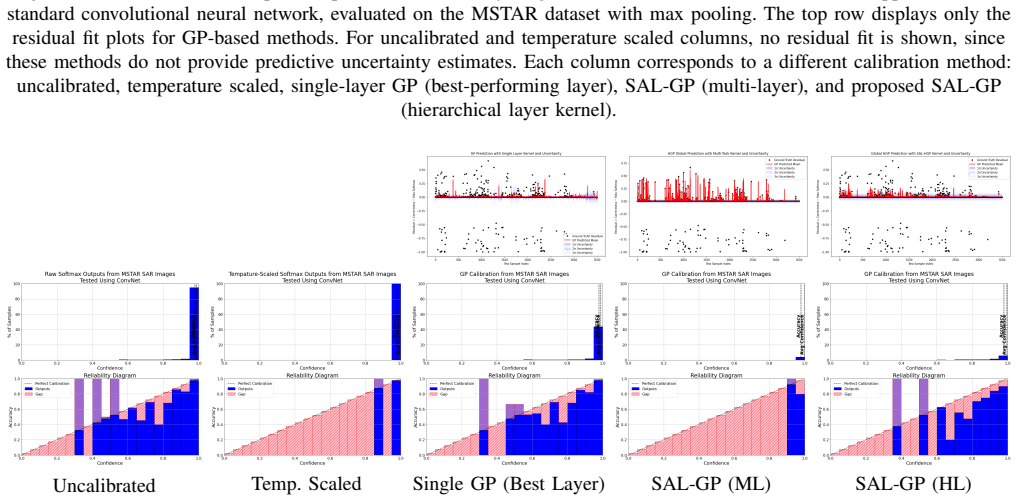
On the paper's own terms, the central discovery is that an additive, layer-indexed kernel over a GP that regresses softmax residuals can pool calibration signal from every internal layer of a network. Each sample enters as $(f_\ell, s, \ell)$, where $f_\ell$ is the pooled feature vector of layer $\ell$, $s$ is the maximum softmax score, and the regression target is the residual $r = c - s$ between correctness and confidence. The kernel $k((x,\ell),(x',\ell')) = k_{\mathrm{global}}(x,x') + \delta_{\ell\ell'} k_{\mathrm{layer}}(x,x')$ is presented as an approximation of the intrinsic coregionalization model in which cross-layer covariances are set to zero, so layers interact only through the shared global term; the global prediction is made by evaluating the kernel at the unseen test layer $\ell^* = -1$. Empirically the paper finds that this configuration outperforms temperature scaling and all single-layer GPs in the miscalibrated regimes, for instance reducing ECE from 0.18257 to 0.08532 on the AConvNet/MSTAR setup and from 0.26768 to 0.15402 on the RNN/PLAsTiCC setup, while the hierarchical-layer variant SAL-GP(HL) is inconsistent and sometimes worse than simple baselines.
Load-bearing premise
The whole result rests on the assumption that ignoring direct cross-layer statistical dependencies—keeping only a shared global kernel plus layer-local corrections—still captures enough of how uncertainty propagates through a deep network to improve calibration under domain shift.
Editorial extensions
If this is right
- If the central claim holds, practitioners can post-hoc calibrate a deep classifier without first deciding which layer's features are best, because the multi-layer kernel's global prediction is stable across layers and pooling choices.
- In severely miscalibrated and domain-shifted settings, structured layerwise GP calibration can cut expected calibration error to roughly half the uncalibrated or temperature-scaled level, while also supplying a per-prediction variance that neither baseline provides.
- The hierarchical-layer variant SAL-GP(HL) should not be used as a drop-in replacement: the paper's experiments show it underperforming single-layer GP in several configurations, indicating that the additive multi-layer kernel rather than the hierarchy is the active ingredient.
- For already well-calibrated networks the method's gains are small, so its practical value is concentrated in high-overconfidence, shifted, or under-represented-class regimes.
Reading between the lines
- Because the additive kernel zeroes out every off-diagonal cross-layer covariance, the improvement over single-layer GP is most plausibly explained by pooling training examples across layers through the shared global kernel rather than by modeling propagation of uncertainty between layers; a flat GP trained on concatenated layer features should reproduce much of the effect.
- The global prediction at $\ell^* = -1$ uses $k_{\mathrm{layer}}$ only in the prior self-variance, which the paper then subtracts when reporting pure global variance; a direct test would be to compare predictive variance with and without that term, since joint marginalization across layers would imply the layer kernel changes the global posterior rather than just the bookkeeping.
- A testable extension is to increase network depth well beyond five layers and check whether the benefit scales; the paper's interpretability story treats each layer as a reasoning stage, but its experiments only report aggregate calibration metrics, not evidence that specific layers contribute specific corrections.
Editorial analysis
A structured set of objections, weighed in public.
Referee Report
Summary. The paper proposes SAL-GP, a Gaussian-process post-hoc calibration framework that pools feature representations from all layers of a deep neural network and models the calibration residual with an additive kernel combining a global (layer-agnostic) kernel and a Kronecker-delta layerwise kernel. Two variants are studied: SAL-GP(HL), a hierarchical layer kernel, and SAL-GP(ML), a reduced ICM-style multi-layer kernel. The manuscript claims that SAL-GP(ML) provides consistent calibration improvement over single-layer GP and temperature scaling, with the global prediction at a test layer index l*=-1 serving as the primary output. Experiments are reported on ConvNet, AConvNet, ResNet-18 (MSTAR) and an RNN (PLAsTiCC), with ECE, MCE, NLL, Brier score, and predictive variance as metrics.
Significance. If the central claim were established, SAL-GP(ML) would be a practically useful calibration method, especially under domain shift, because it offers a tractable way to use all intermediate layers without the intractability of deep GPs. The paper has strengths: it evaluates across several architectures and data modalities, provides ablations over pooling strategies and layer subsets, and the additive kernel in Eq. (62) is a reasonable, computationally efficient approximation of the ICM kernel. However, the empirical evidence is mixed, no uncertainty estimates are reported for the calibration metrics, and the theoretical derivation of the global predictive variance and the 'joint marginalization' claim contain gaps. As presented, the paper's headline claim of consistent superiority is not supported.
major comments (5)
- [V-A3, Table III] The paper's claim that SAL-GP(ML) 'consistently enhances calibration stability' (Section VI) is directly contradicted by Table III: on ResNet-18, the best single-layer GP (Layer 4, max pooling) has ECE=0.01972, while SAL-GP(ML) G has ECE=0.02983 (max) and 0.03243 (average), a relative degradation of 51-64%. NLL and Brier also worsen. Table I (max pooling) and Table II (max pooling) show similar contradictions. The claim of consistency is therefore not supported by the reported results.
- [III-F, Eqs. (53)-(57)] Equation (57) defines the 'pure global predictive variance' by subtracting k_layer(z*,z*) from the actual predictive variance at the test layer index l*=-1. For the additive kernel of Eq. (51), the predictive variance at l*=-1 is k_global(z*,z*)+k_layer(z*,z*) - k_global^T(K+sigma^2 I)^{-1} k_global, not the expression in Eq. (57) with k_layer(z*,z*) removed. Thus Eq. (57) is not the variance of any Gaussian predictive distribution for the model, and the reported uncertainty estimates for the global prediction are not correct posterior variances. The derivation needs to be either corrected or explicitly labeled as a heuristic approximation with a stated justification.
- [V-A1, Eq. (74)] Equation (74) asserts a global posterior p(f_global | X,y) obtained by integrating over the layerwise latent functions, but no derivation is given and this formula is not used to derive the predictive equations in Section III-F or III-G. Moreover, the additive kernel in Eq. (62) sets cross-layer covariances to zero (except through the shared global kernel), so the model does not realize the 'joint marginalization across all layers' claimed in the abstract and in Section III-G. Either a derivation connecting Eq. (74) to the kernel in Eq. (62) must be provided, or the joint-marginalization claim should be removed.
- [Tables I-IV, general empirical protocol] No error bars, confidence intervals, or repeated-seed statistics are reported anywhere in the paper. The improvements over the best single-layer GP in Table I (ECE 0.00832 to 0.00797) and Table II (0.08800 to 0.08532) are on the order of a few percent and could easily be within the sampling noise of a single split. Without such statistics, the claim of 'consistent' improvement is not statistically supported. The paper should either provide multiple runs or clearly label the improvements as not statistically differentiated.
- [V-B, Table IV] In Table IV, the global prediction SAL-GP(ML) G(1-5) is reported with a predictive variance of 0.00001, which is orders of magnitude smaller than the layerwise SAL-GP(ML) variances (about 0.12) and implausibly small for a GP trained on data with duplicate layer copies. This suggests a different computation for the global prediction that is not explained, and it undermines the paper's uncertainty-quantification claims. The MCE of 0.98859 further indicates that worst-case calibration is nearly uncalibrated despite the lower ECE, which should be discussed explicitly.
minor comments (5)
- [III-F, III-G, IV] Typographical errors include 'kenrel' (Eq. 52 area), 'Hierachical' (Section II-D heading), 'Databse' (Section V-A heading), and 'SAL-GP (ML)) L4' in Table III. The paper should be carefully proofread.
- [II-D, V-A] The text refers to 'Appendix 2' and 'Section S1' for derivations and further analysis, but no appendix or supplementary document is included in the manuscript. These references should be either included or removed.
- [V-A2] The text states 'Figs. 6 and 7' when discussing AConvNet reliability diagrams, but Figs. 6-8 are PLAsTiCC light curves and distributions. The correct references are Figs. 11 and 12.
- [IV-A1] The 'Standard CNN' described as Conv(16)->MaxPool->... does not match reference [76] (LeNet-5). Either the architecture description or the reference citation should be corrected.
- [V-A1, Eq. (72)] The temperature-scaling loss in Eq. (72) is written in a way that mixes sample-level and batch-level notation; it would be clearer to define L(T) as the sum of per-sample cross-entropy losses. The gradient analysis in Eq. (73) is correct but should state the assumption that the validation set is perfectly classified.
Circularity Check
No significant circularity: GP hyperparameters are fitted by marginal likelihood on held-out residuals, the ℓ*=-1 global prediction is a modeling choice rather than a fitted target, and the only self-citation is a non-load-bearing pointer to prior OOD work.
full rationale
The derivation chain is self-contained. The GP is trained on the residual target r_i = c_i - s_i via marginal likelihood, and the calibrated output s'_* = s_* + r_* is standard residual regression; the correctness labels enter as training targets, while all ECE/MCE/NLL numbers are computed on held-out test points, so no reported calibration metric is a renamed fitted parameter. The global prediction at the artificial test-layer index ℓ* = -1 (Eqs. 53-56) is an explicit modeling choice: setting the Kronecker delta to zero gives the ordinary GP predictive mean under the global kernel, which does not make the ECE result true by definition. The additive kernel of Eq. 62 is obtained as a valid algebraic special case of ICM/LCM (diagonal or rank-one-plus-diagonal coregionalization matrix), not by circular appeal. The only self-citation ([79]) appears in a future-work/OOD-filtering sentence and is not load-bearing. Concerns that Eq. 62 uses the same notation as Eq. 51, or that Table III contradicts the 'consistently superior' claim, are internal-consistency and empirical-correctness issues rather than circular reductions, so they do not raise the circularity score.
Assumptions & free parameters
free parameters (4)
- GP observation noise variance beta =
not reported
- Global kernel scale and lengthscale =
not reported
- Layer kernel scale and lengthscale =
not reported
- Matern smoothness nu =
2.5
assumptions (6)
- standard math Standard GP regression formulas (posterior mean and variance, marginal likelihood) are valid.
- domain assumption The ICM/LCM kernel framework and its additive approximation are applicable to layerwise calibration.
- domain assumption Each neural network layer's pooled feature vector, together with max softmax score and layer index, is a sufficient input representation for calibration residuals.
- domain assumption The residual r = c - s is a valid calibration target.
- ad hoc to paper Using a test layer index l*=-1 that is absent from training yields a meaningful 'global' prediction.
- ad hoc to paper The additive kernel's zero cross-layer covariance still captures the claimed joint marginalization across layers.
Cite this review
Pith. "Pith review of Semantic-Aware Gaussian Process Calibration with Structured Layerwise Kernels for Deep Neural Networks." pith.science (2026). https://pith.science/paper/5BCXFQY6
@misc{pith2026250715987,
  author       = {Pith},
  title        = {Pith review of: Semantic-Aware Gaussian Process Calibration with Structured Layerwise Kernels for Deep Neural Networks},
  year         = {2026},
  howpublished = {\url{https://pith.science/paper/5BCXFQY6}},
  note         = {Machine review of arXiv:2507.15987}
}
read the original abstract
Calibrating the confidence of neural network classifiers is essential for quantifying the reliability of their predictions during inference. However, conventional Gaussian Process (GP) calibration methods often fail to capture the internal hierarchical structure of deep neural networks, limiting both interpretability and effectiveness for assessing predictive reliability. We propose a Semantic-Aware Layer-wise Gaussian Process (SAL-GP) framework that mirrors the layered architecture of the target neural network. Instead of applying a single global GP correction, SAL-GP employs a multi-layer GP model, where each layer's feature representation is mapped to a local calibration correction. These layerwise GPs are coupled through a structured multi-layer kernel, enabling joint marginalization across all layers. This design allows SAL-GP to capture both local semantic dependencies and global calibration coherence, while consistently propagating predictive uncertainty through the network. The resulting framework enhances interpretability aligned with the network architecture and enables principled evaluation of confidence consistency and uncertainty quantification in deep models.
Figures


Figures from the paper (12 more)




Reference graph
Works this paper leans on
-
[2]
”High- way networks.” arXiv preprint arXiv:1505.00387 (2015)
Srivastava, Rupesh Kumar, Klaus Greff, and J ¨urgen Schmidhuber. ”High- way networks.” arXiv preprint arXiv:1505.00387 (2015)
arXiv 2015
-
[3]
”Deep residual learning for image recognition.” Proceedings of the IEEE conference on computer vision and pattern recognition
He, Kaiming, et al. ”Deep residual learning for image recognition.” Proceedings of the IEEE conference on computer vision and pattern recognition. 2016
2016
-
[4]
Huang, Gao, et al. ”Deep networks with stochastic depth.” Computer Vision–ECCV 2016: 14th European Conference, Amsterdam, The Nether- lands, October 11–14, 2016, Proceedings, Part IV 14. Springer Interna- tional Publishing, 2016
work page 2016
-
[5]
Huang, Gao, et al. ”Densely connected convolutional networks.” Proceed- ings of the IEEE conference on computer vision and pattern recognition. 2017
work page 2017
-
[6]
Bergmann, S ¨oren, S ¨oren Stelzer, and Steffen Strassburger. ”On the use of artificial neural networks in simulation-based manufacturing control.” Journal of Simulation 8.1 (2014): 76-90
work page 2014
-
[7]
”Deep learning.” nature 521.7553 (2015): 436-444
LeCun, Yann, Yoshua Bengio, and Geoffrey Hinton. ”Deep learning.” nature 521.7553 (2015): 436-444
work page 2015
-
[8]
Baldi, Pierre, Peter Sadowski, and Daniel Whiteson. ”Searching for exotic particles in high-energy physics with deep learning.” Nature communica- tions 5.1 (2014): 4308
work page 2014
-
[9]
Niaki, Seyed Taghi Akhavan, and Saeid Hoseinzade. ”Forecasting S&P 500 index using artificial neural networks and design of experiments.” Journal of Industrial Engineering International 9 (2013): 1-9
work page 2013
Show all 80 references
-
[10]
”Neural networks applied to discriminate botanical origin of honeys.” Food chemistry 175 (2015): 128-136
Anjos, Of ´elia, et al. ”Neural networks applied to discriminate botanical origin of honeys.” Food chemistry 175 (2015): 128-136. JOURNAL OF LATEX CLASS FILES, VOL. 13, NO. 9, MARCH 2025 26 Uncalibrated Temp. Scaled Single GP (Best Layer) SAL-GP (ML) SAL-GP (HL) Fig. 16: Calib...
2015
-
[11]
”Applications of arti- ficial neural networks in health care organizational decision-making: A scoping review.” PloS one 14.2 (2019): e0212356
Shahid, Nida, Tim Rappon, and Whitney Berta. ”Applications of arti- ficial neural networks in health care organizational decision-making: A scoping review.” PloS one 14.2 (2019): e0212356
2019
-
[12]
Fienberg
DeGroot, Morris H., and Stephen E. Fienberg. ”The comparison and evaluation of forecasters.” Journal of the Royal Statistical Society: Series D (The Statistician) 32.1-2 (1983): 12-22
1983
-
[13]
”Predicting good prob- abilities with supervised learning.” Proceedings of the 22nd international conference on Machine learning
Niculescu-Mizil, Alexandru, and Rich Caruana. ”Predicting good prob- abilities with supervised learning.” Proceedings of the 22nd international conference on Machine learning. 2005
2005
-
[14]
”On calibration of modern neural networks.” Inter- national conference on machine learning
Guo, Chuan, et al. ”On calibration of modern neural networks.” Inter- national conference on machine learning. PMLR, 2017
2017
-
[15]
”End to end learning for self-driving cars.” arXiv preprint arXiv:1604.07316 (2016)
Bojarski, Mariusz, et al. ”End to end learning for self-driving cars.” arXiv preprint arXiv:1604.07316 (2016)
2016 arXiv
-
[16]
”Calibrating predictive model estimates to support personalized medicine.” Journal of the American Medical Informatics Association 19.2 (2012): 263-274
Jiang, Xiaoqian, et al. ”Calibrating predictive model estimates to support personalized medicine.” Journal of the American Medical Informatics Association 19.2 (2012): 263-274
2012
-
[17]
”Predicting with confidence and tolerance.” Nature methods 15.11 (2018): 843-845
Altman, Naomi, and Martin Krzywinski. ”Predicting with confidence and tolerance.” Nature methods 15.11 (2018): 843-845
2018
-
[18]
”Errors in predictor variables.” (2024): 4-6
Altman, Naomi, and Martin Krzywinski. ”Errors in predictor variables.” (2024): 4-6
2024
-
[19]
”Probabilistic machine learning and artificial in- telligence.” Nature 521.7553 (2015): 452-459
Ghahramani, Zoubin. ”Probabilistic machine learning and artificial in- telligence.” Nature 521.7553 (2015): 452-459
2015
-
[20]
”Simple and scalable predictive uncertainty estimation using deep en- sembles.” Advances in neural information processing systems 30 (2017)
Lakshminarayanan, Balaji, Alexander Pritzel, and Charles Blundell. ”Simple and scalable predictive uncertainty estimation using deep en- sembles.” Advances in neural information processing systems 30 (2017)
2017
-
[21]
”Dropout as a bayesian approxi- mation: Representing model uncertainty in deep learning.” international conference on machine learning
Gal, Yarin, and Zoubin Ghahramani. ”Dropout as a bayesian approxi- mation: Representing model uncertainty in deep learning.” international conference on machine learning. PMLR, 2016
2016
-
[22]
”Neural processes.” arXiv preprint arXiv:1807.01622 (2018)
Garnelo, Marta, et al. ”Neural processes.” arXiv preprint arXiv:1807.01622 (2018)
2018 arXiv
-
[23]
”Classification with Bayesian neural networks.” Ma- chine Learning Challenges Workshop
Neal, Radford M. ”Classification with Bayesian neural networks.” Ma- chine Learning Challenges Workshop. Berlin, Heidelberg: Springer Berlin Heidelberg, 2005
2005
-
[24]
”A practical Bayesian framework for backpropaga- tion networks.” Neural computation 4.3 (1992): 448-472
MacKay, David JC. ”A practical Bayesian framework for backpropaga- tion networks.” Neural computation 4.3 (1992): 448-472
1992
-
[25]
”Weight uncertainty in neural network.” Inter- national conference on machine learning
Blundell, Charles, et al. ”Weight uncertainty in neural network.” Inter- national conference on machine learning. PMLR, 2015
2015
-
[26]
”What uncertainties do we need in bayesian deep learning for computer vision?.” Advances in neural in- formation processing systems 30 (2017)
Kendall, Alex, and Yarin Gal. ”What uncertainties do we need in bayesian deep learning for computer vision?.” Advances in neural in- formation processing systems 30 (2017)
2017
-
[27]
”Non- parametric calibration for classification.” International Conference on Artificial Intelligence and Statistics
Wenger, Jonathan, Hedvig Kjellstr ¨om, and Rudolph Triebel. ”Non- parametric calibration for classification.” International Conference on Artificial Intelligence and Statistics. PMLR, 2020
2020
-
[29]
”Quantifying point- prediction uncertainty in neural networks via residual estimation with an i/o kernel.” arXiv preprint arXiv:1906.00588 (2019)
Qiu, Xin, Elliot Meyerson, and Risto Miikkulainen. ”Quantifying point- prediction uncertainty in neural networks via residual estimation with an i/o kernel.” arXiv preprint arXiv:1906.00588 (2019)
2019 arXiv
-
[30]
”Detecting misclassification errors in neural networks with a gaussian process model.” Proceedings of the AAAI Conference on Artificial Intelligence
Qiu, Xin, and Risto Miikkulainen. ”Detecting misclassification errors in neural networks with a gaussian process model.” Proceedings of the AAAI Conference on Artificial Intelligence. V ol. 36. No. 7. 2022
2022
-
[31]
”Obtaining calibrated probability estimates from decision trees and naive bayesian classifiers.” Icml
Zadrozny, Bianca, and Charles Elkan. ”Obtaining calibrated probability estimates from decision trees and naive bayesian classifiers.” Icml. V ol
-
[32]
Zadrozny, Bianca, and Charles Elkan. ”Transforming classifier scores into accurate multiclass probability estimates.” Proceedings of the eighth ACM SIGKDD international conference on Knowledge discovery and data mining. 2002
2002
-
[33]
”Ob- taining well calibrated probabilities using bayesian binning.” Proceedings of the AAAI conference on artificial intelligence
Naeini, Mahdi Pakdaman, Gregory Cooper, and Milos Hauskrecht. ”Ob- taining well calibrated probabilities using bayesian binning.” Proceedings of the AAAI conference on artificial intelligence. V ol. 29. No. 1. 2015
2015
-
[34]
”Probabilistic outputs for support vector machines and comparisons to regularized likelihood methods.” Advances in large margin classifiers 10.3 (1999): 61-74
Platt, John. ”Probabilistic outputs for support vector machines and comparisons to regularized likelihood methods.” Advances in large margin classifiers 10.3 (1999): 61-74
1999
-
[35]
”Distilling the knowl- edge in a neural network.” arXiv preprint arXiv:1503.02531 (2015)
Hinton, Geoffrey, Oriol Vinyals, and Jeff Dean. ”Distilling the knowl- edge in a neural network.” arXiv preprint arXiv:1503.02531 (2015)
2015 arXiv
-
[36]
Information theory and statistical mechanics
Jaynes, Edwin T. Information theory and statistical mechanics. Physical review, 106(4):620, 1957
1957
-
[37]
”The elements of statistical learning: Data mining, inference, and prediction.” (2009)
Friedman, Jerome. ”The elements of statistical learning: Data mining, inference, and prediction.” (2009)
2009
-
[38]
McAuliffe
Blei, David M., Alp Kucukelbir, and Jon D. McAuliffe. ”Variational inference: A review for statisticians.” Journal of the American statistical Association 112.518 (2017): 859-877
2017
-
[39]
”Ensemble deep learning: A review.” Engi- neering Applications of Artificial Intelligence 115 (2022): 105151
Ganaie, Mudasir A., et al. ”Ensemble deep learning: A review.” Engi- neering Applications of Artificial Intelligence 115 (2022): 105151
2022
-
[40]
”Towards Improved Variational Inference for Deep Bayesian Models.” arXiv preprint arXiv:2401.12418 (2024)
Ober, Sebastian W. ”Towards Improved Variational Inference for Deep Bayesian Models.” arXiv preprint arXiv:2401.12418 (2024)
2024 arXiv
-
[41]
”Deep neural networks as gaussian processes.” arXiv preprint arXiv:1711.00165 (2017)
Lee, Jaehoon, et al. ”Deep neural networks as gaussian processes.” arXiv preprint arXiv:1711.00165 (2017)
2017 arXiv
-
[42]
”Deep kernel learning.” Artificial intel- ligence and statistics
Wilson, Andrew Gordon, et al. ”Deep kernel learning.” Artificial intel- ligence and statistics. PMLR, 2016
2016
-
[43]
Improving Output Uncertainty Estimation and Gen eralization in Deep Learning via Neural Network Gaussian Processes
Tomoharu Iwata and Zoubin Ghahramani. Improving Output Uncertainty Estimation and Gen eralization in Deep Learning via Neural Network Gaussian Processes. arXiv e-prints, art. arXiv:1707.05922, Jul 2017
2017 arXiv
-
[44]
”Revisiting unreasonable effectiveness of data in deep learning era.” Proceedings of the IEEE international conference on computer vision
Sun, Chen, et al. ”Revisiting unreasonable effectiveness of data in deep learning era.” Proceedings of the IEEE international conference on computer vision. 2017
2017
-
[45]
MSTAR Overview, moving and stationary target acquisition and recognition MSTAR databse, Sandia national laboratories, https://www.sdms.afrl.af.mil/index.php?collection=mstar
-
[46]
”Deep learning for remote sensing data: A technical tutorial on the state of the art.” IEEE Geoscience and remote sensing magazine 4.2 (2016): 22-40
Zhang, Liangpei, Lefei Zhang, and Bo Du. ”Deep learning for remote sensing data: A technical tutorial on the state of the art.” IEEE Geoscience and remote sensing magazine 4.2 (2016): 22-40. JOURNAL OF LATEX CLASS FILES, VOL. 13, NO. 9, MARCH 2025 27
2016
-
[47]
”A comprehensive survey on SAR ATR in deep- learning era.” Remote Sensing 15.5 (2023): 1454
Li, Jianwei, et al. ”A comprehensive survey on SAR ATR in deep- learning era.” Remote Sensing 15.5 (2023): 1454
2023
-
[48]
”Change detection in synthetic aperture radar images based on deep neural networks.” IEEE transactions on neural networks and learning systems 27.1 (2015): 125-138
Gong, Maoguo, et al. ”Change detection in synthetic aperture radar images based on deep neural networks.” IEEE transactions on neural networks and learning systems 27.1 (2015): 125-138
2015
-
[49]
”Target classification using the deep convolutional networks for SAR images.” IEEE transactions on geoscience and remote sensing 54.8 (2016): 4806-4817
Chen, Sizhe, et al. ”Target classification using the deep convolutional networks for SAR images.” IEEE transactions on geoscience and remote sensing 54.8 (2016): 4806-4817
2016
-
[50]
”Very deep convolutional net- works for large-scale image recognition.” arXiv preprint arXiv:1409.1556 (2014)
Simonyan, Karen, and Andrew Zisserman. ”Very deep convolutional net- works for large-scale image recognition.” arXiv preprint arXiv:1409.1556 (2014)
2014 arXiv
-
[51]
”Rethinking the inception architecture for computer vision.” Proceedings of the IEEE conference on computer vision and pattern recognition
Szegedy, Christian, et al. ”Rethinking the inception architecture for computer vision.” Proceedings of the IEEE conference on computer vision and pattern recognition. 2016
2016
-
[52]
M ¨uller, Rafael, Simon Kornblith, and Geoffrey E. Hinton. ”When does label smoothing help?.” Advances in neural information processing systems 32 (2019)
2019
-
[53]
Lawrence
Alvarez, Mauricio A., Lorenzo Rosasco, and Neil D. Lawrence. ”Kernels for vector-valued functions: A review.” Foundations and Trends® in Machine Learning 4.3 (2012): 195-266
2012
-
[54]
”Multi-task Gaussian process prediction.” Advances in neural information processing systems 20 (2007)
Bonilla, Edwin V ., Kian Chai, and Christopher Williams. ”Multi-task Gaussian process prediction.” Advances in neural information processing systems 20 (2007)
2007
-
[55]
Lawrence
Alvarez, Mauricio A., and Neil D. Lawrence. ”Computationally efficient convolved multiple output Gaussian processes.” The Journal of Machine Learning Research 12 (2011): 1459-1500
2011
-
[56]
”It is all in the noise: Efficient multi-task Gaussian process inference with structured residuals.” Advances in neural information processing systems 26 (2013)
Rakitsch, Barbara, et al. ”It is all in the noise: Efficient multi-task Gaussian process inference with structured residuals.” Advances in neural information processing systems 26 (2013)
2013
-
[57]
”Simple and principled uncertainty estimation with deterministic deep learning via distance awareness.” Advances in neural information processing systems 33 (2020): 7498-7512
Liu, Jeremiah, et al. ”Simple and principled uncertainty estimation with deterministic deep learning via distance awareness.” Advances in neural information processing systems 33 (2020): 7498-7512
2020
-
[58]
”Gaussian processes for regression.” Advances in neural information processing systems 8 (1995)
Williams, Christopher, and Carl Rasmussen. ”Gaussian processes for regression.” Advances in neural information processing systems 8 (1995)
1995
-
[59]
Gaussian pro- cesses for machine learning
Williams, Christopher KI, and Carl Edward Rasmussen. Gaussian pro- cesses for machine learning. V ol. 2. No. 3. Cambridge, MA: MIT press, 2006
2006
-
[60]
Lawrence, Neil D., and Andrew J. Moore. ”Hierarchical Gaussian process latent variable models.” Proceedings of the 24th international conference on Machine learning. 2007
2007
-
[61]
Lawrence, and Magnus Rattray
Hensman, James, Neil D. Lawrence, and Magnus Rattray. ”Hierarchical Bayesian modelling of gene expression time series across irregularly sampled replicates and clusters.” BMC bioinformatics 14 (2013): 1-12
2013
-
[62]
Lawrence
Titsias, Michalis, and Neil D. Lawrence. ”Bayesian Gaussian process latent variable model.” Proceedings of the thirteenth international con- ference on artificial intelligence and statistics. JMLR Workshop and Conference Proceedings, 2010
2010
-
[63]
Lawrence
Damianou, Andreas, and Neil D. Lawrence. ”Deep gaussian processes.” Artificial intelligence and statistics. PMLR, 2013
2013
-
[64]
”Doubly stochastic variational inference for deep Gaussian processes.” Advances in neural information processing systems 30 (2017)
Salimbeni, Hugh, and Marc Deisenroth. ”Doubly stochastic variational inference for deep Gaussian processes.” Advances in neural information processing systems 30 (2017)
2017
-
[65]
”Monte Carlo implementation of Gaussian pro- cess models for Bayesian regression and classification.” arXiv preprint physics/9701026 (1997)
Neal, Radford M. ”Monte Carlo implementation of Gaussian pro- cess models for Bayesian regression and classification.” arXiv preprint physics/9701026 (1997)
1997 arXiv
-
[66]
Deep learning
Goodfellow, Ian, et al. Deep learning. V ol. 1. No. 2. Cambridge: MIT press, 2016
2016
-
[67]
”Risk versus uncertainty in deep learning: Bayes, bootstrap and the dangers of dropout.” NIPS workshop on bayesian deep learning
Osband, Ian. ”Risk versus uncertainty in deep learning: Bayes, bootstrap and the dangers of dropout.” NIPS workshop on bayesian deep learning. V ol. 192. MIT Press, 2016
2016
-
[68]
”Bayesian deep learning and a probabilistic perspective of generalization.” Advances in neural information processing systems 33 (2020): 4697-4708
Wilson, Andrew G., and Pavel Izmailov. ”Bayesian deep learning and a probabilistic perspective of generalization.” Advances in neural information processing systems 33 (2020): 4697-4708
2020
-
[69]
”Can you trust your model’s uncertainty? evaluating predictive uncertainty under dataset shift.” Advances in neural information processing systems 32 (2019)
Ovadia, Yaniv, et al. ”Can you trust your model’s uncertainty? evaluating predictive uncertainty under dataset shift.” Advances in neural information processing systems 32 (2019)
2019
-
[70]
”Benchmarking neural network robustness to common corruptions and perturbations.” arXiv preprint arXiv:1903.12261 (2019)
Hendrycks, Dan, and Thomas Dietterich. ”Benchmarking neural network robustness to common corruptions and perturbations.” arXiv preprint arXiv:1903.12261 (2019)
2019 arXiv
-
[71]
”Accurate uncertainties for deep learning using calibrated regression.” International conference on machine learning
Kuleshov, V olodymyr, Nathan Fenner, and Stefano Ermon. ”Accurate uncertainties for deep learning using calibrated regression.” International conference on machine learning. PMLR, 2018
2018
-
[72]
”A simple baseline for bayesian uncertainty in deep learning.” Advances in neural information processing systems 32 (2019)
Maddox, Wesley J., et al. ”A simple baseline for bayesian uncertainty in deep learning.” Advances in neural information processing systems 32 (2019)
2019
-
[73]
”Finding structure in time.” Cognitive science 14.2 (1990): 179-211
Elman, Jeffrey L. ”Finding structure in time.” Cognitive science 14.2 (1990): 179-211
1990
-
[74]
”Long short-term memory.” Neural computation 9.8 (1997): 1735-1780
Hochreiter, Sepp, and J ¨urgen Schmidhuber. ”Long short-term memory.” Neural computation 9.8 (1997): 1735-1780
1997
-
[75]
”Learning phrase representations using RNN encoder-decoder for statistical machine translation.” arXiv preprint arXiv:1406.1078 (2014)
Cho, Kyunghyun, et al. ”Learning phrase representations using RNN encoder-decoder for statistical machine translation.” arXiv preprint arXiv:1406.1078 (2014)
2014 arXiv
-
[76]
”Gradient-based learning applied to document recognition.” Proceedings of the IEEE 86.11 (2002): 2278-2324
LeCun, Yann, et al. ”Gradient-based learning applied to document recognition.” Proceedings of the IEEE 86.11 (2002): 2278-2324
2002
-
[77]
”The photometric lsst astronomical time- series classification challenge (plasticc): Data set.” arXiv preprint arXiv:1810.00001 (2018)
Allam Jr, Tarek, et al. ”The photometric lsst astronomical time- series classification challenge (plasticc): Data set.” arXiv preprint arXiv:1810.00001 (2018)
2018 arXiv
-
[78]
Kessler, R., et al. ”Models and simulations for the photometric LSST as- tronomical time series classification challenge (PLAsTiCC).” Publications of the Astronomical Society of the Pacific 131.1003 (2019): 094501
2019
-
[79]
”Adaptive Residual Transfor- mation for Enhanced Feature-Based OOD Detection in SAR Imagery.” arXiv preprint arXiv:2411.00274 (2024)
Lee, Kyung-hwan, and Kyung-tae Kim. ”Adaptive Residual Transfor- mation for Enhanced Feature-Based OOD Detection in SAR Imagery.” arXiv preprint arXiv:2411.00274 (2024)
2024 arXiv
-
[80]
[On- line]
”PLAsTiCC 2018 Simple RNN PyTorch,” Kaggle notebook, 2018. [On- line]. Available: https://www.kaggle.com/code/johnfarrell/plasticc-2018- simple-rnn-pytorch/notebook. [Accessed: July 18, 2025]
2018
-
[81]
”Trainable calibration measures for neural networks from kernel mean embeddings.” Interna- tional Conference on Machine Learning
Kumar, Aviral, Sunita Sarawagi, and Ujjwal Jain. ”Trainable calibration measures for neural networks from kernel mean embeddings.” Interna- tional Conference on Machine Learning. PMLR, 2018
2018
-
[82]
”Beyond temperature scaling: Obtaining well- calibrated multi-class probabilities with dirichlet calibration.” Advances in neural information processing systems 32 (2019)
Kull, Meelis, et al. ”Beyond temperature scaling: Obtaining well- calibrated multi-class probabilities with dirichlet calibration.” Advances in neural information processing systems 32 (2019)
2019
Reviewed August 6, 2026 · model on record in the stance chip above.
Discussion (0). Continue with ORCID to comment.