Periodic Timelike Motion and Gravitational Wave Signatures around a Magnetically Charged Black Hole Surrounded by Quintessence
Pith reviewed 2026-06-26 08:07 UTC · model grok-4.3
The pith
Quintessence systematically shifts the radii, turning points and gravitational waveforms of periodic orbits around a magnetically charged black hole.
A machine-rendered reading of the paper's core claim, the machinery that carries it, and where it could break.
Core claim
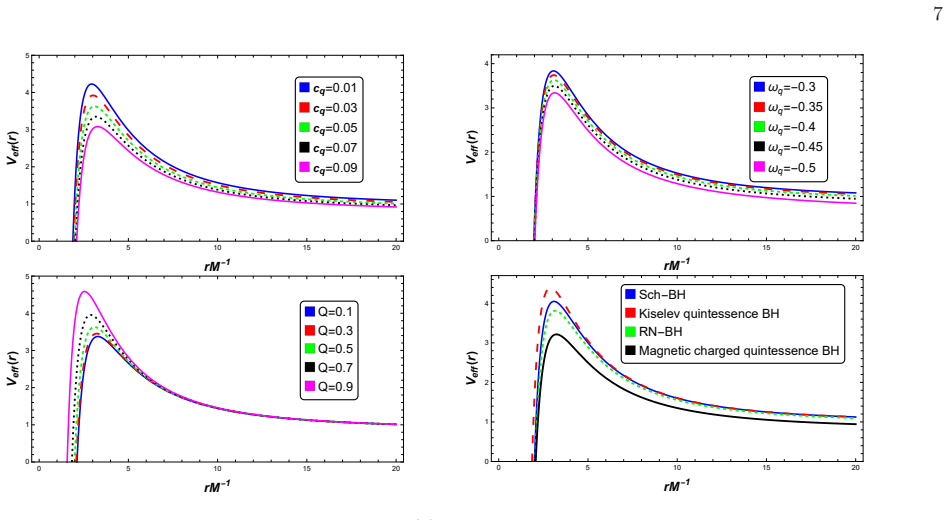
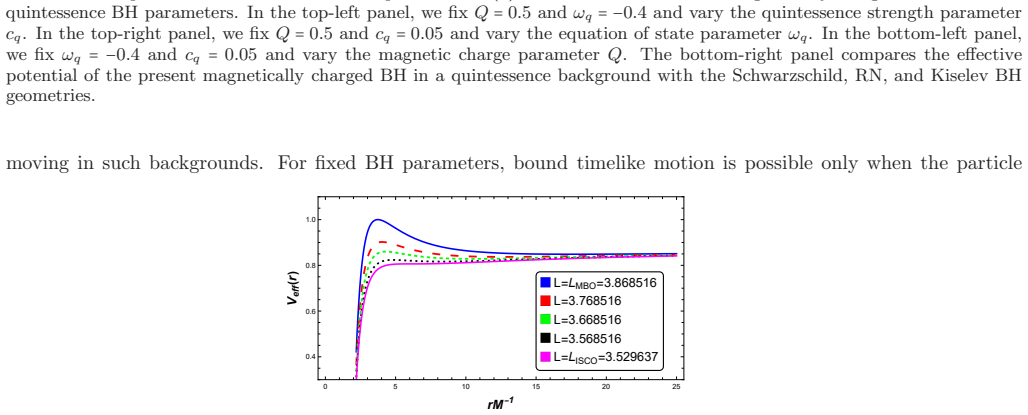
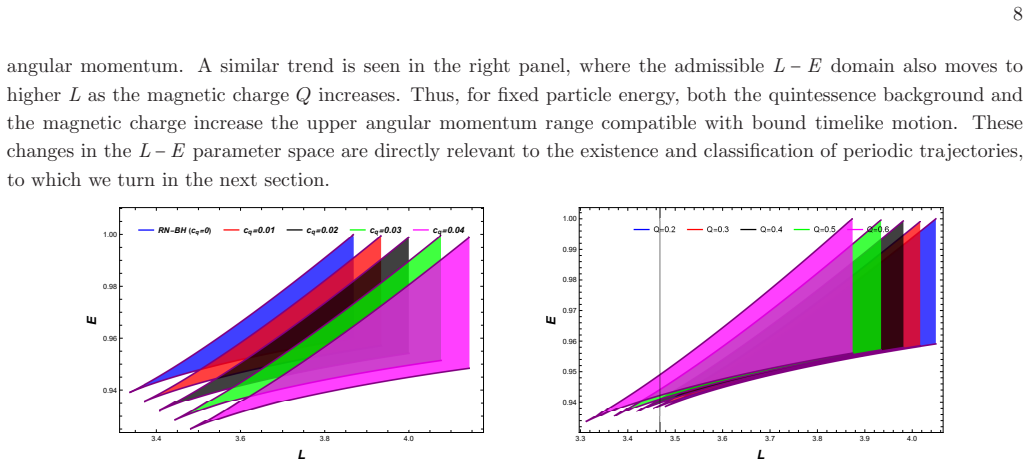
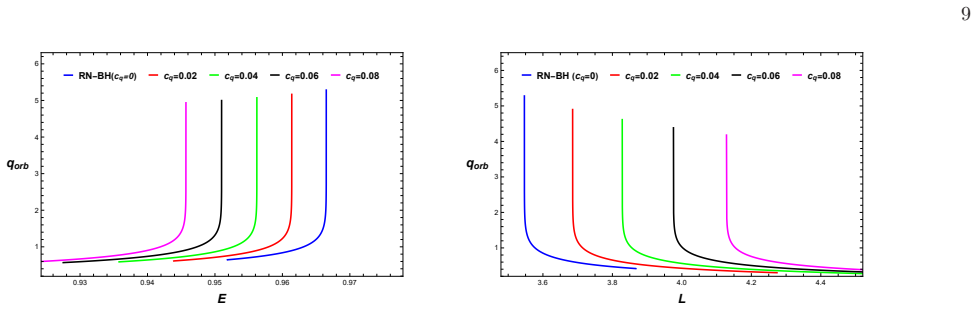
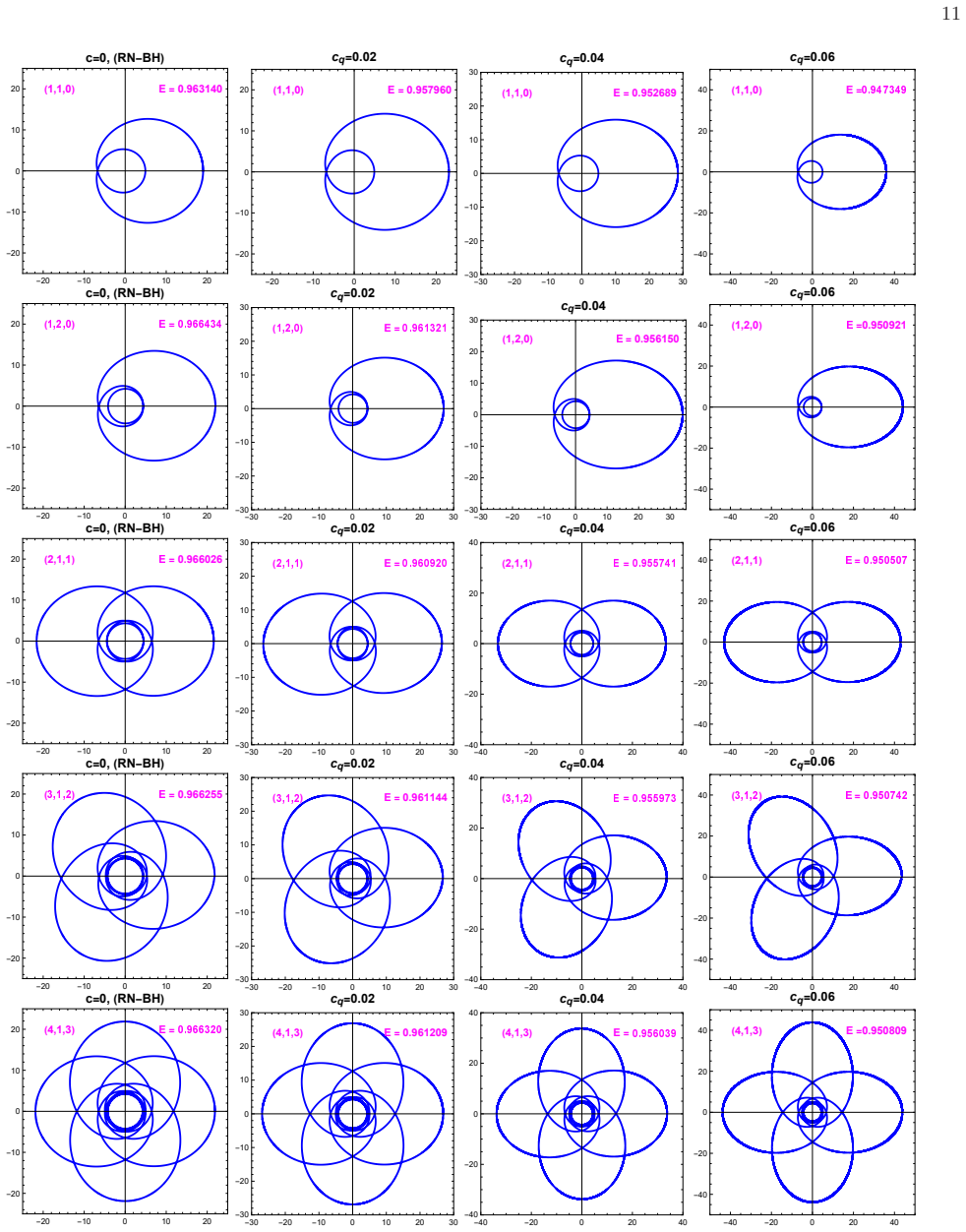
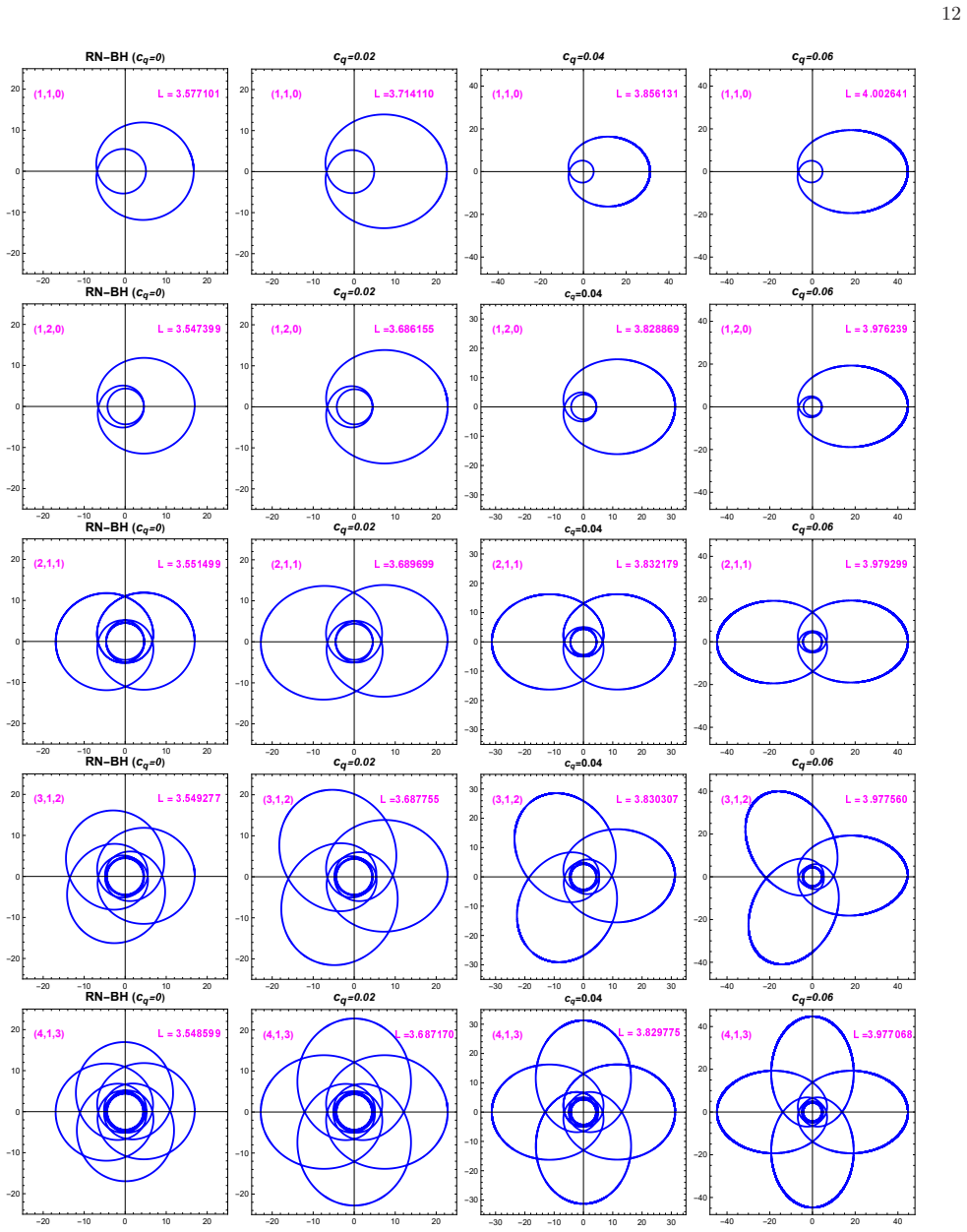
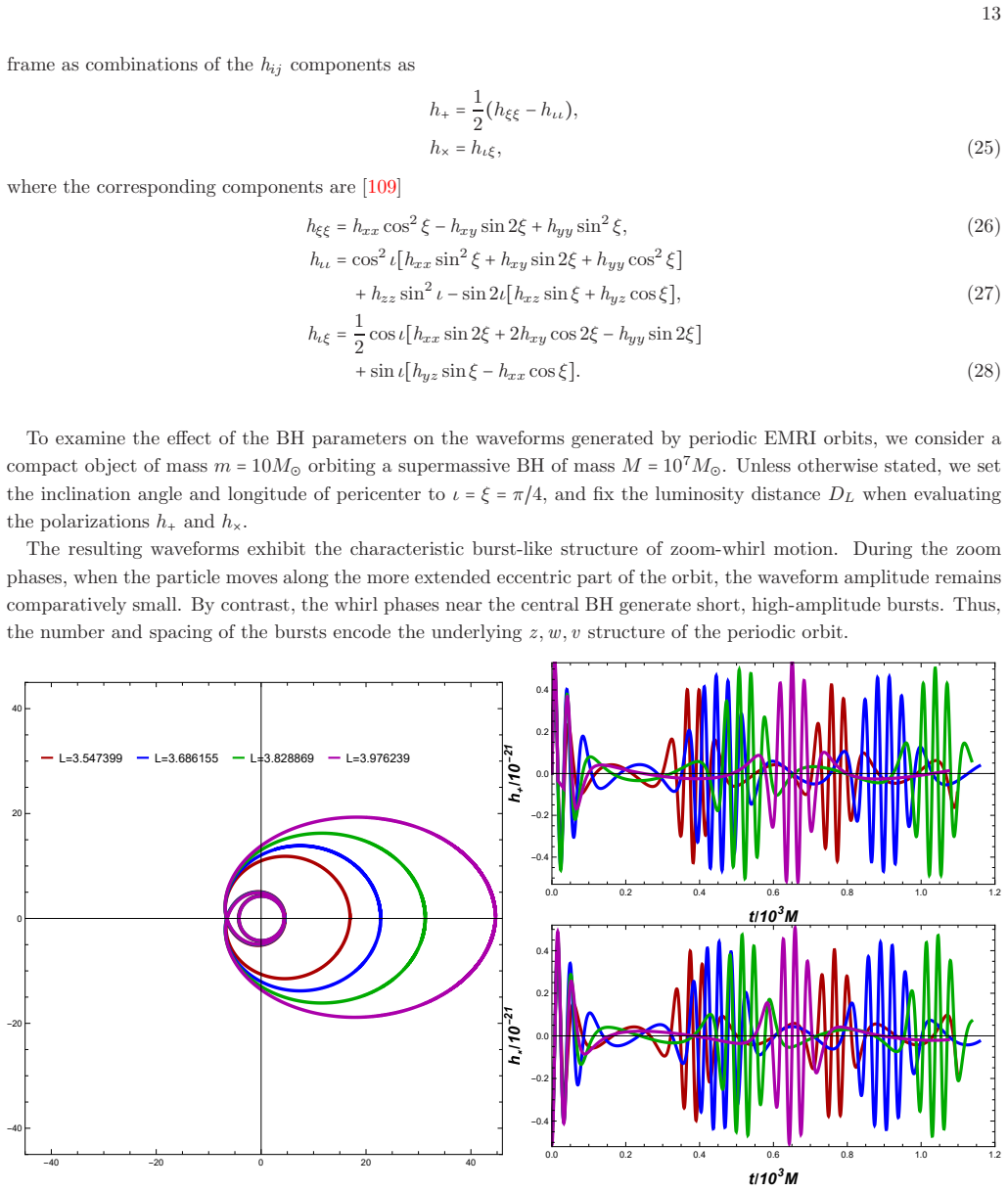
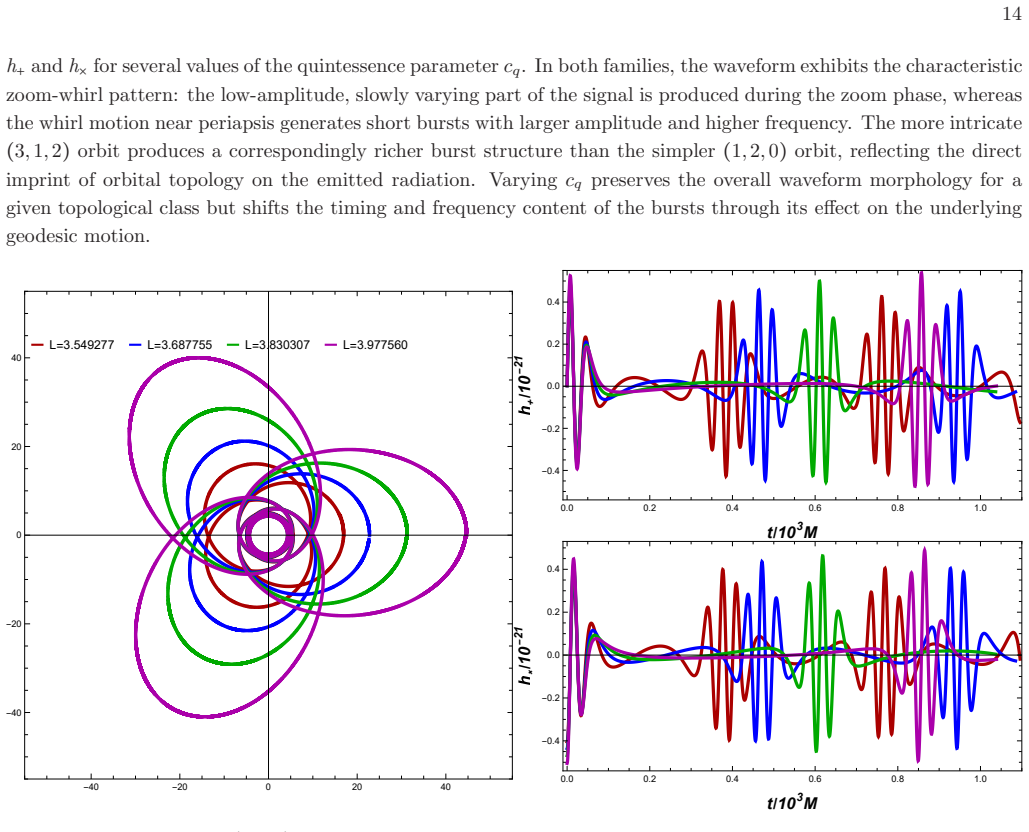
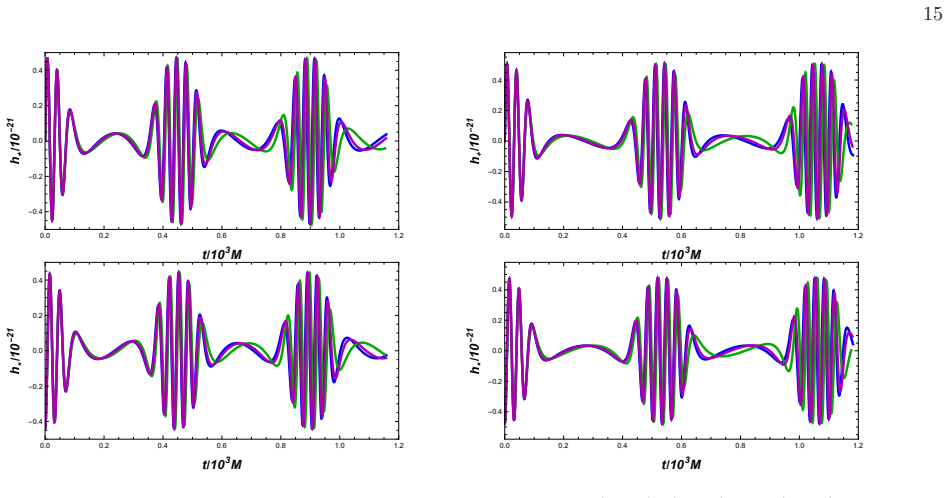
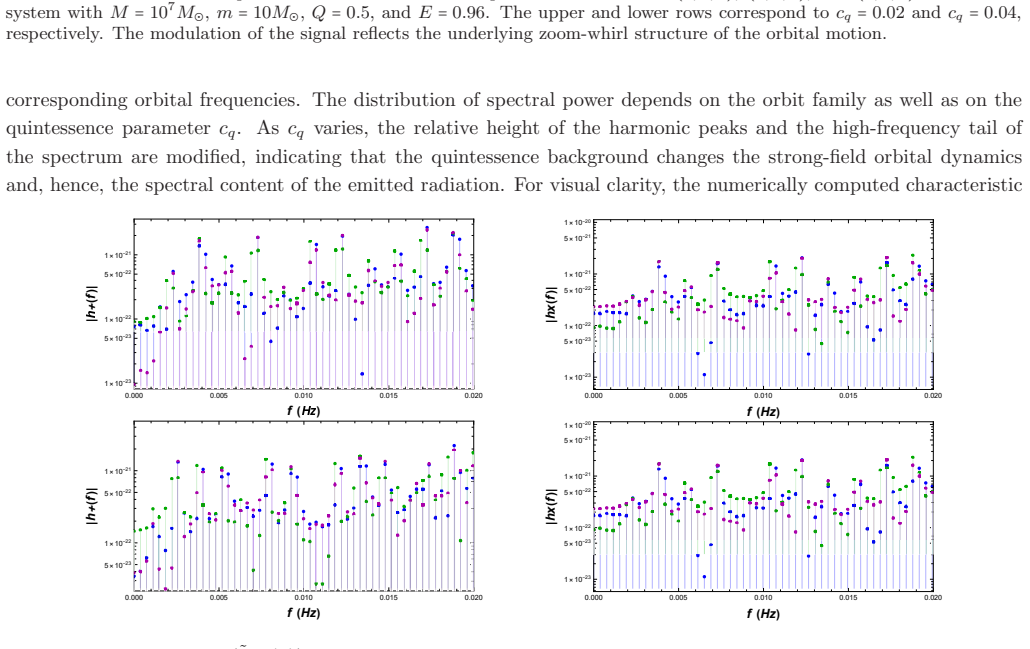
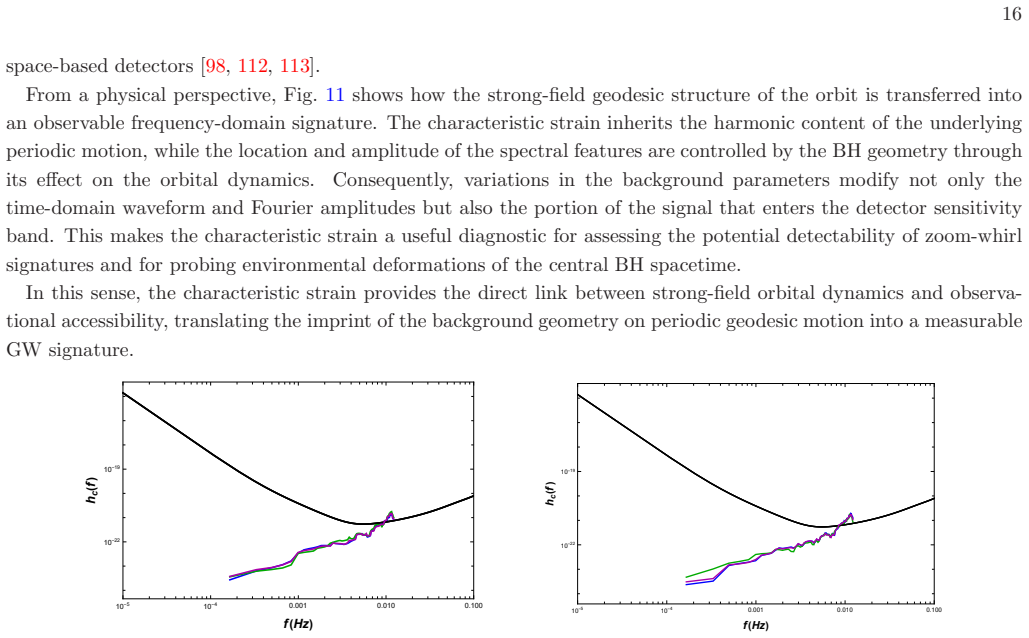
A quintessence background modifies the effective potential of massive particles, thereby shifting the radii of marginally bound and innermost stable circular orbits, the values of the conserved quantities on periodic trajectories, and the (z, w, v) labels of zoom-whirl families; the same background then imprints on the time-domain strain and Fourier spectrum of the gravitational waves produced by extreme-mass-ratio inspirals modeled with the numerical kludge scheme, altering phase evolution, burst timing and harmonic amplitudes while keeping the characteristic strain inside the LISA frequency window.
What carries the argument
The zoom-whirl taxonomy (z, w, v) together with the numerical-kludge waveform generator applied to geodesics in the quintessence-modified magnetically charged metric.
If this is right
- Increasing the quintessence parameter moves the innermost stable circular orbit outward and reduces the number of whirls per radial cycle for a given energy.
- The gravitational-wave bursts become more widely spaced and the phase accumulation between bursts slows as the quintessence coupling grows.
- The discrete lines in the Fourier spectrum shift to lower frequencies while their relative amplitudes change.
- The characteristic strain remains concentrated in the millihertz window but its detailed time-frequency structure carries a quintessence-dependent signature.
Where Pith is reading between the lines
- If the quintessence-induced shifts survive more accurate waveform modeling, they could be used to place upper bounds on the quintessence density from future LISA data.
- The same orbital taxonomy might be applied to other dark-energy or modified-gravity spacetimes to test whether periodic-motion signatures are generic.
- Detecting a mismatch between observed burst timing and the vacuum prediction would constitute indirect evidence for a non-zero cosmological scalar field near the black hole.
Load-bearing premise
The chosen metric correctly describes the spacetime and the numerical kludge approximation is accurate enough to reveal the quintessence-induced changes in the waveforms.
What would settle it
A LISA observation of periodic extreme-mass-ratio inspirals whose burst intervals and frequency comb match the no-quintessence case to within the predicted timing precision would falsify the claim that quintessence leaves systematic imprints.
Figures
read the original abstract
We investigate timelike geodesics and gravitational wave signatures of periodic motion around a static magnetically charged black hole arising from nonlinear electrodynamics and immersed in a quintessence background. We analyze the effective potential for massive particles, determine the marginally bound and innermost stable circular orbits, and classify the resulting bound trajectories using the zoom-whirl taxonomy $(\mathit{z},\mathit{w},\mathit{v})$. We show that the quintessence parameter $c_q$ systematically shifts the orbital radii, conserved quantities, and turning-point structure associated with representative periodic families. We then model the gravitational radiation emitted by periodic extreme-mass-ratio inspirals within the numerical kludge approximation. The resulting waveforms exhibit the characteristic burst-like structure of zoom-whirl motion, while variations in the quintessence coupling parameter modify the phase evolution, burst timing, and harmonic content of the signal. The corresponding Fourier spectra display a discrete comb-like structure, and the characteristic strain is concentrated in the millihertz band relevant for space-based detectors such as LISA. These results indicate that a quintessence background can leave systematic imprints on periodic orbit dynamics and on the associated time and frequency-domain gravitational wave observables.
Editorial analysis
A structured set of objections, weighed in public.
Referee Report
Summary. The manuscript investigates timelike geodesics around a magnetically charged black hole arising from nonlinear electrodynamics in a quintessence background. It determines the effective potential, identifies marginally bound and ISCO radii, classifies bound periodic orbits via the zoom-whirl taxonomy (z,w,v), and computes associated gravitational waveforms for extreme-mass-ratio inspirals using the numerical kludge approximation. The central claim is that the quintessence parameter c_q induces systematic shifts in orbital radii, conserved quantities, turning points, waveform phase evolution, burst timing, harmonic content, and Fourier spectra in the millihertz band.
Significance. If the central claims hold after validation, the work would provide concrete evidence that a quintessence background can produce observable modifications to periodic-orbit dynamics and time/frequency-domain GW signals from EMRIs, extending standard geodesic and kludge analyses to a non-vacuum, non-Kerr static metric relevant for LISA. The explicit use of the zoom-whirl classification and the focus on discrete comb-like spectra are strengths that could support falsifiable predictions.
major comments (1)
- [Abstract and waveform section] Abstract and waveform section: the claim that quintessence-induced changes to the effective potential and periodic orbits translate into observable waveform modifications (phase evolution, burst timing, harmonic content) rests on the numerical kludge approximation accurately mapping geodesic motion to strain for this magnetically charged NLED + quintessence metric. No cross-check against an independent method (e.g., frequency-domain projection adapted to the static metric or direct integration of linearized equations) is described, which is load-bearing for the GW-signature results.
Simulated Author's Rebuttal
We thank the referee for their thorough review and constructive feedback on our manuscript. We address the single major comment below.
read point-by-point responses
-
Referee: [Abstract and waveform section] Abstract and waveform section: the claim that quintessence-induced changes to the effective potential and periodic orbits translate into observable waveform modifications (phase evolution, burst timing, harmonic content) rests on the numerical kludge approximation accurately mapping geodesic motion to strain for this magnetically charged NLED + quintessence metric. No cross-check against an independent method (e.g., frequency-domain projection adapted to the static metric or direct integration of linearized equations) is described, which is load-bearing for the GW-signature results.
Authors: The numerical kludge is a standard and widely adopted approximation in the EMRI literature for generating waveforms from geodesic motion, including in non-Kerr backgrounds. In our work the exact geodesic equations (including all c_q-induced shifts in effective potential, turning points, and zoom-whirl parameters) are solved first; the kludge then maps those trajectories to strain. The reported modifications to phase, burst timing, and spectra therefore originate directly from the altered orbital dynamics rather than from any free parameter in the waveform generator. We did not include an independent cross-validation (e.g., frequency-domain projection or linearized integration) in the present study. We will revise the waveform section to (i) state the precise implementation of the kludge for this static metric, (ii) explicitly list its known limitations, and (iii) add a short discussion of how future work could benchmark against more rigorous methods. These additions will make the load-bearing nature of the approximation transparent without altering the central results. revision: partial
Circularity Check
No significant circularity; external parameters and standard geodesic/waveform methods
full rationale
The paper introduces the quintessence parameter c_q as an external input that is varied to study its effects on the effective potential, orbits, and waveforms. Derivations proceed from the given static metric via standard timelike geodesic equations, zoom-whirl classification, and numerical kludge for radiation, without reducing any reported observable to a quantity defined by fitting the same input. No self-citations, ansatze, or uniqueness theorems are invoked in the abstract or described chain to close a definitional loop. This matches the default expectation of a self-contained computation against external benchmarks.
Axiom & Free-Parameter Ledger
free parameters (1)
- c_q
axioms (3)
- domain assumption The background spacetime is given by the magnetically charged nonlinear-electrodynamics black-hole metric immersed in quintessence.
- standard math Timelike geodesics are governed by the effective potential derived from the metric.
- domain assumption The numerical kludge approximation accurately reproduces the gravitational-wave emission from periodic extreme-mass-ratio inspirals.
Reference graph
Works this paper leans on
-
[1]
06 (magenta) Figures 7 and 8 display the waveforms generated by the ( 1, 2, 0) and ( 3, 1, 2) periodic orbit families, respectively. In each figure, the left panel shows the orbital trajectory, while th e right panels present the corresponding polarizations 14 h+ and h×for several values of the quintessence parameter cq. In both families, the waveform exhi...
-
[2]
Centennial of General Relativity (1915- 2015); The Schwarzschild Solution and Black Holes,
S. M. Blinder, “Centennial of General Relativity (1915- 2015); The Schwarzschild Solution and Black Holes,” arXiv:1512.02061 [physics.pop-ph]
Pith/arXiv arXiv 1915
-
[3]
Gravitational field of a spinning mass as an ex ample of algebraically special metrics,
R. P. Kerr, “Gravitational field of a spinning mass as an ex ample of algebraically special metrics,” Phys. Rev. Lett. 11 (1963) 237–238
1963
-
[4]
Observation of Gravitational Waves from a Binary Blac k Hole Merger,
LIGO Scientific, Virgo Collaboration, B. P. Abbott et al., “Observation of Gravitational Waves from a Binary Blac k Hole Merger,” Phys. Rev. Lett. 116 no. 6, (2016) 061102 , arXiv:1602.03837 [gr-qc]
Pith/arXiv arXiv 2016
-
[5]
LIGO Scientific, Virgo Collaboration, B. P. Abbott et al., “GWTC-1: A Gravitational-Wave Transient Catalog of Compact Binary Mergers Observed by LIGO and Virgo during the First and Second Observing Runs,” Phys. Rev. X 9 no. 3, (2019) 031040 , arXiv:1811.12907 [astro-ph.HE]
Pith/arXiv arXiv 2019
-
[6]
GW190425: Observation of a Compact Binary Coalescence with Total Mass ∼3. 4M⊙,
LIGO Scientific, Virgo Collaboration, B. P. Abbott et al., “GW190425: Observation of a Compact Binary Coalescence with Total Mass ∼3. 4M⊙,” Astrophys. J. Lett. 892 no. 1, (2020) L3 , arXiv:2001.01761 [astro-ph.HE]
arXiv 2020
-
[7]
First M87 Event Horizon Telescope Results. I. The Shadow of the Supermassive Black Hole,
Event Horizon Telescope Collaboration, K. Akiyama et al., “First M87 Event Horizon Telescope Results. I. The Shadow of the Supermassive Black Hole,” Astrophys. J. Lett. 875 (2019) L1 , arXiv:1906.11238 [astro-ph.GA] . 18
Pith/arXiv arXiv 2019
-
[8]
First M87 Event Horizon Telescope Results. IV. Imaging the Central Supermassive Black Hole,
Event Horizon Telescope Collaboration, K. Akiyama et al., “First M87 Event Horizon Telescope Results. IV. Imaging the Central Supermassive Black Hole,” Astrophys. J. Lett. 875 no. 1, (2019) L4 , arXiv:1906.11241 [astro-ph.GA]
Pith/arXiv arXiv 2019
-
[9]
First M87 Event Horizon Telescope Results. V. Physical Origin of the Asymmetric Ring,
Event Horizon Telescope Collaboration, K. Akiyama et al., “First M87 Event Horizon Telescope Results. V. Physical Origin of the Asymmetric Ring,” Astrophys. J. Lett. 875 no. 1, (2019) L5 , arXiv:1906.11242 [astro-ph.GA]
Pith/arXiv arXiv 2019
-
[10]
Event Horizon Telescope Collaboration, K. Akiyama et al., “First Sagittarius A* Event Horizon Telescope Results . I. The Shadow of the Supermassive Black Hole in the Center of t he Milky Way,” Astrophys. J. Lett. 930 no. 2, (2022) L12 , arXiv:2311.08680 [astro-ph.HE]
Pith/arXiv arXiv 2022
-
[11]
First Sagittarius A* Event Horizon Telescope Results . VI. Testing the Black Hole Metric,
Event Horizon Telescope Collaboration, K. Akiyama et al., “First Sagittarius A* Event Horizon Telescope Results . VI. Testing the Black Hole Metric,” Astrophys. J. Lett. 930 no. 2, (2022) L17 , arXiv:2311.09484 [astro-ph.HE]
arXiv 2022
-
[12]
The Galact ic Center Massive Black Hole and Nuclear Star Cluster,
R. Genzel, F. Eisenhauer, and S. Gillessen, “The Galact ic Center Massive Black Hole and Nuclear Star Cluster,” Rev. Mod. Phys. 82 (2010) 3121–3195 , arXiv:1006.0064 [astro-ph.GA]
Pith/arXiv arXiv 2010
-
[13]
L. Iorio, “Perturbed stellar motions around the rotati ng black hole in Sgr A* for a generic orientation of its spin ax is,” Phys. Rev. D 84 (2011) 124001 , arXiv:1107.2916 [gr-qc] . [Erratum: Phys.Rev.D 106, 129902 (2022)]
Pith/arXiv arXiv 2011
-
[14]
Gen eral relativistic effects on the orbit of the S2 star with GRA VITY,
M. Grould, F. H. Vincent, T. Paumard, and G. Perrin, “Gen eral relativistic effects on the orbit of the S2 star with GRA VITY,”Astron. Astrophys. 608 (2017) A60 , arXiv:1709.04492 [astro-ph.HE]
Pith/arXiv arXiv 2017
-
[15]
M. De Laurentis, I. De Martino, and R. Lazkoz, “Analysis of the Yukawa gravitational potential in f ( R) gravity II: relativistic periastron advance,” Phys. Rev. D 97 no. 10, (2018) 104068 , arXiv:1801.08136 [gr-qc]
Pith/arXiv arXiv 2018
-
[16]
Scalar field effects on the orbit of S2 star,
GRA VITYCollaboration, A. Amorim et al., “Scalar field effects on the orbit of S2 star,” Mon. Not. Roy. Astron. Soc. 489 no. 4, (2019) 4606–4621 , arXiv:1908.06681 [astro-ph.GA]
arXiv 2019
-
[17]
DES Collaboration, E. O. Nadler et al., “Milky Way Satellite Census – II. Galaxy-Halo Connecti on Constraints Including the Impact of the Large Magellanic Cloud,” Astrophys. J. 893 (2020) 48 , arXiv:1912.03303 [astro-ph.GA]
arXiv 2020
-
[18]
GW150914: First results from the search for binary bla ck hole coalescence with Advanced LIGO,
LIGO Scientific, Virgo Collaboration, B. P. Abbott et al., “GW150914: First results from the search for binary bla ck hole coalescence with Advanced LIGO,” Phys. Rev. D 93 no. 12, (2016) 122003 , arXiv:1602.03839 [gr-qc]
Pith/arXiv arXiv 2016
-
[19]
Properties of the Binary Black Hole Merger GW150914,
LIGO Scientific, Virgo Collaboration, B. P. Abbott et al., “Properties of the Binary Black Hole Merger GW150914,” Phys. Rev. Lett. 116 no. 24, (2016) 241102 , arXiv:1602.03840 [gr-qc]
Pith/arXiv arXiv 2016
-
[20]
GW150914: The Advanced LIGO Detectors in the Era of First Discoveries,
LIGO Scientific, Virgo Collaboration, B. P. Abbott et al., “GW150914: The Advanced LIGO Detectors in the Era of First Discoveries,” Phys. Rev. Lett. 116 no. 13, (2016) 131103 , arXiv:1602.03838 [gr-qc]
Pith/arXiv arXiv 2016
-
[21]
A Periodic Table for Black Ho le Orbits,
J. Levin and G. Perez-Giz, “A Periodic Table for Black Ho le Orbits,” Phys. Rev. D 77 (2008) 103005 , arXiv:0802.0459 [gr-qc]
Pith/arXiv arXiv 2008
-
[22]
Energy Level Diagrams for Black Hole Orbits,
J. Levin, “Energy Level Diagrams for Black Hole Orbits, ” Class. Quant. Grav. 26 (2009) 235010 , arXiv:0907.5195 [gr-qc]
Pith/arXiv arXiv 2009
-
[23]
Rational Orbits around Charged B lack Holes,
V. Misra and J. Levin, “Rational Orbits around Charged B lack Holes,” Phys. Rev. D 82 (2010) 083001 , arXiv:1007.2699 [gr-qc]
Pith/arXiv arXiv 2010
-
[24]
Periodic orbits around a spherically symmetric naked singularity,
G. Z. Babar, A. Z. Babar, and Y.-K. Lim, “Periodic orbits around a spherically symmetric naked singularity,” Phys. Rev. D 96 no. 8, (2017) 084052 , arXiv:1710.09581 [gr-qc]
Pith/arXiv arXiv 2017
-
[25]
LISA: An ESA cornerstone mission for a gra vitational wave observatory,
K. Danzmann, “LISA: An ESA cornerstone mission for a gra vitational wave observatory,” Class. Quant. Grav. 14 (1997) 1399–1404
1997
-
[26]
B. F. Schutz, “Gravitational wave astronomy,” Class. Quant. Grav. 16 (1999) A131–A156 , arXiv:gr-qc/9911034
Pith/arXiv arXiv 1999
-
[27]
Event rate estimates f or LISA extreme mass ratio capture sources,
J. R. Gair, L. Barack, T. Creighton, C. Cutler, S. L. Lars on, E. S. Phinney, and M. Vallisneri, “Event rate estimates f or LISA extreme mass ratio capture sources,” Class. Quant. Grav. 21 (2004) S1595–S1606 , arXiv:gr-qc/0405137
Pith/arXiv arXiv 2004
-
[28]
Laser Interferometer Space Antenna,
LISA Collaboration, P. Amaro-Seoane et al., “Laser Interferometer Space Antenna,” arXiv:1702.00786 [astro-ph.IM]
-
[29]
A. Maselli, N. Franchini, L. Gualtieri, T. P. Sotiriou, S. Barsanti, and P. Pani, “Detecting fundamental fields with LISA observations of gravitational waves from extreme mass-rat io inspirals,” Nature Astron. 6 no. 4, (2022) 464–470 , arXiv:2106.11325 [gr-qc]
arXiv 2022
-
[30]
TianQin: a space-borne gravitational wave detector,
TianQin Collaboration, J. Luo et al., “TianQin: a space-borne gravitational wave detector, ” Class. Quant. Grav. 33 no. 3, (2016) 035010 , arXiv:1512.02076 [astro-ph.IM]
Pith/arXiv arXiv 2016
-
[31]
Concepts and status of Chin ese space gravitational wave detection projects,
Y. Gong, J. Luo, and B. Wang, “Concepts and status of Chin ese space gravitational wave detection projects,” Nature Astron. 5 no. 9, (2021) 881–889 , arXiv:2109.07442 [astro-ph.IM]
arXiv 2021
-
[32]
The Taiji Program in Space for gra vitational wave physics and the nature of gravity,
W.-R. Hu and Y.-L. Wu, “The Taiji Program in Space for gra vitational wave physics and the nature of gravity,” Natl. Sci. Rev. 4 no. 5, (2017) 685–686
2017
-
[33]
Faster comput ation of adiabatic extreme mass-ratio inspirals using resonances,
R. Grossman, J. Levin, and G. Perez-Giz, “Faster comput ation of adiabatic extreme mass-ratio inspirals using resonances,” Phys. Rev. D 88 no. 2, (2013) 023002 , arXiv:1108.1819 [gr-qc]
Pith/arXiv arXiv 2013
-
[34]
Z.-Y. Tu, T. Zhu, and A. Wang, “Periodic orbits and their gravitational wave radiations in a polymer black hole in loo p quantum gravity,” Phys. Rev. D 108 no. 2, (2023) 024035 , arXiv:2304.14160 [gr-qc]
arXiv 2023
-
[35]
Y.-Z. Li, X.-M. Kuang, and Y. Sang, “Precessing and peri odic timelike orbits and their potential applications in Einsteinian cubic gravity,” Eur. Phys. J. C 84 no. 5, (2024) 529 , arXiv:2401.16071 [gr-qc]
arXiv 2024
-
[36]
Geodesics and periodic orbits around quan tum-corrected black holes,
X.-M. Deng, “Geodesics and periodic orbits around quan tum-corrected black holes,” Phys. Dark Univ. 30 (2020) 100629
2020
-
[37]
Rational orbits around 4 D Einstein–Lovelock black holes,
H.-Y. Lin and X.-M. Deng, “Rational orbits around 4 D Einstein–Lovelock black holes,” Phys. Dark Univ. 31 (2021) 100745
2021
-
[38]
Bound orbits around modified Hayw ard black holes,
B. Gao and X.-M. Deng, “Bound orbits around modified Hayw ard black holes,” Mod. Phys. Lett. A 36 no. 33, (2021) 2150237 . 19
2021
-
[39]
Probing a self-complete and Genera lized-Uncertainty-Principle black hole with precessing a nd periodic motion,
J. Zhang and Y. Xie, “Probing a self-complete and Genera lized-Uncertainty-Principle black hole with precessing a nd periodic motion,” Astrophys. Space Sci. 367 no. 2, (2022) 17
2022
-
[40]
Precessing and periodic orbi ts around Lee–Wick black holes,
H.-Y. Lin and X.-M. Deng, “Precessing and periodic orbi ts around Lee–Wick black holes,” Eur. Phys. J. Plus 137 no. 2, (2022) 176
2022
-
[41]
Bound orbits around c harged black strings,
A. S. Habibina and H. S. Ramadhan, “Bound orbits around c harged black strings,” Annals Phys. 448 (2023) 169169 , arXiv:2205.14635 [gr-qc]
arXiv 2023
-
[42]
Periodic orbits around a st atic spherically symmetric black hole surrounded by quintessence,
R. Wang, F. Gao, and H. Chen, “Periodic orbits around a st atic spherically symmetric black hole surrounded by quintessence,” Annals Phys. 447 no. 1, (2022) 169167
2022
-
[43]
Closed orbits in axial symmetric Fi nslerian extension of a Schwarzschild black hole,
J.-T. Yao and X. Li, “Closed orbits in axial symmetric Fi nslerian extension of a Schwarzschild black hole,” Phys. Rev. D 108 no. 8, (2023) 084067
2023
-
[44]
Dynamics of test particles ar ound hairy black holes in Horndeski’s theory,
H.-Y. Lin and X.-M. Deng, “Dynamics of test particles ar ound hairy black holes in Horndeski’s theory,” Annals Phys. 455 (2023) 169360
2023
-
[45]
Periodic orbits of neutral t est particles in Reissner–Nordstr¨ om naked singularities,
Z. C. S. Chan and Y.-K. Lim, “Periodic orbits of neutral t est particles in Reissner–Nordstr¨ om naked singularities,” Gen. Rel. Grav. 57 no. 2, (2025) 35 , arXiv:2502.03082 [gr-qc]
arXiv 2025
-
[46]
Periodic orbits and their gravita tional wave radiations in a black hole with a dark matter halo ,
S. Haroon and T. Zhu, “Periodic orbits and their gravita tional wave radiations in a black hole with a dark matter halo ,” Phys. Rev. D 112 no. 4, (2025) 044046 , arXiv:2502.09171 [gr-qc]
arXiv 2025
-
[47]
A new typ e of multi-branch periodic orbits in dyonic black holes,
C.-H. Wang, Y.-P. Zhang, T. Zhu, and S.-W. Wei, “A new typ e of multi-branch periodic orbits in dyonic black holes,” arXiv:2508.20558 [gr-qc]
-
[48]
Reg ular black hole’s impact on the gravitational waveforms from periodic orbits,
M. Alloqulov, S. Shaymatov, B. Ahmedov, and T. Zhu, “Reg ular black hole’s impact on the gravitational waveforms from periodic orbits,” Eur. Phys. J. C 86 no. 2, (2026) 117 , arXiv:2508.05245 [gr-qc]
arXiv 2026
-
[49]
Probing a one -loop quantum-corrected Schwarzschild spacetime with precessing and periodic motion,
Z.-L. Wei, J. Zhang, Y. Xie, and P.-L. Yin, “Probing a one -loop quantum-corrected Schwarzschild spacetime with precessing and periodic motion,” Eur. Phys. J. C 85 no. 6, (2025) 698
2025
-
[50]
Orbital mechanics and quasiperiodic oscillation resonances of black holes in Einstein-Æther th eory,
M. Azreg-A ¨ ınou, Z. Chen, B. Deng, M. Jamil, T. Zhu, Q. Wu , and Y.-K. Lim, “Orbital mechanics and quasiperiodic oscillation resonances of black holes in Einstein-Æther th eory,” Phys. Rev. D 102 no. 4, (2020) 044028 , arXiv:2004.02602 [gr-qc]
arXiv 2020
-
[51]
Periodical orbits and waveforms with spontaneous Lorentz symmetry-breaking in Kalb–Ramond gravity,
E. L. B. Junior, J. T. S. S. Junior, F. S. N. Lobo, M. E. Rodr igues, D. Rubiera-Garcia, L. F. D. da Silva, and H. A. Vieira, “Periodical orbits and waveforms with spontaneous Lorentz symmetry-breaking in Kalb–Ramond gravity,” Eur. Phys. J. C 85 no. 5, (2025) 557 , arXiv:2412.00769 [gr-qc]
arXiv 2025
-
[52]
Gra vitational waveforms from periodic orbits around a quantum-corrected black hole,
S. Yang, Y.-P. Zhang, T. Zhu, L. Zhao, and Y.-X. Liu, “Gra vitational waveforms from periodic orbits around a quantum-corrected black hole,” JCAP 01 (2025) 091 , arXiv:2407.00283 [gr-qc]
arXiv 2025
-
[53]
L. Zhao, M. Tang, and Z. Xu, “Periodic orbits and gravita tional wave radiation in short hair black hole spacetimes fo r an extreme mass ratio system,” Eur. Phys. J. C 85 no. 1, (2025) 36 , arXiv:2411.01979 [gr-qc]
arXiv 2025
-
[54]
Periodic orbits and plasma effects on gravitational weak lensing by self-dual black hole in loop quantum gravity,
H. Jiang, M. Alloqulov, Q. Wu, S. Shaymatov, and T. Zhu, “ Periodic orbits and plasma effects on gravitational weak lensing by self-dual black hole in loop quantum gravity,” Phys. Dark Univ. 46 (2024) 101627
2024
-
[55]
Con straining polymerized black holes with quasi-circular extreme mass-ratio inspirals,
S. Yang, Y.-P. Zhang, T. Zhu, L. Zhao, and Y.-X. Liu, “Con straining polymerized black holes with quasi-circular extreme mass-ratio inspirals,” Chin. Phys. C 49 no. 11, (2025) 115107 , arXiv:2412.04302 [gr-qc]
arXiv 2025
-
[56]
Bound orbits and gravitatio nal wave radiation around the hairy black hole,
L. Meng, Z. Xu, and M. Tang, “Bound orbits and gravitatio nal wave radiation around the hairy black hole,” Eur. Phys. J. C 85 no. 3, (2025) 306 , arXiv:2411.01858 [gr-qc]
arXiv 2025
-
[58]
Periodic or bits and their gravitational wave radiations around the Schwarzschild-MOG black hole,
O. Shabbir, M. Jamil, and M. Azreg-A ¨ ınou, “Periodic or bits and their gravitational wave radiations around the Schwarzschild-MOG black hole,” Phys. Dark Univ. 47 (2025) 101816 , arXiv:2501.04367 [gr-qc]
arXiv 2025
-
[59]
M. Alloqulov, T. Xamidov, S. Shaymatov, and B. Ahmedov, “Gravitational waveforms from periodic orbits around a Schwarzschild black hole embedded in a Dehnen-type dark mat ter halo,” Eur. Phys. J. C 85 no. 7, (2025) 798 , arXiv:2504.05236 [gr-qc]
arXiv 2025
-
[60]
Equatorial periodic orbits and gravitational waveform s in a black hole free of Cauchy horizon,
C.-H. Wang, X.-C. Meng, Y.-P. Zhang, T. Zhu, and S.-W. We i, “Equatorial periodic orbits and gravitational waveform s in a black hole free of Cauchy horizon,” JCAP 07 (2025) 021 , arXiv:2502.08994 [gr-qc]
arXiv 2025
-
[61]
Gravitational radiations from period ic orbits around Einstein-Æther black holes,
S. Lu and T. Zhu, “Gravitational radiations from period ic orbits around Einstein-Æther black holes,” Phys. Dark Univ. 50 (2025) 102141 , arXiv:2505.00294 [gr-qc]
Pith/arXiv arXiv 2025
-
[62]
S. Zare, T. Zhu, L. M. Nieto, S. Lu, and H. Hassanabadi, “P robing regular black holes with sub-Planckian curvature through periodic orbits and their gravitational wave radia tion,” JCAP 01 (2026) 059 , arXiv:2510.05166 [gr-qc]
arXiv 2026
-
[63]
Gravitational waveforms from periodic orbits around a novel regular black hole,
H. Gong, S. Long, X.-J. Wang, Z. Xia, J.-P. Wu, and Q. Pan, “Gravitational waveforms from periodic orbits around a novel regular black hole,” Eur. Phys. J. C 86 no. 5, (2026) 469 , arXiv:2509.23318 [gr-qc]
Pith/arXiv arXiv 2026
-
[64]
Y.-Z. Li and X.-M. Kuang, “The bound orbits and gravitat ional waveforms of timelike particles around renormalizat ion group improved Kerr black holes,” Eur. Phys. J. C 86 no. 3, (2026) 261 , arXiv:2509.07333 [gr-qc]
arXiv 2026
-
[65]
Gravitational Wave Signatures of Periodic Motion near Higher-Derivative Einstein-Æther Black Holes,
S. Choudhury, M. K. Hossain, G. Bauyrzhan, and K. Yerzha nov, “Gravitational Wave Signatures of Periodic Motion near Higher-Derivative Einstein-Æther Black Holes,” arXiv:2507.00904 [gr-qc]
-
[66]
Periodic orbits and gravitational waveforms in quantum-corrected black hole spacetimes,
J. Chen and J. Yang, “Periodic orbits and gravitational waveforms in quantum-corrected black hole spacetimes,” Eur. Phys. J. C 85 no. 7, (2025) 726 , arXiv:2505.02660 [gr-qc]
arXiv 2025
-
[67]
Gravitational wav eforms from periodic orbits around a charged black hole with scalar hair*,
W. Deng, S. Long, Q. Tan, and J. Jing, “Gravitational wav eforms from periodic orbits around a charged black hole with scalar hair*,” Chin. Phys. C 50 no. 3, (2026) 035103 , arXiv:2510.24468 [gr-qc]
arXiv 2026
-
[68]
G.-H. Li, C.-K. Qiao, and J. Tao, “Periodic orbits and th eir gravitational waves in EMRIs: supermassive black hole affected by galactic dark matter halos,” arXiv:2510.24989 [gr-qc]
-
[69]
T. Zahra, O. Shabbir, B. Majeed, M. Jamil, J. Rayimbaev, and A. Shermatov, “Gravitational wave radiation from 20 periodic orbits and quasi-periodic oscillations in an Eins tein nonlinear Maxwell–Yukawa black hole,” Eur. Phys. J. C 85 no. 11, (2025) 1340 , arXiv:2510.22761 [gr-qc]
arXiv 2025
-
[70]
Y. Yang, Y.-X. Bai, Y.-Z. Li, and Y. Han, “Particle motio ns and gravitational waveforms in rotating black hole spacetimes of loop quantum gravity,” arXiv:2603.25084 [gr-qc]
-
[71]
Rotating black holes in gene ral relativity coupled to nonlinear electrodynamics,
S. G. Ghosh and R. K. walia, “Rotating black holes in gene ral relativity coupled to nonlinear electrodynamics,” Annals Phys. 434 (2021) 168619 , arXiv:2109.13031 [gr-qc]
arXiv 2021
-
[72]
The shadow of M87* black hole within rati onal nonlinear electrodynamics,
S. I. Kruglov, “The shadow of M87* black hole within rati onal nonlinear electrodynamics,” Mod. Phys. Lett. A 35 no. 35, (2020) 2050291 , arXiv:2009.07657 [gr-qc]
arXiv 2020
-
[73]
A. Bazrafshan, F. Naeimipour, M. Ghanaatian, and A. Kha jeh, “Physical and thermodynamic properties of quartic quasitopological black holes and rotating black branes wit h a nonlinear source,” Phys. Rev. D 100 no. 6, (2019) 064062 , arXiv:1905.12428 [gr-qc]
arXiv 2019
-
[74]
G. Panotopoulos and A. Rincon, “Charged slowly rotatin g toroidal black holes in the (1 + 3)-dimensional Einstein-power-Maxwell theory,” Int. J. Mod. Phys. D 28 no. 01, (2018) 1950016 , arXiv:1808.05171 [gr-qc]
Pith/arXiv arXiv 2018
-
[75]
Generic ro tating regular black holes in general relativity coupled to nonlinear electrodynamics,
B. Toshmatov, Z. Stuchl ´ ık, and B. Ahmedov, “Generic ro tating regular black holes in general relativity coupled to nonlinear electrodynamics,” Phys. Rev. D 95 no. 8, (2017) 084037 , arXiv:1704.07300 [gr-qc]
Pith/arXiv arXiv 2017
-
[76]
D. Flores-Alfonso, B. A. Gonz´ alez-Morales, R. Linare s, and M. Maceda, “Black holes and gravitational waves sourc ed by non-linear duality rotation-invariant conformal elect romagnetic matter,” Phys. Lett. B 812 (2021) 136011 , arXiv:2011.10836 [gr-qc]
arXiv 2021
-
[77]
Probing holonomy corrected Schwarzschild b lack holes with precessing and periodic orbits,
L. Huang, “Probing holonomy corrected Schwarzschild b lack holes with precessing and periodic orbits,” Phys. Rev. D 111 no. 8, (2025) 084038
2025
-
[78]
Regular black holes as an alternative to black bounce,
K. A. Bronnikov, “Regular black holes as an alternative to black bounce,” Phys. Rev. D 110 no. 2, (2024) 024021 , arXiv:2404.14816 [gr-qc]
arXiv 2024
-
[79]
E. Aydiner, E. Sucu, and ˙I. Sakallı, “Regular magnetically charged black holes from nonlinear electrodynamics: Thermodynamics, light deflection, and orbital dynamics,” Phys. Dark Univ. 50 (2025) 102164 , arXiv:2507.05145 [gr-qc]
arXiv 2025
-
[80]
Signatures of NED on quasi periodic oscillations of a magnetically charge d black hole,
B. Hazarika, M. M. Gohain, and P. Phukon, “Signatures of NED on quasi periodic oscillations of a magnetically charge d black hole,” JCAP 07 (2025) 035 , arXiv:2504.07821 [gr-qc]
arXiv 2025
-
[81]
Two-sided NED black-hole, naked-singularity, and soliton solutions,
M. Azreg-A ¨ ınou, “Two-sided NED black-hole, naked-singularity, and soliton solutions,” Eur. Phys. J. C 85 no. 6, (2025) 711 , arXiv:2506.18080 [gr-qc]
arXiv 2025
discussion (0)
Sign in with ORCID, Apple, or X to comment. Anyone can read and Pith papers without signing in.