REVIEW 2 major objections 4 minor 118 references
A parametrized test of general relativity for inspiralling eccentric binaries in LISA
T0 review · 2 major / 4 minor · reviewed 2026-08-14 · deepseek-v4-flash
Pith's one-line read LISA observations of eccentric binaries can bound a deformation of periastron precession to about $10^{-4}$, provided the deformation is placed on the dominant waveform carriers.
desk verdict A careful, honest parametrized-test framework for eccentric LISA inspirals whose headline forecast is same-model; the placement-dependence result is the real contribution. read the letter →
The pith
A machine-rendered reading of the paper's core claim, the machinery that carries it, and where it could break.
The reading
What carries the argument
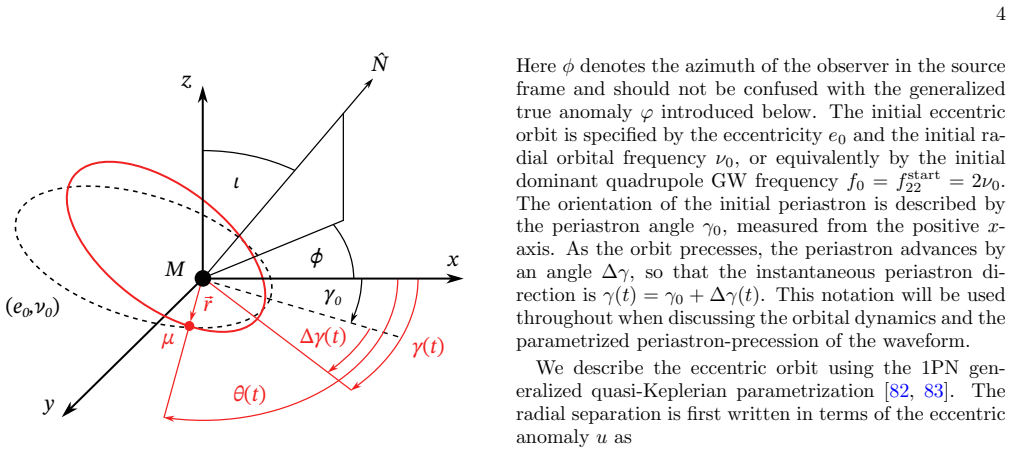
The central object is the parametrized azimuthal-to-radial frequency ratio $K_\alpha = 1 + (1+\delta\alpha)k_{\rm GR}$, where $k_{\rm GR}=3(M\Omega_r)^{2/3}/(1-e^2)$ is the leading 1PN periastron-advance per radial cycle. This ratio is inserted into a frequency-domain eccentric inspiral waveform built from generalized Hansen coefficients and the stationary-phase approximation, with the periastron phase accumulated as $\gamma_\alpha(e)=\gamma_0+(1+\delta\alpha)[\gamma_{\rm GR}(e)-\gamma_{\rm GR}(e_0)]$. The two waveform prescriptions differ in which angular carriers inherit the secular phase: the restricted model keeps it on the explicit 1PN sidebands, while the full model promotes it to the dominant Newtonian and half-PN carriers, producing an enlarged sideband set and coherent phase accumulation across most of the signal power.
What would settle it
Compute the mismatch between the full model's GR limit and the published 1PN eccentric waveform for identical source parameters; a mismatch exceeding $1/(2\rho^2)$ at a forecast SNR $\rho$ would show the quoted sensitivity depends on the approximant. Alternatively, inject waveforms from an independent higher-order eccentric model and recover them with the full model; a bias in $\delta\alpha$ away from zero beyond the 90% credible interval would falsify the robustness of the forecast.
Extended reading notes
Core claim
The paper claims that LISA can measure the conservative azimuthal-to-radial frequency ratio of an eccentric inspiral with enough precision to constrain a fractional deformation of the leading-order periastron advance to $|\delta\alpha|\sim 10^{-4}$ or better. The deformation is introduced through $K_\alpha = 1 + (1+\delta\alpha)k_{\rm GR}$, with $\delta\alpha=0$ recovering general relativity, while radiation reaction and waveform amplitudes remain at their GR values. Two implementations are compared: a restricted model that deforms only the explicit 1PN precession sidebands, and a full model that also assigns the deformed secular phase to the Newtonian and half-PN carriers. The full model achieves comparable constraints at an SNR about eight times lower, because the dominant waveform components coherently accumulate the modified phase. The paper presents this placement dependence as a central methodological result and frames the eccentric LISA signal as a new laboratory for conservative-dynamics tests of gravity.
Load-bearing premise
The forecasts assume the template waveform used for both injection and recovery accurately represents a real general-relativistic eccentric inspiral; if actual signals differ from this finite post-Newtonian approximant, the quoted bounds and the factor-of-eight sensitivity gain are not robust.
Editorial extensions
If this is right
- LISA can place a 90% credible bound $|\delta\alpha|\lesssim 10^{-4}$ on the conservative frequency-ratio deformation for a $3000\,M_\odot$, $e_0=0.5$ eccentric binary at SNR 50, tightening to $|\delta\alpha|\lesssim 2.6\times 10^{-5}$ at SNR 200.
- The placement of a phenomenological deformation within a finitely truncated waveform can change the apparent sensitivity by orders of magnitude, so theory-agnostic tests must specify which waveform components carry the deviation.
- Increasing initial eccentricity improves the marginalized constraint at fixed SNR by redistributing power across radial harmonics and reducing degeneracies with orbital and phase parameters.
- For a fixed SNR, observing the final four years before coalescence yields constraints roughly fifteen times tighter than observing an earlier, less relativistic portion of the inspiral.
- The forecast bounds are comparable to the fractional precision of the Double Pulsar periastron-advance test, while probing a much more relativistic velocity regime ($v\sim0.03$–$0.08$).
Reading between the lines
- The sideband-versus-carrier distinction likely applies to other parametrized tests of gravity: quasicircular ppE-style bounds can be strongly reweighted when the same deformation is carried by dominant harmonics in eccentric templates.
- In the circular limit the deformation reduces to a 1PN correction to the azimuthal phase, so the $\delta\alpha$ constraint could be mapped onto modified binding-energy or periastron-advance coefficients and cross-checked against quasicircular LISA tests.
- A testable extension would inject signals from an independent higher-order eccentric waveform model and recover them with the full model; a recovery bias in $\delta\alpha$ beyond the quoted credible interval would quantify how much of the sensitivity gain is an artifact of same-model recovery.
- The factor-of-eight sensitivity gap between the two prescriptions suggests that future eccentric null-test waveforms should place deformations on dominant phase carriers, but it also means quoted bounds are approximant-dependent until higher-PN and spin effects are included.
Editorial analysis
A structured set of objections, weighed in public.
Referee Report
Summary. The paper constructs a frequency-domain eccentric inspiral waveform model for LISA in which a parameter δα deforms the conservative azimuthal-to-radial frequency ratio K = Ω_θ/Ω_r, with δα = 0 recovering GR. Two prescriptions are defined: a restricted model that applies the deformation only to explicit 1PN precession sidebands, and a full model that promotes the deformed secular phase to the dominant Newtonian and half-PN angular carriers before resummation. Using lisabeta and Bayesian inference with zero-noise injections, the authors find that the full model yields 90% bounds |δα| ≲ 10^-4 for a chirp mass 3000 M_sun, e0 = 0.5, SNR = 50 binary, and that increasing eccentricity sharpens the constraints. A central methodological conclusion is that the inferred sensitivity depends strongly on where the phenomenological deformation is placed in a finitely truncated waveform.
Significance. If the projected bounds are robust, this is a valuable new null test of conservative GR dynamics in eccentric inspirals, complementing quasicircular parametrized tests and pulsar-timing measurements. The paper is careful in several respects: the SPA construction and harmonic truncation are checked against mismatch criteria, the LISA response and TDI channels are included, and the placement-dependence warning is explicitly demonstrated with a controlled likelihood diagnostic. The main caveat, acknowledged in Sec. IV, is that all injections and recoveries use the same waveform model; the full model's GR limit is not the published 1PN eccentric waveform of Ref. [81]. The central numerical claim therefore needs a cross-model validation before it can be read as a physical forecast.
major comments (2)
- [Sec. II.C.2, Sec. III, Sec. IV] The headline bound is obtained through zero-noise injections generated and recovered with the full model H_F, whose GR limit is not the published 1PN eccentric waveform of Ref. [81] but a secularly resummed approximant. The difference is not negligible: Eq. (38) promotes the deformed secular phase to Newtonian and half-PN carriers, adding relative 1PN and 1.5PN phase corrections beyond the formal truncation of Ref. [81]. Because the same model is used on both sides of the likelihood, the reported |δα| ≲ 10^-4 could be an artefact of the finite approximant rather than a measure of the physical frequency-ratio deformation. I request a cross-model injection-recovery study (e.g., inject H_R or Ref. [81] waveforms and recover with H_F, or use a higher-PN eccentric model) to bound the systematic contribution to δα; if that is not possible, the paper should state explicitly that the bound is a property of H_F and not a physical forecast.
- [Sec. II.C.2, Eq. (41)] The full model's deformation of the half-PN carriers introduces corrections at relative 1.5PN order, which are outside the formal 1PN completeness of the baseline waveform. Since δα is claimed to isolate the conservative frequency ratio with dissipative and radiative sectors held fixed, the entanglement of δα with uncontrolled higher-PN phase terms weakens this claim. The manuscript should either show, through a comparison with a 1.5PN or 2PN eccentric waveform, that the δα posterior is insensitive to these omitted terms, or restrict the interpretation of δα to the specific finite approximant used here.
minor comments (4)
- [Sec. II.C.1] In the sentence describing the restricted model, 'these terms terms' should be 'these terms'.
- [Sec. III, Figs. 6 and 8] The restricted and full posteriors are computed at different SNRs (ρ = 400 and ρ = 50); although the text notes this, the figure captions should state the SNRs explicitly so that the posterior widths are not compared directly.
- [Sec. II.F, Eqs. (64)-(66)] The characteristic-strain envelopes sum absolute squares without cross terms; the text should clarify that these curves are diagnostics and do not represent the true spectral density of the signal.
- [Sec. IV] The paper calls the full model the 'fiducial phenomenological prescription' without a criterion for choosing it over the restricted model; a brief justification (e.g., the likelihood diagnostic in Fig. 10) would help the reader understand why H_F is preferred for forecasts.
Circularity Check
No circularity: the δα forecasts are computed self-consistently from a defined deformation and disclosed same-model injection-recovery; the remaining concern is waveform robustness, not circular reasoning.
full rationale
The paper's load-bearing claim is a Bayesian forecast of how tightly LISA could measure the phenomenological parameter δα defined in Eq. (1). The derivation chain is explicit: define K_α = 1 + (1 + δα) k_GR; construct two SPA waveform families H_R and H_F that embed this deformation in different angular carriers; inject zero-noise signals generated by the same model; and recover δα with MCMC. No step fits δα to external data and then re-predicts it; the quoted |δα| bounds are outputs of the likelihood, not inputs. The stronger response of H_F is indeed by construction—the deformation is assigned to the dominant angular carriers—but the paper states this openly as a modeling choice and does not present it as an independent empirical prediction. The paper is also transparent that the δα=0 limit of H_F is not the published Ref. [81] waveform and that all injections and recoveries use the same model (Sec. II.C.2, Sec. III, Sec. IV: 'We use zero-noise injections and recover each signal with the same waveform model used to generate it'). That is a waveform-systematic robustness limitation, not a circular identification: the bound is a property of the finite approximant, but it is not equivalent to its input by definition. The self-citation to lisabeta [80], for which Marsat is a coauthor, is routine use of a published code and does not function as an unverified uniqueness theorem or as a substitute for the derivation. Accordingly, no circularity step meets the evidentiary bar of Eq. X = Eq. Y by construction or fitted-parameter-renamed-as-prediction.
Assumptions & free parameters
free parameters (1)
- δα =
0 (injected); posterior 90% bound from ~1×10^-4 to ~6×10^-4 depending on source and model
assumptions (5)
- domain assumption The 1PN generalized quasi-Keplerian eccentric waveform of Ref. [81] accurately represents the gravitational-wave signal of a non-spinning eccentric binary in the LISA band.
- domain assumption The stationary-phase approximation can be applied separately to each (n,p) sideband and the sum over SPA components reconstructs the full signal.
- ad hoc to paper The full-model GR limit, H_F at δα=0, is an acceptable phenomenological template for a GR eccentric binary.
- ad hoc to paper The deformation δα can be consistently isolated while holding the dissipative radiation-reaction evolution and radiative amplitudes fixed to GR.
- domain assumption The LISA noise model from the Science Requirements and the TDI response implemented in lisabeta are accurate.
Cite this review
Pith. "Pith review of A parametrized test of general relativity for inspiralling eccentric binaries in LISA." pith.science (2026). https://pith.science/paper/5E2EOV4Q
@misc{pith2026260810168,
  author       = {Pith},
  title        = {Pith review of: A parametrized test of general relativity for inspiralling eccentric binaries in LISA},
  year         = {2026},
  howpublished = {\url{https://pith.science/paper/5E2EOV4Q}},
  note         = {Machine review of arXiv:2608.10168}
}
abstract
The space-based detector Laser Interferometer Space Antenna (LISA) will observe inspiralling black hole binaries in the mHz band, many of which may retain orbital eccentricity. In contrast to quasicircular binaries, eccentric systems radiate through multiple orbital harmonics, while relativistic periastron precession introduces a secular phase structure in the waveform. We exploit this structure to develop a parametrized test of general relativity (GR) for eccentric bound orbits. We construct a frequency-domain eccentric waveform model in which a phenomenological deviation parameter $\delta\alpha$ modifies the GR prediction for the conservative azimuthal-to-radial frequency ratio, with $\delta\alpha=0$ corresponding to GR. We consider two parametrizations of this deformation. In the first, $\delta\alpha$ modifies only the explicit precession-dependent sideband structures of the waveform. In the second, the secular precession phase is assigned to the dominant lower-order angular carriers and retained in resummed form. The latter produces a substantially stronger response because the dominant waveform components coherently accumulate the modified phase. We implement both models within \textsc{lisabeta} and perform a Bayesian analysis including the time- and frequency-dependent LISA response and associated time-delay-interferometry observables. We find that LISA can place stringent constraints on the parametrized deviation. For a binary with chirp mass $3000 M_{\odot}$, initial eccentricity $e_0=0.5$ observed for four years at an SNR of $50$, the second model yields a $90\%$ credible bound of $|\delta\alpha|\lesssim 10^{-4}$. Increasing eccentricity further sharpens the constraints by introducing additional harmonic structure and reducing degeneracies among the binary parameters. The framework developed here is general and can be extended to more complete eccentric waveform models.
Figures


Figures from the paper (11 more)


Reference graph
Works this paper leans on
-
[81]
Marsat, J
S. Marsat, J. G. Baker, and T. D. Canton, Exploring the bayesian parameter estimation of binary black holes with lisa, Phys. Rev. D103, 083011 (2021)
2021
- [68]
-
[71]
S. A. Bhat, A. Tiwari, M. A. Shaikh, and S. J. Ka- padia, Eccentricity evolution consistency test to distin- guish eccentric gravitational-wave signals from eccen- tricity mimickers, Phys. Rev. D112, 124004 (2025), arXiv:2508.14850 [gr-qc]
arXiv 2025
-
[1]
SNR contributions of different modes To understand which waveform components dominate the LISA signal, we first examine the SNR budget (in the GR limit,δα= 0). This is useful because the mode and harmonic content of the GR waveform determines where most of the statistical information in the signal resides before introducing the parametrized precession def...
-
[2]
P. Amaro-Seoane, H. Audley, S. Babak, J. Baker, E. Ba- rausse, P. Bender, E. Berti, P. Binetruy, M. Born, D. Bortoluzzi, J. Camp, C. Caprini, V. Cardoso, M. Colpi, J. Conklin, N. Cornish, C. Cutler, K. Danz- mann, R. Dolesi, L. Ferraioli, V. Ferroni, E. Fitzsi- mons, J. Gair, L. Gesa Bote, D. Giardini, F. Gib- ert, C. Grimani, H. Halloin, G. Heinzel, T. H...
arXiv 2017
-
[3]
Klein, E
A. Klein, E. Barausse, A. Sesana, A. Petiteau, E. Berti, S. Babak, J. Gair, S. Aoudia, I. Hinder, F. Ohme, and B. Wardell, Science with the space-based interferometer elisa: Supermassive black hole binaries, Phys. Rev. D 93, 024003 (2016)
2016
-
[4]
J. Bellovary, C. Cleary, F. Munshi, M. Tremmel, C. Christensen, A. Brooks, and T. Quinn, Multimessen- ger Signatures of Massive Black Holes in Dwarf Galax- ies, Mon. Not. Roy. Astron. Soc.482, 2913 (2019), arXiv:1806.00471 [astro-ph.GA]
arXiv 2019
-
[5]
Berti, V
E. Berti, V. Cardoso, and C. M. Will, Gravitational- wave spectroscopy of massive black holes with the space interferometer lisa, Phys. Rev. D73, 064030 (2006)
2006
Show all 118 references
-
[6]
C. J. Moore, A. J. K. Chua, and J. R. Gair, Gravita- tional waves from extreme mass ratio inspirals around bumpy black holes, Class. Quant. Grav.34, 195009 (2017), arXiv:1707.00712 [gr-qc]
2017 arXiv
-
[7]
Liu and Y
J. Liu and Y. Zhang, Gravitational-wave radiation from double compact objects with eLISA in the Galaxy, Publ. Astron. Soc. Pac.126, 211 (2016), arXiv:1404.3848 [astro-ph.SR]
2016 arXiv
-
[8]
M. Y. M. Lau, I. Mandel, A. Vigna-G´ omez, C. J. Nei- jssel, S. Stevenson, and A. Sesana, Detecting Double Neutron Stars with LISA, Mon. Not. Roy. Astron. Soc. 492, 3061 (2020), arXiv:1910.12422 [astro-ph.HE]
2020 arXiv
-
[9]
J. J. Andrews, K. Breivik, C. Pankow, D. J. D’Orazio, and M. Safarzadeh, LISA and the Existence of a Fast- Merging Double Neutron Star Formation Channel, As- trophys. J. Lett.892, L9 (2020), arXiv:1910.13436 [astro-ph.HE]
2020 arXiv
-
[10]
Chen, D.-D
W.-C. Chen, D.-D. Liu, and B. Wang, Detectability of ultra-compact X-ray binaries as LISA sources, Astro- phys. J. Lett.900, L8 (2020), arXiv:2008.05143 [astro- ph.HE]
2020 arXiv
-
[11]
T. Wagg, F. S. Broekgaarden, S. E. de Mink, L. A. C. van Son, N. Frankel, and S. Justham, Gravitational Wave Sources in Our Galactic Backyard: Predictions for BHBH, BHNS, and NSNS Binaries Detectable with LISA, Astrophys. J.937, 118 (2022), arXiv:2111.13704 [astro-ph.HE]
2022 arXiv
-
[12]
Amaro-Seoaneet al., Low-frequency gravitational- wave science with eLISA/NGO, Class
P. Amaro-Seoaneet al., Low-frequency gravitational- wave science with eLISA/NGO, Class. Quant. Grav.29, 124016 (2012), arXiv:1202.0839 [gr-qc]
2012 arXiv
-
[13]
Sesana, Prospects for Multiband Gravitational-Wave Astronomy after GW150914, Phys
A. Sesana, Prospects for Multiband Gravitational-Wave Astronomy after GW150914, Phys. Rev. Lett.116, 231102 (2016), arXiv:1602.06951 [gr-qc]
2016 arXiv
-
[14]
Samsing, M
J. Samsing, M. MacLeod, and E. Ramirez-Ruiz, The Formation of Eccentric Compact Binary Inspirals and the Role of Gravitational Wave Emission in Binary- Single Stellar Encounters, Astrophys. J.784, 71 (2014), arXiv:1308.2964 [astro-ph.HE]
2014 arXiv
-
[15]
Samsing, Eccentric black hole mergers forming in 23 Figure 14
J. Samsing, Eccentric black hole mergers forming in 23 Figure 14. Full 13-dimensional corner plot for a GR injection recovered with the full waveform model. The source has M= 3000M ⊙,e 0 = 0.5,q= 4, is observed forT obs = 4 yr, and has SNRρ= 100. Red lines mark the injected va...
2018
-
[16]
Rasskazov and B
A. Rasskazov and B. Kocsis, The rate of stellar mass black hole scattering in galactic nuclei, Astrophys. J. 881, 20 (2019), arXiv:1902.03242 [astro-ph.HE]
2019 arXiv
-
[17]
Zevin, I
M. Zevin, I. M. Romero-Shaw, K. Kremer, E. Thrane, and P. D. Lasky, Implications of Eccentric Observa- tions on Binary Black Hole Formation Channels, Astro- phys. J. Lett.921, L43 (2021), arXiv:2106.09042 [astro- ph.HE]
2021 arXiv
-
[18]
Dall’Amico, M
M. Dall’Amico, M. Mapelli, S. Torniamenti, and M. A. Sedda, Eccentric black hole mergers via three-body in- teractions in young, globular, and nuclear star clusters, Astron. Astrophys.683, A186 (2024), arXiv:2303.07421 [astro-ph.HE]
2024 arXiv
-
[19]
Rowan, H
C. Rowan, H. Whitehead, G. Fabj, P. Saini, B. Koc- sis, M. Pessah, and J. Samsing, Prompt gravitational- wave mergers aided by gas in active galactic nuclei: the hydrodynamics of binary-single black hole scatter- 24 ings, Mon. Not. Roy. Astron. Soc.539, 1501 (2025), arXiv:2501...
2025 arXiv
-
[20]
I. M. Romero-Shaw, P. D. Lasky, E. Thrane, and J. C. Bustillo, GW190521: orbital eccentricity and signa- tures of dynamical formation in a binary black hole merger signal, Astrophys. J. Lett.903, L5 (2020), arXiv:2009.04771 [astro-ph.HE]
2020 arXiv
-
[21]
Gayathri, J
V. Gayathri, J. Healy, J. Lange, B. O’Brien, M. Szczep- anczyk, I. Bartos, M. Campanelli, S. Klimenko, C. O. Lousto, and R. O’Shaughnessy, Eccentricity estimate for black hole mergers with numerical relativity simula- tions, Nature Astron.6, 344 (2022), arXiv:2009.05461 [astro-ph.HE]
2022 arXiv
-
[22]
I. M. Romero-Shaw, P. D. Lasky, and E. Thrane, Signs of Eccentricity in Two Gravitational-wave Signals May Indicate a Subpopulation of Dynamically Assembled Bi- nary Black Holes, Astrophys. J. Lett.921, L31 (2021), arXiv:2108.01284 [astro-ph.HE]
2021 arXiv
-
[23]
I. M. Romero-Shaw, P. D. Lasky, and E. Thrane, Four Eccentric Mergers Increase the Evidence that LIGO–Virgo–KAGRA’s Binary Black Holes Form Dynamically, Astrophys. J.940, 171 (2022), arXiv:2206.14695 [astro-ph.HE]
2022 arXiv
-
[24]
Gupteet al., Evidence for eccentricity in the population of binary black holes observed by LIGO- Virgo-KAGRA, Phys
N. Gupteet al., Evidence for eccentricity in the population of binary black holes observed by LIGO- Virgo-KAGRA, Phys. Rev. D112, 104045 (2025), arXiv:2404.14286 [gr-qc]
2025 arXiv
-
[25]
Morras, G
G. Morras, G. Pratten, and P. Schmidt, Orbital Ec- centricity in a Neutron Star–Black Hole Merger, Astro- phys. J. Lett.1000, L2 (2026), arXiv:2503.15393 [astro- ph.HE]
2026
-
[26]
Jan, B.-J
A. Jan, B.-J. Tsao, R. O’Shaughnessy, D. Shoemaker, and P. Laguna, GW200105: A detailed study of eccen- tricity in the neutron star-black hole binary, Phys. Rev. D113, 024018 (2026), arXiv:2508.12460 [gr-qc]
2026
-
[27]
Kacanja, K
K. Kacanja, K. Soni, and A. H. Nitz, Eccentricity sig- natures in LIGO-Virgo-KAGRA’s binary neutron star and neutron-star black holes, Phys. Rev. D112, 122007 (2025), arXiv:2508.00179 [gr-qc]
2025
-
[28]
X. Fang, T. A. Thompson, and C. M. Hirata, The Pop- ulation of Eccentric Binary Black Holes: Implications for mHz Gravitational Wave Experiments, Astrophys. J.875, 75 (2019), arXiv:1901.05092 [astro-ph.HE]
2019 arXiv
-
[29]
Hoang, S
B.-M. Hoang, S. Naoz, B. Kocsis, W. Farr, and J. McIver, Detecting Supermassive Black Hole–induced Binary Eccentricity Oscillations with LISA, Astrophys. J. Lett.875, L31 (2019), arXiv:1903.00134 [astro- ph.HE]
2019 arXiv
-
[30]
A. P. Stephan, S. Naoz, A. M. Ghez, M. R. Morris, A. Ciurlo, T. Do, K. Breivik, S. Coughlin, and C. L. Rodriguez, The Fate of Binaries in the Galactic Center: The Mundane and the Exotic, Astrophys. J.878, 58 (2019), arXiv:1903.00010 [astro-ph.SR]
2019 arXiv
-
[31]
H. Wang, A. P. Stephan, S. Naoz, B.-M. Hoang, and K. Breivik, Gravitational-wave Signatures from Com- pact Object Binaries in the Galactic Center, Astrophys. J.917, 76 (2021), arXiv:2010.15841 [astro-ph.HE]
2021 arXiv
-
[32]
Z. Xuan, S. Naoz, B. Kocsis, and E. Michaely, Detect- ing Gravitational Wave Bursts from Stellar-mass Bina- ries in the mHz Band, Astrophys. J.965, 148 (2024), arXiv:2310.00042 [astro-ph.HE]
2024 arXiv
-
[33]
I. M. Romero-Shaw, S. Goorachurn, M. Siwek, and C. J. Moore, Eccentric signatures of stellar-mass binary black holes with circumbinary discs in LISA, Mon. Not. Roy. Astron. Soc.534, L58 (2024), arXiv:2407.03869 [astro- ph.HE]
2024 arXiv
-
[34]
C. M. Will, The Confrontation between general rela- tivity and experiment, Living Rev. Rel.9, 3 (2006), arXiv:gr-qc/0510072
2006 arXiv
-
[35]
B. S. Sathyaprakash and B. F. Schutz, Physics, Astro- physics and Cosmology with Gravitational Waves, Liv- ing Rev. Rel.12, 2 (2009), arXiv:0903.0338 [gr-qc]
2009 arXiv
-
[36]
Yunes and X
N. Yunes and X. Siemens, Gravitational-Wave Tests of General Relativity with Ground-Based Detectors and Pulsar Timing-Arrays, Living Rev. Rel.16, 9 (2013), arXiv:1304.3473 [gr-qc]
2013 arXiv
-
[37]
Bertiet al., Testing General Relativity with Present and Future Astrophysical Observations, Class
E. Bertiet al., Testing General Relativity with Present and Future Astrophysical Observations, Class. Quant. Grav.32, 243001 (2015), arXiv:1501.07274 [gr-qc]
2015 arXiv
-
[38]
N. V. Krishnendu and F. Ohme, Testing General Rel- ativity with Gravitational Waves: An Overview, Uni- verse7, 497 (2021), arXiv:2201.05418 [gr-qc]
2021 arXiv
-
[39]
B. P. Abbottet al.(LIGO Scientific, Virgo), Tests of general relativity with GW150914, Phys. Rev. Lett. 116, 221101 (2016), [Erratum: Phys.Rev.Lett. 121, 129902 (2018)], arXiv:1602.03841 [gr-qc]
2016 arXiv
-
[40]
B. P. Abbottet al.(LIGO Scientific, Virgo), Tests of General Relativity with GW170817, Phys. Rev. Lett. 123, 011102 (2019), arXiv:1811.00364 [gr-qc]
2019 arXiv
-
[41]
Abbottet al.(LIGO Scientific, Virgo), Tests of gen- eral relativity with binary black holes from the second LIGO-Virgo gravitational-wave transient catalog, Phys
R. Abbottet al.(LIGO Scientific, Virgo), Tests of gen- eral relativity with binary black holes from the second LIGO-Virgo gravitational-wave transient catalog, Phys. Rev. D103, 122002 (2021), arXiv:2010.14529 [gr-qc]
2021 arXiv
-
[42]
Abbottet al.(LIGO Scientific, VIRGO, KAGRA), Tests of General Relativity with GWTC-3, Phys
R. Abbottet al.(LIGO Scientific, VIRGO, KAGRA), Tests of General Relativity with GWTC-3, Phys. Rev. D112, 084080 (2025), arXiv:2112.06861 [gr-qc]
2025 arXiv
-
[43]
Dutta Roy, S
P. Dutta Roy, S. Datta, and K. G. Arun, Tests of gen- eral relativity at the fourth post-Newtonian order, Phys. Rev. D110, 064002 (2024), arXiv:2406.07691 [gr-qc]
2024 arXiv
-
[44]
Mahapatraet al., Confronting general relativity with principal component analysis: Simulations and results from GWTC-3 events, Phys
P. Mahapatraet al., Confronting general relativity with principal component analysis: Simulations and results from GWTC-3 events, Phys. Rev. D112, 104007 (2025), arXiv:2508.06862 [gr-qc]
2025
-
[45]
A. G. Abacet al.(LIGO Scientific, VIRGO, KAGRA), GWTC-4.0: Tests of General Relativity. I. Overview and General Tests, (2026), arXiv:2603.19019 [gr-qc]
2026 arXiv
-
[46]
A. G. Abacet al.(LIGO Scientific, VIRGO, KAGRA), GWTC-4.0: Tests of General Relativity. II. Parameter- ized Tests, (2026), arXiv:2603.19020 [gr-qc]
2026 arXiv
-
[47]
A. G. Abacet al.(LIGO Scientific, VIRGO, KAGRA), GWTC-4.0: Tests of General Relativity. III. Tests of the Remnants, (2026), arXiv:2603.19021 [gr-qc]
2026 arXiv
-
[48]
A. G. Abacet al.(LIGO Scientific, VIRGO, KA- GRA), GWTC-5.0: Tests of General Relativity, (2026), arXiv:2607.19293 [gr-qc]
2026 arXiv
-
[49]
Yunes and F
N. Yunes and F. Pretorius, Fundamental Theoretical Bias in Gravitational Wave Astrophysics and the Pa- rameterized Post-Einsteinian Framework, Phys. Rev. D 80, 122003 (2009), arXiv:0909.3328 [gr-qc]
2009 arXiv
-
[50]
Agathos, W
M. Agathos, W. Del Pozzo, T. G. F. Li, C. Van Den Broeck, J. Veitch, and S. Vitale, TIGER: A data analysis pipeline for testing the strong-field dynamics of general relativity with gravitational wave signals from coalescing compact binaries, Phys. Rev. D89, 082001 (2014), arXi...
2014 arXiv
-
[51]
Yunes, K
N. Yunes, K. Yagi, and F. Pretorius, Theoretical Physics Implications of the Binary Black-Hole Mergers GW150914 and GW151226, Phys. Rev. D94, 084002 25 (2016), arXiv:1603.08955 [gr-qc]
2016 arXiv
-
[52]
B. C. Seymour, J. Golomb, and Y. Chen, Inspiral tests of general relativity and waveform geometry, Phys. Rev. D114, 024059 (2026), arXiv:2602.17524 [gr-qc]
2026 arXiv
-
[53]
Barausse, N
E. Barausse, N. Yunes, and K. Chamberlain, Theory- agnostic constraints on black-hole dipole radiation with multiband gravitational-wave astrophysics, Phys. Rev. Lett.116, 241104 (2016)
2016
-
[54]
J. R. Gair, M. Vallisneri, S. L. Larson, and J. G. Baker, Testing General Relativity with Low-Frequency, Space- Based Gravitational-Wave Detectors, Living Rev. Rel. 16, 7 (2013), arXiv:1212.5575 [gr-qc]
2013 arXiv
-
[55]
Datta, Enhancing the performance of multiparame- ter tests of general relativity with LISA using Principal Component Analysis, (2023), arXiv:2303.04399 [gr-qc]
S. Datta, Enhancing the performance of multiparame- ter tests of general relativity with LISA using Principal Component Analysis, (2023), arXiv:2303.04399 [gr-qc]
2023 arXiv
-
[56]
Akamaet al.(LISA Cosmology Working Group), Testing gravitational wave polarizations with LISA, (2026), arXiv:2603.03165 [astro-ph.CO]
S. Akamaet al.(LISA Cosmology Working Group), Testing gravitational wave polarizations with LISA, (2026), arXiv:2603.03165 [astro-ph.CO]
2026
-
[57]
Piarulli, S
M. Piarulli, S. Marsat, E. M. S¨ anger, A. Buonanno, J. Steinhoff, and N. Tamanini, Parametrized test of general relativity for LISA massive black hole bi- nary inspirals, Phys. Rev. D112, 124044 (2025), arXiv:2510.06330 [gr-qc]
2025
-
[58]
Saini, M
P. Saini, M. Favata, and K. G. Arun, Systematic bias on parametrized tests of general relativity due to neglect of orbital eccentricity, Phys. Rev. D106, 084031 (2022)
2022
-
[59]
S. A. Bhat, P. Saini, M. Favata, and K. G. Arun, Sys- tematic bias on the inspiral-merger-ringdown consis- tency test due to neglect of orbital eccentricity, Phys. Rev. D107, 024009 (2023)
2023
-
[60]
Saini, S
P. Saini, S. A. Bhat, M. Favata, and K. G. Arun, Eccentricity-induced systematic error on parametrized tests of general relativity: Hierarchical bayesian infer- ence applied to a binary black hole population, Phys. Rev. D109, 084056 (2024)
2024
-
[61]
Guptaet al., Possible causes of false gen- eral relativity violations in gravitational wave ob- servations 10.21468/SciPostPhysCommRep.5 (2024), arXiv:2405.02197 [gr-qc]
A. Guptaet al., Possible causes of false gen- eral relativity violations in gravitational wave ob- servations 10.21468/SciPostPhysCommRep.5 (2024), arXiv:2405.02197 [gr-qc]
2024 arXiv
-
[62]
Favata, Systematic parameter errors in inspiraling neutron star binaries, Phys
M. Favata, Systematic parameter errors in inspiraling neutron star binaries, Phys. Rev. Lett.112, 101101 (2014)
2014
-
[63]
Favata, C
M. Favata, C. Kim, K. G. Arun, J. Kim, and H. W. Lee, Constraining the orbital eccentricity of inspiralling compact binary systems with advanced ligo, Phys. Rev. D105, 023003 (2022)
2022
-
[64]
Kumar, S
Divyajyoti, S. Kumar, S. Tibrewal, I. M. Romero-Shaw, and C. K. Mishra, Blind spots and biases: The dan- gers of ignoring eccentricity in gravitational-wave sig- nals from binary black holes, Phys. Rev. D109, 043037 (2024), arXiv:2309.16638 [gr-qc]
2024 arXiv
-
[65]
Dutta Roy and P
P. Dutta Roy and P. Saini, Impact of unmodeled eccen- tricity on the tidal deformability measurement and im- plications for gravitational wave physics inference, Phys. Rev. D110, 024002 (2024)
2024
-
[66]
Ma and N
S. Ma and N. Yunes, Improved Constraints on Modified Gravity with Eccentric Gravitational Waves, Phys. Rev. D100, 124032 (2019), arXiv:1908.07089 [gr-qc]
2019 arXiv
-
[67]
Moore and N
B. Moore and N. Yunes, Constraining Gravity with Ec- centric Gravitational Waves: Projected Upper Bounds and Model Selection, Class. Quant. Grav.37, 165006 (2020), arXiv:2002.05775 [gr-qc]
2020 arXiv
-
[69]
S. A. Bhat, P. Saini, M. Favata, C. Gandevikar, C. K. Mishra, and K. G. Arun, Parametrized tests of general relativity using eccentric compact binaries, Phys. Rev. D110, 124062 (2024)
2024
-
[70]
Moore, M
B. Moore, M. Favata, K. G. Arun, and C. K. Mishra, Gravitational-wave phasing for low-eccentricity inspi- ralling compact binaries to 3pn order, Phys. Rev. D93, 124061 (2016)
2016
-
[72]
Chiaramello, N
D. Chiaramello, N. Cibrario, J. Lange, K. Chandra, R. Gamba, R. Bonino, and A. Nagar, Theory-agnostic tests of general relativity with a new parametrized model for gravitational waves from eccentric, precessing binary black holes, Phys. Rev. D114, 044004 (2026), arXiv:2511.195...
2026
-
[73]
Vitale, Multiband Gravitational-Wave Astronomy: Parameter Estimation and Tests of General Relativity with Space- and Ground-Based Detectors, Phys
S. Vitale, Multiband Gravitational-Wave Astronomy: Parameter Estimation and Tests of General Relativity with Space- and Ground-Based Detectors, Phys. Rev. Lett.117, 051102 (2016), arXiv:1605.01037 [gr-qc]
2016 arXiv
-
[74]
Chamberlain and N
K. Chamberlain and N. Yunes, Theoretical Physics Implications of Gravitational Wave Observation with Future Detectors, Phys. Rev. D96, 084039 (2017), arXiv:1704.08268 [gr-qc]
2017 arXiv
-
[75]
Gnocchi, A
G. Gnocchi, A. Maselli, T. Abdelsalhin, N. Giacobbo, and M. Mapelli, Bounding alternative theories of gravity with multiband GW observations, Phys. Rev. D100, 064024 (2019), arXiv:1905.13460 [gr-qc]
2019 arXiv
-
[76]
Carson and K
Z. Carson and K. Yagi, Multi-band gravitational wave tests of general relativity, Class. Quant. Grav.37, 02LT01 (2020), arXiv:1905.13155 [gr-qc]
2020 arXiv
-
[77]
Carson and K
Z. Carson and K. Yagi, Parametrized and inspiral- merger-ringdown consistency tests of gravity with multi- band gravitational wave observations, Phys. Rev. D 101, 044047 (2020), arXiv:1911.05258 [gr-qc]
2020 arXiv
-
[78]
Toubiana, S
A. Toubiana, S. Marsat, E. Barausse, S. Babak, and J. Baker, Tests of general relativity with stellar-mass black hole binaries observed by LISA, Phys. Rev. D101, 104038 (2020), arXiv:2004.03626 [gr-qc]
2020 arXiv
-
[79]
Gupta, S
A. Gupta, S. Datta, S. Kastha, S. Borhanian, K. G. Arun, and B. S. Sathyaprakash, Multiparameter tests of general relativity using multiband gravitational-wave observations, Phys. Rev. Lett.125, 201101 (2020), arXiv:2005.09607 [gr-qc]
2020 arXiv
-
[80]
Datta, A
S. Datta, A. Gupta, S. Kastha, K. G. Arun, and B. S. Sathyaprakash, Tests of general relativity us- ing multiband observations of intermediate mass binary black hole mergers, Phys. Rev. D103, 024036 (2021), arXiv:2006.12137 [gr-qc]
2021 arXiv
-
[82]
Mik´ oczi, P
B. Mik´ oczi, P. Forg´ acs, and M. Vas´ uth, First order post- Newtonian gravitational waveforms of binaries on eccen- tric orbits with Hansen coefficients, Phys. Rev. D92, 044038 (2015), arXiv:1502.00276 [gr-qc]
2015 arXiv
-
[83]
Damour and N
T. Damour and N. Deruelle, General relativistic celes- tial mechanics of binary systems. I. The post-newtonian motion, Annales de l’I.H.P. Physique th´ eorique43, 107 26 (1985)
1985
-
[84]
Klein and P
A. Klein and P. Jetzer, Spin effects in the phasing of gravitational waves from binaries on eccentric orbits, Phys. Rev. D81, 124001 (2010), arXiv:1005.2046 [gr- qc]
2010 arXiv
-
[85]
Blanchet and B
L. Blanchet and B. R. Iyer, Third postNewtonian dy- namics of compact binaries: Equations of motion in the center-of-mass frame, Class. Quant. Grav.20, 755 (2003), arXiv:gr-qc/0209089
2003 arXiv
-
[86]
Cutler and E
C. Cutler and E. E. Flanagan, Gravitational waves from merging compact binaries: How accurately can one extract the binary’s parameters from the inspiral wave form?, Phys. Rev. D49, 2658 (1994), arXiv:gr- qc/9402014
1994
-
[87]
Veitch and A
J. Veitch and A. Vecchio, Bayesian coherent analysis of in-spiral gravitational wave signals with a detector net- work, Phys. Rev. D81, 062003 (2010), arXiv:0911.3820 [astro-ph.CO]
2010 arXiv
-
[88]
Thrane and C
E. Thrane and C. Talbot, An introduction to Bayesian inference in gravitational-wave astronomy: Parameter estimation, model selection, and hierarchical models, Publications of the Astronomical Society of Australia 36, e010 (2019), arXiv:1809.02293 [astro-ph.IM]
2019 arXiv
-
[89]
Technical Report 1.0, Tech
LISA Science Study Team,LISA Science Requirements Document, ESA-L3-EST-SCI-RS-001. Technical Report 1.0, Tech. Rep. (ESA, 2018)
2018
-
[90]
R. M. O’Leary, B. Kocsis, and A. Loeb, Gravitational waves from scattering of stellar-mass black holes in galactic nuclei, Mon. Not. Roy. Astron. Soc.395, 2127 (2009), arXiv:0807.2638 [astro-ph]
2009 arXiv
-
[91]
Wen, On the eccentricity distribution of coalesc- ing black hole binaries driven by the Kozai mecha- nism in globular clusters, Astrophys
L. Wen, On the eccentricity distribution of coalesc- ing black hole binaries driven by the Kozai mecha- nism in globular clusters, Astrophys. J.598, 419 (2003), arXiv:astro-ph/0211492
2003 arXiv
-
[92]
W. D. Vousden, W. M. Farr, and I. Mandel, Dy- namic temperature selection for parallel tempering in Markov chain Monte Carlo simulations, Monthly No- tices of the Royal Astronomical Society455, 1919 (2016), arXiv:1501.05823 [astro-ph.IM]
2016 arXiv
-
[93]
Foreman-Mackey, D
D. Foreman-Mackey, D. W. Hogg, D. Lang, and J. Goodman, emcee: The MCMC Hammer, Publica- tions of the Astronomical Society of the Pacific125, 306 (2013), arXiv:1202.3665 [astro-ph.IM]
2013 arXiv
-
[94]
Chatziioannou, A
K. Chatziioannou, A. Klein, N. Yunes, and N. Cornish, Constructing Gravitational Waves from Generic Spin- Precessing Compact Binary Inspirals, Phys. Rev. D95, 104004 (2017), arXiv:1703.03967 [gr-qc]
2017 arXiv
-
[95]
Kramer, I
M. Kramer, I. H. Stairs, R. N. Manchester, N. Wex, A. T. Deller, W. A. Coles, M. Ali, M. Burgay, F. Camilo, I. Cognard, T. Damour, G. Desvignes, R. D. Ferdman, P. C. C. Freire, S. Grondin, L. Guillemot, G. B. Hobbs, G. Janssen, R. Karuppusamy, D. R. Lorimer, A. G. Lyne, J. W. ...
2021
-
[96]
H. Hu, M. Kramer, N. Wex, D. J. Champion, and M. S. Kehl, Constraining the dense matter equation-of-state with radio pulsars, Mon. Not. Roy. Astron. Soc.497, 3118 (2020), arXiv:2007.07725 [astro-ph.SR]
2020 arXiv
-
[97]
Blanchet, Post-Newtonian Theory for Gravitational Waves, Living Rev
L. Blanchet, Post-Newtonian Theory for Gravitational Waves, Living Rev. Rel.17, 2 (2014), arXiv:1310.1528 [gr-qc]
2014 arXiv
-
[98]
Le Tiec, A
A. Le Tiec, A. H. Mroue, L. Barack, A. Buonanno, H. P. Pfeiffer, N. Sago, and A. Taracchini, Periastron Advance in Black Hole Binaries, Phys. Rev. Lett.107, 141101 (2011), arXiv:1106.3278 [gr-qc]
2011 arXiv
-
[99]
Morras, G
G. Morras, G. Pratten, and P. Schmidt, Improved post- Newtonian waveform model for inspiralling precessing- eccentric compact binaries, Phys. Rev. D111, 084052 (2025), arXiv:2502.03929 [gr-qc]
2025 arXiv
-
[100]
Morras, G
G. Morras, G. Pratten, P. Schmidt, and A. Buonanno, Post-Newtonian inspiral waveform model for eccentric precessing binaries with higher-order modes and matter effects, (2026), arXiv:2604.11903 [gr-qc]
2026 arXiv
-
[101]
Gamboa, M
A. Gamboa, M. Khalil, and A. Buonanno, Third post-Newtonian dynamics for eccentric orbits and aligned spins in the effective-one-body waveform model seobnrv5ehm, Phys. Rev. D112, 044037 (2025), arXiv:2412.12831 [gr-qc]
2025 arXiv
-
[102]
Gamboaet al., Accurate waveforms for eccen- tric, aligned-spin binary black holes: The multipolar effective-one-body model seobnrv5ehm, Phys
A. Gamboaet al., Accurate waveforms for eccen- tric, aligned-spin binary black holes: The multipolar effective-one-body model seobnrv5ehm, Phys. Rev. D 112, 044038 (2025), arXiv:2412.12823 [gr-qc]
2025 arXiv
-
[103]
Gamboaet al., Accurate waveforms for generic planar-orbit binary black holes: The multipolar effective-one-body model SEOBNRv6EHM, (2026), arXiv:2605.28715 [gr-qc]
A. Gamboaet al., Accurate waveforms for generic planar-orbit binary black holes: The multipolar effective-one-body model SEOBNRv6EHM, (2026), arXiv:2605.28715 [gr-qc]
2026 arXiv
-
[104]
K. Paul, A. Maurya, Q. Henry, K. Sharma, P. Satheesh, Divyajyoti, P. Kumar, and C. K. Mishra, Eccentric, spinning, inspiral-merger-ringdown waveform model with higher modes for the detection and characteriza- tion of binary black holes, Phys. Rev. D111, 084074 (2025), arXiv:24...
2025 arXiv
-
[105]
Barausse, N
E. Barausse, N. Yunes, and K. Chamberlain, Theory- Agnostic Constraints on Black-Hole Dipole Radia- tion with Multiband Gravitational-Wave Astrophysics, Phys. Rev. Lett.116, 241104 (2016), arXiv:1603.04075 [gr-qc]
2016 arXiv
-
[106]
Kleinet al., The last three years: multiband gravitational-wave observations of stellar-mass binary black holes, (2022), arXiv:2204.03423 [astro-ph.HE]
A. Kleinet al., The last three years: multiband gravitational-wave observations of stellar-mass binary black holes, (2022), arXiv:2204.03423 [astro-ph.HE]
2022 arXiv
-
[107]
Tahura and K
S. Tahura and K. Yagi, Parameterized Post-Einsteinian Gravitational Waveforms in Various Modified Theories of Gravity, Phys. Rev. D98, 084042 (2018), [Erratum: Phys.Rev.D 101, 109902 (2020)], arXiv:1809.00259 [gr- qc]
2018 arXiv
-
[108]
Buscicchio, A
R. Buscicchio, A. Klein, E. Roebber, C. J. Moore, D. Gerosa, E. Finch, and A. Vecchio, Bayesian pa- rameter estimation of stellar-mass black-hole bina- ries with LISA, Phys. Rev. D104, 044065 (2021), arXiv:2106.05259 [astro-ph.HE]
2021 arXiv
-
[109]
Nishizawa, E
A. Nishizawa, E. Berti, A. Klein, and A. Sesana, eLISA eccentricity measurements as tracers of binary black hole formation, Phys. Rev. D94, 064020 (2016), arXiv:1605.01341 [gr-qc]
2016 arXiv
-
[110]
M. Garg, S. Tiwari, A. Derdzinski, J. G. Baker, S. Marsat, and L. Mayer, The minimum measurable eccentricity from gravitational waves of LISA massive black hole binaries, Mon. Not. Roy. Astron. Soc.528, 4176 (2024), arXiv:2307.13367 [astro-ph.GA]
2024 arXiv
-
[111]
H. Wang, I. Harry, A. Nitz, and Y.-M. Hu, Space- based gravitational wave observatories will be able to use eccentricity to unveil stellar-mass binary black hole formation, Phys. Rev. D109, 063029 (2024), arXiv:2304.10340 [astro-ph.HE]
2024 arXiv
-
[112]
Saini, Resolving the eccentricity of stellar mass binary black holes with next generation ground-based gravita- 27 tional wave detectors, Mon
P. Saini, Resolving the eccentricity of stellar mass binary black holes with next generation ground-based gravita- 27 tional wave detectors, Mon. Not. Roy. Astron. Soc.528, 833 (2024), arXiv:2308.07565 [astro-ph.HE]
2024 arXiv
-
[113]
Virtanen, R
P. Virtanen, R. Gommers, T. E. Oliphant, M. Haber- land, T. Reddy, D. Cournapeau, E. Burovski, P. Pe- terson, W. Weckesser, J. Bright, S. J. van der Walt, M. Brett, J. Wilson, K. J. Millman, N. Mayorov, A. R. J. Nelson, E. Jones, R. Kern, E. Larson, C. J. Carey, ˙I. Polat, Y. ...
2020 arXiv
-
[114]
C. R. Harris, K. J. Millman, S. J. van der Walt, R. Gom- mers, P. Virtanen, D. Cournapeau, E. Wieser, J. Tay- lor, S. Berg, N. J. Smith, R. Kern, M. Picus, S. Hoyer, M. H. van Kerkwijk, M. Brett, A. Haldane, J. F. del R ´ ıo, M. Wiebe, P. Peterson, P. G´ erard-Marchant, K. She...
2020 arXiv
-
[115]
J. D. Hunter, Matplotlib: A 2D Graphics Environment, Computing in Science and Engineering9, 90 (2007)
2007
-
[116]
Kluyver, B
T. Kluyver, B. Ragan-Kelley, F. P´ erez, B. Granger, M. Bussonnier, J. Frederic, K. Kelley, J. Hamrick, J. Grout, S. Corlay, P. Ivanov, D. Avila, S. Abdalla, C. Willing, and J. development team, Jupyter note- books ? a publishing format for reproducible compu- tational workflo...
2016
-
[117]
Wes McKinney, Data Structures for Statistical Com- puting in Python, inProceedings of the 9th Python in Science Conference, edited by St´ efan van der Walt and Jarrod Millman (2010) pp. 56 – 61
2010
-
[118]
Foreman-Mackey, corner.py: Scatterplot matrices in python, The Journal of Open Source Software1, 24 (2016)
D. Foreman-Mackey, corner.py: Scatterplot matrices in python, The Journal of Open Source Software1, 24 (2016)
2016
Reviewed August 14, 2026 · model on record in the stance chip above.
Discussion (0). Continue with ORCID to comment.