Toward an affordable density-based measure for the quality of a coupled cluster calculation
Pith reviewed 2026-05-21 22:06 UTC · model grok-4.3
The pith
A ratio of changes in static and total correlation diagnostics between CCSD and CCSD(T) moderately predicts post-CCSD(T) effects.
A machine-rendered reading of the paper's core claim, the machinery that carries it, and where it could break.
Core claim
We propose two new diagnostics for the degree to which static correlation impacts the quality of a coupled cluster calculation. The first is the change in the Matito static correlation diagnostic between CCSD and CCSD(T). The second is the ratio of the same and of the corresponding change in the total correlation diagnostic. In general, a small value indicates that at this level of theory the density is converged and any further changes to the energy come from dynamical correlation, while larger values indicate that the density is still not converged and some static correlation remains. The ratio is found to be a moderately good predictor for the importance of post-CCSD(T) correlation.
What carries the argument
The ratio r_I[(T)] of the change in the averaged nondynamical correlation diagnostic to the change in the total correlation diagnostic from CCSD to CCSD(T), which quantifies the fractional contribution of static correlation updates at the perturbative triples level.
Load-bearing premise
That the change in the Matito nondynamical correlation diagnostic between CCSD and CCSD(T) directly signals whether the electron density has converged with respect to static correlation effects.
What would settle it
A benchmark set of molecules in which the r_I[(T)] values fail to align with the actual energy contributions computed explicitly at CCSDT or CCSDT(Q) levels.
Figures
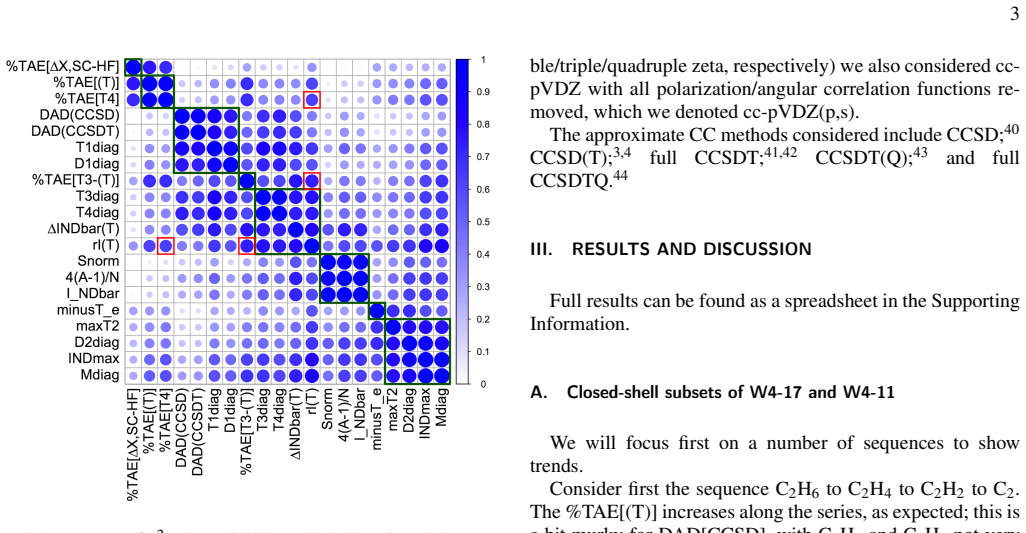

read the original abstract
We propose two new diagnostics for the degree to which static correlation impacts the quality of a coupled cluster calculation. The first is the change in the Matito static correlation diagnostic $\overline{I_{ND}}$ between CCSD and CCSD(T), $\Delta I_{ND}[\textrm{(T)}]=\overline{I_{ND}}[\textrm{CCSD(T)}]-\overline{I_{ND}}[\textrm{CCSD}]$. The second is the ratio of the same and of the corresponding change in the total correlation diagnostic $\overline{I_{T}}=\overline{I_{ND}}+\overline{I_{D}}$, i.e., $r_I[(T)]=\Delta I_{ND}[\textrm{(T)}]/\Delta I_{T}[\textrm{(T)}]$. The first diagnostic can be extended to higher-order improvements in the wave function, e.g., $\Delta I_{ND}[\textrm{(Q)}]=\overline{I_{ND}}[\textrm{CCSDT(Q)}]-\overline{I_{ND}}[\textrm{CCSDT}]$. In general, a small $\Delta I_{ND}$[\textrm{level$_1$}] value indicates that at this level$_1$ of theory, the density is converged and any further changes to the energy come from dynamical correlation, while larger $\Delta I_{ND}$[\textrm{level$_2$}] indicates that the density is still not converged at level$_2$ and some static correlation remains. $r_I[(T)]$ is found to be a moderately good predictor for the importance of post-CCSD(T) correlation effects.
Editorial analysis
A structured set of objections, weighed in public.
Referee Report
Summary. The manuscript proposes two new diagnostics for assessing static correlation effects in coupled cluster calculations: ΔI_ND[(T)] as the difference in the Matito static correlation diagnostic between CCSD and CCSD(T), and r_I[(T)] as the ratio of this difference to the corresponding change in the total correlation diagnostic I_T. It asserts that small ΔI_ND values indicate convergence of the one-particle density (with further energy changes being dynamical), while larger values signal remaining static correlation, and reports that r_I[(T)] is a moderately good predictor for the importance of post-CCSD(T) correlation effects. The approach extends to higher orders such as (Q).
Significance. If the proposed mapping from ΔI_ND to density convergence holds and the predictive performance of r_I[(T)] is robustly validated, the work would offer an affordable, density-based tool to gauge CCSD(T) quality without routine recourse to CCSDT or higher, building directly on existing Matito I_ND and I_T diagnostics in a parameter-free ratio form. This could aid practical decisions on when post-CCSD(T) corrections matter.
major comments (2)
- [Abstract] Abstract: The central interpretive claim that 'a small ΔI_ND[level1] value indicates that at this level1 of theory, the density is converged and any further changes to the energy come from dynamical correlation' is asserted without derivation from the Matito diagnostic equations or explicit validation against reference densities (e.g., from CCSDT or FCI) on the same systems used to test r_I[(T)]. Because CCSD and CCSD(T) are non-variational, this unverified mapping is load-bearing for the predictor claim and requires a direct correlation check with actual density differences.
- [Results (predictive performance paragraph)] The section reporting predictive performance: The statement that r_I[(T)] 'is found to be a moderately good predictor' lacks quantitative support such as correlation coefficients, error metrics, or comparison against existing diagnostics on a defined test set; without these, the strength of the claim and its utility relative to ΔI_ND alone cannot be assessed.
minor comments (2)
- Ensure consistent use of overline notation for averaged diagnostics (I_ND and I_T) throughout the text and equations.
- Clarify whether the diagnostics are computed from relaxed or unrelaxed densities in the CC implementations referenced.
Simulated Author's Rebuttal
We thank the referee for the constructive report and the opportunity to clarify our work. We address the major comments point by point below, providing the strongest honest defense of the manuscript while agreeing to revisions where the concerns are valid.
read point-by-point responses
-
Referee: [Abstract] Abstract: The central interpretive claim that 'a small ΔI_ND[level1] value indicates that at this level1 of theory, the density is converged and any further changes to the energy come from dynamical correlation' is asserted without derivation from the Matito diagnostic equations or explicit validation against reference densities (e.g., from CCSDT or FCI) on the same systems used to test r_I[(T)]. Because CCSD and CCSD(T) are non-variational, this unverified mapping is load-bearing for the predictor claim and requires a direct correlation check with actual density differences.
Authors: The interpretive claim follows from the established purpose of Matito's I_ND as a density-based indicator of non-dynamical correlation: a small ΔI_ND[(T)] means the inclusion of perturbative triples produces little further change in this static-correlation measure, implying that the one-particle density has stabilized and that remaining energy contributions are predominantly dynamical. We acknowledge that the manuscript does not contain an explicit derivation from the diagnostic equations or a side-by-side comparison of ΔI_ND values against numerical density differences obtained from CCSDT or FCI on the identical test systems. Because CCSD and CCSD(T) are non-variational, such a direct check would indeed strengthen the mapping. We will revise the abstract and the relevant discussion section to articulate the rationale more explicitly from the diagnostic definition and to note the non-variational caveat as a limitation. revision: partial
-
Referee: [Results (predictive performance paragraph)] The section reporting predictive performance: The statement that r_I[(T)] 'is found to be a moderately good predictor' lacks quantitative support such as correlation coefficients, error metrics, or comparison against existing diagnostics on a defined test set; without these, the strength of the claim and its utility relative to ΔI_ND alone cannot be assessed.
Authors: We agree that the current phrasing relies on qualitative trends observed across the test systems rather than explicit numerical metrics. The manuscript describes r_I[(T)] as 'moderately good' on the basis of its ability to flag cases where post-CCSD(T) corrections are known to be significant. To address the concern, we will add quantitative measures in the revised results section, including the Pearson correlation coefficient between r_I[(T)] and the size of post-CCSD(T) energy contributions on the defined test set, root-mean-square error relative to a threshold, and a direct comparison of predictive performance against the T1 and D1 diagnostics. This will allow a clearer assessment of its utility relative to ΔI_ND alone. revision: yes
Circularity Check
No significant circularity; definitions and predictor claim are independent
full rationale
The paper defines ΔI_ND[(T)] and r_I[(T)] explicitly as the difference and ratio of the pre-existing Matito I_ND and I_T diagnostics. The statement that small ΔI_ND indicates density convergence is presented as an interpretive guideline rather than a mathematical derivation or fit. The claim that r_I[(T)] is a moderately good predictor is phrased as an empirical finding ('is found to be') and does not reduce by construction to the input definitions or any self-citation chain. No load-bearing self-referential steps, fitted parameters renamed as predictions, or uniqueness theorems imported from the authors' prior work are present in the provided text.
Axiom & Free-Parameter Ledger
axioms (1)
- domain assumption Matito's I_ND diagnostic accurately quantifies static correlation effects in the electron density.
Lean theorems connected to this paper
-
IndisputableMonolith/Cost/FunctionalEquation.leanwashburn_uniqueness_aczel unclear?
unclearRelation between the paper passage and the cited Recognition theorem.
a small ΔI_ND[level1] value indicates that at this level1 of theory, the density is converged and any further changes to the energy come from dynamical correlation
-
IndisputableMonolith/Foundation/RealityFromDistinction.leanreality_from_one_distinction unclear?
unclearRelation between the paper passage and the cited Recognition theorem.
r_I[(T)] = ΔI_ND[(T)] / ΔI_T[(T)]
What do these tags mean?
- matches
- The paper's claim is directly supported by a theorem in the formal canon.
- supports
- The theorem supports part of the paper's argument, but the paper may add assumptions or extra steps.
- extends
- The paper goes beyond the formal theorem; the theorem is a base layer rather than the whole result.
- uses
- The paper appears to rely on the theorem as machinery.
- contradicts
- The paper's claim conflicts with a theorem or certificate in the canon.
- unclear
- Pith found a possible connection, but the passage is too broad, indirect, or ambiguous to say the theorem truly supports the claim.
Forward citations
Cited by 2 Pith papers
-
FNO-CCSDTQ(5)$_\Lambda$ as an economical alternative for connected quintuple excitations contributions in coupled cluster thermochemistry
FNO-CCSDTQ(5) with NO cutoffs of 0.0025 or 0.001, plus naive extrapolation, provides a viable low-cost approximation to quintuple excitation contributions in coupled cluster thermochemistry.
-
A new open-shell CCSDTQ implementation and its application to the basis set convergence of post-CCSDT(Q) corrections in computational thermochemistry
Open-shell CCSDTQ implementation reveals rapid convergence of (Q)Λ corrections and identifies a combined CCSDTQ(5)Λ-CCSDT(Q)Λ correction as most efficient, with good agreement for ozone electron affinity.
Reference graph
Works this paper leans on
-
[1]
author author J. M. L. \ Martin ,\ https://doi.org/10.1002/ijch.202100111 journal journal Israel J. Chem. \ volume 62 ,\ pages e202100111 ( year 2022 ) NoStop
-
[2]
author author I. Shavitt \ and\ author R. J. \ Bartlett ,\ https://doi.org/10.1017/CBO9780511596834 title Many-body methods in chemistry and physics: MBPT and coupled-cluster theory \ ( publisher Cambridge University Press ,\ address Cambridge, England ,\ year 2009 ) NoStop
-
[3]
author author K. Raghavachari , author G. W. \ Trucks , author J. A. \ Pople , \ and\ author M. Head-Gordon ,\ https://doi.org/10.1016/S0009-2614(89)87395-6 journal journal Chem. Phys. Lett. \ volume 157 ,\ pages 479 ( year 1989 ) NoStop
-
[4]
author author J. D. \ Watts , author J. Gauss , \ and\ author R. J. \ Bartlett ,\ https://doi.org/10.1063/1.464480 journal journal J. Chem. Phys. \ volume 98 ,\ pages 8718 ( year 1993 ) NoStop
-
[5]
author author K. L. \ Bak , author P. J rgensen , author J. Olsen , author T. Helgaker , \ and\ author J. Gauss ,\ https://doi.org/10.1016/S0009-2614(99)01315-9 journal journal Chem. Phys. Lett. \ volume 317 ,\ pages 116 ( year 2000 ) NoStop
-
[6]
author author T. A. \ Ruden , author T. Helgaker , author P. Jørgensen , \ and\ author J. Olsen ,\ https://doi.org/10.1016/S0009-2614(03)00225-2 journal journal Chemical Physics Letters \ volume 371 ,\ pages 62 ( year 2003 ) NoStop
-
[7]
author author A. D. \ Boese , author M. Oren , author O. Atasoylu , author J. M. L. \ Martin , author M. K \' a llay , \ and\ author J. Gauss ,\ https://doi.org/10.1063/1.1638736 journal journal J. Chem. Phys. \ volume 120 ,\ pages 4129 ( year 2004 ) NoStop
-
[8]
author author A. Tajti , author P. G. \ Szalay , author A. G. \ Császár , author M. Kállay , author J. Gauss , author E. F. \ Valeev , author B. A. \ Flowers , author J. Vázquez , \ and\ author J. F. \ Stanton ,\ https://doi.org/10.1063/1.1811608 journal journal J. Chem. Phys. \ volume 121 ,\ pages 11599 ( year 2004 ) NoStop
-
[9]
author author Y. J. \ Bomble , author J. Vázquez , author M. Kállay , author C. Michauk , author P. G. \ Szalay , author A. G. \ Császár , author J. Gauss , \ and\ author J. F. \ Stanton ,\ https://doi.org/10.1063/1.2206789 journal journal J. Chem. Phys. \ volume 125 ,\ pages 064108 ( year 2006 ) NoStop
-
[10]
author author M. E. \ Harding , author J. Vázquez , author B. Ruscic , author A. K. \ Wilson , author J. Gauss , \ and\ author J. F. \ Stanton ,\ https://doi.org/10.1063/1.2835612 journal journal J. Chem. Phys. \ volume 128 ,\ pages 114111 ( year 2008 ) NoStop
-
[11]
author author A. Karton , author E. Rabinovich , author J. M. L. \ Martin , \ and\ author B. Ruscic ,\ https://doi.org/10.1063/1.2348881 journal journal J. Chem. Phys. \ volume 125 ,\ pages 144108 ( year 2006 ) NoStop
-
[12]
author author A. Karton , author P. R. \ Taylor , \ and\ author J. M. L. \ Martin ,\ https://doi.org/10.1063/1.2755751 journal journal J. Chem. Phys. \ volume 127 ,\ pages 064104 ( year 2007 ) NoStop
-
[13]
Sinano g lu ,\ in\ https://doi.org/10.1002/9780470143520.ch7 booktitle Adv
author author O. Sinano g lu ,\ in\ https://doi.org/10.1002/9780470143520.ch7 booktitle Adv. Chem. Phys. ,\ Vol. volume 6 ,\ editor edited by\ editor I. Prigogine \ ( publisher Interscience Publishers ,\ address New York ,\ year 1964 )\ pp.\ pages 315--412 NoStop
-
[14]
author author B. O. \ Roos ,\ in\ https://doi.org/10.1007/978-3-642-58150-2_4 booktitle Lecture Notes in Quantum Chemistry ,\ series Lecture Notes in Chemistry , Vol. volume 58 \ ( publisher Springer, Berlin, Heidelberg ,\ year 1992 )\ pp.\ pages 177--254 NoStop
-
[15]
author author A. S. \ Edelstein ,\ https://doi.org/10.1016/S0304-8853(02)00697-2 journal journal Journal of Magnetism and Magnetic Materials \ volume 256 ,\ pages 430 ( year 2003 ) NoStop
-
[16]
author author J. W. \ Hollett \ and\ author P. M. W. \ Gill ,\ https://doi.org/10.1063/1.3570574 journal journal The Journal of Chemical Physics \ volume 134 ,\ pages 114111 ( year 2011 ) NoStop
-
[17]
author author U. R. \ Fogueri , author S. Kozuch , author A. Karton , \ and\ author J. M. L. \ Martin ,\ https://doi.org/10.1007/s00214-012-1291-y journal journal Theor. Chem. Acc. \ volume 132 ,\ pages 1291 ( year 2012 ) NoStop
-
[18]
author author X. Xu , author L. Soriano-Agueda , author X. López , author E. Ramos-Cordoba , \ and\ author E. Matito ,\ https://doi.org/10.1063/5.0250636 journal journal J. Chem. Phys. \ volume 162 ,\ pages 124102 ( year 2025 ) NoStop
-
[19]
author author T. J. \ Lee \ and\ author P. R. \ Taylor ,\ https://doi.org/10.1002/qua.560360824 journal journal Int. J. Quantum Chem. \ volume 36 ,\ pages 199 ( year 1989 ) NoStop
-
[20]
author author D. Jayatilaka \ and\ author T. J. \ Lee ,\ https://doi.org/10.1063/1.464352 journal journal The Journal of Chemical Physics \ volume 98 ,\ pages 9734 ( year 1993 ) NoStop
-
[21]
author author T. J. \ Lee ,\ https://doi.org/10.1016/S0009-2614(03)00435-4 journal journal Chemical Physics Letters \ volume 372 ,\ pages 362 ( year 2003 ) NoStop
-
[22]
author author C. L. \ Janssen \ and\ author I. M. B. \ Nielsen ,\ https://doi.org/10.1016/S0009-2614(98)00504-1 journal journal Chem. Phys. Lett. \ volume 290 ,\ pages 423 ( year 1998 ) NoStop
-
[23]
note For the outer product of a 1-column vector, i.e., a rank one matrix, the matrix 2-norm and the Frobenius 2-norm --- a.k.a., `the Euclidean norm of a matrix' --- are equivalent. This is no longer the case when the vector is replaced by a rectangular matrix, such as that of the T_1 or T_2 amplitudes. Stop
-
[24]
author author I. M. B. \ Nielsen \ and\ author C. L. \ Janssen ,\ https://doi.org/10.1016/S0009-2614(99)00770-8 journal journal Chem. Phys. Lett. \ volume 310 ,\ pages 568 ( year 1999 ) NoStop
-
[25]
author author J. M. L. \ Martin , author G. Santra , \ and\ author E. Semidalas ,\ https://doi.org/10.1063/5.0119280 journal journal AIP Conf. Proc. \ volume 2611 ,\ pages 020014 ( year 2022 ) NoStop
-
[26]
\ L \"o wdin ,\ https://doi.org/10.1103/PhysRev.97.1474 journal journal Phys
author author P.-O. \ L \"o wdin ,\ https://doi.org/10.1103/PhysRev.97.1474 journal journal Phys. Rev. \ volume 97 ,\ pages 1474 ( year 1955 ) NoStop
-
[27]
author author P.-O. \ L \"o wdin \ and\ author H. Shull ,\ https://doi.org/10.1103/PhysRev.101.1730 journal journal Phys. Rev. \ volume 101 ,\ pages 1730 ( year 1956 ) ,\ note suggests that deviations from 0 or 2 can be regarded as measures of correlation strength NoStop
-
[28]
Ziesche ,\ https://doi.org/10.1002/qua.560560422 journal journal Int
author author P. Ziesche ,\ https://doi.org/10.1002/qua.560560422 journal journal Int. J. Quantum Chem. \ volume 56 ,\ pages 363 ( year 1995 ) NoStop
-
[29]
author author K. E. \ Weflen , author M. R. \ Bentley , author J. H. \ Thorpe , author P. R. \ Franke , author J. M. L. \ Martin , author D. A. \ Matthews , \ and\ author J. F. \ Stanton ,\ https://doi.org/10.1021/acs.jpclett.5c00885 journal journal J. Phys. Chem. Lett. \ volume 16 ,\ pages 5121 ( year 2025 ) NoStop
-
[30]
author author O. Tishchenko , author J. Zheng , \ and\ author D. G. \ Truhlar ,\ https://doi.org/10.1021/ct800077r journal journal J. Chem. Theory Comput. \ volume 4 ,\ pages 1208 ( year 2008 ) NoStop
-
[31]
author author E. Ramos-Cordoba , author P. Salvador , \ and\ author E. Matito ,\ https://doi.org/10.1039/C6CP03072F journal journal Phys. Chem. Chem. Phys. \ volume 18 ,\ pages 24015 ( year 2016 ) NoStop
-
[32]
author author X. Xu , author L. Soriano-Agueda , author X. López , author E. Ramos-Cordoba , \ and\ author E. Matito ,\ https://doi.org/10.1021/acs.jctc.3c01073 journal journal J. Chem. Theory Comput. \ volume 20 ,\ pages 721 ( year 2024 ) NoStop
-
[33]
author author D. A. \ Matthews , author L. Cheng , author M. E. \ Harding , author F. Lipparini , author S. Stopkowicz , author T.-C. \ Jagau , author P. G. \ Szalay , author J. Gauss , \ and\ author J. F. \ Stanton ,\ https://doi.org/10.1063/5.0004837 journal journal J. Chem. Phys. \ volume 152 ,\ pages 214108 ( year 2020 ) NoStop
-
[34]
author author G. H. \ Jones , author E. Semidalas , \ and\ author J. M. L. \ Martin ,\ https://doi.org/10.1515/pac-2025-0542 journal journal Pure Appl. Chem. \ volume XX ,\ pages yyyy ( year 2025 ) ,\ note special issue for International Year of Quantum Science and Technology NoStop
-
[35]
author author H.-J. \ Werner , author P. J. \ Knowles , author F. R. \ Manby , author J. A. \ Black , author K. Doll , author A. He elmann , author D. Kats , author A. K \" o hn , author T. Korona , author D. A. \ Kreplin , author Q. Ma , author T. F. \ Miller III , author A. Mitrushchenkov , author K. A. \ Peterson , author I. Polyak , author G. Rauhut ,...
-
[36]
author author A. Karton , author N. Sylvetsky , \ and\ author J. M. L. \ Martin ,\ https://doi.org/10.1002/jcc.24854 journal journal J. Comput. Chem. \ volume 38 ,\ pages 2063 ( year 2017 ) NoStop
-
[37]
author author J. M. L. \ Martin ,\ https://doi.org/10.1016/j.theochem.2006.03.035 journal journal J. Mol. Struct. THEOCHEM \ volume 771 ,\ pages 19 ( year 2006 ) NoStop
-
[38]
author author T. H. \ Dunning Jr ,\ https://doi.org/10.1063/1.456153 journal journal J. Chem. Phys. \ volume 90 ,\ pages 1007 ( year 1989 ) NoStop
-
[39]
author author D. E. \ Woon \ and\ author T. H. \ Dunning Jr. ,\ https://doi.org/10.1063/1.464303 journal journal J. Chem. Phys. \ volume 98 ,\ pages 1358 ( year 1993 ) NoStop
-
[40]
author author G. D. \ Purvis \ and\ author R. J. \ Bartlett ,\ https://doi.org/10.1063/1.443164 journal journal J. Chem. Phys. \ volume 76 ,\ pages 1910 ( year 1982 ) NoStop
-
[41]
author author M. Urban , author J. Noga , author S. J. \ Cole , \ and\ author R. J. \ Bartlett ,\ https://doi.org/10.1063/1.449067 journal journal J. Chem. Phys. \ volume 83 ,\ pages 4041 ( year 1985 ) NoStop
-
[42]
author author J. D. \ Watts \ and\ author R. J. \ Bartlett ,\ https://doi.org/10.1063/1.459002 journal journal J. Chem. Phys. \ volume 93 ,\ pages 6104 ( year 1990 ) NoStop
-
[43]
author author Y. J. \ Bomble , author J. F. \ Stanton , author M. K \' a llay , \ and\ author J. Gauss ,\ https://doi.org/10.1063/1.1950567 journal journal J. Chem. Phys. \ volume 123 ,\ pages 054101 ( year 2005 ) NoStop
-
[44]
author author S. A. \ Kucharski \ and\ author R. J. \ Bartlett ,\ https://doi.org/10.1063/1.463930 journal journal J. Chem. Phys. \ volume 97 ,\ pages 4282 ( year 1992 ) NoStop
-
[45]
Matito2025 ; the diagnostics defined in Eqs
note The ratio I_ ND / I_ T was considered in Ref. Matito2025 ; the diagnostics defined in Eqs. eq:delta and eq:ratio are however new to the present work. Stop
-
[46]
author author A. Karton , author S. Daon , \ and\ author J. M. L. \ Martin ,\ https://doi.org/10.1016/j.cplett.2011.05.007 journal journal Chem. Phys. Lett. \ volume 510 ,\ pages 165 ( year 2011 ) NoStop
-
[47]
Chan ,\ https://doi.org/10.1021/acs.jpca.4c06148 journal journal J
author author B. Chan ,\ https://doi.org/10.1021/acs.jpca.4c06148 journal journal J. Phys. Chem. A \ volume 128 ,\ pages 9829–9836 ( year 2024 ) NoStop
-
[48]
note This dichotomy is easily illustrated by comparing and contrasting the problematic Be _2 molecules with N+++ -- the latter has a very high D_2 diagnostic from type B static correlation between 2s and 2p orbitals, but CCSD can handle it perfectly well. Stop
discussion (0)
Sign in with ORCID, Apple, or X to comment. Anyone can read and Pith papers without signing in.