REVIEW 4 major objections 5 minor 106 references
Learned Offline Query Planning via Bayesian Optimization
T0 review · 4 major / 5 minor · reviewed 2026-08-08 · deepseek-v4-flash
Pith's one-line read Offline query planning is best posed as Bayesian optimization over a learned plan space, and this finds faster plans than hint-based or reinforcement-learning optimizers.
desk verdict Clever and credible application of latent-space Bayesian optimization to offline join-order planning, but the headline latency claims are not actually demonstrated because the main evaluation fixes plan-execution count, not wall-clock time. read the letter →
The pith
A machine-rendered reading of the paper's core claim, the machinery that carries it, and where it could break.
The reading
What carries the argument
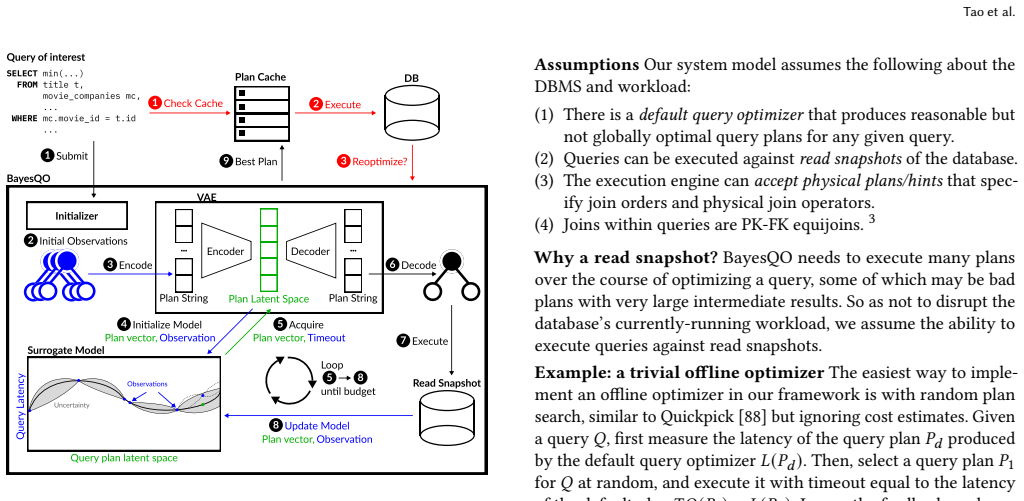
The key machinery is the combination of a string language for join trees, a variational autoencoder that embeds those strings in a continuous latent space, and trust-region Bayesian optimization over that space. The string language is complete, meaning every join tree is representable, and decode-valid, meaning every string decodes to a syntactically valid plan, so the optimizer can explore the whole plan space without feasibility constraints. The VAE's latent vector is the search domain; a scalable Gaussian-process surrogate estimates latency as a function of latent position; Thompson sampling with a dynamically sized trust region guides proposals; and right-censored observations from timeouts are incorporated into the surrogate through a Tobit likelihood, with each timeout chosen so that the incumbent plan is confidently better than the candidate.
What would settle it
Execute a diverse set of plans, record their latent-space coordinates and their runtimes, and check whether latent distance predicts runtime difference: if plans closer in latent space are not significantly more likely to have similar latencies than random pairs, the smoothness assumption fails and BayesQO's search is guided by a proxy unrelated to plan quality.
Extended reading notes
Core claim
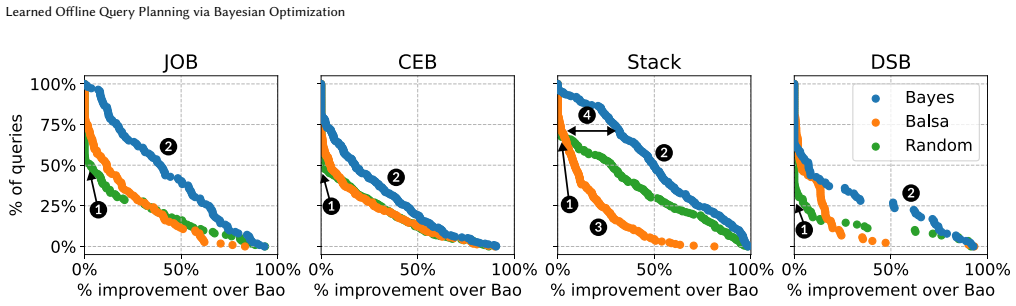
The paper's central claim is that offline query planning is better posed as a Bayesian optimization problem than as an online, regret-minimizing problem. For a given query, BayesQO encodes possible join orders and physical operators as strings, maps those strings into a 64-dimensional latent space with a variational autoencoder, and runs local Bayesian optimization over that space, executing each decoded plan on a read-only snapshot and observing its latency or timeout. The paper demonstrates that this procedure finds plans that beat the best of 49 hint-based alternatives on nearly every query in the JOB, CEB, Stack, and DSB benchmarks, with the largest gains on JOB and Stack, and that reusing an old optimized plan as an initialization point makes re-optimization after data drift several times cheaper.
Load-bearing premise
The load-bearing premise is that the VAE's latent space is smooth with respect to query-plan latency, so nearby latent vectors decode to plans with similar runtimes; if that fails, the Gaussian-process surrogate is not optimizing plan quality.
Editorial extensions
If this is right
- For a workload where a query runs thousands of times, even a small per-query improvement is multiplied, so paying hours of offline compute is worthwhile.
- The best final plan is guaranteed to be at least as good as the best plan in the initialization set, so the approach never regresses below the hint-based baseline.
- Across the evaluated benchmarks, BayesQO finds improvements over the best hint plan on nearly every query, and on the Stack benchmark it finds more than a 2x improvement on half the queries.
- Previously optimized plans remain competitive after a simulated two-year data drift, and re-optimization initialized with the old plan converges in about 1.5 hours versus 8.2 hours from scratch.
- A language model fine-tuned on past optimization traces can generate strong starting plans for unseen queries, though its advantage largely disappears when the query template is absent from its training data.
Reading between the lines
- A testable extension the paper leaves open: measure whether plans close in the VAE latent space have similar runtimes; if latent distance and latency are uncorrelated, the Bayesian surrogate would be optimizing a proxy rather than plan quality.
- The string format encodes join orders and physical operators but not predicates, selections, or subqueries, so extending it to richer plan features would be needed for workloads where join order is not the dominant cost.
- The paper's loop of using execution traces to fine-tune a language model suggests a general recipe for other database design choices, such as index selection and data layout, where each offline run generates training data for the next decision.
Editorial analysis
A structured set of objections, weighed in public.
Referee Report
Summary. The paper proposes BayesQO, an offline query optimizer that uses latent-space Bayesian optimization to search for fast join-order plans for repeated analytic queries. The system encodes query plans as strings, trains a variational autoencoder over those strings, and then performs BO with a Tobit-like censored likelihood, trust regions, and learned timeouts to minimize the best observed plan latency within a budget. Experiments compare BayesQO against exhaustive Bao hint-set execution, Balsa, and random plan search on four workloads (JOB, CEB, Stack, DSB), with additional studies on timeouts, trust regions, data drift, and LLM-based initialization. The paper reports that BayesQO finds faster plans than the baselines for many queries and that it can produce order-of-magnitude improvements on some queries.
Significance. The paper addresses a timely and practical problem: most learned query optimizers are online and must limit optimization overhead, whereas many real analytics workloads consist of repeated queries that justify longer offline optimization. Formalizing offline query optimization and proposing a BO-based alternative to RL is a valuable conceptual contribution, and the idea of using censored observations for timeouts is well motivated. The experimental effort is substantial: three large workloads, multiple baselines, ablations, a data-drift study, and an LLM-initialization experiment. If the empirical claims were established under the stated objective, the paper would make a useful contribution to the learned query optimization literature. However, the current evaluation does not fully support the headline conclusions because the main comparison uses a fixed number of plan executions rather than a time budget, and several supporting experiments suffer from selection bias or circular evaluation.
major comments (4)
- [Section 5.2 and Eq. (1)] The main comparison fixes the number of plan executions at 4000 per query rather than a wall-clock budget, which does not match the formal objective in Eq. (1) of minimizing best latency subject to a time budget B. Since query latencies span orders of magnitude, 4000 executions corresponds to vastly different cumulative execution times across techniques and queries, so the CDFs in Figure 3 do not demonstrate the claimed time-budgeted improvements. Please report results as a function of cumulative execution time (as in Figure 4) or fix a time budget and measure the achieved latency.
- [Section 5.6 and Figure 8] The LLM initialization experiment fine-tunes GPT-4o mini on the fastest optimized plans for the same CEB queries on which it is then evaluated; the text states that the training set included queries from all query templates present in the workload. The top plot of Figure 8 therefore measures in-sample performance and cannot support the claim that fine-tuned LLMs produce good initialization plans for unseen queries. Only the held-out-template experiment (bottom plot) supports cross-query generalization, and even there the queries from the held-out templates were presumably not in the fine-tuning set. Please report results on queries entirely withheld from fine-tuning, and separate in-sample from out-of-sample results clearly.
- [Section 4.2 and Table 2] The paper's core mechanism assumes that the VAE latent space is smooth with respect to plan latency: nearby latent vectors decode to plans with similar execution times. The only validation offered is reconstruction accuracy (Table 2), which does not measure this property. Without evidence that latent distance correlates with latency difference, the BO surrogate may optimize over a distorted proxy of plan quality. Please provide a direct check, e.g., the correlation between latent-space distance and absolute or relative latency difference on a held-out set of plans, or a comparison of BO on the latent space against a surrogate defined on the original string space.
- [Section 5.1 and Figure 3] The CEB and Stack workloads are selected subsets rather than the full benchmarks: CEB is filtered to queries with high improvement headroom (top and bottom 100 by hint-set improvement and longest-running), and Stack selects the longest-running queries per template. This selection biases the aggregate CDFs and undermines the conclusion that BayesQO improves 'nearly every query in several benchmarks.' Please report results on the full benchmarks or clearly label the plots as applicable only to the selected subsets.
minor comments (5)
- [Section 3] The join ordering count 'n!·Cn = 2n!' appears mathematically incorrect; the number of binary join trees without physical operators is n! times the (n-1)-th Catalan number. Please correct the formula.
- [Section 5.2] The paragraph states that each technique 'was executed for several hours' and then says 'Each optimization technique was executed for 4000 plan executions'; these two criteria are inconsistent. Please clarify the actual stopping rule and, if possible, report the wall-clock times corresponding to the 4000-execution runs.
- [Figure 3] The CDF plots lack a clear description of the axes; please state explicitly that the y-axis is the fraction of queries and explain what the x-axis values represent (e.g., percentage improvement over the best Bao plan).
- [Section 4.1] The example encodings '(B,C,⊲⊳m,A,B,⊲⊳h)' are written in a tuple-like notation that is not formally defined. A grammar or BNF for the string language would improve reproducibility and precision.
- [References] References [17] and [18] appear to describe the same paper (arXiv:2009.13828); please de-duplicate.
Circularity Check
Same-template LLM evaluation trains on the optimized plans it later 'predicts'; core BO comparison is not circular.
-
fitted input called prediction
[Section 5.6 (Few-Shot LLM from BO Results), first experiment; training data defined in Section 4.4]
"we fine-tuned GPT-4o mini on the fastest 10 optimized plans for each query from running BO on the CEB workload as described in Section 4.4. This training set included queries from all query templates present in the workload. We then compared the best runtime out of 50 plans (giving it as many plans as Bao) per-query generated by the LLM for a particular query against the runtime of the optimal Bao plan."
Section 4.4 says the fine-tuning dataset is built by 'collecting trajectories from 606 BayesQO runs, selecting the top-1 and top-5 query plans for each query.' In the first experiment of Section 5.6, no queries or templates are withheld: the LLM is fine-tuned on the fastest optimized plans for the CEB workload, then evaluated by asking it to generate plans for 'a particular query' from that same workload. The target output for each evaluated query is thus present in the training set, so a low-latency generated plan can be a memorized or near-memorized copy of the known optimized plan rather than a genuine few-shot prediction.
full rationale
The central BayesQO claim is not circular. The main optimization loop evaluates actual query latencies against a real DBMS; the VAE is trained on planner-generated plan strings without using the target query latencies, and the GP surrogate is fitted online to the externally measured latencies of evaluated plans. The comparison against Bao, Balsa, and Random is an external benchmark, and the fact that BayesQO is initialized with all Bao hint sets transparently guarantees that it can match, not exceed, that baseline by construction; any improvement beyond Bao is an empirical result. No load-bearing self-citation chain or imported uniqueness theorem is present; the heavy use of Maus et al. is method reuse, not a circular justification. The one clear circular step is the same-template LLM evaluation in Section 5.6, where the fine-tuning data includes the optimized plans for the very queries being evaluated, so the reported per-query improvements are at least partly retrieval from training data rather than prediction. The withheld-template experiment is the non-circular control and shows the limitation. The 4 score reflects this partial circularity in a secondary contribution while the core offline-optimization result remains independently supported by external query executions.
Assumptions & free parameters
free parameters (4)
- VAE latent dimension =
64
- Timeout confidence margin kappa =
not reported
- Number of BO initialization plans =
49
- Number of LLM initialization samples =
50
assumptions (6)
- standard math Bayesian optimization and Gaussian process surrogate assumptions: the objective function is modeled as a sample from a GP with a chosen kernel and likelihood.
- standard math Variational inference ELBO derivations for VAE and SVGP are correct as used.
- domain assumption The DBMS executes hinted plans and respects join order and join operator specifications.
- domain assumption Queries can be executed against read-only snapshots without side effects.
- domain assumption The VAE latent space provides a smooth proxy for query plan performance.
- ad hoc to paper Decoding invalid strings by index-based replacement yields a useful, locally consistent mapping from latent space to valid plans.
Cite this review
Pith. "Pith review of Learned Offline Query Planning via Bayesian Optimization." pith.science (2026). https://pith.science/paper/5IAJHTQJ
@misc{pith2026250205256,
  author       = {Pith},
  title        = {Pith review of: Learned Offline Query Planning via Bayesian Optimization},
  year         = {2026},
  howpublished = {\url{https://pith.science/paper/5IAJHTQJ}},
  note         = {Machine review of arXiv:2502.05256}
}
read the original abstract
Analytics database workloads often contain queries that are executed repeatedly. Existing optimization techniques generally prioritize keeping optimization cost low, normally well below the time it takes to execute a single instance of a query. If a given query is going to be executed thousands of times, could it be worth investing significantly more optimization time? In contrast to traditional online query optimizers, we propose an offline query optimizer that searches a wide variety of plans and incorporates query execution as a primitive. Our offline query optimizer combines variational auto-encoders with Bayesian optimization to find optimized plans for a given query. We compare our technique to the optimal plans possible with PostgreSQL and recent RL-based systems over several datasets, and show that our technique finds faster query plans.
Figures

Figures from the paper (7 more)


Reference graph
Works this paper leans on
-
[1]
Christoph Anneser, Nesime Tatbul, David Cohen, Zhenggang Xu, Prithvi Pan- dian, Nikolay Leptev, and Ryan Marcus. 2023. AutoSteer: Learned Query Optimization for Any SQL Database. PVLDB 14, 1 (Aug. 2023). https: //doi.org/10.14778/3611540.3611544
arXiv 2023
-
[2]
M. M. Astrahan, M. W. Blasgen, D. D. Chamberlin, K. P. Eswaran, J. N. Gray, P. P. Griffiths, W. F. King, R. A. Lorie, P. R. McJones, J. W. Mehl, G. R. Putzolu, I. L. Traiger, B. W. Wade, and V. Watson. 1976. System R: relational approach to database management. ACM Trans. Database Syst. 1, 2 (jun 1976), 97–137. https://doi.org/10.1145/320455.320457
arXiv 1976
-
[3]
Shivnath Babu, Pedro Bizarro, and David DeWitt. 2005. Proactive re- optimization with Rio. In Proceedings of the 2005 ACM SIGMOD international conference on Management of data (SIGMOD ’05). Association for Computing Ma- chinery, New York, NY, USA, 936–938. https://doi.org/10.1145/1066157.1066294
arXiv 2005
-
[4]
Henriette Behr, Volker Markl, and Zoi Kaoudi. 2023. Learn What Really Matters: A Learning-to-Rank Approach for ML-based Query Optimization. In Data- base Systems for Business, Technology, and the Web 2023 (BTW ’23) , Birgitta König-Ries, Stefanie Scherzinger, Wolfgang Lehner, and Gottfried Vossen (Eds.). Tao et al. 1.00s 10.00s 1m 16m 2h46m Optimization t...
2023
-
[5]
Stefano Cereda, Stefano Valladares, Paolo Cremonesi, and Stefano Doni. 2021. CGPTuner: a contextual gaussian process bandit approach for the automatic tuning of IT configurations under varying workload conditions. Proc. VLDB Endow. 14, 8 (apr 2021), 1401–1413. https://doi.org/10.14778/3457390.3457404
arXiv 2021
-
[6]
Surajit Chaudhuri. 2009. Query optimizers: time to rethink the contract?. In Proceedings of the 2009 ACM SIGMOD International Conference on Management of Data (Providence, Rhode Island, USA)(SIGMOD ’09). Association for Computing Machinery, New York, NY, USA, 961–968. https://doi.org/10.1145/1559845. 1559955
- [7]
- [8]
Show all 106 references
-
[9]
Guilherme Damasio, Vincent Corvinelli, Parke Godfrey, Piotr Mierzejewski, Alex Mihaylov, Jaroslaw Szlichta, and Calisto Zuzarte. 2019. Guided automated learning for query workload re-optimization. Proceedings of the VLDB Endow- ment 12, 12 (Aug. 2019), 2010–2021. https://doi.o...
2019
-
[10]
Fu, Stefano Ermon, Atri Rudra, and Christopher Ré
Tri Dao, Daniel Y. Fu, Stefano Ermon, Atri Rudra, and Christopher Ré. 2022. FlashAttention: Fast and Memory-Efficient Exact Attention with IO-Awareness. arXiv:2205.14135 [cs.LG] https://arxiv.org/abs/2205.14135
2022 arXiv
-
[11]
Aryan Deshwal and Janardhan Rao Doppa. 2021. Combining Latent Space and Structured Kernels for Bayesian Optimization over Combinatorial Spaces.CoRR abs/2111.01186 (2021). arXiv:2111.01186 https://arxiv.org/abs/2111.01186
2021 arXiv
-
[12]
Bailu Ding, Surajit Chaudhuri, Johannes Gehrke, and Vivek Narasayya. 2021. DSB: a decision support benchmark for workload-driven and traditional data- base systems. Proc. VLDB Endow. 14, 13 (Sept. 2021), 3376–3388. https: //doi.org/10.14778/3484224.3484234
2021
-
[14]
Lyric Doshi, Vincent Zhuang, Gaurav Jain, Ryan Marcus, Haoyu Huang, Deniz Altinbuken, Eugene Brevdo, and Campbell Fraser. 2023. Kepler: Robust Learning for Faster Parametric Query Optimization.Proceedings of the 2023 ACM SIGMOD Conference 1, 1 (May 2023), 109. https://doi.org/...
2023 doi
-
[15]
Jennie Duggan, Ugur Cetintemel, Olga Papaemmanouil, and Eli Upfal. 2011. Performance Prediction for Concurrent Database Workloads. In Proceedings of the 2011 ACM SIGMOD International Conference on Management of Data (SIGMOD ’11). ACM, Athens, Greece, 337–348. https://doi.org/1...
2011 doi
-
[16]
Jennie Duggan, Olga Papaemmanouil, Ugur Cetintemel, and Eli Upfal. 2014. Contender: A Resource Modeling Approach for Concurrent Query Performance Prediction. In Proceedings of the 14th International Conference on Extending Database Technology (EDBT ’14) . 109–120
2014
-
[18]
Katharina Eggensperger, Kai Haase, Philipp Müller, Marius Lindauer, and Frank Hutter. 2020. Neural Model-based Optimization with Right-Censored Observa- tions. arXiv:2009.13828 [cs.AI] https://arxiv.org/abs/2009.13828
2020 arXiv
-
[19]
Stephan Eissman, Daniel Levy, Rui Shu, Stefan Bartzsch, and Stefano Ermon
-
[20]
David Eriksson and Martin Jankowiak. 2021. High-dimensional Bayesian op- timization with sparse axis-aligned subspaces. In Proceedings of the Thirty- Seventh Conference on Uncertainty in Artificial Intelligence . PMLR, 493–503. https://proceedings.mlr.press/v161/eriksson21a.ht...
2021
-
[21]
David Eriksson, Michael Pearce, Jacob Gardner, Ryan D Turner, and Matthias Poloczek. 2019. Scalable Global Optimization via Local Bayesian Op- timization. In Advances in Neural Information Processing Systems . 5496–
2019
-
[22]
David Eriksson, Michael Pearce, Jacob R Gardner, Ryan Turner, and Matthias Poloczek. 2019. Scalable global optimization via local Bayesian optimization. In Proceedings of the 33rd International Conference on Neural Information Processing Systems (NeurIPS ’19) . Curran Associat...
2019
-
[23]
Peter Frazier, Warren Powell, and Savas Dayanik. 2009. The knowledge-gradient policy for correlated normal beliefs. INFORMS journal on Computing 21, 4 (2009), 599–613
2009
-
[24]
Roman Garnett. 2023. Bayesian Optimization. Cambridge University Press
2023
- [25]
-
[26]
Rafael Gómez-Bombarelli, Jennifer N Wei, David Duvenaud, José Miguel Hernández-Lobato, Benjamín Sánchez-Lengeling, Dennis Sheberla, Jorge Aguilera-Iparraguirre, Timothy D Hirzel, Ryan P Adams, and Alán Aspuru- Guzik. 2018. Automatic chemical design using a data-driven continuo...
2018
-
[27]
Goetz Graefe. 1995. The Cascades Framework for Query Optimization. IEEE Data Eng. Bull. 18, 3 (1995), 19–29
1995
-
[28]
Antoine Grosnit, Rasul Tutunov, Alexandre Max Maraval, Ryan-Rhys Grif- fiths, Alexander Imani Cowen-Rivers, Lin Yang, Lin Zhu, Wenlong Lyu, Zhitang Chen, Jun Wang, Jan Peters, and Haitham Bou-Ammar. 2021. High-Dimensional Bayesian Optimisation with Variational Autoencoders and...
2021 arXiv
-
[29]
Lawrence
James Hensman, Nicolò Fusi, and Neil D. Lawrence. 2013. Gaussian processes for Big data. In Proceedings of the Twenty-Ninth Conference on Uncertainty in Artificial Intelligence (Bellevue, WA) (UAI’13). AUAI Press, Arlington, Virginia, USA, 282–290
2013
-
[30]
James Hensman, Alex Matthews, and Zoubin Ghahramani. 2014. Scalable Variational Gaussian Process Classification. arXiv:1411.2005 [stat.ML]
2014 arXiv
-
[31]
Benjamin Hilprecht and Carsten Binnig. 2022. Zero-shot cost models for out- of-the-box learned cost prediction. Proceedings of the VLDB Endowment 15, 11 (July 2022), 2361–2374. https://doi.org/10.14778/3551793.3551799
2022
-
[33]
Hoos, and Kevin Leyton-Brown
Frank Hutter, Holger H. Hoos, and Kevin Leyton-Brown. 2013. Bayesian Optimization With Censored Response Data. CoRR abs/1310.1947 (2013). arXiv:1310.1947 http://arxiv.org/abs/1310.1947
2013 arXiv
-
[34]
Immanuel Trummer. 2022. GenesisDB: Synthesizing Customized SQL Execution Engines from Natural Language Instructions Using GPT-3 Codex . Technical Report. Cornell, Ithaca. NY. https://rm.cab/genesisdb
2022
-
[35]
Jaakkola
Wengong Jin, Regina Barzilay, and Tommi S. Jaakkola. 2018. Junction Tree Variational Autoencoder for Molecular Graph Generation. In Proceedings of the 35th International Conference on Machine Learning, ICML 2018, Stockholmsmäs- san, Stockholm, Sweden, July 10-15, 2018 (Proceed...
2018
-
[36]
Hiroshi Kajino. 2019. Molecular hypergraph grammar with its application to molecular optimization. In International Conference on Machine Learning. PMLR, 3183–3191
2019
-
[37]
Amin Kamali, Verena Kantere, Calisto Zuzarte, and Vincent Corvinelli. 2024. RobOpt: A Tool for Robust Workload Optimization Based on Uncertainty- Aware Machine Learning. In Companion of the 2024 International Conference on Management of Data (SIGMOD ’24) . Association for Comp...
2024
- [38]
-
[39]
Konstantinos Kanellis, Cong Ding, Brian Kroth, Andreas Müller, Carlo Curino, and Shivaram Venkataraman. 2022. LlamaTune: sample-efficient DBMS con- figuration tuning. Proc. VLDB Endow. 15, 11 (July 2022), 2953–2965. https: //doi.org/10.14778/3551793.3551844
2022
-
[40]
Kyoungmin Kim, Sangoh Lee, Injung Kim, and Wook-Shin Han. 2024. ASM: Harmonizing Autoregressive Model, Sampling, and Multi-dimensional Statistics Merging for Cardinality Estimation. Proceedings of the ACM on Management of Data 2, 1 (March 2024), 1–27. https://doi.org/10.1145/3639300
2024 doi
-
[41]
Kingma and Max Welling
Diederik P. Kingma and Max Welling. 2014. Auto-Encoding Variational Bayes. In 2nd International Conference on Learning Representations, ICLR 2014, Banff, AB, Canada, April 14-16, 2014, Conference Track Proceedings , Yoshua Bengio and Yann LeCun (Eds.). http://arxiv.org/abs/1312.6114
2014 arXiv
-
[42]
Andreas Kipf, Thomas Kipf, Bernhard Radke, Viktor Leis, Peter Boncz, and Alfons Kemper. 2019. Learned Cardinalities: Estimating Correlated Joins with Deep Learning. In 9th Biennial Conference on Innovative Data Systems Research (CIDR ’19). http://arxiv.org/abs/1809.00677
2019 arXiv
-
[43]
Mario Krenn, Florian Häse, AkshatKumar Nigam, Pascal Friederich, and Alán Aspuru-Guzik. 2020. Self-Referencing Embedded Strings (SELFIES): A 100% robust molecular string representation. Machine Learning: Science and Tech- nology 1, 4 (Dec. 2020), 045024. https://doi.org/10.108...
2020 arXiv
-
[44]
Jiale Lao, Yibo Wang, Yufei Li, Jianping Wang, Yunjia Zhang, Zhiyuan Cheng, Wanghu Chen, Mingjie Tang, and Jianguo Wang. 2024. GPTuner: A Manual- Reading Database Tuning System via GPT-Guided Bayesian Optimization. Proc. VLDB Endow. 17, 8 (may 2024), 1939–1952. https://doi.org...
2024 doi
-
[46]
Viktor Leis, Andrey Gubichev, Atanas Mirchev, Peter Boncz, Alfons Kemper, and Thomas Neumann. 2015. How good are query optimizers, really? Proc. VLDB Endow. 9, 3 (nov 2015), 204–215. https://doi.org/10.14778/2850583.2850594
2015
-
[47]
Guoliang Li, Xuanhe Zhou, Ji Sun, Xiang Yu, Yue Han, Lianyuan Jin, Wenbo Li, Tianqing Wang, and Shifu Li. 2021. openGauss: an autonomous database system. Proceedings of the VLDB Endowment 14, 12 (July 2021), 3028–3042. https://doi.org/10.14778/3476311.3476380
2021
-
[48]
Pengfei Li, Wenqing Wei, Rong Zhu, Bolin Ding, Jingren Zhou, and Hua Lu. 2023. ALECE: An Attention-based Learned Cardinality Estimator for SPJ Queries on Dynamic Workloads. Proc. VLDB Endow. 17, 2 (Oct. 2023), 197–210. https: //doi.org/10.14778/3626292.3626302
2023
-
[49]
Wan Shen Lim, Lin Ma, William Zhang, Matthew Butrovich, Samuel Arch, and Andrew Pavlo. 2024. Hit the Gym: Accelerating Query Execution to Efficiently Bootstrap Behavior Models for Self-Driving Database Management Systems. Proceedings of the VLDB Endowment 17, 11 (July 2024), 3...
2024
-
[50]
Ives, and Boon Thau Loo
Mengmeng Liu, Zachary G. Ives, and Boon Thau Loo. 2016. Enabling Incremen- tal Query Re-Optimization. In Proceedings of the 2016 International Conference on Management of Data (SIGMOD ’16) . Association for Computing Machinery, New York, NY, USA, 1705–1720. https://doi.org/10....
2016
-
[51]
Guy Lohman. 2014. Is Query Optimization a "Solved" Problem?. InACM SIGMOD Blog (ACM Blog ’14) . https://wp.sigmod.org/?p=1075
2014
-
[52]
Tan, and S
Hongjun Lu, K. Tan, and S. Dao. 1995. The Fittest Survives: An Adaptive Approach to Query Optimization (VLDB ’95) . Zurich, Switzerland. https: //www.semanticscholar.org/paper/The-Fittest-Survives%3A-An-Adaptive- Approach-to-Query-Lu-Tan/3d2625f15445adc9dd23324d4839c5dd364630fa
1995
-
[53]
Wesley J Maddox, Samuel Stanton, and Andrew G Wilson. 2021. Conditioning sparse variational gaussian processes for online decision-making. Advances in Neural Information Processing Systems 34 (2021), 6365–6379
2021
-
[54]
Ryan Marcus. 2023. Learned Query Superoptimization. In Joint Workshops at 49th International Conference on Very Large Data Bases (AIDB@VLDB ’23). CEUR Workshop Proceedings, Vancouver, BC, Canada
2023
-
[55]
Ryan Marcus, Parimarjan Negi, Hongzi Mao, Nesime Tatbul, Mohammad Al- izadeh, and Tim Kraska. 2021. Bao: Making Learned Query Optimization Prac- tical. In Proceedings of the 2021 International Conference on Management of Data (Virtual Event, China) (SIGMOD ’21). Association fo...
2021
-
[57]
Ryan Marcus and Olga Papaemmanouil. 2018. Deep Reinforcement Learning for Join Order Enumeration. In First International Workshop on Exploiting Artificial Intelligence Techniques for Data Management (aiDM @ SIGMOD ’18) . Houston, TX
2018
-
[58]
Ryan Marcus and Olga Papaemmanouil. 2019. Plan-Structured Deep Neural Network Models for Query Performance Prediction. PVLDB 12, 11 (2019), 1733–1746. https://doi.org/10.14778/3342263.3342646
2019
-
[59]
Markl, P
V. Markl, P. J. Haas, M. Kutsch, N. Megiddo, U. Srivastava, and T. M. Tran. 2007. Consistent selectivity estimation via maximum entropy. The VLDB Journal 16, 1 (Jan. 2007), 55–76. https://doi.org/10.1007/s00778-006-0030-1
2007 doi
-
[60]
Alexia Massalin. 1987. Superoptimizer: a look at the smallest program. ACM SIGARCH Computer Architecture News 15, 5 (Oct. 1987), 122–126. https://doi. org/10.1145/36177.36194
1987
-
[61]
Kusner, John Brad- shaw, and Jacob R
Natalie Maus, Haydn Jones, Juston Moore, Matt J. Kusner, John Brad- shaw, and Jacob R. Gardner. 2022. Local Latent Space Bayesian Opti- mization over Structured Inputs. In Advances in Neural Information Pro- cessing Systems 35: Annual Conference on Neural Information Processin...
2022
-
[62]
Natalie Maus, Haydn Thomas Jones, Juston Moore, Matt Kusner, John Brad- shaw, and Jacob R. Gardner. 2022. Local Latent Space Bayesian Optimiza- tion over Structured Inputs (NeurIPS ’22). https://openreview.net/forum?id= nZRTRevUO-
2022
-
[63]
Maus, Haydn T
Natalie T. Maus, Haydn T. Jones, Juston S. Moore, Matt J. Kusner, John Bradshaw, and Jacob R. Gardner. 2024. Local latent space Bayesian optimization over structured inputs. In Proceedings of the 36th International Conference on Neural Information Processing Systems (New Orlea...
2024
-
[64]
Mert Akdere and Ugur Cetintemel. 2012. Learning-based query performance modeling and prediction. In 2012 IEEE 28th International Conference on Data Engineering (ICDE ’12) . IEEE, 390–401
2012
-
[65]
Songsong Mo, Yile Chen, Hao Wang, Gao Cong, and Zhifeng Bao. 2023. Lemo: A Cache-Enhanced Learned Optimizer for Concurrent Queries. Proc. ACM Manag. Data 1, 4 (Dec. 2023), 247:1–247:26. https://doi.org/10.1145/3626734
2023 doi
-
[66]
Parimarjan Negi, Matteo Interlandi, Ryan Marcus, Mohammad Alizadeh, Tim Kraska, Marc Friedman, and Alekh Jindal. 2021. Steering Query Optimizers: A Practical Take on Big Data Workloads. In Proceedings of the 2021 Interna- tional Conference on Management of Data (SIGMOD ’21) . ...
2021
-
[67]
Parimarjan Negi, Ryan Marcus, Andreas Kipf, Hongzi Mao, Nesime Tatbul, Tim Kraska, and Mohammad Alizadeh. 2021. Flow-Loss: Learning Cardinality Estimates That Matter. Proc. VLDB Endow. 14, 11 (jul 2021), 2019–2032. https: //doi.org/10.14778/3476249.3476259
2021
-
[68]
Kiyoshi Ono and Guy M. Lohman. 1990. Measuring the Complexity of Join Enumeration in Query Optimization. In VLDB (VLDB ’90) . 314–325. http: //dl.acm.org/citation.cfm?id=645916.671976
1990
-
[69]
Sathiya Keerthi
Jennifer Ortiz, Magdalena Balazinska, Johannes Gehrke, and S. Sathiya Keerthi
-
[70]
Yongjoo Park, Shucheng Zhong, and Barzan Mozafari. 2018. QuickSel: Quick Selectivity Learning with Mixture Models. arXiv:1812.10568 [cs] (Dec. 2018). http://arxiv.org/abs/1812.10568
2018 arXiv
-
[71]
Matthew Perron, Zeyuan Shang, Tim Kraska, and Michael Stonebraker. 2019. How I Learned to Stop Worrying and Love Re-optimization. 2019 IEEE 35th International Conference on Data Engineering (ICDE) (April 2019), 1758–1761. https://doi.org/10.1109/ICDE.2019.00191 Conference Name...
2019
-
[72]
In 2nd Workshop on Data Managmeent for End-to-End Machine Learning (DEEM ’18)
Learning State Representations for Query Optimization with Deep Re- inforcement Learning. In 2nd Workshop on Data Managmeent for End-to-End Machine Learning (DEEM ’18) . https://arxiv.org/abs/1803.08604
-
[73]
Silvan Reiner and Michael Grossniklaus. 2024. Sample-Efficient Cardinality Estimation Using Geometric Deep Learning. Proc. VLDB Endow. 17, 4 (March 2024), 740–752. https://doi.org/10.14778/3636218.3636229
2024
-
[74]
Tobias Schmidt, Andreas Kipf, Dominik Horn, Gaurav Saxena, and Tim Kraska
-
[75]
PostgreSQL Developers. 2024. PostgreSQL hints, https://www.postgresql.org/docs/current/runtime-config-query.html. https://www.postgresql.org/docs/current/runtime-config-query.html tex.key= 1
2024
-
[76]
Ohad Shamir, Sivan Sabato, and Naftali Tishby. 2010. Learning and general- ization with the information bottleneck. Theoretical Computer Science 411, 29 (June 2010), 2696–2711. https://doi.org/10.1016/j.tcs.2010.04.006 Tao et al
2010 doi
-
[77]
Alexander Shypula, Aman Madaan, Yimeng Zeng, Uri Alon, Jacob Gardner, Milad Hashemi, Graham Neubig, Parthasarathy Ranganathan, Osbert Bastani, and Amir Yazdanbakhsh. 2024. Learning Performance-Improving Code Edits. In The Twelfth International Conference on Learning Representa...
2024
-
[78]
Ji Sun and Guoliang Li. 2019. An end-to-end learning-based cost estimator. Proceedings of the VLDB Endowment 13, 3 (Nov. 2019), 307–319. https://doi.org/ 10.14778/3368289.3368296
2019
-
[79]
Adams, and Nando de Freitas
Bobak Shahriari, Kevin Swersky, Ziyu Wang, Ryan P. Adams, and Nando de Freitas. 2016. Taking the Human Out of the Loop: A Review of Bayesian Optimization. Proc. IEEE 104, 1 (Jan. 2016), 148–175. https://doi.org/10.1109/ JPROC.2015.2494218
2016
-
[80]
Kai Sheng Tai, Richard Socher, and Christopher D. Manning. 2015. Improved Semantic Representations From Tree-Structured Long Short-Term Memory Networks. arXiv:1503.00075 [cs] (Feb. 2015). http://arxiv.org/abs/1503.00075
2015 arXiv
-
[81]
Thompson
William R. Thompson. 1933. On the Likelihood that One Unknown Probability Exceeds Another in View of the Evidence of Two Samples. Biometrika (1933)
1933
-
[82]
Michalis K. Titsias. 2009. Variational Learning of Inducing Variables in Sparse Gaussian Processes. In Proceedings of the Twelfth International Conference on Artificial Intelligence and Statistics, AISTATS 2009, Clearwater Beach, Florida, USA, April 16-18, 2009 (JMLR Proceedin...
2009
-
[83]
Sutton and Andrew G
Richard S. Sutton and Andrew G. Barto. 1998. Introduction to Reinforcement Learning (1st ed.). MIT Press, Cambridge, MA, USA
1998
-
[84]
Immanuel Trummer, Samuel Moseley, Deepak Maram, Saehan Jo, and Joseph Antonakakis. 2018. SkinnerDB: Regret-bounded Query Evaluation via Rein- forcement Learning. PVLDB 11, 12 (2018), 2074–2077. https://doi.org/10.14778/ 3229863.3236263
2018
-
[85]
Robin Van De Water, Francesco Ventura, Zoi Kaoudi, Jorge-Arnulfo Quiané- Ruiz, and Volker Markl. 2022. Farming Your ML-based Query Optimizer’s Food. In 2022 IEEE 38th International Conference on Data Engineering (ICDE) (ICDE ’22). 3186–3189. https://doi.org/10.1109/ICDE53745.2...
2022
-
[86]
Alexander van Renen, Dominik Horn, Pascal Pfeil, Kapil Eknath Vaidya, Wenjian Dong, Murali Narayanaswamy, Zhengchun Liu, Gaurav Saxena, Andreas Kipf, and Tim Kraska. 2024. Why TPC is not enough: An anal- ysis of the Amazon Redshift fleet. Proceedings of the VLDB Endowment (202...
2024
-
[87]
Daxberger, and José Miguel Hernández-Lobato
Austin Tripp, Erik A. Daxberger, and José Miguel Hernández-Lobato. 2020. Sample-Efficient Optimization in the Latent Space of Deep Generative Models via Weighted Retraining. In Advances in Neural Information Processing Systems 33
2020
-
[88]
Michael Waas and Arjan Pellenkoft
F. Michael Waas and Arjan Pellenkoft. 2000. Join Order Selection - Good Enough Is Easy. InBritish National Conference on Databases. https://api.semanticscholar. org/CorpusID:15111246
2000
-
[89]
David Weininger. 1988. SMILES, a chemical language and information system
1988
-
[90]
Lianggui Weng, Rong Zhu, Di Wu, Bolin Ding, Bolong Zheng, and Jingren Zhou
-
[91]
Ashish Vaswani, Noam Shazeer, Niki Parmar, Jakob Uszkoreit, Llion Jones, Aidan N Gomez, Łukasz Kaiser, and Illia Polosukhin. 2017. Attention is All you Need. In Advances in Neural Information Processing Systems (NeurIPS ’17, Vol. 30). Curran Associates, Inc. https://papers.nip...
2017
-
[92]
Peizhi Wu and Zachary G. Ives. 2024. Modeling Shifting Workloads for Learned Database Systems. Proceedings of the ACM on Management of Data 2, 1 (March 2024), 1–27. https://doi.org/10.1145/3639293
2024 doi
- [93]
-
[94]
Journal of Chemical In- formation and Computer Sciences 28, 1 (1988), 31–36
Introduction to methodology and encoding rules. Journal of Chemical In- formation and Computer Sciences 28, 1 (1988), 31–36. https://doi.org/10.1021/ ci00057a005 arXiv:https://doi.org/10.1021/ci00057a005
1988 doi
-
[95]
Zongheng Yang, Wei-Lin Chiang, Sifei Luan, Gautam Mittal, Michael Luo, and Ion Stoica. 2022. Balsa: Learning a Query Optimizer Without Expert Demonstra- tions. In Proceedings of the 2022 International Conference on Management of Data . ACM, Philadelphia PA USA, 931–944. https:...
2022
-
[97]
Lucas Woltmann, Jerome Thiessat, Claudio Hartmann, Dirk Habich, and Wolf- gang Lehner. 2023. FASTgres: Making Learned Query Optimizer Hinting Ef- fective. Proceedings of the VLDB Endowment 16, 11 (Aug. 2023), 3310–3322. https://doi.org/10.14778/3611479.3611528
2023
-
[98]
Xiang Yu, Chengliang Chai, Guoliang Li, and Jiabin Liu. 2022. Cost-Based or Learning-Based? A Hybrid Query Optimizer for Query Plan Selection. Proceedings of the VLDB Endowment 15, 13 (Sept. 2022), 3924–3936. https: //doi.org/10.14778/3565838.3565846
2022
-
[99]
Xiang Yu, Guoliang Li, Chengliang Chai, and Nan Tang. 2020. Reinforce- ment Learning with Tree-LSTM for Join Order Selection. In 2020 IEEE 36th International Conference on Data Engineering (ICDE ’20) . 1297–1308. https: //doi.org/10.1109/ICDE48307.2020.00116 ISSN: 2375-026X
2020
-
[100]
Ziniu Wu, Ryan Marcus, Zhengchun Liu, Parimarjan Negi, Vikram Nathan, Pas- cal Pfeil, Gaurav Saxena, Mohammad Rahman, Balakrishnan Narayanaswamy, and Tim Kraska. 2024. Stage: Query Execution Time Prediction in Amazon Redshift. In Companion of the 2024 International Conference ...
2024
-
[101]
Xinyi Zhang, Zhuo Chang, Yang Li, Hong Wu, Jian Tan, Feifei Li, and Bin Cui. 2022. Facilitating database tuning with hyper-parameter optimization: a comprehensive experimental evaluation. Proc. VLDB Endow. 15, 9 (may 2022), 1808–1821. https://doi.org/10.14778/3538598.3538604
2022
-
[102]
Zongheng Yang, Amog Kamsetty, Sifei Luan, Eric Liang, Yan Duan, Xi Chen, and Ion Stoica. 2020. NeuroCard: One Cardinality Estimator for All Tables. arXiv:2006.08109 [cs] (June 2020). http://arxiv.org/abs/2006.08109 arXiv: 2006.08109
2020 arXiv
-
[103]
Ives, and Ryan Marcus
Zixuan Yi, Yao Tian, Zachary G. Ives, and Ryan Marcus. 2024. Low Rank Approximation for Learned Query Optimization. In International Workshop on Exploiting Artificial Intelligence Techniques for Data Management (aiDM @ SIGMOD ’24). ACM, Santiago, Chile. https://doi.org/10.1145...
2024
-
[104]
Rong Zhu, Wei Chen, Bolin Ding, Xingguang Chen, Andreas Pfadler, Ziniu Wu, and Jingren Zhou. 2023. Lero: A Learning-to-Rank Query Optimizer.Proc. VLDB Endow. 16, 6 (feb 2023), 1466–1479. https://doi.org/10.14778/3583140.3583160
2023
-
[105]
Rong Zhu, Lianggui Weng, Wenqing Wei, Di Wu, Jiazhen Peng, Yifan Wang, Bolin Ding, Defu Lian, Bolong Zheng, and Jingren Zhou. 2024. PilotScope: Steering Databases with Machine Learning Drivers. PVLDB 17, 5 (2024), 980–
2024
-
[106]
Wangda Zhang, Matteo Interlandi, Paul Mineiro, Shi Qiao, Nasim Ghazanfari, Karlen Lie, Marc Friedman, Rafah Hosn, Hiren Patel, and Alekh Jindal. 2022. Deploying a Steered Query Optimizer in Production at Microsoft. InProceedings of the 2022 International Conference on Manageme...
2022
-
[108]
Yue Zhao, Gao Cong, Jiachen Shi, and Chunyan Miao. 2022. QueryFormer: a tree transformer model for query plan representation. Proceedings of the VLDB Endowment 15, 8 (April 2022), 1658–1670. https://doi.org/10.14778/3529337. 3529349
2022 doi
-
[109]
Xuanhe Zhou, Guoliang Li, Chengliang Chai, and Jianhua Feng. 2021. A learned query rewrite system using Monte Carlo tree search. Proceedings of the VLDB Endowment 15, 1 (Sept. 2021), 46–58. https://doi.org/10.14778/3485450.3485456
2021
- [113]
-
[993]
https://doi.org/10.14778/3641204.3641209
-
[2018]
Bayesian optimization and attribute adjustment. In Proc. 34th Conference on Uncertainty in Artificial Intelligence
-
[5507]
http://papers.nips.cc/paper/8788-scalable-global-optimization-via-local- bayesian-optimization.pdf
Reviewed August 8, 2026 · model on record in the stance chip above.
Discussion (0). Continue with ORCID to comment.