REVIEW 4 major objections 6 minor 53 references
Discovery of the richest pulsating ultra-massive white dwarf
T0 review · 4 major / 6 minor · reviewed 2026-08-10 · deepseek-v4-flash
Pith's one-line read The ultra-massive white dwarf WD J0135+5722 pulsates in 19 distinct modes, more than any other known object of its kind.
desk verdict A genuine discovery with a robust core result, but the '19 modes' claim needs a careful revision; still deserves peer review. read the letter →
The pith
A machine-rendered reading of the paper's core claim, the machinery that carries it, and where it could break.
The reading
What carries the argument
The central objects are the 19 detected g-mode pulsation frequencies in the range 743–7259 µHz, extracted by Fourier analysis of high-speed multi-band photometry with a signal-to-noise threshold of 4 and iterative pre-whitening. Cross-band consistency across five simultaneous filters and the two additional nights is what separates likely real modes from noise and aliases, although the paper flags several ambiguous peaks. The mass and crystallized-fraction estimates rest on comparing the spectroscopically measured effective temperature and surface gravity with evolutionary tracks for oxygen-neon and carbon-oxygen core white dwarfs, and on Gaia-parallax-based astrometric and photometric mass derivations.
What would settle it
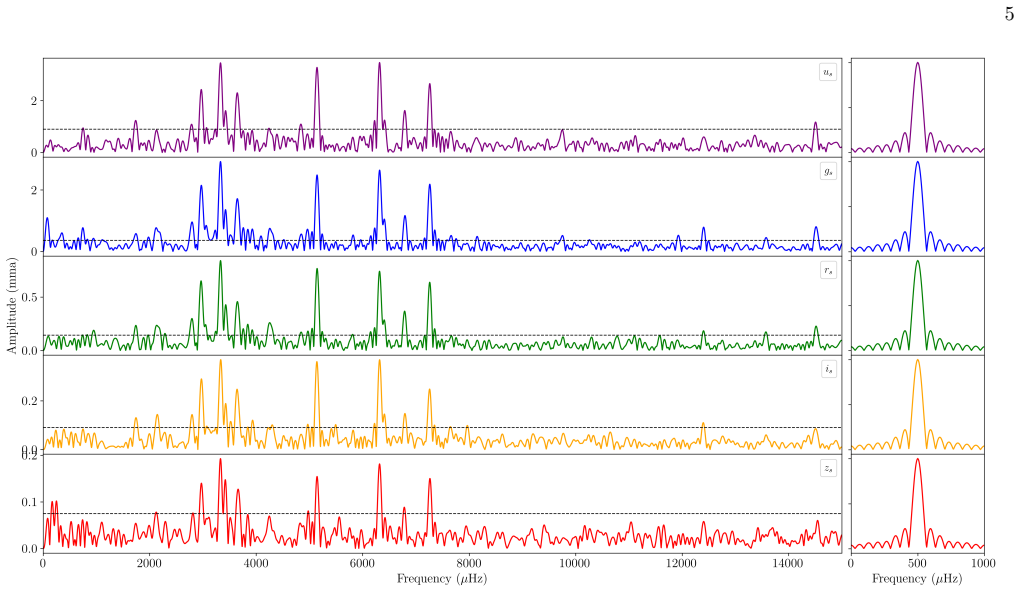
Extended monitoring of WD J0135+5722 over multiple nights, with a frequency resolution better than the roughly 70 µHz of the four-hour HiPERCAM run, would settle the count: the claimed modes should persist at stable frequencies, while the flagged peaks near 3846/3940 µHz, the unresolved feature near 4259 µHz, and the cluster near 6330 µHz would either separate into distinct modes or vanish as artifacts.
Extended reading notes
Core claim
WD J0135+5722, a hydrogen-atmosphere white dwarf with effective temperature 12,415 K and surface gravity log g = 8.9, shows 19 periodic brightness variations with periods between 137 and 1345 seconds, observed in five simultaneous photometric bands plus two additional nights of single-band data. This is the largest number of pulsation modes detected in any ultra-massive white dwarf, surpassing the eight modes of BPM 37093. The star falls inside the ZZ Ceti instability strip, where g-mode pulsations are excited. Combining the observed pulsation frequencies with evolutionary models yields a mass of 1.118 ± 0.002 solar masses if the core is oxygen-neon and 1.135 ± 0.004 solar masses if it is carbon-oxygen, with corresponding crystallized core fractions of 85.6% and 56%; astrometric and photometric mass estimates agree within errors. The paper concludes that a forward period-spacing analysis of the detected modes could discriminate between the two core compositions.
Load-bearing premise
The 19 detected peaks are genuine, distinct pulsation modes rather than noise, aliases, or the same mode appearing at slightly different frequencies in different bands or observing runs.
Editorial extensions
If this is right
- WD J0135+5722 becomes the prime target for ultra-massive white dwarf asteroseismology; a forward period-spacing analysis could distinguish an oxygen-neon core from a carbon-oxygen core.
- If the 19 modes hold, the star offers the first opportunity to measure the crystallized mass fraction of an ultra-massive white dwarf directly from pulsation modes, rather than only from cooling models.
- The detection suggests that other faint ultra-massive DA white dwarfs in the ZZ Ceti instability strip may be similarly pulsation-rich, motivating high-speed multi-band surveys of the remaining candidates.
- The mass and core-composition estimates place the star in the mass range expected for supernova progenitors or merger products, linking its pulsation properties to the evolutionary end states of high-mass stars.
Reading between the lines
- The 19-mode claim should be treated as provisional: a longer baseline is likely to resolve the flagged aliases and close pairs, potentially raising or lowering the accepted mode count.
- If the period-spacing pattern is eventually identified, the star could serve as a clean observational test of competing oxygen-neon and carbon-oxygen evolutionary models for the most massive white dwarfs.
- The technique of using simultaneous multi-band photometry to cross-check faint pulsation signals may generalize to other ZZ Ceti stars near the detection threshold, where single-band observations are ambiguous.
- The two candidate combination frequencies near 12,406 and 14,518 µHz, if confirmed, would provide a direct measure of the convection-zone thermal response in an ultra-massive white dwarf, extending a diagnostic used in lower-mass pulsators.
Signed reviews
Editorial analysis
A structured set of objections, weighed in public.
Referee Report
Summary. The paper reports the discovery of pulsations in the ultra-massive white dwarf WD J0135+5722 using simultaneous five-band HiPERCAM/GTC photometry and two APO runs. It claims 19 pulsation modes, making the star the richest pulsating hydrogen-atmosphere ultra-massive white dwarf known, surpassing BPM 37093 (8 modes). The authors derive the stellar mass from evolutionary tracks, astrometry, and photometry, obtaining M ~ 1.12-1.15 Msun with either ONe or CO cores, and estimate a large crystallized core fraction. They argue this object is a uniquely powerful asteroseismic target for probing the core composition of ultra-massive white dwarfs.
Significance. If the 19-mode claim holds, this is a genuinely important discovery: it would provide a dramatically richer pulsation spectrum than any other ultra-massive white dwarf, enabling the first detailed asteroseismic probe of the core composition (CO vs ONe) and crystallization in this mass regime. The mass determination itself is reassuringly consistent across three independent methods (spectroscopy, astrometry, photometry) and two core compositions, which strengthens the reliability of the stellar parameters. The paper also benefits from using high-quality, multi-band, multi-epoch photometry and from explicitly discussing aliases and unresolved features. However, the central claim depends entirely on the mode-counting criterion, and the paper's own text identifies several peaks as tentative or ambiguous; the headline "richest" claim is not yet supported with the required rigor.
major comments (4)
- [§2.2 and Table 2] The overall frequency solution in Table 2 lists exactly 19 entries, but the text states that "The final list includes 5 significant frequencies from this region" for frequencies beyond 8000 µHz (e.g., 12406, 14518, 18001, 18761 µHz in the g- and r-band subsolutions). These high-frequency peaks are absent from the overall solution, so the total number of claimed modes is ambiguous. Please clarify whether the 19-mode count includes these peaks, and if not, reconcile the statement about 5 significant frequencies with the table.
- [§2.2 and Table 2] Several entries in the overall frequency solution are labeled in the text as possible aliases, unresolved, or single-band detections: the 3846/3940 µHz pair "might be aliases", the 4259 µHz peak is an "unresolved, tooth-shaped peak", and 3468 and 5185 µHz are detected only in one APO dataset (Table 2 lists them under APO 01 September 2024 only). The paper still counts all of these as secure modes when claiming "19 pulsation modes" and "richest". A reduction of even a few modes is not fatal for the headline (BPM 37093 has 8), but the counting criterion must be stated explicitly and the table should flag candidate/secure status so the reader can assess the robustness of the claim.
- [§2.2 frequency resolution] The HiPERCAM run is 4 hours long, giving a Rayleigh frequency resolution of about 70 µHz, yet the overall solution includes the pair 3937.1916 and 3940.6543 µHz, which are separated by only 3.5 µHz. The paper does not explain how these two peaks are resolved from a single 4-hour run or whether they are resolved only in the APO data. Please specify the resolution criterion used for the combined solution and how the NLLS pre-whitening procedure decides between a single peak and two close peaks.
- [§2.2, cluster near 6317 µHz] The text describes a cluster near 6330 µHz with "slight positional variations between the HiPERCAM and APO datasets" and mentions peaks at 6317, 6335, and 6347 µHz that are retained to investigate rotational multiplets. The overall solution includes only 6317.6627 µHz, while the APO-only peaks 6335.8604 and 6347.5099 appear in the per-band solutions but not in the overall list. The relationship among these peaks (same mode shifted, different modes, or artifacts) is crucial for the mode count and should be discussed explicitly with a figure or a clear criterion for inclusion.
minor comments (6)
- [Abstract] The abstract contains a leftover commented LaTeX line ("%In this work, we report the discovery of pulsations in WD~J0135+5722...") that should be removed before publication.
- [Throughout] The star name is inconsistent: the text often writes "WD J0135+572" (missing a final '2') while the title and Tables use "WD J0135+5722". Please standardize.
- [Table 1 and Table 2] The table captions read "T able 1" and "T able 2" in the text; there are also missing or mis-numbered table labels (the paper refers to 'Table 1' twice). These typographical issues should be fixed.
- [§2.2, §3] The quoted log g uncertainty is 0.007 dex in the text and Table 1, but Figure 5 caption and the mass discussion quote log g = 8.90 ± 0.007, while the abstract and Table 1 list 0.007. Please confirm the correct value and keep it consistent.
- [§2.2] The sentence "In the second segment, we focused on between µHz and 8000 µHz" is missing a numeric lower limit; it should read something like "between 2500 µHz and 8000 µHz".
- [§4] The conclusion states "we identified 19 distinct pulsation periods, ranging from ∼137 s (7259 µHz) to 1345 s (743 µHz)", but the abstract also mentions periods as short as ~137 s; the high-frequency candidates (>8000 µHz, i.e., <125 s) are not reflected in this range statement, which is inconsistent with the text in §2.2 reporting 5 significant frequencies beyond 8000 µHz.
Circularity Check
No significant circularity: the pulsation-mode discovery is an independent observational result, and the mass estimates are cross-checked against independent astrometric and photometric methods.
full rationale
The paper's central claim -- detection of 19 pulsation modes in WD J0135+5722, making it the richest pulsating ultra-massive white dwarf -- comes from Fourier analysis of HiPERCAM and APO time-series photometry (Sec. 2.2, Table 2). This is independent of the authors' evolutionary models: no theoretical period list is fitted to the data, and no mode count is derived from the models. The mass estimates in Sec. 3 use LPCODE evolutionary tracks (Camisassa et al. 2019, 2022; De Geronimo et al. 2025 in prep.), which are indeed authored or co-authored by members of the present team, but the mass is not the input to the pulsation claim; moreover it is corroborated by Gaia-based astrometric and photometric masses (M_astr = 1.137-1.145, M_phot = 1.142-1.153) following an independent procedure, and by the earlier Jewett et al. (2024) estimate using Bedard et al. (2020) tracks. The paper's own caveats about aliases (3846/3940 uHz), an unresolved 'tooth-shaped' peak near 4259 uHz, single-band APO detections, and the 4-h HiPERCAM resolution near 70 uHz are robustness concerns about the mode count, not circularity: they do not make the observed frequencies equal to any fitted parameter or model output. No self-citation chain forces the 19-mode conclusion; no uniqueness theorem or ansatz is imported from the authors' prior work to define the result. The claim is therefore self-contained as an observational finding, with any residual fragility residing in data quality and frequency resolution rather than in circular reasoning.
Assumptions & free parameters
assumptions (5)
- domain assumption The atmospheric parameters Teff = 12,415 K and log g = 8.90 for WD J0135+5722, taken from Jewett et al. (2024), are correct.
- domain assumption The 19 detected periodicities are genuine stellar pulsation modes.
- domain assumption The core composition of the star is either ONe or CO, and published evolutionary tracks for these compositions bracket its interior structure.
- domain assumption The LPCODE evolutionary models correctly treat cooling, crystallization, and phase separation for ultra-massive white dwarfs.
- domain assumption The Gaia parallax and photometry, along with standard mass-radius relations and atmospheric models, yield accurate astrometric and photometric masses.
Cite this review
Pith. "Pith review of Discovery of the richest pulsating ultra-massive white dwarf." pith.science (2026). https://pith.science/paper/5NBRGXIR
@misc{pith2026250113661,
  author       = {Pith},
  title        = {Pith review of: Discovery of the richest pulsating ultra-massive white dwarf},
  year         = {2026},
  howpublished = {\url{https://pith.science/paper/5NBRGXIR}},
  note         = {Machine review of arXiv:2501.13661}
}
abstract
The discovery of pulsations in ultra-massive white dwarfs can help to probe their interiors and unveil their core composition and crystallized mass fraction through asteroseismic techniques. To date, the richest pulsating ultra-massive white dwarf known is BPM 37093 with 8 modes detected, for which detailed asteroseismic analysis has been performed in the past. In this work, we report the discovery of 19 pulsation modes in the ultra-massive white dwarf star WD~J0135+5722, making it the richest pulsating hydrogen-atmosphere ultramassive white dwarf known to date. %In this work, we report the discovery of pulsations in WD~J0135+5722, a hydrogen-rich ultra-massive white dwarf observed with the Gran Telescopio Canarias. This object exhibits multi-periodic luminosity variations with periods ranging from 137 to 1345 s, typical of pulsating white dwarfs in the ZZ Ceti instability strip, which is centered at $T_{\rm eff} \sim 12\,000$ K. We estimate the stellar mass of WD J0135+5722 by different methods, resulting in $M_{\star} \sim 1.12-1.14 M_{\odot}$ if the star's core is made of oxygen and neon, or $M_{\star} \sim 1.14-1.15 M_{\odot}$ if the star hosts a carbon oxygen core. Future analysis of the star periods could shed light on the core chemical composition through asteroseismology.
Figures


Figures from the paper (2 more)


Reference graph
Works this paper leans on
-
[1]
, " * write output.state after.block = add.period write newline
ENTRY address archivePrefix author booktitle chapter doi edition editor eprint howpublished institution journal key month number organization pages publisher school series title misctitle type volume year version url label extra.label sort.label short.list INTEGERS output.state before.all mid.sentence after.sentence after.block FUNCTION init.state.consts ...
-
[2]
write newline
" write newline "" before.all 'output.state := FUNCTION format.url url empty "" new.block "" url * "" * if FUNCTION format.eprint eprint empty "" archivePrefix empty "" archivePrefix "arXiv" = new.block " " eprint * " " * new.block " " eprint * " " * if if if FUNCTION format.doi doi empty "" " " doi * " " * if FUNCTION format.pid doi empty eprint empty ur...
-
[3]
N/N7 ˙2tt: ]*|S)R +g♉ b;j G2K X^Wrq k 3v.ͥ9ܥd 5 8/X?S jk
thebibliography [1] 20pt to REFERENCES 6pt =0pt -12pt 10pt plus 3pt =0pt =0pt =1pt plus 1pt =0pt =0pt -12pt =13pt plus 1pt =20pt =13pt plus 1pt \@M =10000 =-1.0em =0pt =0pt 0pt =0pt =1.0em @enumiv\@empty 10000 10000 `\.\@m \@noitemerr \@latex@warning Empty `thebibliography' environment \@ifnextchar \@reference \@latexerr Missing key on reference command E...
-
[4]
Althaus , L. G., C \'o rsico , A. H., Isern , J., & Garc \' a-Berro , E. 2010, , 18, 471, 10.1007/s00159-010-0033-1
-
[5]
G., De Ger \'o nimo , F., C \'o rsico , A., Torres , S., & Garc \' a-Berro , E
Althaus , L. G., De Ger \'o nimo , F., C \'o rsico , A., Torres , S., & Garc \' a-Berro , E. 2017, , 597, A67, 10.1051/0004-6361/201629909
-
[6]
Althaus , L. G., Serenelli , A. M., Panei , J. A., et al. 2005, , 435, 631, 10.1051/0004-6361:20041965
-
[7]
G., Gil-Pons , P., C \'o rsico , A
Althaus , L. G., Gil-Pons , P., C \'o rsico , A. H., et al. 2021, , 646, A30, 10.1051/0004-6361/202038930
-
[8]
2020, , 901, 93, 10.3847/1538-4357/abafbe
B \'e dard , A., Bergeron , P., Brassard , P., & Fontaine , G. 2020, , 901, 93, 10.3847/1538-4357/abafbe
Show all 53 references
-
[9]
2019, , 876, 67, 10.3847/1538-4357/ab153a
Bergeron , P., Dufour , P., Fontaine , G., et al. 2019, , 876, 67, 10.3847/1538-4357/ab153a
2019 doi
-
[10]
K., & Ruiz , M
Bergeron , P., Leggett , S. K., & Ruiz , M. T. 2001, , 133, 413, 10.1086/320356
2001 doi
-
[11]
T., & Leggett , S
Bergeron , P., Ruiz , M. T., & Leggett , S. K. 1997, , 108, 339, 10.1086/312955
1997 doi
-
[12]
2016, Information Bulletin on Variable Stars, 6184, 1
Bognar , Z., & Sodor , A. 2016, Information Bulletin on Variable Stars, 6184, 1. 1610.07470
2016 arXiv
-
[13]
1993, , 271, 482
Breger , M., Stich , J., Garrido , R., et al. 1993, , 271, 482
1993
-
[14]
Brickhill , A. J. 1975, , 170, 405, 10.1093/mnras/170.2.405
1975 doi
- [15]
-
[16]
M., C \'o rsico , A
Calcaferro , L. M., C \'o rsico , A. H., Uzundag , M., et al. 2024, , 691, A194, 10.1051/0004-6361/202450582
2024 doi
-
[17]
E., Althaus , L
Camisassa , M. E., Althaus , L. G., Koester , D., et al. 2022, , 511, 5198, 10.1093/mnras/stac348
2022 doi
-
[18]
E., Althaus , L
Camisassa , M. E., Althaus , L. G., C \'o rsico , A. H., et al. 2019, , 625, A87, 10.1051/0004-6361/201833822
2019 doi
-
[19]
H., Althaus , L
C \'o rsico , A. H., Althaus , L. G., Miller Bertolami , M. M., & Kepler , S. O. 2019 a , , 27, 7, 10.1007/s00159-019-0118-4
2019 doi
-
[20]
H., De Ger \'o nimo , F
C \'o rsico , A. H., De Ger \'o nimo , F. C., Camisassa , M. E., & Althaus , L. G. 2019 b , , 632, A119, 10.1051/0004-6361/201936698
2019 doi
-
[21]
J., et al
Curd , B., Gianninas , A., Bell , K. J., et al. 2017, , 468, 239, 10.1093/mnras/stx320
2017 doi
-
[22]
C., C \'o rsico , A
De Ger \'o nimo , F. C., C \'o rsico , A. H., Althaus , L. G., Wachlin , F. C., & Camisassa , M. E. 2019, , 621, A100, 10.1051/0004-6361/201833789
2019 doi
-
[23]
C., Miller Bertolami , M
De Ger \'o nimo , F. C., Miller Bertolami , M. M., Battich , T., et al. 2024, , 975, 259, 10.3847/1538-4357/ad7d8e
2024 doi
-
[24]
S., Bezawada , N., Black , M., et al
Dhillon , V. S., Bezawada , N., Black , M., et al. 2021, , 507, 350, 10.1093/mnras/stab2130
2021 doi
-
[25]
1981, , 102, 375
Dolez , N., & Vauclair , G. 1981, , 102, 375
1981
-
[26]
2008, PASP, 120, 1043, 10.1086/592788
Fontaine , G., & Brassard , P. 2008, PASP, 120, 1043, 10.1086/592788
2008 doi
-
[27]
P., Tremblay , P.-E., G \"a nsicke , B
Gentile Fusillo , N. P., Tremblay , P.-E., G \"a nsicke , B. T., et al. 2019, , 482, 4570, 10.1093/mnras/sty3016
2019 doi
-
[28]
1999, , 511, 904, 10.1086/306705
Goldreich , P., & Wu , Y. 1999, , 511, 904, 10.1086/306705
1999 doi
-
[29]
A., Vanderbosch , Z
Guidry , J. A., Vanderbosch , Z. P., Hermes , J. J., et al. 2021, , 912, 125, 10.3847/1538-4357/abee68
2021 doi
-
[30]
J., Kepler , S
Hermes , J. J., Kepler , S. O., Castanheira , B. G., et al. 2013, , 771, L2, 10.1088/2041-8205/771/1/L2
2013 doi
-
[31]
J., G \"a nsicke , B
Hermes , J. J., G \"a nsicke , B. T., Kawaler , S. D., et al. 2017, , 232, 23, 10.3847/1538-4365/aa8bb5
2017 doi
-
[32]
A., Tremblay , P
Hollands , M. A., Tremblay , P. E., G \"a nsicke , B. T., et al. 2020, Nature Astronomy, 4, 663, 10.1038/s41550-020-1028-0
2020 doi
-
[33]
2024, , 974, 12, 10.3847/1538-4357/ad6905
Jewett , G., Kilic , M., Bergeron , P., et al. 2024, , 974, 12, 10.3847/1538-4357/ad6905
2024 doi
-
[34]
M., Torres , S., Rebassa-Mansergas , A., et al
Jim \'e nez-Esteban , F. M., Torres , S., Rebassa-Mansergas , A., et al. 2023, , 518, 5106, 10.1093/mnras/stac3382
2023 doi
- [35]
-
[36]
2020, , 898, 84, 10.3847/1538-4357/ab9b8d
Kilic , M., Bergeron , P., Kosakowski , A., et al. 2020, , 898, 84, 10.3847/1538-4357/ab9b8d
2020 doi
-
[37]
H., Moss , A
Kilic , M., C \'o rsico , A. H., Moss , A. G., et al. 2023, , 522, 2181, 10.1093/mnras/stad1113
2023 doi
-
[38]
2005, Communications in Asteroseismology, 146, 53, 10.1553/cia146s53
Lenz , P., & Breger , M. 2005, Communications in Asteroseismology, 146, 53, 10.1553/cia146s53
2005 doi
-
[39]
2018, , 863, 82, 10.3847/1538-4357/aad0f4
Luan , J., & Goldreich , P. 2018, , 863, 82, 10.3847/1538-4357/aad0f4
2018 doi
-
[40]
S., Montgomery , M
Metcalfe , T. S., Montgomery , M. H., & Kanaan , A. 2004, , 605, L133, 10.1086/420884
2004 doi
-
[41]
Montgomery , M. H. 2005, , 633, 1142, 10.1086/466511
2005 doi
-
[42]
O., Chen \'e , A.-N., et al
Nitta , A., Kepler , S. O., Chen \'e , A.-N., et al. 2016, IAU Focus Meeting, 29B, 493, 10.1017/S1743921316005962
2016 doi
-
[43]
Norris , J. E. 2004, , 612, L25, 10.1086/423986
2004 doi
- [44]
-
[45]
D., Kepler , S
Romero , A. D., Kepler , S. O., Hermes , J. J., et al. 2022, , 511, 1574, 10.1093/mnras/stac093
2022 doi
-
[46]
2022, , 988, 1, 10.1016/j.physrep.2022.09.001
Saumon , D., Blouin , S., & Tremblay , P.-E. 2022, , 988, 1, 10.1016/j.physrep.2022.09.001
2022 doi
-
[47]
2007, , 476, 893, 10.1051/0004-6361:20078132
Siess , L. 2007, , 476, 893, 10.1051/0004-6361:20078132
2007 doi
-
[48]
2010, , 512, A10, 10.1051/0004-6361/200913556
---. 2010, , 512, A10, 10.1051/0004-6361/200913556
2010 doi
-
[49]
2023, , 269, 32, 10.3847/1538-4365/acfbe4
Sowicka , P., Handler , G., Jones , D., et al. 2023, , 269, 32, 10.3847/1538-4365/acfbe4
2023 doi
-
[50]
C., C \'o rsico , A
Uzundag , M., De Ger \'o nimo , F. C., C \'o rsico , A. H., et al. 2023, , 526, 2846, 10.1093/mnras/stad2776
2023 doi
-
[51]
2020, , 160, 252, 10.3847/1538-3881/abbe20
Vincent , O., Bergeron , P., & Lafreni \`e re , D. 2020, , 160, 252, 10.3847/1538-3881/abbe20
2020 doi
-
[52]
E., & Kepler , S
Winget , D. E., & Kepler , S. O. 2008, , 46, 157, 10.1146/annurev.astro.46.060407.145250
2008
-
[53]
E., van Horn , H
Winget , D. E., van Horn , H. M., Tassoul , M., et al. 1982, , 252, L65, 10.1086/183721
1982 doi
Reviewed August 10, 2026 · model on record in the stance chip above.
Discussion (0). Continue with ORCID to comment.