REVIEW 2 major objections 5 minor 12 references
Multi-Level Fusion Graph Neural Network for Molecule Property Prediction
T0 review · 2 major / 5 minor · reviewed 2026-08-06 · deepseek-v4-flash
Pith's one-line read MLFGNN fuses local and global graph views with molecular fingerprints, and the authors report that it outperforms prior state-of-the-art models on eight of the ten benchmarks, with best RMSE on ESOL, FreeSolv, Lipophilicity, PDBbind-C and…
desk verdict Strong regression results on standard benchmarks, but the 'consistently outperforms' claim is not supported by the paper's own classification table. read the letter →
The pith
A machine-rendered reading of the paper's core claim, the machinery that carries it, and where it could break.
The reading
What carries the argument
The machinery is the fusion pipeline itself. The local branch is a graph attention network (neighbor attention followed by a GRU update) kept deliberately shallow to preserve substructure locality. The global branch is a transformer whose self-attention is modified by adding the normalized molecular adjacency matrix with learnable balancing scalars, and whose LayerNorm is replaced by Dynamic Tanh (a learnable $\gamma \tanh(\alpha x) + \beta$ squashing function). An adaptive mixture layer with a learned scalar blends the two node-level streams, a virtual super node attends over atoms and is updated by a GRU to produce the graph-level embedding, and a final cross-attention layer fuses that embedding with an MLP-projected concatenation of Morgan, PubChem, and ErG fingerprints. The adjacency-injected attention and the cross-attention layer are what carry the paper's claims of long-range awareness and task-relevant feature selection.
What would settle it
Re-run MLFGNN and the strongest named baselines (for example HimGNN, FP-GNN, ResGAT, and D-MPNN) in a single codebase with identical 8:1:1 splits, identical scaffold or random seeds, and identical early stopping, and compare RMSE and ROC-AUC on the same ten datasets. If MLFGNN no longer ranks first on most of those benchmarks, the paper's central claim of consistent state-of-the-art performance collapses.
Extended reading notes
Core claim
The central claim is that jointly modeling intra-graph hierarchy and inter-modal complementarity improves molecular property prediction beyond what either graph structure or fingerprint descriptors provide alone. In the paper's telling, a shallow GAT stack captures local substructure, an adjacency-augmented Graph Transformer with DyT layers captures long-range dependencies, an adaptive mixture layer balances the two, a virtual super node with attention and GRU update summarizes the molecule, and a cross-attention layer filters fingerprint information against the graph representation. The reported outcome is consistent top performance: best RMSE on all five regression datasets (ESOL, FreeSolv, Lipophilicity, PDBbind-C, PDBbind-R) and best ROC-AUC on the scaffold-split classification datasets BACE and BBBP. The authors further claim the resulting attention is interpretable, concentrating on rings and functional groups known to drive permeability and lipophilicity.
Load-bearing premise
The load-bearing premise is that the baseline numbers copied from earlier papers are directly comparable to MLFGNN's runs; if those numbers came from different data splits, training protocols, seeds, or evaluation code, the reported margins could be artifacts of protocol mismatch rather than real model gains.
Editorial extensions
If this is right
- On the reported benchmarks, MLFGNN becomes the strongest non-pretrained architecture, so practitioners can adopt it as a default for solubility, solvation, lipophilicity, and binding-affinity regression.
- The learned scalar in the adaptive mixture layer means the model can weight local versus global information per dataset, removing the need to hand-pick that balance for each task.
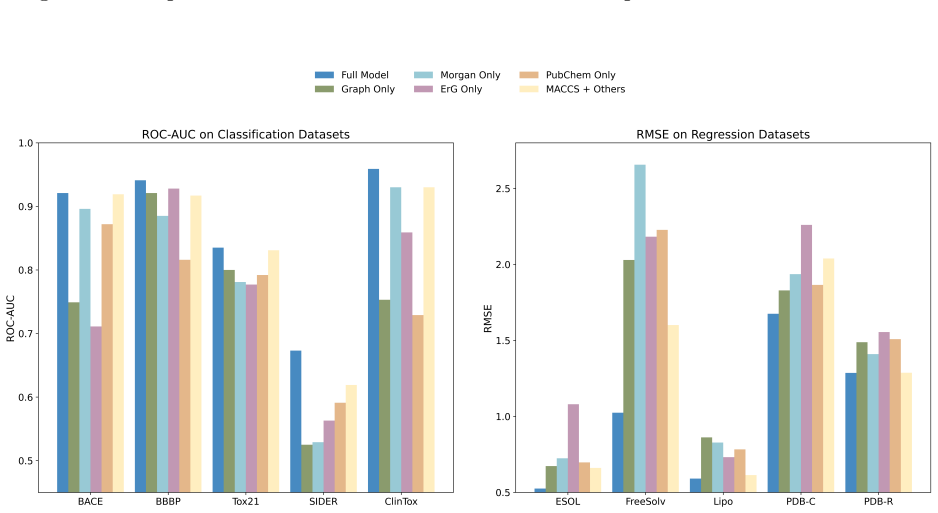
- The ablations attribute the gains to the combination of both graph branches and all three fingerprints, so removing any one of these parts should degrade performance.
- The attention visualizations indicate that the model's predictions concentrate on chemically meaningful substructures, which supports using the method for hypothesis generation about structure-property relationships.
Reading between the lines
- Because the paper's baseline table mixes numbers from several earlier papers without a matched re-run, the true size of the improvement is untested; a matched benchmark could easily shrink the reported margins.
- The same fusion recipe—graph attention plus adjacency-augmented transformer plus descriptor cross-attention—could transfer to other graph prediction tasks such as materials property prediction or protein-ligand affinity, where local and global structure both matter.
- A natural test is to score the model on matched molecular pair (activity cliff) splits; if the claimed local-plus-global sensitivity is real, it should beat baselines specifically on cliff pairs, not just on random splits.
- The use of DyT in place of LayerNorm is reported to be effective in the Supporting Information; one could isolate DyT's contribution versus standard normalization to see whether the transformer's structure or the normalization choice drives the gains.
Editorial analysis
A structured set of objections, weighed in public.
Referee Report
Summary. The paper proposes MLFGNN, a hybrid architecture for molecular property prediction that fuses a GAT-based local stream, a Graph Transformer-based global stream with adjacency-matrix injection and Dynamic Tanh normalization, and a fingerprint branch via cross-attention. The model is evaluated on ten MoleculeNet datasets (five classification, five regression), reporting ROC-AUC and RMSE, and the authors claim that MLFGNN consistently outperforms state-of-the-art methods in both task types.
Significance. If the regression results hold under matched baselines, MLFGNN provides a competitive architecture for regression benchmarks, reporting the lowest RMSE on ESOL, FreeSolv, Lipophilicity, PDBbind-C and PDBbind-R. The paper also includes ablation studies and attention-based visualizations that support the value of combining local and global graph information with fingerprint features. However, the classification part of the central claim is not supported by the paper's own Table 4, and the baseline numbers are taken from heterogeneous literature sources rather than from controlled reruns, so the strength of the claimed gains is currently uncertain.
major comments (2)
- [Abstract and Performance analysis (Table 4)] The abstract's claim that MLFGNN 'consistently outperforms state-of-the-art methods in both classification and regression tasks' is contradicted by the results in Table 4. Across the five classification benchmarks, MLFGNN is the top performer only on BACE (0.900) and BBBP (0.934); on SIDER it places second behind MolGT (0.647 vs. 0.654), on Tox21 it is below AttentiveFP (0.818 vs. 0.860) and LineEvo (0.835), and on ClinTox it is below PremuNet (0.892 vs. 0.992) and MolTailor (0.923). The Results section itself concedes 'the highest performance on two out of five datasets and ranks second on one.' This is an internal inconsistency: even if every baseline number were perfectly matched, the classification portion of the 'consistently outperforms' claim would still be false. The claim should be revised to a more defensible statement, for example that MLFGNN achieves state-of-the-art or competitive results on regression while showing strong performance on selected classification datasets.
- [Baselines models and Implementation details] The baseline metrics are not obtained through a matched evaluation protocol. The text states that baseline results were taken from HimGNN, FP-GNN, and the original papers, while the MLFGNN results come from the authors' own runs with hyperparameters tuned on Lipophilicity and then transferred. Because the baselines may have used different data splits (random vs. scaffold), different seeds, different early-stopping criteria, and different evaluation code, the reported improvements on regression tables, especially the relatively small gains in PDBbind-R (1.330 vs. 1.338), could be artifacts of protocol differences rather than genuine model improvements. To support the state-of-the-art claim, the authors should either rerun at least the closest baselines under the same splits, seeds, and evaluation harness, or restrict their claims to comparisons against previously published numbers and clearly state this limitation.
minor comments (5)
- [Molecular graph Representation, Eq. (12)-(16)] The notation is overloaded: in Eq. (12), n denotes the number of GAT layers and H_i denotes an n×d node embedding matrix, while in Eq. (16) H_i denotes the embedding of atom i and the summation goes over atoms. Please use distinct symbols for layer index, atom index, and matrix dimensions to avoid ambiguity.
- [Molecular graph Representation, after Eq. (11)] The sentence 'We have done relevant experiments and put them in the Supporting Information' is unverifiable because no Supporting Information section or file is provided with the manuscript. Please include the supplementary material or remove the reference.
- [Ablation study] The ablation discussion in Figures 2-4 is qualitative; the figures do not show numerical values or error bars in the manuscript. The claim that certain configurations 'consistently outperforms' the alternatives should be supported by explicit numbers with standard deviations, and ideally by significance tests.
- [Implementation details and Table 3] The text says hyperparameter configurations were trained with 5 random seeds during Bayesian optimization, but later says the final model was trained with 10 random seeds. Please clarify how the final results in Tables 4-6 relate to the 5-seed and 10-seed runs, and report the number of seeds used for each table consistently.
- [Table 5] The baseline entries for D-MPNN and FP-GNN on the PDBbind datasets report standard deviations of exactly 0.000. Such zero variance is implausible for neural network training and should be explained or replaced with the actual variability reported in the original sources.
Circularity Check
No meaningful circularity: the paper's claims are empirical benchmark results, not a derivation that reduces to its own inputs.
full rationale
MLFGNN is an empirical architecture paper: the model is trained on standard MoleculeNet benchmark datasets using conventional supervised learning, and the target properties are external labels, not quantities defined in terms of the model or its hyperparameters. The strongest claimed results are benchmark tables, and while baseline numbers are imported from other papers (raising a comparability concern, not a circularity concern), the MLFGNN numbers themselves come from training and evaluating the model on the data. There is no self-citation chain serving as load-bearing evidence, no imported uniqueness theorem, and no equation in which a predicted quantity is constructed from the fitted parameters by definition. The closest issue is that hyperparameters are tuned on Lipophilicity and the same dataset is reported as a headline regression result, but this is a model-selection statistical concern, not constructional circularity: the reported value is still a held-out test evaluation of a model trained on property labels. The paper therefore contains no derivation step that is equivalent to its input by construction.
Assumptions & free parameters
free parameters (2)
- Model hyperparameters (N, h, dk, Gout, Gd, Fd, Ad) =
N=3, h=19, dk=96, Gout=110, Gd=0.50, Fd=0.05, Ad=0.50 (Table 3, iteration 17)
- Learnable fusion gates (alpha in Eq 15, lambda_a and lambda_b in Eq 10) =
trained end-to-end
assumptions (4)
- domain assumption MoleculeNet benchmark labels and splits as provided by Wu et al. are correct and comparable across methods.
- domain assumption Baseline metrics reported in prior papers were produced under the same data splits and evaluation protocol.
- domain assumption RDKit-derived atomic and bond features plus the Morgan, PubChem and ErG fingerprints sufficiently encode the chemistry needed for the target tasks.
- domain assumption Validation-based model selection does not leak test information.
Cite this review
Pith. "Pith review of Multi-Level Fusion Graph Neural Network for Molecule Property Prediction." pith.science (2026). https://pith.science/paper/5OJ3KQQL
@misc{pith2026250703430,
  author       = {Pith},
  title        = {Pith review of: Multi-Level Fusion Graph Neural Network for Molecule Property Prediction},
  year         = {2026},
  howpublished = {\url{https://pith.science/paper/5OJ3KQQL}},
  note         = {Machine review of arXiv:2507.03430}
}
read the original abstract
Accurate prediction of molecular properties is essential in drug discovery and related fields. However, existing graph neural networks (GNNs) often struggle to simultaneously capture both local and global molecular structures. In this work, we propose a Multi-Level Fusion Graph Neural Network (MLFGNN) that integrates Graph Attention Networks and a novel Graph Transformer to jointly model local and global dependencies. In addition, we incorporate molecular fingerprints as a complementary modality and introduce a mechanism of interaction between attention to adaptively fuse information across representations. Extensive experiments on multiple benchmark datasets demonstrate that MLFGNN consistently outperforms state-of-the-art methods in both classification and regression tasks. Interpretability analysis further reveals that the model effectively captures task-relevant chemical patterns, supporting the usefulness of multi-level and multi-modal fusion in molecular representation learning.
Figures


Figures from the paper (8 more)


Reference graph
Works this paper leans on
-
[1]
(1) Luttens, A.; Cabeza de Vaca, I.; Sparring, L.; Brea, J.; Martínez, A. L.; Kahlous, N. A.; Radchenko, D. S.; Moroz, Y. S.; Loza, M. I.; Norinder, U.; others Rapid traversal of vast chemical space using machine learning-guided docking screens.Nature Computational Science 2025, 1–12. (2) Gusev, F.; Gutkin, E.; Kurnikova, M. G.; Isayev, O. Active learning...
work page 2025
-
[3]
(30) Cai, H.; Zhang, H.; Zhao, D.; Wu, J.; Wang, L. FP-GNN: a versatile deep learning architecture for enhanced molecular property prediction.Briefings in bioinformatics 2022, 23, bbac408. (31) Teng, S.; Yin, C.; Wang, Y.; Chen, X.; Yan, Z.; Cui, L.; Wei, L. MolFPG: multi-level fingerprint-based graph transformer for accurate and robust drug toxicity pred...
work page 2022
-
[25]
(8) Hirschberg, J.; Manning, C. D. Advances in natural language processing.Science 2015, 349, 261–266. (9) Wang, J.; Cao, D.; Tang, C.; Xu, L.; He, Q.; Yang, B.; Chen, X.; Sun, H.; Hou, T. DeepAtomicCharge: a new graph convolutional network-based architecture for accurate prediction of atomic charges.Briefings in bioinformatics 2021, 22, bbaa183. (10) Guo...
work page 2015
-
[30]
(20) Xu, K.; Hu, W.; Leskovec, J.; Jegelka, S. How powerful are graph neural networks? arXiv preprint arXiv:1810.00826 2018, (21) Qiao, J.; Jin, J.; Wang, D.; Teng, S.; Zhang, J.; Yang, X.; Liu, Y.; Wang, Y.; Cui, L.; Zou, Q.; others A self-conformation-aware pre-training framework for molecular prop- erty prediction with substructure interpretability.Nat...
arXiv 2018
-
[32]
(28) Maziarka, Ł.; Danel, T.; Mucha, S.; Rataj, K.; Tabor, J.; Jastrzębski, S. Molecule attention transformer.arXiv preprint arXiv:2002.08264 2020, (29) Maziarka, Ł.; Majchrowski, D.; Danel, T.; Gaiński, P.; Tabor, J.; Podolak, I.; Mork- isz, P.; Jastrzębski, S. Relative molecule self-attention transformer.Journal of Chem- informatics 2024, 16,
arXiv 2002
-
[34]
MolTailor: tailoring chemical molecular representation to specific tasks via text prompts
(48) Guo, H.; Zhao, S.; Wang, H.; Du, Y.; Qin, B. MolTailor: tailoring chemical molecular representation to specific tasks via text prompts. Proceedings of the AAAI Conference on Artificial Intelligence. 2024; pp 18144–18152. (49) Zhang, T.; Ren, Y.; Hou, C.; Lv, H.; Zhang, X. Molecular graph representation learning 41 integrating large language models wi...
arXiv 2024
-
[72]
Junction tree variational autoencoder for molecular graph generation
(12) Jin, W.; Barzilay, R.; Jaakkola, T. Junction tree variational autoencoder for molecular graph generation. International conference on machine learning. 2018; pp 2323–2332. (13) Zhu, Z.; Yao, Z.; Qi, G.; Mazur, N.; Yang, P.; Cong, B. Associative learning mechanism for drug-target interaction prediction.CAAI Transactions on Intelligence Technology 2023...
arXiv 2018
-
[287]
(26) Brody, S.; Alon, U.; Yahav, E
(25) Velickovic, P.; Cucurull, G.; Casanova, A.; Romero, A.; Lio, P.; Bengio, Y.; others Graph attention networks.stat 2017, 1050, 10–48550. (26) Brody, S.; Alon, U.; Yahav, E. How attentive are graph attention networks?arXiv preprint arXiv:2105.14491 2021, (27) Yun, S.; Jeong, M.; Kim, R.; Kang, J.; Kim, H. J. Graph transformer networks.Ad- vances in neu...
arXiv 2017
Show all 12 references
-
[2021]
(11) Li, B.; Su, S.; Zhu, C.; Lin, J.; Hu, X.; Su, L.; Yu, Z.; Liao, K.; Chen, H
2021; pp 2559–2567. (11) Li, B.; Su, S.; Zhu, C.; Lin, J.; Hu, X.; Su, L.; Yu, Z.; Liao, K.; Chen, H. A deep learn- ing framework for accurate reaction prediction and its application on high-throughput experimentation data.Journal of Cheminformatics 2023, 15,
2021
-
[3388]
(43) Ma, H.; Bian, Y.; Rong, Y.; Huang, W.; Xu, T.; Xie, W.; Ye, G.; Huang, J
(42) Wang, Z.; Liu, M.; Luo, Y.; Xu, Z.; Xie, Y.; Wang, L.; Cai, L.; Qi, Q.; Yuan, Z.; Yang, T.; others Advanced graph and sequence neural networks for molecular property prediction and drug discovery.Bioinformatics 2022, 38, 2579–2586. (43) Ma, H.; Bian, Y.; Rong, Y.; Huang, ...
2022
-
[4382]
A pre-trained multi-representation fusion network for molecular property prediction.Information Fusion 2024, 103, 102092
(22) Zhang, H.; Wu, J.; Liu, S.; Han, S. A pre-trained multi-representation fusion network for molecular property prediction.Information Fusion 2024, 103, 102092. 38 (23) Chen, R.; Li, C.; Wang, L.; Liu, M.; Chen, S.; Yang, J.; Zeng, X. Pretraining graph transformer for molecu...
2024
-
[8760]
Empirical evaluation of gated recurrent neural networks on sequence modeling.arXiv preprint arXiv:1412.3555 2014, (39) Zhu, J.; Chen, X.; He, K.; LeCun, Y.; Liu, Z
(38) Chung, J.; Gulcehre, C.; Cho, K.; Bengio, Y. Empirical evaluation of gated recurrent neural networks on sequence modeling.arXiv preprint arXiv:1412.3555 2014, (39) Zhu, J.; Chen, X.; He, K.; LeCun, Y.; Liu, Z. Transformers without normalization. Proceedings of the Compute...
2014 arXiv
Reviewed August 6, 2026 · model on record in the stance chip above.
Discussion (0). Continue with ORCID to comment.