REVIEW 3 major objections 2 minor 1 cited by
Tiny Brains, Giant Impact: Uncovering the Keystone Neurons of LLM with Just a Few Prompts
T0 review · 3 major / 2 minor · reviewed 2026-06-30 · grok-4.3
Pith's one-line read A sparse set of keystone neurons, isolated by consistent high activation across tasks, controls core capabilities in open-weight Transformers.
desk verdict The paper isolates a sparse cross-task activation subset whose removal collapses behavior and whose selective fine-tuning matches full updates, but the causal link to unique criticality still needs matched controls. read the letter →
The pith
A machine-rendered reading of the paper's core claim, the machinery that carries it, and where it could break.
The reading
What carries the argument
Keystone neurons: the sparse subset isolated by high cross-task activation strength whose removal collapses model behavior.
What would settle it
An experiment in which randomly chosen neurons matched for activation strength produce the same collapse upon removal, or in which keystone neurons selected from one prompt set fail to affect held-out tasks.
Extended reading notes
Core claim
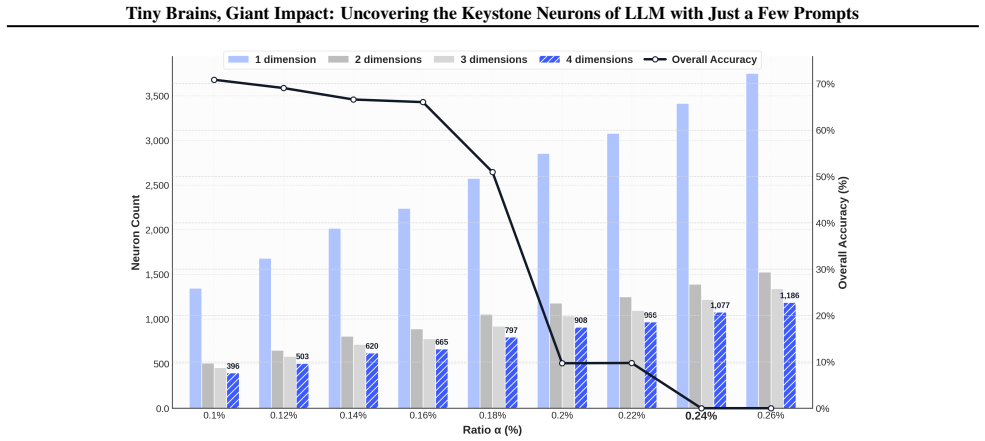
Across a wide range of open-weight Transformers, a subset of neurons remains consistently highly activated during inference across tasks of multiple capability dimensions. By probing along the cross-task activation strength, an extremely sparse subset is isolated, whose removal causes a collapse in model behavior, which we term keystone neurons. Our analysis reveals that keystone neurons are a stable and intrinsic neuron subset of the model that is largely established during pretraining. The parameters associated with these neurons are tightly calibrated during the training process, and their precise values are critical for the capabilities of the model.
Load-bearing premise
The high cross-task activation and the performance collapse after removal are caused by these neurons being uniquely critical rather than by the selection method itself or by other components that were not isolated.
Editorial extensions
If this is right
- Updating only keystone neurons during supervised fine-tuning yields task gains comparable to or better than full-parameter fine-tuning.
- Targeted updates on keystone neurons better preserve performance in other capability dimensions.
- Keystone neurons form a stable intrinsic subset largely established during pretraining.
- Precise parameter values tied to these neurons are critical for overall model capabilities.
Reading between the lines
- The finding could enable prompt-only auditing of model internals without full retraining.
- It raises the possibility that similar sparse critical subsets exist in non-Transformer architectures.
- Targeted editing of keystone neurons might support more precise capability addition or removal.
- The approach could extend to measuring how pretraining data distributions shape these stable subsets.
Editorial analysis
A structured set of objections, weighed in public.
Referee Report
Summary. The manuscript claims that across open-weight Transformers, a sparse subset of neurons exhibits consistently high activation across tasks spanning multiple capability dimensions. By selecting on cross-task activation strength, an extremely sparse 'keystone' subset is isolated whose removal produces behavioral collapse; these neurons are argued to be stable, intrinsic, and largely fixed during pretraining with tightly calibrated parameters. The work further proposes a supervised fine-tuning procedure that updates only the keystone neurons and reports task gains comparable or superior to full-parameter fine-tuning while better preserving performance on unrelated capabilities despite modifying far fewer parameters.
Significance. If the empirical claims are substantiated with appropriate controls and quantitative results, the identification of a stable, pretraining-established sparse subset whose targeted update yields efficient adaptation would be a notable contribution to LLM interpretability and parameter-efficient fine-tuning. The potential reduction in modified parameters while maintaining or improving multi-task performance could influence both mechanistic understanding and practical deployment.
major comments (3)
- [Abstract / probing procedure] Abstract and method description: the central claim that ablation of the cross-task high-activation subset produces collapse specifically because of the cross-task consistency property (rather than generic high-activation or magnitude properties) requires explicit controls. No description is given of matched-cardinality random subsets, single-task activation subsets, or gradient-based importance baselines that would isolate the selection criterion; without these, the observed drop cannot be attributed to the stated mechanism.
- [Abstract / fine-tuning section] Abstract and experiments: the fine-tuning claim that updating only keystone neurons yields 'comparable or even better' task gains while better preserving other capabilities is presented without any reported metrics, number of updated parameters, task suite, baseline comparisons, or ablation on the selection threshold. These quantitative details are load-bearing for the practical contribution and are absent from the provided text.
- [Abstract / analysis of pretraining stability] Abstract: the assertion that keystone neurons are 'largely established during pretraining' and that their 'precise values are critical' is stated without supporting evidence such as activation statistics across training checkpoints, parameter-sensitivity analysis, or comparison to randomly initialized models. This is central to the intrinsic-property claim yet unsupported in the given material.
minor comments (2)
- [Method] Notation for activation strength and the precise definition of the 'probing along the cross-task activation strength' procedure should be formalized with an equation or algorithm box to allow replication.
- [Introduction] The term 'keystone neurons' is introduced without reference to prior related concepts in the interpretability literature (e.g., 'critical neurons' or 'superposition' studies); a brief related-work paragraph would clarify novelty.
Simulated Author's Rebuttal
We thank the referee for their valuable feedback on our manuscript. We address each of the major comments point by point below, and we will make the necessary revisions to strengthen the empirical support for our claims.
read point-by-point responses
-
Referee: [Abstract / probing procedure] Abstract and method description: the central claim that ablation of the cross-task high-activation subset produces collapse specifically because of the cross-task consistency property (rather than generic high-activation or magnitude properties) requires explicit controls. No description is given of matched-cardinality random subsets, single-task activation subsets, or gradient-based importance baselines that would isolate the selection criterion; without these, the observed drop cannot be attributed to the stated mechanism.
Authors: We agree that the manuscript requires these controls to properly attribute the effect to the cross-task consistency. The current version does not provide descriptions of matched-cardinality random subsets, single-task activation subsets, or gradient-based baselines. We will add these controls to the probing procedure and results in the revised manuscript. revision: yes
-
Referee: [Abstract / fine-tuning section] Abstract and experiments: the fine-tuning claim that updating only keystone neurons yields 'comparable or even better' task gains while better preserving other capabilities is presented without any reported metrics, number of updated parameters, task suite, baseline comparisons, or ablation on the selection threshold. These quantitative details are load-bearing for the practical contribution and are absent from the provided text.
Authors: The referee is correct that the provided manuscript text does not include the specific quantitative metrics, parameter counts, task suite details, baseline comparisons, or threshold ablations for the fine-tuning experiments. We will revise the experiments section to report these details comprehensively, including a table with the metrics and ablations. revision: yes
-
Referee: [Abstract / analysis of pretraining stability] Abstract: the assertion that keystone neurons are 'largely established during pretraining' and that their 'precise values are critical' is stated without supporting evidence such as activation statistics across training checkpoints, parameter-sensitivity analysis, or comparison to randomly initialized models. This is central to the intrinsic-property claim yet unsupported in the given material.
Authors: We acknowledge that the current manuscript does not include the supporting evidence such as activation statistics across checkpoints, parameter-sensitivity analysis, or comparisons to random initialization. We will perform and incorporate these analyses into the revised version to support the claims about pretraining stability and parameter criticality. revision: yes
Circularity Check
No circularity: empirical selection and ablation claims remain independent of inputs
full rationale
The paper contains no equations, derivations, fitted parameters presented as predictions, or self-citation chains that reduce claims to their own inputs by construction. Keystone neuron identification proceeds from cross-task activation measurements followed by ablation experiments; these are observable, falsifiable steps whose outcomes are not forced by the selection criterion itself. The fine-tuning proposal similarly updates a pre-identified subset without renaming or smuggling prior results. No load-bearing step matches any enumerated circularity pattern.
Assumptions & free parameters
invented entities (1)
-
keystone neurons
Cite this review
Pith. "Pith review of Tiny Brains, Giant Impact: Uncovering the Keystone Neurons of LLM with Just a Few Prompts." pith.science (2026). https://pith.science/paper/5OYWEVLQ
@misc{pith2026260524846,
  author       = {Pith},
  title        = {Pith review of: Tiny Brains, Giant Impact: Uncovering the Keystone Neurons of LLM with Just a Few Prompts},
  year         = {2026},
  howpublished = {\url{https://pith.science/paper/5OYWEVLQ}},
  note         = {Machine review of arXiv:2605.24846}
}
read the original abstract
Large language models (LLMs) display strong comprehensive abilities, yet the internal mechanisms that support these behaviors remain insufficiently understood. In this work, we show that across a wide range of open-weight Transformers, a subset of neurons remains consistently highly activated during inference across tasks of multiple capability dimensions. By probing along the cross-task activation strength, an extremely sparse subset is isolated, whose removal causes a collapse in model behavior, which we term keystone neurons. Our analysis reveals that keystone neurons are a stable and intrinsic neuron subset of the model that is largely established during pretraining. The parameters associated with these neurons are tightly calibrated during the training process, and their precise values are critical for the capabilities of the model. Building on these insights, we propose a supervised fine-tuning approach that updates only keystone neurons, achieving task gains comparable to or even better than full-parameter fine-tuning while better preserving performance in other capability dimensions, despite modifying a much smaller number of parameters.
Figures


Figures from the paper (2 more)


Forward citations
Cited by 1 Pith paper
-
AgentOPSD: Recursive Self-Distillation for Agentic Reinforcement Learning
AgentOPSD converts sparse outcome rewards into turn-level credit by recursively accumulating self-distillation evidence in log-odds space, beating GRPO on most agentic benchmarks.
Reference graph
Works this paper leans on
-
[1]
" write newline "" before.all 'output.state := FUNCTION n.dashify 't := "" t empty not t #1 #1 substring "-" = t #1 #2 substring "--" = not "--" * t #2 global.max substring 't := t #1 #1 substring "-" = "-" * t #2 global.max substring 't := while if t #1 #1 substring * t #2 global.max substring 't := if while FUNCTION format.date year duplicate empty "emp...
-
[2]
Tom B. Brown, Benjamin Mann, Nick Ryder, Melanie Subbiah, Jared Kaplan, Prafulla Dhariwal, Arvind Neelakantan, Pranav Shyam, Girish Sastry, Amanda Askell, Sandhini Agarwal, Ariel Herbert-Voss, Gretchen Krueger, Tom Henighan, Rewon Child, Aditya Ramesh, Daniel M. Ziegler, Jeffrey Wu, Clemens Winter, Christopher Hesse, Mark Chen, Eric Sigler, Mateusz Litwin...
work page 2020
-
[3]
Aakanksha Chowdhery, Sharan Narang, Jacob Devlin, Maarten Bosma, Gaurav Mishra, Adam Roberts, Paul Barham, Hyung Won Chung, Charles Sutton, Sebastian Gehrmann, Parker Schuh, Kensen Shi, Sasha Tsvyashchenko, Joshua Maynez, Abhishek Rao, Parker Barnes, Yi Tay, Noam Shazeer, Vinodkumar Prabhakaran, Emily Reif, Nan Du, Ben Hutchinson, Reiner Pope, James Bradb...
work page 2022
- [4]
-
[5]
Sparks of artificial general intelligence: Early experiments with gpt-4, 2023
Sébastien Bubeck, Varun Chandrasekaran, Ronen Eldan, Johannes Gehrke, Eric Horvitz, Ece Kamar, Peter Lee, Yin Tat Lee, Yuanzhi Li, Scott Lundberg, Harsha Nori, Hamid Palangi, Marco Tulio Ribeiro, and Yi Zhang. Sparks of artificial general intelligence: Early experiments with gpt-4, 2023
work page 2023
-
[6]
Solving quantitative reasoning problems with language models, 2022
Aitor Lewkowycz, Anders Andreassen, David Dohan, Ethan Dyer, Henryk Michalewski, Vinay Ramasesh, Ambrose Slone, Cem Anil, Imanol Schlag, Theo Gutman-Solo, Yuhuai Wu, Behnam Neyshabur, Guy Gur-Ari, and Vedant Misra. Solving quantitative reasoning problems with language models, 2022
work page 2022
-
[7]
Yujia Li, David Choi, Junyoung Chung, Nate Kushman, Julian Schrittwieser, Rémi Leblond, Tom Eccles, James Keeling, Felix Gimeno, Agustin Dal Lago, Thomas Hubert, Peter Choy, Cyprien de Masson d’Autume, Igor Babuschkin, Xinyun Chen, Po-Sen Huang, Johannes Welbl, Sven Gowal, Alexey Cherepanov, James Molloy, Daniel J. Mankowitz, Esme Sutherland Robson, Pushm...
work page 2022
-
[8]
A survey of large language models, 2025
Wayne Xin Zhao, Kun Zhou, Junyi Li, Tianyi Tang, Xiaolei Wang, Yupeng Hou, Yingqian Min, Beichen Zhang, Junjie Zhang, Zican Dong, Yifan Du, Chen Yang, Yushuo Chen, Zhipeng Chen, Jinhao Jiang, Ruiyang Ren, Yifan Li, Xinyu Tang, Zikang Liu, Peiyu Liu, Jian-Yun Nie, and Ji-Rong Wen. A survey of large language models, 2025
work page 2025
Show all 53 references
-
[9]
Deepseek-r1 incentivizes reasoning in llms through reinforcement learning
DeepSeek - AI. Deepseek-r1 incentivizes reasoning in llms through reinforcement learning. page 633–638, September 2025
2025
-
[10]
Longcat-flash-thinking-2601 technical report, 2026
Meituan LongCat Team. Longcat-flash-thinking-2601 technical report, 2026
2026
-
[11]
On generative agents in recommendation, 2024
An Zhang, Yuxin Chen, Leheng Sheng, Xiang Wang, and Tat-Seng Chua. On generative agents in recommendation, 2024
2024
-
[12]
Internalizing safety understanding in large reasoning models via verification, 2026
Yi Zhang, Yuxin Chen, Leheng Sheng, Dongcheng Zhang, Chaochao Lu, Xiang Wang, and An Zhang. Internalizing safety understanding in large reasoning models via verification, 2026
2026
-
[13]
L-mtp: Leap multi-token prediction beyond adjacent context for large language models, 2025
Xiaohao Liu, Xiaobo Xia, Weixiang Zhao, Manyi Zhang, Xianzhi Yu, Xiu Su, Shuo Yang, See-Kiong Ng, and Tat-Seng Chua. L-mtp: Leap multi-token prediction beyond adjacent context for large language models, 2025
2025
-
[14]
Unlocking emergent modularity in large language models, 2024
Zihan Qiu, Zeyu Huang, and Jie Fu. Unlocking emergent modularity in large language models, 2024
2024
-
[15]
Switch transformers: Scaling to trillion parameter models with simple and efficient sparsity, 2022
William Fedus, Barret Zoph, and Noam Shazeer. Switch transformers: Scaling to trillion parameter models with simple and efficient sparsity, 2022
2022
-
[16]
St-moe: Designing stable and transferable sparse expert models, 2022
Barret Zoph, Irwan Bello, Sameer Kumar, Nan Du, Yanping Huang, Jeff Dean, Noam Shazeer, and William Fedus. St-moe: Designing stable and transferable sparse expert models, 2022
2022
-
[17]
Towards monosemanticity: Decomposing language models with dictionary learning, 2023
Tom Bricken, Nelson Elhage, Chris Olah, Catherine Olsson, Nicholas Schiefer, Ben Mann, and Dario Amodei. Towards monosemanticity: Decomposing language models with dictionary learning, 2023. Transformer Circuits Thread
2023
-
[18]
Llm modularity: The separability of capabilities in large language models, 2023
Nicky Pochinkov. Llm modularity: The separability of capabilities in large language models, 2023. LessWrong / AI Alignment Forum
2023
-
[19]
Language-specific neurons: The key to multilingual capabilities in large language models, 2024
Tianyi Tang, Wenyang Luo, Haoyang Huang, Dongdong Zhang, Xiaolei Wang, Xin Zhao, Furu Wei, and Ji-Rong Wen. Language-specific neurons: The key to multilingual capabilities in large language models, 2024
2024
-
[20]
The emergence of abstract thought in large language models beyond any language, 2025
Yuxin Chen, Yiran Zhao, Yang Zhang, An Zhang, Kenji Kawaguchi, Shafiq Joty, Junnan Li, Tat-Seng Chua, Michael Qizhe Shieh, and Wenxuan Zhang. The emergence of abstract thought in large language models beyond any language, 2025
2025
-
[21]
How do large language models handle multilingualism?, 2024
Yiran Zhao, Wenxuan Zhang, Guizhen Chen, Kenji Kawaguchi, and Lidong Bing. How do large language models handle multilingualism?, 2024
2024
-
[22]
Mechanistic understanding of language models in syntactic code completion, 2025
Samuel Miller, Daking Rai, and Ziyu Yao. Mechanistic understanding of language models in syntactic code completion, 2025
2025
-
[23]
Interpreting arithmetic mechanism in large language models through comparative neuron analysis, 2024
Zeping Yu and Sophia Ananiadou. Interpreting arithmetic mechanism in large language models through comparative neuron analysis, 2024
2024
-
[24]
Ran Song, Shizhu He, Shuting Jiang, Yantuan Xian, Shengxiang Gao, Kang Liu, and Zhengtao Yu. Does large language model contain task-specific neurons? In Yaser Al-Onaizan, Mohit Bansal, and Yun-Nung Chen, editors, Proceedings of the 2024 Conference on Empirical Methods in Natur...
2024
-
[25]
Not all parameters are created equal: Smart isolation boosts fine-tuning performance, 2025 a
Yao Wang, Di Liang, and Minlong Peng. Not all parameters are created equal: Smart isolation boosts fine-tuning performance, 2025 a
2025
-
[26]
The lottery ticket hypothesis: Finding sparse, trainable neural networks, 2019
Jonathan Frankle and Michael Carbin. The lottery ticket hypothesis: Finding sparse, trainable neural networks, 2019
2019
-
[27]
Investigating pattern neurons in urban time series forecasting
Chengxin Wang, Yiran Zhao, Shaofeng Cai, and Gary Tan. Investigating pattern neurons in urban time series forecasting. In The Thirteenth International Conference on Learning Representations, ICLR 2025, Singapore, April 24-28, 2025 . OpenReview.net, 2025 b
2025
-
[28]
Qwen3 technical report, 2025
An Yang, Anfeng Li, Baosong Yang, Beichen Zhang, Binyuan Hui, Bo Zheng, Bowen Yu, Chang Gao, Chengen Huang, Chenxu Lv, Chujie Zheng, Dayiheng Liu, Fan Zhou, Fei Huang, Feng Hu, Hao Ge, Haoran Wei, Huan Lin, Jialong Tang, and 40 others. Qwen3 technical report, 2025
2025
-
[29]
Qwen2.5 technical report, 2025
Qwen, :, An Yang, Baosong Yang, Beichen Zhang, Binyuan Hui, Bo Zheng, Bowen Yu, Chengyuan Li, Dayiheng Liu, Fei Huang, Haoran Wei, Huan Lin, Jian Yang, Jianhong Tu, Jianwei Zhang, Jianxin Yang, Jiaxi Yang, Jingren Zhou, Junyang Lin, Kai Dang, Keming Lu, Keqin Bao, Kexin Yang, ...
2025
-
[30]
Gemma 3 technical report
Gemma Team . Gemma 3 technical report. CoRR, abs/2503.19786, 2025
2025 arXiv
-
[31]
The llama 3 herd of models, 2024
Llama3 Team . The llama 3 herd of models, 2024
2024
-
[32]
Albert Q. Jiang, Alexandre Sablayrolles, Antoine Roux, Arthur Mensch, Blanche Savary, Chris Bamford, Devendra Singh Chaplot, Diego de las Casas, Emma Bou Hanna, Florian Bressand, Gianna Lengyel, Guillaume Bour, Guillaume Lample, Lélio Renard Lavaud, Lucile Saulnier, Marie-Anne...
2024
-
[33]
Measuring massive multitask language understanding, 2021 a
Dan Hendrycks, Collin Burns, Steven Basart, Andy Zou, Mantas Mazeika, Dawn Song, and Jacob Steinhardt. Measuring massive multitask language understanding, 2021 a
2021
-
[34]
Measuring mathematical problem solving with the math dataset, 2021 b
Dan Hendrycks, Collin Burns, Saurav Kadavath, Akul Arora, Steven Basart, Eric Tang, Dawn Song, and Jacob Steinhardt. Measuring mathematical problem solving with the math dataset, 2021 b
2021
-
[35]
Is your code generated by chatgpt really correct? rigorous evaluation of large language models for code generation, 2023
Jiawei Liu, Chunqiu Steven Xia, Yuyao Wang, and Lingming Zhang. Is your code generated by chatgpt really correct? rigorous evaluation of large language models for code generation, 2023
2023
-
[36]
Language models are multilingual chain-of-thought reasoners, 2022
Freda Shi, Mirac Suzgun, Markus Freitag, Xuezhi Wang, Suraj Srivats, Soroush Vosoughi, Hyung Won Chung, Yi Tay, Sebastian Ruder, Denny Zhou, Dipanjan Das, and Jason Wei. Language models are multilingual chain-of-thought reasoners, 2022
2022
-
[37]
Colin Raffel, Noam Shazeer, Adam Roberts, Katherine Lee, Sharan Narang, Michael Matena, Yanqi Zhou, Wei Li, and Peter J. Liu. Exploring the limits of transfer learning with a unified text-to-text transformer, 2023
2023
-
[38]
Documenting large webtext corpora: A case study on the colossal clean crawled corpus, 2021
Jesse Dodge, Maarten Sap, Ana Marasović, William Agnew, Gabriel Ilharco, Dirk Groeneveld, Margaret Mitchell, and Matt Gardner. Documenting large webtext corpora: A case study on the colossal clean crawled corpus, 2021
2021
-
[39]
Pointer sentinel mixture models, 2016
Stephen Merity, Caiming Xiong, James Bradbury, and Richard Socher. Pointer sentinel mixture models, 2016
2016
-
[40]
Openmathinstruct-2: Accelerating ai for math with massive open-source instruction data, 2024
Shubham Toshniwal, Wei Du, Ivan Moshkov, Branislav Kisacanin, Alexan Ayrapetyan, and Igor Gitman. Openmathinstruct-2: Accelerating ai for math with massive open-source instruction data, 2024
2024
-
[41]
Wildguard: Open one-stop moderation tools for safety risks, jailbreaks, and refusals of llms, 2024
Seungju Han, Kavel Rao, Allyson Ettinger, Liwei Jiang, Bill Yuchen Lin, Nathan Lambert, Yejin Choi, and Nouha Dziri. Wildguard: Open one-stop moderation tools for safety risks, jailbreaks, and refusals of llms, 2024
2024
-
[42]
Training verifiers to solve math word problems, 2021
Karl Cobbe, Vineet Kosaraju, Mohammad Bavarian, Mark Chen, Heewoo Jun, Lukasz Kaiser, Matthias Plappert, Jerry Tworek, Jacob Hilton, Reiichiro Nakano, Christopher Hesse, and John Schulman. Training verifiers to solve math word problems, 2021
2021
-
[43]
O lympiad B ench: A challenging benchmark for promoting AGI with olympiad-level bilingual multimodal scientific problems
Chaoqun He, Renjie Luo, Yuzhuo Bai, Shengding Hu, Zhen Thai, Junhao Shen, Jinyi Hu, Xu Han, Yujie Huang, Yuxiang Zhang, Jie Liu, Lei Qi, Zhiyuan Liu, and Maosong Sun. O lympiad B ench: A challenging benchmark for promoting AGI with olympiad-level bilingual multimodal scientifi...
2024
-
[44]
AIME 2024 , 2024
HuggingFaceH4 . AIME 2024 , 2024. Dataset, accessed 2025-11-21
2024
-
[45]
Gshard: Scaling giant models with conditional computation and automatic sharding, 2020
Dmitry Lepikhin, HyoukJoong Lee, Yuanzhong Xu, Dehao Chen, Orhan Firat, Yanping Huang, Maxim Krikun, Noam Shazeer, and Zhifeng Chen. Gshard: Scaling giant models with conditional computation and automatic sharding, 2020
2020
-
[46]
Emergent modularity in pre-trained transformers, 2023
Zhengyan Zhang, Zhiyuan Zeng, Yankai Lin, Chaojun Xiao, Xiaozhi Wang, Xu Han, Zhiyuan Liu, Ruobing Xie, Maosong Sun, and Jie Zhou. Emergent modularity in pre-trained transformers, 2023
2023
-
[47]
Smith, and Luke Zettlemoyer
Suchin Gururangan, Mike Lewis, Ari Holtzman, Noah A. Smith, and Luke Zettlemoyer. Demix layers: Disentangling domains for modular language modeling, 2021
2021
-
[48]
Are neural nets modular? inspecting functional modularity through differentiable weight masks, 2021
Róbert Csordás, Sjoerd van Steenkiste, and Jürgen Schmidhuber. Are neural nets modular? inspecting functional modularity through differentiable weight masks, 2021
2021
-
[49]
Recurrent independent mechanisms, 2020
Anirudh Goyal, Alex Lamb, Jordan Hoffmann, Shagun Sodhani, Sergey Levine, Yoshua Bengio, and Bernhard Schölkopf. Recurrent independent mechanisms, 2020
2020
-
[50]
Knowledge neurons in pretrained transformers, 2022
Damai Dai, Li Dong, Yaru Hao, Zhifang Sui, Baobao Chang, and Furu Wei. Knowledge neurons in pretrained transformers, 2022
2022
-
[51]
Transformer feed-forward layers are key-value memories, 2021
Mor Geva, Roei Schuster, Jonathan Berant, and Omer Levy. Transformer feed-forward layers are key-value memories, 2021
2021
-
[52]
Locating and editing factual associations in gpt, 2023
Kevin Meng, David Bau, Alex Andonian, and Yonatan Belinkov. Locating and editing factual associations in gpt, 2023
2023
-
[53]
The lottery ticket hypothesis for pre-trained bert networks, 2020
Tianlong Chen, Jonathan Frankle, Shiyu Chang, Sijia Liu, Yang Zhang, Zhangyang Wang, and Michael Carbin. The lottery ticket hypothesis for pre-trained bert networks, 2020
2020
Reviewed June 30, 2026 · model on record in the stance chip above.
Discussion (0). Continue with ORCID to comment.