REVIEW 3 major objections 5 minor 63 references
Open-Set Living Need Prediction with Large Language Models
T0 review · 3 major / 5 minor · reviewed 2026-08-07 · deepseek-v4-flash
Pith's one-line read PIGEON claims open-set, free-text living-need predictions, backed by behavioral retrieval and Maslow-guided refinement, recall consumed life services better than closed-set classifiers.
desk verdict A well-engineered open-set need prediction system whose evaluation proxy leaves the headline gain underdetermined; deserves review but needs a generic-query control. read the letter →
The pith
A machine-rendered reading of the paper's core claim, the machinery that carries it, and where it could break.
The reading
What carries the argument
The machine that carries the argument is a four-stage pipeline. (1) Behavioral embedding learning: a GNN with user, spatiotemporal-context, and need nodes, trained with a Bayesian Personalized Ranking loss, gives embeddings that retrieve the user's own and similar users' past consumption records by cosine similarity. (2) In-context LLM prediction: the retrieved records, with time and location, are fed to an LLM that produces an unrestricted need sentence. (3) Maslow-guided refinement: the LLM builds a three-tier living-needs framework from Maslow's hierarchy and the platform's service list, then rewrites the initial prediction to align with genuine need types while staying flexible. (4) Fine-tuned embedding recall: a pretrained text embedding model is fine-tuned with triplet loss on pairs of refined need descriptions and the services actually consumed, then used to rank life services for any new need description. The paper also distills the two-step LLM pipeline into instruction-tuning pairs so that smaller LLMs can do the whole prediction in one inference step.
What would settle it
Take PIGEON's fine-tuned recall module and feed it, as queries, the closed-set need labels and generic popular need phrases of similar length, keeping the service corpus and rankings unchanged; if either matches PIGEON's Recall@20 while free-text queries add little, the reported gains would come from the recall module rather than open-set need prediction.
Extended reading notes
Core claim
On its own terms, the paper's discovery is that an open-set formulation with LLM generation beats the closed-set formulation on the task that matters: recalling life services. PIGEON learns behavioral embeddings for users and spatiotemporal contexts through a graph neural network, retrieves the most relevant personal and similar-user consumption records, and prompts an LLM to write a free-text need. It then prompts the same LLM to refine that description against a three-tier living-needs framework built from Maslow's hierarchy plus the platform's service list. For evaluation and application, a fine-tuned text embedding model maps the refined need description to life services. Across all metrics on the Beijing and Shanghai datasets, PIGEON is reported to outperform the best closed-set baseline, for example reaching Recall@10 of 0.10503 versus 0.07268 in Shanghai, with relative dataset-level gains of 15.18% and 23.55% and an average improvement of 19.37% over closed-set approaches.
Load-bearing premise
The load-bearing premise is that the service a user actually consumed is a faithful and complete label for the user's living need, so retrieving that service correctly is a valid measure of how good a predicted need is.
Editorial extensions
If this is right
- Because need descriptions are free text, the system can express vague needs such as 'relaxation after work' and composite needs such as 'lunch, and eating with family at home' that a fixed category set cannot encode, so recall is no longer bounded by the category list.
- The behavioral retrieval module carries much of the personalization: ablations in the paper drop Beijing Recall@10 from 0.10405 to 0.02770 when all history records are removed, showing that LLM common sense alone is far from enough.
- Both refinements matter: removing Maslow-guided refinement or replacing the fine-tuned recall model with an unfine-tuned embedding model each lowers performance, so the reported gain is spread across the pipeline rather than coming from one component.
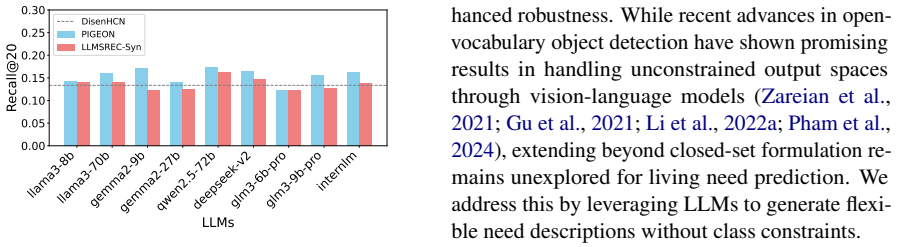
- Instruction tuning closes most of the gap to a large proprietary LLM: a fine-tuned 3B open model approaches the teacher model's Recall@20 and a 7B model surpasses it, which makes the approach deployable at lower latency.
- With prefix caching and an optimized inference engine, the paper reports P99 latency under 0.75 seconds at batch size 256 and roughly 10 million queries per hour on eight GPUs, placing the system in the feasible near-line deployment regime.
Reading between the lines
- If this result holds, living-need prediction on any platform with consumption logs—travel, entertainment, fitness—can be recast as the same pipeline: behavior-graph retrieval, free-text LLM generation, taxonomy-guided refinement, and embedding-based recall.
- A conservative reading is that the headline 19.37% measures service recall, not need-prediction accuracy; the evaluation's proxy, using the consumed service as ground truth, is the paper's own load-bearing choice, and a direct test would compare predicted need sentences against human-written need labels.
- The open-set versus closed-set comparison is entangled with the recall module: PIGEON and the LLM baselines share the fine-tuned recall model, so an ablation that feeds closed-set labels through the same recall module would isolate how much of the gain comes from free-text prediction versus embedding fine-tuning.
- The Maslow refinement step is the most portable and least isolated piece; one could validate it independently by asking humans to judge whether refined predictions are more need-like than unrefined ones across different service taxonomies and languages.
Editorial analysis
A structured set of objections, weighed in public.
Referee Report
Summary. The paper redefines living-need prediction on a life-service platform as an open-set problem: given a user, time, and location, an LLM generates an unrestricted textual need description. The proposed system, PIGEON, retrieves relevant personal and similar-user historical records via a GNN-based behavioral embedding, refines the LLM's initial prediction with a Maslow-inspired need hierarchy, and maps the resulting flexible description to life services through a fine-tuned text-embedding recall module. Experiments on Meituan data from Beijing and Shanghai compare PIGEON against closed-set CTR/GNN baselines and LLM-based open-set baselines, using Recall@K and NDCG@K of the actually consumed service as the proxy metric. The paper also reports human evaluation of prediction quality, ablation studies, instruction tuning for smaller LLMs, and latency optimizations for deployment.
Significance. If the evaluation is accepted as valid, the paper demonstrates a substantive practical advance: it shows that open-ended LLM-generated need descriptions can outperform fixed-category predictions on downstream life-service recall, with consistent gains across two large real-world datasets, multiple LLM backbones, and several ablations. The work is unusually thorough in operational details: it releases code, fixes the inference temperature, reports five-run averages, provides human evaluation, includes cost and latency analyses, and evaluates a range of open- and closed-source LLMs. The central idea of replacing closed-set need categories with an open-set, LLM-generated description whose quality is measured through a learned recall module is timely and industrially relevant. The main risk is that the quantitative evaluation may be measuring query informativeness rather than need-prediction correctness, because the only automatic label is the consumed service and no generic-query control is provided.
major comments (3)
- [§4.3, §5.1, Table 2] The central evaluation claim rests on the assumption that the consumed life service is a valid ground-truth signal for the user's living need. The paper states this proxy in §4.3, but it never validates the proxy or reports a control for query informativeness. The fine-tuned recall model in §3.3 is trained on need-like text paired with consumed services, so a 20-word PIGEON description may retrieve the correct service simply because it is more lexically specific than a 1–2 word closed-set category. Without a control using generic paraphrases, random need descriptions, or category-only queries under the same recall model, the relative gains in Table 2 do not establish that the predicted need is more accurate; they may only show that longer, service-related text is easier to embed close to service names. I request this control and a direct human evaluation of whether predicted needs match the user's actual need on a labeled subset.
- [§5.1, Table 2, Abstract] The headline numbers are not auditable from the reported table. The abstract claims an average improvement of 19.37%, and §5.1 claims relative improvements of 15.18% and 23.55% on Beijing and Shanghai, but the per-metric best-baseline relative gains computed from Table 2 differ substantially (e.g., Beijing Recall@10 ≈ 12.6%, Recall@20 ≈ 24.5%, NDCG@10 ≈ 6.3%, NDCG@20 ≈ 11.1%; Shanghai Recall@10 ≈ 44.5%, Recall@20 ≈ 20.8%, NDCG@10 ≈ 36.5%, NDCG@20 ≈ 33.5%). The paper should define the exact aggregation formula, report per-metric relative improvements, and state whether the comparison is against the single best baseline or the best baseline per metric.
- [§4.2, Table 2] Section 4.2 states that each reported result is the average of 5 runs, but Table 2 contains no error bars, confidence intervals, or standard deviations. The paired t-test statement (p < 0.05) is not sufficient to assess variability, and several baseline differences are small (e.g., Beijing NDCG@10: PIGEON 0.05124 vs. DisenHCN 0.04820). Please report per-metric standard deviations or confidence intervals in Table 2, and ideally the distribution of the relative gains across runs.
minor comments (5)
- [§A.2 vs. §A.3] There is an inconsistency in the hyperparameter settings: §A.2 states that the optimal values for Ks and Kp are 5 and 10, respectively, while §A.3 lists Kp=5 and Ks=10. The main text and Figure 8 labels should be checked and aligned, or the typo corrected.
- [§3.2 vs. §5.2 vs. §A.7] The desired output length is stated as 'around 20 words' in §3.2 and the appendix example, but §5.2 says human-evaluated LLM outputs were constrained to approximately 10 words. Since the human evaluation is used to support claims about specificity and information density, the exact constraint should be stated consistently.
- [Figure 3] The figure axis label 'Information Density2.0' appears garbled; the intended label is likely 'Information Density'.
- [§8] The Limitations section does not mention the unvalidated ground-truth proxy (consumed service as need label) or the absence of a generic-query control; adding this limitation would make the evaluation caveats explicit.
- [Table 1] The table reports 14 locations while the text in §4.1 says locations are grouped into 13 categories; please reconcile the two numbers.
Circularity Check
No significant circularity: the central claim is supported by a time-split extrinsic recall evaluation, and self-citations are contextual rather than load-bearing.
full rationale
The paper's derivation chain is self-contained. The central claim—that PIGEON's open-set need descriptions improve life-service recall—is evaluated by a time-split protocol in which the fine-tuned text-embedding recall module (Section 3.3) is trained on historical (u,t,l,n,s) tuples with a triplet loss and then applied to held-out test queries from PIGEON and baselines. The test labels are the actually consumed services, and no test label is used to fit the GNN encoder or the recall module, so this is standard supervised extrinsic evaluation rather than a prediction of a fitted value. The Maslow-guided refinement is presented as a prompt-level design choice, not derived from the evaluation metric. Self-citations (Lan et al. 2023; Li et al. 2022b; Chen et al. 2022) appear only in problem positioning and dataset-split conventions and are not load-bearing for the reported superiority. One caveat outside circularity is that the headline 'average of 19.37%' relative improvement is not directly reproducible from Table 2 by simple per-metric averaging, which is an auditability concern; in addition, the recall model is fine-tuned on PIGEON-style query distributions, which raises a comparison-fairness concern for open-set baselines. Neither concern reduces the result to its own inputs by construction, and no equation or fitted parameter is renamed as a prediction.
Assumptions & free parameters
free parameters (3)
- Kp (number of personal historical records retrieved) =
5
- Ks (number of similar users' historical records retrieved) =
10
- Triplet margin alpha in recall loss =
0.5
assumptions (4)
- domain assumption The actually consumed life service is a valid ground-truth label for the user's living need at that time and location.
- domain assumption LLM role-play with retrieved personal and similar-user records produces need descriptions that reflect the user's actual preferences.
- domain assumption Maslow's hierarchy is an appropriate organizing framework for aligning predictions with life service needs.
- domain assumption A fine-tuned text embedding model with triplet loss can generalize from training queries to unseen flexible need descriptions and retrieve relevant services.
Cite this review
Pith. "Pith review of Open-Set Living Need Prediction with Large Language Models." pith.science (2026). https://pith.science/paper/5P6TGTMI
@misc{pith2026250602713,
  author       = {Pith},
  title        = {Pith review of: Open-Set Living Need Prediction with Large Language Models},
  year         = {2026},
  howpublished = {\url{https://pith.science/paper/5P6TGTMI}},
  note         = {Machine review of arXiv:2506.02713}
}
read the original abstract
Living needs are the needs people generate in their daily lives for survival and well-being. On life service platforms like Meituan, user purchases are driven by living needs, making accurate living need predictions crucial for personalized service recommendations. Traditional approaches treat this prediction as a closed-set classification problem, severely limiting their ability to capture the diversity and complexity of living needs. In this work, we redefine living need prediction as an open-set classification problem and propose PIGEON, a novel system leveraging large language models (LLMs) for unrestricted need prediction. PIGEON first employs a behavior-aware record retriever to help LLMs understand user preferences, then incorporates Maslow's hierarchy of needs to align predictions with human living needs. For evaluation and application, we design a recall module based on a fine-tuned text embedding model that links flexible need descriptions to appropriate life services. Extensive experiments on real-world datasets demonstrate that PIGEON significantly outperforms closed-set approaches on need-based life service recall by an average of 19.37%. Human evaluation validates the reasonableness and specificity of our predictions. Additionally, we employ instruction tuning to enable smaller LLMs to achieve competitive performance, supporting practical deployment.
Figures


Figures from the paper (6 more)




Reference graph
Works this paper leans on
-
[1]
Wentao Bao, Qi Yu, and Yu Kong. 2022. Opental: Towards open set temporal action localization. In Proceedings of the IEEE/CVF Conference on Computer Vision and Pattern Recognition, pages 2979--2989
work page 2022
-
[2]
Abhijit Bendale and Terrance E Boult. 2016. Towards open set deep networks. In Proceedings of the IEEE conference on computer vision and pattern recognition, pages 1563--1572
work page 2016
-
[3]
Huanhuan Cao, Jinhu Jiang, Lih-Bin Oh, Hao Li, Xiuwu Liao, and Zhiwu Chen. 2013. A maslow's hierarchy of needs analysis of social networking services continuance. Journal of Service Management, 24(2):170--190
work page 2013
-
[4]
Tianqi Chen and Carlos Guestrin. 2016. Xgboost: A scalable tree boosting system. In Proceedings of the 22nd acm sigkdd international conference on knowledge discovery and data mining, pages 785--794
2016
-
[5]
Zhilong Chen, Xiaochong Lan, Jinghua Piao, Yunke Zhang, and Yong Li. 2022. A mixed-methods analysis of the algorithm-mediated labor of online food deliverers in china. Proceedings of the ACM on Human-Computer Interaction, 6(CSCW2):1--24
work page 2022
-
[6]
Jie Feng, Yuwei Du, Jie Zhao, and Yong Li. 2025 a . Agentmove: A large language model based agentic framework for zero-shot next location prediction. In Proceedings of the 2025 Annual Conference of the Nations of the Americas Chapter of the Association for Computational Linguistics
work page 2025
-
[7]
Jie Feng, Tianhui Liu, Yuwei Du, Siqi Guo, Yuming Lin, and Yong Li. 2025 b . Citygpt: Empowering urban spatial cognition of large language models. Proceedings of the 31st ACM SIGKDD Conference on Knowledge Discovery and Data Mining
work page 2025
-
[8]
Jie Feng, Jinwei Zeng, Qingyue Long, Hongyi Chen, Jie Zhao, Yanxin Xi, Zhilun Zhou, Yuan Yuan, Shengyuan Wang, Qingbin Zeng, et al. 2025 c . A survey of large language model-powered spatial intelligence across scales: Advances in embodied agents, smart cities, and earth science. arXiv:2504.09848
arXiv 2025
Show all 63 references
-
[9]
Jie Feng, Jun Zhang, Tianhui Liu, Xin Zhang, Tianjian Ouyang, Junbo Yan, Yuwei Du, Siqi Guo, and Yong Li. 2025 d . Citybench: Evaluating the capabilities of large language models for urban tasks. Proceedings of the 31st ACM SIGKDD Conference on Knowledge Discovery and Data Mining
2025
-
[10]
Chen Gao, Xiaochong Lan, Nian Li, Yuan Yuan, Jingtao Ding, Zhilun Zhou, Fengli Xu, and Yong Li. 2024. Large language models empowered agent-based modeling and simulation: A survey and perspectives. Humanities and Social Sciences Communications, 11(1):1--24
2024
-
[11]
Chen Gao, Xiaochong Lan, Zhihong Lu, Jinzhu Mao, Jinghua Piao, Huandong Wang, Depeng Jin, and Yong Li. 2023. S3: Social-network simulation system with large language model-empowered agents. arXiv preprint arXiv:2307.14984
2023 arXiv
-
[12]
Xiuye Gu, Tsung-Yi Lin, Weicheng Kuo, and Yin Cui. 2021. Open-vocabulary object detection via vision and language knowledge distillation. arXiv preprint arXiv:2104.13921
2021 arXiv
-
[13]
Sylvain Gugger, Lysandre Debut, Thomas Wolf, Philipp Schmid, Zachary Mueller, Sourab Mangrulkar, Marc Sun, and Benjamin Bossan. 2022. Accelerate: Training and inference at scale made simple, efficient and adaptable. https://github.com/huggingface/accelerate
2022
-
[14]
Huifeng Guo, Ruiming Tang, Yunming Ye, Zhenguo Li, and Xiuqiang He. 2017. Deepfm: a factorization-machine based neural network for ctr prediction. arXiv preprint arXiv:1703.04247
2017 arXiv
-
[15]
Qianyue Hao, Jingyang Fan, Fengli Xu, Jian Yuan, and Yong Li. 2024. Hlm-cite: Hybrid language model workflow for text-based scientific citation prediction. arXiv preprint arXiv:2410.09112
2024 arXiv
-
[16]
Qianyue Hao, Sibo Li, Jian Yuan, and Yong Li. 2025 a . Rl of thoughts: Navigating llm reasoning with inference-time reinforcement learning. arXiv preprint arXiv:2505.14140
2025
-
[17]
Qianyue Hao, Yiwen Song, Qingmin Liao, Jian Yuan, and Yong Li. 2025 b . Llm-explorer: A plug-in reinforcement learning policy exploration enhancement driven by large language models. arXiv preprint arXiv:2505.15293
2025
-
[18]
Xiangnan He, Kuan Deng, Xiang Wang, Yan Li, Yongdong Zhang, and Meng Wang. 2020. Lightgcn: Simplifying and powering graph convolution network for recommendation. In Proceedings of the 43rd International ACM SIGIR conference on research and development in Information Retrieval,...
2020
-
[19]
Takeshi Kojima, Shixiang Shane Gu, Machel Reid, Yutaka Matsuo, and Yusuke Iwasawa. 2022. Large language models are zero-shot reasoners. Advances in neural information processing systems, 35:22199--22213
2022
-
[20]
Woosuk Kwon, Zhuohan Li, Siyuan Zhuang, Ying Sheng, Lianmin Zheng, Cody Hao Yu, Joseph Gonzalez, Hao Zhang, and Ion Stoica. 2023. Efficient memory management for large language model serving with pagedattention. In Proceedings of the 29th Symposium on Operating Systems Princip...
2023
-
[21]
Xiaochong Lan, Yiming Cheng, Li Sheng, Chen Gao, and Yong Li. 2024 a . Depression detection on social media with large language models. arXiv preprint arXiv:2403.10750
2024
-
[22]
Xiaochong Lan, Chen Gao, Depeng Jin, and Yong Li. 2024 b . Stance detection with collaborative role-infused llm-based agents. In Proceedings of the international AAAI conference on web and social media, volume 18, pages 891--903
2024
-
[23]
Xiaochong Lan, Chen Gao, Shiqi Wen, Xiuqi Chen, Yingge Che, Han Zhang, Huazhou Wei, Hengliang Luo, and Yong Li. 2023. Neon: Living needs prediction system in meituan. In Proceedings of the 29th ACM SIGKDD Conference on Knowledge Discovery and Data Mining, pages 5292--5302
2023
-
[24]
Boyi Li, Kilian Q Weinberger, Serge Belongie, Vladlen Koltun, and Ren \'e Ranftl. 2022 a . Language-driven semantic segmentation. arXiv preprint arXiv:2201.03546
2022 arXiv
-
[25]
Jin Li, Jie Liu, Shangzhou Li, Yao Xu, Ran Cao, Qi Li, Biye Jiang, Guan Wang, Han Zhu, Kun Gai, et al. 2021. Truncation-free matching system for display advertising at alibaba. arXiv preprint arXiv:2102.09283
2021 arXiv
-
[26]
Nian Li, Chen Gao, Mingyu Li, Yong Li, and Qingmin Liao. 2023 a . Econagent: large language model-empowered agents for simulating macroeconomic activities. arXiv preprint arXiv:2310.10436
2023 arXiv
-
[27]
Yinfeng Li, Chen Gao, Xiaoyi Du, Huazhou Wei, Hengliang Luo, Depeng Jin, and Yong Li. 2022 b . Automatically discovering user consumption intents in meituan. In Proceedings of the 28th ACM SIGKDD Conference on Knowledge Discovery and Data Mining, pages 3259--3269
2022
-
[28]
Yinfeng Li, Chen Gao, Quanming Yao, Tong Li, Depeng Jin, and Yong Li. 2022 c . Disenhcn: Disentangled hypergraph convolutional networks for spatiotemporal activity prediction. arXiv preprint arXiv:2208.06794
2022 arXiv
-
[29]
Yuhan Li, Zhixun Li, Peisong Wang, Jia Li, Xiangguo Sun, Hong Cheng, and Jeffrey Xu Yu. 2023 b . A survey of graph meets large language model: Progress and future directions. arXiv preprint arXiv:2311.12399
2023 arXiv
-
[30]
Zhixun Li, Bin Cao, Rui Jiao, Liang Wang, Ding Wang, Yang Liu, Dingshuo Chen, Jia Li, Qiang Liu, Yu Rong, et al. 2025. Materials generation in the era of artificial intelligence: A comprehensive survey. arXiv preprint arXiv:2505.16379
2025
-
[31]
Zhixun Li, Liang Wang, Xin Sun, Yifan Luo, Yanqiao Zhu, Dingshuo Chen, Yingtao Luo, Xiangxin Zhou, Qiang Liu, Shu Wu, et al. 2023 c . Gslb: The graph structure learning benchmark. Advances in Neural Information Processing Systems, 36:30306--30318
2023
-
[32]
Jianxun Lian, Xiaohuan Zhou, Fuzheng Zhang, Zhongxia Chen, Xing Xie, and Guangzhong Sun. 2018. xdeepfm: Combining explicit and implicit feature interactions for recommender systems. In Proceedings of the 24th ACM SIGKDD international conference on knowledge discovery & data mi...
2018
-
[33]
Yile Liang, Haocheng Luo, Haining Duan, Donghui Li, Hongsen Liao, Jie Feng, Jiuxia Zhao, Hao Ren, Xuetao Ding, Ying Cha, et al. 2024. Meituan’s real-time intelligent dispatching algorithms build the world’s largest minute-level delivery network. INFORMS Journal on Applied Anal...
2024
-
[34]
Jianghao Lin, Rong Shan, Chenxu Zhu, Kounianhua Du, Bo Chen, Shigang Quan, Ruiming Tang, Yong Yu, and Weinan Zhang. 2024. Rella: Retrieval-enhanced large language models for lifelong sequential behavior comprehension in recommendation. In Proceedings of the ACM on Web Conferen...
2024
-
[35]
Chang Liu, Chen Gao, Yuan Yuan, Chen Bai, Lingrui Luo, Xiaoyi Du, Xinlei Shi, Hengliang Luo, Depeng Jin, and Yong Li. 2022. Modeling persuasion factor of user decision for recommendation. In Proceedings of the 28th ACM SIGKDD conference on knowledge discovery and data mining, ...
2022
-
[36]
Chang Liu, Huan Yan, Hongjie Sui, Haomin Wen, Yuan Yuan, Yuyang Han, Hongsen Liao, Xuetao Ding, Jinghua Hao, and Yong Li. 2025. Mrgrp: Empowering courier route prediction in food delivery service with multi-relational graph. In Companion Proceedings of the ACM on Web Conferenc...
2025
-
[37]
Junling Liu, Chao Liu, Peilin Zhou, Qichen Ye, Dading Chong, Kang Zhou, Yueqi Xie, Yuwei Cao, Shoujin Wang, Chenyu You, et al. 2023. Llmrec: Benchmarking large language models on recommendation task. arXiv preprint arXiv:2308.12241
2023 arXiv
-
[38]
Man Luo, Xin Xu, Yue Liu, Panupong Pasupat, and Mehran Kazemi. 2024. In-context learning with retrieved demonstrations for language models: A survey. arXiv preprint arXiv:2401.11624
2024 arXiv
-
[39]
Saul McLeod. 2007. Maslow's hierarchy of needs. Simply psychology, 1(1-18)
2007
-
[40]
Martin Mundt, Iuliia Pliushch, Sagnik Majumder, and Visvanathan Ramesh. 2019. Open set recognition through deep neural network uncertainty: Does out-of-distribution detection require generative classifiers? In Proceedings of the IEEE/CVF international conference on computer vi...
2019
-
[41]
OpenAI. 2024. Gpt-4o system card
2024
-
[42]
Adam Paszke, Sam Gross, Francisco Massa, Adam Lerer, James Bradbury, Gregory Chanan, Trevor Killeen, Zeming Lin, Natalia Gimelshein, Luca Antiga, et al. 2019. Pytorch: An imperative style, high-performance deep learning library. Advances in neural information processing systems, 32
2019
-
[43]
Chau Pham, Truong Vu, and Khoi Nguyen. 2024. Lp-ovod: Open-vocabulary object detection by linear probing. In Proceedings of the IEEE/CVF Winter Conference on Applications of Computer Vision, pages 779--788
2024
-
[44]
Jinghua Piao, Yuwei Yan, Jun Zhang, Nian Li, Junbo Yan, Xiaochong Lan, Zhihong Lu, Zhiheng Zheng, Jing Yi Wang, Di Zhou, et al. 2025. Agentsociety: Large-scale simulation of llm-driven generative agents advances understanding of human behaviors and society. arXiv preprint arXi...
2025 arXiv
-
[45]
Yukun Ping, Chen Gao, Taichi Liu, Xiaoyi Du, Hengliang Luo, Depeng Jin, and Yong Li. 2021. User consumption intention prediction in meituan. In Proceedings of the 27th ACM SIGKDD conference on knowledge discovery & data mining, pages 3472--3482
2021
-
[46]
Walter J Scheirer, Lalit P Jain, and Terrance E Boult. 2014. Probability models for open set recognition. IEEE transactions on pattern analysis and machine intelligence, 36(11):2317--2324
2014
-
[47]
Charles D Schewe. 1988. Marketing to our aging population: Responding to physiological changes. Journal of Consumer Marketing, 5(3):61--73
1988
-
[48]
Saroja Subrahmanyan and J Tomas Gomez-Arias. 2008. Integrated approach to understanding consumer behavior at bottom of pyramid. Journal of Consumer Marketing, 25(7):402--412
2008
-
[49]
Zhen Tian, Ting Bai, Wayne Xin Zhao, Ji-Rong Wen, and Zhao Cao. 2023. Eulernet: Adaptive feature interaction learning via euler's formula for ctr prediction. In Proceedings of the 46th International ACM SIGIR Conference on Research and Development in Information Retrieval, pag...
2023
-
[50]
Heng Wang, Shangbin Feng, Tianxing He, Zhaoxuan Tan, Xiaochuang Han, and Yulia Tsvetkov. 2024 a . Can language models solve graph problems in natural language? Advances in Neural Information Processing Systems, 36
2024
-
[51]
Jianguo Wang, Xiaomeng Yi, Rentong Guo, Hai Jin, Peng Xu, Shengjun Li, Xiangyu Wang, Xiangzhou Guo, Chengming Li, Xiaohai Xu, et al. 2021. Milvus: A purpose-built vector data management system. In Proceedings of the 2021 International Conference on Management of Data, pages 2614--2627
2021
-
[52]
Jing Yi Wang, Nicholas Sukiennik, Tong Li, Weikang Su, Qianyue Hao, Jingbo Xu, Zihan Huang, Fengli Xu, and Yong Li. 2024 b . A survey on human-centric llms. arXiv preprint arXiv:2411.14491
2024 arXiv
-
[53]
Lei Wang and Ee-Peng Lim. 2024. The whole is better than the sum: Using aggregated demonstrations in in-context learning for sequential recommendation. arXiv preprint arXiv:2403.10135
2024 arXiv
-
[54]
Ruoxi Wang, Bin Fu, Gang Fu, and Mingliang Wang. 2017. Deep & cross network for ad click predictions. In Proceedings of the ADKDD'17, pages 1--7
2017
-
[55]
Xiao Wang, Houye Ji, Chuan Shi, Bai Wang, Yanfang Ye, Peng Cui, and Philip S Yu. 2019. Heterogeneous graph attention network. In The world wide web conference, pages 2022--2032
2019
-
[56]
Shitao Xiao, Zheng Liu, Peitian Zhang, and Niklas Muennighof. 2023. C-pack: Packaged resources to advance general chinese embedding. arXiv preprint arXiv:2309.07597
2023 arXiv
-
[57]
Fengli Xu, Qianyue Hao, Zefang Zong, Jingwei Wang, Yunke Zhang, Jingyi Wang, Xiaochong Lan, Jiahui Gong, Tianjian Ouyang, Fanjin Meng, et al. 2025. Towards large reasoning models: A survey of reinforced reasoning with large language models. arXiv preprint arXiv:2501.09686
2025 arXiv
-
[58]
Alireza Zareian, Kevin Dela Rosa, Derek Hao Hu, and Shih-Fu Chang. 2021. Open-vocabulary object detection using captions. In Proceedings of the IEEE/CVF Conference on Computer Vision and Pattern Recognition, pages 14393--14402
2021
-
[59]
Guibin Zhang, Yanwei Yue, Zhixun Li, Sukwon Yun, Guancheng Wan, Kun Wang, Dawei Cheng, Jeffrey Xu Yu, and Tianlong Chen. 2024. Cut the crap: An economical communication pipeline for llm-based multi-agent systems. arXiv preprint arXiv:2410.02506
2024 arXiv
-
[60]
Hanlei Zhang, Hua Xu, and Ting-En Lin. 2021. Deep open intent classification with adaptive decision boundary. In Proceedings of the AAAI Conference on Artificial Intelligence, volume 35, pages 14374--14382
2021
-
[61]
Lianmin Zheng, Liangsheng Yin, Zhiqiang Xie, Chuyue Livia Sun, Jeff Huang, Cody Hao Yu, Shiyi Cao, Christos Kozyrakis, Ion Stoica, Joseph E Gonzalez, et al. 2024. Sglang: Efficient execution of structured language model programs. Advances in Neural Information Processing Syste...
2024
-
[62]
URL: " 'urlintro :=
ENTRY address author booktitle chapter edition editor howpublished institution journal key month note number organization pages publisher school series title type volume year eprint doi pubmed url lastchecked label extra.label sort.label short.list INTEGERS output.state before...
-
[63]
write newline
" write newline "" before.all 'output.state := FUNCTION n.dashify 't := "" t empty not t #1 #1 substring "-" = t #1 #2 substring "--" = not "--" * t #2 global.max substring 't := t #1 #1 substring "-" = "-" * t #2 global.max substring 't := while if t #1 #1 substring * t #2 gl...
Reviewed August 7, 2026 · model on record in the stance chip above.
Discussion (0). Sign in to comment.