REVIEW 4 major objections 4 minor 1 cited by
Unraveling the Origins of GRB X-ray Plateaus through a Study of X-ray Flares
T0 review · 4 major / 4 minor · reviewed 2026-08-11 · deepseek-v4-flash
Pith's one-line read This paper claims that the statistical properties of X-ray flares in gamma-ray bursts are identical whether or not the burst's light curve shows a plateau, and uses that equality to narrow down why plateaus form.
desk verdict A useful new comparison of flare properties in plateau vs non-plateau GRBs, undermined by a headline inconsistency (w/tpk ≈ 1 vs measured ~1.7) and overstated statistics. read the letter →
The pith
A machine-rendered reading of the paper's core claim, the machinery that carries it, and where it could break.
The reading
What carries the argument
The load-bearing diagnostic is the dimensionless ratio $w/t_{\rm pk}$, the flare width measured at half maximum in log-flux space divided by the time the flare peaks: both are directly fixed by the best-fit light-curve model. Flares are represented by the named Norris function, an asymmetric pulse with exponential rise and decay, embedded in fits of 36 physically motivated afterglow models (wind or constant-density medium; with or without steep decay and jet break; zero, one, or two flares), with model choice made by Bayesian evidence and the corrected Akaike information criterion. The physical identity that carries the argument is the radius–time cancellation for internal dissipation: collisions in an outflow with variability timescale $\delta t$ occur at radius $r \sim \Gamma^2 c\,\delta t$, while the observer sees them at $t_{\rm obs} \sim r/\Gamma^2 c$, so the Lorentz factor $\Gamma$ drops out and low-$\Gamma$ and high-$\Gamma$ jets can produce flares at statistically identical observed times.
What would settle it
Re-fit the full 100-burst sample without dropping the 11 bursts listed in Appendix B (including GRB 221009A and GRB 190114C) and repeat the Kolmogorov–Smirnov tests on $t_{\rm pk}$ and $w/t_{\rm pk}$; if the plateau and non-plateau groups then separate at $p<0.05$, the claimed distributional match is an artifact of the sample cut.
Extended reading notes
Core claim
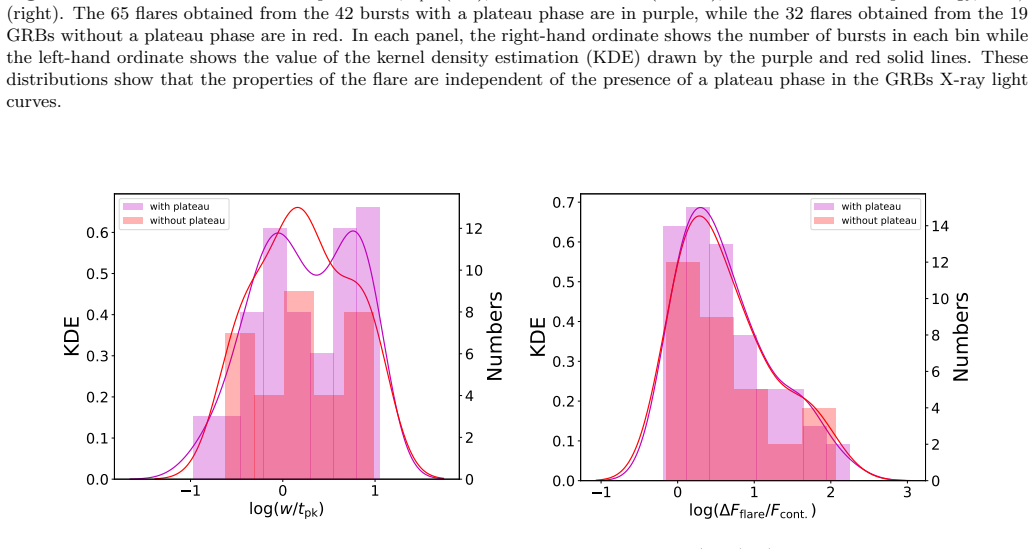
On its own terms, the paper's central claim is that the flare populations in gamma-ray bursts are the same whether or not the burst's X-ray light curve contains a plateau. From a spectroscopically selected sample of 100 bursts observed by an X-ray telescope, 11 are set aside because their flares were misidentified, leaving 89; 61 of these show flares and 57 show plateaus, with flare rates of 73% (42/57) and 59% (19/32) respectively. For the 65 flares in plateau bursts and the 32 flares in non-plateau bursts, Kolmogorov–Smirnov tests give $p = 0.18$ for peak time $t_{\rm pk}$, $p = 0.92$ for width, $p = 0.96$ for isotropic energy, $p = 0.88$ for the width-to-peak ratio $w/t_{\rm pk}$, and $p = 0.99$ for flux variability, leading the authors to conclude the two subsamples come from one population. The ratio $w/t_{\rm pk}$ is of order unity in both groups (logarithmic means $0.25\pm0.07$ and $0.22\pm0.09$). The paper then argues that this equality of flare timing and shape is hard to reconcile with plateau models based on late energy injection or off-axis viewing, and instead supports a coasting-phase model in which plateau bursts have terminal Lorentz factors of a few tens.
Load-bearing premise
The load-bearing premise is that the 11 bursts excluded from the sample were dropped for reasons unrelated to their flare properties; if their very wide and energetic flares were included, the two distributions might no longer match.
Editorial extensions
If this is right
- Flare production and plateau production are independent: the presence of flares tells nothing about whether a burst will show a plateau, and vice versa.
- Late-time energy injection as the plateau cause is disfavored, since it would make plateau-burst flares occur later or narrower than the equal $t_{\rm pk}$ and $w/t_{\rm pk}$ observed.
- Off-axis viewing of a structured jet is disfavored, since Doppler deboosting would delay flare peak times in plateau bursts, contrary to observation.
- Low-Lorentz-factor jets of a few tens remain as a viable plateau origin: dissipation at smaller radii yields the same observed flare times because the Lorentz factor cancels in $t_{\rm obs}\sim r/\Gamma^2 c$.
- A testable prediction follows: plateau bursts with long, flat plateaus should show no GeV emission and no strong thermal component.
Reading between the lines
- A larger sample with denser early light-curve coverage could resolve whether the hints of bimodality in $w/t_{\rm pk}$ correspond to two distinct flare classes; the present sample is too small to settle that.
- The same $w/t_{\rm pk}$ comparison applied to optical and ultraviolet flares would test whether the plateau-independence is a property of the jet as a whole or specific to the X-ray band.
- If low Lorentz factors are common, GeV-bright plateau bursts would be a direct counter-example worth checking against existing high-energy catalogs; the paper notes the model predicts no GeV emission for long flat plateaus.
Signed reviews
Editorial analysis
A structured set of objections, weighed in public.
Referee Report
Summary. The paper analyzes X-ray light curves of 100 Swift GRBs, fitting physically motivated afterglow models with Norris-function flares via MultiNest and selecting models with Bayesian evidence and AICc. The final sample contains 89 GRBs, 61 of which have flares; these are split into 65 flares from 42 bursts with an X-ray plateau and 32 flares from 19 bursts without one. The authors report that the distributions of peak time, width, isotropic energy, flux variability, and especially the width-to-peak-time ratio w/tpk are statistically indistinguishable between the two subsamples, and they interpret w/tpk ≈ 1 as evidence against viewing-angle and late-energy-injection explanations and as independent support for their low-Lorentz-factor (Γ ~ tens) coasting-phase model of plateaus.
Significance. If the central result were robust, it would be a valuable observational discriminator for plateau models: the comparison is not circular, since flare properties are measured from the light-curve fits before the low-Lorentz interpretation is applied, and the sample selection and fitting procedure are described in sufficient detail to be reproduced. The paper also contains a useful comparison with previous flaring studies. However, the main quantitative claim suffers from an internal inconsistency in the reported value of w/tpk, the statistical evidence for identical populations is weaker than claimed, and the handling of 11 excluded extreme bursts may bias the sample. These issues currently prevent full confidence in the conclusions.
major comments (4)
- [Abstract; §3.1; §4; §5; §6] The paper's headline 'w/tpk ≈ 1' is inconsistent with the values reported in §3.1. The text reports ⟨log10 w/tpk⟩ = 0.25 ± 0.07 and 0.22 ± 0.09, which correspond to 1.78 and 1.66 in linear scale, and §4 explicitly states 'approximately 0.25 ± 0.07 (1.78 linear scale) and 0.22 ± 0.09 (1.66 linear scale)'. Yet the abstract, §5 point (2), and §6 state that w/tpk ≈ 1. The physical argument in §5 ('The constant ratio (w/tpk ≈ 1) is a strong indication...') and the comparison with Lazzati & Perna (2007, w/tpk ∼ 0.83) both depend on the numerical value. The authors must either report the corrected central value and re-evaluate the support for their model, or justify why a value near 1.7 is described as ≈1 (e.g., if the median or a different width definition gives unity).
- [§3.1] The KS tests are used to conclude that the two subsamples 'originate from the same population'. With 65 and 32 flares, the KS test has limited power; for example, the tpk test gives D = 0.23 with p = 0.18, which is consistent with no difference but does not demonstrate identical distributions. In addition, the caption of Figure 2 notes bimodality in w/tpk, suggesting a possible mixture that a two-sample KS test is not designed to exclude. I ask the authors to provide a practical effect-size measure (e.g., 95% confidence intervals on the difference of means or medians, or a Bayesian model comparison / power calculation) before claiming population identity.
- [§2.4 and Appendix B] The exclusion of 11 GRBs from the sample is load-bearing. Table B0 shows that the excluded bursts have flare widths up to 0.8×10^8 s and isotropic energies up to 10^53 erg, and they include well-known extreme bursts such as GRB 221009A and 190114C. If these bursts were removed because their flares were 'misidentified', it is essential to verify that this removal is not itself correlated with the flare properties under study. Otherwise, the remaining sample may be biased against wide, late, or very energetic flares, which would directly affect the comparison of w/tpk and Eiso,f. Please show the results with a conservative alternative treatment (e.g., allowing a separate component for those flares, or presenting the distributions with the excluded flares overlaid).
- [§3.2] The reported correlation-fit uncertainties, r = 0.87 ± 4.2×10^-5 and r = 0.97 ± 5.9×10^-5, are unrealistically small and likely reflect a fit that ignores intrinsic scatter and measurement uncertainties. Since the text uses this correlation as independent evidence for the similarity of flare properties, the authors should quote uncertainties that account for both sources, e.g., from bootstrap or from a model that includes intrinsic dispersion.
minor comments (4)
- [§2.2] There is a typographical error in the sentence defining the two half-maximum times: '¯t2 > ¯t11' should presumably read '¯t2 > ¯t1'.
- [§2.2 and §4] The width definition appears inconsistent: §2.2 states that the width is defined from the half-maximum points in log-space, while §4 says 'in this model, the width w is defined as the distance between two points where the function has dropped to 37% (or 1/e) of its peak value.' Please reconcile these statements, since this affects the interpretation of w/tpk.
- [Figure 2 caption] The caption says 'bimodal distributions are observed' while the text in §3.1 more cautiously says the data 'may indicate a possible existence of two populations'. Please make the caption consistent with the more cautious language.
- [Appendix C] Table C1 is dense and difficult to read; a machine-readable version would improve usability and reproducibility.
Circularity Check
No significant circularity: the flare properties are measured directly from Swift-XRT fits and compared across plateau classes, with no parameter fitted to the low-Lorentz model.
full rationale
The derivation chain is self-contained on the observational side. Flare peak times, widths, energies, and width-to-peak ratios are obtained from Norris-function fits to Swift-XRT light curves, and the with/without-plateau comparison is made through KS tests and mean values; none of these quantities is fitted to the low-Lorentz model or derived from it. The interpretive claim that the similar flare properties 'provide an independent support' to the low-Lorentz plateau model of Dereli-Begué et al. (2022) is a consistency argument based on a generic scaling (r ~ Gamma^2 c delta_t and t ~ r/Gamma^2 c), and the cited model is externally published work with falsifiable predictions rather than an input to the flare fits. Two non-circular concerns should be weighed as correctness risks: (1) the abstract, Section 5, and Section 6 state w/tpk ~ 1, while Section 3.1 and Section 4 report <log10 w/tpk> = 0.25 +/- 0.07 and 0.22 +/- 0.09, i.e., linear values of 1.78 and 1.66, so the 'constant ratio ~ 1' premise is not supported by the paper's own reported means; (2) Appendix B excludes 11 GRBs with extreme flare widths and energies, which could bias the sub-sample comparison if the exclusion criteria correlate with flare properties. These are internal-consistency and robustness issues, not circular reductions: no equation is defined in terms of the result it is used to support, and no fitted parameter is renamed as a prediction.
Assumptions & free parameters
free parameters (2)
- Minimum flare amplitude threshold (Af_min) =
0.2 in log flux, i.e. 1.58 in linear
- Minimum data points per independent feature =
5
assumptions (4)
- domain assumption GRB prompt emission and afterglow are produced by internal and external shocks in a relativistic fireball.
- domain assumption X-ray flares are produced by internal dissipation at radius r ~ Gamma^2 c dt, with observed time t_obs ~ r/(Gamma^2 c).
- domain assumption Long GRB progenitors expand into a low-density stellar wind environment.
- ad hoc to paper The X-ray plateau is emission during the coasting phase of a forward shock with terminal Lorentz factor of a few tens.
Cite this review
Pith. "Pith review of Unraveling the Origins of GRB X-ray Plateaus through a Study of X-ray Flares." pith.science (2026). https://pith.science/paper/5QN6FEZN
@misc{pith2026241211533,
  author       = {Pith},
  title        = {Pith review of: Unraveling the Origins of GRB X-ray Plateaus through a Study of X-ray Flares},
  year         = {2026},
  howpublished = {\url{https://pith.science/paper/5QN6FEZN}},
  note         = {Machine review of arXiv:2412.11533}
}
abstract
The X-ray light curves of gamma-ray bursts (GRBs) display complex features, including plateaus and flares, that challenge theoretical models. Here, we study the properties of flares that are observed in the early afterglow phase (up to a few thousand of seconds). We split the sample into two groups: bursts with and without X-ray plateau. We find that the distributions of flare properties are similar in each group. Specifically, the peak time ($t_{\rm pk}$) of the flares and the ratio of the flare width to the flare peak time ($w/t_{\rm pk}$) which is found to be $\approx 1$, regardless of the presence of a plateau. We discuss these results in view of the different theoretical models aimed at explaining the origin of the plateau. These results are difficult to explain by viewing angle effects or late-time energy injection, but do not contradict the idea that GRBs with X-ray plateau have low Lorentz factor, of the order of tens. For these GRBs, the dissipation processes that produce the flares naturally occur at smaller radii compared to GRBs with higher Lorentz factors, while the flares maintain a similar behaviour. Our results therefore provide an independent support for the idea that many GRBs have a Lorentz factor of a few tens rather than a few hundreds.
Figures


Figures from the paper (1 more)

Forward citations
Cited by 1 Pith paper
-
Gamma-ray bursts: what do we know today that we did not know 10 years ago?
A review of the past decade of gamma-ray burst research, highlighting structured jets, GR-MHD simulations, TeV detections, and the contested idea that many GRBs have moderate Lorentz factors.
Reference graph
Works this paper leans on
-
[1]
, " * write output.state after.block = add.period write newline
ENTRY address archivePrefix author booktitle chapter doi edition editor eprint howpublished institution journal key month number organization pages publisher school series title misctitle type volume year version url label extra.label sort.label short.list INTEGERS output.state before.all mid.sentence after.sentence after.block FUNCTION init.state.consts ...
-
[2]
write newline
" write newline "" before.all 'output.state := FUNCTION format.url url empty "" new.block "" url * "" * if FUNCTION format.eprint eprint empty "" archivePrefix empty "" archivePrefix "arXiv" = new.block " " eprint * " " * new.block " " eprint * " " * if if if FUNCTION format.doi doi empty "" " " doi * " " * if FUNCTION format.pid doi empty eprint empty ur...
-
[3]
Provided by the SAO/NASA Astrophysics Data System
thebibliography [1] 20pt to REFERENCES 6pt =0pt -12pt 10pt plus 3pt =0pt =0pt =1pt plus 1pt =0pt =0pt -12pt =13pt plus 1pt =20pt =13pt plus 1pt \@M =10000 =-1.0em =0pt =0pt 0pt =0pt =1.0em @enumiv\@empty 10000 10000 `\.\@m \@noitemerr \@latex@warning Empty `thebibliography' environment \@ifnextchar \@reference \@latexerr Missing key on reference command E...
arXiv 2021
-
[4]
A., Ackermann , M., Ajello , M., et al
Abdo , A. A., Ackermann , M., Ajello , M., et al. 2011, , 734, L27, 10.1088/2041-8205/734/2/L27
-
[5]
Barthelmy , S. D., Cannizzo , J. K., Gehrels , N., et al. 2005, , 635, L133, 10.1086/499432
doi:10.1086/499432 2005
-
[6]
2020 a , , 492, 2847, 10.1093/mnras/staa070
Beniamini , P., Duque , R., Daigne , F., & Mochkovitch , R. 2020 a , , 492, 2847, 10.1093/mnras/staa070
-
[7]
2020 b , , 493, 3521, 10.1093/mnras/staa538
Beniamini , P., Granot , J., & Gill , R. 2020 b , , 493, 3521, 10.1093/mnras/staa538
-
[8]
2019, , 482, 5430, 10.1093/mnras/sty3110
Beniamini , P., & Nakar , E. 2019, , 482, 5430, 10.1093/mnras/sty3110
Show all 64 references
-
[9]
G., Margutti , R., Chincarini , G., Guidorzi , C., & Mao , J
Bernardini , M. G., Margutti , R., Chincarini , G., Guidorzi , C., & Mao , J. 2011, , 526, A27, 10.1051/0004-6361/201015703
2011 doi
-
[10]
N., Romano , P., Falcone , A., et al
Burrows , D. N., Romano , P., Falcone , A., et al. 2005, Science, 309, 1833, 10.1126/science.1116168
2005 doi
-
[11]
2007, , 671, 1903, 10.1086/521591
Chincarini , G., Moretti , A., Romano , P., et al. 2007, , 671, 1903, 10.1086/521591
2007 doi
-
[13]
A., Starling , R
Curran , P. A., Starling , R. L. C., O'Brien , P. T., et al. 2008, , 487, 533, 10.1051/0004-6361:200809652
2008 doi
-
[14]
2022, Nature Communications, 13, 5611, 10.1038/s41467-022-32881-1
Dereli-B \'e gu \'e , H., Pe'er , A., Ryde , F., et al. 2022, Nature Communications, 13, 5611, 10.1038/s41467-022-32881-1
2022 doi
-
[15]
2022, , 513, 951, 10.1093/mnras/stac938
Duque , R., Beniamini , P., Daigne , F., & Mochkovitch , R. 2022, , 513, 951, 10.1093/mnras/stac938
2022 doi
-
[16]
2014, , 787, L32, 10.1088/2041-8205/787/2/L32
Eichler , D. 2014, , 787, L32, 10.1088/2041-8205/787/2/L32
2014 doi
-
[17]
2006, , 641, L5, 10.1086/503667
Eichler , D., & Granot , J. 2006, , 641, L5, 10.1086/503667
2006 doi
-
[18]
A., Beardmore , A
Evans , P. A., Beardmore , A. P., Page , K. L., et al. 2007, , 469, 379, 10.1051/0004-6361:20077530
2007 doi
-
[20]
D., Burrows , D
Falcone , A. D., Burrows , D. N., Lazzati , D., et al. 2006, , 641, 1010, 10.1086/500655
2006 doi
-
[21]
D., Morris , D., Racusin , J., et al
Falcone , A. D., Morris , D., Racusin , J., et al. 2007, , 671, 1921, 10.1086/523296
2007 doi
-
[24]
E., Epstein , R
Fenimore , E. E., Epstein , R. I., & Ho , C. 1993, , 97, 59
1993
-
[25]
P., & Bridges , M
Feroz , F., Hobson , M. P., & Bridges , M. 2009, , 398, 1601, 10.1111/j.1365-2966.2009.14548.x
2009
-
[26]
2004, , 611, 1005, 10.1086/422091
Gehrels , N., Chincarini , G., Giommi , P., et al. 2004, , 611, 1005, 10.1086/422091
2004 doi
-
[27]
2007, , 381, 732, 10.1111/j.1365-2966.2007.12243.x
Genet , F., Daigne , F., & Mochkovitch , R. 2007, , 381, 732, 10.1111/j.1365-2966.2007.12243.x
2007
-
[28]
2006, , 455, L5, 10.1051/0004-6361:20065578
Giannios , D. 2006, , 455, L5, 10.1051/0004-6361:20065578
2006 doi
-
[29]
L., Wynn , G
Gibson , S. L., Wynn , G. A., Gompertz , B. P., & O'Brien , P. T. 2018, , 478, 4323, 10.1093/mnras/sty1363
2018 doi
-
[30]
2006, , 370, 1946, 10.1111/j.1365-2966.2006.10621.x
Granot , J., K \"o nigl , A., & Piran , T. 2006, , 370, 1946, 10.1111/j.1365-2966.2006.10621.x
2006
-
[31]
2006, , 366, L13, 10.1111/j.1745-3933.2005.00121.x
Granot , J., & Kumar , P. 2006, , 366, L13, 10.1111/j.1745-3933.2005.00121.x
2006
- [32]
-
[33]
2007, , 662, 443, 10.1086/517868
Grupe , D., Gronwall , C., Wang , X.-Y., et al. 2007, , 662, 443, 10.1086/517868
2007 doi
-
[34]
L., Hill , R
Hinshaw , G., Weiland , J. L., Hill , R. S., et al. 2009, , 180, 225, 10.1088/0067-0049/180/2/225
2009 doi
-
[35]
2005, , 631, 429, 10.1086/432567
Ioka , K., Kobayashi , S., & Zhang , B. 2005, , 631, 429, 10.1086/432567
2005 doi
- [36]
-
[37]
2015, , 561, 1, 10.1016/j.physrep.2014.09.008
Kumar , P., & Zhang , B. 2015, , 561, 1, 10.1016/j.physrep.2014.09.008
2015 doi
-
[38]
H., Morsony , B
Lazzati , D., Blackwell , C. H., Morsony , B. J., & Begelman , M. C. 2011, , 411, L16, 10.1111/j.1745-3933.2010.00984.x
2011
-
[39]
2007, , 375, L46, 10.1111/j.1745-3933.2006.00273.x
Lazzati , D., & Perna , R. 2007, , 375, L46, 10.1111/j.1745-3933.2006.00273.x
2007
-
[40]
2011, , 410, 1064, 10.1111/j.1365-2966.2010.17504.x
Margutti , R., Bernardini , G., Barniol Duran , R., et al. 2011, , 410, 1064, 10.1111/j.1365-2966.2010.17504.x
2011
-
[41]
2006, Reports on Progress in Physics, 69, 2259, 10.1088/0034-4885/69/8/R01
M \'e sz \'a ros , P. 2006, Reports on Progress in Physics, 69, 2259, 10.1088/0034-4885/69/8/R01
2006 doi
-
[42]
Meszaros , P., & Rees , M. J. 1993, , 405, 278, 10.1086/172360
1993 doi
- [43]
-
[44]
J., & Wijers , R
M \'e sz \'a ros , P., Rees , M. J., & Wijers , R. A. M. J. 1998, , 499, 301, 10.1086/305635
1998 doi
-
[45]
D., Giannios , D., Thompson , T
Metzger , B. D., Giannios , D., Thompson , T. A., Bucciantini , N., & Quataert , E. 2011, , 413, 2031, 10.1111/j.1365-2966.2011.18280.x
2011
-
[46]
P., Bonnell , J
Norris , J. P., Bonnell , J. T., Kazanas , D., et al. 2005, , 627, 324, 10.1086/430294
2005 doi
-
[47]
A., Kouveliotou , C., Grupe , D., et al
Nousek , J. A., Kouveliotou , C., Grupe , D., et al. 2006, , 642, 389, 10.1086/500724
2006 doi
-
[48]
T., Willingale , R., Osborne , J., et al
O'Brien , P. T., Willingale , R., Osborne , J., et al. 2006, , 647, 1213, 10.1086/505457
2006 doi
-
[49]
2020, , 893, 88, 10.3847/1538-4357/ab8221
Oganesyan , G., Ascenzi , S., Branchesi , M., et al. 2020, , 893, 88, 10.3847/1538-4357/ab8221
2020 doi
-
[50]
2001, , 560, L49, 10.1086/324061
Panaitescu , A., & Kumar , P. 2001, , 560, L49, 10.1086/324061
2001 doi
- [51]
-
[52]
A., et al
Perri , M., Guetta , D., Antonelli , L. A., et al. 2007, , 471, 83, 10.1051/0004-6361:20066227
2007 doi
-
[53]
2004, Reviews of Modern Physics, 76, 1143, 10.1103/RevModPhys.76.1143
Piran , T. 2004, Reviews of Modern Physics, 76, 1143, 10.1103/RevModPhys.76.1143
2004 doi
-
[54]
L., Karpov , S
Racusin , J. L., Karpov , S. V., Sokolowski , M., et al. 2008, , 455, 183, 10.1038/nature07270
2008 doi
-
[55]
L., Oates , S
Racusin , J. L., Oates , S. R., Schady , P., et al. 2011, , 738, 138, 10.1088/0004-637X/738/2/138
2011 doi
- [56]
-
[57]
2021, Nature Communications, 12, 4040, 10.1038/s41467-021-24246-x
Ronchini , S., Oganesyan , G., Branchesi , M., et al. 2021, Nature Communications, 12, 4040, 10.1038/s41467-021-24246-x
2021 doi
-
[58]
1998, , 497, L17+, 10.1086/311269
Sari , R., Piran , T., & Narayan , R. 1998, , 497, L17+, 10.1086/311269
1998 doi
-
[59]
Shen , R., & Matzner , C. D. 2012, , 744, 36, 10.1088/0004-637X/744/1/36
2012 doi
-
[60]
P., Dainotti , M
Srinivasaragavan , G. P., Dainotti , M. G., Fraija , N., et al. 2020, , 903, 18, 10.3847/1538-4357/abb702
2020 doi
-
[61]
2005, , 436, 985, 10.1038/nature03934
Tagliaferri , G., Goad , M., Chincarini , G., et al. 2005, , 436, 985, 10.1038/nature03934
2005 doi
-
[62]
2006, , 640, L139, 10.1086/503384
Toma , K., Ioka , K., Yamazaki , R., & Nakamura , T. 2006, , 640, L139, 10.1086/503384
2006 doi
- [63]
-
[64]
T., Osborne , J
Willingale , R., O'Brien , P. T., Osborne , J. P., et al. 2007, , 662, 1093, 10.1086/517989
2007 doi
-
[65]
2022, , 924, 69, 10.3847/1538-4357/ac35e7
Yi , S.-X., Du , M., & Liu , T. 2022, , 924, 69, 10.3847/1538-4357/ac35e7
2022 doi
-
[66]
2016, , 224, 20, 10.3847/0067-0049/224/2/20
Yi , S.-X., Xi , S.-Q., Yu , H., et al. 2016, , 224, 20, 10.3847/0067-0049/224/2/20
2016 doi
-
[67]
A., Harrison , F
Yost , S. A., Harrison , F. A., Sari , R., & Frail , D. A. 2003, , 597, 459, 10.1086/378288
2003 doi
-
[68]
Z., Dyks , J., et al
Zhang , B., Fan , Y. Z., Dyks , J., et al. 2006, , 642, 354, 10.1086/500723
2006 doi
Reviewed August 11, 2026 · model on record in the stance chip above.
Discussion (0). Continue with ORCID to comment.