REVIEW 3 major objections 5 minor 44 references
LLMs for Agentic Home Energy Management
T0 review · 3 major / 5 minor · reviewed 2026-08-02 · deepseek-v4-flash
Pith's one-line read A tool-calling LLM agent can schedule home appliances at near-optimal cost, but only if a deterministic validator checks every committed schedule before actuation.
desk verdict Worth a serious referee, but the undefined 'realized generation' could make the headline PV savings in-sample. read the letter →
The pith
A machine-rendered reading of the paper's core claim, the machinery that carries it, and where it could break.
The reading
What carries the argument
The central object is a flat, single-agent tool-calling ReAct loop: a model iterates between reasoning and calls to structured tools — price retrieval, weather forecasting, PV generation prediction, cheapest-window search, appliance scheduling, and infeasibility reporting — until it commits a schedule or reports infeasibility. The load-bearing mechanism is native function calling, which restricts actions to validated tool names and arguments, compared directly with text-parsed actions. The decisive safety mechanism is a model-independent deterministic feasibility validator that re-checks appliance duration, horizon limits, deadlines, calendar conditions, power caps, and duplicate or missing
What would settle it
Re-run the seven-day deployment on real smart-meter data with measured PV generation and varied occupancy, keeping the same agent, prompts, and mixed-integer linear program oracle; if the timer-to-oracle savings share falls materially below the reported 96.7–98.0%, the headline result depends on the generation model rather than the LLM's scheduling ability.
Extended reading notes
Core claim
In the paper's own terms, the discovery is that a flat, tool-calling ReAct agent with native function calling closes the multi-appliance coordination gap that earlier hierarchical LLM schedulers left open, and that the remaining differences between models show up under constraint conflict rather than on benign cost-minimization days. The evidence is a five-backend, 1,100+ run benchmark against a mixed-integer linear program, a constraint-conflict stress suite, a weather-aware PV co-optimization arm, and a seven-day rolling deployment in which the three commercial agents capture 96.7–98.0% of the timer-to-oracle savings. Because some models fabricate schedules for infeasible requests and comm
Load-bearing premise
The load-bearing premise is that the 'realized generation' used to score weather-aware and seven-day results is genuine measured PV output and that one archived week of simulated requests represents real households; if realized generation is instead the same forecast model used for planning, the savings claims become partly self-scoring.
Editorial extensions
If this is right
- On ordinary tariff days, at least four of five backends commit every appliance with a 0% median cost gap under native function calling, so structured tool use, not model scale, closes the coordination gap.
- Text-parsed actions degrade reliability for every model, so systems that parse free-form LLM output will be less dependable than systems built on native function calling.
- Constraint violations can be cheaper than feasible schedules — one infeasible case produced a mean cost gap of −152.9% — so cost alone is a misleading success metric.
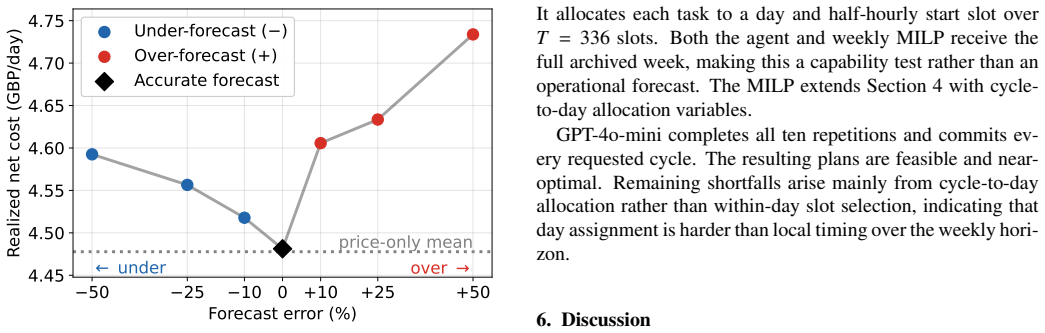
- Weather-aware scheduling should target net cost, not self-consumption: it saves about £0.139/day on overcast days but can raise cost on sunny days with negative import prices.
- A deterministic pre-actuation validator is mandatory because correct explanations can conceal invalid committed schedules, and prompt guidance can worsen weaker models.
Reading between the lines
- A consequence the paper leaves implicit: the 96.7–98.0% savings share is an upper-bound estimate if the 'realized generation' used for scoring is the same PV model used for planning rather than measured meter output; measured PV would separate scheduling skill from model bias.
- The one-week, one-household, simulated-request design suggests the headline ratios are relative-policy evidence, not annual savings; a multi-season deployment with real occupants is the natural next test.
- The flat agent's success on three appliances leaves open the point at which complexity demands hierarchy: adding batteries, heating, or cooling introduces inter-temporal state that the current validator does not cover.
- A concrete extension would be to apply the same validator-gated architecture to real smart-meter data and compare measured-PV savings capture, which would also test whether conservative PV forecasting remains the safer default outside the tested week.
Editorial analysis
A structured set of objections, weighed in public.
Referee Report
Summary. The paper proposes a single flat ReAct agent with native function calling and six tools (price, weather, PV, cheapest-window, scheduling, infeasibility) for scheduling a washing machine, dishwasher, and EV charger under half-hourly Octopus Agile prices, weather forecasts, PV generation estimates, and household base load. Five LLM backends are evaluated against an extended MILP ground truth across 12 tariff days, two action interfaces, 13 constraint-conflict scenarios, weather-aware PV co-optimization, and a seven-day rolling deployment. Headline claims are that native function calling yields high scheduling success and near-optimal cost on ordinary tariff days, that constraint conflicts expose safety gaps, that weather-aware scheduling gives regime-dependent cost effects, and that the three commercial agents capture 96.7–98.0% of the timer-to-oracle savings over the evaluated week, provided every committed schedule is checked by an independent deterministic feasibility validator.
Significance. If the results hold, this is a useful and unusually careful benchmark for LLM-based residential load orchestration. The design separates model, interface, and scenario effects; fixes prompts, tools, model identifiers, and archived inputs; uses temperature 0 with R=3 repeats; and compares against an independently implemented MILP. The paper also provides trace-level failure modes (fabricated schedules, non-commits, reasoning-to-action mismatches) and a concrete safety recommendation (model-independent feasibility validation before actuation), which is well supported by the conflict experiments. The main load-bearing concern is that the headline savings are scored against a quantity called "realized generation" that is never defined; the limitations section (Sec. 6.3) states that all experiments use archived data and simulated requests, with no mention of metered PV output. If "realized" means Eq. (9) evaluated on archived weather, then the weather-aware cost savings and the 96.7–98.0% savings capture are in-sample scores with respect to an unvalidated PV model, and the manuscript's most prominent quantitative claims are conditional on parameters (P_stc, PR, NOCT, α) that are never v
major comments (3)
- [Sec. 5.4–5.5, Eq. (9), Tables 6–7, Sec. 6.3] The paper repeatedly scores results against "realized generation" and "realized data" (e.g., Table 6 caption: "Realized daily net cost"; Table 7: "Seven-day realized net cost"), but this quantity is never defined. The only PV model in the paper is Eq. (9), which is also the model embedded in the agent's PV prediction tool. Sec. 6.3 states that experiments use archived data and simulated requests, and nowhere is metered PV output mentioned. If "realized generation" is Eq. (9) evaluated on archived weather, then the overcast-day benefit (£0.139/day), the sunny-day penalty (£0.146/day), and the 96.7–98.0% timer-to-oracle savings are measured against the same model the agent is optimizing, not against physical PV output. The LLM-vs-MILP comparison remains fair, but the headline savings are then conditional on unvalidated PV parameters. The authors must state explicitly whether "realized" mea
- [Sec. 5.1, Tables 4, 6, 7] All quantitative comparisons are reported as point estimates without confidence intervals, statistical tests, or per-run distributions. Each cell has only 36–45 runs, and the seven-day deployment has 3×7×3=63 model-day runs. The £0.139/day overcast benefit and the 96.7–98.0% savings figures could be within run-to-run or day-to-day variation. The paper does report median and maximum cost gaps, but the maximum gap of 122.86% for Qwen-3 shows that medians hide heavy tails; expected cost or a distributional summary is needed. Given that the contribution statement (Sec. 1.1, C1) promises "statistical analysis," the absence of any uncertainty quantification or significance testing is a gap that should be addressed before the comparative claims can be taken as strong.
- [Sec. 5.2, Table 4] Cost gaps and optimality rates are computed over successful runs only, as noted in the Table 4 footnote. This is appropriate when reported alongside success rates, but the text states "Median cost gaps are 0% for all function-calling models except Llama-3.3" and "GPT-4o-mini and Gemini attain the exact MILP optimum in every run." For the text-parsed interface, success rates fall to 0.50–0.94, so a median gap of 0% over successful runs can coexist with half the runs failing to commit a schedule. The narrative should make the joint distribution of success and cost explicit in the summary statements, especially for Claude's text-parsed configuration, where a fluent confirmation without any tool call could be misinterpreted as a successful low-cost schedule. This is a presentation issue, but it affects how the headline "near-optimal" claim is read.
minor comments (5)
- [Throughout] There are several duplicated references: Ref. [16] and Ref. [43] are the same work (Raghavan and Giridhar), and Sec. 5.3 says "Appendix Appendix B" and Sec. C says "Appendix Appendix A." Please clean these up.
- [Eq. (7)] The notation A_ddl is used in constraint (7) but is not defined in the text. Please define it explicitly, e.g., as the subset of appliances subject to calendar-deadline constraints.
- [Fig. 3] The heatmaps in Fig. 3 contain empty-looking cells that are presumably 0.00 but are rendered as blanks/dots. A legend or explicit note about zero entries would make the failure-rate visualization unambiguous.
- [Sec. 5.5.1] The sentence "The evaluation includes both weekdays and a weekend" is slightly ambiguous for a seven-day period; state explicitly how many weekdays and weekend days are included and how they are distributed across the week.
- [Sec. 5.3] For scenario S4, the definition of "correct infeasibility reporting" is clear, but the text says "A non-committing S4 run that neither fabricates nor reports infeasibility is scored as incorrect." This scoring rule is fine, but it should be stated before the results are presented, not only in the figure caption.
Circularity Check
No significant circularity: MILP-anchored benchmark, fixed champion selection, and no load-bearing self-citations; the undefined 'realized generation' is a validation gap, not a circular step.
full rationale
The paper's load-bearing claims are anchored to an independently implemented MILP (Sec. 4) rather than to quantities fitted from LLM outputs. The MILP defines the net-cost objective and constraints from first principles, and all agent schedules are scored against this oracle (Sec. 5). The champion-selection rule was fixed before the later experiments and selects GPT-4o-mini based on earlier success/optimality and constraint-compliance criteria, not on the outcome being predicted, so it does not create a fitted-input-called-prediction loop. No load-bearing self-citation is present: the only author-linked artifacts are the GitHub/live-demo links, and the prior-work comparison [15] is external. The seven-day savings metric (Eq. 10) is a descriptive ratio of measured costs, not a derived prediction. The one legitimate concern is the undefined term 'realized generation' in Sec. 5.4 and Table 6: if it means Eq. (9) evaluated on archived weather rather than metered PV output, the weather-aware cost benefits are in-sample with respect to the PV model. However, the paper never states this equivalence, the LLM-vs-MILP comparison remains independent of that model, and this is an external-validity/validation gap, not a circular derivation. Therefore no circular step can be exhibited.
Assumptions & free parameters
free parameters (4)
- PV system size P_stc =
4.0 kWp (assumed; not measured)
- PV performance ratio PR =
0.80
- Module NOCT =
45 °C
- Temperature coefficient α =
0.004 K⁻¹
assumptions (5)
- domain assumption MILP in Sec. 4.2–4.3 with CBC solver provides exact ground-truth schedules.
- domain assumption Household demand profile, appliance parameters, and export price F=5p/kWh are representative.
- domain assumption Eq. (9) PV model is an adequate proxy for realized PV output.
- domain assumption Temperature-0 decoding plus R=3 repetitions approximates deterministic model behaviour.
- domain assumption The selected 12 tariff days, 13 conflict scenarios, and one archived week are representative enough for model ranking.
Cite this review
Pith. "Pith review of LLMs for Agentic Home Energy Management." pith.science (2026). https://pith.science/paper/5VOW2UXS
@misc{pith2026260704569,
  author       = {Pith},
  title        = {Pith review of: LLMs for Agentic Home Energy Management},
  year         = {2026},
  howpublished = {\url{https://pith.science/paper/5VOW2UXS}},
  note         = {Machine review of arXiv:2607.04569}
}
read the original abstract
Home Energy Management Systems (HEMS) can reduce residential electricity costs, but many require users to express everyday preferences as technical constraints. This paper presents a tool-calling ReAct agent that converts natural-language requests into schedules for multiple household appliances using half-hourly Octopus Agile prices, weather forecasts, photovoltaic generation estimates, and household demand data. Five large language model backends are evaluated against a mixed-integer linear programming benchmark across dynamic tariff conditions, constraint conflicts, weather-aware scheduling, and a seven-day rolling deployment. Native function calling achieves high scheduling success and near-optimal cost on ordinary tariff days, whereas text-parsed actions reduce reliability. Constraint-conflict testing shows that low cost does not guarantee safe or feasible behaviour. Claude Sonnet 4.6 performs best in power-cap and infeasibility scenarios, while Qwen-3 achieves higher overall constraint compliance than GPT-4o-mini. The evaluation also identifies fabricated schedules, failed commitments, and reasoning-to-action failures in which models explain a deadline correctly but commit an invalid schedule. Weather-aware scheduling reduces cost and increases solar self-consumption under overcast conditions, but provides limited or adverse economic value under some dynamic-price regimes. Across the evaluated seven-day period, the agents capture 96.7-98.0% of the savings available between an off-peak timer and the MILP oracle and outperform the rule-based policies. The results support LLM-based HEMS orchestration, provided that every committed schedule is checked by an independent deterministic feasibility validator before actuation. Code and a live demonstration are available at https://github.com/sokistar24/ecohome-experiments and https://www.ecohomeagent.com/.
Figures


Figures from the paper (10 more)




Reference graph
Works this paper leans on
-
[1]
Hevia-Koch, B
P. Hevia-Koch, B. Wanner, R. Kuwahata, et al., Electric- ity grids and secure energy transitions, IEA: Paris, Frence (2023)
2023
-
[2]
Cabot, M
C. Cabot, M. Villavicencio, The demand-side flexibility in liberalised power market: A review of current market design and objectives, Renewable and Sustainable Energy Reviews 201 (2024) 114643
2024
-
[3]
URLhttps://www.iea.org/energy-system/ energy-efficiency-and-demand/ demand-response
International Energy Agency, Demand response, ac- cessed: 2026-07-05 (2023). URLhttps://www.iea.org/energy-system/ energy-efficiency-and-demand/ demand-response
2026
-
[4]
H. Duan, S. Chen, J. Song, Characterizing regional build- ing energy consumption under joint climatic and socioe- conomic impacts, Energy 245 (2022) 123290
2022
-
[5]
Felez, J
R. Felez, J. Felez, Advanced energy management for res- idential buildings optimizing costs and efficiency through thermal energy storage and predictive control, Applied Sciences 15 (2) (2025) 880
2025
-
[6]
Golmohamadi, S
H. Golmohamadi, S. Golestan, R. Sinha, B. Bak-Jensen, Demand-side flexibility in power systems, structure, op- portunities, and objectives: A review for residential sec- tor, Energies 17 (18) (2024) 4670
2024
-
[7]
D’Ettorre, M
F. D’Ettorre, M. Banaei, R. Ebrahimy, S. A. Pourmousavi, E. Blomgren, J. Kowalski, Z. Bohdanowicz, B. Łopaciuk- Gonczaryk, C. Biele, H. Madsen, Exploiting demand-side flexibility: State-of-the-art, open issues and social per- spective, Renewable and Sustainable Energy Reviews 165 (2022) 112605. 12 Table B.8: Constraint-conflict scenario matrix. ID Family ...
2022
-
[8]
Shimoda, M
Y . Shimoda, M. Sugiyama, R. Nishimoto, T. Momonoki, Evaluating decarbonization scenarios and energy man- agement requirement for the residential sector in japan through bottom-up simulations of energy end-use demand in 2050, Applied Energy 303 (2021) 117510
Show all 44 references
-
[9]
Khafiso, C
T. Khafiso, C. Aigbavboa, S. A. Adekunle, Barriers to the adoption of energy management systems in residen- tial buildings, Facilities 42 (15-16) (2024) 107–125
2024
-
[10]
Michelon, Y
F. Michelon, Y . Zhou, T. Morstyn, Large language model interface for home energy management systems, in: Pro- ceedings of the 16th ACM International Conference on Future and Sustainable Energy Systems, 2025, pp. 590– 602
2025
-
[11]
F. F. Xu, Y . Song, B. Li, Y . Tang, K. Jain, M. Bao, Z. Z. Wang, X. Zhou, Z. Guo, M. Cao, et al., Theagentcom- pany: Benchmarking llm agents on consequential real world tasks, 2024, URL https://arxiv. org/abs/2412.14161 (2024)
2024 arXiv
-
[12]
S. Yao, J. Zhao, D. Yu, N. Du, I. Shafran, K. Narasimhan, Y . Cao, React: Synergizing reasoning and acting in lan- guage models, arXiv preprint arXiv:2210.03629 (2022)
2022 arXiv
-
[13]
Aksitov, S
R. Aksitov, S. Miryoosefi, Z. Li, D. Li, S. Babayan, K. Kopparapu, Z. Fisher, R. Guo, S. Prakash, P. Srini- vasan, et al., Rest meets react: Self-improvement for multi-step reasoning llm agent, 2023, URL https://arxiv. org/abs/2312.10003. 13 Figure E.8: Interface details. Left...
2023 arXiv
-
[14]
Jung, Multi-agent home energy management assistant (hema), SoftwareX 34 (2026) 102633
W. Jung, Multi-agent home energy management assistant (hema), SoftwareX 34 (2026) 102633
2026
-
[15]
El Makroum, S
R. El Makroum, S. Zwickl-Bernhard, L. Kranzl, Agentic ai home energy management system: A large language model framework for residential load scheduling, Results in Engineering (2026) 109857
2026
-
[17]
Welch, E
S. Welch, E. Obonyo, A. M. Memari, A review of the pre- vious and current challenges of passive house retrofits, Building and Environment 245 (2023) 110938.doi: 10.1016/j.buildenv.2023.110938
2023
-
[18]
F. Wise, A. Gillich, P. Palmer, Retrofit information chal- lenges and potential solutions: Perspectives of house- holds, retrofit professionals and local policy makers in the united kingdom, Energy Research & Social Science 119 (2025) 103866.doi:10.1016/j.erss.2024.103866
2025
-
[19]
Ibrahim, F
M. Ibrahim, F. Harkouss, P. Biwole, F. Fardoun, S. Ould- boukhitine, Building retrofitting towards net zero energy: A review, Energy and Buildings 322 (2024) 114707.doi: 10.1016/j.enbuild.2024.114707
2024
-
[20]
C. A. Faulkner, R. Lutes, S. Huang, W. Zuo, D. Vrabie, Simulation-based assessment of ASHRAE guideline 36, considering energy performance, indoor air quality, and control stability, Building and Environment 240 (2023) 110371.doi:10.1016/j.buildenv.2023.110371
2023
-
[21]
Drgo ˇna, J
J. Drgo ˇna, J. Arroyo, I. Cupeiro Figueroa, D. Blum, K. Arendt, D. Kim, E. P. Ollé, J. Oravec, M. Wetter, D. L. Vrabie, L. Helsen, All you need to know about model predictive control for buildings, Annual Reviews in Con- trol 50 (2020) 190–232.doi:10.1016/j.arcontrol. 2020.09.001
2020 doi
-
[22]
Michailidis, I
P. Michailidis, I. Michailidis, F. Minelli, H. H. Coban, E. Kosmatopoulos, Model predictive control for smart buildings: Applications and innovations in energy man- agement, Buildings 15 (18) (2025) 3298
2025
-
[23]
Y . Zong, G. M. Böning, R. M. Santos, S. You, J. Hu, X. Han, Challenges of implementing economic model predictive control strategy for buildings interacting with smart energy systems, Applied Thermal Engineering 114 (2017) 1476–1486
2017
-
[24]
Z. Nagy, G. Henze, S. Dey, J. Arroyo, L. Helsen, X. Zhang, B. Chen, K. Amasyali, K. Kurte, A. Zamzam, et al., Ten questions concerning reinforcement learning for building energy management, Building and Environ- ment 241 (2023) 110435.doi:10.1016/j.buildenv. 2023.110435
2023
-
[25]
Zhang, S
H. Zhang, S. Seal, D. Wu, F. Bouffard, B. Boulet, Build- ing energy management with reinforcement learning and model predictive control: A survey, IEEE Access 10 (2022) 27853–27862
2022
-
[26]
L. Yu, S. Qin, M. Zhang, C. Shen, T. Jiang, X. Guan, A re- view of deep reinforcement learning for smart building en- ergy management, IEEE Internet of Things Journal 8 (15) (2021) 12046–12063. 14
2021
-
[27]
H. Li, L. Zhang, H. Zhou, T. Hong, Mcp-enabled agen- tic ai workflow for building energy modelling: framework and use cases, Journal of Building Performance Simula- tion (2026) 1–27
2026
-
[28]
Sapkota, K
R. Sapkota, K. I. Roumeliotis, M. Karkee, Ai agents vs. agentic ai: A conceptual taxonomy, applications and chal- lenges, Information Fusion (2025) 103599
2025
-
[29]
Hosseini, H
S. Hosseini, H. Seilani, The role of agentic ai in shap- ing a smart future: A systematic review, Array 26 (2025) 100399
2025
-
[30]
Majumder, L
S. Majumder, L. Dong, F. Doudi, Y . Cai, C. Tian, D. Kalathil, K. Ding, A. A. Thatte, N. Li, L. Xie, Ex- ploring the capabilities and limitations of large language models in the electric energy sector, Joule 8 (6) (2024) 1544–1549
2024
-
[31]
Zhang, R
H. Zhang, R. Zhang, W. Zhang, D. Niyato, Y . Wen, C. Miao, Advancing generative artificial intelligence and large language models for demand side management with internet of electric vehicles, IEEE Internet of Things Jour- nal (2026)
2026
-
[32]
Z. Niu, J. Li, Q. Ai, J. Jiang, Q. Yang, H. Zhou, Ev charging system considering power dispatching based on multi-agent llms and cgan, IEEE Transactions on Intelli- gent Transportation Systems (2025)
2025
-
[33]
H. Fan, M. Li, J. Cui, Z. Zhang, W. Run, D. Liu, Spa- tiotemporal prediction of electric vehicle charging load based on large language models, in: 2026 IEEE PES In- ternational Meeting (PES IM), IEEE, 2026, pp. 1–5
2026
-
[34]
S. Chen, X. Liang, Y . Liu, X. Li, X. Jin, Z. Du, Cus- tomized large-scale model for human-ai collaborative op- eration and maintenance management of building energy systems, Applied Energy 393 (2025) 126169
2025
-
[35]
Mirshekali, M
H. Mirshekali, M. R. Shadi, F. G. Ladani, H. R. Shaker, A review of large language models for energy systems: Ap- plications, challenges, and future prospects, IEEE Access (2025)
2025
-
[36]
L. Shu, A. Yeganeh, D. Zhao, Large language models for building energy retrofit decision-making: Technical and sociotechnical evaluations, Buildings 15 (22) (2025) 4081
2025
-
[37]
Sawada, M
T. Sawada, M. Mizuno, T. Hasegawa, K. Yokoyama, M. Kono, Office-in-the-loop: an investigation into agen- tic ai for advanced building hvac control systems, Data- Centric Engineering 6 (2025) e31
2025
-
[38]
Jiang, Z
G. Jiang, Z. Ma, L. Zhang, J. Chen, EPlus-LLM: A large language model-based computing platform for automated building energy modeling, Applied Energy 367 (2024) 123431.doi:10.1016/j.apenergy.2024.123431
2024
-
[39]
Ren, S.-M
C. Ren, S.-M. Hong, R. Tang, Agenticontrol-mpc: Auto- mated model predictive control for buildings using large language model-based multi-agent system, Advanced En- gineering Informatics 76 (2026) 105062
2026
-
[40]
Giudici, A
M. Giudici, A. Sironi, I. Villa, S. Scherini, F. Garzotto, Generating homeassistant automations using an llm-based chatbot, arXiv preprint arXiv:2505.02802 (2025)
2025 arXiv
-
[41]
Li, Y .-K
T.-C. Li, Y .-K. Liu, Y .-C. Tsai, Ai-driven smart home en- ergy optimization: integrating ai agents with iot for adap- tive decision-making, in: International Conference on Ap- plied System Innovation (ICASI 2025), V ol. 2025, IET, 2025, pp. 225–230
2025
-
[42]
N. V . Gkalinikis, C. Nalmpantis, D. Vrakas, S. Chatzi- georgiou, C. Athanasiadis, D. Doukas, Rhea: Residential home energy advisor, in: 2025 10th International Confer- ence on Smart and Sustainable Technologies (SpliTech), IEEE, 2025, pp. 1–6
2025
-
[43]
V . S. Raghavan, A. Giridhar, Cost-optimal residential en- ergy scheduling via a zero-shot llm agent and model pre- dictive control, Journal of Building Performance Simula- tion (2025) 1–19
2025
-
[44]
Accessed: 2026-07-05 (2026)
Octopus Energy, Agile octopus and the octopus energy API, product AGILE-24-10-01; tariffE-1R-AGILE-24- 10-01-C; region C. Accessed: 2026-07-05 (2026). URLhttps://developer.octopus.energy/
2026
-
[45]
Zippenfenig, Open-meteo
P. Zippenfenig, Open-meteo. com weather api, Zenodo (2023). 15
2023
Reviewed August 2, 2026 · model on record in the stance chip above.
Discussion (0). Continue with ORCID to comment.