Uniaxial compression of crystalline HCP titanium: an atomistic modelling study of size effects
Pith reviewed 2026-06-29 03:16 UTC · model grok-4.3
The pith
Molecular dynamics simulations of HCP titanium under compression show that elastic properties are independent of system size and strain rate, while plastic deformation exhibits strong size effects.
A machine-rendered reading of the paper's core claim, the machinery that carries it, and where it could break.
Core claim
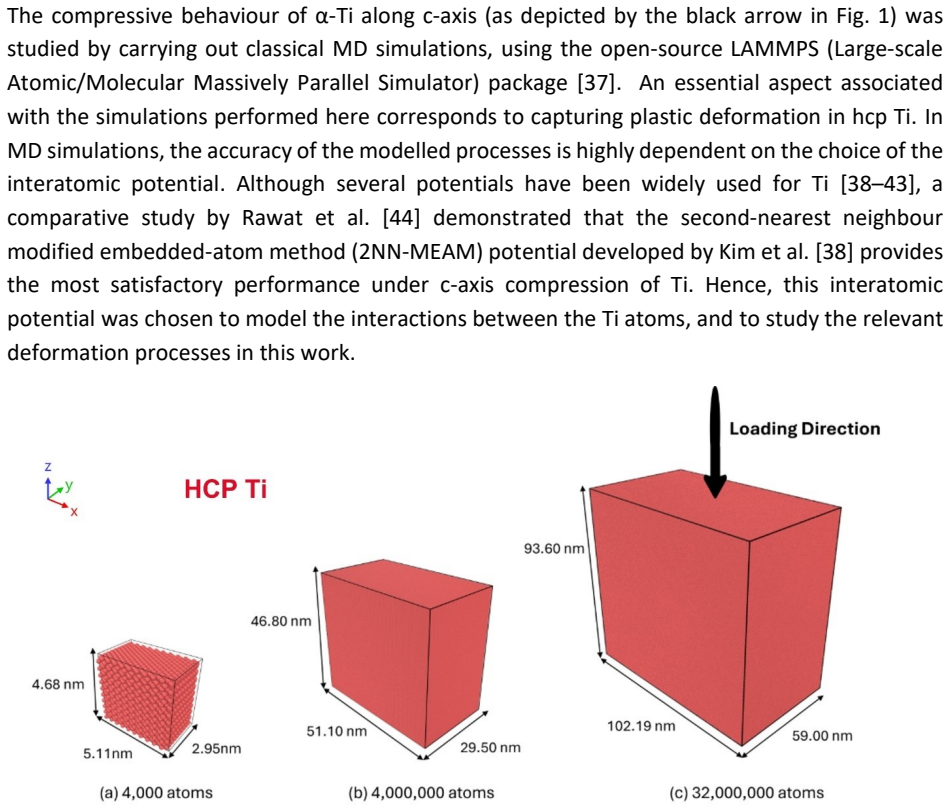
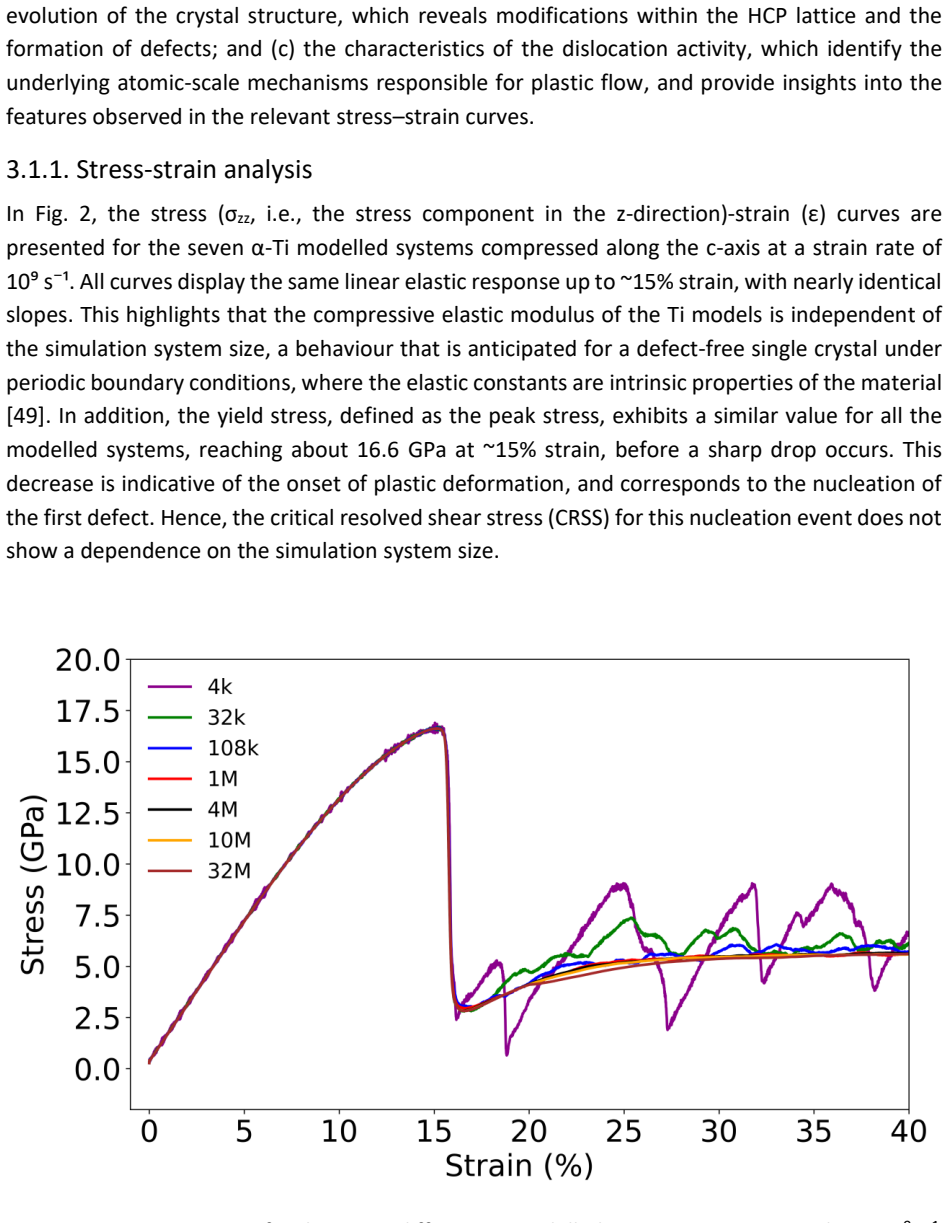
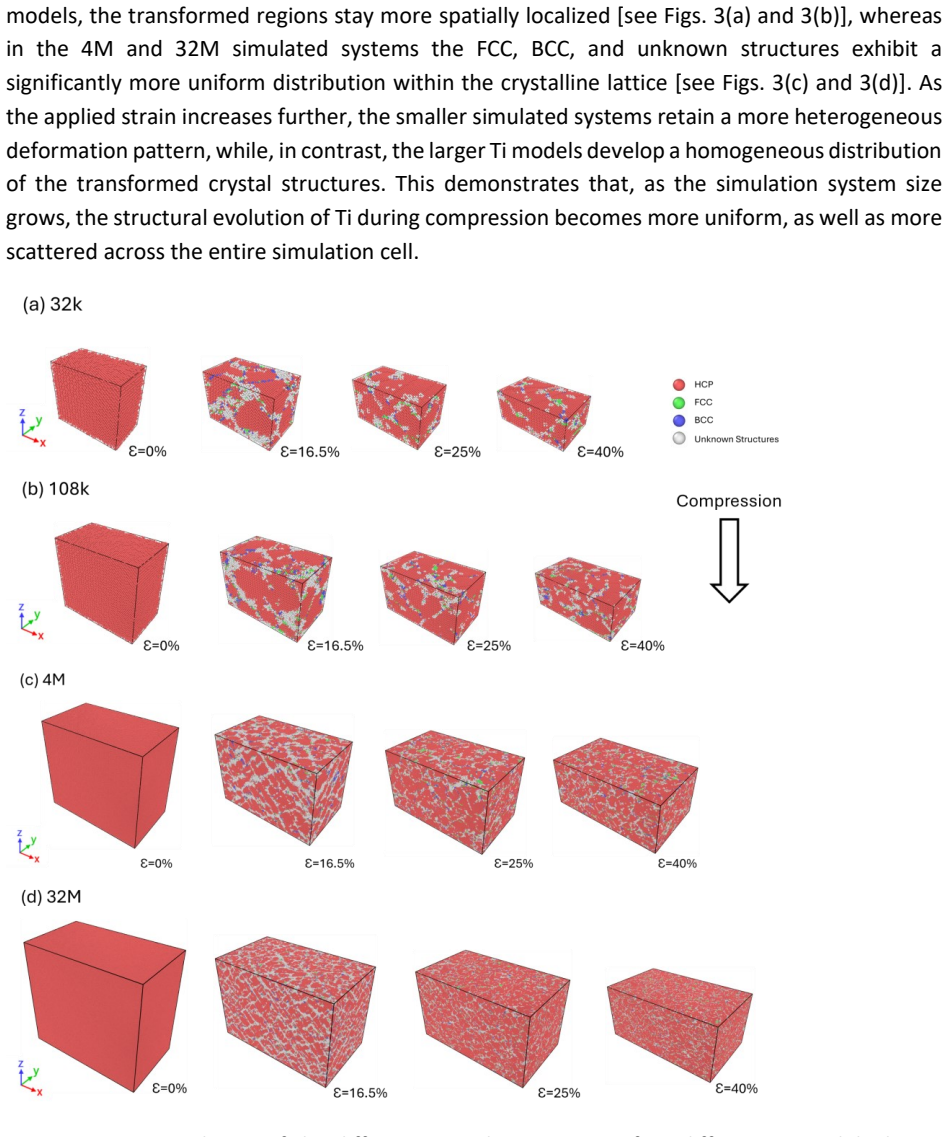
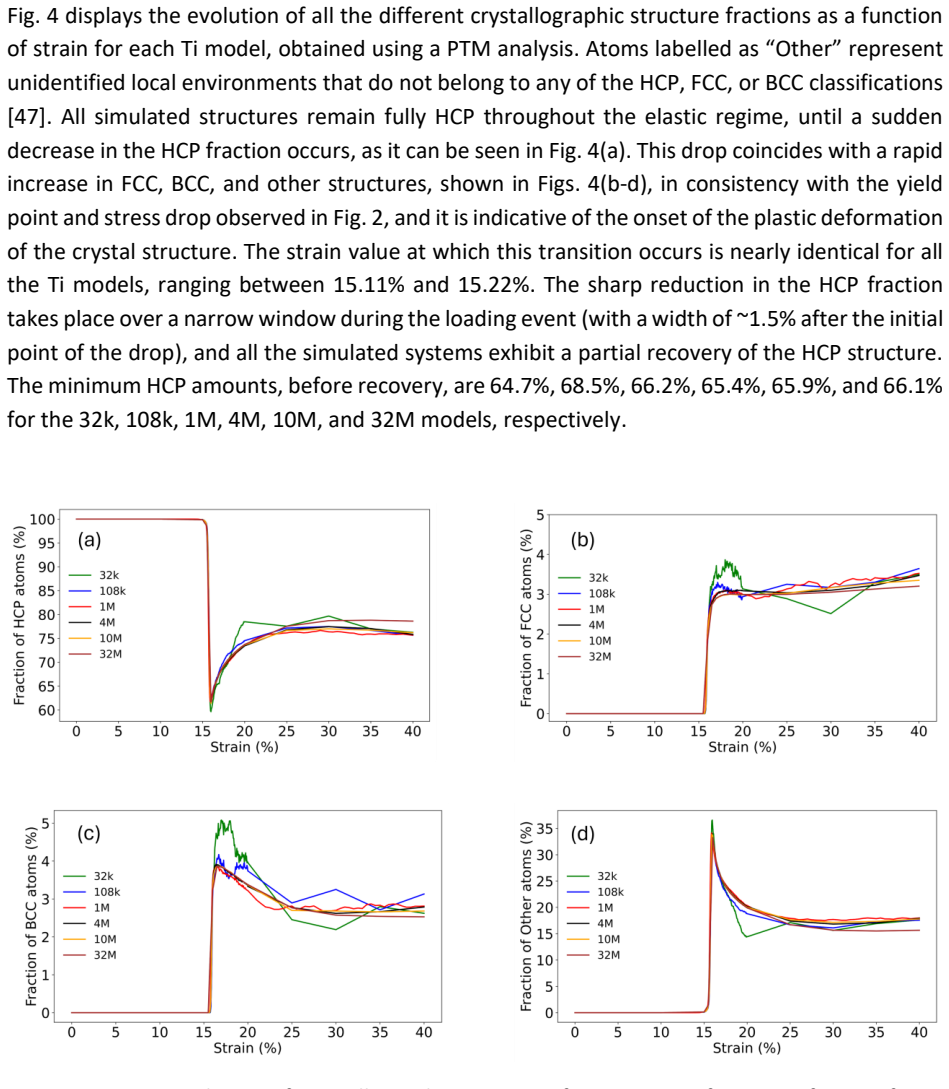
In this computational study, molecular-dynamics simulations ascertain the impact of model size on the mechanical response of alpha-titanium under compression. The deformation behaviour is investigated as a function of system sizes varied by four orders of magnitude up to 32 million atoms, and strain rates down to 10^8 s^-1. The elastic properties remain independent of both system size and strain rate, whereas marked size effects emerge during plastic deformation. Increasing the system size reduces stress fluctuations, results in more homogeneous structural evolution, and stabilizes dislocation activity. Decreasing the applied strain rate requires a larger system size to achieve equilibration
What carries the argument
Molecular dynamics models of HCP titanium crystals under uniaxial compression, with system sizes from small to 32 million atoms, used to compare elastic and plastic responses including dislocation activity.
If this is right
- Elastic constants extracted from small simulations remain valid for larger systems.
- Plastic deformation simulations must use sufficiently large systems to avoid artificial stress fluctuations.
- Lower strain rates demand proportionally larger models to maintain stable dislocation dynamics.
- Combined size and rate effects control the homogeneity of structural changes during compression.
Where Pith is reading between the lines
- Similar size requirements may apply to simulations of other HCP metals like zirconium or magnesium.
- Experimental validation at lower strain rates would require even larger computational models than those tested here.
- These findings suggest that convergence studies with respect to system size are essential before interpreting plastic flow mechanisms from MD results.
Load-bearing premise
The chosen interatomic potential and boundary conditions produce deformation mechanisms representative of real titanium across the varied system sizes and strain rates.
What would settle it
If simulations with systems larger than 32 million atoms at strain rates below 10^8 s^-1 still show the same size-dependent plastic behavior instead of converging, the claim of stabilization with size would be challenged.
Figures


read the original abstract
Understanding the deformation behaviour of titanium is important not only for technological advances associated with industrially-relevant applications, but also essential to achieve a fundamental understanding of the mechanical properties of the relevant alloys. In this computational study, molecular-dynamics simulations are employed to ascertain the impact of model size on the mechanical response of alpha-titanium under compression. The deformation behaviour of the crystalline models is investigated as a function of different system sizes (varied by four orders of magnitude, up to 32 million atoms), and strain rates (down to 10^8 s^-1). The results show that the elastic properties remain independent of both system size and strain rate, whereas marked size effects emerge during plastic deformation. Increasing the system size of the titanium model reduces stress fluctuations, results in more homogeneous structural evolution, and stabilizes dislocation activity. Decreasing the applied strain rate requires correspondingly a larger system size to achieve equilibration and to ensure a stable behaviour for the simulated structure. The modelling results demonstrate that system size and strain rate are strongly coupled, and their combined effect governs the simulated deformation behaviour of the compressed crystalline material.
Editorial analysis
A structured set of objections, weighed in public.
Referee Report
Summary. The manuscript reports molecular-dynamics simulations of uniaxial compression on HCP titanium crystals, varying system size over four orders of magnitude (up to 32 million atoms) and strain rate down to 10^8 s^{-1}. It claims that elastic properties remain independent of both size and rate, while plastic deformation exhibits clear size effects: larger systems reduce stress fluctuations, produce more homogeneous structural evolution, and stabilize dislocation activity. The work concludes that system size and strain rate are strongly coupled and must be considered jointly to obtain equilibrated, stable plastic response.
Significance. If the results hold, the study would be useful for the atomistic modeling of HCP metals by providing concrete evidence that plastic deformation requires substantially larger cells than elastic response and by demonstrating the size-rate coupling at accessible MD scales. The direct simulation of dislocation activity in cells up to 32 M atoms is a technical strength that supplies practical guidance on convergence for similar systems.
major comments (1)
- [Methods section] Methods section: the interatomic potential is not identified and no validation is reported against experimental or DFT values for key quantities controlling plastic flow (dislocation nucleation barriers, stacking-fault energies, or cross-slip energetics in HCP Ti). Because the central claim concerns the emergence and stabilization of dislocation-mediated plasticity with increasing cell size, the absence of such validation makes it impossible to determine whether the reported homogenization and rate-size coupling are representative or potential-specific artifacts.
Simulated Author's Rebuttal
We thank the referee for the constructive comment on the methods section. We address it point-by-point below and will revise the manuscript accordingly.
read point-by-point responses
-
Referee: [Methods section] Methods section: the interatomic potential is not identified and no validation is reported against experimental or DFT values for key quantities controlling plastic flow (dislocation nucleation barriers, stacking-fault energies, or cross-slip energetics in HCP Ti). Because the central claim concerns the emergence and stabilization of dislocation-mediated plasticity with increasing cell size, the absence of such validation makes it impossible to determine whether the reported homogenization and rate-size coupling are representative or potential-specific artifacts.
Authors: We agree that the interatomic potential must be explicitly identified and that validation against experimental and DFT data for dislocation nucleation barriers, stacking-fault energies, and cross-slip energetics is necessary to support claims about dislocation-mediated plasticity. In the revised manuscript we will update the Methods section to name the potential and add the requested validation comparisons. This will allow readers to evaluate whether the reported size-rate coupling is representative. revision: yes
Circularity Check
No circularity; results are direct outputs of MD simulations
full rationale
The paper presents molecular-dynamics simulation results on HCP titanium under uniaxial compression, varying system size (up to 32 million atoms) and strain rate (down to 10^8 s^-1). Claims that elastic properties are independent of size/rate while plastic deformation exhibits size effects, reduced stress fluctuations, and stabilized dislocation activity are reported as direct simulation outputs, not as predictions derived from equations or fitted parameters. No self-definitional steps, fitted-input predictions, load-bearing self-citations, uniqueness theorems, or ansatz smuggling appear in the abstract or described methodology. The modeling assumptions (interatomic potential and boundary conditions) are external inputs whose validity is a separate question of model fidelity, not a circular reduction of the reported results to themselves. The derivation chain is therefore self-contained as computational observation.
Axiom & Free-Parameter Ledger
axioms (1)
- standard math Newtonian mechanics and periodic boundary conditions govern atomic motion in the simulated crystal
Reference graph
Works this paper leans on
-
[1]
Y. Li, C. Yang, H. Zhao, S. Qu, X. Li, Y. Li, New developments of Ti-based alloys for biomedical applications, Materials 7 (2014) 1709–1800. https://doi.org/10.3390/ma7031709
-
[2]
P. Pushp, S.M. Dasharath, C. Arati, Classification and applications of titanium and its alloys, Mater. Today Proc. 54 (2022) 537–542. https://doi.org/10.1016/j.matpr.2022.01.008
-
[3]
M. Najafizadeh, S. Yazdi, M. Bozorg, M. Ghasempour-Mouziraji, M. Hosseinzadeh, M. Zarrabian, P. Cavaliere, Classification and applications of titanium and its alloys: A review, J. Alloys Compd. Commun. 3 (2024) 100019. https://doi.org/10.1016/j.jacomc.2024.100019
-
[4]
C. Leyens, M. Peters, eds., Titanium and Titanium Alloys, Wiley, 2003. https://doi.org/10.1002/3527602119
-
[5]
Schauerte, Titanium in Automotive Production, Adv
O. Schauerte, Titanium in Automotive Production, Adv. Eng. Mater. 5 (2003) 411–418. https://doi.org/10.1002/adem.200310094
-
[6]
D. Raabe, B. Sander, M. Friák, D. Ma, J. Neugebauer, Theory-guided bottom-up design of β-titanium alloys as biomaterials based on first principles calculations: Theory and experiments, Acta Mater. 55 (2007) 4475–4487. https://doi.org/10.1016/j.actamat.2007.04.024. 23
-
[7]
D. Ryu, Y. Kim, S. Nahm, L. Kang, Recent developments in plastic deformation behavior of titanium and its alloys during the rolling process: A review, Materials 17 (2024) 6060. https://doi.org/10.3390/ma17246060
-
[8]
X. Zheng, M. Gong, T. Xiong, H. Ge, L. Yang, Y. Zhou, S. Zheng, J. Wang, X. Ma, Deformation induced FCC lamellae and their interaction in commercial pure Ti, Scr. Mater. 162 (2019) 326–330. https://doi.org/10.1016/j.scriptamat.2018.11.037
-
[9]
S. Nemat-Nasser, W.G. Guo, J.Y. Cheng, Mechanical properties and deformation mechanisms of a commercially pure titanium, Acta Mater. 47 (1999) 3705–3720. https://doi.org/10.1016/S1359-6454(99)00203-7
-
[10]
H. Zhang, X. Ou, B. Wei, S. Ni, M. Song, Strain direction dependency of deformation mechanisms in an HCP-Ti crystalline by molecular dynamics simulations, Comput. Mater. Sci. 172 (2020) 109328. https://doi.org/10.1016/j.commatsci.2019.109328
-
[11]
Morrow, R.A
B.M. Morrow, R.A. Lebensohn, C.P. Trujillo, D.T. Martinez, F.L. Addessio, C.A. Bronkhorst, T. Lookman, E.K. Cerreta, Characterization and modeling of mechanical behavior of single crystal titanium deformed by split-Hopkinson pressure bar, Int. J. Plast. 82 (2016) 225–
2016
-
[12]
https://doi.org/10.1016/j.ijplas.2016.03.006
-
[13]
B.D. Bishoyi, R.K. Sabat, S.K. Sahoo, Effect of temperature on microstructure and texture evolutions during uniaxial compression of commercially pure titanium, Mater. Sci. Eng. A 718 (2018) 398–411. https://doi.org/10.1016/j.msea.2018.01.128
-
[14]
S. Rawat, N. Mitra, Evolution of tension twinning in single crystal Ti under compressive uniaxial strain conditions, Comput. Mater. Sci. 141 (2018) 302–312. https://doi.org/10.1016/j.commatsci.2017.09.041
-
[15]
S. Rawat, P.M. Raole, Molecular dynamics investigation of void evolution dynamics in single crystal iron at extreme strain rates, Comput. Mater. Sci. 154 (2018) 393–404. https://doi.org/10.1016/j.commatsci.2018.08.010
-
[16]
S. Rawat, N. Mitra, Twinning assisted α to ω phase transformation in titanium single crystal, AIP Conf. Proc. 1832 (2017) 030018. https://doi.org/10.1063/1.4980197
-
[17]
H. Zong, X. Ding, T. Lookman, J. Sun, Twin boundary activated α → ω phase transformation in titanium under shock compression, Acta Mater. 115 (2016) 1–9. https://doi.org/10.1016/j.actamat.2016.05.037
-
[18]
A.A. Salem, S.R. Kalidindi, R.D. Doherty, Strain hardening of titanium: role of deformation twinning, Acta Mater. 51 (2003) 4225–4237. https://doi.org/10.1016/S1359- 6454(03)00239-8. 24
-
[19]
J. Li, L. Dong, H. Xie, W. Meng, X. Zhang, J. Zhang, W. Zhao, Molecular dynamics simulation of nanocrack propagation mechanism of polycrystalline titanium under tension deformation in nanoscale, Mater. Today Commun. 26 (2021) 101837. https://doi.org/10.1016/j.mtcomm.2020.101837
-
[20]
T.-T.B. Ngo, V.-T. Nguyen, T.-H. Fang, Deformation and phase transformation of dual- phase Ti under tension and compression process, J. Mol. Model. 31 (2025) 125. https://doi.org/10.1007/s00894-025-06349-0
-
[21]
Y. Niu, Y. Jia, X. Lv, Y. Zhu, Y. Wang, Molecular dynamics simulations of polycrystalline titanium mechanical properties: Grain size effect, Mater. Today Commun. 40 (2024) 109558. https://doi.org/10.1016/j.mtcomm.2024.109558
-
[22]
L. Chang, C.-Y. Zhou, L.-L. Wen, J. Li, X.-H. He, Molecular dynamics study of strain rate effects on tensile behavior of single crystal titanium nanowire, Comput. Mater. Sci. 128 (2017) 348–358. https://doi.org/10.1016/j.commatsci.2016.11.034
-
[23]
M. An, M. Su, Q. Deng, H. Song, C. Wang, Y. Shang, Anisotropic plasticity of nanocrystalline Ti: A molecular dynamics simulation, Chin. Phys. B 29 (2020) 046201. https://doi.org/10.1088/1674-1056/ab7188
-
[24]
J. Ren, Q. Sun, L. Xiao, X. Ding, J. Sun, Size-dependent of compression yield strength and deformation mechanism in titanium single-crystal nanopillars orientated [0001] and [112̄0], Mater. Sci. Eng. A 615 (2014) 22–28. https://doi.org/10.1016/j.msea.2014.07.065
-
[25]
Y. Li, J. Li, B. Liu, Homogeneous shear-driven reversible α-to-α″ phase transformation and superelasticity of titanium investigated by molecular dynamics simulations, Acta Mater. 93 (2015) 105–113. https://doi.org/10.1016/j.actamat.2015.04.009
-
[26]
P. Srinivasan, L. Nicola, A. Simone, Atomistic modeling of the orientation-dependent pseudoelasticity in NiTi: Tension, compression, and bending, Comput. Mater. Sci. 154 (2018) 25–36. https://doi.org/10.1016/j.commatsci.2018.07.028
-
[27]
S. Fazeli, M. Izadifar, J.S. Dolado, A. Ramazani, S.K. Sadrnezhaad, Atomistic study of the effect of crystallographic orientation on the twinning and detwinning behavior of NiTi shape memory alloys, Comput. Mater. Sci. 203 (2022) 111080. https://doi.org/10.1016/j.commatsci.2021.111080
-
[28]
Z.-C. Ma, X.-Z. Tang, Y. Mao, Y.-F. Guo, The Plastic Deformation Mechanisms of hcp Single Crystals with Different Orientations: Molecular Dynamics Simulations, Materials 14 (2021) 733. https://doi.org/10.3390/ma14040733. 25
-
[29]
S. Chen, H. Wang, P. Yan, S. Li, H. Zhang, H. Zhan, Molecular Dynamics Simulation of Temperature and Ti Volume Fraction on Compressive Properties of Ti/Al Layered Composites, Metals (Basel) 14 (2024) 1182. https://doi.org/10.3390/met14101182
-
[30]
I.V. Nelasov, A.I. Kartamyshev, A.O. Boev, A.G. Lipnitskii, Y.R. Kolobov, T.K. Nguyen, Molecular dynamics simulation of the behavior of titanium under high-speed deformation, Model. Simul. Mater. Sci. Eng. 29 (2021) 065012. https://doi.org/10.1088/1361-651X/ac0c22
-
[31]
S. Rawat, N. Mitra, Molecular dynamics investigation of c-axis deformation of single crystal Ti under uniaxial stress conditions: Evolution of compression twinning and dislocations, Comput. Mater. Sci. 141 (2018) 19–29. https://doi.org/10.1016/j.commatsci.2017.09.015
-
[32]
Frenkel, Simulations: The dark side, Eur
D. Frenkel, Simulations: The dark side, Eur. Phys. J. Plus 128 (2013) 10. https://doi.org/10.1140/epjp/i2013-13010-8
-
[33]
A. Mahata, M. Asle Zaeem, Size effect in molecular dynamics simulation of nucleation process during solidification of pure metals: investigating modified embedded atom method interatomic potentials, Model. Simul. Mater. Sci. Eng. 27 (2019) 085015. https://doi.org/10.1088/1361-651X/ab4b36
-
[34]
J.J. Salacuse, A.R. Denton, P.A. Egelstaff, Finite-size effects in molecular dynamics simulations: Static structure factor and compressibility. I. Theoretical method, Phys. Rev. E 53 (1996) 2382–2389. https://doi.org/10.1103/PhysRevE.53.2382
-
[35]
G. Sainath, B.K. Choudhary, T. Jayakumar, Molecular dynamics simulation studies on the size dependent tensile deformation and fracture behaviour of body centred cubic iron nanowires, Comput. Mater. Sci. 104 (2015) 76–83. https://doi.org/10.1016/j.commatsci.2015.03.053
-
[36]
Hirel, Atomsk: A tool for manipulating and converting atomic data files.Comp
P. Hirel, Atomsk: A tool for manipulating and converting atomic data files, Comput. Phys. Commun. 197 (2015) 212–219. https://doi.org/10.1016/j.cpc.2015.07.012
-
[37]
Wood, The Lattice Constants of High Purity Alpha Titanium, Proc
R.M. Wood, The Lattice Constants of High Purity Alpha Titanium, Proc. Phys. Soc. 80 (1962) 783–786. https://doi.org/10.1088/0370-1328/80/3/323
-
[38]
Plimpton, Fast Parallel Algorithms for Short-Range Molecular Dynamics, J
S. Plimpton, Fast Parallel Algorithms for Short-Range Molecular Dynamics, J. Comput. Phys. 117 (1995) 1–19. https://doi.org/10.1006/jcph.1995.1039
-
[39]
Y.-M. Kim, B.-J. Lee, M.I. Baskes, Modified embedded-atom method interatomic potentials for Ti and Zr, Phys. Rev. B 74 (2006) 014101. https://doi.org/10.1103/PhysRevB.74.014101. 26
-
[40]
R.R. Zope, Y. Mishin, Interatomic potentials for atomistic simulations of the Ti-Al system, Phys. Rev. B 68 (2003) 024102. https://doi.org/10.1103/PhysRevB.68.024102
-
[41]
H. Sharifi, C.D. Wick, Developing interatomic potentials for complex concentrated alloys of Cu, Ti, Ni, Cr, Co, Al, Fe, and Mn, Comput. Mater. Sci. 248 (2025) 113595. https://doi.org/10.1016/j.commatsci.2024.113595
-
[42]
M.S. Nitol, D.E. Dickel, C.D. Barrett, Machine learning models for predictive materials science from fundamental physics: An application to titanium and zirconium, Acta Mater. 224 (2022) 117347. https://doi.org/10.1016/j.actamat.2021.117347
-
[43]
R.G. Hennig, T.J. Lenosky, D.R. Trinkle, S.P. Rudin, J.W. Wilkins, Classical potential describes martensitic phase transformations between the α, β, and ω titanium phases, Phys. Rev. B 78 (2008) 054121. https://doi.org/10.1103/PhysRevB.78.054121
-
[44]
Ackland, Theoretical study of titanium surfaces and defects with a new many-body potential, Philos
G.J. Ackland, Theoretical study of titanium surfaces and defects with a new many-body potential, Philos. Mag. A 66 (1992) 917–932. https://doi.org/10.1080/01418619208247999
-
[45]
S. Rawat, N. Mitra, Compression twinning and structural phase transformation of single crystal titanium under uniaxial compressive strain conditions: Comparison of inter- atomic potentials, Comput. Mater. Sci. 126 (2017) 228–237. https://doi.org/10.1016/j.commatsci.2016.09.034
-
[46]
Evans, B.L
D.J. Evans, B.L. Holian, The Nose–Hoover thermostat, J. Chem. Phys. 83 (1985) 4069–
1985
-
[47]
https://doi.org/10.1063/1.449071
-
[48]
A. Stukowski, Visualization and analysis of atomistic simulation data with OVITO–the Open Visualization Tool, Model. Simul. Mater. Sci. Eng. 18 (2010) 015012. https://doi.org/10.1088/0965-0393/18/1/015012
-
[49]
P.M. Larsen, S. Schmidt, J. Schiøtz, Robust structural identification via polyhedral template matching, Model. Simul. Mater. Sci. Eng. 24 (2016) 055007. https://doi.org/10.1088/0965-0393/24/5/055007
-
[50]
A. Stukowski, V.V. Bulatov, A. Arsenlis, Automated identification and indexing of dislocations in crystal interfaces, Model. Simul. Mater. Sci. Eng. 20 (2012) 085007. https://doi.org/10.1088/0965-0393/20/8/085007
-
[51]
E.B. Tadmor, R.E. Miller, Modeling Materials, Cambridge University Press, 2011. https://doi.org/10.1017/CBO9781139003582. 27
-
[52]
B. von Blanckenhagen, P. Gumbsch, E. Arzt, Dislocation sources in discrete dislocation simulations of thin-film plasticity and the Hall-Petch relation, Model. Simul. Mater. Sci. Eng. 9 (2001) 157–169. https://doi.org/10.1088/0965-0393/9/3/303
-
[53]
D. Hull, D.J. Bacon, Defects in Crystals, in: Introduction to Dislocations, Butterworth- Heinemann, Oxford, 2011, pp. 1–20. https://doi.org/10.1016/B978-0-08-096672- 4.00001-3
-
[54]
L. Nervo, A. King, A. Fitzner, W. Ludwig, M. Preuss, A study of deformation twinning in a titanium alloy by X-ray diffraction contrast tomography, Acta Mater. 105 (2016) 417–428. https://doi.org/10.1016/j.actamat.2015.12.032
-
[55]
E. Clouet, D. Caillard, N. Chaari, F. Onimus, D. Rodney, Dislocation locking versus easy glide in titanium and zirconium, Nat. Mater. 14 (2015) 931–936. https://doi.org/10.1038/nmat4340
-
[56]
S. Rawat, N. Mitra, Twinning, phase transformation and dislocation evolution in single crystal titanium under uniaxial strain conditions: A molecular dynamics study, Comput. Mater. Sci. 172 (2020) 109325. https://doi.org/10.1016/j.commatsci.2019.109325
-
[57]
Akhtar, Basal slip and twinning in α-titanium single crystals, Metall
A. Akhtar, Basal slip and twinning in α-titanium single crystals, Metall. Trans. A 6 (1975) 1105–1113. https://doi.org/10.1007/BF02661366
-
[58]
H. Liu, X.K. Shang, B.B. He, Z.Y. Liang, Strain rate dependence of strengthening mechanisms in ultrahigh strength lath martensite, Int. J. Plast. 161 (2023) 103495. https://doi.org/10.1016/j.ijplas.2022.103495
-
[59]
I. Dowding, C.A. Schuh, Metals strengthen with increasing temperature at extreme strain rates, Nature 630 (2024) 91–95. https://doi.org/10.1038/s41586-024-07420-1
-
[60]
M. Vedani, Plastic Deformation of Metals, in: Metal Science in Modern Manufacturing Technologies, Springer Nature Switzerland, 2025, pp. 35–56. https://doi.org/10.1007/978-3-031-97125-9_2. 28 Uniaxial compression of crystalline HCP titanium: an atomistic modelling study of size effects Fatemeh Safari a,*, Konstantinos Konstantinou a,* a Department of Mech...
discussion (0)
Sign in with ORCID, Apple, or X to comment. Anyone can read and Pith papers without signing in.