pith. sign in

arxiv: 2605.29137 · v1 · pith:5YENBPITnew · submitted 2026-05-27 · 🪐 quant-ph

Quantum error correction and fault tolerance: A comprehensive tutorial

Pith reviewed 2026-06-29 11:16 UTC · model grok-4.3

classification 🪐 quant-ph
keywords quantum error correctionfault tolerancestabilizer codestopological codesqLDPC codesbosonic codesqudit codessyndrome decoding
0
0 comments X

The pith

This tutorial develops the core concepts of quantum error correction from codes and syndromes through to fault tolerance and modern code families.

A machine-rendered reading of the paper's core claim, the machinery that carries it, and where it could break.

The paper sets out to give newcomers and researchers a single coherent path through quantum error correction, beginning with the basic objects of codes, syndromes, stabilizers, decoding, and fault tolerance. It then links these objects to established and newer constructions including topological codes, subsystem codes, bosonic and qudit codes, dynamical codes, and quantum low-density parity-check codes. A reader would care because the same framework shows how fragile quantum states can be protected from noise without copying or direct measurement, which is required for any scalable quantum computer. The emphasis throughout is on operational use: how each object is applied in code design, error diagnosis, and fault-tolerant operations.

Core claim

The tutorial develops the core concepts of codes, syndromes, stabilizers, decoding, and fault tolerance before connecting them to major code families and current research directions, covering both established constructions and newer developments including topological and subsystem codes, bosonic and qudit codes, dynamical codes, and quantum low-density parity-check codes, with the goal of building operational understanding of how these objects are used in code design, error diagnosis, decoding, and fault-tolerant computation.

What carries the argument

The stabilizer formalism, which defines quantum codes through sets of operators whose measurement outcomes (syndromes) reveal errors without disturbing the encoded logical information.

If this is right

  • Readers gain the ability to diagnose errors in a quantum system by extracting syndrome information without collapsing the state.
  • Operational understanding of stabilizers and decoding allows systematic design of codes matched to particular noise models.
  • Connection of basic concepts to topological, subsystem, bosonic, qudit, dynamical, and qLDPC codes equips readers to follow and contribute to active research directions.
  • Grasp of fault tolerance shows how logical operations can be performed while keeping error rates below a threshold that permits scalable computation.

Where Pith is reading between the lines

These are editorial extensions of the paper, not claims the author makes directly.

  • A shared reference of this kind could reduce duplication of effort when experimental groups adopt new codes.
  • The tutorial structure itself suggests a natural sequence for teaching modules that move from abstract stabilizers to concrete hardware implementations.
  • Periodic updates could test whether emerging dynamical or qLDPC constructions remain central or are superseded by still newer families.

Load-bearing premise

The topics, code families, and explanations chosen for the tutorial accurately and comprehensively represent the most relevant material for both newcomers and researchers without significant omissions or outdated framing.

What would settle it

A demonstration that a central recent development in quantum error correction, such as an important new code family or decoding algorithm, is either omitted or described with explanations that no longer match current practice would show the tutorial's selection is incomplete.

Figures
Figures reproduced from arXiv: 2605.29137 by Andrew Tanggara, Daniel J. Spencer, Derek Khu, Kishor Bharti, Shubham P. Jain, Tobias Haug, Zeen Sun.

Figure 1
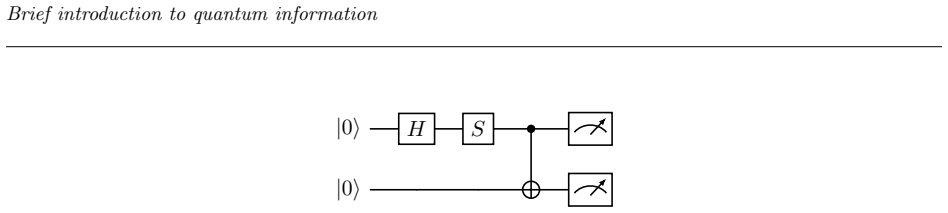
Figure 1. Figure 1: Example of a quantum circuit. The figure illustrates the basic structure of a circuit diagram: wires denote qubits, gates represent unitary operations, and meter symbols indicate measurements. measure the qubits, represented by the meter symbols in the figure. Gates can act on one, two, or more qubits, though single-qubit and two-qubit gates are the most common and multi-qubit gates can be decomposed into … view at source ↗
Figure 2
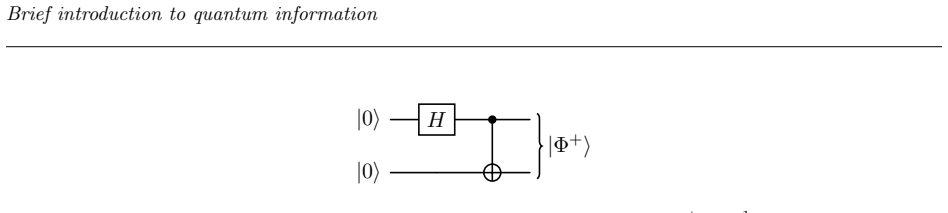
Figure 2. Figure 2: Quantum circuit that prepares the two-qubit Bell state |Φ +⟩ = √ 1 2 (|00⟩ + |11⟩). Other important gates include the phase or S gate and the π/8 or T gate, which are given by S =  1 0 0 i  , T =  1 0 0 e iπ/4  . (2.31) There are also important two-qubit gates, in particular the controlled gates. In a controlled gate, there are two qubits, one called the control and the other called the target, where t… view at source ↗
Figure 3
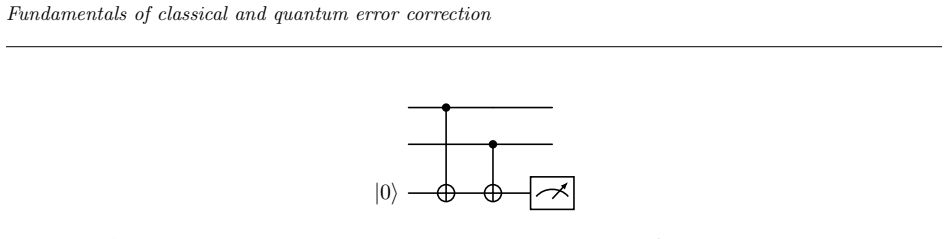
Figure 3. Figure 3: Quantum circuit for measuring the joint parity of two qubits. Ancilla measurement of 1 implies odd parity, while 0 implies even parity. is straightforward. We start by defining the codewords, which are the same codewords as in the classical repetition code but written as kets [PITH_FULL_IMAGE:figures/full_fig_p020_3.png] view at source ↗
Figure 4
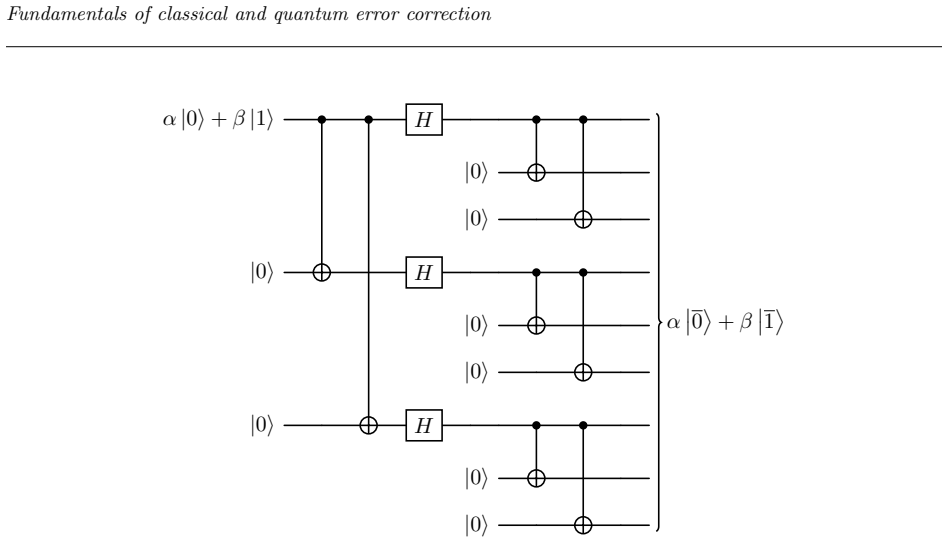
Figure 4. Figure 4: Quantum circuit for encoding a single qubit into the nine-qubit Shor code. errors and correct up to ⌊(dX − 1)/2⌋ = 1 bit-flip error. By contrast, the logical Z operator can be implemented by any of ZII, IZI, IIZ, or ZZZ, where the minimum weight is 1 and hence dZ = 1, meaning that the code cannot detect or correct any phase-flip errors. The overall code distance is therefore d = min{dX, dZ} = 1. (3.22) Thu… view at source ↗
Figure 5
Figure 5. Figure 5: Quantum circuit illustrating a single Z error on the middle block of the nine-qubit Shor code, followed by a syndrome measurement that identifies which block the error occurred in. The syndrome outcome 11 indicates that the Z error occurred on the middle block of three qubits. The full syndrome￾extraction circuit is larger and measures all relevant X- and Z-type syndromes; here we show only the part releva… view at source ↗
Figure 6
Figure 6. Figure 6: Example circuit for measuring the stabilizer P1 ⊗ P2 ⊗ P3. One choice of logical operators is {XXX, ZII}. However, logical operators are not unique: mul￾tiplying a logical operator by any stabilizer gives another operator with the same action on the codespace. For example, multiplying ZII by the stabilizer ZIZ gives IIZ, which is also a valid logical Z. More generally, if |ψ⟩ lies in the codespace and Sj ∈… view at source ↗
Figure 7
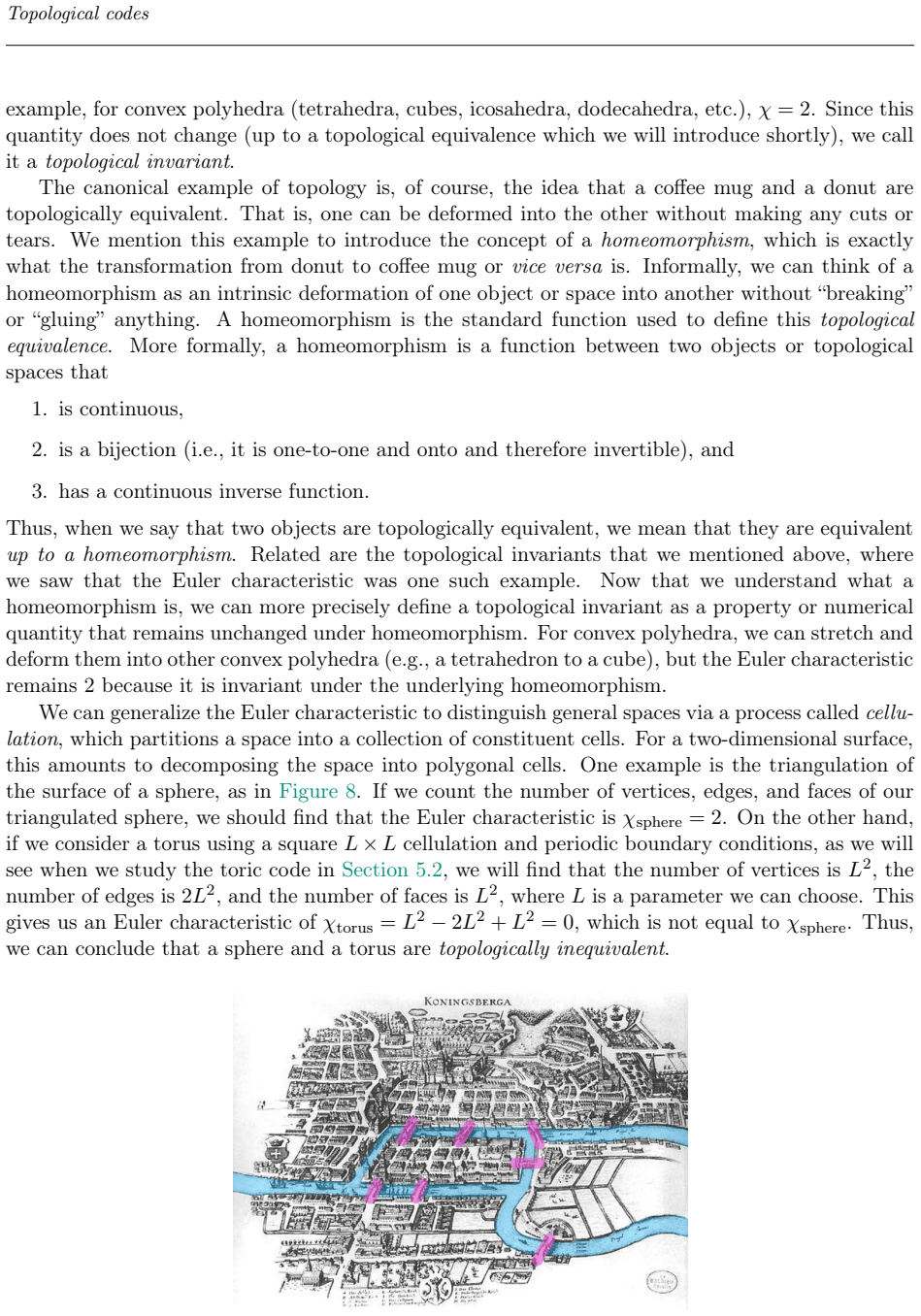
Figure 7. Figure 7: Map of the seven bridges of Königsberg. Photo credit: Wikipedia. 41 [PITH_FULL_IMAGE:figures/full_fig_p041_7.png] view at source ↗
Figure 8
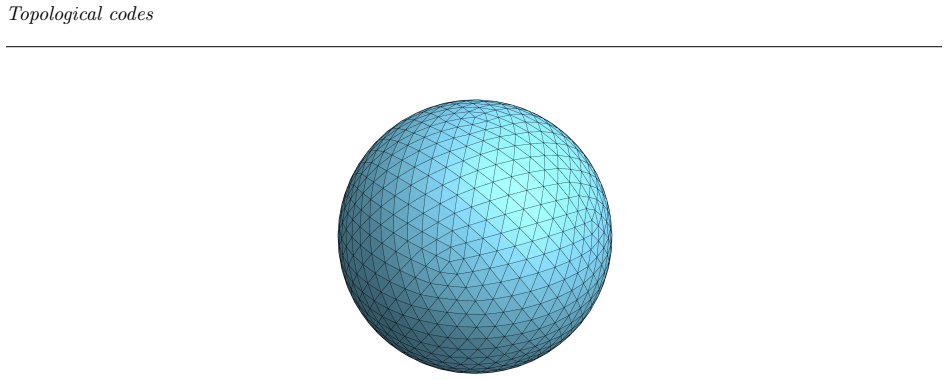
Figure 8. Figure 8: Triangulated sphere. Finally, we highlight an additional property that differentiates topological objects: the number of holes an object has, which we characterize by its genus. In the sphere and torus example from above, we can see that a sphere has 0 holes and a torus has 1 hole. Thus, we say that a sphere is a genus-0 object while a torus is a genus-1 object. One important result that we will find helpf… view at source ↗
Figure 9
Figure 9. Figure 9: (a) 5 × 5 lattice with periodic boundary conditions for the toric code where qubits (hollow circles) are placed on the edges and Zp and Xv are stabilizer generators comprised of Pauli-Z (blue) and Pauli-X (red) operators, respectively. These operators surround either a vertex or a plaquette. The dashed lines indicate the dual lattice. (b) A torus, shown as a geometric visualization of the periodic boundary… view at source ↗
Figure 10
Figure 10. Figure 10: Distance-5 unrotated and rotated surface codes. (a) A 5 × 5 unrotated planar patch with open boundary conditions. Qubits are placed on edges. Interior plaquette and vertex checks have weight 4, while boundary checks have weight 3. The left and right boundaries are rough and the top and bottom boundaries are smooth. (b) A rotated surface code of distance 5. Hollow circles and gray circles denote data and s… view at source ↗
Figure 11
Figure 11. Figure 11: (a) A 3-colorable honeycomb lattice for a 2D color code, with Fr, Fg, and Fb denoting the sets of red, green, and blue faces, respectively. (b) String operators drawn on the red shrunk lattice. Figures are adapted from Ref. [106, Figs. 1 and 3] 61 [PITH_FULL_IMAGE:figures/full_fig_p061_11.png] view at source ↗
Figure 12
Figure 12. Figure 12: The lattice for a 6 × 5 Bacon–Shor code. Red links represent XX gauge generators, and blue links represent ZZ gauge generators. Qubits are located at vertices. 6.3.2 Stabilizers and logicals The stabilizers of the Bacon–Shor code are formed by products of gauge operators that commute with all operators in G. • An X-stabilizer is formed by taking the product of horizontal XX checks across two adjacent colu… view at source ↗
Figure 13
Figure 13. Figure 13: The lattice for the subsystem toric code with M = 3, with two noncontractible loops Γh and Γv labeled. Note that the left and right boundaries of the lattice are identified with each other, and so are the top and bottom boundaries. Qubits are placed at each vertex and the center of each edge of the lattice. Red triangles represent XXX check operators, with an X check at each vertex of the triangle. Blue t… view at source ↗
Figure 14
Figure 14. Figure 14: Distance calculation for the subsystem toric code with M = 3, showing a weight-3 X-error E along the vertical edges. Note that the left and right boundaries of the lattice are identified with each other. To determine the distance of the code, we need to calculate the minimum distance of any nontrivial logical operator. Observe that such a Pauli operator E must commute with all the stabilizers but must ant… view at source ↗
Figure 15
Figure 15. Figure 15: The lattice for the subsystem surface code with M = 4. Like the subsystem toric code, qubits are placed at each vertex and the center of each edge of the lattice. Red triangles represent XXX check operators, with an X check at each vertex of the triangle. Blue triangles represent ZZZ check operators, with a Z check at each vertex of the triangle. Boundary operators of weight-2 are indicated by thick bars … view at source ↗
Figure 16
Figure 16. Figure 16: A change of logical subspace and syndrome subspaces. A subspace stabilizer code Q (left-hand side) consists of logical subspace L which is the joint +1 eigenspace of three stabilizer generators g0, g1, g2, and subspaces corresponding to −1 for each stabilizer generator g0, g1, g2. Any operation performed on a code state |ψ⟩ of Q, such as measurements or gates, may change the code Q to a new subspace stabi… view at source ↗
Figure 17
Figure 17. Figure 17: A 36-qubit Kitaev’s honeycomb code on a hexagonal “honeycomb” lattice with degree 3 on the surface of a torus. The lattice has a periodic boundary condition: The bottom and top boundaries represent the same set of edges, similarly for its left and right boundaries. Colors of hexagonal plaquettes and edges determine 6-qubit stabilizers and 2-qubit check measurements, respectively. In addition to the 6-qubi… view at source ↗
Figure 18
Figure 18. Figure 18: Four-qubit rotated surface code. We label the top-left qubit as qubit 1, top-right qubit as qubit 2, bottom-left qubit 3, and bottom-right qubit 4. The red colored half-circles represent the X1X3 (left) and X2X4 (right) stabilizer generator of the code, whereas the blue square represents the Z1Z2Z3Z4 stabilizer generator. The bright red line and bright blue line represent the X-type logical operator X = X… view at source ↗
Figure 19
Figure 19. Figure 19: Stabilizer group and logical operator update from the 4-qubit rotated surface code (left) to another 4-qubit code (right). Vertices represent qubits, while red (resp. blue) faces represent X (resp. Z) stabilizer generators. Thus, we can see that the updated eigenstates of Z are still eigenstates of Z. On the other hand, the eigenstates of logical X, given by |+⟩ = |0⟩ + |1⟩ √ 2 and |−⟩ = |0⟩ − |1⟩ √ 2 , (… view at source ↗
Figure 20
Figure 20. Figure 20: Four-qubit dynamical code with period-6 measurement schedule given in Eq. (7.19). Red (resp. blue) faces represent Z-type (resp. X-type) stabilizers for each ISG. Bright red (resp. bright blue) lines represent X-type (resp. Z-type) logical operator representative for each ISG. Four-qubit dynamical code as a subsystem code. As we have mentioned, this 4-qubit dy￾namical code does not encode any logical qubi… view at source ↗
Figure 21
Figure 21. Figure 21: Honeycomb lattice for a 36 qubit honeycomb code. Vertices in the lattice represent qubits, edges represent two-qubit check measurements, and hexagonal plaquettes represent stabilizers of the code. Edge color indicates its check measurement basis, where 2-qubit X measurements are performed on green edges, 2-qubit Y measurements on red edges, and 2-qubit Z measurements on blue edges. Similarly, green plaque… view at source ↗
Figure 22
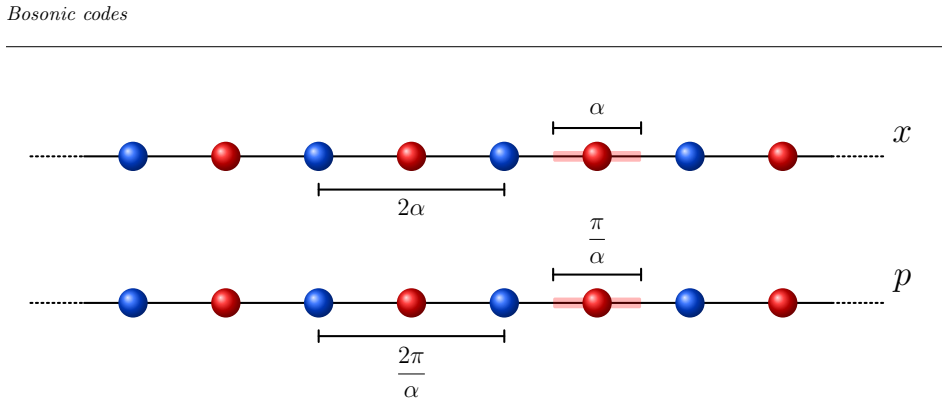
Figure 22. Figure 22: Code states for the d = 2 GKP code are depicted by red and blue spheres. The red region shows the shifts for which the errors are correctable if the initial state was the red state. be rounded back to the nearest lattice point. In this sense, GKP codes convert small continuous displacement errors into correctable syndromes. Position displacement errors e −i∆xpˆ for |∆x| ≤ α/2 can be corrected by projectin… view at source ↗
Figure 23
Figure 23. Figure 23: (Left) Computational basis states for the cat code are visualized in the coherent state basis. The red region shows the dephasing shifts for which the errors are correctable if the initial state was the red state. (Right) Hadamard basis states for the cat code are visualized in the Fock basis. |α|, this family of states [PITH_FULL_IMAGE:figures/full_fig_p094_23.png] view at source ↗
Figure 24
Figure 24. Figure 24: Measurement protocol for Z-type (left) and X-type (right) stabilizers, here shown for weight 4 stabilizers. The decoder’s goal is therefore not necessarily to identify the exact physical error, but rather to determine the most probable logical class [L] consistent with the observed syndrome s. Thus, it is sufficient for the decoder to infer the most likely logical class of the error and then apply the cor… view at source ↗
Figure 25
Figure 25. Figure 25: (a) A cylinder (a trivial fiber bundle) and (b) a Möbius strip (a simple but nontrivial fiber bundle). are lines in this case, they really are like fibers!). Then, the total space is the product of the base space and the fibers, that is, the combined set of points on the circle and the corresponding fibers. Mathematically, we write this as S = B × F, but we took B = S 1 and F = R, so a cylinder can, in fi… view at source ↗
Figure 26
Figure 26. Figure 26: Pauli error propagation through CNOT. The naive use of two-qubit gates can turn one fault into multiple data errors. 143 [PITH_FULL_IMAGE:figures/full_fig_p143_26.png] view at source ↗
Figure 27
Figure 27. Figure 27: Illustration of encoding by concatenation (left) and block encoding (right). In both figures, blue circles represent physical qubits and green circles represent logical qubits. On the left-hand side, each green circle represent an outer J4, 1K code, where each one of its four qubits (yellow, rounded squares) is itself a J4, 1K code (where the four physical qubits are the blue circles inside a yellow round… view at source ↗
Figure 28
Figure 28. Figure 28: Code switching between Steane’s J7, 1, 3K code (right-hand side face of the tetrahedron on the right-hand side) and J15, 1, 3K tetrahedral 3-D color code (left-hand side). (Figure reproduced from [275] with permission from the authors.) of output error is Pr[output error] = Pr[bad output|output accepted] ≤ Pr[bad output accepted] Pr[output accepted] = O(p 2 ) 1 − O(p) = O(p 2 ). (14.154) Thus, we have sho… view at source ↗
read the original abstract

Noise is one of the central obstacles to building useful quantum computers, and quantum error correction (QEC) provides the framework for protecting quantum information against it. Unlike classical error correction, QEC must preserve fragile quantum states without copying them, measuring them directly, or destroying the information they encode. Driven by rapid progress in both theory and experiment, this challenge has grown into one of the most active areas of quantum information science. This tutorial gives a guided introduction to modern QEC, developing the core concepts of codes, syndromes, stabilizers, decoding, and fault tolerance before connecting them to major code families and current research directions. We cover both established constructions and newer developments, including topological and subsystem codes, bosonic and qudit codes, dynamical codes, and quantum low-density parity-check (qLDPC) codes. The emphasis is on building operational understanding: explaining not only what the main objects are, but how they are used in code design, error diagnosis, decoding, and fault-tolerant computation. The tutorial is intended for newcomers seeking a first path through QEC, as well as researchers looking for a coherent reference for the concepts, code families, and tools that arise in current work.

Editorial analysis

A structured set of objections, weighed in public.

Desk editor's note, referee report, simulated authors' rebuttal, and a circularity audit. Tearing a paper down is the easy half of reading it; the pith above is the substance, this is the friction.

Referee Report

0 major / 0 minor

Summary. The manuscript is a tutorial on quantum error correction and fault tolerance. It develops core concepts including codes, syndromes, stabilizers, decoding, and fault tolerance before connecting them to major code families (topological, subsystem, bosonic, qudit, dynamical, and qLDPC codes), with emphasis on operational understanding for code design, error diagnosis, decoding, and fault-tolerant computation. The work is intended for newcomers and as a reference for researchers.

Significance. As a synthesis rather than a source of new theorems or results, the tutorial's significance rests on whether it supplies accurate, operationally useful explanations and a coherent selection of topics amid rapid progress in the field. A high-quality tutorial of this scope could function as a standard reference and training resource in quantum information science.

Simulated Author's Rebuttal

0 responses · 0 unresolved

We thank the referee for their positive review and recommendation to accept the manuscript. The referee's summary correctly identifies the tutorial's scope, target audience, and emphasis on operational understanding of quantum error correction concepts and code families.

Circularity Check

0 steps flagged

No significant circularity: tutorial synthesizes existing literature

full rationale

This paper is explicitly a tutorial that develops core QEC concepts (codes, syndromes, stabilizers, decoding, fault tolerance) by reference to established literature before surveying major code families. No new theorems, derivations, empirical predictions, or first-principles results are asserted; the central claim is educational coverage and operational explanation of prior work. The abstract and structure contain no self-definitional steps, fitted inputs renamed as predictions, or load-bearing self-citations that reduce the content to the paper's own inputs. The topic selection is presented as authorial choice of relevance, not as a derived or forced result. This is the normal case for a survey/tutorial and meets the criterion of being self-contained against external benchmarks.

Axiom & Free-Parameter Ledger

0 free parameters · 2 axioms · 0 invented entities

The tutorial rests on standard quantum information axioms without introducing new free parameters or invented entities; it explains established material from prior literature.

axioms (2)
  • standard math Quantum states cannot be cloned or directly measured without destroying information
    Stated in the abstract as the central distinction from classical error correction and the reason QEC is required.
  • domain assumption Noise is the central obstacle to useful quantum computation
    Opening premise of the abstract that motivates the entire tutorial.

pith-pipeline@v0.9.1-grok · 5756 in / 1239 out tokens · 35052 ms · 2026-06-29T11:16:34.451704+00:00 · methodology

discussion (0)

Sign in with ORCID, Apple, or X to comment. Anyone can read and Pith papers without signing in.

Reference graph

Works this paper leans on

3 extracted references · 1 canonical work pages · 1 internal anchor

  1. [1]

    Fault-Tolerant Conversion between the Steane and Reed-Muller Quantum Codes

    Jonas T. Anderson, Guillaume Duclos-Cianci, and David Poulin, “Fault-Tolerant Conversion between the Steane and Reed-Muller Quantum Codes”,Physical Review Letters113(2014)

  2. [2]

    Efficientfault-tolerantcodeswitchingviaone-waytransver- sal CNOT gates

    SaschaHeußenandJanineHilder,“Efficientfault-tolerantcodeswitchingviaone-waytransver- sal CNOT gates”,Quantum9, 1846 (2025)

  3. [3]

    Magic state cultivation: growing T states as cheap as CNOT gates

    Craig Gidney, Noah Shutty, and Cody Jones, “Magic state cultivation: growingTstates as cheap as CNOT gates”,arXiv:2409.17595(2024). 209