AI-Driven Discovery of Information-Efficient Collider Observables for Interference Measurements
Pith reviewed 2026-06-30 20:25 UTC · model grok-4.3
The pith
Symbolic evolution guided by matrix-element scores discovers compact analytic observables that capture substantially more local Fisher information about CP-violating interactions than standard angular baselines.
A machine-rendered reading of the paper's core claim, the machinery that carries it, and where it could break.
Core claim
By applying symbolic evolution to matrix-element reweighting scores, the method identifies observables for the HZ_{\mu\nu}\tilde Z^{\mu\nu} interaction that retain substantially more local Fisher information than angular baselines while remaining compact analytic functions in both associated production and four-lepton decay channels.
What carries the argument
The symbolic evolution procedure that treats the matrix-element score from reweighting as the statistical fitness target to evolve compact analytic expressions.
If this is right
- In associated production the expressions supplement helicity-interference harmonics with laboratory-frame asymmetry mappings.
- In four-lepton decay the angular kernel is the robust component while the mass-ratio factor acts as a bounded prefactor.
- Optimal-observable design is recast as a symbolic discovery problem that yields transparent, interpretable probes.
- The approach supplies a route to information-efficient observables for collider interference studies.
Where Pith is reading between the lines
- The same guided symbolic search could be applied to other couplings where closed-form optimal observables are unavailable.
- One could test retention of the information advantage by injecting the discovered expressions into existing analysis frameworks with realistic smearing.
- The recovered harmonic structures might suggest new ways to classify interference terms across different processes.
Load-bearing premise
The symbolic evolution procedure guided only by the matrix-element score will converge to expressions that remain information-efficient once detector resolution, backgrounds, and higher-order corrections are included.
What would settle it
A direct numerical comparison, in full detector-level simulation including backgrounds and higher-order corrections, of the local Fisher information obtained from the learned observables versus standard angular baselines; reversal of the reported advantage would falsify the central claim.
Figures


read the original abstract
Optimal observables provide statistically powerful probes of small deformations from a reference theory, but in realistic collider measurements they are rarely available in compact analytic form. We show that interpretable event-level observables can be discovered by AI-driven symbolic evolution using score information from matrix-element reweighting as the statistical target. Focusing on the CP-sensitive interaction $HZ_{\mu\nu}\tilde Z^{\mu\nu}$, we study two complementary realizations of the same coupling structure: associated production $e^+e^-\to Z(\to \mu^-\mu^+)H$ and the decay channel $pp\to H\to ZZ^*\to e^-e^+\mu^-\mu^+$. The learned observables retain substantially more local Fisher information than standard angular baselines while remaining compact analytic functions. In both cases, the discovered expressions recover characteristic helicity-interference harmonics. In associated production these harmonics are supplemented by laboratory-frame asymmetry mappings, while in four-lepton decay the robust component is the angular kernel, with the mass-ratio factor serving as a bounded representative prefactor. These results recast optimal-observable design as a symbolic discovery problem and provide a transparent route to information-efficient, interpretable probes of collider interference.
Editorial analysis
A structured set of objections, weighed in public.
Referee Report
Summary. The paper claims that AI-driven symbolic evolution, guided by matrix-element reweighting scores for the CP-sensitive HZ_{\mu\nu}\tilde Z^{\mu\nu} coupling, can discover compact analytic observables for e^+e^- \to ZH(\to \mu\mu) and H \to 4\ell that retain substantially more local Fisher information than standard angular baselines, recover helicity-interference harmonics, and remain interpretable; the method is demonstrated in associated production (with lab-frame asymmetries) and four-lepton decay (with angular kernels plus bounded mass-ratio prefactors).
Significance. If the information gains hold under realistic conditions, the work recasts optimal-observable construction as an automated symbolic search problem and supplies a transparent route to compact, high-information probes of interference effects; the explicit recovery of known harmonics plus supplementary structures is a concrete strength.
major comments (2)
- [Results (Fisher information comparisons)] The central claim that the discovered observables are substantially more information-efficient for collider measurements rests on Fisher comparisons performed exclusively at parton/truth level (see results sections on associated production and four-lepton decay). No folding with detector resolution, acceptance, backgrounds, or NLO corrections is described, so it remains untested whether the reported gains survive the conditions under which the observables would actually be used.
- [Methods (symbolic evolution procedure)] The symbolic evolution is optimized directly against the matrix-element score; while this avoids circularity in the reported numbers, the manuscript does not demonstrate that the resulting expressions remain optimal or even stable once the score is replaced by a realistic, detector-level likelihood or when higher-order corrections alter the interference structure.
minor comments (2)
- [Associated production results] Notation for the laboratory-frame mappings in the e^+e^- channel could be clarified with an explicit definition of the coordinate system used for the asymmetry terms.
- [Summary of discovered observables] The abstract states that the observables 'remain compact analytic functions,' but the manuscript would benefit from a short table listing the exact discovered expressions alongside their Fisher values for direct comparison with the angular baselines.
Simulated Author's Rebuttal
We thank the referee for the careful reading and constructive feedback on the manuscript. We address the two major comments point by point below.
read point-by-point responses
-
Referee: [Results (Fisher information comparisons)] The central claim that the discovered observables are substantially more information-efficient for collider measurements rests on Fisher comparisons performed exclusively at parton/truth level (see results sections on associated production and four-lepton decay). No folding with detector resolution, acceptance, backgrounds, or NLO corrections is described, so it remains untested whether the reported gains survive the conditions under which the observables would actually be used.
Authors: We agree that the Fisher information comparisons are performed exclusively at parton level. This is a deliberate scope choice to isolate the information efficiency of the symbolically discovered observables using the matrix-element score as target, without confounding factors from experimental effects. The manuscript's core contribution is the automated discovery of compact analytic forms that outperform angular baselines at this level and recover known interference structures. We acknowledge that survival of the gains under detector resolution, acceptance, backgrounds, and NLO corrections remains untested. In the revised version we will add a paragraph in the Conclusions explicitly stating this limitation and identifying full detector-level validation as an important direction for follow-up work. revision: partial
-
Referee: [Methods (symbolic evolution procedure)] The symbolic evolution is optimized directly against the matrix-element score; while this avoids circularity in the reported numbers, the manuscript does not demonstrate that the resulting expressions remain optimal or even stable once the score is replaced by a realistic, detector-level likelihood or when higher-order corrections alter the interference structure.
Authors: The direct optimization against the matrix-element reweighting score is the methodological point of the work: it supplies an unambiguous, circularity-free target for information efficiency at truth level. The resulting expressions are therefore optimal by construction within that well-defined setting. Demonstrating stability or re-optimality under a detector-level likelihood or NLO-altered interference would require an entirely separate campaign of full simulation and re-running the symbolic search, which lies outside the present scope. The paper presents a proof-of-principle that the symbolic-evolution approach can recover high-information, interpretable observables; we do not claim broader robustness at this stage. revision: no
Circularity Check
No circularity in derivation chain; symbolic discovery uses external score target with independent Fisher evaluation
full rationale
The paper's core procedure applies symbolic evolution to discover compact observables guided by an external matrix-element reweighting score for the CP parameter, then performs separate Fisher information comparisons against angular baselines at parton level. This does not reduce the reported information gains to a fitted parameter inside the evolved expressions, a self-citation chain, or a self-definitional loop; the optimization target and the subsequent Fisher metric are distinct, and no load-bearing uniqueness theorem or ansatz is imported from prior author work. The derivation remains self-contained against the stated external benchmark.
Axiom & Free-Parameter Ledger
axioms (1)
- domain assumption Matrix-element reweighting yields a reliable statistical target for local Fisher information
Reference graph
Works this paper leans on
-
[1]
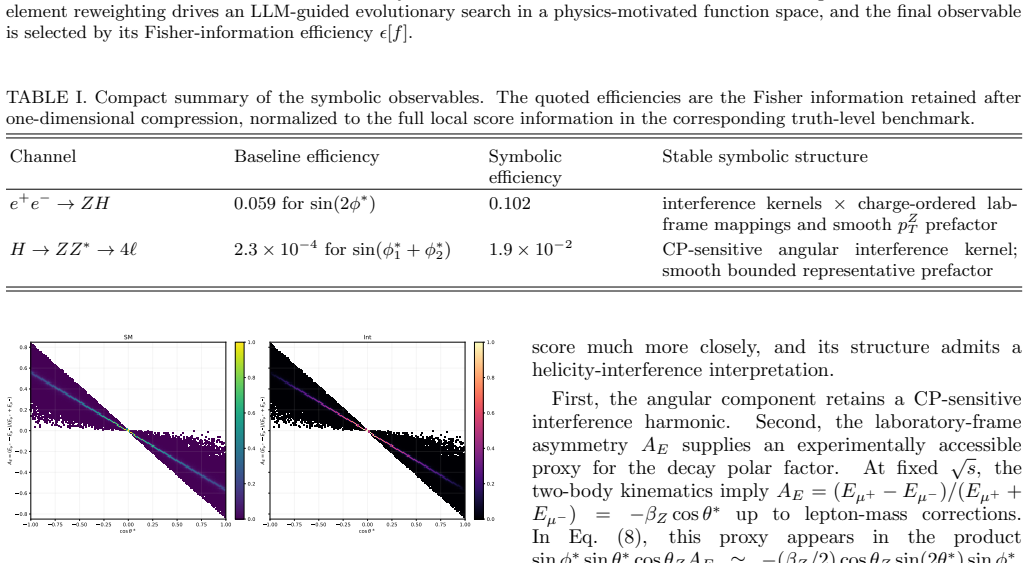
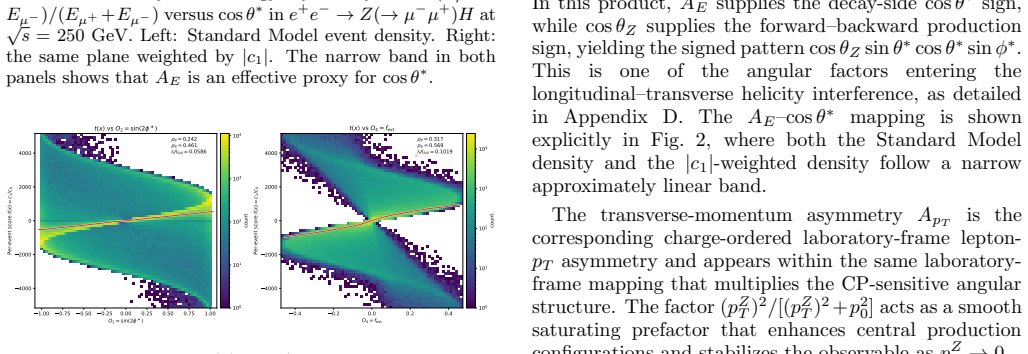
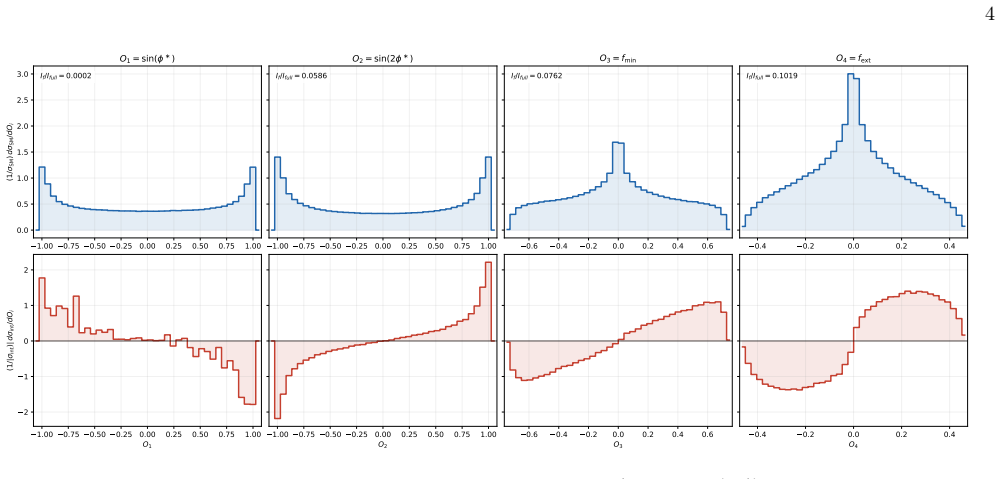
1.9×10 −2 CP-sensitive angular interference kernel; smooth bounded representative prefactor 1.00 0.75 0.50 0.25 0.00 0.25 0.50 0.75 1.00 cos 0.8 0.6 0.4 0.2 0.0 0.2 0.4 0.6 0.8 AE = (E + E )/(E + + E ) SM 1.00 0.75 0.50 0.25 0.00 0.25 0.50 0.75 1.00 cos AE = (E + E )/(E + + E ) Int 0.0 0.2 0.4 0.6 0.8 1.0 0.0 0.2 0.4 0.6 0.8 1.0 FIG. 2. Laboratory-frame e...
2000
-
[2]
The angle and transverse-axis conventions for (θ∗ i , ϕ∗ i ) are defined in Appendix C
sin(ϕ∗ 1 +ϕ ∗ 2),(9) wherer Z ≡m Z2 /(mZ1 +m Z2), with the fixed-flavor conventionZ 1 ≡e −e+ andZ 2 ≡µ −µ+. The angle and transverse-axis conventions for (θ∗ i , ϕ∗ i ) are defined in Appendix C. Again, the angular dependence reconstructs the expected CP-sensitive interference harmonic, now appropriate to theH→ZZ ∗ →4ℓdecay geometry [29– 31, 34, 38–40]. W...
-
[3]
The accompanying invariant-mass factorr Z(1−r Z) is a smooth, bounded representative prefactor selected by the symbolic search
sin(2θ∗ 2) isolates the relevant longitudinal–transverse interference. The accompanying invariant-mass factorr Z(1−r Z) is a smooth, bounded representative prefactor selected by the symbolic search. Direct ablations indicate that the Fisher efficiency is dominated by the angular kernel, so the physical interpretation below focuses on the CP- sensitive ang...
-
[4]
carries only a tiny fraction of the available information, withϵ≃ 2.3×10 −4, whereas the symbolic observable reaches 1.0 0.5 0.0 0.5 1.0 O1 0.0 0.2 0.4 0.6 0.8 1.0 1.2(1/ SM) d SM/dOi O1 = sin( 1 + 2 ) 0.2 0.1 0.0 0.1 0.2 O4 0 2 4 6 8 10 12 14(1/ SM) d SM/dOi O4 1.0 0.5 0.0 0.5 1.0 O1 2 1 0 1 2 (1/| int)| d int/dOi O1 = sin( 1 + 2 ) 0.2 0.1 0.0 0.1 0.2 O4...
-
[5]
The symbolic observable separates opposite- sign interference regions much more clearly than the angular baseline
andO 4ℓ inpp→H→ZZ ∗ → e−e+µ−µ+. The symbolic observable separates opposite- sign interference regions much more clearly than the angular baseline. The Fisher-information efficiency improves from ϵ≃2.3×10 −4 toϵ≃1.9×10 −2. ϵ≃1.9×10 −2. Figure 5 shows this improvement directly: the learned observable reorganizes the events so that opposite-sign interference...
-
[6]
Davier, L
M. Davier, L. Duflot, F. Le Diberder, and A. Rouge, Phys. Lett. B306, 411 (1993)
1993
-
[7]
Diehl and O
M. Diehl and O. Nachtmann, Z. Phys. C62, 397 (1994)
1994
-
[8]
J. Brehmer, F. Kling, I. Espejo, and K. Cranmer, Comput. Softw. Big Sci.4, 3 (2020), 1907.10621
-
[9]
Guest, K
D. Guest, K. Cranmer, and D. Whiteson, Annual Review of Nuclear and Particle Science68, 161 (2018), ISSN 1545-4134, URLhttp://dx.doi.org/10.1146/ annurev-nucl-101917-021019
2018
-
[10]
X. C. Cid Vidal, L. D. Dieste Maro˜ nas, and ´A. D. Dosil Su´ arez, Applied Sciences11, 11076 (2021), ISSN 2076-3417, URLhttp://dx.doi.org/10.3390/ app112211076
2021
- [11]
-
[12]
Radovic, M
A. Radovic, M. Williams, D. Rousseau, M. Kagan, D. Bonacorsi, A. Himmel, A. Aurisano, K. Terao, and T. Wongjirad, Nature560, 41 (2018)
2018
-
[13]
J. H. Collins, K. Howe, and B. Nachman, Phys. Rev. D 99, 014038 (2019), 1902.02634
work page internal anchor Pith review Pith/arXiv arXiv 2019
-
[14]
J. Ren, L. Wu, J. M. Yang, and J. Zhao, Nucl. Phys. B 943, 114613 (2019), 1708.06615
work page internal anchor Pith review Pith/arXiv arXiv 2019
-
[15]
M. Abdughani, D. Wang, L. Wu, J. M. Yang, and J. Zhao, Phys. Rev. D104, 056003 (2021), 2005.11086
- [16]
- [17]
- [18]
-
[19]
R. Barru´ e, P. Conde-Mu´ ı˜ no, V. Dao, and R. Santos, JHEP04, 014 (2024), 2308.02882
-
[20]
Badger et al., SciPost Phys.14, 079 (2023), 2203.07460
S. Badger et al., SciPost Phys.14, 079 (2023), 2203.07460
- [21]
- [22]
-
[23]
Pawan Kumar, Emilien Dupont, Francisco J
B. Romera-Paredes, M. Barekatain, A. Novikov, M. Balog, M. P. Kumar, E. Dupont, F. J. R. Ruiz, J. S. Ellenberg, P. Wang, O. Fawzi, et al., Nature625(2024), URLhttps://doi.org/10.1038/s41586-023-06924-6
-
[24]
AlphaEvolve: A coding agent for scientific and algorithmic discovery
A. Novikov, N. V˜ u, M. Eisenberger, E. Dupont, P.-S. Huang, A. Z. Wagner, S. Shirobokov, B. Kozlovskii, F. J. R. Ruiz, A. Mehrabian, et al. (2025), 2506.13131, URLhttps://arxiv.org/abs/2506.13131
work page internal anchor Pith review Pith/arXiv arXiv 2025
-
[25]
Z.-Y. Song, T.-Z. Yang, Q.-H. Cao, M.-x. Luo, and H. X. Zhu (2025), 2502.09544
- [26]
-
[27]
Automation of the matrix element reweighting method
P. Artoisenet, V. Lemaitre, F. Maltoni, and O. Mattelaer, JHEP12, 068 (2010), 1007.3300
work page internal anchor Pith review Pith/arXiv arXiv 2010
-
[28]
K. Cranmer, J. Brehmer, and G. Louppe, Proc. Nat. Acad. Sci.117, 30055 (2020), 1911.01429
-
[29]
G. J. Gounaris, F. M. Renard, and N. D. Vlachos, Nucl. Phys. B459, 51 (1996)
1996
-
[30]
Deconstructing Angular Correlations in ZH, ZZ, and WW Production at LEP2
G. Mahlon and S. J. Parke, Phys. Rev. D58, 054015 (1998), hep-ph/9803410
work page internal anchor Pith review Pith/arXiv arXiv 1998
-
[31]
Anomalous Higgs couplings in angular asymmetries of H --> Zl+l- and e+e- --> HZ
M. Beneke, D. Boito, and Y.-M. Wang, JHEP11, 028 (2014), 1406.1361
work page internal anchor Pith review Pith/arXiv arXiv 2014
-
[32]
Beyond Higgs Couplings: Probing the Higgs with Angular Observables at Future $e^+ e^-$ Colliders
N. Craig, J. Gu, Z. Liu, and K. Wang, JHEP03, 050 (2016), 1512.06877
work page internal anchor Pith review Pith/arXiv arXiv 2016
- [33]
-
[34]
Y. Gao, A. V. Gritsan, Z. Guo, K. Melnikov, M. Schulze, and N. V. Tran, Phys. Rev. D81, 075022 (2010), 1001.3396
work page internal anchor Pith review Pith/arXiv arXiv 2010
-
[35]
On the spin and parity of a single-produced resonance at the LHC
S. Bolognesi, Y. Gao, A. V. Gritsan, K. Melnikov, M. Schulze, N. V. Tran, and A. Whitbeck, Phys. Rev. D86, 095031 (2012), 1208.4018
work page internal anchor Pith review Pith/arXiv arXiv 2012
-
[36]
Constraining anomalous HVV interactions at proton and lepton colliders
I. Anderson, S. Bolognesi, F. Caola, Y. Gao, A. V. Gritsan, C. B. Martin, K. Melnikov, M. Schulze, N. V. Tran, A. Whitbeck, et al., Phys. Rev. D89, 035007 (2014), 1309.4819
work page internal anchor Pith review Pith/arXiv arXiv 2014
-
[37]
R. M. Godbole, D. J. Miller, and M. M. Muhlleitner, JHEP12, 031 (2007), 0708.0458
work page internal anchor Pith review Pith/arXiv arXiv 2007
-
[38]
Extracting Effective Higgs Couplings in the Golden Channel
Y. Chen and R. Vega-Morales, JHEP04, 057 (2014), 1310.2893
work page internal anchor Pith review Pith/arXiv arXiv 2014
-
[39]
Y. Chen, E. Di Marco, J. Lykken, M. Spiropulu, R. Vega- Morales, and S. Xie, JHEP01, 125 (2015), 1401.2077
work page internal anchor Pith review Pith/arXiv arXiv 2015
-
[40]
Atwood and A
D. Atwood and A. Soni, Phys. Rev. D45, 2405 (1992)
1992
-
[41]
A. A. Babich, P. Osland, A. A. Pankov, and N. Paver, Phys. Lett. B476, 95 (2000), hep-ph/9910403
work page internal anchor Pith review Pith/arXiv arXiv 2000
-
[42]
S. Bhattacharya, A. Subba, and A. Sarkar, Phys. Rev. D 112, 115018 (2025), 2508.08893
-
[43]
S. Y. Choi, D. J. Miller, M. M. M¨ uhlleitner, and P. M. Zerwas, Phys. Lett. B553, 61 (2003), hep-ph/0210077
work page internal anchor Pith review Pith/arXiv arXiv 2003
-
[44]
Angular asymmetries as a probe for anomalous contributions to HZZ vertex at the LHC
N. Belyaev, R. Konoplich, L. E. Pedersen, and K. Prokofiev, Phys. Rev. D91, 115014 (2015), 1502.03045
work page internal anchor Pith review Pith/arXiv arXiv 2015
-
[45]
Precision studies of the Higgs boson decay channel H -> ZZ -> 4l with MEKD
P. Avery et al., Phys. Rev. D87, 055006 (2013), 1210.0896. 7 Appendix A: Score Estimation and Fisher-Information Projection This appendix is organized around the points needed to reproduce and interpret the main-text results. Sec. A defines the score and projected Fisher-information estimator. Sec. B collects the event samples, benchmark efficiencies, and...
work page internal anchor Pith review Pith/arXiv arXiv 2013
-
[46]
baseline 2.3×10 −4 4ℓsymbolicO 4ℓ 1.9×10 −2 The two symbolicZHrepresentatives are fmin ∼ sin2 θZ sin2 θ∗ sin(2ϕ∗)q 0.5 + sin2 θZ sin2 θ∗ 2 (1.5 + cos 2ϕ∗) ,(B1) fext = 0.706 sin(2ϕ∗) sin2 θ∗ sinθ Z + sinϕ ∗ sinθ ∗ cosθ Z(2AE +A pT ) (pZ T )2 (pZ T )2 +p 2 0 .(B2) For the four-lepton channel, O4ℓ =r Z(1−r Z) sin(2θ∗
-
[47]
sin(ϕ∗ 1 +ϕ ∗ 2).(B3) All kinematic variables entering these expressions are defined in Sec. C. The numerical coefficients inf ext, including the relative coefficient multiplyingA E and the scalep 0 = 46 GeV, are selected by the search. Appendix C: Kinematic Conventions a. Associated production.Fore +e− →Z(→ℓ −ℓ+)H, all angles are defined in the laborator...
-
[48]
sin(ϕ∗ 1 +ϕ ∗ 2),(D12) with the angle convention of Sec. C. This is the angular kernel appearing inO 4ℓ in the main text; the role of the additional mass-ratio envelope is tested by the ablations in Sec. E. 11 Appendix E: Symbolic Search and Robustness Checks The symbolic search evolves compact analytic expressions of the available event-level variables. ...
-
[49]
In the selected compact representative the prefactor is the symmetric mass-ratio enveloper Z(1−r Z)
and closely related polar-angle structures, while the smooth kinematic prefactor is less unique. In the selected compact representative the prefactor is the symmetric mass-ratio enveloper Z(1−r Z). Direct ablations confirm this interpretation. With the nominal 30-bin estimator,r Z(1−r Z) alone givesϵ≃3.4×10 −5, while the angular kernel sin(2θ∗
-
[50]
sin(ϕ∗ 1 +ϕ ∗ 2) givesϵ≃1.9×10 −2, essentially the same as the full displayed observable. This supports the interpretation that the stable output of the search is the helicity-interference angular pattern rather than a unique algebraic representative or a uniquely informative mass envelope. Appendix F: Asymmetry Selection in the F our-Lepton Channel For t...
discussion (0)
Sign in with ORCID, Apple, or X to comment. Anyone can read and Pith papers without signing in.