REVIEW 5 major objections 6 minor 65 references
Text and Image Are Mutually Beneficial: Enhancing Training-Free Few-Shot Classification with CLIP
T0 review · 5 major / 6 minor · reviewed 2026-08-11 · deepseek-v4-flash
Pith's one-line read TIMO shows that mutual text-image guidance — reweighting prompts by image-prototype similarity and using those weights to repair image features — lets training-free CLIP classification beat trained few-shot adapters.
desk verdict Solid training-free CLIP paper with a clear mutual-guidance contribution; the cross-modal core holds, but the 'beats trained methods' headline is built on an unreproduced baseline and should be reined in. read the letter →
The pith
A machine-rendered reading of the paper's core claim, the machinery that carries it, and where it could break.
The reading
What carries the argument
The load-bearing object is the prompt-to-prototype similarity matrix $S \in \mathbb{R}^{N \times P}$, where each entry is the cosine similarity between the CLIP text feature of prompt $p$ for class $i$ and the class's image prototype $W_i^v$ (Eq. 4). TGI uses $S$ to element-wise weight the text features before concatenating them with support features, forming $F_{\mathrm{TGI}}$ that replaces the image-only features in an existing classifier builder. IGT solves $\max_{r_i} r_i^\top F_i^t W_i^v$ subject to $\|r_i\| = \gamma$, whose Lagrange-multiplier solution is $r_i = \gamma \, F_i^t W_i^v / \|F_i^t W_i^v\|$; after softmax, this produces $F_{\mathrm{IGT}} = F_t R^\top$, a rectified text representation. Both modules therefore reduce to different uses of the same similarity measure, and neither requires gradient updates.
What would settle it
Train TIMO on a fine-grained dataset where the lowest-similarity prompts (e.g., descriptions of subtle parts not visually salient in prototypes) actually have the highest per-prompt validation accuracy; if weighing prompts by similarity then degrades accuracy below equal weighting, the core proxy fails.
Extended reading notes
Core claim
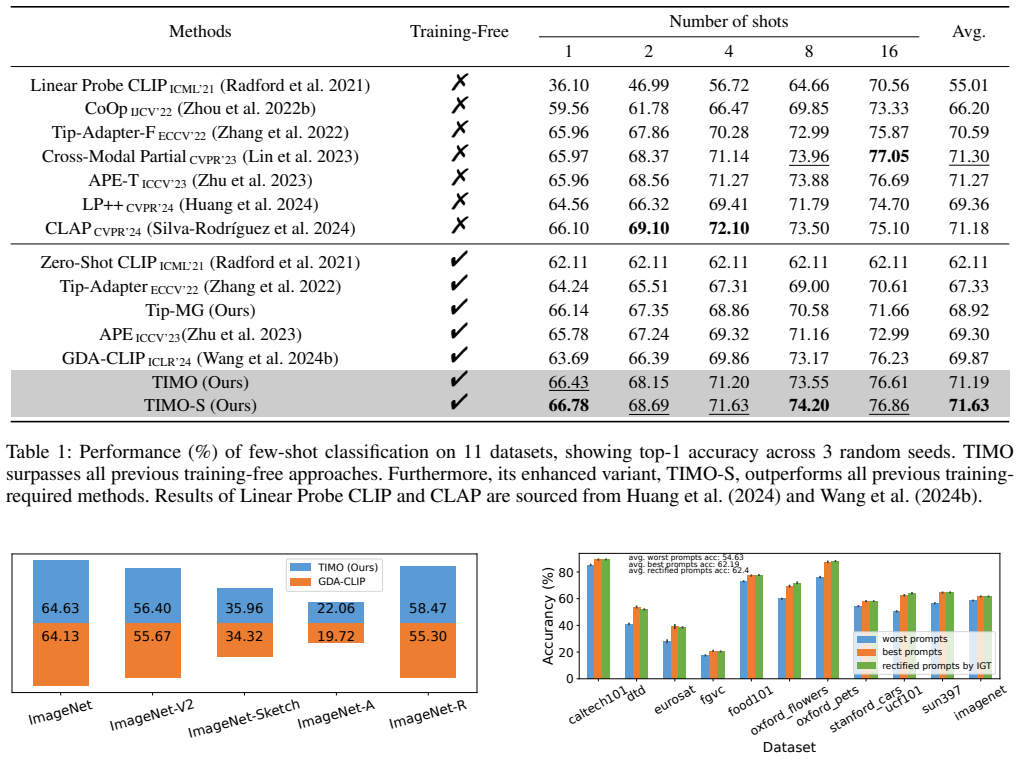
The paper's central discovery is that a single similarity signal — the cosine similarity between each text prompt's CLIP embedding and the class image prototype — can drive both directions of cross-modal repair. In the TGI branch, this similarity serves as a per-prompt importance weight; the weighted text features are concatenated with the support-image features to build a classifier that is less prone to anomalous image-only matches. In the IGT branch, the same similarity, normalized under a norm constraint and passed through a softmax, defines the optimal linear combination of prompts, yielding rectified text features that average out low-quality prompts. The authors prove that the constrained optimization in IGT has a closed-form solution equal to the normalized similarity, making both modules parameter-free and plug-and-play with existing training-free methods. Integrated into GDA-CLIP, the combined method raises average accuracy from 69.87% to 71.19% (TIMO) and to 71.63% (TIMO-S), the latter exceeding the best training-required baseline.
Load-bearing premise
The method assumes that cosine similarity between a prompt's text feature and a class's image prototype is a reliable measure of that prompt's usefulness for classification.
Editorial extensions
If this is right
- TGI and IGT each improve existing training-free methods when applied alone, and the two together give the largest gain: +1.20% average accuracy on Tip-Adapter and +1.32% on GDA-CLIP across 11 datasets.
- TIMO-S reaches 71.63% average accuracy across 11 datasets with a ResNet-50 CLIP encoder, outperforming the best training-free method by 1.76% and the best training-required method by 0.33%.
- The gains hold across CLIP backbones (RN50, RN101, ViT-B/32, ViT-B/16) and across out-of-distribution ImageNet variants, where TIMO-S beats GDA-CLIP on every target dataset.
- The method introduces no extra parameters and adds only constant-time operations to the base training-free pipeline, making its practical cost essentially that of the base model.
- The prompt-rectification effect of IGT is strongest when prompts come from a diverse information source such as CuPL, suggesting the module's value scales with prompt diversity.
Reading between the lines
- Because both guidance branches draw on the same cosine-similarity proxy, the method implicitly predicts that prompt usefulness correlates monotonically with this similarity; a dataset violating that correlation (e.g., fine-grained classes where rare but discriminative descriptors have low similarity) is where the method would most likely fail.
- The mechanism could generalize beyond classification: the same prompt-reweighting via image-prototype similarity could be applied to zero-shot captioning evaluation or image retrieval, where prompt quality also varies and ground-truth labels are scarce.
- An ablation separating variance reduction from true complementarity — comparing TIMO against random prompt subsetting with the same budget — would clarify whether the gains come from the similarity signal or simply from ensembling more diverse features.
- Since the IGT solution is a closed-form normalized similarity, the method can be seen as a training-free analog of prompt ensembling with attention; extending the norm constraint to other $p$-norms or adding a diversity penalty might yield further improvements.
Editorial analysis
A structured set of objections, weighed in public.
Referee Report
Summary. This paper proposes TIMO, a training-free adaptation of CLIP for few-shot classification. TIMO combines two guidance modules: TGI weights text prompts by their cosine similarity to class-level image prototypes and concatenates the weighted text features with support image features before building an image classifier; IGT obtains a text classifier from a weighted combination of prompts, where the weights are derived from a constrained maximization whose closed-form solution is the normalized prompt-to-prototype similarity. The two modules are integrated into GDA-CLIP to form TIMO, and TIMO-S additionally performs a validation-set grid search over the guidance-strength hyperparameters β and γ. The paper reports experiments on 11 datasets at 1, 2, 4, 8, and 16 shots with several CLIP backbones, ablations for the two modules, robustness tests, and a 100-seed statistical comparison against GDA-CLIP.
Significance. If the reported results hold, TIMO is a simple and practical plug-and-play enhancement for training-free CLIP few-shot classification: it introduces no learned parameters, is applicable on top of existing methods, and shows consistent gains over GDA-CLIP across datasets, backbones, and shot counts. The paper's strengths include open-source code, the 100-seed significance test for one central comparison, and the ablation evidence that each module contributes to the improvement. The main caveats concern the provenance of the CLAP baseline, the level of statistical support for the TIMO-S variant, and the framing of the IGT optimization.
major comments (5)
- [§Appendix C and Table 1] The paper states in Appendix C that the authors could not reproduce CLAP under their own training/validation protocol and therefore cite CLAP's originally published numbers. This is an explicit missing-support limitation for a baseline in the main table. I note that the headline 0.33% margin over training-required methods is actually over Cross-Modal (71.30 vs 71.63) rather than over CLAP (71.18), so that specific claim does not rest on the unreproduced CLAP row; nevertheless, the CLAP row should either be replaced by the authors' own runs under the same protocol or be clearly labeled as externally sourced and excluded from any head-to-head comparison. The same clarification is needed for Linear Probe CLIP, which is also externally sourced.
- [§Appendix B and Implementation Details] The 100-seed significance test is the statistical support for the abstract claim that TIMO 'significantly outperforms' the SOTA training-free method, but its description is incomplete. It reports average accuracies of 70.01% and 71.53% 'across 100 trials' without specifying the dataset(s), how support sets were drawn, whether the per-dataset γ values from the paper were used, or how the Kruskal-Wallis test was applied to paired or unpaired observations. Moreover, the test compares TIMO, not the advertised TIMO-S variant, and no significance test is provided for TIMO-S versus GDA-CLIP or for the training-required comparison. The authors should document the test protocol and add a significance test for the variant whose performance is the headline result.
- [§Method, Eq. (8)-(12)] The IGT 'optimization' is constructed so that its closed-form solution is exactly the normalized cosine-similarity weighting: maximizing r_i^T F_t^i W_v^i under ||r_i||=γ forces r_i ∝ F_t^i W_v^i. The Lagrange derivation therefore does not provide an independent argument that this weighting is optimal; it restates the design choice. Since the entire IGT module relies on the assumption that prompt-to-prototype cosine similarity measures prompt usefulness, the paper should either justify this proxy with additional evidence (beyond the prompt-selection experiment in Fig. 5) or present IGT as an explicit similarity-based weighting rather than the outcome of an optimization. This is a framing issue rather than an experimental error, but it directly affects contribution 3.
- [§Implementation Details and §Construction of TIMO-S] The reported TIMO results use per-dataset values of γ (50 for all datasets except 1 for ImageNet and 100 for Flowers102), and TIMO-S performs an additional validation-set grid search over β and γ. The paper does not disclose whether these per-dataset values were selected on the validation split or the test split, nor does it report the validation-set size and the number of configurations tried for each dataset. Without this information, the risk of selection-induced inflation of the reported gains cannot be assessed, and the comparison with GDA-CLIP, which also uses grid search, is incomplete. Please report per-dataset hyperparameters, validation-set sizes, and a sensitivity analysis beyond the single DTD example in Fig. 6.
- [§Complexity Discussion, Table 4, Abstract] The abstract's claim that TIMO-S achieves its accuracy 'with approximately ×100 less time cost' is not substantiated by Table 4, which lists no training-required method; the table only shows TIMO-S taking 6.0 s versus 1.1 s for GDA-CLIP on 16-shot ImageNet. To support the time-cost claim, the authors should report runtimes for CoOp, Tip-Adapter-F, Cross-Modal, and APE-T under the same hardware and protocol, or qualify the statement as an estimate based on published costs.
minor comments (6)
- [§Method, Eq. (6)] The stated dimension R^{N×(K+β)×D} is only correct if zero-weight text features are actually dropped; as written, Concat(F_v, F_t ⊙ S) has P text rows even when β<P. Please clarify the selection step and align the notation.
- [Alg. 1, line 9] The pseudocode applies SoftMax to γ * W/||W||, while Eq. (11) applies SoftMax to r_i from Eq. (10). These are consistent only because of pre-normalization, but the notation should be made consistent in the main text.
- [§Method, Eq. (5)] The 'reordering' of F_t^i is described in prose but not represented in the equations; please make the permutation explicit or define the mask on the sorted indices.
- [Table 2 caption] The caption says 'average performance ... across 11 datasets and 3 random seeds'; clarify whether the average is computed over dataset-level averages and report per-backbone standard deviations.
- [Abstract and Fig. S1] The phrase 'approximately ×100 less time cost' should read 'approximately 100 times less time cost.' Also, Figure S1 uses the names 'CoIn' and 'CoIn-S' instead of 'TIMO' and 'TIMO-S' in the legends; please update.
- [Eq. (2) and general text] There are minor typographical errors, including 'ClassiferImage' in Eq. (2) and 'Accurancy' in Figure 6; these should be corrected in the final version.
Circularity Check
No significant circularity: the empirical claims rest on external benchmarks, and the IGT/TGI similarity weighting is an explicitly constructed design choice, not a hidden reduction of a prediction to a fit.
full rationale
The paper's load-bearing claims are empirical rather than derivational. TGI weights text prompts by cosine similarity to class prototypes (Eq. 4), and IGT's constrained optimization (Eq. 8) is explicitly constructed to maximize r^T F W, whose closed-form solution (Eq. 10) is the same normalized cosine similarity; the paper openly states that 'ri is essentially equivalent to the normalisation of si'. This is a transparent design choice, not a hidden circular reduction: the method is defined in terms of that similarity measure, and its value is then tested on external data. The central performance claims (TIMO outperforming GDA-CLIP, and TIMO-S surpassing training-required methods) are supported by evaluations across 11 datasets, ablations, and a 100-seed significance test against GDA-CLIP (Appendix B). There are no load-bearing self-citations, no imported uniqueness theorems, and no renamed known results that are presented as new derivations. The one notable evidence weakness is the CLAP baseline in Table 1: Appendix C admits that the authors attempted replication using the same training and validation sets as their method, found results 'significantly lower than those reported in their paper', and therefore chose to cite CLAP's original published numbers. This is a reproducibility and comparability concern about an external baseline, not circularity, because the comparison does not feed back into the derivation of TIMO or its components. Accordingly, the paper shows no significant circularity.
Assumptions & free parameters
free parameters (3)
- alpha =
grid-searched over {1e-4, 1e-3, ..., 1e4} on validation set
- beta =
default P; grid-searched over {1,...,2P} in TIMO-S
- gamma =
50 except ImageNet=1, Flowers102=100
assumptions (4)
- domain assumption Cosine similarity between a text prompt and the class image prototype measures prompt usefulness.
- domain assumption Textual representations are more robust than image representations in CLIP.
- domain assumption Validation-set grid search for hyperparameters is compatible with the 'training-free' label.
- standard math CLIP image and text features are comparable after L2 normalization.
Cite this review
Pith. "Pith review of Text and Image Are Mutually Beneficial: Enhancing Training-Free Few-Shot Classification with CLIP." pith.science (2026). https://pith.science/paper/5ZRJ4LKY
@misc{pith2026241211375,
  author       = {Pith},
  title        = {Pith review of: Text and Image Are Mutually Beneficial: Enhancing Training-Free Few-Shot Classification with CLIP},
  year         = {2026},
  howpublished = {\url{https://pith.science/paper/5ZRJ4LKY}},
  note         = {Machine review of arXiv:2412.11375}
}
read the original abstract
Contrastive Language-Image Pretraining (CLIP) has been widely used in vision tasks. Notably, CLIP has demonstrated promising performance in few-shot learning (FSL). However, existing CLIP-based methods in training-free FSL (i.e., without the requirement of additional training) mainly learn different modalities independently, leading to two essential issues: 1) severe anomalous match in image modality; 2) varying quality of generated text prompts. To address these issues, we build a mutual guidance mechanism, that introduces an Image-Guided-Text (IGT) component to rectify varying quality of text prompts through image representations, and a Text-Guided-Image (TGI) component to mitigate the anomalous match of image modality through text representations. By integrating IGT and TGI, we adopt a perspective of Text-Image Mutual guidance Optimization, proposing TIMO. Extensive experiments show that TIMO significantly outperforms the state-of-the-art (SOTA) training-free method. Additionally, by exploring the extent of mutual guidance, we propose an enhanced variant, TIMO-S, which even surpasses the best training-required methods by 0.33% with approximately 100 times less time cost. Our code is available at https://github.com/lyymuwu/TIMO.
Figures


Figures from the paper (3 more)


Reference graph
Works this paper leans on
-
[1]
Bossard, L.; Guillaumin, M.; and Van Gool, L. 2014. Food-101 -- Mining Discriminative Components with Random Forests . In Fleet, D.; Pajdla, T.; Schiele, B.; and Tuytelaars, T., eds., Proceedings of the European Conference on Computer Vision ( ECCV ) , 446--461. Cham: Springer International Publishing. ISBN 978-3-319-10599-4
work page 2014
-
[2]
Chen, G.; Yao, W.; Song, X.; Li, X.; Rao, Y.; and Zhang, K. 2023. PLOT : Prompt Learning with Optimal Transport for Vision-Language Models . (arXiv:2210.01253)
arXiv 2023
-
[3]
Cimpoi, M.; Maji, S.; Kokkinos, I.; Mohamed, S.; and Vedaldi, A. 2014. Describing Textures in the Wild . In Proceedings of the IEEE Conference on Computer Vision and Pattern Recognition , 3606--3613
work page 2014
-
[4]
Deng, J.; Dong, W.; Socher, R.; Li, L.-J.; Li, K.; and Fei-Fei , L. 2009. ImageNet : A Large-Scale Hierarchical Image Database. In 2009 IEEE Conference on Computer Vision and Pattern Recognition , 248--255
work page 2009
-
[5]
Fan, Y.; Xu, W.; Wang, H.; Wang, J.; and Guo, S. 2023. PMR : Prototypical Modal Rebalance for Multimodal Learning . In Proceedings of the IEEE / CVF Conference on Computer Vision and Pattern Recognition , 20029--20038
work page 2023
-
[6]
Fei-Fei , L.; Fergus, R.; and Perona, P. 2004. Learning Generative Visual Models from Few Training Examples : An Incremental Bayesian Approach Tested on 101 Object Categories . In 2004 Conference on Computer Vision and Pattern Recognition Workshop , 178--178
work page 2004
-
[7]
Fellbaum, C. 1998. WordNet : An Electronic Lexical Database . MIT Press. ISBN 978-0-262-06197-1
work page 1998
-
[8]
Gao, P.; Geng, S.; Zhang, R.; Ma, T.; Fang, R.; Zhang, Y.; Li, H.; and Qiao, Y. 2021. CLIP-Adapter : Better Vision-Language Models with Feature Adapters . (arXiv:2110.04544)
arXiv 2021
Show all 65 references
-
[9]
Gong, C. 2017. Exploring Commonality and Individuality for Multi-Modal Curriculum Learning . In AAAI , volume 31
2017
-
[10]
Guo, Z.; Zhang, R.; Qiu, L.; Ma, X.; Miao, X.; He, X.; and Cui, B. 2023. CALIP : Zero-Shot Enhancement of CLIP with Parameter-Free Attention . In AAAI , volume 37, 746--754
2023
-
[11]
He, K.; Zhang, X.; Ren, S.; and Sun, J. 2016. Deep Residual Learning for Image Recognition . In Proceedings of the IEEE Conference on Computer Vision and Pattern Recognition , 770--778
2016
-
[12]
Helber, P.; Bischke, B.; Dengel, A.; and Borth, D. 2019. EuroSAT : A Novel Dataset and Deep Learning Benchmark for Land Use and Land Cover Classification . IEEE Journal of Selected Topics in Applied Earth Observations and Remote Sensing, 12(7): 2217--2226
2019
-
[13]
Hendrycks, D.; Basart, S.; Mu, N.; Kadavath, S.; Wang, F.; Dorundo, E.; Desai, R.; Zhu, T.; Parajuli, S.; Guo, M.; Song, D.; Steinhardt, J.; and Gilmer, J. 2021 a . The Many Faces of Robustness : A Critical Analysis of Out-of-Distribution Generalization . In Proceedings of the...
2021
-
[14]
Hendrycks, D.; Zhao, K.; Basart, S.; Steinhardt, J.; and Song, D. 2021 b . Natural Adversarial Examples . In Proceedings of the IEEE / CVF Conference on Computer Vision and Pattern Recognition , 15262--15271
2021
-
[15]
Huang, T.; Chu, J.; and Wei, F. 2022. Unsupervised Prompt Learning for Vision-Language Models . (arXiv:2204.03649)
2022 arXiv
-
[16]
Huang, Y.; Shakeri, F.; Dolz, J.; Boudiaf, M.; Bahig, H.; and Ayed, I. B. 2024. LP ++: A Surprisingly Strong Linear Probe for Few-Shot CLIP . (arXiv:2404.02285)
2024 arXiv
-
[17]
Krause, J.; Stark, M.; Deng, J.; and Fei-Fei , L. 2013. 3D Object Representations for Fine-Grained Categorization . In Proceedings of the IEEE International Conference on Computer Vision Workshops , 554--561
2013
-
[18]
Krogh, A.; and Vedelsby, J. 1994. Neural Network Ensembles , Cross Validation , and Active Learning . In Advances in Neural Information Processing Systems , volume 7
1994
-
[19]
Lin, Z.; Yu, S.; Kuang, Z.; Pathak, D.; and Ramanan, D. 2023. Multimodality Helps Unimodality : Cross-Modal Few-Shot Learning With Multimodal Models . In Proceedings of the IEEE / CVF Conference on Computer Vision and Pattern Recognition , 19325--19337
2023
-
[20]
Liu, P.; Yuan, W.; Fu, J.; Jiang, Z.; Hayashi, H.; and Neubig, G. 2023. Pre-Train, Prompt , and Predict : A Systematic Survey of Prompting Methods in Natural Language Processing . ACM Computing Surveys, 55(9): 195:1--195:35
2023
-
[21]
Lu, Y.; Liu, J.; Zhang, Y.; Liu, Y.; and Tian, X. 2022. Prompt Distribution Learning . (arXiv:2205.03340)
2022 arXiv
-
[22]
Maji, S.; Rahtu, E.; Kannala, J.; Blaschko, M.; and Vedaldi, A. 2013. Fine- Grained Visual Classification of Aircraft . (arXiv:1306.5151)
2013 arXiv
-
[23]
Martin, S.; Huang, Y.; Shakeri, F.; Pesquet, J.-C.; and Ben Ayed, I. 2024. Transductive Zero-Shot and Few-Shot CLIP . In Proceedings of the IEEE / CVF Conference on Computer Vision and Pattern Recognition , 28816--28826
2024
-
[24]
Menon, S.; and Vondrick, C. 2022. Visual Classification via Description from Large Language Models . (arXiv:2210.07183)
2022 arXiv
-
[25]
Mu, N.; Kirillov, A.; Wagner, D.; and Xie, S. 2022. SLIP : Self-supervision Meets Language-Image Pre-training . 529--544
2022
-
[26]
F.; Xian, Y.; Gool, L
Naeem, M. F.; Xian, Y.; Gool, L. V.; and Tombari, F. 2022. I2DFormer : Learning Image to Document Attention for Zero-Shot Image Classification. In Koyejo, S.; Mohamed, S.; Agarwal, A.; Belgrave, D.; Cho, K.; and Oh, A., eds., Advances in Neural Information Processing Systems, ...
2022
-
[27]
Nilsback, M.-E.; and Zisserman, A. 2008. Automated Flower Classification over a Large Number of Classes . In 2008 Sixth Indian Conference on Computer Vision , Graphics & Image Processing , 722--729
2008
-
[28]
M.; Vedaldi, A.; Zisserman, A.; and Jawahar, C
Parkhi, O. M.; Vedaldi, A.; Zisserman, A.; and Jawahar, C. V. 2012. Cats and Dogs. In Proceedings of the IEEE Conference on Computer Vision and Pattern Recognition , 3498--3505
2012
-
[29]
Paszke, A.; Gross, S.; Massa, F.; Lerer, A.; Bradbury, J.; Chanan, G.; Killeen, T.; Lin, Z.; Gimelshein, N.; Antiga, L.; Desmaison, A.; Kopf, A.; Yang, E.; DeVito, Z.; Raison, M.; Tejani, A.; Chilamkurthy, S.; Steiner, B.; Fang, L.; Bai, J.; and Chintala, S. 2019. PyTorch : An...
2019
-
[30]
Paz-Argaman , T.; Atzmon, Y.; Chechik, G.; and Tsarfaty, R. 2020. ZEST : Zero-shot Learning from Text Descriptions Using Textual Similarity and Visual Summarization . (arXiv:2010.03276)
2020 arXiv
-
[31]
Pratt, S.; Covert, I.; Liu, R.; and Farhadi, A. 2023. What Does a Platypus Look Like ? Generating Customized Prompts for Zero-Shot Image Classification . In Proceedings of the IEEE / CVF International Conference on Computer Vision , 15691--15701
2023
-
[32]
Qiu, L.; Zhang, R.; Guo, Z.; Zeng, Z.; Guo, Z.; Li, Y.; and Zhang, G. 2023. VT-CLIP : Enhancing Vision-Language Models with Visual-guided Texts . (arXiv:2112.02399)
2023 arXiv
-
[33]
W.; Hallacy, C.; Ramesh, A.; Goh, G.; Agarwal, S.; Sastry, G.; Askell, A.; Mishkin, P.; Clark, J.; Krueger, G.; and Sutskever, I
Radford, A.; Kim, J. W.; Hallacy, C.; Ramesh, A.; Goh, G.; Agarwal, S.; Sastry, G.; Askell, A.; Mishkin, P.; Clark, J.; Krueger, G.; and Sutskever, I. 2021. Learning Transferable Visual Models From Natural Language Supervision . In Proceedings of the 38th International Confere...
2021
-
[34]
Recht, B.; Roelofs, R.; Schmidt, L.; and Shankar, V. 2019. Do ImageNet Classifiers Generalize to ImageNet ? In Proceedings of the International Conference on Machine Learning , 5389--5400. PMLR
2019
-
[35]
M.; Koepke, A
Roth, K.; Kim, J. M.; Koepke, A. S.; Vinyals, O.; Schmid, C.; and Akata, Z. 2023. Waffling Around for Performance : Visual Classification with Random Words and Broad Concepts . In Proceedings of the IEEE / CVF International Conference on Computer Vision , 15746--15757
2023
-
[36]
Roth, K.; Vinyals, O.; and Akata, Z. 2022. Integrating Language Guidance Into Vision-Based Deep Metric Learning . In Proceedings of the IEEE / CVF Conference on Computer Vision and Pattern Recognition , 16177--16189
2022
-
[37]
G.; Wang, Y.; Cheng, C.-Y.; Fumero, M.; and Malekshan, K
Sanghi, A.; Chu, H.; Lambourne, J. G.; Wang, Y.; Cheng, C.-Y.; Fumero, M.; and Malekshan, K. R. 2022. CLIP-Forge : Towards Zero-Shot Text-To-Shape Generation . In Proceedings of the IEEE / CVF Conference on Computer Vision and Pattern Recognition , 18603--18613
2022
-
[38]
Shao, S.; Bai, Y.; Wang, Y.; Liu, B.; and Zhou, Y. 2024. DeIL : Direct-and-Inverse CLIP for Open-World Few-Shot Learning . In Proceedings of the IEEE / CVF Conference on Computer Vision and Pattern Recognition , 28505--28514
2024
-
[39]
Shen, S.; Li, C.; Hu, X.; Xie, Y.; Yang, J.; Zhang, P.; Gan, Z.; Wang, L.; Yuan, L.; Liu, C.; Keutzer, K.; Darrell, T.; Rohrbach, A.; and Gao, J. 2022. K- LITE : Learning Transferable Visual Models with External Knowledge. In Koyejo, S.; Mohamed, S.; Agarwal, A.; Belgrave, D.;...
2022
-
[40]
B.; and Dolz, J
Silva-Rodriguez , J.; Hajimiri, S.; Ayed, I. B.; and Dolz, J. 2023. A Closer Look at the Few-Shot Adaptation of Large Vision-Language Models . (arXiv:2312.12730)
2023 arXiv
-
[41]
Silva-Rodr \'i guez , J.; Hajimiri, S.; Ben Ayed, I.; and Dolz, J. 2024. A Closer Look at the Few-Shot Adaptation of Large Vision-Language Models . In Proceedings of the IEEE / CVF Conference on Computer Vision and Pattern Recognition , 23681--23690
2024
-
[42]
Snell, J.; Swersky, K.; and Zemel, R. 2017. Prototypical Networks for Few-shot Learning . In Advances in Neural Information Processing Systems , volume 30
2017
-
[43]
R.; and Shah, M
Soomro, K.; Zamir, A. R.; and Shah, M. 2012. UCF101 : A Dataset of 101 Human Actions Classes From Videos in The Wild . (arXiv:1212.0402)
2012 arXiv
-
[44]
Tahmasebzadeh, G.; Springstein, M.; Ewerth, R.; and M \"u ller-Budack , E. 2024. Few- Shot Event Classification in Images Using Knowledge Graphs for Prompting . In Proceedings of the IEEE / CVF Winter Conference on Applications of Computer Vision , 7286--7295
2024
-
[45]
Tan, Q.; Yu, G.; Wang, J.; Domeniconi, C.; and Zhang, X. 2021. Individuality- and Commonality-Based Multiview Multilabel Learning . IEEE Transactions on Cybernetics, 51(3): 1716--1727
2021
-
[46]
Tang, Y.; Lin, Z.; Wang, Q.; Zhu, P.; and Hu, Q. 2024. AMU-Tuning : Effective Logit Bias for CLIP-based Few-shot Learning . In Proceedings of the IEEE / CVF Conference on Computer Vision and Pattern Recognition , 23323--23333
2024
-
[47]
Udandarao, V.; Gupta, A.; and Albanie, S. 2023. SuS-X : Training-Free Name-Only Transfer of Vision-Language Models . In Proceedings of the IEEE / CVF International Conference on Computer Vision , 2725--2736
2023
-
[48]
Wang, H.; Ge, S.; Lipton, Z.; and Xing, E. P. 2019. Learning Robust Global Representations by Penalizing Local Predictive Power . In Advances in Neural Information Processing Systems , volume 32
2019
-
[49]
Wang, Y.; Yao, Q.; Kwok, J.; and Ni, L. M. 2020. Generalizing from a Few Examples : A Survey on Few-Shot Learning . (arXiv:1904.05046)
2020 arXiv
-
[50]
Wang, Z.; Liang, J.; He, R.; Wang, Z.; and Tan, T. 2024 a . Connecting the Dots : Collaborative Fine-tuning for Black-Box Vision-Language Models . arXiv:2402.04050
2024 arXiv
-
[51]
Wang, Z.; Liang, J.; Sheng, L.; He, R.; Wang, Z.; and Tan, T. 2024 b . A Hard-to-Beat Baseline for Training-free CLIP-based Adaptation . (arXiv:2402.04087)
2024 arXiv
-
[52]
Wu, J.; Wang, R.; Zhao, H.; Zhang, R.; Lu, C.; Li, S.; and Henao, R. 2023. Few- Shot Composition Learning for Image Retrieval with Prompt Tuning . Proceedings of the AAAI Conference on Artificial Intelligence, 37(4): 4729--4737
2023
-
[53]
A.; Oliva, A.; and Torralba, A
Xiao, J.; Hays, J.; Ehinger, K. A.; Oliva, A.; and Torralba, A. 2010. SUN Database: Large-scale Scene Recognition from Abbey to Zoo. In 2010 IEEE Computer Society Conference on Computer Vision and Pattern Recognition , 3485--3492
2010
-
[54]
Yu, T.; Lu, Z.; Jin, X.; Chen, Z.; and Wang, X. 2023. Task Residual for Tuning Vision-Language Models . In Proceedings of the IEEE / CVF Conference on Computer Vision and Pattern Recognition , 10899--10909
2023
-
[55]
Zhang, R.; Hu, X.; Li, B.; Huang, S.; Deng, H.; Qiao, Y.; Gao, P.; and Li, H. 2023. Prompt, Generate , Then Cache : Cascade of Foundation Models Makes Strong Few-Shot Learners . In Proceedings of the IEEE / CVF Conference on Computer Vision and Pattern Recognition , 15211--15222
2023
-
[56]
Zhang, R.; Zhang, W.; Fang, R.; Gao, P.; Li, K.; Dai, J.; Qiao, Y.; and Li, H. 2022. Tip- Adapter : Training-Free Adaption of CLIP for Few-Shot Classification . In Avidan, S.; Brostow, G.; Ciss \'e , M.; Farinella, G. M.; and Hassner, T., eds., Proceedings of the European Conf...
2022
-
[57]
Zhang, X.; Yoon, J.; Bansal, M.; and Yao, H. 2024 a . Multimodal Representation Learning by Alternating Unimodal Adaptation . In Proceedings of the IEEE / CVF Conference on Computer Vision and Pattern Recognition , 27456--27466
2024
-
[58]
Zhang, Y.; Zhang, C.; Yu, K.; Tang, Y.; and He, Z. 2024 b . Concept- Guided Prompt Learning for Generalization in Vision-Language Models . (arXiv:2401.07457)
2024 arXiv
-
[59]
Zhao, Z.; Liu, Y.; Wu, H.; Li, Y.; Wang, S.; Teng, L.; Liu, D.; Cui, Z.; Wang, Q.; and Shen, D. 2024. CLIP in Medical Imaging : A Comprehensive Survey . (arXiv:2312.07353)
2024 arXiv
-
[60]
C.; and Liu, Z
Zhou, K.; Yang, J.; Loy, C. C.; and Liu, Z. 2022 a . Conditional Prompt Learning for Vision-Language Models . In Proceedings of the IEEE / CVF Conference on Computer Vision and Pattern Recognition , 16816--16825
2022
-
[61]
C.; and Liu, Z
Zhou, K.; Yang, J.; Loy, C. C.; and Liu, Z. 2022 b . Learning to Prompt for Vision-Language Models . International Journal of Computer Vision, 130(9): 2337--2348
2022
-
[62]
Zhou, Z.; Lei, Y.; Zhang, B.; Liu, L.; and Liu, Y. 2023. ZegCLIP : Towards Adapting CLIP for Zero-Shot Semantic Segmentation . In Proceedings of the IEEE / CVF Conference on Computer Vision and Pattern Recognition , 11175--11185
2023
-
[63]
Zhu, X.; Zhang, R.; He, B.; Zhou, A.; Wang, D.; Zhao, B.; and Gao, P. 2023. Not All Features Matter : Enhancing Few-shot CLIP with Adaptive Prior Refinement . In Proceedings of the IEEE / CVF International Conference on Computer Vision , 2605--2615
2023
-
[64]
, " * write output.state after.block = add.period write newline
ENTRY address archivePrefix author booktitle chapter edition editor eid eprint howpublished institution isbn journal key month note number organization pages publisher school series title type volume year label extra.label sort.label short.list INTEGERS output.state before.all...
-
[65]
write newline
" write newline "" before.all 'output.state := FUNCTION n.dashify 't := "" t empty not t #1 #1 substring "-" = t #1 #2 substring "--" = not "--" * t #2 global.max substring 't := t #1 #1 substring "-" = "-" * t #2 global.max substring 't := while if t #1 #1 substring * t #2 gl...
Reviewed August 11, 2026 · model on record in the stance chip above.
Discussion (0). Continue with ORCID to comment.