REVIEW 4 major objections 5 minor 59 references
Registration of 3D Point Sets Using Exponential-based Similarity Matrix
T0 review · 4 major / 5 minor · reviewed 2026-08-15 · deepseek-v4-flash
Pith's one-line read ESM-ICP replaces ICP's hard correspondences with a Gaussian exponential similarity matrix, enabling alignment under full-range rotations and non-Gaussian noise.
desk verdict A clearly written but overclaimed repackaging of correntropy-weighted ICP; the convergence proof is invalid as stated and the tables don't add up, but the idea has a real place in the registration toolkit. read the letter →
The pith
A machine-rendered reading of the paper's core claim, the machinery that carries it, and where it could break.
The reading
What carries the argument
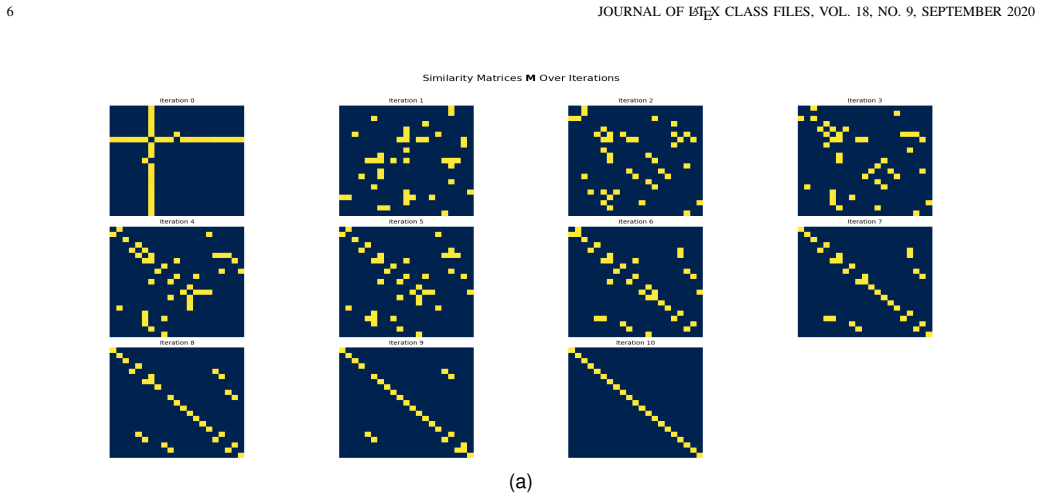
The load-bearing object is the similarity matrix $M$, updated every iteration from the Gaussian kernel $f(x) = \exp(-x^2/(2\sigma^2))$. Its entry $M(i,c(i)) = w_i$ encodes the confidence that source point $s_i$ corresponds to its nearest target point $t_{c(i)}$, and symmetry makes the matrix $M = M^\top$. This matrix converts the ordinary cross-covariance into a weighted Procrustes problem; after SVD, the rotation and translation are recovered exactly as in classic ICP. The exponential kernel carries the argument: correspondences with small residuals contribute near full weight, large residuals decay exponentially, and as the clouds align the weights tighten toward 1 so $M$ approaches the identity, smoothly handing over to standard ICP.
What would settle it
Take a real pair of scans of the same object from widely separated viewpoints, so the two clouds overlap only partially and have different sampling densities, rotate the source by roughly 180 degrees, and run ESM-ICP. If it fails to recover the alignment on cases where exact one-to-one correspondences do not exist, then the claim that the method addresses large-rotation registration in practical scenarios is not established.
Extended reading notes
Core claim
The central claim is that a sparse, symmetric similarity matrix built from a Gaussian kernel is enough to move ICP out of the local-minima trap that large rotations create. The authors define weights from the Euclidean distance between each source point and its closest target point, build the matrix $M$ with $M(i,c(i)) = M(c(i),i) = w_i$, and compute the cross-covariance as $H = \sum_i (s_i - \bar{s}) M (t_i - \bar{t})$. SVD of $H$ yields the update $R = VU^\top$, $\tau = -R\bar{s} + \bar{t}$. On ModelNet40 classes (Airplane, Person, Vase, Bottle) the reported rotation and translation errors are orders of magnitude below those of the compared geometric and learned methods, and the paper also shows $M$ evolving toward the identity matrix as alignment improves, with the weighted error $E_k$ monotonically decreasing and the algorithm reducing to classic ICP when all weights approach 1.
Load-bearing premise
The experiments generate the source point cloud by applying a rigid transform to the target, so every source point has an exact counterpart in the target, and the claimed success under full-range rotations is only demonstrated in that same-point-set setting with the scale parameter $\sigma$ tuned per dataset.
Editorial extensions
If this is right
- Pipelines that currently require a good initial guess can use ESM-ICP directly for large-rotation cases, removing the need for a separate coarse alignment stage such as feature matching or global search.
- Because the method needs no training data or learned features, it can be applied to novel object classes and sensor modalities without a pretraining step.
- The monotone decrease of the weighted error and the convergence of $M$ to the identity provide a built-in stopping criterion: once $M$ is nearly diagonal, further updates are essentially classic ICP.
- Under non-Gaussian noise, the exponential weights suppress outlier correspondences during the covariance computation, so no explicit outlier-trimming pre-pass is required.
- Since the per-iteration cost mirrors classic ICP, the approach can run at real-time rates on CPU hardware, which the paper states makes it suitable for real-time applications.
Reading between the lines
- Inference: the 100%-success result on 2,000 synthetic rotations should not be extrapolated to partial-overlap or differently-sampled scans; a direct test on such pairs would be the natural next validation.
- Inference: annealing $\sigma$ across iterations (starting large to see broad structure, shrinking as alignment tightens) is a plausible extension that could remove the manual per-dataset tuning the paper currently requires.
- Inference: because the update is a weighted Procrustes step driven by a Gaussian kernel, the method belongs to the correntropy-style family of registration algorithms; the paper's results suggest that family is a stronger competitor to global search and learned methods than previously assumed.
- Inference: if extended with an explicit outlier class or a distance threshold, ESM-ICP could be dropped into LiDAR odometry and SLAM pipelines as a lightweight alternative to feature-based coarse-to-fine registration.
Signed reviews
Editorial analysis
A structured set of objections, weighed in public.
Referee Report
Summary. The paper proposes ESM-ICP, a modification of the Iterative Closest Point algorithm in which a Gaussian kernel defines per-pair weights w_i = exp(-||s_i - t_{c(i)}||^2/(2σ²)), used to build a symmetric similarity matrix M and a weighted cross-covariance matrix for SVD-based transformation estimation. The authors claim that this addresses large rotational differences and non-Gaussian noise, provide a convergence theorem, and report experiments on Stanford Bunny and ModelNet40 comparing against classical, learning-based, and KISS-Matcher baselines, with the stated finding that ESM-ICP successfully aligned over 2,000 random rotation trials within 100 iterations.
Significance. If the claims were supported, a training-free, simple robust-ICP variant would be a practically useful contribution for robotics and vision systems. The public implementation is a positive reproducibility feature. However, the method is a reformulation of correntropy-weighted ICP approaches already cited by the authors, the convergence theorem is not valid as stated, Equation (9) is dimensionally inconsistent, and the experimental protocol uses synthetic same-point-set data with exact correspondences. The reported tables also contain internally inconsistent metric values. These issues mean the central practical claim is not established, so the paper's significance falls well below the standard for a journal publication.
major comments (4)
- [Section IV-A, Theorem 1] The proof asserts in Eq. (15) that E_{k+1} < E_k, but this does not follow from the stated argument. After iteration k, the correspondences c(i) and weights w_i are recomputed from the new transformation, so A_{k+1} minimizes E_k, not the reweighted objective E_{k+1}. Additionally, the proof states that the transformation updates 'satisfy ||A_{k+1} - A_k||' without giving any bound or completing the sentence, and a monotonically decreasing scalar error does not imply convergence of the transformation sequence for this nonconvex nearest-neighbor iteration. This invalidates the theoretical support for the 100%-success robustness claim made in Section V-B.
- [Section IV, Eq. (9)] Equation (9) defines H = Σ (s_i - \bar{s}) M (t_i - \bar{t}) with M an N×N matrix and s_i, t_i 3D vectors. This expression is dimensionally inconsistent as written; it needs a convention (for example, treating the point vectors as rows and summing scalars, or replacing M with the scalar weight w_i) to yield the 3×3 cross-covariance matrix required by the SVD step in Eq. (10). The algorithm depends on this definition, so the method is not precisely specified.
- [Section V-B and experimental setup] The experimental protocol generates the Source by applying a rigid transformation to the Target point cloud, guaranteeing equal cardinality and exact one-to-one correspondences. This does not exercise partial overlap, differing sampling density, or viewpoint-dependent coverage, which are the conditions that make real multi-view registration challenging. The 2,000-trial success claim is reported without a success threshold, per-trial counts, or error distributions; Tables I-IV show single examples and Table V only means. Consequently, the abstract's conclusion that ESM-ICP handles the practical limitations of current registration techniques is not supported by the evidence.
- [Tables I-VI] Several reported metric values violate the identities RMSE = sqrt(MSE) and RMSE ≥ MAE. For example, Table V Person KISS-Matcher reports MSE(t)=0.930943 but RMSE(t)=0.032311, whereas sqrt(0.930943)=0.9648; Table V Person ESM-ICP reports MSE(t)=3.17e-08 but RMSE(t)=1.07e-04, whereas sqrt(3.17e-08)=1.78e-04; Table VI Stool ESM-ICP reports MSE(t)=0.040046 but RMSE(t)=0.164954, whereas sqrt(0.040046)=0.2001. These internal inconsistencies undermine the quantitative comparisons and suggest an error in metric computation or reporting.
minor comments (5)
- [Algorithm 1] In Algorithm 1, line 6 defines the variable d but line 7 recomputes the same distance; d is unused and should be removed or used consistently.
- [Figure 2 caption] The Figure 2 caption reports the translation as (0, 0, 0.3), while the text in Section V-A states that translations are sampled uniformly in [-0.1, 0.1]; this discrepancy should be resolved.
- [Abstract] The GitHub URL in the abstract contains a space ('ESM ICP') and should be corrected to a valid hyperlink.
- [References] References [20] and [22] are duplicated, and the bibliography would benefit from a careful pass to remove redundancies and align in-text citations with the numbered list.
- [Eq. (11)] Equation (11) states the minimization over R ∈ SO(3) only, but the objective includes τ as well; the optimization domain should be clarified as SE(3) or the dependence on τ through Eq. (10) should be made explicit.
Circularity Check
ESM-ICP's weighted objective is the standard Gaussian/correntropy ICP objective renamed; the claimed novel derivation reduces to known equations, while no self-citation chain forces the result.
-
renaming known result
[Section IV (Weighted Cross-Covariance Matrix), Eqs. (6)-(11)]
"we define a Gaussian kernel function as: f(x) = exp( − x^2 / 2σ^2 ) , (6) ... From the Gaussian Kernel function in Equ. 6, we define our alignment problem as a weighted Procrustes problem, where the weights for each corresponding pair ... are defined as: w_i = exp( −∥s_i − t_{c(i)}∥^2 / 2σ^2 ) , (7) ... we arrive at minimizing the function: min_{R∈SO(3)} Σ_i w_i ∥R s′_i − t′_i∥^2 , (11)"
Substituting Eq. (7) into Eq. (11) gives min Σ_i exp(−∥s_i − t_{c(i)}∥^2 / 2σ^2) ∥R s′_i − t′_i∥^2, the iteratively reweighted least-squares form of correntropy-based registration. The paper's own reference list includes correntropy-based scale ICP ([11], reprinted as [58]) and maximum-correntropy-criterion registration ([12]/[59], [13]/[60]), which use the same Gaussian-weighted distance objective. The sparse symmetric matrix M in Eq. (8) merely stores these w_i values, and the SVD update in Eq. (10) is the standard weighted-Procrustes/ICP update.
full rationale
ESM-ICP's derivation from Eqs. (6)-(11) is internally self-contained, but it reproduces the published correntropy/weighted-ICP objective under a new name, so the central novelty claim reduces to a reformulation rather than a new first-principles result. The convergence proof in Section IV-A (Theorem 1) is mathematically unsupported—weights and nearest-neighbor correspondences are recomputed at every iteration, so the inequality E_{k+1} < E_k in Eq. (15) does not follow—but that is a correctness gap, not a circular argument, and it does not increase the circularity score. The self-citations in the Introduction ([5]-[7], [4], [2]) do not carry any derivation step, so they are not load-bearing. The experimental evaluation against public baselines on ModelNet40 and the Stanford Bunny, with released code, provides independent empirical content, and the hand-set σ values are not presented as fitted predictions. A score of 4 reflects the significant novelty/derivation circularity while acknowledging that the empirical comparisons are external and not statistically forced by construction.
Assumptions & free parameters
free parameters (1)
- sigma =
0.05 to 1.0 per point cloud density
assumptions (5)
- domain assumption Closest-point nearest-neighbor correspondences provide a meaningful soft-correspondence signal even under large rotations.
- ad hoc to paper The weighted least-squares error E_k decreases monotonically when correspondences and weights are recomputed.
- ad hoc to paper At convergence the similarity matrix M becomes the identity, reducing ESM-ICP to standard ICP.
- standard math Standard weighted Procrustes via SVD yields the optimal rotation for fixed weights.
- domain assumption The source and target point sets have the same cardinality and exact correspondences exist.
Cite this review
Pith. "Pith review of Registration of 3D Point Sets Using Exponential-based Similarity Matrix." pith.science (2026). https://pith.science/paper/673G64MD
@misc{pith2026250504540,
  author       = {Pith},
  title        = {Pith review of: Registration of 3D Point Sets Using Exponential-based Similarity Matrix},
  year         = {2026},
  howpublished = {\url{https://pith.science/paper/673G64MD}},
  note         = {Machine review of arXiv:2505.04540}
}
read the original abstract
Point cloud registration is a fundamental problem in computer vision and robotics, involving the alignment of 3D point sets captured from varying viewpoints using depth sensors such as LiDAR or structured light. In modern robotic systems, especially those focused on mapping, it is essential to merge multiple views of the same environment accurately. However, state-of-the-art registration techniques often struggle when large rotational differences exist between point sets or when the data is significantly corrupted by sensor noise. These challenges can lead to misalignments and, consequently, to inaccurate or distorted 3D reconstructions. In this work, we address both these limitations by proposing a robust modification to the classic Iterative Closest Point (ICP) algorithm. Our method, termed Exponential Similarity Matrix ICP (ESM-ICP), integrates a Gaussian-inspired exponential weighting scheme to construct a similarity matrix that dynamically adapts across iterations. This matrix facilitates improved estimation of both rotational and translational components during alignment. We demonstrate the robustness of ESM-ICP in two challenging scenarios: (i) large rotational discrepancies between the source and target point clouds, and (ii) data corrupted by non-Gaussian noise. Our results show that ESM-ICP outperforms traditional geometric registration techniques as well as several recent learning-based methods. To encourage reproducibility and community engagement, our full implementation is made publicly available on GitHub. https://github.com/aralab-unr/ESM_ICP
Figures


Figures from the paper (3 more)


Reference graph
Works this paper leans on
-
[58]
Correntropy Based Scale ICP Algorithm for Robust Point Set Registration,
Wu, Zongze, Chen, Hongchen, Du, Shaoyi, Fu, Minyue, Zhou, Nan, Zheng, Nanning. “Correntropy Based Scale ICP Algorithm for Robust Point Set Registration,” Pattern Recognition, vol. 93, 2019
work page 2019
-
[60]
G. Xu, S. Du, D. Cui, S. Zhang, B. Chen, X. Zhang, J. Xue, Y . Gao. “Precise Point Set Registration Using Point-to-Plane Distance and Correntropy for LiDAR Based Localization,” 2018 IEEE Intelligent Vehicles Symposium (IV), pp. 734-739, 2018
work page 2018
-
[1]
Least-Squares Fitting of Two 3-D Point Sets,
Arun, K. S., Huang, T. S., Blostein, S. D.. “Least-Squares Fitting of Two 3-D Point Sets,” IEEE Trans. Pattern Anal. Mach. Intell. , vol. 9, pp. 698–700, 1987
work page 1987
-
[2]
A Review of SLAM Techniques and Security in Autonomous Driving,
A. Singandhupe, H. M. La. “A Review of SLAM Techniques and Security in Autonomous Driving,” 2019 Third IEEE International Conference on Robotic Computing (IRC) , pp. 602-607, 2019
work page 2019
-
[3]
A method for registration of 3-D shapes,
P. J. Besl, N. D. McKay. “A method for registration of 3-D shapes,” IEEE Transactions on Pattern Analysis and Machine Intelligence , vol. 14, pp. 239-256,, 1992
work page 1992
-
[4]
”Lidar-Monocular Visual Odometry with Genetic Al- gorithm for Parameter Optimization
”Sehgal, Adarsh. “”Lidar-Monocular Visual Odometry with Genetic Al- gorithm for Parameter Optimization”,” ”Advances in Visual Computing”, pp. ”358–370”, ”2019”
work page 2019
-
[5]
MCC-EKF for Autonomous Car Security,
A. Singandhupe, H. M. La . “MCC-EKF for Autonomous Car Security,” Proceedings of the 4th IEEE International Conference on Robotic Com- puting (IRC), 2020
work page 2020
-
[6]
Reliable Security Algorithm for Drones Using Individual Characteristics From an EEG Signal,
A. Singandhupe, H. M. La, D. Feil-Seifer. “Reliable Security Algorithm for Drones Using Individual Characteristics From an EEG Signal,” IEEE Access, vol. 6, pp. 2–12, 2018
work page 2018
Show all 59 references
-
[7]
Securing a UA V Using Individual Characteristics From an EEG Signal,
A. Singandhupe, H. M. La, D. Feil-Seifer, P. Huang, L. Guo, M. Li. “Securing a UA V Using Individual Characteristics From an EEG Signal,” IEEE Intern. Conf. on Systems, Man, and Cybernetics (SMC) , 2018
2018
-
[8]
Linear Least-Squares Optimization for Point-to-Plane ICP Surface Registration,
Low, Kok-Lim. “Linear Least-Squares Optimization for Point-to-Plane ICP Surface Registration,” , 2004
2004
-
[9]
”The Stanford 3D Scanning Repository
”Stanford”. “”The Stanford 3D Scanning Repository”,” , ”2020”
2020
-
[10]
Go-ICP: A globally optimal solution to 3D ICP point-set registration,
Yang, Jiaolong, Li, Hongdong, Jia, Yunde. “Go-ICP: A globally optimal solution to 3D ICP point-set registration,” IEEE Transactions on Pattern Analysis and Machine Intelligence , vol. 38, pp. 2241–2254, 2015
2015
-
[11]
”Correntropy based scale ICP algorithm for robust point set registration
”Zongze Wu, Hongchen Chen, Shaoyi Du, Minyue Fu, Nan Zhou, Nanning Zheng”. “”Correntropy based scale ICP algorithm for robust point set registration”,” ”Pattern Recognition”, vol. ”93”, pp. ”14 - 24”, ”2019”
2019
-
[12]
Robust 3D point cloud registration based on bidirectional Maximum Correntropy Criterion,
Zhang, Xuetao, Jian, Libo, Xu, Meifeng. “Robust 3D point cloud registration based on bidirectional Maximum Correntropy Criterion,”PloS one, vol. 13, pp. e0197542, 2018
2018
-
[13]
Precise point set registration using point-to-plane distance and correntropy for LiDAR based local- ization,
Xu, Guanglin, Du, Shaoyi, Cui, Dixiao, Zhang, Sirui, Chen, Badong, Zhang, Xuetao, Xue, Jianru, Gao, Yue. “Precise point set registration using point-to-plane distance and correntropy for LiDAR based local- ization,” 2018 IEEE Intelligent Vehicles Symposium (IV) , pp. 734–739, 2018
2018
-
[14]
Generalized-ICP,
Segal, Aleksandr, H ¨ahnel, Dirk. “Generalized-ICP,” Proc. of Robotics: Science and Systems , 2009
2009
-
[15]
The phase correlation image align- ment method,
Kuglin, Charles D, Hines, Daniel C. “The phase correlation image align- ment method,” Proceedings of the IEEE 1975 International Conference on Cybernetics and Society , pp. 163–165, 1975
1975
-
[16]
Distinctive image features from scale-invariant key- points,
Lowe, David G. “Distinctive image features from scale-invariant key- points,” International Journal of Computer Vision , vol. 60, pp. 91–110, 2004
2004
-
[17]
Fast point feature histograms (FPFH) for 3D registration,
Rusu, Radu Bogdan, Blodow, Nico, Beetz, Michael. “Fast point feature histograms (FPFH) for 3D registration,” 2009 IEEE International Con- ference on Robotics and Automation (ICRA) , pp. 3212–3217, 2009
2009
-
[18]
Fast global registration,
Zhou, Qian-Yi, Park, Jaesik, Koltun, Vladlen. “Fast global registration,” European Conference on Computer Vision (ECCV) , pp. 766–782, 2016
2016
-
[20]
Fast Point Feature Histograms (FPFH) for 3D registration,
Rusu, Radu Bogdan, Blodow, Norbert, Beetz, Michael. “Fast Point Feature Histograms (FPFH) for 3D registration,” IEEE International Conference on Robotics and Automation (ICRA) , pp. 3212–3217, 2009
2009
-
[21]
SURF: Speeded Up Robust Features,
Bay, Herbert, Tuytelaars, Tinne, Van Gool, Luc. “SURF: Speeded Up Robust Features,” Computer Vision–ECCV 2006 , pp. 404–417, 2006
2006
-
[22]
Effi- cient subpixel image registration algorithms,
Guizar-Sicairos, Manuel, Thurman, Samuel T, Fienup, James R. “Effi- cient subpixel image registration algorithms,” Optics Letters, vol. 33, pp. 156–158, 2008
2008
-
[23]
Image registration methods: a survey,
Zitova, Barbara, Flusser, Jan. “Image registration methods: a survey,” Image and Vision Computing , vol. 21, pp. 977–1000, 2003
2003
-
[24]
Position, rotation, and scale invariant optical correlation,
Casasent, David, Psaltis, Demetri. “Position, rotation, and scale invariant optical correlation,” Applied Optics, vol. 15, pp. 1795–1799, 1985
1985
-
[25]
The normal distributions transform: a new approach to laser scan matching,
Biber, P., Strasser, W.. “The normal distributions transform: a new approach to laser scan matching,” Proceedings 2003 IEEE/RSJ Interna- tional Conference on Intelligent Robots and Systems (IROS 2003) (Cat. No.03CH37453), vol. 3, pp. 2743-2748 vol.3, 2003
2003
-
[26]
Information-Theoretic Learning,
Principe, Jose, Iii, John. “Information-Theoretic Learning,” Advances in unsupervised adaptive filtering , 2000
2000
-
[27]
Robust registration of 2D and 3D point sets,
Andrew W Fitzgibbon. “Robust registration of 2D and 3D point sets,” Image and Vision Computing , vol. 21, pp. 1145-1153, 2003
2003
-
[28]
”Fast Global Registration
”Zhou, Qian-Yi. “”Fast Global Registration”,” ”Computer Vision – ECCV 2016”, pp. ”766–782”, ”2016”. 10 JOURNAL OF LATEX CLASS FILES, VOL. 18, NO. 9, SEPTEMBER 2020
2016
-
[29]
Deep Global Regis- tration,
Choy, Christopher, Dong, Wei, Koltun, Vladlen. “Deep Global Regis- tration,” Proceedings of the IEEE Conference on Computer Vision and Pattern Recognition, 2020
2020
-
[30]
TEASER: Fast and Certifiable Point Cloud Registration,
Heng Yang, J. Shi, L. Carlone. “TEASER: Fast and Certifiable Point Cloud Registration,” ArXiv, vol. abs/2001.07715, 2020
2001 arXiv
-
[31]
RPM-Net: Robust Point Matching Using Learned Features,“
Yew, Zi Jian and Lee, Gim Hee.“RPM-Net: Robust Point Matching Using Learned Features,“ ”Conference on Computer Vision and Pattern Recognition (CVPR)”, ”2020”
2020
-
[32]
Object modeling by registration of mul- tiple range images,
Chen, Yang, Medioni, Gerard. “Object modeling by registration of mul- tiple range images,” Proceedings. 1992 IEEE International Conference on Robotics and Automation , pp. 2724–2729, 1992
1992
-
[33]
Efficient variants of the ICP algorithm,
Rusinkiewicz, Szymon, Levoy, Marc. “Efficient variants of the ICP algorithm,” Proceedings Third International Conference on 3-D Digital Imaging and Modeling , pp. 145–152, 2001
2001
-
[34]
Fast and Robust Iterative Closest Point,
Zhang, Jiayi, Yao, Yao, Deng, Baoquan. “Fast and Robust Iterative Closest Point,” arXiv preprint arXiv:2007.07627 , 2020
2007 arXiv
-
[35]
The iterative closest point registration algorithm based on the normal distribution transformation,
Shi, Xiaolei, Peng, Ji, Li, Jun. “The iterative closest point registration algorithm based on the normal distribution transformation,” Procedia Computer Science, vol. 147, pp. 181–190, 2019
2019
-
[36]
A review of point cloud regis- tration algorithms for laser scanners: Applications in large-scale aircraft measurement,
Si, Haiqing, Qiu, Jingxuan, Li, Yao. “A review of point cloud regis- tration algorithms for laser scanners: Applications in large-scale aircraft measurement,” Applied Sciences, vol. 12, pp. 10247, 2022
2022
-
[37]
3D is here: Point Cloud Library (PCL),
Rusu, Radu Bogdan, Cousins, Steve. “3D is here: Point Cloud Library (PCL),” IEEE International Conference on Robotics and Automation (ICRA), pp. 1–4, 2011
2011
-
[38]
Generalized-ICP,
Segal, A., Haehnel, D., Thrun, S.. “Generalized-ICP,” Robotics: Science and Systems (RSS) , 2009
2009
-
[40]
Multi-scale EM-ICP: A fast and robust approach for surface registration,
Granger, S., Pennec, X.. “Multi-scale EM-ICP: A fast and robust approach for surface registration,” European Conference on Computer Vision (ECCV), pp. 418–432, 2002
2002
-
[41]
Semantic-ICP: Iterative Closest Point for Non-rigid Multi-label Point Cloud Registra- tion,
Li, Xianzhi, Dai, Yinda, Li, Hongdong, Zhang, Zixin. “Semantic-ICP: Iterative Closest Point for Non-rigid Multi-label Point Cloud Registra- tion,” IEEE/CVF Conference on Computer Vision and Pattern Recognition (CVPR), pp. 12988–12997, 2021
2021
-
[42]
Robust affine registration method using line/surface normals and correspondence,
Zhou, Feng, De la Torre, Fernando. “Robust affine registration method using line/surface normals and correspondence,” IEEE Transactions on Pattern Analysis and Machine Intelligence, vol. 37, pp. 1051–1064, 2015
2015
-
[43]
KSS-ICP: Point Cloud Registration based on Kendall Shape Space,
Lin, Junyi, Wang, Cheng, Chen, Huan, Huang, Ruihong, Li, Jun. “KSS-ICP: Point Cloud Registration based on Kendall Shape Space,” IEEE International Conference on Robotics and Automation (ICRA) , pp. 10587–10593, 2022
2022
-
[44]
DICP: Doppler Iterative Closest Point Algo- rithm,
Gao, Chenfeng, Wang, Jie, Zheng, Yifan, Chen, Yuxiang, Wang, Fei, Zhang, Jinqiao, Tian, Qi. “DICP: Doppler Iterative Closest Point Algo- rithm,” IEEE/CVF Conference on Computer Vision and Pattern Recogni- tion (CVPR), pp. 1841–1851, 2023
2023
-
[45]
Deep learning-based point cloud registration: A comprehensive survey and taxonomy,
Zhang, Yu-Xin, Gui, Jie, Yu, Baosheng, Cong, Xiaofeng, Gong, Xin, Tao, Wenbing, Tao, Dacheng. “Deep learning-based point cloud registration: A comprehensive survey and taxonomy,” arXiv preprint arXiv:2404.13830, 2024
2024 arXiv
-
[46]
RPM-Net: Robust point matching using learned features,
Yew, Zac, Lee, Gim Hee. “RPM-Net: Robust point matching using learned features,” Proceedings of the IEEE/CVF Conference on Computer Vision and Pattern Recognition , pp. 11824–11833, 2020
2020
-
[47]
Deep Closest Point: Learning rep- resentations for point cloud registration,
Wang, Yue, Solomon, Justin M.. “Deep Closest Point: Learning rep- resentations for point cloud registration,” Proceedings of the IEEE/CVF International Conference on Computer Vision , pp. 3523–3532, 2019
2019
-
[48]
PointNet++: Deep hierarchical feature learning on point sets in a metric space,
Qi, Charles R, Yi, Li, Su, Hao, Guibas, Leonidas J. “PointNet++: Deep hierarchical feature learning on point sets in a metric space,” Advances in Neural Information Processing Systems (NeurIPS) , vol. 30, pp. 5099– 5108, 2017
2017
-
[49]
PointNet: Deep learning on point sets for 3D classification and segmentation,
Qi, Charles R, Su, Hao, Mo, Kaichun, Guibas, Leonidas J. “PointNet: Deep learning on point sets for 3D classification and segmentation,” Proceedings of the IEEE Conference on Computer Vision and Pattern Recognition (CVPR), pp. 652–660, 2017
2017
-
[50]
Dynamic Graph CNN for Learning on Point Clouds,
Wang, Yue, Sun, Yongbin, Liu, Ziwei, Sarma, Sanjay E, Bronstein, Michael M, Solomon, Justin M. “Dynamic Graph CNN for Learning on Point Clouds,” Proceedings of the ACM SIGGRAPH Conference on Computer Vision and Pattern Recognition (CVPR) , pp. 10206–10215, 2019
2019
-
[51]
PointNetLK: Robust and efficient point cloud registration using Point- Net,
Aoki, Yasuhiro, Goforth, Hunter, Srivatsan, Ramakrishna, Lucey, Simon. “PointNetLK: Robust and efficient point cloud registration using Point- Net,” Proceedings of the IEEE/CVF Conference on Computer Vision and Pattern Recognition, pp. 7163–7172, 2019
2019
-
[52]
The normal distributions transform: A new approach to laser scan matching,
Biber, Peter, Straßer, Wolfgang. “The normal distributions transform: A new approach to laser scan matching,” Proceedings of the IEEE/RSJ International Conference on Intelligent Robots and Systems , pp. 2743– 2748, 2003
2003
-
[53]
PRNet: Self-supervised learning for partial-to-partial registration,
Wang, Yue, Solomon, Justin M. “PRNet: Self-supervised learning for partial-to-partial registration,” Advances in Neural Information Processing Systems (NeurIPS), vol. 32, 2019
2019
-
[54]
A comprehensive survey on point cloud registration,
Huang, Xiaoshui, Mei, Guofeng, Zhang, Jian, Abbas, Rana. “A comprehensive survey on point cloud registration,” arXiv preprint arXiv:2103.02690, 2021
2021 arXiv
-
[55]
A robust algorithm for point set registration using mixture of Gaussians,
Jian, Bing, Vemuri, Baba C. “A robust algorithm for point set registration using mixture of Gaussians,” Proceedings of the Tenth IEEE International Conference on Computer Vision (ICCV) , vol. 2, pp. 1246–1251, 2005
2005
-
[56]
DeepGMR: Learning Latent Gaussian Mixture Models for Registration,
Y . Yuan, A. Eckart, and D. Held, “DeepGMR: Learning Latent Gaussian Mixture Models for Registration,” in Proc. European Conf. Comput. Vis. (ECCV), 2020, pp. 733–750
2020
-
[57]
3D ShapeNets: A deep representation for volumetric shapes,
Z. Wu, S. Song, A. Khosla, F. Yu, L. Zhang, X. Tang, and J. Xiao, “3D ShapeNets: A deep representation for volumetric shapes,” Proceedings of the IEEE Conference on Computer Vision and Pattern Recognition (CVPR), pp. 1912–1920, 2015
1912
-
[59]
Robust 3D point cloud registration based on bidirectional Maximum Correntropy Criterion,
Zhang, Xuetao, Jian, Libo, Xu, Meifeng. “Robust 3D point cloud registration based on bidirectional Maximum Correntropy Criterion,” PLOS ONE, vol. 13, pp. e0197542, 2018
2018
-
[61]
KISS-Matcher: Fast and Robust Point Cloud Registration Revisited,
H. Lim, D. Kim, G. Shin, J. Shi, I. Vizzo, H. Myung, J. Park, and L. Carlone, “KISS-Matcher: Fast and Robust Point Cloud Registration Revisited,” in Proc. IEEE Int. Conf. Robot. Automat. (ICRA) , 2025. [Online]. Available: https://github.com/MIT-SPARK/KISS-Matcher
2025
Reviewed August 15, 2026 · model on record in the stance chip above.
Discussion (0). Continue with ORCID to comment.