REVIEW 3 major objections 5 minor 87 references
Angular Distribution of Gamma Rays Produced in Proton-Proton Collisions
T0 review · 3 major / 5 minor · reviewed 2026-08-11 · deepseek-v4-flash
Pith's one-line read The paper provides the joint energy-angle yield of gamma rays from proton-proton collisions, from the pion threshold to 100 GeV, and shows that the gamma rays are measurably non-collinear at the low energies that dominate astrophysical…
desk verdict A genuinely useful public resource for gamma-ray modelers, held back by the fact that the new angular dimension is never independently validated. read the letter →
The pith
A machine-rendered reading of the paper's core claim, the machinery that carries it, and where it could break.
The reading
What carries the argument
The carrying mechanism is a particle-transport Monte Carlo code calibrated to accelerator data, used to simulate inelastic proton-proton collisions and the subsequent decays of pions and other secondaries, with gamma-ray energy binned logarithmically ($\Delta\log E_\gamma=0.125$) and angle in $5^\circ$ bins. The paper's central objects are the per-interaction joint yield $F_{p,\gamma}(E_p,E_\gamma,\theta)$ and its dimensionless form $x\,d^2N_\gamma/dx\,d\Omega$ with $x=E_\gamma/E_p$, chosen to exploit approximate Feynman scaling. The ancillary analytic fit, $f(x,\theta,E_p)=A(x,E_p)\exp[-B(x,E_p)\theta^{I(E_p)}]$, captures the exponential suppression with angle and resolves the peak position through the $e^{-A_1 x^2}-e^{-A_3 x}$ factor. The critical kinematic ingredient is that pion decay produces a flat-in-log photon spectrum centered near $E_\gamma=E_\pi/2$, so backward-emitted photons fall below the 100 MeV threshold and the forward beaming cone widens as energy drops.
What would settle it
Measure the gamma-ray yield per collision in a fixed energy-angle bin, for example near $E_p=5.6$ GeV, $E_\gamma \sim 200$ MeV, and $\theta \sim 60^\circ$, using an independent hadronic simulation or a dedicated accelerator measurement; if the measured or independently computed yield disagrees with the tables beyond the estimated hadronic uncertainties, the angular component of the central claim fails.
Extended reading notes
Core claim
The core claim is that gamma-ray production in $pp$ collisions is measurably non-collinear up to primary energies of tens of GeV, and that the full double-differential yield per inelastic collision, expressed as $E_\gamma F_{p,\gamma}(E_p,E_\gamma,\theta)$, can be tabulated with enough accuracy to replace the collinear approximation. The paper shows that near threshold the yield extends beyond $90^\circ$ with low-energy photons, that the spectral shape depends sharply on viewing angle, and that even at high $E_p$ a low-energy off-axis component persists. It further claims that by roughly 65 GeV a $10^\circ$ cone contains 90% of the $\geq100$ MeV gamma rays, establishing 100 GeV as the energy above which the old collinear formulas suffice. The compiled tables, the analytic fit, and the validation against angle-integrated spectra together constitute the deliverable.
Load-bearing premise
The angular shape of the simulated secondary production is trusted as accurate; the paper validates only the angle-averaged spectra against independent calculations, so a systematic error in the off-axis yield would invalidate the tables even if the total spectra match.
Editorial extensions
If this is right
- Above roughly 65 GeV, a $10^\circ$ cone contains 90% of the $\geq100$ MeV yield, so for higher-energy systems the collinear approximation remains valid and the new tables are not needed.
- For a power-law cosmic-ray spectrum like $\propto E_p^{-2.2}$, protons near threshold dominate, so a large fraction of the observed gamma rays are emitted at significant angles; jet-cloud models that assume collinearity will mispredict off-axis spectra.
- The gamma-ray spectrum shape varies with viewing angle, so in principle a measured spectrum can be inverted to determine the direction of an unseen cosmic-ray beam.
- Solar gamma rays from cosmic rays reflected by magnetic fields require the joint distribution to predict the disk-versus-annulus brightness pattern; the paper sketches how the brightness moves from a thin limb ring to a full disk as photon energy decreases.
- The analytic fit keeps maximum error under about 40% over the first decade above threshold (away from sharp pion-multiplicity thresholds), making the distribution cheap enough for repeated use in astrophysical simulations.
Reading between the lines
- If the tables are correct, lunar gamma rays are a clean test: the Moon lacks a magnetic field, so only gamma rays emitted at large angles can escape, making the observed limb profile a direct read-off of the off-axis yield.
- A natural extension is to generate analogous tables for proton-helium and alpha-proton collisions rather than a simple nuclear enhancement factor, because intranuclear cascades could alter the angular spread at low energy.
- The exponential form of the analytic fit suggests a compact universal scaling in $\theta^{I(E_p)}x$ that could be tested across independent Monte Carlo codes; if it holds, the distribution reduces to a one-dimensional family of curves.
- The analogy drawn to off-axis neutrino beams suggests the same tables could be applied to studies of beam-dump and collider neutrino fluxes where parent meson direction matters.
Editorial analysis
A structured set of objections, weighed in public.
Referee Report
Summary. This paper calculates the double-differential gamma-ray yield d²Nγ/dE dΩ from inelastic proton-proton collisions for incident proton energies from 1.33 to 100 GeV, using FLUKA simulations for pion production and secondary decays. The authors present the results as public tables and a Python tool, validate the angle-integrated yields against Kafexhiu et al. and check the inclusive π0 cross section, provide an analytic fit over the first decade above threshold with quantified errors, and discuss applications to off-axis jets and solar gamma rays.
Significance. If the tabulated results are accurate, the paper fills a genuine gap: the commonly used models provide dNγ/dE only, while the earlier angular treatments either cover different energy regimes or are less accessible. The public database and Python tool are a useful community resource for Fermi-LAT-era modeling, and the paper is explicit that the analytic formula is an ad-hoc fit with quantified errors rather than a prediction. The main risk is that the angular dimension itself, which is the central deliverable, is not independently validated against experiment or another angular model. The paper's angle-integrated agreement with Kafexhiu et al. is necessary but not sufficient to certify the off-axis and low-energy regime for which the tables are intended.
major comments (3)
- [Sec. III, Fig. 4] The only quantitative validation shown is the solid-angle-integrated yield compared with Kafexhiu et al.; this constrains dN/dE only. The abstract's deliverable is d²N/dE dΩ, and the angular shape of pion production is never checked against experiment, against the earlier model of Karlsson & Kamae [45], or against an alternative Monte Carlo. Because off-axis and low-energy users rely precisely on the angular shape, the paper should add a direct comparison of angular distributions (e.g., π0 or γ-ray yields at representative Ep) or otherwise provide a quantitative estimate of FLUKA's angular uncertainty. Without this, the central product is not yet supported.
- [Sec. III (public tables and GitHub database)] The primary tabular results carry no quoted statistical or systematic uncertainties per bin. The analytic fit errors are quantified in Sec. IV, but the tables themselves are presented without error bars, so the reader cannot assess the significance of discrepancies in the non-collinear regime. Please state the number of simulated events per energy and provide at least a global systematic uncertainty estimate, for example from FLUKA version dependence or from comparison with an alternative code.
- [Sec. IV, Eqs. (15)-(16) and Fig. 7] The analytic fit is restricted to 0°–90° and to the first decade above threshold, with maximum errors of roughly 40% and larger errors above ~13.3 GeV. This is clearly stated in the text, but the abstract's advertised range of 'the pion production threshold to 100 GeV' could mislead users into applying the formula outside its fitted domain. The text should state prominently that the analytic formula is only for the first decade and that the tables are the intended product for the full range.
minor comments (5)
- [Sec. III, Eq. (9)] In the sentence following Eq. (9), 'Fp,γ(Ep, Eγ, θ), defined similarly to Fp,γ(Ep, Eπ, θ)' should refer to Fp,π in the second occurrence; the pion index is lost.
- [Sec. III, Eq. (12)-(13)] The cutoff ncut depends on xmin = 100 MeV/Ep, which varies with primary energy; please state this dependence explicitly when defining ncut.
- [Sec. III, Fig. 2] The caption notes that x ranges and colorbar ranges vary among panels, which makes quantitative cross-panel comparison difficult; consider adding a fixed reference scale or contour labels.
- [Sec. V.A, Eq. (21)-(22) and Fig. 9] The power-law integration in the jet example uses an arbitrary high-energy cutoff at 1000 GeV; please state in the text or caption that the displayed spectra may depend on this cutoff choice.
- [Sec. III, simulation setup] The GitHub repository URL is given, but the text does not state the exact FLUKA version or release used to generate the tables; because FLUKA results can change between releases, this information should be included with the tables.
Circularity Check
No circularity: the central FLUKA-based tables are independent simulated outputs, and the analytic formula is an openly labeled fit with quantified errors.
full rationale
The paper's central deliverable, d2Nγ/dE dΩ from 1.33 to 100 GeV, is generated by FLUKA simulations of proton-proton collisions and pion/secondary decays (Sec. III), not derived from the analytic formula. The comparison with Kafexhiu et al. (Fig. 4) checks the angle-integrated yield against an independent model built from other Monte Carlos and data, providing external support for the energy spectrum; the lack of an independent check of the angular shape is a validation gap, not a circular reduction. The analytic formula in Sec. IV is explicitly introduced as a fit ('we fit our numerical results ... with an ad-hoc functional form'), with the residuals quantified by Eq. (14), so the 29 constants are not disguised predictions. Citations to the authors' own solar-gamma-ray papers (e.g., Refs. [17, 26, 29-31]) are contextual applications and do not support the FLUKA calculation itself, and there is no imported uniqueness theorem or ansatz smuggled in by citation. No equation reduces to its own input by construction.
Assumptions & free parameters
free parameters (2)
- Analytic fit coefficients Aij, Bkl, Im =
See Table II; 29 constants
- Yield cutoff ncut =
Set by Eq. (13); chosen so 100 interactions would over-predict one gamma ray if every bin were at ncut
assumptions (6)
- domain assumption FLUKA's hadronic interaction models correctly reproduce the double-differential gamma-ray yield of proton-proton collisions over the studied energy range.
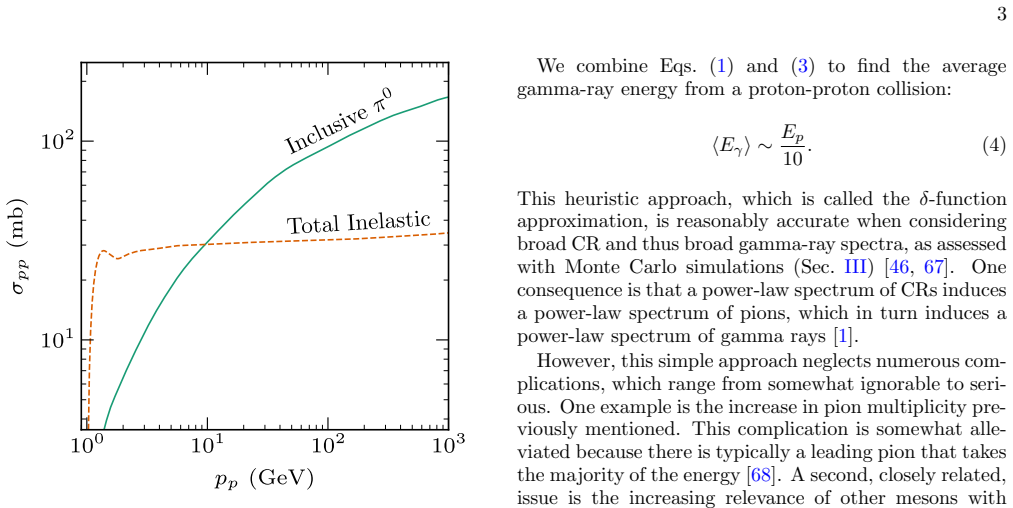
- domain assumption The inelastic pp cross section and its energy dependence used for normalization (Fig. 1) are correct.
- domain assumption Feynman scaling in x = Eγ/Ep is a sufficiently good organizing variable over 1.33-100 GeV.
- domain assumption Gamma rays below 100 MeV can be ignored for the Fermi-LAT applications considered.
- ad hoc to paper The functional form f = A exp(-B theta^I) is flexible enough to represent the simulated yields in the fitted range.
- ad hoc to paper Bins below ncut contribute negligibly to likely applications and can be zeroed.
Cite this review
Pith. "Pith review of Angular Distribution of Gamma Rays Produced in Proton-Proton Collisions." pith.science (2026). https://pith.science/paper/67NYFZWS
@misc{pith2026241208726,
  author       = {Pith},
  title        = {Pith review of: Angular Distribution of Gamma Rays Produced in Proton-Proton Collisions},
  year         = {2026},
  howpublished = {\url{https://pith.science/paper/67NYFZWS}},
  note         = {Machine review of arXiv:2412.08726}
}
abstract
Accurate modeling of how high-energy proton-proton collisions produce gamma rays through the decays of pions and other secondaries is needed to correctly interpret astrophysical observations with the Fermi-LAT telescope. In the existing literature on cosmic-ray collisions with gas, the focus is on the gamma-ray yield spectrum, $d N_\gamma/dE$. However, in some situations, the joint energy and angular distribution can be observed, so one needs instead $d^2 N_\gamma/dE \, d\Omega$. We provide calculations of this distribution over the energy range from the pion production threshold to $100~{\rm GeV}$, basing our results on FLUKA simulations. We provide the results in tabular form and provide a Python tool on GitHub to aid in utilization. We also provide an approximate analytic formula that illuminates the underlying physics. We discuss simplified examples where this angular dependence can be observed to illustrate the necessity of taking the joint distribution into account.
Figures


Figures from the paper (5 more)


Reference graph
Works this paper leans on
-
[45]
N. Karlsson and T. Kamae, Astrophys. J. 674, 278 (2008), arXiv:0709.0233 [astro-ph]
work page Pith review arXiv 2008
-
[1]
Stecker, Cosmic Gamma Rays, NASA SP (Scientific and Technical Information Office, National Aeronautics and Space Administration, 1971)
F. Stecker, Cosmic Gamma Rays, NASA SP (Scientific and Technical Information Office, National Aeronautics and Space Administration, 1971)
1971
-
[2]
Aharonian, Very High Energy Cosmic Gamma Radi- ation: A Crucial Window on the Extreme Universe, EB- SCO ebook academic collection (World Scientific, 2004)
F. Aharonian, Very High Energy Cosmic Gamma Radi- ation: A Crucial Window on the Extreme Universe, EB- SCO ebook academic collection (World Scientific, 2004)
2004
-
[3]
Dermer and G
C. Dermer and G. Menon, High Energy Radiation from Black Holes: Gamma Rays, Cosmic Rays, and Neutri- nos, Princeton Series in Astrophysics (Princeton Univer- sity Press, 2009)
2009
-
[4]
F. Aharonian et al. (H.E.S.S.), Astron. Astrophys. 449, 223 (2006), arXiv:astro-ph/0511678
work page Pith review arXiv 2006
-
[5]
Huang, S.-E
C.-Y. Huang, S.-E. Park, M. Pohl, and C. Daniels, As- tropart. Phys. 27, 429 (2007)
2007
-
[6]
M. Ackermann et al. (Fermi-LAT), Science 339, 807 (2013), arXiv:1302.3307 [astro-ph.HE]
arXiv 2013
-
[7]
H. Abdalla et al. (HESS), Astron. Astrophys. 612, A6 (2018), arXiv:1609.08671 [astro-ph.HE]
work page Pith review arXiv 2018
Show all 87 references
-
[8]
A. U. Abeysekara et al. , Nature Astron. 5, 465 (2021), [Erratum: Nature Astron. 5, 724–724 (2021)], arXiv:2103.06820 [astro-ph.HE]
2021 arXiv
-
[9]
V. A. Acciari et al. (MAGIC), Nature Astron. 6, 689 (2022), [Erratum: Nature Astron. 6, 760–760 (2022)], arXiv:2202.07681 [astro-ph.HE]
2022
-
[10]
Sudoh and J
T. Sudoh and J. F. Beacom, Phys. Rev. D 107, 043002 (2023), arXiv:2209.03970 [astro-ph.HE]
2023 arXiv
-
[11]
Sudoh and J
T. Sudoh and J. F. Beacom, Phys. Rev. D 108, 043016 (2023), arXiv:2305.07043 [astro-ph.HE]
2023 arXiv
-
[12]
Song, T.-Q
B.-H. Song, T.-Q. Huang, and K. Wang, Astrophys. J. 961, 254 (2024), arXiv:2310.11813 [astro-ph.HE]
2024 arXiv
-
[13]
Fang and F
K. Fang and F. Halzen, J. High Energy Astrophys. 43, 140 (2024)
2024
-
[14]
Aguilar et al
M. Aguilar et al. (AMS Collaboration), Phys. Rev. Lett. 114, 171103 (2015)
2015
-
[15]
Aguilar et al
M. Aguilar et al. (AMS Collaboration), Phys. Rev. Lett. 115, 211101 (2015)
2015
-
[16]
Maurin, M
D. Maurin, M. Ahlers, H. Dembinski, A. Haungs, P.-S. Mangeard, F. Melot, P. Mertsch, D. Wochele, and J. Wochele, Eur. Phys. J. C 83, 971 (2023), arXiv:2306.08901 [astro-ph.HE]
2023 arXiv
-
[17]
J.-T. Li, J. F. Beacom, and A. H. G. Peter, Astrophys. J. 937, 27 (2022), arXiv:2206.14815 [astro-ph.SR]
2022 arXiv
-
[18]
Seckel, T
D. Seckel, T. Stanev, and T. K. Gaisser, Astrophys. J. 382, 652 (1991)
1991
-
[19]
Orlando and A
E. Orlando and A. W. Strong, Astron. Astrophys. 480, 847 (2008), arXiv:0801.2178 [astro-ph]
2008 arXiv
-
[20]
B. Zhou, K. C. Y. Ng, J. F. Beacom, and A. H. G. Peter, Phys. Rev. D 96, 023015 (2017), arXiv:1612.02420 [astro- ph.HE]
2017 arXiv
-
[21]
H. S. Hudson, A. MacKinnon, M. Szydlarski, and M. Carlsson, Mon. Not. R. Astron. Soc. 491, 4852 (2019), https://academic.oup.com/mnras/article- pdf/491/4/4852/31570524/stz3373.pdf
2019
-
[22]
Z. Li, K. C. Y. Ng, S. Chen, Y. Nan, and H. He, Chin. Phys. C 48, 045101 (2024), arXiv:2009.03888 [astro- ph.HE]
2024 arXiv
-
[23]
Guti´ errez and M
M. Guti´ errez and M. Masip, Astropart. Phys. 119, 102440 (2020), arXiv:1911.07530 [hep-ph]
2020 arXiv
-
[24]
Guti´ errez, M
M. Guti´ errez, M. Masip, and S. Mu˜ noz, Astrophys. J. 941, 86 (2022), arXiv:2206.00964 [astro-ph.HE]
2022 arXiv
-
[25]
M. N. Mazziotta, P. De La Torre Luque, L. Di Venere, A. Fass` o, A. Ferrari, F. Loparco, P. R. Sala, and D. Serini, Phys. Rev. D 101, 083011 (2020), arXiv:2001.09933 [astro-ph.HE]
2020 arXiv
-
[26]
J.-T. Li, J. F. Beacom, S. Griffith, and A. H. G. Peter, Astrophys. J. 961, 167 (2024), arXiv:2307.08728 [astro- ph.HE]
2024 arXiv
-
[27]
Puzzoni, F
E. Puzzoni, F. Fraschetti, J. K´ ota, and J. Giacalone, Astrophys. J. 973, 118 (2024), arXiv:2407.16859 [astro- ph.HE]
2024 arXiv
-
[28]
A. A. Abdo et al. (Fermi-LAT), Astrophys. J. 734, 116 (2011), arXiv:1104.2093 [astro-ph.HE]
2011 arXiv
-
[29]
Linden, B
T. Linden, B. Zhou, J. F. Beacom, A. H. G. Peter, K. C. Y. Ng, and Q.-W. Tang, Phys. Rev. Lett. 121, 131103 (2018), arXiv:1803.05436 [astro-ph.HE]
2018 arXiv
-
[30]
Q.-W. Tang, K. C. Y. Ng, T. Linden, B. Zhou, J. F. Beacom, and A. H. G. Peter, Phys. Rev. D 98, 063019 (2018), arXiv:1804.06846 [astro-ph.HE]
2018 arXiv
-
[31]
Linden, J
T. Linden, J. F. Beacom, A. H. G. Peter, B. J. Buckman, B. Zhou, and G. Zhu, Phys. Rev. D 105, 063013 (2022), arXiv:2012.04654 [astro-ph.HE]
2022 arXiv
-
[32]
Arsioli and E
B. Arsioli and E. Orlando, Astrophys. J. 962, 52 (2024), arXiv:2401.03466 [astro-ph.HE]
2024 arXiv
-
[33]
Linden, J.-T
T. Linden, J.-T. Li, B. Zhou, I. John, M. Crnogorˇ cevi´ c, A. H. G. Peter, and J. F. Beacom, (2025), arXiv:2505.04625 [astro-ph.HE]
2025
-
[34]
Acharyya et al., (2025), arXiv:2505.06348 [astro- ph.HE]
A. Acharyya et al., (2025), arXiv:2505.06348 [astro- ph.HE]
2025 arXiv
-
[35]
G. D. Badhwar, S. A. Stephens, and R. L. Golden, Phys. Rev. D 15, 820 (1977)
1977
-
[36]
Hanssgen and J
K. Hanssgen and J. Ranft, Nucl. Sci. Eng. 88, 537 (1984)
1984
-
[37]
Ranft and S
J. Ranft and S. Ritter, Z. Phys. C 20, 347 (1983)
1983
-
[38]
Hanssgen, H
K. Hanssgen, H. J. Mohring, and J. Ranft, Nucl. Sci. Eng. 88, 551 (1984)
1984
-
[39]
H. J. Mohring and J. Ranft, Nucl. Sci. Eng. 89, 247 (1985)
1985
-
[40]
C. D. Dermer, Astron. Astrophys. 157, 223 (1986)
1986
-
[41]
Hanssgen, Nucl
K. Hanssgen, Nucl. Sci. Eng. 95, 135 (1987)
1987
-
[42]
Capella, U
A. Capella, U. Sukhatme, C.-I. Tan, and J. Tran Thanh Van, Phys. Rept. 236, 225 (1994)
1994
-
[43]
A. B. Kaidalov, Phys. Atom. Nucl. 66, 1994 (2003)
2003
-
[44]
Kamae, N
T. Kamae, N. Karlsson, T. Mizuno, T. Abe, and T. Koi, Astrophys. J. 647, 692 (2006), [Erratum: Astrophys.J. 662, 779 (2007)], arXiv:astro-ph/0605581
2006 arXiv
-
[46]
S. R. Kelner, F. A. Aharonian, and V. V. Bugayov, Phys. Rev. D 74, 034018 (2006), [Erratum: Phys.Rev.D 79, 039901 (2009)], arXiv:astro-ph/0606058
2006 arXiv
-
[47]
Kafexhiu, F
E. Kafexhiu, F. Aharonian, A. M. Taylor, and G. S. Vila, Phys. Rev. D 90, 123014 (2014), arXiv:1406.7369 [astro-ph.HE]
2014 arXiv
-
[48]
Orusa, M
L. Orusa, M. Di Mauro, F. Donato, and M. Korsmeier, Phys. Rev. D 107, 083031 (2023), arXiv:2302.01943 [astro-ph.HE]
2023 arXiv
-
[49]
H. B. J. Koers, A. Pe’er, and R. A. M. J. Wijers, (2006), arXiv:hep-ph/0611219
2006 arXiv
-
[50]
I. V. Moskalenko and T. A. Porter, Astrophys. J. 670, 1467 (2007), arXiv:0708.2742 [astro-ph]
2007 arXiv
-
[51]
A. A. Abdo et al., Astrophys. J. 758, 140 (2012). 15
2012
-
[52]
Ackermann et al
M. Ackermann et al. (Fermi-LAT), Phys. Rev. D 93, 082001 (2016), arXiv:1604.03349 [astro-ph.HE]
2016 arXiv
- [53]
-
[54]
T. T. B¨ ohlen, F. Cerutti, M. P. W. Chin, A. Fass` o, A. Ferrari, P. G. Ortega, A. Mairani, P. R. Sala, G. Smirnov, and V. Vlachoudis, Nucl. Data Sheets 120, 211 (2014)
2014
-
[55]
Battistoni et al., Annals Nucl
G. Battistoni et al., Annals Nucl. Energy 82, 10 (2015)
2015
-
[56]
Ahdida et al., Front
C. Ahdida et al., Front. in Phys. 9, 788253 (2022)
2022
-
[57]
Kachelriess, I
M. Kachelriess, I. V. Moskalenko, and S. S. Ostapchenko, Astrophys. J. 789, 136 (2014), arXiv:1406.0035 [astro- ph.HE]
2014 arXiv
-
[58]
M. N. Mazziotta, F. Cerutti, A. Ferrari, D. Gaggero, F. Loparco, and P. R. Sala, Astropart. Phys. 81, 21 (2016), arXiv:1510.04623 [astro-ph.HE]
2016 arXiv
-
[59]
Ballarini et al., EPJ Nuclear Sci
F. Ballarini et al., EPJ Nuclear Sci. Technol. 10 (2024), 10.1051/epjn/2024015
2024
-
[60]
W. B. Atwood et al. (Fermi-LAT), Astrophys. J. 697, 1071 (2009), arXiv:0902.1089 [astro-ph.IM]
2009 arXiv
-
[61]
C. D. Dermer, Astrophys. J. 307, 47 (1986)
1986
-
[62]
R. L. Workman et al. (Particle Data Group), PTEP 2022, 083C01 (2022)
2022
-
[63]
Lock and D
W. Lock and D. Measday, Intermediate Energy Nuclear Physics (Methuen, 1970)
1970
-
[64]
Beringer et al
J. Beringer et al. (Particle Data Group), Phys. Rev. D 86, 010001 (2012)
2012
-
[65]
T. K. Gaisser, R. Engel, and E. Resconi, Cosmic Rays and Particle Physics: 2nd Edition (Cambridge Univer- sity Press, 2016)
2016
-
[66]
Navas et al.(Particle Data Group), Phys
S. Navas et al.(Particle Data Group), Phys. Rev. D 110, 030001 (2024)
2024
-
[67]
F. A. Aharonian and A. M. Atoyan, Astron. Astrophys. 309, 917 (1996)
1996
-
[68]
Basile et al., Nuovo Cim
M. Basile et al., Nuovo Cim. A 66, 129 (1981)
1981
-
[69]
A comprehensive guide to the physics and usage of pythia 8.3,
C. Bierlich et al., “A comprehensive guide to the physics and usage of pythia 8.3,” (2022), arXiv:2203.11601 [hep- ph]
2022 arXiv
-
[70]
E.-J. Ahn, R. Engel, T. K. Gaisser, P. Lipari, and T. Stanev, Phys. Rev. D 80 (2009), 10.1103/phys- revd.80.094003
2009 doi
-
[71]
Ostapchenko, Nucl
S. Ostapchenko, Nucl. Phys. B Proc. Suppl. 151, 143 (2006), arXiv:hep-ph/0412332
2006 arXiv
-
[72]
Agostinelli et al., Nuclear Instruments and Methods in Physics Research Section A: Accelerators, Spectrometers, Detectors and Associated Equipment 506, 250 (2003)
S. Agostinelli et al., Nuclear Instruments and Methods in Physics Research Section A: Accelerators, Spectrometers, Detectors and Associated Equipment 506, 250 (2003)
2003
-
[73]
H. S. Fesefeldt, The simulation of hadronic showers: physics and applications, Tech. Rep. (Aachen TU 3. Inst. Phys., Aachen, 1985)
1985
-
[74]
Bleicher et al., J
M. Bleicher et al., J. Phys. G 25, 1859 (1999), arXiv:hep- ph/9909407
1999
- [75]
-
[76]
Kamae, T
T. Kamae, T. Abe, and T. Koi, Astrophys. J. 620, 244 (2005), arXiv:astro-ph/0410617
2005 arXiv
-
[77]
R. P. Feynman, Phys. Rev. Lett. 23, 1415 (1969)
1969
-
[78]
Jiang et al., Chin
W. Jiang et al., Chin. Phys. Lett. 37, 119601 (2020), arXiv:2009.13036 [physics.ins-det]
2020 arXiv
-
[79]
Bolshakova et al
A. Bolshakova et al. (HARP-CDP), Eur. Phys. J. C 70, 543 (2010), arXiv:1006.3429 [hep-ex]
2010 arXiv
- [80]
-
[81]
J. M. Paley et al. (MIPP), Phys. Rev. D 90, 032001 (2014), arXiv:1404.5882 [hep-ex]
2014 arXiv
-
[82]
Adriani et al
O. Adriani et al. (LHCf), Phys. Rev. D 94, 032007 (2016), arXiv:1507.08764 [hep-ex]
2016 arXiv
-
[83]
Angular distribution of gamma rays pro- duced in proton-proton collisions,
S. Griffith, “Angular distribution of gamma rays pro- duced in proton-proton collisions,” (2024)
2024
-
[84]
Ackermann et al.(Fermi-LAT), Astrophys
M. Ackermann et al.(Fermi-LAT), Astrophys. J.787, 15 (2014), arXiv:1304.3749 [astro-ph.HE]
2014 arXiv
-
[85]
Pesce-Rollins, N
M. Pesce-Rollins, N. Omodei, V. Petrosian, W. Liu, F. R. da Costa, A. Allafort, and Q. Chen, Astrophys. J. Lett. 805, L15 (2015), arXiv:1505.03480 [astro-ph.SR]
2015 arXiv
-
[86]
Kouloumvakos, A
A. Kouloumvakos, A. P. Rouillard, G. H. Share, I. Plot- nikov, R. Murphy, A. Papaioannou, and Y. Wu, Astro- phys. J. 893, 76 (2020), arXiv:2004.00355 [astro-ph.SR]
2020 arXiv
- [87]
Reviewed August 11, 2026 · model on record in the stance chip above.
Discussion (0). Continue with ORCID to comment.