Phonon-mediated stabilization of first and second modes in hypersonic boundary-layer flows
Pith reviewed 2026-06-26 16:24 UTC · model grok-4.3
The pith
Subsurface phonon engineering stabilizes both the first and second modes in hypersonic boundary layers by tailoring phase relations between wall pressure and velocity fluctuations.
A machine-rendered reading of the paper's core claim, the machinery that carries it, and where it could break.
Core claim
The central claim is that phase relations between wall pressure and velocity fluctuations can be tailored using subsurface phonon engineering to control both the first and second modes concurrently in hypersonic boundary-layer flows, enabling substantial drag reduction and alleviation of extreme thermal loads.
What carries the argument
Subsurface phonon engineering that tailors phase relations between wall pressure and velocity fluctuations to stabilize both modes.
If this is right
- Both the first and second modes can be suppressed simultaneously rather than one at a time.
- Skin-friction drag on hypersonic surfaces drops because transition is delayed.
- Peak heat-transfer rates fall when turbulence is postponed.
- A single subsurface treatment addresses the two dominant transition mechanisms.
Where Pith is reading between the lines
- The same phase-tailoring principle might apply to other multi-mode instability problems in compressible shear flows.
- Practical devices would require phonon-band engineering that survives high-temperature and high-strain environments.
- Integration questions arise about how the subsurface layer affects the structural response of the vehicle skin.
Load-bearing premise
Subsurface phonon engineering can be realized to produce the exact phase shifts needed to stabilize both modes at once without creating new instabilities or running into material limits.
What would settle it
A simulation or wind-tunnel test of a phonon-engineered surface that either fails to stabilize the first mode while controlling the second or triggers additional unstable disturbances.
Figures

read the original abstract
Laminar-to-turbulent transition delay is a key challenge in hypersonic boundary-layer flows. Unstable disturbances-most prominently the first and second modes-trigger the onset of turbulence and pose a fundamental technological barrier to hypersonic transport. While existing control strategies target the second mode, simultaneous mitigation of the first mode has long appeared physically impossible. A new flow-control concept is introduced in which phase relations between wall pressure and velocity fluctuations are tailored using subsurface phonon engineering to control both modes concurrently. The outcome is substantial drag reduction and alleviation of the extreme thermal loads associated with turbulence.
Editorial analysis
A structured set of objections, weighed in public.
Referee Report
Summary. The manuscript introduces a new flow-control concept for hypersonic boundary-layer flows in which subsurface phonon engineering is used to tailor phase relations between wall pressure and velocity fluctuations, enabling concurrent stabilization of both the first and second modes and thereby producing substantial drag reduction together with alleviation of extreme thermal loads.
Significance. If a viable mechanism for simultaneous first- and second-mode control via phonon engineering were demonstrated, the result would address a recognized barrier in hypersonic transition control. The manuscript, however, supplies no derivation, model, or evidence, so significance cannot be assessed from the presented material.
major comments (1)
- [Abstract] Abstract: the central claim that subsurface phonon engineering can produce the precise phase tailoring required to damp both the first (viscous) and second (acoustic) modes simultaneously without exciting new instabilities is load-bearing for the entire contribution, yet no dispersion relation, coupled fluid-solid eigenvalue problem, or numerical demonstration is supplied to show that phonon frequencies and wavelengths can be matched to both mode families across the relevant Mach- and Reynolds-number range.
Simulated Author's Rebuttal
We thank the referee for the detailed review. We respond to the major comment below.
read point-by-point responses
-
Referee: [Abstract] Abstract: the central claim that subsurface phonon engineering can produce the precise phase tailoring required to damp both the first (viscous) and second (acoustic) modes simultaneously without exciting new instabilities is load-bearing for the entire contribution, yet no dispersion relation, coupled fluid-solid eigenvalue problem, or numerical demonstration is supplied to show that phonon frequencies and wavelengths can be matched to both mode families across the relevant Mach- and Reynolds-number range.
Authors: We agree that the central claim is load-bearing and that the current manuscript does not supply the requested derivation, coupled eigenvalue problem, or numerical demonstration. The manuscript as submitted is limited to a conceptual introduction of the phonon-engineering approach and its potential outcomes. In a revised version we will add an explicit section deriving the relevant dispersion relations for the fluid-solid system and outlining the coupled eigenvalue problem, together with parameter ranges over which phonon frequencies and wavelengths can be matched to the first and second modes. revision: yes
Circularity Check
No derivation chain or equations present
full rationale
The provided abstract and description introduce a conceptual flow-control idea using subsurface phonon engineering to tailor phase relations for stabilizing both first and second modes. No equations, dispersion relations, eigenvalue problems, fitted parameters, or derivation steps appear in the text. Without any claimed mathematical chain or self-referential inputs, no circularity of any enumerated kind can be identified. The paper's central claim is a proposal rather than a derived result.
Axiom & Free-Parameter Ledger
invented entities (1)
-
subsurface phonon engineering for phase tailoring
no independent evidence
Reference graph
Works this paper leans on
-
[1]
6 m downstream of the leading edge for a dis- turbance frequency of 100 kHz, and more generally across the full spectrum. Under the locally parallel- flow assumption of LST, disturbances are represented by the spatial traveling-wave ansatz q′(x,y,z,t ) = [p′,u ′ 1,u ′ 2,u ′ 3,T ′]T = ˜q(y) exp [i(−αx +ωt +βz )] [ 10]. The spatial amplification rate (with −α...
Pith/arXiv arXiv 2026
-
[2]
piano key
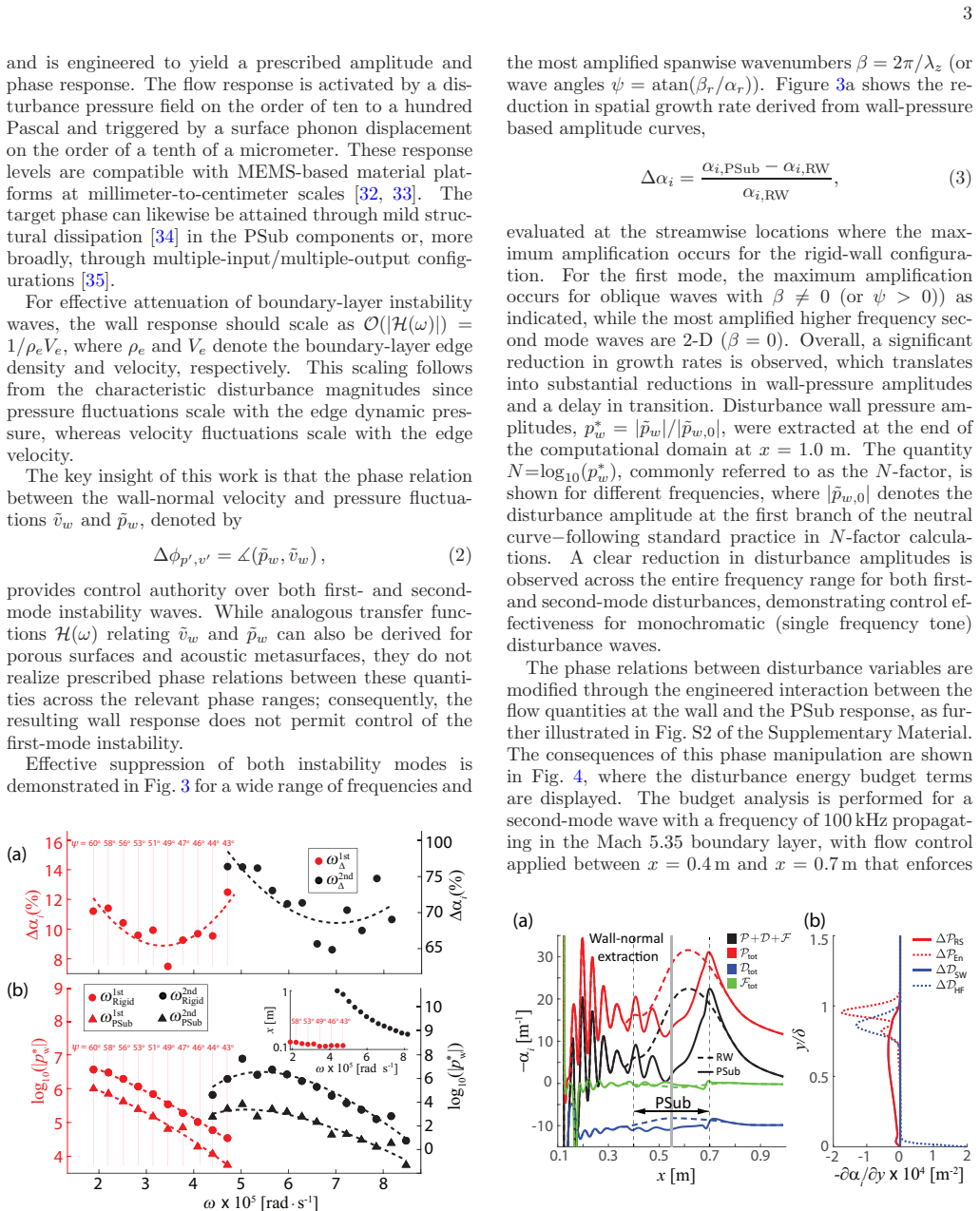
For the rigid wall (R W) case (black line), the 2-D instability waves with disturbance frequencies of 50 kHz and 100 kHz associated with the first and sec- ond mode instabilities, respectively, grow exponentially as expected for an unstable boundary-layer flow. When a phonon engineered subsurface is inserted, however, the disturbances are strongly attenuate...
-
[3]
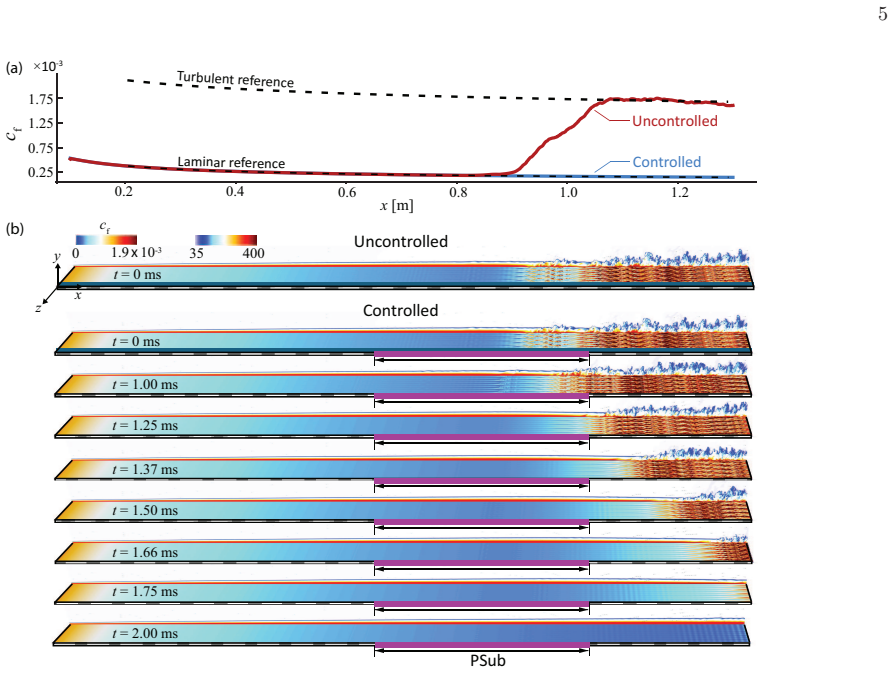
This result underpins another key contribution− the effective control of first- and second- mode waves in a broadband disturbance environment. In conclusion, this work introduces a new paradigm for passive control of hypersonic boundary-layer tran- sition based on engineered phase relations between wall pressure and velocity fluctuations. By leveraging local...
-
[4]
Hypersonic laminar–turbulent transi - tion on circular cones and scramjet forebodies,
S. P. Schneider, “Hypersonic laminar–turbulent transi - tion on circular cones and scramjet forebodies,” Progress in Aerospace Sciences, vol. 40, no. 1, pp. 1–50, 2004
2004
-
[5]
Laminar, transi- tional, and turbulent heating on mid lift-to-drag ratio en- try vehicles,
B. R. Hollis and K. E. Hollingsworth, “Laminar, transi- tional, and turbulent heating on mid lift-to-drag ratio en- try vehicles,” Journal of Spacecraft and Rockets, vol. 50, no. 5, pp. 937–949, 2013
2013
-
[6]
Independent market study: Commercial hyper- sonic transportation,
W. Bastedo, J. Matthews, C. Griffin, A. Stiles, L. Band- hauer, S. Fischer, J. Olds, H. Magill, M. Braun, M. Schaf- fer, J. Fritch, L. Gambetta, J. Hedgepeth, and D. Stan- ley, “Independent market study: Commercial hyper- sonic transportation,” Tech. Rep. NASA Delivery Or- der 80HQTR20F0177, Task Order 36 under Contract 80HQTR18A0012, NASA, 2021. 5 x y z t ...
2021
-
[7]
An examination of high- speed aircraft – part 1: Past, present, and future,
L. Pollock and G. Wild, “An examination of high- speed aircraft – part 1: Past, present, and future,” Transportation Engineering, vol. 18, p. 100290, 2024
2024
-
[8]
Design aspects of long range supersonic lfc airplanes with highly swept wings,
W. Pfenninger and C. S. Vemuru, “Design aspects of long range supersonic lfc airplanes with highly swept wings,” in SAE Technical Paper, no. 881397, SAE International,
-
[9]
Presented at the Aerospace Technology Conference and Exposition, Anaheim, CA, USA
-
[10]
Feasibil- ity and benefits of laminar flow control on supersonic cruise airplanes,
A. G. Powell, S. Agrawal, and T. R. Lacey, “Feasibil- ity and benefits of laminar flow control on supersonic cruise airplanes,” Contractor Report NASA-CR-181817, NASA, July 1989. Prepared by McDonnell Douglas Corp., Long Beach, CA
1989
-
[11]
CFD validation of a supersonic laminar flow control concept,
C.-J. Woan, P. B. Gingrich, and M. W. George, “CFD validation of a supersonic laminar flow control concept,” in 29th Aerospace Sciences Meeting, no. AIAA-91-0188, (Reno, NV, USA), pp. 1–12, American Institute of Aero- nautics and Astronautics, Jan. 1991
1991
-
[12]
Performance and economic assessment of a wing-integrated hybrid laminar flow control system,
B. Fr¨ ohler, A. Pohya, J. H¨ aßy, T. Kilian, A. Bismark, M. Radestock, and D. Cruz Palacios, “Performance and economic assessment of a wing-integrated hybrid laminar flow control system,” The Aeronautical Journal, vol. 129, no. 1338, p. 2103–2130, 2025
2025
-
[13]
These instabilities are also referred to, interchangea bly, as disturbances or fluctuations
-
[14]
Boundary-layer stability theory,
L. M. Mack, “Boundary-layer stability theory,” Tech. Rep. JPL Report 900-277, Rev. A, Jet Propulsion Labo- ratory, California Institute of Technology, Pasadena, CA, 1969
1969
-
[15]
On the inviscid energetics of Mack’s first mode instability,
T. Liang, S. Kafle, A. Amin Khan, P. Paredes, and J. Kuehl, “On the inviscid energetics of Mack’s first mode instability,” Theoretical and Computational Fluid Dynamics, vol. 37, 12 2022
2022
-
[16]
Stabilization of hypersonic boundary layers by porous coatings,
A. V. Fedorov, N. D. Malmuth, A. Rasheed, and H. G. Hornung, “Stabilization of hypersonic boundary layers by porous coatings,” AIAA Journal, vol. 39, no. 4, pp. 605– 610, 2001
2001
-
[17]
Acoustic properties of porous coatings for hypersonic boundary- layer control,
G. A. Br` es, T. Colonius, and A. V. Fedorov, “Acoustic properties of porous coatings for hypersonic boundary- layer control,” AIAA Journal, vol. 48, no. 2, pp. 267–274, 2010
2010
-
[18]
Second-mode attenuation and cancellation by porous coatings in a high-speed boundary layer,
G. Br` es, M. Inkman, T. Colonius, and A. Fedorov, “Second-mode attenuation and cancellation by porous coatings in a high-speed boundary layer,” Journal of Fluid Mechanics, vol. 726, pp. 312–337, 07 2013
2013
-
[19]
The- oretical modeling and optimization of porous coating for hypersonic laminar flow control,
R. Zhao, T. Liu, C. Y. Wen, J. Zhu, and L. Cheng, “The- oretical modeling and optimization of porous coating for hypersonic laminar flow control,” AIAA Journal, vol. 56, no. 8, pp. 2942–2946, 2018
2018
-
[20]
Impedance- near-zero acoustic metasurface for hypersonic boundary- layer flow stabilization,
R. Zhao, T. Liu, C.-Y. Wen, and J. Zhu, “Impedance- near-zero acoustic metasurface for hypersonic boundary- layer flow stabilization,” Physical Review Applied, vol. 11, p. 44015, 04 2019
2019
-
[21]
Control of reflected waves with acoustic meta- surfaces for hypersonic boundary-layer stabilization,
R. Zhao, Y. Dong, X. Zhang, C. Wen, T. Long, and W. Yuan, “Control of reflected waves with acoustic meta- surfaces for hypersonic boundary-layer stabilization,” 6 AIAA Journal, vol. 59, no. 6, pp. 1893–1898, 2021
2021
-
[22]
Review of acoustic metasurfaces for hypersonic boundary layer stabilization,
R. Zhao, C. Wen, Y. Zhou, G. Tu, and J. Lei, “Review of acoustic metasurfaces for hypersonic boundary layer stabilization,” Progress in Aerospace Sciences, vol. 130, p. 100808, 2022
2022
-
[23]
Direct numerical sim- ulation of breakdown to turbulence in a Mach 6 boundary layer over a porous surface,
N. De Tullio and N. D. Sandham, “Direct numerical sim- ulation of breakdown to turbulence in a Mach 6 boundary layer over a porous surface,” Physics of Fluids, vol. 22, p. 094105, 09 2010
2010
-
[24]
The stabilization of a hyper- sonic boundary layer using local sections of porous coat- ing,
X. Wang and X. Zhong, “The stabilization of a hyper- sonic boundary layer using local sections of porous coat- ing,” Physics of Fluids, vol. 24, p. 034105, 03 2012
2012
-
[25]
Stabiliza - tion of a hypersonic boundary layer using a felt-metal porous coating,
R. C. Tritarelli, S. K. Lele, and A. Fedorov, “Stabiliza - tion of a hypersonic boundary layer using a felt-metal porous coating,” Journal of Fluid Mechanics, vol. 769, p. 729–739, 2015
2015
-
[26]
The stability of the laminar boundary layer in a compressible fluid,
L. Lees, “The stability of the laminar boundary layer in a compressible fluid,” Tech. Rep. NACA-TR-876, Na- tional Advisory Committee for Aeronautics (NACA), July 1947
1947
-
[27]
Prediction and control of transition in supersonic and hypersonic boundary layers,
M. R. Malik, “Prediction and control of transition in supersonic and hypersonic boundary layers,” AIAA Journal, vol. 27, no. 11, pp. 1487–1493, 1989
1989
-
[28]
Effects of wall cooling on hypersonic boundary layer receptivity over a cone,
K. Kara, P. Balakumar, and O. A. Kandil, “Effects of wall cooling on hypersonic boundary layer receptivity over a cone,” in 38th AIAA Fluid Dynamics Conference and Exhibit, (Seattle, W A, USA), June 2008
2008
-
[29]
Flow stabilization by subsurface phonons,
M. I. Hussein, S. Biringen, O. R. Bilal, and A. Kucala, “Flow stabilization by subsurface phonons,” Proceedings of the Royal Society of London A, vol. 471, p. 20140928, 05 2015
2015
-
[30]
¨Uber die entstehung der tur- bulenz. 1. mitteilung,
W. Tollmien, “ ¨Uber die entstehung der tur- bulenz. 1. mitteilung,” Nachrichten von der Gesellschaft der Wissenschaften zu G¨ ottingen, Mathematisch-Physikalische Klasse, pp. 21–44, 1929
1929
-
[31]
Biorthogonal decomposition of the disturbance flow field generated by particle impingement on a hypersonic boundary layer,
S. Al Hasnine, V. Russo, A. Tumin, and C. Brehm, “Biorthogonal decomposition of the disturbance flow field generated by particle impingement on a hypersonic boundary layer,” Journal of Fluid Mechanics, vol. 969, p. A1, 2023
2023
-
[32]
Dynamics of phononic materials and structures: Historical origins, recent progress, and future outlook,
M. I. Hussein, M. Leamy, and M. Ruzzene, “Dynamics of phononic materials and structures: Historical origins, recent progress, and future outlook,” Applied Mechanics Reviews, vol. 66, p. 040802, 07 2014
2014
-
[33]
Additive manufacturing of metal lat- tice structures: A comprehensive review of technologies, mechanical properties, applications, and future trends,
R. Wang, H. Shi, J. Gu, X. He, P. Zhang, Z. Yu, H. Yan, and Q. Lu, “Additive manufacturing of metal lat- tice structures: A comprehensive review of technologies, mechanical properties, applications, and future trends,” Materials Today Physics, p. 101933, 2025
2025
-
[34]
Stabilization of hypersonic shockwave/boundary-layer interactions with phononic metamaterials,
J. D. Navarro, D. Balderas, E. J. LaLonde, J. C. Velasquez-Gonzalez, E. N. Hoffman, C. S. Combs, and D. Restrepo, “Stabilization of hypersonic shockwave/boundary-layer interactions with phononic metamaterials,” Matter, vol. 8, no. 7, 2025
2025
-
[35]
A nonlinear compressible flow disturbance formulation for adaptive mesh refinement wavepacket tracking in hy- personic boundary-layer flows,
O. M. Browne, A. P. Haas, H. F. Fasel, and C. Brehm, “A nonlinear compressible flow disturbance formulation for adaptive mesh refinement wavepacket tracking in hy- personic boundary-layer flows,” Computers & Fluids, p. 105395, 2022
2022
-
[36]
What is the Young’s modulus of silicon?,
M. A. Hopcroft, W. D. Nix, and T. W. Kenny, “What is the Young’s modulus of silicon?,” Journal of microelectromechanical systems, vol. 19, no. 2, pp. 229– 238, 2010
2010
-
[37]
Investigation on the qual- ity factor limit of the (111) silicon based disk resonator,
X. Zhou, D. Xiao, Q. Li, Q. Hu, Z. Hou, K. He, Z. Chen, C. Zhao, Y. Wu, X. Wu, et al., “Investigation on the qual- ity factor limit of the (111) silicon based disk resonator,” Micromachines, vol. 9, no. 1, p. 25, 2018
2018
-
[38]
Effect of viscous loss on mechanical resonators designed for mass detection,
J. F. Vignola, J. A. Judge, J. Jarzynski, M. Zalalutdino v, B. H. Houston, and J. W. Baldwin, “Effect of viscous loss on mechanical resonators designed for mass detection,” Applied Physics Letters, vol. 88, no. 4, 2006
2006
-
[39]
Tollmien–schlichting wave manipulation by a multi-input multi-output phononic subsurface,
C. Willey, C. Barnes, V. Chen, K. Rosenberg, A. Medina, and A. T. Juhl, “Tollmien–schlichting wave manipulation by a multi-input multi-output phononic subsurface,” The Journal of the Acoustical Society of America, vol. 155, no. 3 Supplement, pp. A57–A57, 2024
2024
-
[40]
Turbulent boundary layer in com- pressible fluids,
E. R. Van Driest, “Turbulent boundary layer in com- pressible fluids,” J. Aeronaut. Sci., vol. 18, no. 3, 1951. SUPPLEMENTARY MATERIAL Phonon-mediated stabilization of first and second modes in hypersonic boundary-layer flows Christoph Brehm, 1, ∗ Connor W. Klauss, 1, † and Mahmoud I. Hussein 2, 3, ‡ 1Department of Aerospace Engineering, University of Maryla...
Pith/arXiv arXiv 1951
discussion (0)
Sign in with ORCID, Apple, or X to comment. Anyone can read and Pith papers without signing in.