REVIEW 3 major objections 5 minor 27 references
Flex-Forcing: Towards a Unified Autoregressive and Bidirectional Video Diffusion Model
T0 review · 3 major / 5 minor · reviewed 2026-07-12 · grok-4.5
Pith's one-line read One trained video diffusion model can switch between bidirectional, autoregressive, and hybrid generation by flexible chunking of frames and denoising steps.
desk verdict Solid systems paper: one post-trained model with joint frame+timestep flexible chunking and K-projection beats rigid Self-Forcing on the quality–speed Pareto and adds useful hybrid/editing modes; novelty is incremental, long-video transfer still leans on pretraining priors. read the letter →
The pith
A machine-rendered reading of the paper's core claim, the machinery that carries it, and where it could break.
The reading
What carries the argument
Flexible chunking: a partition of frames that may change both across temporal regions and across denoising timesteps (nested, pyramid-style), so that bidirectional attention is used inside chunks for structure while generation across chunks stays causal; complemented by a timestep-conditioned K-projection that maps clean cached keys into the current noise level so mixed causal/non-causal attention remains consistent.
What would settle it
Train an identical base model with the same distillation recipe but force fixed uniform chunks and ablate the K-projection; if the flexible and hybrid configurations then lose their Pareto advantage on 5 s and 30 s VBench (and any-order edits fail to preserve later-frame consistency), the central claim fails.
Extended reading notes
Core claim
A bidirectional video diffusion model can be converted, via flexible-chunk training, into a single generator that supports fully bidirectional, fully autoregressive, or hybrid chunk-wise inference at test time, yielding higher VBench quality and faster FPS than rigid causal baselines while remaining competitive with few-step bidirectional distillation and improving long-video stability.
Load-bearing premise
Randomly sampling chunk sizes during distillation, plus a small key projection, is enough to keep the model’s original bidirectional power while adding causal power, and the long-video gains mostly ride on what the pretrained model already knew.
Editorial extensions
If this is right
- A single checkpoint can be deployed under different device budgets by choosing chunk layouts at inference, without retraining.
- Hybrid front-loaded chunking (larger early chunks, smaller late chunks) can outperform both pure causal and pure bidirectional schedules on quality–speed.
- Any-order, any-timestep autoregressive editing becomes possible: re-denoise an arbitrary middle segment while conditioning on both past and future clean tokens.
- Long-video generation inherits better global planning and higher dynamic degree than rigid self-rollout causal models of the same size.
- Few-step bidirectional quality is retained, so the same model can also serve pure diffusion distillation use cases.
Reading between the lines
- The same nested-chunk idea could let interactive world models switch between fast local response and occasional global re-planning without two separate networks.
- If the dependence on strong bidirectional pretraining priors is the main limiter, the method may underperform when applied to models that were never trained with full temporal attention.
- Searchable chunk configurations open a practical auto-tuning loop: given a latency budget and a short validation set, pick the Pareto-optimal partition once and freeze it for production.
- Noise-level alignment of cached keys may be reusable in other hybrid attention settings (for example, mixed clean/noisy conditioning in image or audio diffusion).
Editorial analysis
A structured set of objections, weighed in public.
Referee Report
Summary. Flex-Forcing post-trains a bidirectional video diffusion model (Wan2.1-T2V-1.3B) so that a single network can run bidirectional, autoregressive, or hybrid inference. The mechanism is flexible chunking of the frame index set jointly with nested partitions across denoising timesteps (Eqs. 1–3, Table 1), trained by stochastic chunk sampling during asymmetric DMD/self-rollout (§3.3) plus a timestep-conditioned K-projection that maps clean past keys into the current noise level (Eqs. 5–6). Reported results claim a better quality–efficiency Pareto frontier than Self-Forcing on VBench (Tables 2–3, Figs. 1, 4, 8), competitive few-step bidirectional quality, improved VBench-Long metrics especially dynamic degree (Table 4), and qualitative any-order / any-timestep editing (Figs. 5–6).
Significance. If the results hold under tighter controls, the paper offers a practical unification of two regimes that the field has largely treated as separate distillation targets. The nested frame–timestep factorization and the noise-aligned KV projection are concrete, reusable design choices; the multi-config Pareto plots, matched-seed Self-Forcing comparisons, K-projection ablation (Fig. 10), and user study give the efficiency claim more empirical weight than a single fixed schedule. The any-order editing application is a useful implication of mixed causal/non-causal attention. The work is systems-empirical rather than theoretical, but the contribution is well scoped for video generation research.
major comments (3)
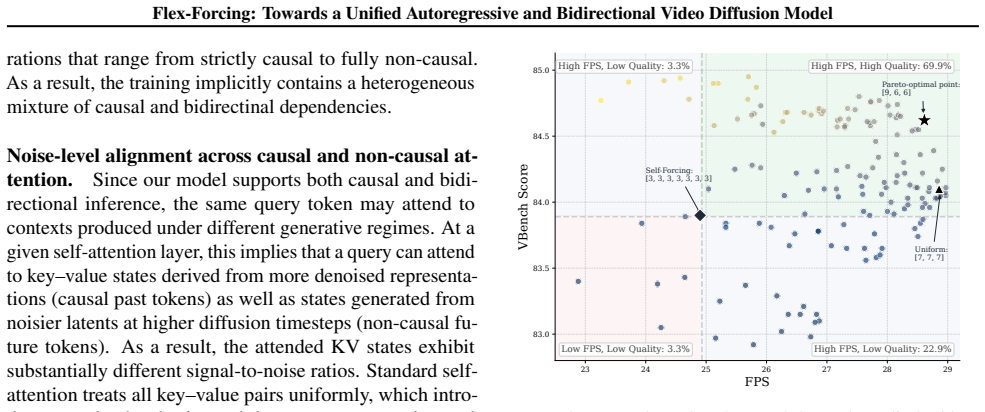
- [§3.3, Fig. 4, Table 2] §3.3 and Fig. 4 / Table 2: The central claim is that flexible-chunk training enables hybrid regimes, yet the strongest short-video numbers come from brute-force partition search (e.g., 15-3-3, 12-6-3). Please isolate training from search: (i) evaluate the Flex-Forcing checkpoint under fixed, non-searched schedules matched to Self-Forcing (including pure frame-wise and uniform chunking), and (ii) if possible, apply the same hybrid schedules to a Self-Forcing-style model without stochastic flexible-chunk training / K-projection. Without this, it remains ambiguous whether the Pareto gains are a property of the trained model or of post-hoc config search on short clips.
- [§5, Table 4, Limitations] §5, Table 4, Limitations: Long-video results build on Infinity-RoPE with short-video training only, and the Limitations section states that effectiveness “depend[s] heavily on capabilities inherited from pre-training.” The large Dynamic Degree gain is interesting, but attribution to Flex-Forcing’s flexible chunking (vs. RoPE/windowing and bidirectional priors) is not controlled. Add a same-backbone ablation (e.g., Self-Forcing + Infinity-RoPE vs. Flex-Forcing + Infinity-RoPE under identical sink/window) and temper claims of “long-video stability” accordingly.
- [§4.2, Figs. 5–6, Eq. 7] §4.2, Figs. 5–6: Any-order / any-timestep editing is presented as a main application of non-causal conditioning (Eq. 7), but evidence is purely qualitative success cases versus Self-Forcing. For a load-bearing application claim, provide at least a small quantitative protocol (e.g., identity/consistency metrics on unedited segments, edit success rate over a fixed prompt set, or human preference on edited vs. unedited continuity). Otherwise reframe §4.2 as a qualitative demonstration rather than a validated capability.
minor comments (5)
- [§3.1, Table 1, Eq. 2] Table 1 and Eq. 2: Notation mixes x^{F}_{t} and x^{k}_{t}; define F_{t,k} consistently before first use and clarify that x^{F_{t,<k}}_0 is the clean KV cache, not a re-encoded clean video.
- [§3.2–3.3, Fig. 3] Figure 3 caption and §3.3: “speratability” / “propogation” / “bidirectinal” typos; also “intialized” in the K-projection paragraph. A careful proofread pass is needed.
- [Tables 2–3] Table 2 footnote: NFE accounting (“N steps + 1 caching”) should be stated once in the main text so FPS/NFE comparisons to few-step bidirectional distillations in Table 3 are unambiguous.
- [Fig. 1, Fig. 12] Figure 1 vs. Figure 12: GB200 and A100 Pareto plots use overlapping but not identical config sets; a short note on which configs are shared would help reproducibility.
- [§2] Related Work: Causal distillation line (CausVid, Self-Forcing, Self-Forcing++) is covered; a one-sentence contrast with concurrent rolling/long-context AR methods (e.g., Rolling Forcing, LongLive) on what flexible chunking uniquely enables would sharpen positioning.
Circularity Check
Empirical systems paper with external VBench/FPS metrics; only minor post-hoc config selection, no definitional or fitted-as-prediction circularity in the claimed unification.
-
fitted input called prediction
[§4.1 / Figure 4 / Table 2]
"We perform a brute-force search to identify the optimal chunk configuration for a 5-second video under a fixed constraint of three chunks. ... Pareto-optimal point: [9, 6, 6] ... Ours (15-3-3) - Best Performance ... Ours - (7-7-7) - Fastest"
After training with random chunk sampling, the paper enumerates partitions and highlights the best-scoring layouts as evidence of a superior Pareto frontier. This is disclosed selection among supported schedules rather than a forced algebraic prediction, but it mildly elevates post-hoc search results into the central performance claim; the matched-to-baseline and multi-config ablations keep the circularity minor.
full rationale
Flex-Forcing is a post-training + inference framework paper. The core claims (unified bidirectional/AR/hybrid regimes via flexible chunking over frames and timesteps + K-projection, better quality-efficiency Pareto than Self-Forcing, competitive few-step bidirectional quality, improved long-video metrics) are evaluated on external benchmarks (VBench, VBench-Long, FPS on GB200/A100) with fixed seeds and shared prompts. Training follows the established CausVid/Self-Forcing pipeline (ODE init + asymmetric DMD/self-rollout) while randomly sampling chunk partitions (Eqs. 1-4, §3.3) and adding a lightweight timestep-conditioned K-projection (Eqs. 5-6); success is not defined as the training loss itself. Table 1 simply special-cases the same sampling equation for pure AR vs. bidirectional vs. hybrid; this is definitional taxonomy, not a circular derivation of performance. Brute-force enumeration of short-video partitions (Fig. 4) and reporting of best/fastest/matched configs (Tables 2-3) is disclosed test-time search, not a fitted parameter renamed as an independent prediction. Long-video results inherit Infinity-RoPE and pretraining priors (Limitations), which the paper itself flags; this is an untested transfer assumption, not circularity. No self-citation supplies a uniqueness theorem that forces the result, no ansatz is smuggled as external fact, and no algebraic identity equates outputs to inputs by construction. Score 1 only for the mild selection emphasis on Pareto-optimal points after enumeration; central claims remain independently falsifiable.
Assumptions & free parameters
free parameters (6)
- Inference chunk boundary schedules a_t (e.g., 15-3-3, 7-7-7, 12-6-3)
- Training chunk size range (uniform sample 2–10)
- K-projection learning rate (2e-6) and identity init
- NFE / denoising schedules (e.g., 5-step, 3-step, [1000,500] for 2-step)
- Long-video sink size (3) and attention window (21 latent frames)
- Training iterations (600) and batch size (64)
assumptions (5)
- domain assumption A pretrained bidirectional video diffusion transformer (Wan2.1) already encodes useful global temporal structure that can be retained under causal/hybrid post-training.
- domain assumption Asymmetric distillation with DMD/VSD and self-rollout (as in CausVid/Self-Forcing) is a valid way to inject causality into a bidirectional diffusion model.
- standard math Standard diffusion forward process and score-based distillation gradients (Eq. 4) correctly train the generator under mixed attention masks.
- ad hoc to paper Projecting clean past keys into the current-timestep noise space makes mixed causal/non-causal attention well-behaved.
- ad hoc to paper Nested/pyramid chunk splits across denoising steps preserve causal dependencies if execution is buffered in the described order.
invented entities (3)
-
Flexible chunking over frames and denoising timesteps (nested a_t partitions)
-
Timestep-dependent K-Projection (Π_{t←0}) on clean KV cache
-
Any-order / any-timestep autoregressive editing under Flex-Forcing
Cite this review
Pith. "Pith review of Flex-Forcing: Towards a Unified Autoregressive and Bidirectional Video Diffusion Model." pith.science (2026). https://pith.science/paper/6FLUVMYG
@misc{pith2026260703509,
  author       = {Pith},
  title        = {Pith review of: Flex-Forcing: Towards a Unified Autoregressive and Bidirectional Video Diffusion Model},
  year         = {2026},
  howpublished = {\url{https://pith.science/paper/6FLUVMYG}},
  note         = {Machine review of arXiv:2607.03509}
}
read the original abstract
Recent progress in large-scale generative models has substantially advanced video generation, yet existing methods remain constrained by a rigid inference paradigm. Bidirectional diffusion models excel at global coherence and visual fidelity but suffer from slow inference, while autoregressive models offer efficient and streaming generation at the cost of long-range consistency and exposure bias. We introduce Flex-Forcing, a unified training and inference framework that enables a video diffusion model to seamlessly operate under both bidirectional and autoregressive generation regimes. The core idea is a flexible chunking mechanism jointly defined over the temporal axis and denoising steps. This design allows the model to (1) perform flexible chunking according to different device budgets, (2) perform bidirectional inference across chunks for global structure planning, while generating frames autoregressively within each chunk for efficient and fine-grained synthesis, and (3) perform any-order, any-timestep autoregressive generation without the strict causal constraint. Extensive experiments on multiple video generation benchmarks demonstrate that Flex-Forcing achieves consistently better video quality, long-video stability than strong baselines with a rigid inference schedule, while offering faster inference.
Figures


Figures from the paper (13 more)


Reference graph
Works this paper leans on
-
[1]
Lu- miere: A space-time diffusion model for video generation
Bar-Tal, O., Chefer, H., Tov, O., Herrmann, C., Paiss, R., Zada, S., Ephrat, A., Hur, J., Liu, G., Raj, A., et al. Lu- miere: A space-time diffusion model for video generation. InSIGGRAPH Asia 2024 Conference Papers, pp. 1–11,
2024
-
[2]
Blattmann, A., Dockhorn, T., Kulal, S., Mendelevitch, D., Kilian, M., Lorenz, D., Levi, Y ., English, Z., V oleti, V ., Letts, A., et al. Stable video diffusion: Scaling latent video diffusion models to large datasets.arXiv preprint arXiv:2311.15127, 2023a. Blattmann, A., Rombach, R., Ling, H., Dockhorn, T., Kim, S. W., Fidler, S., and Kreis, K. Align you...
-
[3]
Autoregressive video generation without vector quantization.arXiv preprint arXiv:2412.14169,
Deng, H., Pan, T., Diao, H., Luo, Z., Cui, Y ., Lu, H., Shan, S., Qi, Y ., and Wang, X. Autoregressive video generation without vector quantization.arXiv preprint arXiv:2412.14169,
-
[4]
Ltx-2: Efficient joint audio-visual foundation model.arXiv preprint arXiv:2601.03233,
HaCohen, Y ., Brazowski, B., Chiprut, N., Bitterman, Y ., Kvochko, A., Berkowitz, A., Shalem, D., Lifschitz, D., Moshe, D., Porat, E., et al. Ltx-2: Efficient joint audio-visual foundation model.arXiv preprint arXiv:2601.03233,
-
[5]
He, X., Peng, C., Liu, Z., Wang, B., Zhang, Y ., Cui, Q., Kang, F., Jiang, B., An, M., Ren, Y ., et al. Matrix-game 2.0: An open-source real-time and streaming interactive world model.arXiv preprint arXiv:2508.13009,
-
[6]
P., Poole, B., Norouzi, M., Fleet, D
Ho, J., Chan, W., Saharia, C., Whang, J., Gao, R., Gritsenko, A., Kingma, D. P., Poole, B., Norouzi, M., Fleet, D. J., et al. Imagen video: High definition video generation with diffusion models.arXiv preprint arXiv:2210.02303, 2022a. Ho, J., Salimans, T., Gritsenko, A., Chan, W., Norouzi, M., and Fleet, D. J. Video diffusion models.Advances in neural inf...
-
[7]
Relic: Interactive video world model with long-horizon memory.arXiv preprint arXiv:2512.04040,
Hong, Y ., Mei, Y ., Ge, C., Xu, Y ., Zhou, Y ., Bi, S., Hold- Geoffroy, Y ., Roberts, M., Fisher, M., Shechtman, E., et al. Relic: Interactive video world model with long-horizon memory.arXiv preprint arXiv:2512.04040,
-
[8]
Huang, X., Li, Z., He, G., Zhou, M., and Shechtman, E. Self forcing: Bridging the train-test gap in autoregressive video diffusion.arXiv preprint arXiv:2506.08009, 2025a. Huang, Z., He, Y ., Yu, J., Zhang, F., Si, C., Jiang, Y ., Zhang, Y ., Wu, T., Jin, Q., Chanpaisit, N., et al. Vbench: Compre- hensive benchmark suite for video generative models. In Pro...
Show all 27 references
-
[9]
Vbench++: Comprehensive and versatile benchmark suite for video generative models.IEEE Transactions on Pattern Analy- sis and Machine Intelligence, 2025b
Huang, Z., Zhang, F., Xu, X., He, Y ., Yu, J., Dong, Z., Ma, Q., Chanpaisit, N., Si, C., Jiang, Y ., et al. Vbench++: Comprehensive and versatile benchmark suite for video generative models.IEEE Transactions on Pattern Analy- sis and Machine Intelligence, 2025b. Jiang, Z., Han...
-
[10]
Pyramidal flow matching for efficient video generative modeling.arXiv preprint arXiv:2410.05954,
Jin, Y ., Sun, Z., Li, N., Xu, K., Jiang, H., Zhuang, N., Huang, Q., Song, Y ., Mu, Y ., and Lin, Z. Pyramidal flow matching for efficient video generative modeling.arXiv preprint arXiv:2410.05954,
-
[11]
Li, J., Long, Q., Zheng, J., Gao, X., Piramuthu, R., Chen, W., and Wang, W. Y . T2v-turbo-v2: Enhancing video genera- tion model post-training through data, reward, and condi- tional guidance design.arXiv preprint arXiv:2410.05677,
-
[12]
Diffusion adversarial post-training for one-step video generation.arXiv preprint arXiv:2501.08316,
Lin, S., Xia, X., Ren, Y ., Yang, C., Xiao, X., and Jiang, L. Diffusion adversarial post-training for one-step video generation.arXiv preprint arXiv:2501.08316,
-
[13]
Rolling forcing: Autoregressive long video diffusion in real time.arXiv preprint arXiv:2509.25161,
Liu, K., Hu, W., Xu, J., Shan, Y ., and Lu, S. Rolling forcing: Autoregressive long video diffusion in real time.arXiv preprint arXiv:2509.25161,
-
[14]
Videofusion: Decomposed diffusion models for high-quality video generation.arXiv preprint arXiv:2303.08320,
Luo, Z., Chen, D., Zhang, Y ., Huang, Y ., Wang, L., Shen, Y ., Zhao, D., Zhou, J., and Tan, T. Videofusion: Decomposed diffusion models for high-quality video generation.arXiv preprint arXiv:2303.08320,
-
[15]
Transition matching distillation for fast video generation
Nie, W., Berner, J., Ma, N., Liu, C., Xie, S., and Vahdat, A. Transition matching distillation for fast video generation. arXiv preprint arXiv:2601.09881,
-
[16]
Make-a- video: Text-to-video generation without text-video data
10 Flex-Forcing: Towards a Unified Autoregressive and Bidirectional Video Diffusion Model Singer, U., Polyak, A., Hayes, T., Yin, X., An, J., Zhang, S., Hu, Q., Yang, H., Ashual, O., Gafni, O., et al. Make-a- video: Text-to-video generation without text-video data. arXiv prepr...
-
[17]
Magi-1: Au- toregressive video generation at scale.arXiv preprint arXiv:2505.13211,
Teng, H., Jia, H., Sun, L., Li, L., Li, M., Tang, M., Han, S., Zhang, T., Zhang, W., Luo, W., et al. Magi-1: Au- toregressive video generation at scale.arXiv preprint arXiv:2505.13211,
-
[18]
T., Castro, S., Kunze, J., and Erhan, D
Villegas, R., Babaeizadeh, M., Kindermans, P.-J., Moraldo, H., Zhang, H., Saffar, M. T., Castro, S., Kunze, J., and Erhan, D. Phenaki: Variable length video generation from open domain textual description.arXiv preprint arXiv:2210.02399,
-
[19]
Wan: Open and advanced large-scale video generative models.arXiv preprint arXiv:2503.20314,
Wan, T., Wang, A., Ai, B., Wen, B., Mao, C., Xie, C.-W., Chen, D., Yu, F., Zhao, H., Yang, J., et al. Wan: Open and advanced large-scale video generative models.arXiv preprint arXiv:2503.20314,
-
[20]
Loong: Generating minute-level long videos with autoregressive language models.arXiv preprint arXiv:2410.02757,
Wang, Y ., Xiong, T., Zhou, D., Lin, Z., Zhao, Y ., Kang, B., Feng, J., and Liu, X. Loong: Generating minute-level long videos with autoregressive language models.arXiv preprint arXiv:2410.02757,
-
[21]
Hunyuanvideo 1.5 technical report.arXiv preprint arXiv:2511.18870,
Wu, B., Zou, C., Li, C., Huang, D., Yang, F., Tan, H., Peng, J., Wu, J., Xiong, J., Jiang, J., et al. Hunyuanvideo 1.5 technical report.arXiv preprint arXiv:2511.18870,
-
[22]
Videogpt: Video generation using vq-vae and transformers.arXiv preprint arXiv:2104.10157,
Yan, W., Zhang, Y ., Abbeel, P., and Srinivas, A. Videogpt: Video generation using vq-vae and transformers.arXiv preprint arXiv:2104.10157,
-
[23]
Longlive: Real- time interactive long video generation.arXiv preprint arXiv:2509.22622,
Yang, S., Huang, W., Chu, R., Xiao, Y ., Zhao, Y ., Wang, X., Li, M., Xie, E., Chen, Y ., Lu, Y ., et al. Longlive: Real- time interactive long video generation.arXiv preprint arXiv:2509.22622,
-
[24]
Cogvideox: Text-to-video diffusion models with an ex- pert transformer.arXiv preprint arXiv:2408.06072,
Yang, Z., Teng, J., Zheng, W., Ding, M., Huang, S., Xu, J., Yang, Y ., Hong, W., Zhang, X., Feng, G., et al. Cogvideox: Text-to-video diffusion models with an ex- pert transformer.arXiv preprint arXiv:2408.06072,
-
[25]
Yesiltepe, H., Meral, T. H. S., Akan, A. K., Oktay, K., and Yanardag, P. Infinity-rope: Action-controllable infinite video generation emerges from autoregressive self-rollout. arXiv preprint arXiv:2511.20649,
-
[26]
Lumos-1: On autoregressive video generation from a unified model perspective.arXiv preprint arXiv:2507.08801,
Yuan, H., Chen, W., Cen, J., Yu, H., Liang, J., Chang, S., Lin, Z., Feng, T., Liu, P., Xing, J., et al. Lumos-1: On autoregressive video generation from a unified model perspective.arXiv preprint arXiv:2507.08801,
-
[27]
Large scale diffusion distillation via score-regularized continuous- time consistency.arXiv preprint arXiv:2510.08431,
Zheng, K., Wang, Y ., Ma, Q., Chen, H., Zhang, J., Balaji, Y ., Chen, J., Liu, M.-Y ., Zhu, J., and Zhang, Q. Large scale diffusion distillation via score-regularized continuous- time consistency.arXiv preprint arXiv:2510.08431,
Reviewed July 12, 2026 · model on record in the stance chip above.
Discussion (0). Continue with ORCID to comment.