Impurity-induced loss bursts from anomalous scale-free localization in a non-Hermitian dissipative lattice
Pith reviewed 2026-05-21 04:56 UTC · model grok-4.3
The pith
Impurities in a non-Hermitian lattice create effective boundaries that induce scale-free localization and trigger loss bursts even for distant initial states.
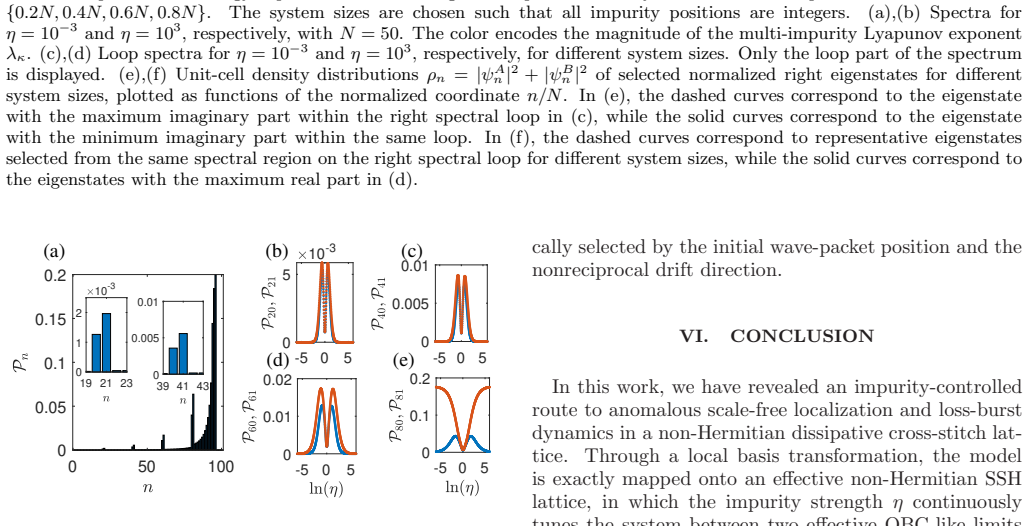
A machine-rendered reading of the paper's core claim, the machinery that carries it, and where it could break.
Core claim
The central claim is that anomalous scale-free localization pinned by impurities produces an impurity-induced loss burst: the long-time integrated dissipation probability is strongly enhanced near an impurity-generated effective boundary even when the initial wave packet is far away. In the single-impurity case the burst region consists of the impurity site and its adjacent effective-boundary site. The effect occurs without imaginary-gap closing. For multiple impurities local burst regions emerge around all impurities while the dominant burst boundary is selected by the initial wave-packet position and the nonreciprocal drift direction.
What carries the argument
The local-basis-rotation mapping of the cross-stitch lattice onto an effective non-Hermitian Su-Schrieffer-Heeger chain, in which impurity strength acts as a tunable parameter that connects open-boundary-like and periodic-boundary limits and pins energy-dependent scale-free localized eigenmodes.
If this is right
- In the single-impurity case the loss burst is confined to the impurity site and one neighboring effective-boundary site.
- Multiple impurities each generate their own local burst region, yet only one becomes dominant depending on starting position and drift direction.
- The loss enhancement occurs without any closing of the imaginary gap.
- Spectral loops remain detached from the real axis for all finite impurity strengths except the two special limits.
Where Pith is reading between the lines
- The energy dependence of the localization length could be used to engineer position-selective dissipation by choosing the initial wave-packet energy.
- The same impurity-as-boundary mechanism may appear in other non-Hermitian lattices once they are reduced to an effective SSH form.
- Varying the nonreciprocal drift strength should shift which impurity dominates the burst, offering a testable control knob.
Load-bearing premise
Tuning the impurity strength connects two effective open-boundary-condition limits through generalized-boundary regimes while keeping spectral loops separated from the real-energy axis.
What would settle it
Evolve an initial wave packet placed many sites away from a single impurity and check whether the long-time integrated dissipation probability exhibits a pronounced peak exactly at the impurity site plus its adjacent effective-boundary site.
Figures


read the original abstract
We identify anomalous scale-free localization and the associated impurity-induced loss bursts in a non-Hermitian dissipative cross-stitch lattice. By a local basis rotation, the model is mapped onto an effective non-Hermitian Su-Schrieffer-Heeger lattice, where local impurities act as tunable effective boundaries. For the parameter choice considered here, tuning the impurity strength $\eta$ connects two effective open-boundary-condition-like limits, reached for $\eta\to0$ and $\eta\to\infty$, through generalized-boundary-condition regimes and the impurity-free periodic-boundary-condition point at $\eta=1$. For finite $\eta\notin\{0,1\}$, the spectral loops remain separated from the real-energy axis, while the eigenstates exhibit scale-free localization pinned by the impurity. Unlike conventional impurity-induced scale-free localization, the Lyapunov exponent depends explicitly on the eigenenergy, making the localization strength eigenstate dependent. We further show that this anomalous eigenmode structure produces an impurity-induced loss burst: the long-time integrated dissipation probability is strongly enhanced near an impurity-generated effective boundary even when the initial wave packet is far away. In the single-impurity case, the burst region consists of the impurity site and its adjacent effective-boundary site, and the effect occurs without imaginary-gap closing. For multiple impurities, local burst regions emerge around all impurities, while the dominant burst boundary is selected by the initial wave-packet position and the nonreciprocal drift direction. These results connect anomalous scale-free localization with controllable dissipation dynamics in non-Hermitian lattices.
Editorial analysis
A structured set of objections, weighed in public.
Referee Report
Summary. The manuscript identifies anomalous scale-free localization and impurity-induced loss bursts in a non-Hermitian dissipative cross-stitch lattice. A local basis rotation maps the model onto an effective non-Hermitian Su-Schrieffer-Heeger lattice in which impurities act as tunable effective boundaries. Tuning the impurity strength η connects open-boundary-condition-like limits (η→0 and η→∞) through generalized-boundary regimes, with the impurity-free periodic point at η=1. For finite η∉{0,1} the spectral loops remain separated from the real axis while eigenstates exhibit energy-dependent scale-free localization pinned at the impurity-generated effective boundary. This structure produces a long-time integrated dissipation probability that is strongly enhanced near the effective boundary even when the initial wave packet is distant; the effect occurs without imaginary-gap closing. For multiple impurities, local burst regions form around each impurity with the dominant boundary selected by initial position and nonreciprocal drift.
Significance. If the central claims are verified, the work establishes a concrete link between anomalous scale-free localization and controllable dissipation dynamics in non-Hermitian lattices, distinct from conventional skin-effect or exceptional-point mechanisms. The local basis rotation that converts impurities into tunable boundaries and the explicit energy dependence of the Lyapunov exponent are technically interesting. The mapping appears parameter-free, which is a positive feature for the robustness of the predicted loss-burst phenomenology.
major comments (1)
- [Abstract and effective SSH mapping section] The statement that spectral loops remain separated from the real-energy axis for finite η∉{0,1} (abstract and effective-model discussion) is load-bearing for the claim that the loss burst originates purely from the energy-dependent Lyapunov exponent and scale-free localization rather than gap closing. No explicit analytic proof or numerical scan of the Brillouin zone is provided to confirm that no eigenvalue acquires zero imaginary part at finite η; without this verification the attribution to the anomalous mechanism cannot be secured.
minor comments (1)
- [Model and mapping] The definition of the effective boundary sites and the precise form of the energy-dependent Lyapunov exponent would benefit from an additional equation or schematic diagram for clarity.
Simulated Author's Rebuttal
We thank the referee for the careful reading of our manuscript and the positive assessment of its significance. We address the single major comment below and have revised the manuscript to incorporate the requested verification.
read point-by-point responses
-
Referee: [Abstract and effective SSH mapping section] The statement that spectral loops remain separated from the real-energy axis for finite η∉{0,1} (abstract and effective-model discussion) is load-bearing for the claim that the loss burst originates purely from the energy-dependent Lyapunov exponent and scale-free localization rather than gap closing. No explicit analytic proof or numerical scan of the Brillouin zone is provided to confirm that no eigenvalue acquires zero imaginary part at finite η; without this verification the attribution to the anomalous mechanism cannot be secured.
Authors: We agree that an explicit verification is necessary to secure the attribution. In the revised manuscript we add a numerical scan of the complex spectrum over the Brillouin zone for representative finite values of η (η = 0.5 and η = 2) that confirms all eigenvalues retain strictly negative imaginary parts with no zero crossings. We also include a concise analytic argument in the effective non-Hermitian SSH mapping section showing that the dissipative terms in the model keep the spectral loops separated from the real axis for η ∉ {0,1}. These additions demonstrate that the impurity-induced loss bursts arise from the energy-dependent Lyapunov exponent and scale-free localization without requiring imaginary-gap closing. The abstract and effective-model discussion have been updated for clarity, and a new supplementary figure displays the scan results. revision: yes
Circularity Check
No circularity; derivation follows from lattice mapping and effective-model analysis
full rationale
The paper defines the cross-stitch lattice Hamiltonian, applies an exact local basis rotation to obtain the effective non-Hermitian SSH chain with impurity-tuned boundaries, and then computes the spectrum, energy-dependent Lyapunov exponents, and long-time integrated dissipation directly from the resulting eigenmodes. The separation of spectral loops from the real axis for finite η, the absence of imaginary-gap closing, and the impurity-pinned scale-free localization are all obtained by solving the effective model rather than by redefining inputs as outputs or by load-bearing self-citation. No fitted parameter is relabeled as a prediction, and the loss-burst enhancement is a computed consequence of the eigenstate structure, not a tautology.
Axiom & Free-Parameter Ledger
axioms (1)
- domain assumption A local basis rotation maps the dissipative cross-stitch lattice onto an effective non-Hermitian Su-Schrieffer-Heeger lattice in which impurities act as tunable effective boundaries.
Lean theorems connected to this paper
-
IndisputableMonolith/Foundation/RealityFromDistinction.leanreality_from_one_distinction unclear?
unclearRelation between the paper passage and the cited Recognition theorem.
the Lyapunov exponent depends explicitly on the eigenenergy through the impurity-modified transfer relation... λ(E,η,N) = 1/N [ln|2t/η| + 2 ln|(E1 E2 − J²)/(E1² − J²)|]
-
IndisputableMonolith/Foundation/AlexanderDuality.leanalexander_duality_circle_linking unclear?
unclearRelation between the paper passage and the cited Recognition theorem.
For finite η∉{0,1}, the spectral loops remain separated from the real-energy axis... without imaginary-gap closing
What do these tags mean?
- matches
- The paper's claim is directly supported by a theorem in the formal canon.
- supports
- The theorem supports part of the paper's argument, but the paper may add assumptions or extra steps.
- extends
- The paper goes beyond the formal theorem; the theorem is a base layer rather than the whole result.
- uses
- The paper appears to rely on the theorem as machinery.
- contradicts
- The paper's claim conflicts with a theorem or certificate in the canon.
- unclear
- Pith found a possible connection, but the passage is too broad, indirect, or ambiguous to say the theorem truly supports the claim.
Reference graph
Works this paper leans on
-
[1]
allows the single-impurity eigenvalue problem to be reduced to a scalar transfer problem for the amplitudes on the Q sublattice of the effective SSH lattice. Away from the impurity, the transfer is governed by the impurity-free factor qn = E2 1 − J 2 2tJ qn− 1, (5) where E1 =E +iγ. The impurity replaces two consecu- tive impurity-free transfer steps by an ...
-
[2]
The spectral evolution can be understood directly from Eq
determines the single-impurity spectrum and shows how the impurity strength η controls the global boundary closure of the effective SSH chain. The spectral evolution can be understood directly from Eq. ( 7). In the limit η = 0, transmission across the impurity cell is suppressed, and the impurity effectively cuts the ring into an OBC-like configuration. The ...
-
[3]
reduces to E2 1 − J 2 = ei2πl/N for l = 0, 1,...,N − 1, so that the spectral loops become tangent to the real axis. For η > 1, the spectrum moves away from the real- energy axis again, and an imaginary gap reopens between the spectral loops and the real axis. Meanwhile, four eigenvalues detach from the loop structure. In the oppo- 4 site limitη → ∞ , the ...
-
[4]
is local and unitary within each unit cell, this unit-cell density cap- tures the same spatial scaling behavior as the amplitudes in the mapped SSH basis. The profiles collapse onto size- independent curves, consistent with a localization length that scales linearly with the system size. At the same time, the wave functions exhibit an abrupt change at the ...
-
[5]
provides a direct way to distinguish the present localized states from conventional impurity- induced scale-free localized states. In conventional SFL models, the impurity modifies the boundary closure con- dition through an energy-independent factor. In the no- tation of the present work, the corresponding Lyapunov exponent takes the form λ conv = N − 1 l...
-
[6]
depends on the impurity strength. For η ≪ 1, the conventional impurity-controlled term ln |2t/η |is large and dominates the Lyapunov exponent. By contrast, for η ≫ 1, the dominant contribution comes from the energy-dependent term 2 ln |(E1E2 − J 2)/ (E2 1 − J 2)|, which reflects the impurity-modified two-step transfer across the impurity region. In both str...
-
[7]
is pro- portional to 1 /N , so that the localization length scales linearly with the system size, ξ ∼ N . This accounts for the convergence of the finite-size spectra toward the PBC spectrum in the thermodynamic limit, while the eigenstates remain spatially nonuniform in finite systems. The distinction from conventional impurity-induced SFL therefore does n...
-
[8]
with a single im- purity, the walker is initially prepared on sublattice A of the n0th unit cell, ψ A n (0) = δn,n 0 and ψ B n (0) = 0, which is normalized to unity. Since dissipation occurs only on sublatticeB, the integrated loss provides a natural probe of the long-time absorption profile. In the parameter regimes considered below, the long-time surviva...
-
[9]
The eigenstate is written as |ψ ⟩ = ∑ n ( pnP † n +qnQ† n ) |0⟩
with a single impurity at unit cell m. The eigenstate is written as |ψ ⟩ = ∑ n ( pnP † n +qnQ† n ) |0⟩. (A1) For impurity-free unit cells, the eigenvalue equations are E1qn− 1 =Jp n, E1pn =Jq n− 1 + 2tqn, (A2) where E1 =E +iγ. Eliminating pn gives qn =A(E)qn− 1, A (E) = E2 1 − J 2 2tJ . (A3) The impurity modifies the local transfer relation. The eigenvalue...
-
[10]
We next derive the Lyapunov exponent
in the main text. We next derive the Lyapunov exponent. Away from the impurity, |qnref +Ld | ≃ |A(E)|Ld |qnref |. (A8) Comparing this relation with |qnref +Ld| ≃ e− λL d |qnref |, (A9) one obtains λ = − ln |A(E)|= ln ⏐ ⏐ ⏐ ⏐ 2tJ E2 1 − J 2 ⏐ ⏐ ⏐ ⏐. (A10) Taking the logarithm of the modulus of Eq. ( A7) and rearranging terms gives N ln ⏐ ⏐ ⏐ ⏐ 2tJ E2 1 − J...
-
[11]
in the main text. Appendix B: Derivation of the multi-impurity self-consistency equation We now consider an impurity set M = {m1,m 2,...,m κ }, (B1) with no two impurities occupying nearest-neighbor unit cells under PBCs. This condition ensures that the impurity-modified two-step transfer regions do not over- lap. Away from the impurities, the transfer rel...
-
[12]
For fixed κ,λ κ ∝ 1/N , giving scale-free localization
in the main text. For fixed κ,λ κ ∝ 1/N , giving scale-free localization. ACKNOWLEDGMENTS Z. X. is supported by Quantum Science and Technology-National Science and Technology Major Project (Grant No. 2025ZD0300400), the NSFC (Grant Nos. 12375016 and 12461160324), and Beijing Na- tional Laboratory for Condensed Matter Physics (No. 2023BNLCMPKF001). DATA A V...
-
[13]
Y. Plotnik, O. Peleg, F. Dreisow, M. Heinrich, S. Nolte, A. Szameit, and M. Segev, Experimental observation of optical bound states in the continuum, Phys. Rev. Lett. 107, 183901 (2011)
work page 2011
- [14]
- [15]
-
[16]
L. Li, C. H. Lee, S. Mu, and J. Gong, Critical non- Hermitian skin effect, Nat. Commun. 11, 5491 (2020)
work page 2020
- [17]
-
[18]
S. Yao, F. Song, and Z. Wang, Non-Hermitian Chern bands, Phys. Rev. Lett. 121, 136802 (2018)
work page 2018
-
[19]
C. H. Lee and R. Thomale, Anatomy of skin modes and topology in non-Hermitian systems, Phys. Rev. B 99, 201103(R) (2019)
work page 2019
- [20]
-
[21]
C. H. Lee and S. Longhi, Ultrafast and anharmonic Rabi oscillations between non-Bloch bands, Commun. Phys. 3, 147 (2020)
work page 2020
-
[22]
C. H. Lee, Many-body topological and skin states with- out open boundaries, Phys. Rev. B 104, 195102 (2021)
work page 2021
-
[23]
T. Yoshida, T. Mizoguchi, and Y. Hatsugai, Mirror skin effect and its electric circuit simulation, Phys. Rev. Res. 2, 022062 (2020)
work page 2020
- [24]
-
[25]
L. Xiao, T. Deng, K. Wang, G. Zhu, Z. Wang, W. Yi, and P. Xue, Non-Hermitian bulk-boundary correspondence in quantum dynamics, Nat. Phys. 16, 761 (2020)
work page 2020
-
[26]
T. E. Lee, Anomalous edge state in a non-Hermitian lat- tice, Phys. Rev. Lett. 116, 133903 (2016)
work page 2016
-
[27]
C.-A. Li, B. Trauzettel, T. Neupert, and S.-B. Zhang, Enhancement of second-order non-Hermitian skin effect by magnetic fields, Phys. Rev. Lett. 131, 116601 (2023)
work page 2023
-
[28]
T. Yoshida, S.-B. Zhang, T. Neupert, and N. Kawakami, Non-Hermitian Mott skin effect, Phys. Rev. Lett. 133, 076502 (2024)
work page 2024
- [29]
-
[30]
K. Kawabata, T. Numasawa, and S. Ryu, Entanglement phase transition induced by the non-Hermitian skin ef- fect, Phys. Rev. X 13, 021007 (2023)
work page 2023
-
[31]
J. Gliozzi, G. De Tomasi, and T. L. Hughes, Many-body non-Hermitian skin effect for multipoles, Phys. Rev. Lett. 133, 136503 (2024)
work page 2024
-
[32]
G.-G. Liu, S. Mandal, P. Zhou, X. Xi, R. Banerjee, Y.- H. Hu, M. Wei, M. Wang, Q. Wang, Z. Gao, H. Chen, Y. Yang, Y. Chong, and B. Zhang, Localization of chiral edge states by the non-Hermitian skin effect, Phys. Rev. Lett. 132, 113802 (2024)
work page 2024
- [33]
- [34]
- [35]
-
[36]
Z.-H. Xu, X. Xia, and S. Chen, Exact mobility edges and topological phase transition in two-dimensional non- Hermitian quasicrystals, Sci. China Phys. Mech. Astron. 65, 227211 (2022)
work page 2022
-
[37]
Xiong, Why does bulk boundary correspondence fail in some non-Hermitian topological models, J
Y. Xiong, Why does bulk boundary correspondence fail in some non-Hermitian topological models, J. Phys. Com- mun. 2, 035043 (2018)
work page 2018
-
[38]
F. K. Kunst, E. Edvardsson, J. C. Budich, and E. J. Bergholtz, Biorthogonal bulk-boundary correspondence in non-Hermitian systems, Phys. Rev. Lett. 121, 026808 (2018)
work page 2018
-
[39]
J. C. Budich and E. J. Bergholtz, Non-Hermitian topo- logical sensors, Phys. Rev. Lett. 125, 180403 (2020)
work page 2020
-
[40]
L. Li, C. H. Lee, and J. Gong, Impurity induced scale-free localization, Commun. Phys. 4, 42 (2021)
work page 2021
-
[41]
K. Yokomizo and S. Murakami, Scaling rule for the criti- cal non-Hermitian skin effect, Phys. Rev. B 104, 165117 (2021)
work page 2021
-
[42]
C.-X. Guo, X. Wang, H. Hu, and S. Chen, Accumula- tion of scale-free localized states induced by local non- Hermiticity, Phys. Rev. B 107, 134121 (2023)
work page 2023
- [43]
-
[44]
P. Molignini, O. Arandes, and E. J. Bergholtz, Anoma- lous skin effects in disordered systems with a single non- Hermitian impurity, Phys. Rev. Res. 5, 033058 (2023)
work page 2023
-
[45]
H.-R. Wang, B. Li, F. Song, and Z. Wang, Scale-free non-Hermitian skin effect in a boundary-dissipated spin chain, SciPost Phys. 15, 191 (2023)
work page 2023
- [46]
-
[47]
X. Xie, G. Liang, F. Ma, Y. Du, Y. Peng, E. Li, H. Chen, L. Li, F. Gao, and H. Xue, Observation of scale- free localized states induced by non-Hermitian defects, Phys. Rev. B 109, L140102 (2024)
work page 2024
-
[48]
W. Li, Z. Sun, Z. Yang, and F. Li, Universal scalefree non-Hermitian skin effect near the Bloch point, Phys. Rev. B 109, 035119 (2024)
work page 2024
- [49]
-
[50]
J. Zhang, K.-X. Hu, C.-L. Zhang, X.-F. Nie, Z.-X. Zhang, Y. Yan, J. Cao, S. Zhang, and H.-F. Wang, PT- symmetric phase transition and unidirectional accumu- lation of eigenstates in a non-Hermitian system with a single impurity, Phys. Rev. A 110, 062216 (2024)
work page 2024
- [51]
- [52]
- [53]
- [54]
-
[55]
M. S. Rudner and L. S. Levitov, Topological transition in a non-Hermitian quantum walk, Phys. Rev. Lett. 102, 065703 (2009)
work page 2009
- [56]
- [57]
-
[58]
L. Qiao, W. Zhang, and K. Shi, Anomalous quantum dynamics in lossy nonlocal system, Chin. Phys. Lett. 41, 120301 (2024)
work page 2024
-
[59]
C. Yuce and H. Ramezani, Strong edge burst with bipo- lar non-Hermitian skin effect, Phys. Rev. B 109, 214301 (2024)
work page 2024
- [60]
-
[61]
L. Xiao, W.-T. Xue, F. Song, Y.-M. Hu, W. Yi, Z. Wang, and P. Xue, Observation of non-Hermitian edge burst in quantum dynamics, Phys. Rev. Lett. 133, 070801 (2024)
work page 2024
-
[62]
P. Wen, J. Pi, and G.-L. Long, Investigation of a non- Hermitian edge burst with time-dependent perturbation theory, Phys. Rev. A 109, 022236 (2024)
work page 2024
- [63]
-
[64]
S. Longhi, Spectral structure and doublon dissociation in the two-particle non-Hermitian Hubbard model, Ann. Phys. (Berlin) 535, 2300291 (2023)
work page 2023
-
[65]
S. Ma, H. Lin, and J. Pi, Imaginary gap-closed points and dynamics in a class of dissipative systems, Phys. Rev. B 109, 214311 (2024)
work page 2024
-
[66]
C. Yuce and H. Ramezani, Non-Hermitian edge burst without skin localization, Phys. Rev. B 107, L140302 (2023)
work page 2023
- [67]
discussion (0)
Sign in with ORCID, Apple, or X to comment. Anyone can read and Pith papers without signing in.